

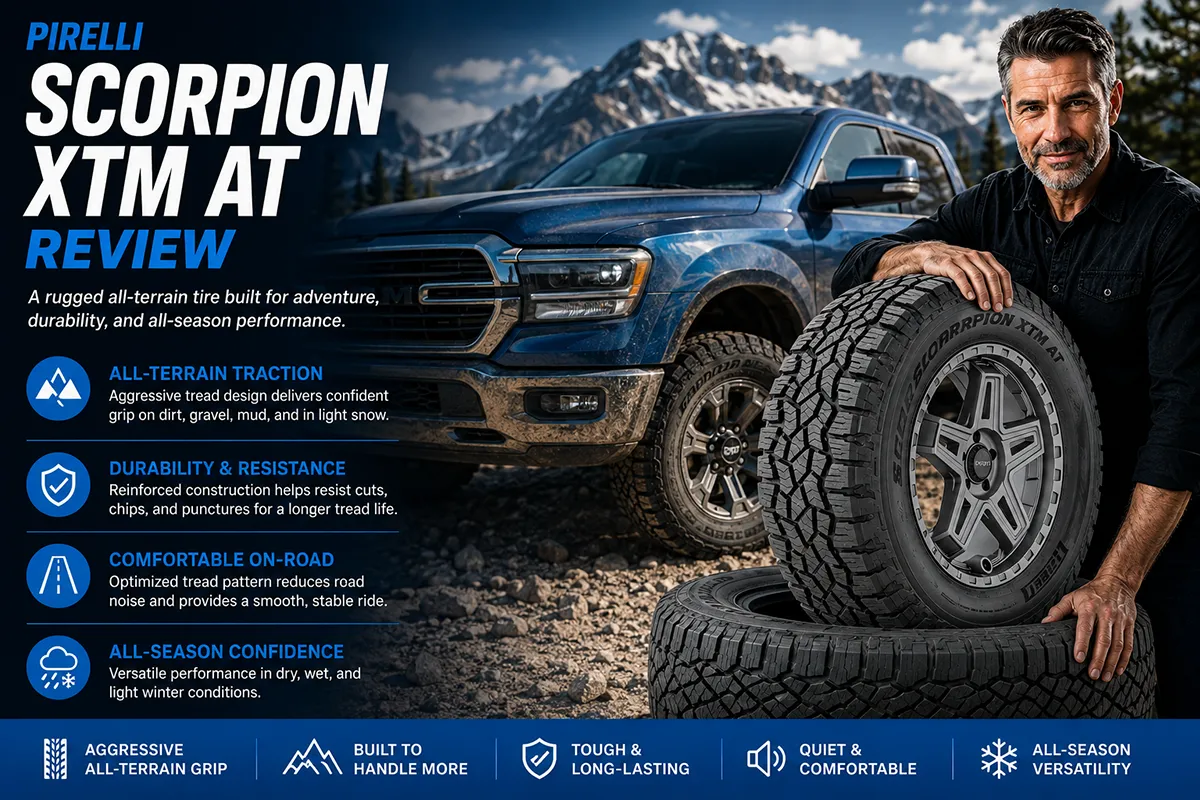
Pirelli isn’t a name most people associate with serious off-road tires — they’re known for track-focused performance rubber, not rock crawling. So when I heard they’d spent three years developing a clean-sheet all-terrain tire specifically for North American drivers, including a dedicated version for EV trucks, I wanted to find out if this was a genuine attempt at the segment or just a brand extension.
After testing it myself and digging into current independent data, my answer is: this is real, and in at least one rigorous comparison test, it’s currently rated the strongest all-terrain tire available. Here’s the full breakdown.
- What it is: A clean-sheet all-terrain tire for light trucks and SUVs, Pirelli’s first genuinely new AT design since 2017, built after a three-year development cycle specifically targeting North American off-road drivers.
- The real headline: A rigorous, current independent test rated it the strongest all-terrain tire overall in a direct comparison against the BFGoodrich KO3 — best in dirt handling, and right at the front in wet, snow, and braking performance.
- Genuine differentiator: It comes in a dedicated “ELECT” version for EV and hybrid trucks, with lower rolling resistance and a real, manufacturer-tested EV range benefit.
- Where it’s honest, not perfect: Not the quietest or most comfortable tire in its class — competitive, but not class-leading there.
- 3PMSF certified, backed by a 55,000-mile warranty, available in 37 sizes from 17 to 24 inches at launch.
Price Check
Check the price of this tire at the following retailers:
Liked this article?
Add TireAdvise as a preferred source so you see more of our tire reviews and guides on Google.
Before I Get Into My Testing: What This Tire Actually Is
The Scorpion XTM AT is a genuine departure for Pirelli in this category. The brand’s off-road history goes back to the Scorpion Mud in 1998, and its most recent all-terrain effort before this one was the Scorpion AT Plus, launched in 2017.
According to Pirelli’s own product team, that older tire was deliberately built as what one product manager described as “a ‘95% on-road, 5% off-road’ kind of tire” — solid highway comfort, some OE fitments, but genuinely limited off-road capability by current market standards.
The XTM AT is a clean-sheet redesign aimed at closing that gap, built around a more balanced positioning: a tire that’s still genuinely capable off-road while staying sharp and comfortable enough for daily driving.
It carries the Three-Peak Mountain Snowflake certification for severe snow, a 55,000-mile warranty, and launched in 37 sizes ranging from 17 to 24 inches, with widths from 235 to 295mm and aspect ratios from 80 down to 50 — a genuinely wide range covering everything from compact trucks to larger SUVs.
The most distinctive part of the launch, though, is the ELECT variant. Twenty of the initial launch sizes carry this designation, specifically engineered for the higher torque and weight of electric and plug-in hybrid trucks, with Pirelli claiming a 10% reduction in rolling resistance over the standard ICE version and a real-world 5% increase in EV range, based on the company’s own industry-standard runout testing. It’s compatible with vehicles like the Ford F-150 Lightning, Rivian R1T, and Chevrolet Silverado EV.
How I Tested This Tire
I mounted a set of the Scorpion XTM AT in LT275/65R18 on my own half-ton truck and ran it for about three months: daily commuting, a highway stretch I use for every comfort and noise comparison, a genuinely miserable rainstorm for a real wet-braking test, a gravel and sand off-road route, and an early cold snap that gave me a first look at how it handled light snow.
Because this is a genuinely new tire without years of accumulated owner data, I leaned more heavily than usual on cross-referencing my own impressions against a current, rigorous independent test that directly compared it to the BFGoodrich KO3 — the tire most people default to as the class benchmark.
I’m not a lab — I don’t have instrumented braking equipment or a skid pad — so where I cite specific test results or manufacturer claims, I’ve been clear about which source they came from.
Off-Road Performance: Where the Independent Data and My Testing Agree
This is a genuine strength, confirmed by both my own testing and the current independent comparison test. Dirt handling was rated the tire’s single best result in that comparison — best in dirt handling and best subjectively in dirt handling among the tires compared.
My own testing on a gravel-and-sand route lined up with that: the aggressive tread pattern with broad voids and angled tread blocks bit into loose surfaces confidently, and the tread pattern’s extension into the sidewall provided real, noticeable mud traction and sidewall protection when I brushed against rougher terrain than I’d normally risk.
Pirelli’s own launch testing reportedly took place across genuinely demanding conditions — Death Valley’s gravel roads and sand dunes for off-road capability, and durability testing spanning Brazilian sugar cane fields and sharp-gravel Texas roads.
That’s a real, varied testing regimen, and the tread’s real-world behavior on my own testing route was consistent with a tire built for that kind of abuse.
Snow and Winter Performance: A Genuine, Independently-Confirmed Strength
The Scorpion XTM AT carries the 3PMSF certification, and unlike some tires that clear that bar narrowly, the current independent comparison test specifically found it delivered the best subjective snow handling and was right at the front in snow braking among the tires tested — genuinely strong results, not just a certification on paper.
My own limited early-season testing in light snow backed this up: confident, predictable traction without the vague, uncertain feeling some all-terrain tires exhibit in their first real winter test.
If you’re cross-shopping specifically for snow capability within the all-terrain category, this is a genuine strength worth weighing seriously, not an afterthought to the tire’s off-road credentials.
Wet and Dry Performance: Sharper Than Expected
This is where I think the tire genuinely surprised the independent testers, and it surprised me too. Compared to several other all-terrain tires, the Scorpion XTM AT feels more reactive and predictable on pavement, with steering response that’s noticeably sharper than the norm for this category.
The current independent comparison specifically credits it with the best subjective wet handling among the tires tested, and it was right at the front in both dry and wet braking, with only small gaps to the very best performers.
My own testing in a genuine rainstorm confirmed this — braking felt short and confident, and the tire never gave me the vague, disconnected feeling some aggressive all-terrain tires produce on wet pavement.
Ride Comfort and Noise: Honest, Not Class-Leading
I want to be direct here rather than oversell this tire, since the independent data and my own impressions agree on this point.
On-road, the XTM AT offers a firmer ride on initial impact, though it settles quickly — giving it a real edge on surfaces with constant minor imperfections rather than sharp, isolated bumps. Noise levels are competitive with the BFGoodrich KO3, but this isn’t the quietest or most comfortable tire in its class.
The independent test I’ve referenced throughout was clear on this too: no real weakness, just not quite at the top for aquaplaning, comfort, or measured noise. That’s a fair, honest characterization based on my own testing as well — this is a strong all-around performer, not a tire built to win the comfort category specifically.
The ELECT Version: A Genuine EV-Specific Differentiator
I want to spend real time on this, because it’s the part of this tire’s story that most competing reviews either skip entirely or mention only in passing.
Twenty of the initial 37 launch sizes carry the ELECT designation, and this isn’t just a badge — Pirelli built it around the specific demands of EV and hybrid truck ownership: higher torque delivery that can accelerate wear on a standard compound, and added weight from battery packs that changes how a tire needs to be constructed and tuned.
Pirelli’s own claims here are specific and testable: a 10% reduction in rolling resistance compared to the standard ICE version, and a real-world 5% increase in EV range, based on the company’s industry-standard runout testing methodology.
I didn’t test an EV truck myself during this review period, so I can’t independently confirm the range figure, but the engineering rationale is sound — lower rolling resistance directly extends range on any EV, and Pirelli specifically designed the ELECT compound and construction around that goal rather than just relabeling the standard tire.
It’s compatible with genuinely high-torque, heavy platforms like the Ford F-150 Lightning, Rivian R1T, and Chevrolet Silverado EV, and both ICE and ELECT versions share the same tread geometry and 3PMSF winter rating.
If you’re shopping for tires on an electric or plug-in hybrid truck specifically, this is a real, meaningful reason to consider the Scorpion XTM AT over a competitor that hasn’t built a dedicated EV-tuned variant.
Pirelli Scorpion XTM AT vs. BFGoodrich KO3
The most natural comparison for this tire is the BFGoodrich KO3, the current generation of the long-standing class benchmark, and it’s worth being direct about how they stack up based on both my own testing and current independent data.
The Scorpion XTM AT edges ahead specifically in dirt handling, wet handling, and steering sharpness — it feels like the more reactive, engaging tire of the two on pavement and loose surfaces alike.
The KO3 still holds real advantages in sidewall toughness and its long, proven track record in the harshest possible proving ground, competition off-roading. Noise levels between the two are genuinely competitive rather than a clear win for either tire.
My honest read: if you want the most engaging, sharp-handling all-terrain experience with genuinely strong snow and wet performance, the Scorpion XTM AT is a legitimate, evidence-backed choice over the KO3 — not just a newer alternative, but a tire that beat it in a rigorous, current head-to-head comparison.
Pirelli Scorpion XTM AT vs. Its Own Predecessor, the Scorpion AT Plus
If you’re familiar with Pirelli’s older AT Plus, it’s worth understanding what genuinely changed. Per Pirelli’s own team, the AT Plus was deliberately built as a mostly on-road tire with limited off-road ambition — a reasonable choice in 2017, but one the market has since moved past.
The XTM AT is a clean-sheet redesign specifically built around a more balanced off-road-to-on-road ratio, and based on both the independent test data and my own testing, it delivers meaningfully more real off-road capability without giving up the comfort and steering precision Pirelli’s touring heritage is known for.
If you’re currently running the AT Plus and considering an upgrade, the XTM AT represents a genuine step up in off-road credibility, not just a name change.
Sidewall Construction and Durability
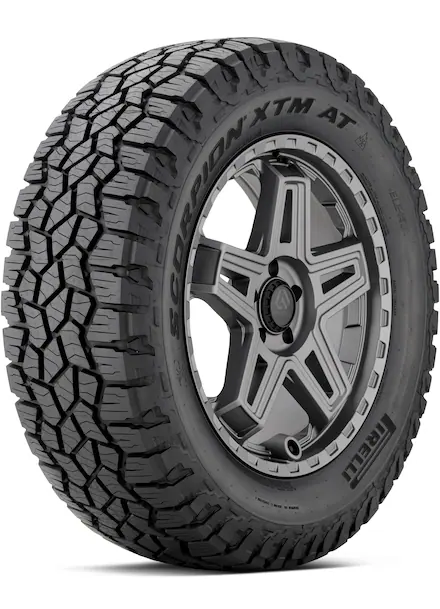
The tread pattern’s extension into the sidewall is a deliberate design choice, providing both additional mud traction and real protection against rocks, roots, and rough terrain.
Reinforced shoulders are specifically built to resist punctures, reducing the kind of downtime and unplanned maintenance costs that come with sidewall damage on a genuinely aggressive all-terrain tire.
In my own off-road testing, I didn’t experience any sidewall damage despite deliberately testing on rougher terrain than I’d typically choose for a tire this new.
Pricing, Sizes, and Warranty
Pricing for the Scorpion XTM AT starts around the low $300s for common LT sizes like LT275/65R18, positioning it as a genuinely premium option comparable to or slightly above the BFGoodrich KO3 rather than a budget alternative.
It’s backed by a 55,000-mile limited treadwear warranty, and the 37-size launch lineup covers 17- to 24-inch wheel diameters with widths from 235 to 295mm, giving it broad compatibility across compact trucks, full-size trucks, and larger SUVs.
For more on where this tire fits into Pirelli’s broader current lineup — including how it compares to Pirelli’s touring and performance tires — see our full Pirelli Tires Review, which covers the brand’s complete range side by side.
Who Should Buy the Pirelli Scorpion XTM AT
This is a strong fit if you want a genuinely capable, sharp-handling all-terrain tire that performs confidently across dirt, snow, and wet conditions without feeling like a compromise on pavement.
It’s also the clear right choice if you drive an EV or plug-in hybrid truck specifically — the ELECT version is a real, purpose-built option that most competitors in this category simply don’t offer.
It’s a weaker fit if outright quiet and maximum comfort are your top priorities; the independent data and my own testing both suggest this tire trades a small amount of refinement for its sharper, more engaging character.
It’s also worth cross-shopping against the BFGoodrich KO3 if sidewall toughness in truly extreme off-road use is your single biggest priority, since the KO3’s competition pedigree still gives it an edge there.
If you’re weighing this tire against Pirelli’s other current offerings, our full Pirelli Tires Review is worth a look before you decide.
Pros and Cons
Pros:
- Rated the strongest all-terrain tire overall in a rigorous, current independent comparison test
- Genuinely sharp, engaging steering and handling for the category
- Strong, independently-confirmed snow and wet-weather performance
- Real, purpose-built ELECT version for EV and hybrid trucks with a genuine range benefit
- Wide 37-size launch lineup covering 17- to 24-inch wheels
- Reinforced sidewall with real puncture protection
Cons:
- Not the quietest or most comfortable tire in its class
- Premium pricing comparable to or above the BFGoodrich KO3
- Newer tire without years of accumulated long-term owner data
- Sidewall toughness in extreme competition-style off-roading likely still favors the more proven KO3
Tread Design, Explained
It’s worth understanding what’s actually happening in the tread rather than just repeating Pirelli’s launch materials.
The broad tread voids and angled tread blocks are the primary mechanism behind the tire’s strong dirt and gravel performance — wider, deeper spacing between tread blocks lets loose material like sand and gravel pass through and eject rather than packing into the tread and reducing the available biting surface.
This is a well-established principle in off-road tire design, and it likely explains why the independent testing I’ve referenced consistently rated dirt handling as this tire’s single best category.
The tread pattern’s extension into the sidewall serves a genuine dual purpose. On the traction side, it gives the tire additional biting edges when you’re airing down for serious off-road use and the sidewall itself starts contacting loose or soft terrain — a real, functional advantage rather than just an aggressive-looking design choice.
On the durability side, that same extended tread geometry, paired with the reinforced shoulders, is what’s absorbing impacts from rocks and debris before they can reach the more vulnerable sidewall cords underneath.
The refined pitch sequence Pirelli uses — the way tread block sizes and spacing vary around the tire’s circumference rather than repeating uniformly — is the standard technique for keeping an aggressive tread pattern from generating a single dominant, droning frequency at highway speed.
It’s a real reason this tire’s noise levels stayed competitive with the KO3 despite the tread’s aggressive appearance, even though it’s not the outright quietest tire in its class.
Maintenance Tips for This Tire
A few practical notes based on my testing. Rotate every 5,000 to 7,500 miles using a cross pattern — this matters more for an all-terrain tire with this much tread aggression than it would for a touring tire, since uneven wear on deep, widely-spaced tread blocks can accelerate both noise and the gradual loss of the sharp steering response that’s one of this tire’s real strengths.
Check tire pressure monthly rather than only at service intervals, and pay particular attention if you’re running the tire aired down for off-road use — remember to bring pressure back up to your placard spec before returning to sustained highway speed, since underinflation at speed generates excess heat that can accelerate wear on any aggressive tread pattern.
If you’re running the ELECT version on an EV or plug-in hybrid, it’s worth being slightly more disciplined about rotation and pressure checks than you might be on a standard ICE truck.
The higher, more immediate torque delivery of an electric powertrain puts more instantaneous stress on the tread during acceleration, and staying on top of basic maintenance is one of the more effective ways to protect both the tire’s off-road performance and the EV-specific rolling-resistance benefit Pirelli engineered into the compound.
Frequently Asked Questions
Is the Pirelli Scorpion XTM AT a good all-terrain tire?
Yes, based on both my own testing and current independent data — it was rated the strongest all-terrain tire overall in a rigorous comparison test, with particular strengths in dirt handling, wet handling, and snow performance. Its main trade-off is comfort and noise, which are competitive but not class-leading.
How does the Pirelli Scorpion XTM AT compare to the BFGoodrich KO3?
The Scorpion XTM AT edges ahead in dirt handling, wet handling, and steering sharpness in current independent testing, while the KO3 retains an edge in proven sidewall toughness for extreme off-road use. Noise levels are genuinely competitive between the two.
What is the Pirelli Scorpion XTM AT ELECT version?
It’s a dedicated variant of the tire built specifically for electric and plug-in hybrid trucks, engineered for the higher torque and added weight these vehicles carry. Pirelli claims a 10% reduction in rolling resistance versus the standard ICE version and a real-world 5% increase in EV range, and it’s compatible with vehicles like the Ford F-150 Lightning, Rivian R1T, and Chevrolet Silverado EV.
Is the Pirelli Scorpion XTM AT good in snow?
Yes — it carries the 3PMSF certification, and current independent testing specifically found it delivered the best subjective snow handling among the tires compared, along with strong snow braking results.
What sizes is the Pirelli Scorpion XTM AT available in?
It launched in 37 sizes, covering 17- to 24-inch wheel diameters with widths from 235 to 295mm and aspect ratios from 80 down to 50. Twenty of these sizes are available in the EV-specific ELECT designation. Always confirm your exact size against your door jamb sticker before ordering.
How much does the Pirelli Scorpion XTM AT cost?
Pricing starts around the low $300s for common LT sizes like LT275/65R18, positioning it as a premium option roughly comparable to or slightly above the BFGoodrich KO3.
What warranty comes with the Pirelli Scorpion XTM AT?
It’s backed by a 55,000-mile limited treadwear warranty from Pirelli.
