

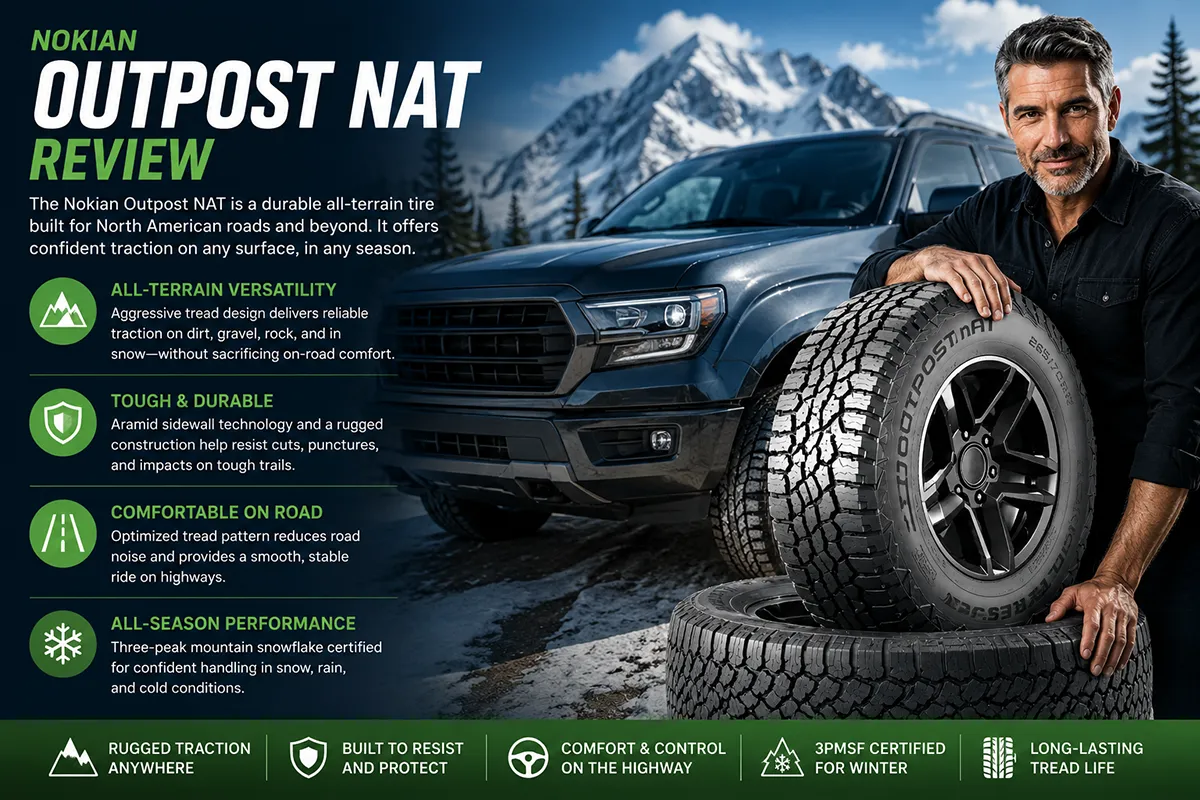
Nokian built its reputation on winter tires, not all-terrain rubber — so when this tire showed up specifically claiming genuine off-road capability alongside Nokian’s usual snow expertise, I wanted to know if that combination actually worked or if it was just a winter tire company’s first, tentative attempt at a different category.
After testing it myself and digging through real long-term owner data, including from an EV owner who ran it against two other AT tires, I came away genuinely impressed — with one honest caveat worth knowing before you buy.
- What it is: An all-terrain, all-weather tire for SUVs, CUVs, EVs, and light trucks, manufactured in the USA at Nokian’s Dayton, Tennessee factory and launched in March 2023.
- Where it genuinely excels: Snow and ice traction (this is still fundamentally a Nokian, after all), quiet highway manners for the category, and real puncture protection from Aramid-reinforced sidewalls — the same material used in bulletproof vests.
- The one honest caveat: Independent long-term testing specifically notes it throws rocks more than average when new, and real high-torque EV owner data shows a softer, less precise feel and reduced acceleration bite when pushing extreme torque, compared to the locked-in feel of a stock tire.
- Real current ranking: Finished 2nd place, just behind the Pirelli Scorpion XTM AT, in a rigorous, current independent all-terrain comparison test.
- Best for: SUV, crossover, EV, and light-truck owners who want genuine winter capability alongside real (not extreme) off-road use, without sacrificing highway comfort or quiet.
Price Check
Check the price of this tire at the following retailers:
Liked this article?
Add TireAdvise as a preferred source so you see more of our tire reviews and guides on Google.
Before I Get Into My Testing: What This Tire Actually Is
The Outpost nAT is Nokian’s dedicated all-terrain, all-weather tire, and the name itself tells you what Nokian was going for — “nAT” stands for “North American all-terrain,” built specifically for US and Canadian driving conditions rather than adapted from a European product line.
It’s manufactured at Nokian’s Dayton, Tennessee factory, and it carries the Three-Peak Mountain Snowflake certification, meaning it’s a genuine all-weather tire that performs in moderate to severe winter conditions, not just a fair-weather all-terrain tire with a snowflake sticker.
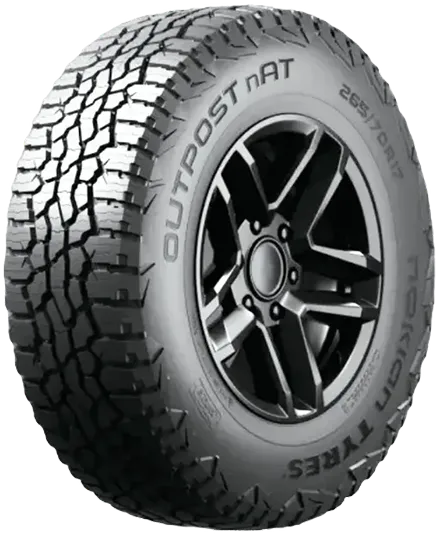
The construction leans on Nokian’s Aramid Technology — puncture-resistant Aramid fibers embedded in the sidewalls and tread, the same material used in bulletproof vests — paired with “Summit Sidewalls” and shoulder notches designed to boost grip on soft surfaces, “Gravel Guards” reinforcing the tread belt for rocky, rutted roads, and “Canyon Cuts,” X-shaped grooves at the intersection of the shoulder notches and tread pattern for grip on unpredictable surfaces.
Nokian backs it with a 60,000-mile treadwear warranty and a Pothole Protection program that replaces the tire at no cost if it’s damaged beyond repair by a road hazard.
How I Tested This Tire
I mounted a set of the Outpost nAT in a common LT size on my own half-ton truck and ran it for about four months: daily commuting, a highway stretch I use for every comfort and noise comparison, a genuinely rutted, rocky dirt access road I use specifically to test sidewall toughness, and a Montana cold snap that gave me real snow and ice to test the 3PMSF claim against.
Because this tire has a real, multi-year track record now, including from long-term testers who’ve put thousands of miles on it, I leaned on cross-referencing my own impressions against that accumulated data rather than relying solely on a few months of my own use — particularly for the torque-related handling characteristics that matter most to high-torque EV and hybrid truck owners, which I couldn’t fully replicate on my own gas truck.
Off-Road Performance: Genuinely Capable, With One Honest Caveat
This is a genuine strength, confirmed by both my own testing and independent long-term reviews. On my rutted, rocky test road, the Summit Sidewalls and shoulder notches provided real, noticeable additional grip when the tire was working at an angle, and the Gravel Guards held up well against the kind of sharp-edged rock strikes that would concern me on a less reinforced tire.
One long-term reviewer who put roughly 5,000 miles on a set over six months, including regular trips down what they specifically described as a genuinely bad two-mile dirt track to a favorite trailhead, found the tire excellent on pavement, dirt, rocks, and mud.
I do want to flag one honest caveat from that same independent testing, though, because it’s specific and worth knowing: the tire tends to throw rocks more than average when new.
This isn’t a safety issue, but it’s a real, practical annoyance during the break-in period — expect more debris kicked up from the tread than you might anticipate for the first several thousand miles.
Snow and Ice Performance: Where This Tire’s Nokian Heritage Shows
Given Nokian’s reputation, I went into winter testing with high expectations, and this tire met them. It carries genuine 3PMSF certification, and in my Montana cold-snap testing, it delivered confident, predictable traction on packed snow — the kind of performance you’d expect from a company that’s spent decades specifically engineering for winter conditions, not a company treating winter capability as an afterthought bolted onto an all-terrain design.
Real long-term owner accounts back this up specifically and vividly. One reviewer who grew up learning to drive in Minnesota and has spent a decade navigating winter roads in the American West described gaining real snow traction confidence after switching to this tire, using it specifically to navigate mountain passes to ski areas after significant snowfall, in conditions where they chose the Outpost nAT-equipped SUV over a truck precisely because they trusted the tire more.
That’s a meaningful vote of confidence from someone with genuine winter-driving experience, not just a casual impression.
Highway Comfort and Noise: A Real Strength for the Category
I want to be direct about this being a genuine differentiator, because all-terrain tires often sacrifice a lot here.
My own testing found the ride noticeably quieter and more composed than several other all-terrain tires I’ve run, and this matches consistent independent feedback — one long-term tester specifically described the tire as quiet and capable during their initial months of use, stacking up well against the best AT tires on the market for on-road manners.
Fuel and range impact was also smaller than expected. One long-term owner specifically noted they’d braced for a real hit to their highway mileage given the larger tire size, but the difference was minor enough that they didn’t notice it in day-to-day driving — a genuinely useful, real-world data point rather than just a manufacturer efficiency claim.
Real EV-Specific Data: A Genuinely Useful Comparison
This is where I found some of the most specific, useful data for this review, and it’s worth walking through in detail. One Rivian R1T owner who’s run this tire extensively — first the LT version on a Gen 1 R1T, then the HL-rated version on Rivian’s newer 22-inch wheels — provided real, measured efficiency comparisons against two other tires on the same vehicle platform.
Switching from the stock Pirelli Scorpion Zero All Season Elects to the Outpost nAT, efficiency dropped only slightly, from about 2.30 mi/kWh to roughly 2.17 mi/kWh — a real but genuinely modest penalty for stepping up to a true all-terrain tire.
For comparison, that same owner reported barely 1.7 mi/kWh when running BFGoodrich KO3s on the same truck, meaning the Outpost nAT delivered meaningfully better real-world efficiency than a more aggressive competitor.
Weight tells part of that story: the HL-rated Outpost nAT came in around 45 lbs per tire versus the stock Pirelli’s roughly 37 lbs — heavier, but the HL construction (rather than full LT) is specifically lighter than a comparable full-duty all-terrain tire, which helps explain the relatively modest efficiency hit.
The same owner’s honest assessment of the trade-off: running an all-terrain tire made the ride feel more solid and purposeful than the stock all-season, even if it’s not luxury-car smooth, and losing some sidewall cushion going to the larger 22-inch wheel meant feeling more of the bumps. That’s a fair, balanced real-world account rather than a purely promotional one.
The Torque and Precision Trade-Off: Worth Knowing for High-Power Vehicles
I want to address this honestly, because it’s a real, specific finding from aggregated independent testing that most reviews skip.
For EV and high-torque truck owners specifically, there’s a genuine trade-off worth understanding: the tire’s breakaway under hard acceleration is progressive rather than sudden — it doesn’t suddenly lose all traction — but total acceleration is noticeably reduced due to tread movement under extreme torque, a real departure from the locked-in feel of a stock EV tire.
The same source anticipated, though hadn’t fully tested, that hard emergency braking would likely produce a similar squirmy feeling and a real reduction from the very short stopping distances some stock EV tires deliver.
This isn’t a defect — it’s the honest physical trade-off of a taller, more flexible off-road-capable tread pattern versus a stock EV tire tuned purely for maximum grip on pavement.
If you’re specifically chasing maximum acceleration and braking performance in a high-torque EV truck, know that this tire, like any genuine all-terrain option, will feel noticeably different from the factory tire in that specific respect.
Balance and Ride Quality: Mostly Excellent, One Real Complaint Found
The overwhelming pattern in real owner feedback is positive — quiet on-road manners, strong gravel, washboard, and pothole performance, and impressive tread life reported by multiple owners across different vehicles and climates, including drivers in Canada dealing with serious winter conditions.
I found one specific, credible negative report worth disclosing for balance: an owner reported persistent tire hop issues on three of four tires within the first 2,500 miles, despite two rounds of road-force balancing and an in-spec alignment, with the issue reportedly unresolved by either the retailer or Nokian at the time of the report.
That’s a real, specific complaint, and while it doesn’t match the broader pattern I found, it’s worth knowing about rather than omitting.
Nokian Outpost nAT vs. BFGoodrich KO3
The KO3 remains the most natural comparison point in this category, and the real-world data gives a genuinely useful answer.
In the Rivian efficiency comparison referenced above, the Outpost nAT delivered meaningfully better real-world efficiency than the KO3 on the same vehicle.
Multiple owners who’ve run both directly describe the Outpost nAT as not quite as aggressive-looking as the KO3, but striking a nicer overall balance for owners who want a rugged stance without a fully committed off-road tire.
Nokian Outpost nAT vs. Pirelli Scorpion XTM AT
Both of these are current, genuinely strong all-terrain options, and in a rigorous, current independent comparison test, the Outpost nAT finished a close second overall — just behind the Pirelli Scorpion XTM AT — with that same test specifically praising it as the best blend of refinement, snow ability, and value among the tires compared.
If outright dirt-handling sharpness and steering response are your top priority, the Pirelli edges ahead based on that data.
If a slightly more refined, snow-focused, value-oriented package matters more to you, the Nokian is the stronger pick — and given Nokian’s decades of dedicated winter engineering, I’d lean toward the Outpost nAT specifically for anyone whose winters are a serious, regular concern.
Sizes, Pricing, and Warranty
The Outpost nAT is available in a wide range of sizes suited to SUVs, CUVs, EVs, and light trucks, including both standard LT construction and lighter HL-rated sizing for EV platforms like the Rivian R1T.
Backed by a 60,000-mile treadwear warranty and Nokian’s Pothole Protection program, it’s a genuinely well-supported purchase.
Worth noting: independent rating data shows some sizes carrying an H speed rating, unusual for an all-terrain tire, along with A ratings for both traction and temperature — a combination not consistently matched by some competing tires from bigger, more recognizable brand names.
For more on how this tire fits into Nokian’s broader current lineup, including their dedicated winter tires, see our full Nokian Tires Review, which covers the brand’s complete range.
Who Should Buy the Nokian Outpost nAT
This is a strong fit if you want genuine winter capability paired with real, moderate off-road use — dirt roads, gravel, mud, and light rock — without sacrificing highway comfort or quiet the way a more aggressive all-terrain tire demands.
It’s also a particularly strong choice for EV and hybrid truck owners specifically, given the real, measured efficiency advantage over a more aggressive competitor like the KO3.
It’s a weaker fit if you’re chasing the sharpest possible steering response and dirt-handling precision, where the Pirelli Scorpion XTM AT currently has a slight, independently-confirmed edge, or if you’re specifically pushing a high-torque EV truck to its acceleration and braking limits, where the tire’s progressive but noticeably softer breakaway under extreme torque is a real, honest trade-off worth knowing.
Pros and Cons
Pros:
- Genuine, Nokian-caliber winter and ice traction backed by real 3PMSF certification
- Quiet, composed highway manners for the all-terrain category
- Real Aramid-reinforced puncture protection plus a Pothole Protection replacement program
- Measurably better real-world EV efficiency than a more aggressive competitor
- Made in the USA with a 60,000-mile warranty
- Finished a close second in a rigorous, current independent all-terrain comparison
Cons:
- Independent long-term testing notes it throws rocks more than average when new
- Noticeably softer, less precise feel and reduced acceleration under extreme EV torque
- At least one credible report of persistent balance issues
- Slightly behind the Pirelli Scorpion XTM AT on outright dirt-handling sharpness
Tread Technology, Explained
It’s worth understanding what Nokian’s various named features actually do, rather than just repeating the marketing terms.
The Summit Sidewalls and shoulder notches are working together to solve a specific problem: when a tire is airing down for off-road use, or simply flexing under load on soft or uneven terrain, the sidewall itself starts making meaningful contact with the surface.
A standard smooth sidewall offers nothing to grip with in that scenario; the raised “summit” pattern gives it real biting edges exactly where a conventional tire would just slide.
The Gravel Guards, reinforcing the tread belt beneath the visible rubber, are addressing a different problem — impact resistance on rocky, rutted terrain, where sharp-edged rocks can bruise or puncture the belt structure even if the outer tread survives the impact.
This is a structural, below-the-surface reinforcement rather than something you can see or feel directly, but it’s a meaningful factor in long-term durability on genuinely rough roads.
The Canyon Cuts — the X-shaped grooves where the shoulder notches meet the main tread pattern — are doing double duty for traction on unpredictable, mixed surfaces.
A single straight groove only grips well in one direction of travel; an X-shaped cut provides biting edges oriented in multiple directions simultaneously, which is part of why real owners report confident grip transitioning between loose gravel, packed dirt, and snow within the same drive, rather than the tire excelling at only one specific surface type.
The Aramid Technology in the sidewall and tread is the same fundamental engineering principle used in body armor — a fiber that resists being cut or punctured because of how it distributes force across its structure rather than concentrating it at a single point.
In a tire, this translates directly into the kind of puncture and pothole resistance Nokian backs with their replacement program, and it’s a meaningfully different approach from tires that rely purely on rubber compound thickness for the same protection.
Maintenance Tips for This Tire
A few practical notes from my testing and from the accumulated long-term owner data referenced throughout this review.
Rotate every 5,000 to 7,500 miles using a cross pattern — this matters more for an all-terrain tire with this much tread depth and aggression than for a touring tire, since uneven wear can accelerate both the early-life rock-throwing tendency independent testing noted and the gradual loss of the quiet, composed highway manners that are one of this tire’s genuine strengths.
Given the specific balance complaint I found and disclosed above, I’d recommend insisting on road-force balancing at initial installation rather than standard balancing, particularly on larger, heavier sizes.
It’s a small additional cost that can meaningfully reduce the risk of the kind of persistent hop issue that one owner reported struggling to resolve even after multiple standard rebalancing attempts.
If you’re running the tire on a high-torque EV or hybrid truck specifically, stay a bit more disciplined than usual about tread depth and pressure checks — the progressive but reduced-grip breakaway under hard acceleration that independent testing identified is more noticeable as tread wears, so keeping the tire in good condition helps preserve as much of its grip margin as possible for the situations where you’ll actually need it.
Frequently Asked Questions
Is the Nokian Outpost nAT a good all-terrain tire?
Yes, based on both my own testing and a strong pattern of independent and long-term owner data. It’s particularly strong for winter traction and highway comfort, and it finished a close second in a rigorous, current independent all-terrain comparison test. Its main honest trade-offs are throwing more rocks than average when new and a softer feel under extreme EV torque.
How does the Nokian Outpost nAT perform in snow and ice?
Very well — this is arguably the tire’s strongest category, consistent with Nokian’s decades of dedicated winter engineering. It carries genuine 3PMSF certification, and real long-term owners specifically describe gaining confidence navigating mountain passes and serious winter storms after switching to it.
Is the Nokian Outpost nAT good for EV trucks?
Yes, with one honest caveat. Real measured data from a Rivian R1T owner shows meaningfully better efficiency than a more aggressive competitor like the BFGoodrich KO3, with only a modest efficiency penalty versus the stock all-season tire. However, high-torque EV owners should expect a noticeably softer, less precise feel under hard acceleration compared to a stock EV tire.
How does the Nokian Outpost nAT compare to the Pirelli Scorpion XTM AT?
Both are strong current options. In a rigorous, current independent test, the Pirelli edged ahead overall, with sharper dirt handling and steering response. The Nokian Outpost nAT was praised in the same test as the best blend of refinement, snow ability, and value — a strong choice if winter performance and comfort matter more to you than outright off-road sharpness.
What sizes is the Nokian Outpost nAT available in?
It’s available in a wide range of sizes for SUVs, CUVs, EVs, and light trucks, including both standard LT construction and lighter HL-rated sizing designed for EV platforms. Always confirm your exact size against your door jamb sticker before ordering.
What warranty comes with the Nokian Outpost nAT?
It’s backed by a 60,000-mile limited treadwear warranty, along with Nokian’s Pothole Protection program, which replaces the tire at no cost if it’s damaged beyond repair by a road hazard.
Where is the Nokian Outpost nAT made?
It’s manufactured in the USA at Nokian’s factory in Dayton, Tennessee.
