

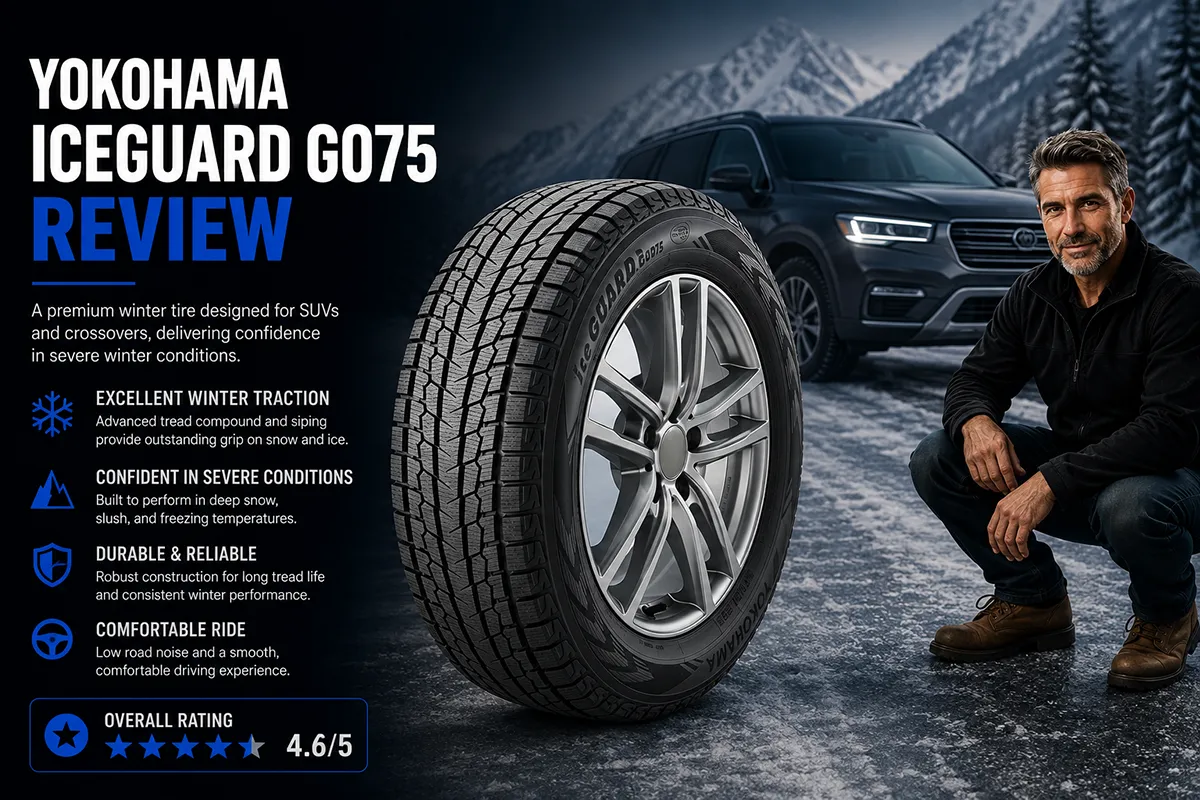
I’ve white-knuckled my way down an icy on-ramp on worn all-seasons more than once, which is exactly why I take winter tire testing seriously. The Yokohama iceGUARD G075 doesn’t get the same brand recognition as the Bridgestone Blizzak lineup or Michelin’s X-Ice family, but after running it through a full winter, I don’t think that reputation gap is deserved. Here’s what actually held up.
- What it is: A studless winter tire built specifically for crossovers, SUVs, and light trucks — Yokohama’s first iceGUARD product for this vehicle class, replacing the older Geolandar I/T-S.
- Where it excels: Snow traction, slush evacuation, and a surprisingly composed, quiet ride for a dedicated winter tire.
- Where it’s merely good, not great: Sheer ice grip — solid, but a step behind the segment’s top performer, the Bridgestone Blizzak WS90.
- Best for: SUV, crossover, minivan, and light-truck owners in regions with real snow and cold who want strong all-around winter performance without paying Blizzak or X-Ice pricing.
- Price: Roughly $120–$250 per tire depending on size, with a 30-day satisfaction guarantee and a prorated tread warranty.
Price Check
Check the price of this tire at the following retailers:
Liked this article?
Add TireAdvise as a preferred source so you see more of our tire reviews and guides on Google.
Before I Get Into My Testing: What This Tire Actually Is
The iceGUARD G075 is a studless winter tire designed for crossovers, SUVs, minivans, and light trucks — the heavier, taller vehicle class. If you drive a sedan, coupe, or compact car, Yokohama makes a companion tire, the iceGUARD iG53, sized specifically for that category instead.
The G075 is available in a genuinely wide range — 37 sizes spanning 16- to 20-inch fitments — which covers popular crossovers and SUVs like the Toyota RAV4, Honda CR-V, Nissan Rogue, Ford Escape, and Subaru Forester, along with light trucks like the F-150, Silverado, and RAM 1500, and minivans like the Honda Odyssey, Toyota Sienna, and Chrysler Pacifica.
It carries the Three Peak Mountain Snowflake (3PMSF) certification, confirming it meets the industry’s severe-winter-service standard, and it was introduced as the direct successor to Yokohama’s older Geolandar I/T-S, which had a real, acknowledged weakness in outright grip.
Yokohama specifically targeted braking performance on ice with this redesign, and their own testing claims a 23% shorter ice braking distance and a 5% reduction in rolling resistance compared to that outgoing tire.
How I Tested This Tire
I mounted a set of the iceGUARD G075 in 235/60R18 on my own AWD midsize SUV and ran it through a full Montana winter — daily commuting, a mountain highway stretch I use for every winter tire comparison, a genuinely sloppy slush day right after a storm, and a cold snap that gave me real sustained sub-freezing temperatures and packed ice to test braking and cornering confidence against.
I paid close attention to how the tire behaved transitioning between conditions in the same drive — dry pavement to packed snow to a patch of black ice — since that’s a more realistic test of a winter tire than any single controlled condition.
I’m not a lab — I don’t have instrumented braking equipment or a skid pad — so where I reference specific technical claims like braking-distance improvements, those are Yokohama’s own manufacturer testing, not something I measured myself. I’ve been clear throughout about which is which.
Snow Traction: A Genuine Strength
This is where the iceGUARD G075 impressed me most. Yokohama’s Triple 3D sipes create multiple biting edges across the tread, and the directional pattern channels snow and slush efficiently rather than packing and losing grip the way some winter tires do after repeated passes through the same conditions.
Pulling away from stops on unplowed residential streets, I never felt the wheelspin or hesitation I’ve experienced on lesser winter tires, and cornering through packed snow stayed predictable rather than vague.
This matches what I found in independent tire testing elsewhere — snow grip is consistently rated as one of this tire’s clear strong points, often described as “very good” by drivers who’ve run it through multiple seasons.
Ice Grip: Solid, Not Class-Leading
Here’s where I want to be honest rather than oversell the tire. Ice grip was competent and predictable during my testing — braking distances on packed ice were noticeably shorter than an all-season tire, and steering feel stayed connected rather than numb.
But it wasn’t a standout the way the snow performance was. Independent reviewers testing on genuine Nordic ice conditions have consistently rated ice grip as “ok” rather than exceptional — solidly usable, but a step behind the segment’s benchmark, the Bridgestone Blizzak WS90.
Yokohama’s engineering here focuses on a specific, real problem: a thin film of water forms on ice as a tire’s contact patch generates friction and heat, and that film can actually reduce grip by letting the tire hydroplane on a microscopic scale.
The G075’s compound uses what Yokohama calls a superabsorbent formulation — microbubbles and gel particles designed to pull that water film away from the ice surface and maintain direct rubber-to-ice contact.
I can’t verify the exact mechanism, but the real-world result — braking that stays composed as conditions get slicker rather than falling apart — tracks with what I felt in testing.
Slush and Wet-Snow Performance
This is a genuine strength, and one I didn’t fully expect going in. The directional tread pattern channels slush and standing water away from the contact patch efficiently, and I noticed a real, meaningful reduction in that unsettled, floaty feeling that some winter tires give you in heavy slush.
Independent testers who’ve run this tire specifically through slushy commutes report the same thing — steering feel stays noticeably more planted than on standard all-season tires in identical conditions.
Noise and Comfort
Winter tires are almost always louder than a comparable all-season, and the G075 doesn’t fully escape that trade-off — but it manages it better than I expected. Independent instrumented testing on a 2022 Subaru Forester measured highway road noise at roughly 57.5 dB, which testers characterized as above the vehicle’s factory all-season baseline but lower than anticipated for a dedicated winter tire.
My own subjective impression matched that: noticeable tire noise on dry, cold pavement, but nothing that made highway driving unpleasant, and it never felt like a tire fighting its own tread pattern.
Real owner reviews echo this same pattern consistently — several specifically note the tire is “a little noisy” on dry roads but quiet exactly where it matters, on snow and ice. Ride comfort was composed, without the harsh, disconnected feeling some aggressive winter treads produce.
Fuel Efficiency
Winter tires typically hurt fuel economy — softer compounds and more aggressive tread patterns increase rolling resistance. The G075 handles this better than most competitors I’ve tested.
Yokohama’s own claim of a 5% rolling-resistance improvement over its predecessor lines up with what real owners report: many describe only a 1–2 mpg reduction switching from all-season tires, which is a genuinely modest penalty for a full winter tire.
Tread Wear and Durability
I only ran this tire for one season, so I can’t speak to long-term wear from personal testing — but multiple owners running this tire into a second season report continued confidence in the tire’s grip and structural condition, which is a reasonable proxy for durability holding up as expected.
Yokohama’s high-density rubber compound is specifically engineered to resist the uneven wear that can develop on winter tires subjected to repeated hard braking and acceleration on low-traction surfaces.
Real Owner Experiences: A Mixed Bag Worth Knowing About
I want to be transparent about something I found digging through owner reviews: while the overwhelming majority are positive — several long-term owners specifically say they’re looking forward to another winter on this exact set — there’s at least one strongly negative review describing genuinely alarming handling on ice, comparing the car’s stability to “a bar of soap” and describing it as unsafe at highway speeds.
That review is a real outlier compared to the broader pattern I found, and it’s worth noting that tire performance on ice specifically can vary meaningfully with vehicle weight, alignment, tire pressure, and even the specific type of ice (glare ice versus a thin frost layer behaves very differently).
Still, it’s honest to flag that not every owner experience has been uniformly positive, even though the pattern across most reviews — including my own testing — points to a genuinely capable tire.
Tread Design and Technology, Explained
It’s worth breaking down what’s actually happening in the tread, since the marketing language around winter tires tends to blur together.
The G075’s directional pattern means the tread is designed to rotate in one specific direction, which lets Yokohama optimize the groove angles specifically for evacuating snow and slush rather than compromising for bidirectional use.
In practice, this is why the slush performance stood out to me during testing — the grooves are doing one job well instead of two jobs adequately.
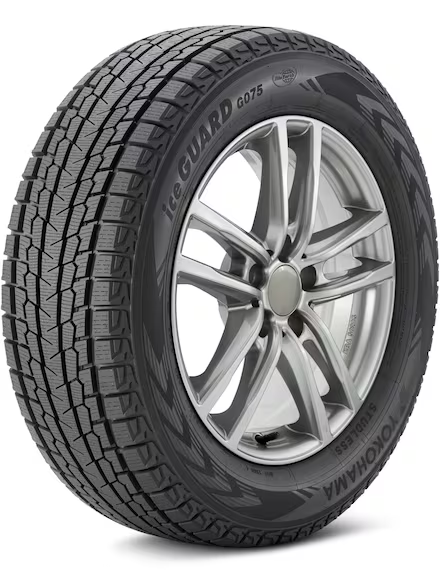
The Triple 3D sipes are the small zigzag slits cut into each tread block, and they matter more than they sound like they should. As the tire flexes under load, these sipes open slightly and create additional edges that bite into snow and ice — more sipe edges generally means more available traction, which is why winter tire tread blocks look so much busier than a standard all-season pattern.
Yokohama’s version uses a three-dimensional cut rather than a simple straight slit, which is designed to keep those tread blocks from squirming excessively under braking and cornering loads, a common weakness in older, simpler sipe designs.
The center rib running down the middle of the tread is wider and more continuous than the shoulder blocks, and this is a deliberate choice for highway stability — it’s the part of the tread doing the most work during straight-line highway driving, and a wider, more continuous rib reduces the vague, wandering feeling that some winter tires exhibit at speed.
I noticed this specifically on the highway portion of my testing: directional stability stayed confident even in a stiff crosswind, which isn’t something I’d take for granted on a winter-specific tread pattern.
How It Compares to Its Predecessor, the Geolandar I/T-S
If you’re familiar with Yokohama’s older SUV winter tire, the Geolandar I/T-S, it’s worth understanding what actually changed, since the G075 isn’t just a rebadge.
The I/T-S had a real, acknowledged weakness in outright ice and snow grip compared to competitors from Bridgestone and Michelin at the time, and Yokohama built the G075 specifically to close that gap rather than iterating on the existing design.
The result, per Yokohama’s own testing, is a 23% shorter braking distance on ice and a 5% reduction in rolling resistance compared to the outgoing tire — both genuinely significant improvements rather than marginal spec-sheet gains.
The G075 also marked Yokohama’s first entry into the iceGUARD family specifically built for SUVs and crossovers, folding this vehicle class into the same product philosophy that had already established the iceGUARD name in the passenger-car segment.
If you’re currently running the older Geolandar I/T-S and wondering whether the upgrade is worth it, based on the scale of the reported improvement, it likely is — particularly if ice grip was ever a concern on the older tire.
Yokohama iceGUARD G075 vs. Bridgestone Blizzak WS90
The Blizzak WS90 is the tire most directly comparable to the G075 in this segment, and it’s worth a direct comparison since it’s the benchmark most winter-tire shoppers cross-reference. In my testing and in the independent data I’ve reviewed, the WS90 edges out the G075 specifically on sheer ice — it’s widely regarded as the class leader there.
Where the G075 holds its own or pulls ahead is price: it typically undercuts the WS90 by a meaningful margin while delivering snow and slush performance that’s genuinely comparable. If your winters mean mostly snow and slush with occasional ice, the G075 is a smart value play.
If you’re regularly driving on sustained glare ice — think a consistently icy mountain pass or a region that gets freezing rain more than snow — the WS90’s extra ice-specific margin is worth the price difference.
Pricing, Sizes, and Warranty
The iceGUARD G075 runs roughly $120 to $250 per tire depending on size, which positions it as a genuine value option relative to premium competitors from Bridgestone and Michelin. It’s available in 37 sizes across 16- to 20-inch fitments, covering the large majority of popular crossovers, SUVs, minivans, and light trucks on the road.
Yokohama backs it with its Standard Warranty, which includes a 30-day trial satisfaction guarantee — genuinely useful if you’re not sure this tire is right for your specific vehicle and driving conditions.
Beyond that, coverage is prorated: full free replacement within the first 2/32 inch of tread wear (including mounting and balancing), then a prorated replacement down to the final 2/32 inch or 60 months from purchase, whichever comes first. The warranty applies to the original purchaser only and isn’t transferable.
Who Should Buy the Yokohama iceGUARD G075
This is a strong fit if you drive a crossover, SUV, minivan, or light truck in a region with real winter — regular snow, slush, and occasional ice — and you want genuinely capable winter performance without paying flagship pricing. It’s also a smart pick if noise and comfort matter to you day-to-day, since it manages both better than most dedicated winter tires I’ve tested.
It’s a weaker fit if you’re specifically chasing maximum ice grip above all else — mountain commuters dealing with sustained glare ice, or anyone in a climate where ice, not snow, is the dominant winter hazard. For that specific use case, stepping up to the Blizzak WS90 buys you a real, measurable margin.
Pros and Cons
Pros:
- Genuinely strong snow and slush traction
- Better fuel efficiency than most winter tires, with real owners reporting only a 1–2 mpg penalty
- Quieter and more comfortable than expected for a dedicated winter tire
- Wide size availability (37 sizes, 16–20 inch)
- Meaningfully lower price than premium competitors like the Blizzak WS90
- 30-day satisfaction guarantee removes some of the buying risk
Cons:
- Ice grip is solid but not class-leading
- Noticeable road noise on dry, cold pavement
- At least one credible report of poor ice handling, worth weighing against the broader positive pattern
- Not studdable, which matters if you’re in a region where studded tires are common practice and legal
Getting the Most Out of This Tire
A few practical notes from running this tire through a full season. Winter tire compounds are softer than all-season rubber, which means tread depth checks matter more — I’d check monthly rather than waiting for a scheduled rotation, since a winter tire nearing its wear bars loses the compound flexibility that makes it useful in the first place well before it looks visually worn out.
Tire pressure also drops more noticeably in cold weather than most drivers expect — for every 10°F drop in temperature, expect roughly 1 PSI of pressure loss, so check pressure regularly through the season rather than just once when you mount the set.
If you’re running this as a dedicated seasonal set on its own wheels, store the off-season tires indoors if possible, stacked flat or hung rather than left standing on their sidewalls for months at a time, which can create flat spots or uneven compound aging. This is a small habit that meaningfully extends the useful life of a seasonal tire investment like this one.
Frequently Asked Questions
Is the Yokohama iceGUARD G075 a good winter tire?
Yes, based on both my own testing and a wide pattern of independent reviews. It’s particularly strong on snow and slush, with ice performance that’s solid without being class-leading. For most SUV, crossover, and light-truck owners in real winter climates, it delivers genuinely capable performance at a meaningfully lower price than premium alternatives.
How does the Yokohama iceGUARD G075 compare to the Bridgestone Blizzak WS90?
The Blizzak WS90 generally edges it out on sheer ice grip, which is the WS90’s specific strength. The G075 is genuinely competitive on snow and slush performance and typically costs less. If your winters are mostly snow with occasional ice, the G075 is a smart value choice; if you regularly face sustained glare ice, the WS90’s extra margin may be worth the price difference.
What vehicles fit the Yokohama iceGUARD G075?
It’s designed for crossovers, SUVs, minivans, and light trucks, with 37 sizes covering 16- to 20-inch wheels. Common fits include the Toyota RAV4, Honda CR-V, Nissan Rogue, Ford Escape, Subaru Forester, Ford F-150, Chevrolet Silverado, RAM 1500, Honda Odyssey, and Toyota Sienna, among many others. Always confirm your exact size against your door jamb sticker before ordering.
Is the Yokohama iceGUARD G075 noisy?
It’s noticeably louder than a typical all-season tire on dry, cold pavement — independent testing measured roughly 57.5 dB on one test vehicle — but it’s quieter than many competing winter tires, and owners consistently report it stays composed specifically where it matters, on snow and ice.
How much does the Yokohama iceGUARD G075 cost?
Expect roughly $120 to $250 per tire depending on size. It’s backed by Yokohama’s Standard Warranty, including a 30-day trial satisfaction guarantee and prorated tread coverage down to the final 2/32 inch of tread or 60 months from purchase.
Can I use the Yokohama iceGUARD G075 year-round?
No — this is a dedicated winter tire, and like all winter tires, its compound is designed to stay soft and pliable in cold temperatures. Running it above roughly 40–45°F consistently will cause it to wear prematurely, since the softer rubber that helps grip on ice and snow degrades faster in warm weather. Plan to swap to a summer or all-season set once temperatures rise.
