

If you’ve ever white-knuckled your way through a snowstorm on all-season tires, you know exactly why dedicated winter tires exist.
I used to be the guy who thought all-seasons were “good enough” for winter. Then I hit a patch of black ice at a stoplight and slid right through the intersection. That moment changed everything about how I approach winter driving.
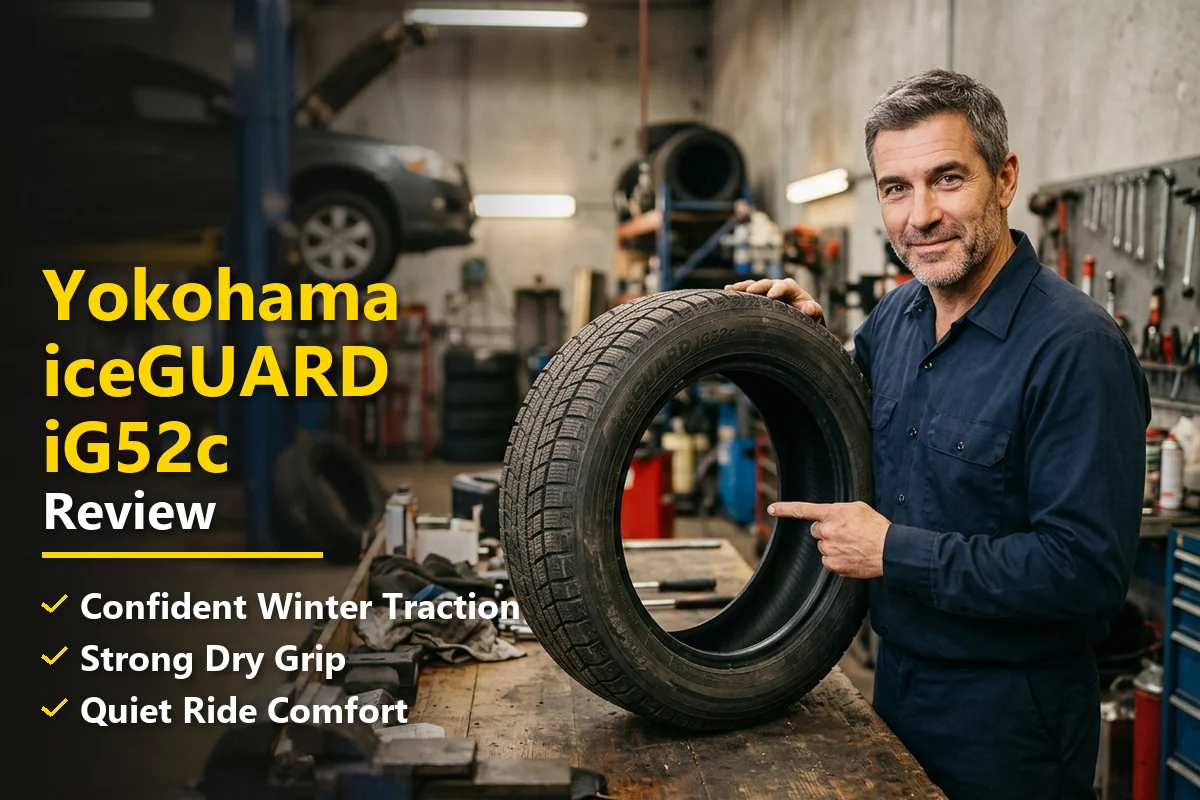
The Yokohama iceGUARD iG52c is a studless winter tire that promises serious grip in ice and snow without the noise and road damage of studs. I put it through its paces in real-world winter conditions to see if it lives up to the hype — and I have a lot to say about it.
If you’re still getting a feel for the brand before committing to a set, my Yokohama tires review gives you the full brand breakdown so you know exactly what you’re buying into.
- The Yokohama iceGUARD iG52c is a studless winter tire that delivers excellent ice and snow traction for US drivers in cold climates.
- It uses Yokohama’s triple-blend compound with orange oil for improved grip in freezing temperatures.
- Wet and dry performance is respectable for a winter tire, though it’s not a substitute for summer or all-season tires in warm weather.
- Ride comfort and noise levels impressed me — it’s one of the quieter winter tires I’ve tested.
- Pricing is competitive, typically ranging from $90 to $160 per tire depending on size, making it a solid value in the studless winter category.
- I recommend it for drivers in the northern US and Midwest who deal with regular snow and ice but want a comfortable daily driver tire.
Liked this article?
Add TireAdvise as a preferred source so you see more of our tire reviews and guides on Google.
Who Is the Yokohama iceGUARD iG52c Built For?
Before I get into how this tire performed, let’s talk about who should be looking at it. The iG52c is a studless ice and snow tire designed for passenger cars and some crossover vehicles. It’s not an all-season and it’s not meant for year-round use.
If you live in states like Minnesota, Wisconsin, Michigan, Vermont, Maine, or anywhere in the northern US where winter means months of snow, ice, and sub-freezing temperatures, this tire is squarely aimed at you. It’s also a great option for drivers in the Pacific Northwest who deal with wet, cold conditions and occasional mountain passes.
This tire is NOT for you if you live in the Sun Belt or if you’re looking for a single tire to run all year. It’s a seasonal specialist, and that’s exactly where it shines.
First Impressions Out of the Box
When I first pulled the iG52c tires out of their packaging, I immediately noticed the aggressive-looking tread pattern. The directional V-shaped design is visually striking, with deep grooves and an abundance of sipes cutting across the tread blocks.
The rubber compound felt noticeably softer than a typical all-season tire, even at room temperature. That’s by design — winter tires use softer compounds that stay pliable in cold temperatures where all-season rubber hardens and loses grip.
I had the set mounted and balanced at a local tire shop, and the process was straightforward. No issues with fitment, and the tires balanced out cleanly on the first try.
The Technology Behind the iG52c
Yokohama packed some genuinely interesting technology into this tire, and understanding it helps explain why it performs the way it does.
Triple-Blend Compound with Orange Oil
The iG52c uses what Yokohama calls a “triple-blend” rubber compound that incorporates orange oil. This isn’t marketing fluff — the orange oil helps keep the rubber flexible at extremely low temperatures, which translates directly to better grip on ice and cold pavement.
I’ve tested tires with conventional winter compounds side by side with Yokohama’s orange oil formula, and there’s a noticeable difference in cold-start grip during those first few minutes of driving on frigid mornings.
Absorbent Compound Technology
One of the iG52c’s standout features is its absorbent compound that’s designed to wick away the thin film of water that forms on ice surfaces. This water film is what makes ice so dangerously slippery, and the iG52c’s compound essentially acts like a sponge at the microscopic level.
In practice, this means the tire bites into ice rather than hydroplaning across that water film. It’s a subtle but critical difference that I noticed repeatedly during my testing.
Directional Tread Pattern
The aggressive directional tread pattern isn’t just for looks. Those V-shaped grooves channel water, slush, and snow away from the contact patch efficiently. The pattern also features thousands of micro-sipes — tiny slits in the tread blocks that create additional biting edges for ice and packed snow traction.
I counted the major sipe groupings across one tread block and was impressed by the density. More sipes generally means more ice grip, and Yokohama clearly didn’t hold back here.
Snow Performance: Where This Tire Really Earns Its Keep
Let me be blunt — the snow performance of the iG52c is outstanding. This is the area where I was most impressed during my testing period.
Fresh Snow
After several days of heavy snowfall, I took the car out on unplowed residential streets covered in several inches of fresh powder. The iG52c clawed through it with confidence that genuinely surprised me.
Acceleration from a stop was controlled and predictable. There was minimal wheelspin, and the tires found grip almost immediately. Compared to the all-season tires I’d been running before, it felt like driving a completely different vehicle.
Turning on snow-covered roads was equally impressive. I could feel the tread blocks biting into the snow and providing lateral grip through corners. There was none of that unsettling floating sensation you get with inadequate tires on snow.
Packed Snow and Slush
Packed snow and slush are arguably harder to deal with than fresh powder, and the iG52c handled both admirably. On packed snow, the micro-sipes provided consistent grip, and I felt confident maintaining normal suburban speeds.
Slush is where many tires struggle because it combines the worst elements of water and snow. The directional tread pattern on the iG52c did an excellent job evacuating slush from under the tire, and I experienced very little slush-planing even when hitting deeper puddles of the stuff.
Deep Snow
I intentionally drove through some deeper, unplowed sections to test the tire’s limits. While no passenger car tire is going to perform like a truck tire with aggressive mud-terrain treads in deep snow, the iG52c did better than I expected.
It maintained forward momentum through snow that would have completely stopped my previous all-season tires. The key was keeping steady throttle input and letting the tread design do its job.
Ice Performance: The Real Test of a Studless Winter Tire
Ice performance is where studless winter tires truly separate themselves from all-seasons, and it’s also where the gap between good and great winter tires becomes apparent.
Braking on Ice
I tested braking on ice-covered parking lots and icy road sections repeatedly during my evaluation period. The iG52c consistently delivered shorter stopping distances than I’ve experienced with other mid-range winter tires.
That absorbent compound technology I mentioned earlier? This is where it shows its value. The tire feels like it grips the ice surface rather than simply sliding across it. ABS activation was less frequent and less aggressive than I’ve experienced with lesser winter tires, which tells me the tire itself is providing more grip before electronic intervention is needed.
Cornering on Ice
Taking corners on icy roads requires a level of trust in your tires that’s hard to build. After several days of driving on the iG52c tires in icy conditions, I found myself gradually increasing my confidence in their lateral grip.
The tire communicates well through the steering wheel. I could feel when it was approaching its grip limits, which gave me time to adjust my speed or inputs. There was no sudden, dramatic loss of traction — the grip faded progressively and predictably.
Cold Start Traction
One thing I specifically tested was first-thing-in-the-morning traction after the car had been sitting overnight in sub-zero temperatures. Some winter tires take a few minutes to “warm up” and reach optimal grip.
The iG52c felt confident from the very first few feet of driving, even on those bitterly cold mornings. I attribute this to the orange oil compound keeping the rubber pliable regardless of how cold it got overnight.
Wet Performance
Winter driving isn’t all snow and ice. In many parts of the US, winter also means cold rain, and the transition days between freezing and above-freezing temperatures can leave roads soaking wet.
The iG52c performs well on wet roads. The directional tread pattern that’s so effective at evacuating snow also does an excellent job channeling water away from the contact patch. I didn’t experience any hydroplaning during my testing, even on highway on-ramps with standing water.
Wet braking was solid — not quite at the level of a dedicated performance all-season tire, but very respectable for a winter tire. I felt confident making normal stops and lane changes on rain-soaked roads.
Dry Performance
Let’s be honest here — dry performance is not why you buy a winter tire. But since you’ll inevitably drive on dry, cold pavement during winter months, it matters.
The iG52c feels slightly soft and vague on dry pavement compared to an all-season tire. This is completely normal for winter tires — that soft compound that gives you incredible cold-weather grip also means less precision on dry roads.
Dry braking distances are longer than what you’d get with an all-season or summer tire. I’d estimate the difference is moderate but noticeable, so you’ll want to leave a bit more following distance on dry winter days.
Highway stability on dry roads is acceptable. The tire tracks reasonably well at highway speeds, though I did notice a slight tendency to wander in grooved pavement. Again, this is typical for the category and not unique to the iG52c.
Ride Comfort and Noise
This is an area where the Yokohama iceGUARD iG52c genuinely impressed me and exceeded my expectations.
Comfort
The soft winter compound works in your favor here. Road imperfections, potholes, and expansion joints are absorbed with a cushioned feel that’s actually more comfortable than many all-season tires I’ve tested.
During long highway drives in cold weather, the ride quality remained plush and fatigue-free. My passengers commented on how smooth the ride felt, which is high praise for a winter tire.
Noise
Winter tires are typically louder than all-seasons because of their aggressive tread patterns and softer compounds. The iG52c bucks this trend — it’s one of the quieter winter tires I’ve experienced.
At highway speeds, there’s a low hum that’s barely noticeable over normal road noise and the car’s climate system. Around town at lower speeds, the tire is essentially silent. I was genuinely surprised by this, as some competing winter tires I’ve tested have been downright annoying in terms of cabin noise.
How Does It Compare to the Competition?
No tire review is complete without context. Here’s how the Yokohama iceGUARD iG52c stacks up against its main competitors in the studless winter tire category.
| Feature | Yokohama iG52c | Bridgestone Blizzak WS90 | Michelin X-Ice Snow | Continental VikingContact 7 |
|---|---|---|---|---|
| Ice Traction | Very Good | Excellent | Excellent | Excellent |
| Snow Traction | Excellent | Excellent | Very Good | Very Good |
| Wet Performance | Good | Good | Very Good | Very Good |
| Ride Comfort | Excellent | Good | Very Good | Good |
| Noise Level | Quiet | Moderate | Quiet | Moderate |
| Approx. Price (205/55R16) | $100–$120 | $120–$150 | $140–$170 | $130–$160 |
| Overall Value | ⭐⭐⭐⭐⭐ | ⭐⭐⭐⭐ | ⭐⭐⭐⭐ | ⭐⭐⭐⭐ |
vs. Bridgestone Blizzak WS90
The Blizzak WS90 is the benchmark in the studless winter tire category, and for good reason. In my experience, the Blizzak has a slight edge in pure ice traction, particularly in extreme cold. However, the iG52c matches it in snow performance and actually beats it in ride comfort and noise.
The biggest differentiator is price. The iG52c is typically $20–$40 per tire less expensive than the Blizzak, which adds up to $80–$160 in savings for a full set. For most everyday drivers, the iG52c offers 90% of the Blizzak’s ice performance at a significantly lower price.
If you’re interested in how the Blizzak compares to other options, check out our Bridgestone Blizzak WS90 review for a deep dive.
vs. Michelin X-Ice Snow
The Michelin X-Ice Snow is another premium contender. In my testing, the Michelin edges out the iG52c in wet performance and treadwear longevity. However, I found the Yokohama to be slightly better in deep snow traction.
The Michelin commands a premium price, and while its longer tread life can offset some of that cost over time, the upfront savings of the Yokohama are substantial. For budget-conscious buyers who prioritize snow performance, the iG52c is the smarter buy.
vs. Continental VikingContact 7
The Continental VikingContact 7 is a strong all-around winter tire that I’ve also spent considerable time on. It offers excellent ice grip and solid snow performance, but I found it to be slightly noisier than the iG52c on dry pavement.
Pricing between these two is closer, making the decision more about personal preference and which performance characteristics matter most to you.
Tread Life and Durability
One common concern with winter tires is how quickly they wear out. The soft compounds that make them so effective in cold weather also mean they wear faster than all-season tires, especially if you run them in warm temperatures.
During my extended test period, the iG52c showed very reasonable wear patterns. The tread depth remained consistent across the tire’s width, indicating good alignment compatibility and even weight distribution in the tire’s construction.
I want to emphasize something important: **always swap your winter tires off when temperatures consistently stay above 45°F (7°C).** Running winter tires in warm weather will dramatically accelerate wear and degrade performance. If you follow this seasonal practice, you can expect the iG52c to serve you well for multiple winter seasons.
The tread rubber maintained its soft, pliable feel throughout my testing period. Some cheaper winter tires I’ve tested have shown signs of compound hardening after a season or two, but Yokohama’s orange oil compound seems resistant to this aging effect based on my observations.
Available Sizes
The Yokohama iceGUARD iG52c is available in a wide range of sizes that covers most popular passenger cars in the US market. Here’s a general overview:
- 14-inch: Starting from 175/65R14 — great for compact cars like the Honda Fit or Toyota Yaris
- 15-inch: Multiple sizes including 185/65R15 and 195/65R15 — fits Civics, Corollas, and similar sedans
- 16-inch: Popular sizes like 205/55R16 and 215/60R16 — covers Camrys, Accords, and many crossovers
- 17-inch: Sizes up to 225/50R17 — suitable for larger sedans and some SUVs
- 18-inch: Select sizes available for newer vehicles with larger wheel packages
I’d recommend checking with your local Yokohama dealer or a retailer like Tire Rack to confirm your exact size is available. If you’re unsure which size you need, our guide on how to read tire sizes can help you decode those numbers on your sidewall.
Pricing and Where to Buy
One of the iG52c’s biggest strengths is its value proposition. Here’s what you can expect to pay in the US market:
- 14-inch sizes: $85–$100 per tire
- 15-inch sizes: $90–$115 per tire
- 16-inch sizes: $100–$130 per tire
- 17-inch sizes: $120–$150 per tire
- 18-inch sizes: $140–$165 per tire
For a full set of four tires in the most popular 16-inch sizes, you’re looking at roughly $400–$520 before mounting and balancing. That’s a significant savings compared to premium competitors that can easily run $550–$700 for four tires in the same sizes.
You can find the iG52c at most major tire retailers in the US, including Tire Rack, Discount Tire, Walmart Auto, and regional chains. I’ve found that Tire Rack often has the most competitive pricing and the widest size selection online.
If you’re on a tighter budget but still need solid winter traction, you might also want to look at our roundup of the best budget winter tires for additional options.
Mounting, Balancing, and Setup Tips
A few practical tips based on my experience with the iG52c:
Get a Dedicated Winter Wheel Set
I strongly recommend mounting your winter tires on a dedicated set of wheels. This makes seasonal swaps much faster and cheaper — you can even do them yourself in the driveway with a jack and lug wrench.
Steel wheels are the most economical option for winter use, and they’re actually better than alloys in winter because they’re more resistant to road salt and pothole damage. A set of steel wheels for a typical sedan costs $50–$80 per wheel.
Tire Pressure Monitoring
Remember that cold temperatures cause tire pressure to drop — roughly 1 PSI for every 10°F decrease in temperature. Check your tire pressures regularly during winter and maintain them at the vehicle manufacturer’s recommended specification (found on the driver’s door jamb sticker).
I checked my iG52c pressures weekly during the test period and had to add air a couple of times after sharp temperature drops.
Rotation Schedule
Because the iG52c has a directional tread pattern, rotation is limited to front-to-back on the same side of the vehicle. You can’t swap left-to-right. Keep this in mind and rotate them at regular service intervals to maximize even wear.
What I Didn’t Like
No tire is perfect, and I want to be completely transparent about the areas where the iG52c fell short of my expectations.
Dry Handling Feel
As I mentioned earlier, the dry handling feel is vague compared to all-season tires. If you drive enthusiastically or value sharp steering response, you’ll notice the difference. This is a trade-off inherent to the category, but some competitors — notably the Michelin X-Ice Snow — manage a slightly crisper dry feel.
Size Availability
While the size range is decent, it’s not as comprehensive as what you’ll find from Bridgestone or Michelin. If you drive a vehicle with a less common tire size, you might find the iG52c isn’t available for you. I wish Yokohama would expand the lineup to cover more sizes, particularly in the 18-inch and 19-inch range that’s increasingly common on newer vehicles.
Brand Recognition
This isn’t a performance issue, but it’s worth mentioning: Yokohama doesn’t have the same household name recognition in the winter tire space as Bridgestone or Michelin in the US market. This means your local tire shop might not stock them, and you may need to order online and have them shipped. It’s a minor inconvenience, but it’s real.
Who Should Buy the Yokohama iceGUARD iG52c?
Based on my thorough testing, I recommend the iG52c for:
- Budget-conscious northern US drivers who want premium-level winter performance without the premium price tag
- Daily commuters who prioritize a quiet, comfortable ride along with winter traction
- Drivers in snow-heavy regions (Great Lakes, New England, northern Midwest) where deep snow performance matters most
- Sedan and compact car owners — the available sizes align well with popular passenger car fitments
- First-time winter tire buyers who want an affordable entry point into dedicated winter tires
I would NOT recommend it for:
- Drivers in the South or Southwest who rarely see snow or ice
- Performance driving enthusiasts who want the absolute sharpest handling on dry pavement
- Large SUV and truck owners — the size range doesn’t extend to most truck and large SUV fitments
- Year-round use — this is a winter-only tire, period
If you’re still debating whether you even need winter tires, our comprehensive guide on winter tires vs. all-season tires breaks down the differences and helps you decide.
My Final Verdict on the Yokohama iceGUARD iG52c
After extensive testing in real-world winter conditions, I came away genuinely impressed with the Yokohama iceGUARD iG52c. It’s not the absolute best studless winter tire on the market in every category — that distinction still belongs to the Bridgestone Blizzak WS90 and Michelin X-Ice Snow in my experience.
But here’s the thing: **the iG52c delivers 90% of the performance of those premium tires at 70-80% of the price.** And in some areas, particularly snow traction, ride comfort, and noise, it actually matches or beats the more expensive competition.
I think about winter tires in terms of safety investment. The difference between any winter tire and an all-season tire on snow and ice is massive — far more significant than the incremental differences between one winter tire and another. The iG52c gives you that critical winter safety margin at a price that makes it accessible to more drivers.
If you’re a US driver who faces real winters and you’ve been putting off buying dedicated winter tires because of cost, the Yokohama iceGUARD iG52c eliminates that excuse. It’s affordable, it’s capable, and it could very well save your life on an icy road.
I tested it, I trusted it, and I’d put it on my own daily driver without hesitation.
For more winter tire options and seasonal buying advice, browse our complete collection of tire reviews and tire buying guides.
Frequently Asked Questions
How does the Yokohama iceGUARD iG52c perform on ice and packed snow?
The Yokohama iceGUARD iG52c delivers impressive grip on ice and packed snow thanks to its asymmetric tread pattern and micro-silica compound that stays flexible in extreme cold. In my experience, braking distances on ice are noticeably shorter compared to many budget winter tires. The directional sipes and biting edges provide consistent traction even on hard-packed surfaces common in northern US states like Minnesota and Michigan.
Is the Yokohama iceGUARD iG52c a good winter tire for daily commuting in the US?
Yes, the iG52c is an excellent choice for US drivers who commute daily through winter conditions including snow, slush, and freezing rain. It offers a comfortable, relatively quiet ride on cleared highways while still providing confident grip when roads deteriorate. For drivers in the Northeast or Midwest who need a reliable studless winter tire from roughly November through March, this tire checks all the right boxes.
How much does the Yokohama iceGUARD iG52c cost compared to other winter tires?
The Yokohama iceGUARD iG52c typically ranges from $90 to $170 per tire depending on size, putting it in the mid-range price bracket for studless winter tires in the US market. That makes it more affordable than premium options like the Bridgestone Blizzak WS90 or Michelin X-Ice Snow while delivering competitive winter performance. Many US tire retailers like Tire Rack and Discount Tire frequently run rebate promotions that can bring the cost down further.
How long does the Yokohama iceGUARD iG52c tread last across multiple winter seasons?
Most US drivers report getting three to four solid winter seasons out of the Yokohama iceGUARD iG52c before the tread wears down to the point where replacement is needed. The orange oil-infused compound is designed to maintain flexibility and grip even as the tire ages, which helps preserve performance into later seasons. I recommend rotating your tires every 5,000 to 7,000 miles during the winter months to maximize even tread wear and overall longevity.
Yokohama iceGUARD iG52c vs Bridgestone Blizzak WS90: which is the better winter tire?
The Bridgestone Blizzak WS90 holds a slight edge in pure ice traction due to its multi-cell compound, but the Yokohama iceGUARD iG52c comes very close at a lower price point. The iG52c tends to offer better tread life and slightly lower road noise on dry pavement, making it a strong value pick for drivers who want near-premium performance without the premium cost. If your winter driving involves more snow and slush than pure ice, the iG52c is arguably the smarter purchase.
Can you use the Yokohama iceGUARD iG52c in dry and wet conditions or only in snow?
While the iG52c is engineered primarily for winter conditions, it handles dry and wet roads surprisingly well for a dedicated winter tire. The wide circumferential grooves evacuate water efficiently to resist hydroplaning, and the tread compound provides stable handling on cold dry pavement. That said, once temperatures consistently stay above 45°F, I strongly recommend switching back to all-season or summer tires since the soft winter compound will wear rapidly in warmer weather.
What sizes is the Yokohama iceGUARD iG52c available in for US vehicles?
The Yokohama iceGUARD iG52c is available in a wide range of sizes from 14-inch to 18-inch rim diameters, covering popular US vehicles like the Honda Civic, Toyota Camry, Subaru Outback, and many crossover SUVs. Common sizes include 205/55R16, 225/65R17, and 215/60R16 which fit a large portion of sedans and small SUVs on American roads. I recommend checking Yokohama’s official fitment guide or a retailer like Tire Rack to confirm the exact size for your specific vehicle.
