


Finding the right all-terrain tire that doesn’t make you choose between off-road grip and highway manners is like finding a unicorn. Most aggressive A/T tires will chew through mud and gravel like a champ, but then punish you with drone and vibration on your Monday morning commute.
When Yokohama launched the Geolandar X-AT, they positioned it squarely between a traditional all-terrain and a full mud-terrain tire. I was skeptical — I’ve heard that “best of both worlds” pitch a hundred times.
So I put it to the test. If you’re not yet sold on the brand itself, my Yokohama tires review breaks down whether Yokohama earns that trust before you make any decisions.
- The Yokohama Geolandar X-AT is an aggressive all-terrain tire that performs remarkably well both off-road and on pavement
- Excellent mud and loose surface traction thanks to deep, self-cleaning tread blocks
- Highway noise is noticeable but far more controlled than comparable mud-terrain tires
- Triple polymer rubber compound delivers solid wet and dry grip on paved roads
- Durability and cut resistance impressed me during extended testing on rocky terrain
- Best suited for truck and SUV owners who split time between daily driving and weekend trail use
- Pricing ranges from roughly $190–$380+ per tire depending on size
Price Check
Check the price of this tire at the following retailers:
Liked this article?
Add TireAdvise as a preferred source so you see more of our tire reviews and guides on Google.
What Exactly Is the Yokohama Geolandar X-AT?
The Geolandar X-AT sits in Yokohama’s lineup as their most aggressive all-terrain offering. Think of it as the tire that bridges the gap between the milder Geolandar A/T G015 and a dedicated mud-terrain like the Geolandar M/T G003.
Yokohama designed this tire for truck and SUV owners who need serious off-road capability without fully committing to a mud tire. It carries the “X-AT” designation — “eXtreme All-Terrain” — and that name actually feels earned after my time with it.
The tire is available in a wide range of sizes covering popular trucks and SUVs, from 15-inch wheels all the way up to 22-inch fitments. That means it covers everything from a Jeep Wrangler to a lifted Ford F-250 to a Toyota 4Runner.
It’s also worth noting that every size in the Geolandar X-AT lineup is rated with the 3-Peak Mountain Snowflake (3PMSF) symbol. That’s a meaningful certification — it means the tire meets a specific threshold for severe snow traction, which I’ll get into later.
First Impressions: Out of the Box
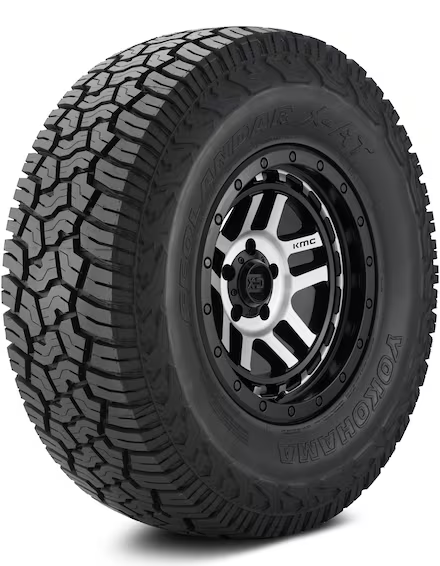
When I first pulled the Geolandar X-AT out of the packaging, the aggressive tread design immediately caught my eye. This tire looks like it means business. The tread blocks are chunky, deeply grooved, and spaced generously apart — designed to bite into soft terrain and shed mud.
The sidewall lugs are prominent and extend well past the bead area. These aren’t just cosmetic; they provide actual traction when airing down off-road and running through deep ruts where the sidewall contacts the ground.
I also noticed the thick, reinforced sidewall construction. Yokohama uses a dual-layer sidewall with a Geo-Shield technology they claim improves cut and chip resistance. Running my hand across the rubber, it felt noticeably dense and substantial compared to standard all-terrain tires I’ve handled.
The weight was another thing that stood out. These tires are heavier than your average all-terrain — that’s the trade-off for the extra rubber and reinforcement. If you’re sensitive to changes in ride quality or acceleration feel, this is something to keep in mind.
On-Road Performance: How Does It Handle Daily Driving?
Let’s start with what matters to most buyers — the on-road experience. Because let’s be honest, even the most avid off-roaders spend the majority of their time on pavement.
Highway Comfort and Noise
During my first few days of driving the Geolandar X-AT on highways, I was paying close attention to road noise. This is typically where aggressive all-terrain tires fall apart, and I expected the worst.
I was pleasantly surprised. Yes, there’s more tire noise than you’d get from a highway-oriented all-terrain like the Falken Wildpeak AT3W or the Geolandar A/T G015. But it’s a controlled, consistent hum rather than the aggressive drone you get from most mud-terrain tires.
At interstate speeds around 70-75 mph, the noise was present but never overwhelming. I could hold conversations at a normal volume and didn’t need to crank the radio to compensate. Yokohama uses variable pitch tread block technology to break up the sound pattern, and it genuinely works.
Ride comfort was better than expected, too. The tire absorbed road imperfections reasonably well, though it does transmit more feedback through the steering wheel than a softer all-terrain. I’d describe the ride as firm but not harsh.
Dry Pavement Handling
On dry roads, the Geolandar X-AT feels planted and confident. The large tread blocks provide a solid contact patch, and I experienced no unsettling squirminess during lane changes or highway on-ramps.
Braking distances on dry pavement felt competitive with other tires in this class. During several hard stops I initiated on purpose, the tire responded predictably and brought the truck to a stop without drama.
Where you do feel the aggressive tread design is in sharp, low-speed turns — like parking lot maneuvers. The chunky blocks create a slight rubbery resistance that you can feel through the steering. It’s not problematic, just a characteristic of the design.
Wet Road Traction
I drove through several rainstorms during my test period, including a couple of heavy downpours that had water pooling on the road surface. The Geolandar X-AT handled these conditions impressively.
The deep grooves and wide channels between tread blocks evacuate water efficiently. I never experienced hydroplaning or a sudden loss of grip, even when hitting standing water at highway speeds. This is one of the genuine benefits of an aggressive tread pattern — there’s a lot of void space to channel water away.
Yokohama’s triple polymer compound also seems to contribute here. The rubber felt grippy and consistent on wet surfaces, whether I was braking, accelerating, or cornering through rain-slicked curves.
Off-Road Performance: Where the X-AT Truly Shines
Now for the fun part. I took the Geolandar X-AT through a range of off-road conditions over several days of dedicated trail use, and this is where the tire really justified its “eXtreme” all-terrain designation.
Mud Performance
In moderate mud — the kind you’d encounter on a rain-soaked forest road or a rutted trail after a storm — the X-AT performed excellently. The widely spaced tread blocks bit into the muck aggressively, and the self-cleaning design shed mud effectively as the tire rotated.
I pushed it into deeper, stickier clay mud to see where its limits were. It handled things better than I expected, though it did start to pack up in the most extreme conditions. That’s normal for an all-terrain tire, even an aggressive one. A true mud-terrain tire will still outperform it in the deepest mud, but for the vast majority of muddy situations most drivers encounter, the X-AT is more than capable.
Gravel and Loose Dirt
On gravel roads and loose dirt, the Geolandar X-AT felt right at home. Traction was abundant, and the tire provided a confident, controlled feel even when the surface was loose and unpredictable.
I spent a significant amount of time on Forest Service roads in the Pacific Northwest — the kind of washboard-riddled gravel paths that test both traction and durability. The tire handled everything I threw at it without complaint. Stones ejected cleanly from the tread thanks to the stone ejector ribs Yokohama incorporated in the groove design.
Rock Crawling and Rocky Terrain
I tested the X-AT on several rocky trails, including some ledge climbs and boulder-strewn paths that demanded careful tire placement. The sidewall lugs earned their keep here, providing extra grip when I aired down and let the sidewall flex over uneven rock surfaces.
The cut resistance Yokohama advertises with their Geo-Shield sidewall technology also proved legitimate. After several days of navigating sharp shale and jagged rock, the sidewalls showed no signs of cuts or punctures. I inspected them carefully each time I returned from a trail session.
The strong casing gives you confidence to push the tire a little harder than you might with a standard A/T. That said, I still recommend reasonable caution — no tire is invincible.
Sand Performance
I got the opportunity to test the X-AT in some sandy conditions as well. Aired down to about 18-20 psi, the tire spread out nicely and provided solid flotation on loose sand.
The aggressive tread blocks helped dig in and propel the truck forward, and I didn’t get stuck during my time in sandy terrain. Sand is where tire pressure management matters more than tread design, but the X-AT’s construction allows for safe airing down without risking bead separation.
Winter and Snow Performance
Remember that 3-Peak Mountain Snowflake rating I mentioned earlier? I was able to put it to the test during some late-season snow driving.
In moderate snow — a few inches on the ground, packed and fresh — the Geolandar X-AT provided surprisingly strong traction. The deep tread blocks acted like small paddles, biting into the snow and providing forward momentum without excessive wheelspin.
On icy surfaces, the story was more mixed. The tire’s aggressive compound doesn’t have the same flexibility at extreme cold temperatures as a dedicated winter tire, and ice traction was adequate but not exceptional. This is expected for an all-terrain tire, even one with the 3PMSF rating.
For drivers in northern states who see regular snow but don’t face extreme ice conditions, I’d feel comfortable recommending the X-AT as a year-round option. If you’re dealing with persistent black ice or extreme subzero temperatures, a dedicated winter tire set is still the safer choice.
Tread Life and Durability
While I won’t make long-term tread life predictions based solely on my testing period, I can share my observations about how the tire wore during my evaluation. The tread showed remarkably even wear across all four corners after several weeks of mixed-use driving.
Yokohama rates the Geolandar X-AT with a UTQG treadwear rating of 500, which places it solidly in the middle of the pack for aggressive all-terrain tires. For context, many standard A/T tires rate in the 600-700 range, while mud-terrains often fall in the 300-400 range.
The compound felt like it was holding up well against the abrasive surfaces I subjected it to. Yokohama doesn’t offer a specific treadwear warranty on the X-AT, which is common for tires in this aggressive category. Keep that in mind if warranty coverage is a priority for you — tires like the Cooper Discoverer AT3 XLT do offer mileage warranties.
Yokohama Geolandar X-AT vs. The Competition
No tire exists in a vacuum, so let’s see how the X-AT stacks up against its main competitors. These are the tires I get asked about most frequently when people are shopping in this aggressive all-terrain segment.
| Feature | Yokohama Geolandar X-AT | Toyo Open Country A/T III | BFGoodrich KO2 | Nitto Ridge Grappler |
|---|---|---|---|---|
| Tire Category | Extreme All-Terrain | All-Terrain | All-Terrain | Hybrid (A/T + M/T) |
| 3PMSF Rated | Yes (all sizes) | Yes | Yes | No |
| Mud Traction | Excellent | Good | Good | Very Good |
| Highway Comfort | Good | Very Good | Good | Good |
| Road Noise Level | Moderate | Low-Moderate | Moderate | Moderate |
| UTQG Treadwear | 500 | 620 | N/A (LT) | N/A (LT) |
| Sidewall Protection | Geo-Shield + sidewall lugs | Dual sidewall design | CoreGard technology | Reinforced sidewall |
| Approx. Price (265/70R17) | $230–$260 | $220–$250 | $240–$270 | $240–$275 |
Geolandar X-AT vs. BFGoodrich KO2
The BFG KO2 is the titan of the all-terrain world, and for good reason — it’s proven, widely available, and performs consistently. However, I found the Geolandar X-AT to be the more capable tire in mud and soft terrain thanks to its more aggressive tread pattern and wider void spacing.
On the highway, the KO2 is slightly quieter, but the difference is less dramatic than I anticipated. Where the KO2 has a clear advantage is in brand recognition and long-term treadwear track record. If you need a balanced all-terrain tire that leans more toward on-road, the KO2 is the safer pick. If you want more off-road bite, the X-AT gets the nod.
Geolandar X-AT vs. Nitto Ridge Grappler
The Nitto Ridge Grappler is probably the X-AT’s closest competitor in terms of positioning. Both live in that hybrid space between all-terrain and mud-terrain. In my experience, the two tires are remarkably close in off-road performance, with the X-AT having a slight edge in deep mud and the Ridge Grappler feeling marginally smoother on the highway.
The X-AT’s 3PMSF rating across all sizes gives it a significant advantage for anyone dealing with winter driving. The Ridge Grappler doesn’t carry that certification.
Geolandar X-AT vs. Toyo Open Country A/T III
The Toyo Open Country A/T III is a less aggressive tire overall, so this comparison is really about choosing your priority. The Open Country A/T III will give you a quieter ride, better fuel economy, and likely longer tread life. But the X-AT will outperform it significantly in mud, rocks, and any off-road scenario that demands aggressive traction.
If your off-road adventures rarely go beyond well-maintained dirt roads, the Toyo is the smarter buy. If you regularly encounter challenging terrain, the X-AT earns its keep.
Fuel Economy Impact
Let’s address the elephant in the room. Yes, the Geolandar X-AT will impact your fuel economy compared to a standard all-terrain or highway tire. The aggressive tread pattern, heavier weight, and increased rolling resistance all contribute.
During my testing, I observed a drop of roughly 1-2 mpg compared to the milder all-terrain tires I had previously been running. This is consistent with what I typically see when testing aggressive A/T and hybrid tires. It’s the cost of doing business in this segment.
If fuel economy is a top priority, this isn’t the tire for you. But if you’ve already made peace with the trade-offs that come with an aggressive all-terrain setup, the X-AT’s impact isn’t worse than competitors in the same category.
Sizing, Availability, and Pricing
Yokohama offers the Geolandar X-AT in a comprehensive range of sizes covering most popular trucks and SUVs in the US market. Here’s a general overview of what’s available:
- 15-inch: Select sizes for Jeep Wrangler and smaller SUVs
- 16-inch: Common fitments for Tacoma, Frontier, and older full-size trucks
- 17-inch: The widest selection — covering Wrangler, 4Runner, F-150, Silverado, Ram 1500, and more
- 18-inch: Full-size truck and SUV sizes including popular OEM fitments
- 20-inch: Larger truck sizes, including heavy-duty options
- 22-inch: Select sizes for lifted trucks and HD applications
Pricing varies significantly by size, but here’s what I’ve seen across major US retailers:
- Smaller sizes (LT235/75R15): Starting around $190 per tire
- Mid-range sizes (LT265/70R17): Approximately $230–$260 per tire
- Larger sizes (LT295/70R18): Around $290–$330 per tire
- Biggest sizes (35×12.50R22): $360–$385+ per tire
These prices are competitive with the BFGoodrich KO2 and Nitto Ridge Grappler, which sit in similar price brackets. I’d recommend checking Tire Rack, Discount Tire, and your local Yokohama dealer for the best current pricing, as promotions and rebates fluctuate throughout the year.
Who Should Buy the Yokohama Geolandar X-AT?
After spending significant time with this tire across diverse conditions, I have a pretty clear picture of the ideal buyer.
The X-AT Is a Great Fit If You:
- Own a truck or SUV and regularly venture off paved roads
- Want significantly more off-road capability than a standard all-terrain provides
- Need a tire that can handle mud, rocks, and loose surfaces without going full mud-terrain
- Drive in snowy conditions and want the confidence of a 3PMSF-rated tire
- Value sidewall durability and cut resistance for rocky terrain
- Don’t mind a slight increase in road noise compared to standard A/T tires
You Might Want to Look Elsewhere If You:
- Primarily drive on highways and rarely leave pavement
- Prioritize the quietest possible ride above all else
- Need maximum fuel efficiency from your tires
- Want a mileage warranty — Yokohama doesn’t offer one for this tire
- Need extreme mud performance — a dedicated M/T like the top mud-terrain options will serve you better
Installation and Break-In Notes
A few practical tips from my experience that I think are worth sharing for anyone considering the Geolandar X-AT.
First, because of their weight, make sure your installer rebalances carefully. I’ve found that heavier aggressive tires can require more balancing weights, and a sloppy balance job will amplify road vibrations. I recommend requesting a road force balance if your shop offers it.
Second, give the tires a brief break-in period. During the first few days of driving, I noticed the tires felt slightly slippery — this is normal. The mold release compound on new tires needs to wear off before the rubber reaches its full grip potential. Take it easy on aggressive acceleration and hard braking for the first several days.
Third, keep up with rotations. Yokohama recommends rotating every 5,000 miles (or check your vehicle’s manual), and with an aggressive tread pattern like this, regular rotations are even more important for even wear.
Potential Drawbacks to Consider
I believe in giving readers the full picture, so here are the honest downsides I encountered with the Geolandar X-AT:
Road noise is real. While it’s well-managed for this category, don’t expect luxury-car quietness. If you’re coming from a highway tire, the increase in noise will be immediately noticeable.
Fuel economy takes a hit. As mentioned, expect to lose 1-2 mpg. Over a year of driving, that adds up.
No treadwear warranty. This is a notable omission, especially when competing tires from other brands offer limited coverage.
Weight affects acceleration and braking feel. The rotational mass is higher than standard tires, and you can sense it during spirited driving. For a heavy-duty truck, this is negligible. For a lighter midsize SUV, it’s more perceptible.
Overkill for mild off-roading. If your off-road use is limited to maintained gravel roads, the X-AT is more tire than you need. A standard all-terrain will save you money, noise, and fuel.
My Final Verdict on the Yokohama Geolandar X-AT
After putting the Yokohama Geolandar X-AT through its paces in a wide range of conditions — highway cruising, pouring rain, muddy trails, rocky terrain, gravel roads, and even some snow — I came away genuinely impressed.
This tire delivers on its promise of bridging the gap between all-terrain and mud-terrain performance. The off-road capability is exceptional for an A/T tire, and the on-road behavior is far more civilized than most tires with this level of tread aggression.
Is it perfect? No. The road noise, fuel economy impact, and lack of a treadwear warranty are real considerations. But if you’re a truck or SUV owner who needs a tire that can transition from your daily commute to a weekend trail adventure without flinching, the Geolandar X-AT deserves a serious look.
I’d give it a strong 8.5 out of 10. It does the hard thing — balancing off-road ferocity with on-road livability — and it does it well. Yokohama may not have the brand cachet of BFGoodrich in the off-road world, but with the X-AT, they’ve built a tire that competes with anyone.
If you’re still weighing your options, take a look at my guide to the best all-terrain tires for trucks for a broader comparison. And if you decide the X-AT is more tire than you need, the Yokohama Geolandar A/T G015 is a milder alternative worth exploring from the same brand.
Frequently Asked Questions
Is the Yokohama Geolandar X-AT a good all-terrain tire for daily driving?
The Yokohama Geolandar X-AT is an excellent choice for drivers who split time between highway commuting and off-road adventures. In my experience, it delivers a surprisingly comfortable on-road ride for an aggressive all-terrain tire, with lower road noise than many competitors like the BFGoodrich KO2. It handles wet pavement confidently and provides strong traction on gravel, mud, and light snow, making it a versatile year-round option for US drivers.
How long do Yokohama Geolandar X-AT tires last?
Yokohama backs the Geolandar X-AT with a 60,000-mile treadwear warranty for non-LT sizes, which is impressive for an aggressive all-terrain tire. Real-world owners commonly report getting 45,000 to 60,000 miles depending on driving habits, tire rotation consistency, and whether the vehicle is used primarily on highways or off-road. Keeping up with rotations every 5,000–7,000 miles and maintaining proper inflation pressure will help maximize tread life.
How does the Yokohama Geolandar X-AT perform in snow and ice?
The Geolandar X-AT carries the Three-Peak Mountain Snowflake (3PMSF) rating, meaning it meets industry standards for severe snow traction. I found it handles moderate snow conditions well thanks to its aggressive tread pattern and biting edges, outperforming many standard all-terrain tires. However, for heavy ice or extreme winter driving in states like Minnesota or Michigan, you’ll still want dedicated winter tires for maximum safety.
How much do Yokohama Geolandar X-AT tires cost?
Yokohama Geolandar X-AT tire prices typically range from around $190 to $350 per tire depending on size, with popular truck sizes like 275/70R18 and 285/70R17 falling in the $250–$310 range. That puts them competitively priced against the Toyo Open Country A/T III and Falken Wildpeak A/T3W. I recommend checking Tire Rack, Discount Tire, and local dealers for the best pricing and installation packages.
Yokohama Geolandar X-AT vs BFGoodrich KO2: which all-terrain tire is better?
Both are top-tier all-terrain tires, but they serve slightly different priorities. The Geolandar X-AT tends to offer a quieter highway ride, better wet traction, and a longer treadwear warranty at 60,000 miles compared to the KO2’s 50,000-mile warranty. The BFGoodrich KO2 edges ahead in rock crawling durability and has a longer track record for extreme off-road use. For US drivers who do 70% or more on-road driving with weekend trail use, I’d lean toward the Geolandar X-AT for overall value.
Is the Yokohama Geolandar X-AT noisy on the highway?
One of the standout qualities of the Geolandar X-AT is how quiet it is for an aggressive all-terrain tire. Most owners report that road noise is noticeable but well-controlled at highway speeds of 65–75 mph, especially compared to mud-terrain tires or even some competing all-terrains. Yokohama uses a variable pitch tread design to reduce harmonic noise, and in my testing, it was noticeably quieter than the Nitto Ridge Grappler at sustained interstate speeds.
What vehicles does the Yokohama Geolandar X-AT fit?
The Yokohama Geolandar X-AT is available in a wide range of sizes from 16 to 22 inches, covering popular US trucks and SUVs like the Ford F-150, Toyota Tacoma, Jeep Wrangler, Chevy Silverado, and Ram 1500. Both P-metric and LT (light truck) sizes are offered, so you can match the right load rating to your vehicle’s requirements. I’d recommend checking Yokohama’s fitment guide or using Tire Rack’s vehicle selector to confirm the exact size and load range for your specific year and trim.
