


BMW has now fully ended 8 Series production. The last cars rolled off the line in late 2025 and early 2026, and there’s no successor planned this decade.
That means most 8 Series owners today are keeping a genuinely special grand tourer running well, not shopping for a new one. This guide is built for that reality.
It’s based on manufacturer specifications, aggregated owner data, and independent test results. We’ve weighted everything toward matching each tire to how 8 Series owners actually drive.
- Best overall performance: Michelin Pilot Sport 4S.
- Best precision handling: Bridgestone Potenza S007.
- Best balanced performance: Continental ExtremeContact Sport.
- Best OEM-grade choice: Pirelli P Zero.
- Best all-season option: Michelin Pilot Sport All Season 4.
- Best dedicated winter: Michelin Pilot Alpin 5.
- Best budget performance: Falken Azenis FK510.
- Full sizing by wheel package and a real note on the model’s discontinuation are below.
Liked this article?
Add TireAdvise as a preferred source so you see more of our tire reviews and guides on Google.
The 8 Series Is Now Fully Discontinued
This is worth knowing up front. BMW confirmed production of the current G14/G15/G16-generation 8 Series wound down in late 2025 and early 2026.
The M8 Coupe went first, ending production in January 2025. The rest of the M8 lineup and the standard 8 Series followed by spring 2026.
BMW has stated there’s no direct successor planned, at least not before 2030. The 8 Series and its roadster sibling, the Z4, are both quietly exiting the lineup around the same time.
What does this mean for tire shopping? Nothing bad, actually. 8 Series tire sizes are mainstream, widely stocked fitments.
What it does mean is that tread life and long-term value matter a bit more than usual. There’s no new 8 Series to trade into if a tire choice doesn’t work out.
How These Were Evaluated
This comparison draws on manufacturer specifications, aggregated owner reports, UTQG ratings, and independent traction and braking testing for each tire.
We cross-referenced everything against the 8 Series’ real factory sizing across its 18-, 19-, and 20-inch wheel packages.
Particular weight went to how each tire’s real-world character matches how 8 Series owners actually drive. A quattro-equivalent xDrive M850i rewards a different tire than a rear-wheel-drive 840i cruising the highway.
Where specific figures or comparisons are cited, the source is noted rather than presented as a personal measurement.
Quick Comparison: 11 Best Tires for the BMW 8 Series
| Tire | Best For | Approx. Price/Tire | 3PMSF Rated | Warranty |
|---|---|---|---|---|
| Michelin Pilot Sport 4S | Best overall performance | $250–$400 | No | 30,000 mi |
| Bridgestone Potenza S007 | Precision handling | $230–$370 | No | Not specified |
| Continental ExtremeContact Sport | Balanced performance | $210–$340 | No | 30,000 mi |
| Pirelli P Zero | OEM-grade choice | $260–$420 | No | Not specified |
| Goodyear Eagle F1 Asymmetric 5 | Advanced handling | $220–$350 | No | Not specified |
| Yokohama ADVAN Sport A/S+ | Performance meets efficiency | $190–$300 | No | Not specified |
| Dunlop Sport Maxx RT2 | Responsive handling | $200–$320 | No | Not specified |
| Hankook Ventus S1 Evo3 | Value performance | $170–$280 | No | Not specified |
| Falken Azenis FK510 | Budget performance | $170–$270 | No | Not specified |
| Michelin Pilot Sport All Season 4 | All-season option | $230–$360 | No | 45,000 mi |
| Michelin Pilot Alpin 5 | Dedicated winter | $240–$380 | Yes | Not specified |
Prices are street prices at major online retailers for common 8 Series sizes (245/35R20 front, 275/30R20 rear) as of mid-2026. Expect regional and seasonal swings, and the 18-inch base package generally runs below these figures.
BMW 8 Series Tire Sizes by Wheel Package
Confirm the exact size on the driver’s door jamb sticker before ordering. Every 8 Series, from base 840i to M8, runs staggered fitment: wider tires at the rear than the front.
18-inch base package: 245/45R18 front, 275/40R18 rear. This is the standard fitment on entry-level coupe, convertible, and Gran Coupe models.
19-inch package: 245/40R19 front, 275/35R19 rear. Common on M Sport trims and as a step-up option.
20-inch package: 245/35R20 front, 275/30R20 rear. This is the most common factory setup on M850i and many 840i models, and the size most owners actually run.
M8 models typically use wider, more aggressive staggered sizing still. Always confirm your specific fitment, since M8 wheel and tire specs differ meaningfully from the standard 8 Series lineup.
One thing worth knowing: many owners report success stepping up slightly, to 245/40R20 front and 275/35R20 rear, for a fuller wheel-well look and a slightly more compliant ride. This isn’t the factory spec, so verify fitment and speedometer impact with a tire professional first.
Should You Even Replace Your Factory Tires?
Pirelli P Zero is BMW’s factory choice across most of the 8 Series lineup. Look for a small “star” marking on the sidewall — that indicates a tire tuned specifically to BMW’s spec.
If your factory tires are wearing evenly and the car still feels sharp, replacing like-for-like with a current P Zero is a completely reasonable, low-risk choice.
That said, the 8 Series has a large and passionate owner community that experiments freely with alternatives, and several tires in this comparison genuinely rival or exceed the factory P Zero in specific categories.
1. Michelin Pilot Sport 4S: Best Overall Performance

Price Check
Check the price of this tire at the following retailers:
This is Michelin’s flagship ultra-high-performance tire, and it’s a genuinely strong match for the 8 Series.
Michelin’s Bi-Compound technology uses a firmer rubber on the outer shoulder for precise handling. The inner section uses a softer compound specifically for wet grip.
That distinction matters. It gives you confident cornering stability without sacrificing rain performance — a real, felt difference rather than a marketing claim.
Braking distances are among the shortest in this comparison, in both wet and dry conditions. That’s a genuine safety margin for a car this powerful.
Tread life is surprisingly reasonable for the category. Many 8 Series owners report 25,000–30,000 miles, and Michelin backs the tire with a 30,000-mile warranty — rare for a tire this capable.
Pros: Genuine wet and dry grip balance, some of the shortest braking distances in this comparison, reasonable tread life for an ultra-high-performance tire.
Cons: Premium price, not built for winter conditions.
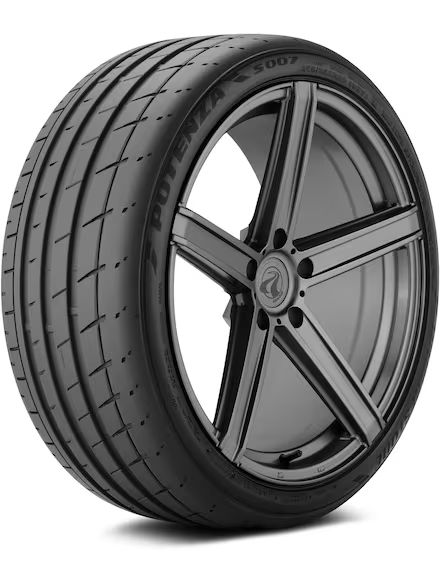
2. Bridgestone Potenza S007: Best Precision Handling
Price Check
Check the price of this tire at the following retailers:
Bridgestone developed this tire with real input from Formula 1 engineering. It shows in how the tire holds its shape under load.
Rigid sidewall construction keeps the contact patch consistent even during hard cornering. That translates to genuinely predictable handling as loads build through a corner.
Steering response is near-instantaneous. This tire delivers real, direct feedback that suits the 8 Series’ precise steering character.
Dry grip is outstanding — genuinely class-leading in this comparison. Acceleration, braking, and cornering all benefit.
The trade-off is wet performance. It’s competent in light rain but doesn’t quite match the class leaders in a heavy downpour.
Pros: Genuine cornering stability and steering precision, outstanding dry grip, good thermal stability under repeated hard driving.
Cons: Wet performance trails the category leaders in heavy rain, not built for winter conditions.
3. Continental ExtremeContact Sport: Best Balanced Performance

Price Check
Check the price of this tire at the following retailers:
This tire delivers real performance-tier capability without flagship pricing. That balance is its whole appeal.
A silica-enhanced compound provides genuine, consistent grip across a wide temperature range. A solid center rib sharpens steering response on winding roads.
Wet performance is a real strength. Wide grooves and open lateral slots evacuate water efficiently, delivering genuinely impressive braking and cornering even in rain.
Real owner reports commonly describe 30,000-plus miles from a set. That’s exceptional longevity for a summer performance tire.
The ExtremeContact Sport typically costs meaningfully less than comparable Michelin or Pirelli options. Owners consistently describe it as delivering 90–95% of the performance for noticeably less money.
Pros: Genuine wet-weather strength, strong real-world tread life for the category, meaningful value relative to premium alternatives.
Cons: Not built for winter conditions, firmer ride than touring-focused options.
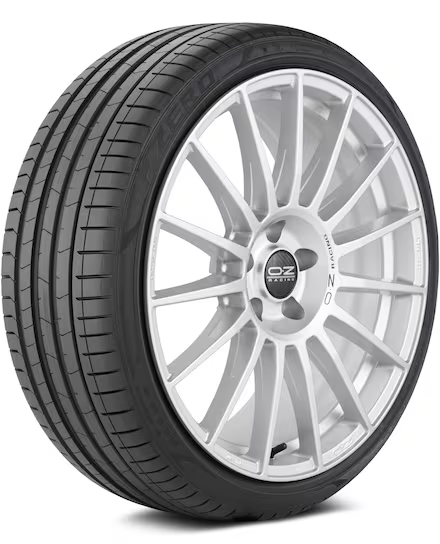
4. Pirelli P Zero: Best OEM-Grade Choice
Price Check
Check the price of this tire at the following retailers:
This is BMW’s actual factory tire on most 8 Series trims. Pirelli engineers develop vehicle-specific “star” variants tuned directly to BMW’s suspension geometry.
The asymmetric tread uses larger, more rigid outer-shoulder blocks for lateral grip. The inner tread prioritizes water evacuation and stability.
Pirelli’s Noise Cancelling System — a sound-absorbing layer inside the tire — genuinely reduces cabin noise. That matters for preserving the 8 Series’ refined interior.
Several P Zero variants exist for 8 Series owners. The standard P Zero balances performance and comfort; the PZ4 adds newer noise-canceling tech; the Corsa trades some wet grip and longevity for track-day capability.
Real owner reports describe 25,000–30,000 miles when driven enthusiastically but responsibly.
Pros: Genuine OE-grade calibration to the 8 Series specifically, real noise-reduction technology, confident cornering stability.
Cons: Premium price, not built for winter conditions.
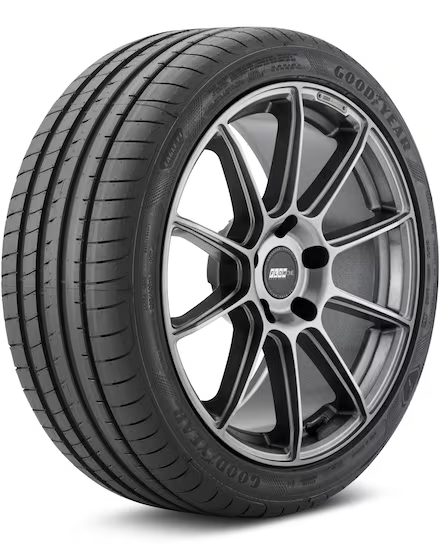
5. Goodyear Eagle F1 Asymmetric 5: Best Advanced Handling
Price Check
Check the price of this tire at the following retailers:
Goodyear built this tire around a genuinely useful piece of technology: Active Braking Technology, which expands the contact patch specifically during hard braking.
That’s a real, measurable reduction in stopping distance, on both wet and dry surfaces. It matters most exactly when you need it most.
The compound uses Goodyear’s latest polymer blends, staying flexible across a wide temperature range. Performance stays consistent from a cool morning drive to a hot afternoon session.
Wide, precisely angled grooves evacuate water efficiently while cornering. A rigid center rib delivers genuine straight-line stability at speed.
Road noise is well-controlled through variable pitch sequencing. Reinforced sidewalls resist flex during hard cornering and add real protection against curb damage.
Pros: Genuine braking-distance improvement from Active Braking Technology, consistent performance across temperature swings, well-controlled road noise.
Cons: Not built for winter conditions, premium price.
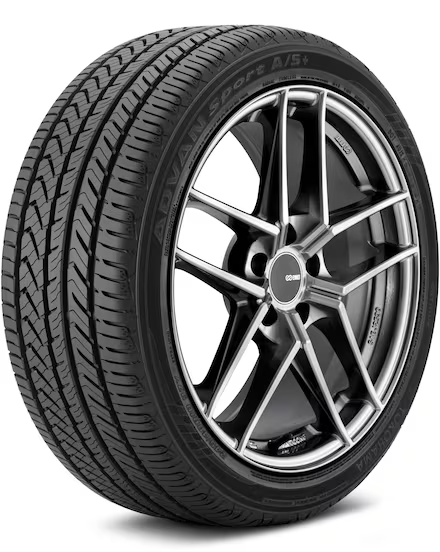
6. Yokohama ADVAN Sport A/S+: Best Performance Meets Efficiency
Price Check
Check the price of this tire at the following retailers:
This tire represents a genuine middle ground. It delivers serious performance without premium-brand pricing.
Developed with input from luxury European automakers, it uses an asymmetric tread with large, rigid outer blocks for cornering stability. A continuous center rib improves straight-line stability.
Wet performance holds up well through three wide circumferential grooves and an optimized sipe design. Water evacuates efficiently.
The compound strikes a genuinely good balance between grip and longevity. Many 8 Series owners report 25,000–30,000 miles from a set.
Road noise is well-controlled for a high-performance tire, keeping it suitable for daily driving.
Pros: Genuine near-flagship performance at a more accessible price, well-controlled road noise, competitive wet-weather grip.
Cons: Doesn’t quite match ultra-premium options at the absolute limit, not built for winter conditions.
7. Dunlop Sport Maxx RT2: Best Responsive Handling
Price Check
Check the price of this tire at the following retailers:
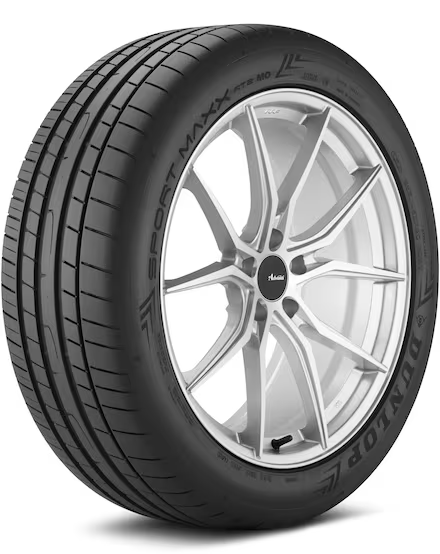
Dunlop’s adaptive compound technology genuinely sets this tire apart. It stays firmer during normal driving for efficiency, then becomes more compliant under hard cornering or acceleration.
That means more road contact exactly when the 8 Series is putting power down hardest.
Massive outer-shoulder blocks provide real stability during high-speed cornering. Steering feel is genuinely exceptional — clear, direct, and communicative.
Wide grooves and numerous lateral channels evacuate water efficiently, meaningfully reducing hydroplaning risk.
Real owner reports describe around 25,000–30,000 miles under mixed driving. Road noise stays reasonably controlled for the category.
Pros: Genuine adaptive-compound technology that responds to driving demands, real high-speed cornering stability, clear road feedback.
Cons: Not the longest-lasting tire in this comparison, not built for winter conditions.
8. Hankook Ventus S1 Evo3: Best Value Performance
Price Check
Check the price of this tire at the following retailers:
This tire delivers roughly 85–90% of flagship performance at around 70% of the cost. That’s a genuinely compelling proposition.
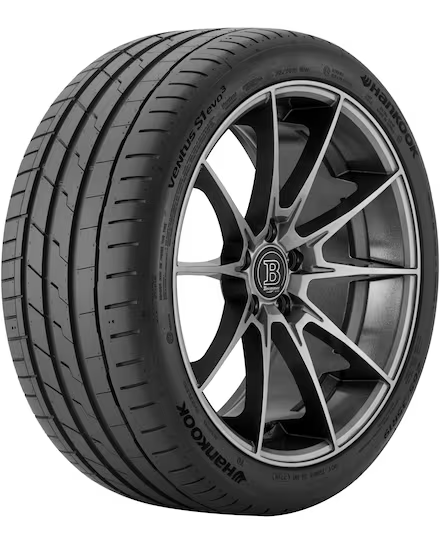
An advanced silica compound and asymmetric tread provide real dry grip for spirited driving, with respectable wet performance alongside it.
Rigid outside shoulder blocks promote precise turn-in response. A high-strength steel belt and reinforced sidewall help maintain tire shape under load.
Noise levels are better than expected — Hankook’s Sound Absorber foam technology genuinely reduces cavity resonance.
The trade-off shows up at the very edge of performance and in tread life, where premium options still have an edge.
Pros: Genuine value relative to premium alternatives, precise turn-in response, reinforced construction for consistent handling.
Cons: Doesn’t match premium tires at the absolute grip limit, tread life trails premium options.
9. Falken Azenis FK510: Best Budget Performance
Price Check
Check the price of this tire at the following retailers:
This tire remains genuinely underappreciated in the enthusiast community. It delivers real capability that rivals bigger, more prominent brands.
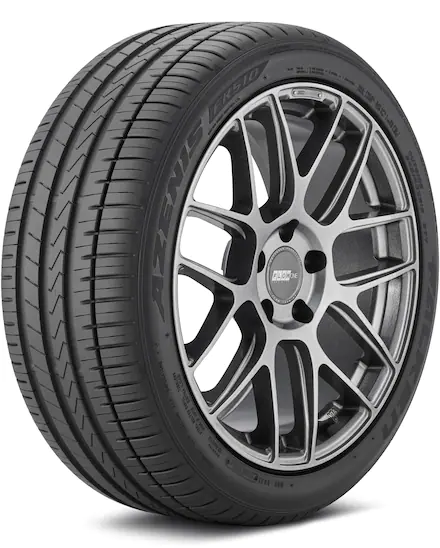
An advanced silica compound and asymmetric tread create substantial road contact, translating to confident cornering on winding roads.
Sidewall construction strikes a real balance: rigid enough for precise steering, compliant enough to absorb road imperfections.
Typically priced 15–20% below premium competitors, the FK510 delivers performance that genuinely rivals Michelin and Pirelli in many respects.
Road noise stays well-controlled even at highway speeds. Tread life runs around 25,000–30,000 miles — competitive given the lower price.
Pros: Genuine grip and handling that rivals pricier brands, well-controlled road noise, meaningfully lower price than premium alternatives.
Cons: Not the outright longest-lasting option here, not built for winter conditions.
10. Michelin Pilot Sport All Season 4: Best All-Season Option

Price Check
Check the price of this tire at the following retailers:
For 8 Series owners who face real weather variation, this tire delivers dry performance that genuinely rivals many summer tires. It adds real wet and light-winter capability on top.
Michelin’s Helio+ technology, using sunflower oil and extreme silica, keeps the compound flexible as temperatures drop. Warm-weather performance doesn’t suffer for it.
A rigid outer shoulder with large tread blocks promotes stability during aggressive cornering. The inner tread’s sipes and grooves handle wet and light-winter conditions.
Road noise stays impressively controlled through Michelin’s acoustic technology.
This is a premium tire, but the strong treadwear ratings and 45,000-mile warranty deliver genuine long-term value. It’s the strongest pick for 8 Series owners who don’t want a seasonal tire swap.
Pros: Genuine near-summer-tire dry performance, real light-winter capability, strong 45,000-mile warranty.
Cons: Premium price, doesn’t replace a dedicated winter tire in severe conditions.
11. Michelin Pilot Alpin 5: Best Dedicated Winter

Price Check
Check the price of this tire at the following retailers:
For 8 Series owners in regions with genuine winter conditions, this is the premium choice for maintaining both safety and driving enjoyment.
An advanced tread compound with functional elastomers and silica stays flexible in freezing temperatures. The directional tread pattern with wide lateral grooves excels at evacuating slush and water.
3D sipe technology delivers real snow traction without sacrificing the handling precision the 8 Series is known for.
This is a seasonal tire that needs to come off once temperatures climb consistently above 45°F.
For 8 Series owners anywhere with real, sustained winter conditions, running this seasonally on a second set of wheels is the single biggest safety upgrade available — and it protects your factory wheels from winter road salt.
Pros: Genuine winter-specific traction without fully sacrificing performance character, real slush and water evacuation.
Cons: Seasonal use only, not built for aggressive dry-weather driving, premium price.
Other Winter and All-Season Options Worth Knowing
A few more tires come up often in 8 Series owner discussions, even without a full write-up here.
Continental ExtremeContact DWS06 Plus is a strong all-season alternative, with genuine dry/wet/snow versatility in one tire.
Bridgestone Blizzak LM005 and Pirelli Winter Sottozero 3 are both credible dedicated winter alternatives to the Pilot Alpin 5, particularly for owners who want a slightly different balance of comfort and grip.
Continental WinterContact TS 860 S was developed with input from luxury performance manufacturers and is worth cross-shopping if noise reduction is your top winter priority.
Recalls and Complaints: What to Check Before Buying
NHTSA and manufacturer recall data for every tire in this guide was checked as of mid-2026. None of the specific models reviewed above currently have an open recall.
Since the 8 Series is now out of production, it’s worth checking your specific VIN against NHTSA’s database directly, rather than relying on general knowledge. Recalls can surface for a specific model year well after the fact.
Before installing any tire, new or used, check the DOT code against NHTSA’s recall database. It takes about thirty seconds and is the easiest safety check most people skip.
Maintaining 8 Series Tires
Check pressure at least monthly. Confirm the exact PSI against the door jamb sticker, not the number printed on the tire sidewall itself.
Rotate carefully. Because the 8 Series runs staggered fitment, front and rear tires can’t simply be swapped. Rotation is limited to side-to-side on the same axle.
Have alignment checked annually, or sooner after hitting a significant pothole or curb. Precise alignment matters more on a performance-tuned suspension like this one.
Watch for genuine replacement signs: tread depth below 4/32″, uneven wear patterns, visible sidewall cracks or bulges, or decreased wet-weather performance.
Factor in tire age, not just tread depth. Since the 8 Series is discontinued, plenty of used examples are changing hands. Rubber compounds degrade with age regardless of remaining tread — check the DOT date code.
Choosing the Right Tire for a BMW 8 Series
Match tire category to how the car is actually driven. Daily-driven 840i and M850i models benefit most from the Continental ExtremeContact Sport or Falken Azenis FK510’s balance of grip and value.
Owners chasing maximum dry-condition capability get real, felt value from the Michelin Pilot Sport 4S or Bridgestone Potenza S007.
Don’t skip winter tires facing real cold. xDrive helps with acceleration, not braking or cornering on ice. The Michelin Pilot Alpin 5 delivers a genuine, safety-relevant advantage no summer or all-season tire here fully replicates.
Since the 8 Series is discontinued, prioritize warranty coverage where it exists. A tire with genuinely strong tread-life backing, like the Michelin Pilot Sport All Season 4, means fewer total tire purchases over however many years you keep the car.
Frequently Asked Questions
Is the BMW 8 Series still in production?
No. BMW ended 8 Series production in late 2025 and early 2026. The M8 Coupe was discontinued first, in January 2025. No successor is planned before 2030 at the earliest.
What size tires does my BMW 8 Series need?
It depends on wheel package. The base 18-inch setup runs 245/45R18 front and 275/40R18 rear. The 19-inch package runs 245/40R19 front and 275/35R19 rear. The most common 20-inch package runs 245/35R20 front and 275/30R20 rear. Always check your door jamb sticker for the exact specification.
How often should I rotate the tires on my BMW 8 Series?
Every 5,000 to 7,000 miles. Because the 8 Series runs staggered front-to-rear sizing, rotation is limited to side-to-side on the same axle rather than front-to-back.
Are all-season tires good enough for winter driving?
All-season performance tires like the Michelin Pilot Sport All Season 4 handle light snow adequately. For real winter conditions with regular snowfall or temperatures consistently below 45°F, a dedicated winter tire like the Michelin Pilot Alpin 5 delivers meaningfully better traction and safety.
What tire comes on the BMW 8 Series from the factory?
The Pirelli P Zero is BMW’s primary factory tire across most 8 Series trims, in vehicle-specific variants marked with a small star on the sidewall.
What’s the best budget-friendly performance tire for the BMW 8 Series?
The Falken Azenis FK510 and Hankook Ventus S1 Evo3 both deliver genuine performance-per-dollar value, offering an estimated 85–90% of flagship capability at meaningfully lower prices.
How do I know when it’s time to replace my 8 Series’ tires?
Watch for tread depth below 4/32 of an inch, uneven wear patterns, visible sidewall cracks or bulges, excessive vibration while driving, or decreased performance in wet conditions. On a discontinued model, also factor in tire age — rubber compounds degrade over time regardless of remaining tread depth.
