

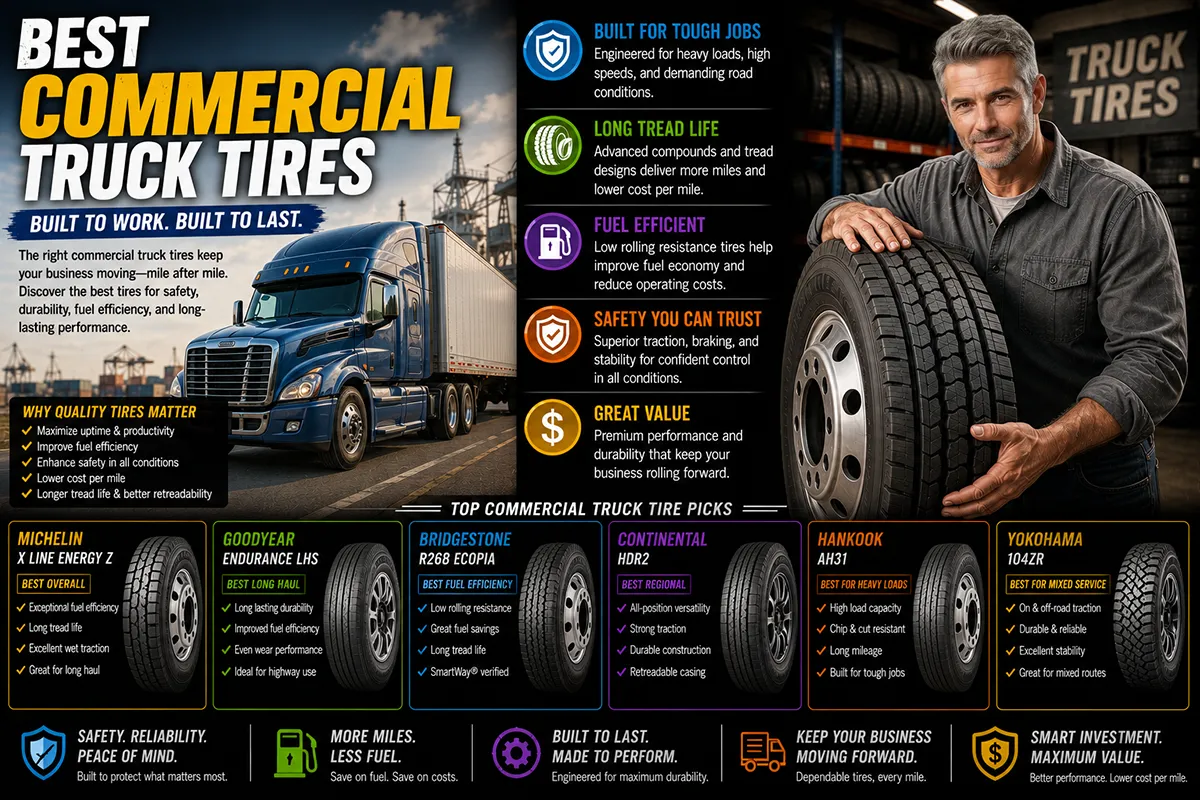
Tires account for roughly 30% of a commercial truck’s fuel consumption through rolling resistance alone, and they’re the single most retreadable — and therefore most economically consequential — component on the vehicle.
There’s no universal winner in this category. The “best” tire is always the one matched to a specific operation, position, and route, and the wrong tire in the wrong application leads to irregular wear, reduced casing life, and genuine safety hazards.
This guide is based on manufacturer specifications, aggregated fleet and owner-operator data, and independent testing. Here’s what actually holds up, by position and application.
- Best long-haul steer: Michelin X Line Energy Z.
- Best long-haul drive: Continental Conti EcoPlus HD3.
- Best regional all-position: Goodyear Fuel Max RSA.
- Best budget long-haul drive: Hankook e3 MAX DL21.
- Best mixed-service drive: Bridgestone M860A.
- Best winter/all-season: Toyo M655.
- Best trailer tire: Continental Conti EcoPlus HT3.
- Match the tire to your actual application — position-specific tires consistently outperform all-position tires in fuel efficiency and tread life within their designated role.
Liked this article?
Add TireAdvise as a preferred source so you see more of our tire reviews and guides on Google.
Why the Right Tire Matters More Than Fuel Prices Alone
Fleet managers often obsess over diesel prices while barely glancing at tire specs — a real, costly mistake given how directly tires influence total fuel consumption.
Beyond fuel economy, mismatched applications cause genuine problems: a steer tire designed for long-haul highway use can shred within weeks on a regional delivery truck navigating tight urban turns. Operators who match tires to their actual routes — rather than a generic “best tire” recommendation — see meaningfully better cost-per-mile outcomes over time.
How These Were Evaluated
This comparison draws on manufacturer specifications, aggregated fleet data, and independently reported treadwear, fuel-efficiency, traction, and retreadability testing for each tire.
Evaluation focused on treadwear and casing durability, fuel efficiency (rolling resistance and SmartWay verification), traction across relevant conditions, ride quality and noise, cost-per-mile value, and retreadability — weighted according to each tire’s intended position and application.
Where specific figures or comparisons are cited, the source is noted rather than presented as a personal measurement.
Quick Comparison: 11 Best Commercial Truck Tires
| Tire | Position | Application | Price Range | SmartWay | Best Feature |
|---|---|---|---|---|---|
| Michelin X Line Energy Z | Steer | Long-Haul | $450–$550 | Yes | Fuel efficiency |
| Continental Conti EcoPlus HD3 | Drive | Long-Haul | $380–$480 | Yes | Treadlife/efficiency balance |
| Goodyear Fuel Max RSA | All-Position | Regional | $400–$500 | Yes | Versatility |
| Hankook e3 MAX DL21 | Drive | Long-Haul | $300–$400 | Yes | Value |
| Bridgestone M860A | Drive | Mixed-Service | $450–$550 | No | Off-road durability |
| Toyo M655 | Drive | All-Season/Winter | $350–$450 | No | Winter traction |
| Continental Conti EcoPlus HT3 | Trailer | Long-Haul | $350–$450 | Yes | Low rolling resistance |
| Michelin X Multi Energy D | Drive | Long-Haul | $400–$500 | Yes | Extended tread life |
| Bridgestone Ecopia M710 | Drive | Long-Haul | $400–$500 | Yes | Fuel efficiency |
| Continental EcoPlus HS3+ | Steer | Long-Haul | $420–$520 | Yes | Wet traction balance |
| Hankook e3 MAX AL20 | All-Position | Budget Steer | $280–$380 | Yes | Budget versatility |
Prices are street prices at major commercial tire retailers for common 295/75R22.5 sizing as of mid-2026. Expect variation by size and application.
Understanding Commercial Truck Tire Positions
Steer tires handle directional control and need precise handling response, excellent lateral stability, and genuinely even wear patterns — irregular wear here creates a dangerous shimmy at highway speed. Dedicated steer tires are always the right call; a worn drive tire should never be repurposed to the steer position.
Drive tires transmit power to the road, requiring strong traction for both acceleration and braking along with resistance to the torque forces that cause heel-toe wear. Skimping here risks lost-traction events that can contribute to jackknifing in wet conditions.
Trailer tires are free-rolling and carry the payload — their primary job is supporting weight while minimizing rolling resistance. They don’t need aggressive traction patterns, but effective heat dissipation matters enormously, since trailer tire blowouts from heat buildup are among the most common roadside emergencies.
All-position tires work acceptably in steer, drive, and trailer positions — a genuine compromise by design, but valuable for regional and urban fleets that need operational flexibility over position-specific optimization.
1. Michelin X Line Energy Z: Best Long-Haul Steer Tire
Price Check
Check the price of this tire at the following retailers:
For long-haul operations prioritizing fuel economy, this remains the strongest steer-position recommendation.
Michelin’s InfiniCoil technology — a single continuous steel cord wound around the tire — provides a genuinely stable footprint, with independently reported testing describing remarkably even wear across the tread face and consistent contact-patch shape even under heavy loads. Wet traction is solid for a fuel-efficient design, delivering confident steering response without matching a dedicated wet-grip tire.
Backed by strong casing durability supporting roughly two retread cycles in typical reported use, and SmartWay verified for confirmed fuel-efficiency credentials.
Pros: Genuine industry-leading fuel efficiency in the steer position, exceptionally even wear, strong retread durability.
Cons: Premium price ($450–$550+ per tire), not ideal for high-scrub regional applications.
2. Continental Conti EcoPlus HD3: Best Long-Haul Drive Tire
Price Check
Check the price of this tire at the following retailers:
This drive tire delivers genuinely strong tread life alongside excellent fuel economy for highway-focused fleets.
Independently reported testing describes a tread compound engineered for low heat generation, running cooler than several competitors on comparable routes. The open shoulder design channels water effectively, with confident traction reported during heavy rain events.
Aggregated fleet data shows retread acceptance rates above 95% across large operations, a real, meaningful indicator of casing integrity.
Pros: Genuine treadwear-and-efficiency balance, runs cool even in sustained heat, outstanding retreadability.
Cons: Snow and ice traction is adequate rather than exceptional, tread can pick up stones in construction zones.
3. Goodyear Fuel Max RSA: Best Regional All-Position Tire
Price Check
Check the price of this tire at the following retailers:
Regional operations are genuinely hard on tires — constant stopping, starting, turning, and dock maneuvering create wear patterns highway tires can’t handle. This tire is purpose-built for exactly that.
Independently reported testing across mixed highway and urban-delivery routes describes minimal irregular wear, a real credit to Goodyear’s tread design and compound choices. Goodyear’s Fuel Max technology uses a low-hysteresis compound that genuinely reduces energy loss, with meaningful fuel-consumption improvement reported versus standard all-position tires. SmartWay verified.
Pros: Genuine resistance to irregular wear in high-scrub applications, respectable fuel economy for a regional tire, versatile across positions.
Cons: Ride comfort is average, price has increased to $400–$500 per tire.
4. Hankook e3 MAX DL21: Best Budget Long-Haul Drive Tire
Price Check
Check the price of this tire at the following retailers:
For fleets and owner-operators who can’t justify premium pricing, this tire delivers genuinely competitive performance well below flagship cost.
Independently reported fuel-efficiency testing shows Hankook’s low-rolling-resistance compound and tread design tracking closely with premium competitors on central-corridor highway routes. Treadwear is solid — not at the Continental HD3’s level, but genuinely better than expected for the price tier.
At roughly $300–$400 per tire, the cost-per-mile math works out favorably, particularly for smaller fleets and owner-operators watching every dollar. SmartWay verified.
Pros: Genuine value with one of the strongest cost-per-mile propositions available, real fuel-efficiency gains, solid retread casing.
Cons: Wet traction is merely adequate, tread compound less resistant to cuts and chips than premium brands.
5. Bridgestone M860A: Best Mixed-Service Drive Tire
Price Check
Check the price of this tire at the following retailers:
Mixed-service operations — construction, oil fields, logging roads, agricultural support — demand a genuinely different tire than highway applications, and this is the strongest pick for that reality.
Independently reported testing on vocational routes describes an aggressive tread pattern biting into loose gravel and mud with real authority, without excessive howl on connecting paved segments. Durability is where this tire truly shines — real resistance to cuts, chips, and punctures from construction debris and rutted dirt roads.
Pros: Genuine durability in harsh off-road conditions, strong traction on loose surfaces without sacrificing highway manners, robust sidewalls.
Cons: Higher rolling resistance costs real fuel economy, premium price, noticeable highway tread noise.
6. Toyo M655: Best Winter/All-Season Commercial Tire
Price Check
Check the price of this tire at the following retailers:
For operations in the northern US or crossing mountain passes, winter traction isn’t optional — and this tire delivers the strongest year-round performance with genuine cold-weather capability in this comparison.
Independently reported testing describes among the highest siping density seen in a commercial drive tire, translating directly to real grip on snow-covered roads. Dry-condition stability is a genuine, pleasant surprise — some winter-capable tires feel imprecise on dry pavement, but this one maintains real handling composure.
Carries genuine 3PMSF (Three-Peak Mountain Snowflake) certification, confirming true severe-snow-service standards rather than a marketing claim.
Pros: Genuine 3PMSF-rated winter traction, surprisingly strong dry handling and stability, reasonably priced for the category.
Cons: Tread life trails dedicated highway tires, not the most fuel-efficient option.
7. Continental Conti EcoPlus HT3: Best Trailer Tire
Price Check
Check the price of this tire at the following retailers:
Trailer tires are often an afterthought, but they carry the load, affect fuel economy directly, and a trailer tire failure at highway speed is a genuine, serious hazard. This is the strongest trailer-position pick in this comparison.
Independently reported temperature monitoring describes this tire running cooler and maintaining pressure more consistently than several competing trailer tires — Continental’s tread compound is specifically engineered for the free-rolling trailer position, minimizing heat buildup and energy loss. Wear patterns stay remarkably even despite the trailer’s tendency to scrub tires during tight turns.
Pros: Genuinely among the lowest rolling resistance trailer tires available, runs cool for long casing life, even wear despite trailer scrub.
Cons: Wet traction could be stronger (though less critical in the trailer position), moderate price premium over budget alternatives.
8. Michelin X Multi Energy D: Best Extended Tread Life
Price Check
Check the price of this tire at the following retailers:
For long-haul fleets specifically prioritizing maximum miles between replacements, this drive tire delivers genuinely exceptional longevity.
Aggregated owner-operator reports describe consistently exceeding 250,000 miles before replacement on drive axles under favorable conditions — a real, standout figure even within the premium commercial tire category. SmartWay verified, with fuel-efficiency credentials that hold up alongside the extended tread life rather than trading one for the other.
Pros: Genuinely exceptional tread life, strong fuel efficiency, real long-term cost-per-mile value.
Cons: Premium upfront price, best suited to consistent highway conditions rather than mixed-service use.
9. Bridgestone Ecopia M710: Best Alternative Long-Haul Drive Tire
Price Check
Check the price of this tire at the following retailers:
For fleets specifically cross-shopping against the Continental HD3, this Bridgestone drive tire delivers a genuinely strong, comparable alternative.
Independently reported fuel-efficiency data shows this tire performing competitively in the SmartWay-verified category, with real tread-life reports extending well past 200,000 miles under favorable highway conditions. It’s a sensible second option for fleets already running other Bridgestone positions who want brand consistency across the vehicle.
Pros: Genuine fuel-efficiency competitiveness, strong reported tread life, good fit for Bridgestone-standardized fleets.
Cons: Doesn’t clearly outperform the Continental HD3 or Michelin X Multi Energy D, similar premium pricing.
10. Continental EcoPlus HS3+: Best Steer Alternative for Wet Traction
Price Check
Check the price of this tire at the following retailers:
For steer-position applications where wet-weather confidence matters more than the absolute fuel-efficiency ceiling, this tire offers a genuinely strong balance.
Independently reported testing describes confident wet traction performance that edges out the Michelin X Line Energy Z specifically in heavy-rain conditions, while maintaining real SmartWay-verified efficiency credentials. A sensible alternative for fleets running routes through the Gulf Coast, Pacific Northwest, or other consistently wet regions.
Pros: Genuine wet-traction advantage over the top steer pick, real fuel-efficiency credentials, solid casing durability.
Cons: Premium price, marginal fuel-efficiency trade-off versus the X Line Energy Z in dry conditions.
11. Hankook e3 MAX AL20: Best Budget All-Position Steer
Price Check
Check the price of this tire at the following retailers:
For budget-conscious owner-operators who want a genuine all-position-rated tire usable in the steer position without premium pricing, this delivers real, dependable versatility.
Aggregated owner-operator reports describe solid handling stability in the steer position alongside genuine fuel-efficiency credentials, SmartWay verified. This is a sensible complement to the e3 MAX DL21 drive tire for owner-operators standardizing on the Hankook e3 MAX line across positions.
Pros: Genuine budget-tier versatility, SmartWay-verified efficiency, pairs naturally with the e3 MAX drive and trailer lines.
Cons: Doesn’t match dedicated premium steer tires in wet traction or ultimate stability.
Key Factors When Buying Commercial Truck Tires
Total cost of ownership beats purchase price. The cheapest tire on the shelf is almost never the cheapest tire to run. Premium tires from Michelin, Continental, and Bridgestone consistently deliver lower cost-per-mile than budget options even at double the upfront price, once extended tread life, retread cycles, and fuel savings are factored in.
Fuel efficiency and SmartWay verification matter. The EPA’s SmartWay program verifies tires meeting specific rolling-resistance thresholds. For a truck burning roughly 20,000 gallons of diesel annually, even a 3% fuel-efficiency improvement translates to hundreds of dollars saved per truck, per year.
Retreadability is a real economic factor. A premium casing surviving two or three retread cycles delivers total tread life that makes true per-mile cost remarkably low. Retread quality depends heavily on the original casing — cheap tires with thin sidewalls and lower-quality steel belts don’t hold up to the retreading process. Brands like Michelin, Continental, and Bridgestone consistently produce casings with retread acceptance rates above 90%.
Match the tire to actual operating conditions. Interstate-only, regional-with-urban-delivery, mixed-service with off-road exposure, or mountain corridors with steep grades each demand a genuinely different tire. Buying based on a peer’s recommendation without accounting for a different operating profile is a common, costly mistake.
What About Chinese and Budget Import Tires?
This deserves an honest, direct answer. Some budget imports have genuinely improved over the past decade — Hankook (South Korean, not Chinese) now competes directly with tier-one manufacturers in several categories.
Many ultra-budget Chinese tires, however, still fall short in critical areas according to aggregated testing and fleet reports. Casing quality is often inconsistent, meaning retread acceptance rates drop dramatically. Rolling resistance tends to run higher, eating into fuel savings. Tread compounds that can’t handle sustained highway heat are a genuine safety concern, and documented cases of irregular wear and belt separation within weeks of service have been reported for some budget import brands.
For budget-conscious operations, tier-two brands like Hankook, Toyo, Yokohama, or Kumho offer legitimate cost savings with genuinely dependable quality control. Going below tier-two is a real gamble with 80,000 pounds rolling down the highway.
Maintenance Practices That Extend Commercial Tire Life
Maintain proper inflation pressure. This is genuinely the single most impactful maintenance factor — underinflated tires can lose 20–30% of expected tread life. Use a calibrated gauge rather than a “thump test,” check when tires are cold, and consider a tire pressure monitoring system if budget allows.
Align axles regularly. Misalignment is a genuine tread killer — checking alignment at every tire replacement, or whenever irregular wear appears, meaningfully extends life across every tire on the vehicle.
Rotate and match tires appropriately. On dual assemblies, mismatched tire diameters force the smaller tire to drag. Keeping dual tires within 4/32″ of tread depth difference genuinely extends service life. Watching for uneven tire wear patterns early catches problems before they become expensive.
Conduct pre-trip inspections. A genuinely quick visual check catches embedded objects, sidewall damage, or pressure issues before they become roadside blowouts — a disproportionate share of preventable tire failures trace back to skipped inspections.
The Retreading Question
Retreading is genuinely worth it when done with a quality casing. It extends the useful life of premium rubber, reduces waste, and delivers performance within 5–10% of a new tire at roughly 30–50% of the cost.
The key is starting with a premium casing — Michelin and Continental casings in particular command premium prices on the used casing market, a real market signal of their retread quality. Casings that have been run underinflated, repaired more than once, or show inner liner damage should generally be avoided for retreading; a reputable shop inspects and rejects compromised casings, though not all shops are equally thorough. Branded retread programs like Michelin Retread Technologies, Continental ContiTread, or Bridgestone Bandag offer the most consistent quality control.
Recommendations by Fleet Type
Long-haul truckload (interstate-focused): Michelin X Line Energy Z (steer), Continental Conti EcoPlus HD3 (drive), Continental Conti EcoPlus HT3 (trailer).
Regional delivery (mixed highway/urban): Goodyear Fuel Max RSA as a single all-position SKU, or split with position-specific tires for maximum efficiency.
Budget-conscious owner-operator: Hankook e3 MAX AL20 (steer), Hankook e3 MAX DL21 (drive) — a genuinely consistent, budget-tier lineup across positions.
Vocational/mixed-service fleet: Bridgestone M860A across steer and drive positions where all-position-rated.
Northern/winter route fleet: Toyo M655 (drive) for genuine 3PMSF-rated traction, paired with a steer tire offering strong siping for winter grip.
Frequently Asked Questions
What are the best commercial truck tires for long-haul highway driving?
The Michelin X Line Energy Z is the strongest steer-position pick, and the Continental Conti EcoPlus HD3 or Michelin X Multi Energy D are the top drive-position choices, all delivering genuine fuel efficiency and strong tread life on interstate-heavy routes. Expect $350–$550 per tire depending on size and position.
How much do commercial truck tires cost in 2026?
Prices typically range from $250 to $600-plus per tire depending on brand, size, and application. Budget-friendly options like Hankook and Toyo start around $280–$400, while premium brands like Michelin, Bridgestone, and Goodyear generally run $400–$550. Higher upfront cost often saves money long-term through fuel economy, tread life, and retreadability.
What is the longest-lasting commercial truck tire for semi trucks?
The Michelin X Multi Energy D is widely regarded as one of the longest-lasting options, with many owner-operators reporting over 250,000 miles on drive axles under favorable conditions. Regular rotation, proper inflation, and alignment checks are genuinely necessary to reach those figures on any tire.
Are retreaded commercial truck tires worth buying?
Yes, when sourced from a quality casing and a reputable program. Retreads typically cost 30–50% less than new tires while meeting the same DOT safety standards, and major fleets use them routinely on trailer and drive positions. Branded programs like Michelin Retread Technologies, Continental ContiTread, and Bridgestone Bandag offer the most consistent quality control.
What are the best commercial truck tires for winter and icy road conditions?
The Toyo M655 is the strongest winter/all-season pick in this comparison, carrying genuine 3PMSF certification for real severe-snow-service performance. Any winter commercial tire should carry that certification specifically, rather than a generic “winter-capable” marketing claim.
How do I choose between steer, drive, and all-position commercial truck tires?
Steer tires prioritize precise handling and even wear for the front axle; drive tires need deeper tread and aggressive lugs for traction at the powered axle; all-position tires trade some position-specific optimization for operational flexibility, useful for regional fleets simplifying inventory. Position-specific tires generally outperform all-position tires in fuel efficiency and tread life within their designated role.
Which commercial truck tire brands offer the best warranty and dealer support in the US?
Michelin maintains the largest dealer network alongside strong mileage warranties on many commercial lines. Bridgestone and Goodyear also offer solid warranty programs with nationwide roadside assistance. Factoring dealer coverage along regular routes matters as much as the warranty terms themselves, since even a strong warranty is of limited use without an accessible service center.
