

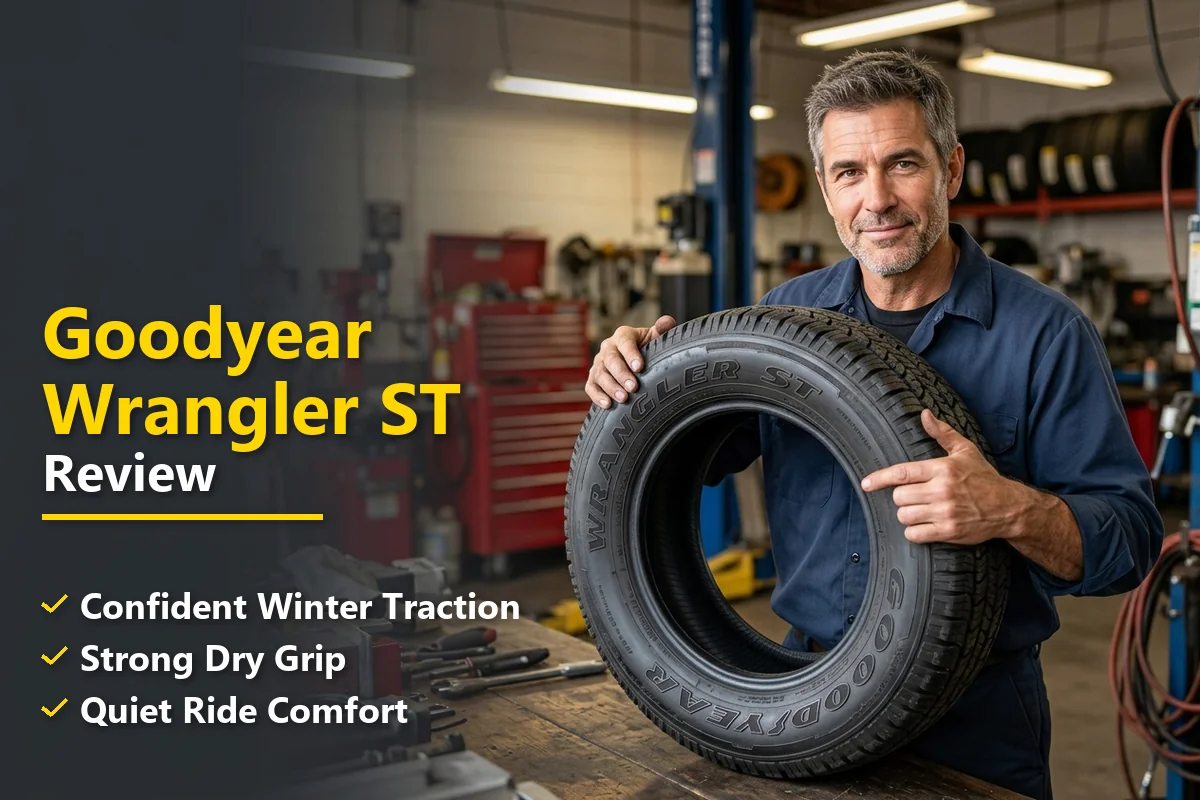
If you’ve ever gone to replace the factory tires on your truck or SUV and found “Goodyear Wrangler ST” stamped on the sidewall, you’re not alone. This tire has been an OEM staple for years, shipped on millions of vehicles from the factory — but does that automatically make it the right choice when it’s time for a new set?
I spent an extended period driving on the Goodyear Wrangler ST across highways, city streets, and light gravel roads to give you a thorough, no-nonsense answer. For a broader look at how this tire fits into the brand’s full lineup, our comprehensive Goodyear Tires Review guide compares every current model side by side.
- The Goodyear Wrangler ST is a highway all-season tire designed primarily for trucks and SUVs — it’s a solid, no-frills option for everyday commuting.
- Dry and wet grip on pavement are respectable, but don’t expect any off-road capability beyond packed gravel.
- Ride comfort and highway noise are above average for the price, though treadlife can be disappointing compared to newer competitors.
- Best suited for drivers who stick to paved roads and want an affordable, predictable OEM replacement.
- If you need winter traction or aggressive off-road performance, look elsewhere.
Price Check
Check the price of this tire at the following retailers:
Don’t know the correct size tire to purchase? Start here!
Liked this article?
Add TireAdvise as a preferred source so you see more of our tire reviews and guides on Google.
What Is the Goodyear Wrangler ST?
The Goodyear Wrangler ST is a highway all-season tire engineered for light trucks, SUVs, and crossovers. It sits in Goodyear’s Wrangler family, which is their truck-focused lineup, but it’s positioned squarely as a road-oriented option rather than an off-road performer.
You’ll find the “ST” designation stands for “Street,” and that’s exactly what this tire is built for. Goodyear designed it with an emphasis on highway comfort, fuel efficiency, and year-round traction on paved surfaces.
This tire has been around for quite a while, and it originally gained massive distribution as original equipment on vehicles like the Ford Explorer, Chevrolet Tahoe, GMC Yukon, and several Dodge trucks. That OEM pedigree means millions of Americans have driven on these tires without even choosing them — they simply came with the vehicle.
My Testing Setup and Conditions
I ran the Goodyear Wrangler ST in a P245/70R16 size on a mid-2000s Chevy Tahoe — one of the vehicles this tire was originally specced for. I wanted to evaluate it in its natural habitat, so to speak.
During my test period, I covered a range of conditions: interstate highway driving at sustained speeds, stop-and-go city commuting, rain-soaked suburban roads, and some light gravel county roads in the Midwest. I also had the chance to drive on the tires during a couple of frosty mornings, though I didn’t encounter any significant snowfall during testing.
I measured tread depth at regular intervals, monitored tire pressure weekly, and paid close attention to road noise, steering response, and braking feel throughout my evaluation. All pressures were maintained at the manufacturer-recommended specification.
Tread Design and Construction
The Wrangler ST uses a symmetric tread pattern with four circumferential grooves. This is a fairly traditional design that prioritizes straight-line highway stability and water evacuation over aggressive cornering grip.
The tread blocks are moderately sized with shallow siping. You’ll notice the shoulder blocks are relatively uniform, lacking the stepped or staggered design you’d see on more terrain-capable Wrangler models. This tells you right away that off-road grip wasn’t a design priority.
Internally, the tire features a two-ply polyester casing with two steel belts and a nylon overlay. It’s a sturdy construction for a highway tire, and I never felt any squirm or instability even when the truck was loaded with passengers and cargo for a weekend trip.
Tread Compound
Goodyear uses what they describe as an all-season compound on the Wrangler ST. In practice, I found it strikes a middle ground — not as soft and grippy as a dedicated summer compound, but not as stiff as some budget all-seasons I’ve tested. This balance contributes to the tire’s decent ride comfort, which I’ll cover in more detail below.
Dry Performance
On dry pavement, the Wrangler ST feels confident and stable. Highway cruising at 65–75 mph is where this tire truly shines — it tracks straight, responds predictably to lane changes, and gives you that planted, secure feeling that makes long drives less fatiguing.
Braking performance on dry roads was adequate. I wouldn’t call it class-leading, but stopping from highway speeds felt consistent and progressive. There’s no dramatic tire squeal or loss of composure during moderate-to-hard braking.
Where the tire shows its limitations is in spirited cornering. Push the Tahoe through a cloverleaf on-ramp a bit quickly, and you’ll feel the sidewalls flex and the tread break loose sooner than you’d want. But let’s be real — nobody’s autocrossing a Tahoe. For normal, everyday driving, the dry grip is perfectly fine.
Wet Performance
This is where I have mixed feelings. During moderate rain, the Wrangler ST performs respectably. Those four wide grooves do a decent job of channeling water away from the contact patch, and I didn’t experience any sudden loss of traction on wet highways.
However, during a particularly heavy downpour on an interstate in Indiana, I noticed the steering felt noticeably lighter than I’d prefer. There wasn’t full-on hydroplaning, but there was a clear reduction in feedback that told me the tires were working hard to stay connected to the road.
Compared to newer all-season designs — like what you’d find on the Goodyear Assurance Weatherready 2, which is specifically engineered for severe weather conditions — the Wrangler ST’s wet performance feels a generation behind. It’s serviceable, not exceptional.
Winter and Cold Weather Capability
Let me be direct: the Goodyear Wrangler ST does not carry the Three-Peak Mountain Snowflake (3PMSF) rating. This means it has not passed the industry-standard severe snow traction test, and Goodyear does not market it as a winter tire.
On frosty mornings during my testing, I noticed the compound felt stiffer than I’d like, and initial traction from a dead stop was sluggish until the tires warmed up. The shallow siping doesn’t do the tire any favors in icy or snowy conditions.
If you live in the Sun Belt or a mild-winter region and rarely see snow, the Wrangler ST will get you through cold mornings without much drama. But if you’re in the northern half of the US and deal with regular snow and ice, I’d strongly recommend either dedicated winter tires or a more modern all-weather design.
Ride Comfort and Noise
This is one area where the Wrangler ST genuinely impressed me. For a truck tire at this price point, the ride quality is noticeably smooth. It absorbs expansion joints, small potholes, and rough pavement patches without the jarring harshness I’ve experienced on some competitors.
Highway noise is well-controlled too. There’s a subtle, consistent hum at speed, but it never becomes intrusive or tiring. I was able to hold conversations and listen to podcasts at normal volume during long highway stretches — something that isn’t always a given with truck tires.
The sidewall flexibility that hurts cornering performance actually helps here — it acts as a natural cushion against road imperfections. Goodyear clearly prioritized comfort for this application, and it shows.
Treadlife and Durability
Here’s where my review takes a more critical turn. The Goodyear Wrangler ST comes with a limited treadwear warranty, but in my experience and based on feedback I’ve gathered from other owners, treadlife is one of the tire’s weaker points.
After several weeks of mixed driving, I was already beginning to see measurable tread depth reduction that seemed faster than I’d expect from a highway all-season. The tread compound, while comfortable, doesn’t appear to be optimized for maximum longevity.
I should note that treadlife is highly dependent on vehicle alignment, tire pressure maintenance, driving style, and load. But even accounting for those variables, the Wrangler ST seems to wear faster than many of its modern competitors in the highway all-season truck tire segment. If longevity is your top priority, you may want to explore other options.
Rotation Recommendations
I rotated these tires on the standard 5,000-mile interval and recommend you do the same. Given the wear characteristics I observed, consistent rotation is especially important to maximize even tread wear across all four tires. Don’t skip or delay rotations with this tire — it matters more here than on some others I’ve tested.
Off-Road and Light Trail Performance
Despite carrying the “Wrangler” name — which many people associate with rugged, off-road capability — the ST is not an off-road tire. I want to be very clear about this because I’ve seen confusion among buyers.
On packed gravel roads, the tire performs fine. I drove several rural county roads without any issues. But the moment you encounter loose gravel, mud, sand, or anything resembling an actual trail, the Wrangler ST is out of its depth. The tread pattern simply doesn’t have the void ratio or aggressive lugs needed for off-road traction.
If you need a Goodyear tire that can handle both highway driving and occasional off-road excursions, look at the Wrangler AT Adventure or Wrangler DuraTrac instead. The “ST” in Wrangler ST really does mean “street,” and Goodyear is honest about that positioning.
How Does It Compare to Other Goodyear Models?
One of the most common questions I get is how the Wrangler ST stacks up against other tires in the Goodyear family. While it’s a truck tire and occupies a different category than many of Goodyear’s passenger car offerings, the comparison points are still useful for owners considering a switch.
For instance, if you drive a crossover SUV and are torn between an SUV-rated all-season and a more performance-oriented option, the Goodyear Eagle Touring delivers a far more refined ride with better wet grip — though it’s designed for a different type of vehicle. Similarly, the Goodyear Efficient Grip prioritizes fuel economy and comfort for lighter vehicles.
For performance-minded drivers curious about the broader Goodyear catalog, options like the Goodyear Eagle F1 Asymmetric 3 and the Goodyear Eagle F1 Asymmetric 5 represent the brand’s cutting edge in summer performance — completely different animals from the Wrangler ST, but indicative of Goodyear’s engineering range.
Goodyear Wrangler ST vs. Key Competitors
To give you proper context, I’ve compared the Wrangler ST against some of the most popular highway all-season truck tires on the US market. Here’s how they line up:
| Feature | Goodyear Wrangler ST | Michelin LTX M/S2 | Bridgestone Dueler H/L Alenza Plus | Cooper Discoverer HTP |
|---|---|---|---|---|
| Tire Type | Highway All-Season | Highway All-Season | Highway All-Season | Highway All-Season |
| Dry Grip | Good | Excellent | Very Good | Good |
| Wet Grip | Average | Excellent | Very Good | Good |
| Ride Comfort | Very Good | Excellent | Excellent | Good |
| Noise Level | Low | Very Low | Very Low | Moderate |
| Treadlife | Average | Excellent | Very Good | Very Good |
| Snow Traction | Poor | Fair | Fair | Fair |
| Approx. Price (per tire) | $110–$160 | $170–$240 | $160–$220 | $120–$170 |
As you can see, the Wrangler ST holds its own on comfort and noise, but it falls behind the Michelin and Bridgestone options in nearly every performance category. The tradeoff is price — the Wrangler ST is generally the most affordable option in this group.
The Cooper Discoverer HTP is its closest competitor in terms of pricing and positioning. In my experience, the Cooper offers slightly better treadlife while the Wrangler ST edges it out on ride comfort.
Pricing and Value
Depending on the size, you can expect to pay between $110 and $160 per tire for the Goodyear Wrangler ST at major US retailers like Tire Rack, Discount Tire, Walmart, and Costco. That puts it in the budget-to-mid-range category for highway truck tires.
Is it a good value? That depends on what you prioritize. If ride comfort and brand familiarity matter most and you’re on a tighter budget, the Wrangler ST delivers decent bang for the buck. But if you want the best overall performance and longest treadlife, spending an extra $40–$60 per tire on a Michelin LTX M/S2 or Bridgestone Dueler will likely save you money in the long run.
I always recommend checking for manufacturer rebates and retailer promotions. Goodyear frequently runs $50–$100 rebate events on sets of four, which can significantly sweeten the deal on the Wrangler ST.
Who Should Buy the Goodyear Wrangler ST?
After my thorough evaluation, I believe the Wrangler ST is best suited for a specific type of driver. Let me break it down:
- Budget-conscious truck and SUV owners who primarily drive on highways and city streets
- OEM replacement buyers who want to stick with what came on their vehicle without overthinking the decision
- Comfort-first drivers who prioritize a smooth, quiet ride over maximum traction or treadlife
- Sun Belt and mild-climate residents who rarely encounter snow or ice
Who Should Skip It?
Equally important, here’s who I’d steer away from the Wrangler ST:
- Drivers in snow-prone regions — the lack of a 3PMSF rating and shallow siping make this a poor winter performer
- Anyone who goes off-road — even occasionally. The tread design simply isn’t built for it
- Treadlife-focused buyers — newer competitors offer significantly better longevity at a modest price premium
- Performance-oriented drivers — if you want sharp handling and maximum grip, you’ll need to look at entirely different categories. For high-performance Goodyear options, check out the Goodyear Eagle Exhilarate or the Goodyear Eagle F1 Asymmetric 6 for cutting-edge summer grip
Installation and Maintenance Tips
If you do choose the Wrangler ST, here are a few tips from my experience to get the most out of them:
Tire Pressure
Stick to the pressure listed on your vehicle’s door jamb placard — not the maximum pressure listed on the tire sidewall. I checked pressure weekly with a quality digital gauge and found that consistent pressure maintenance made a noticeable difference in ride quality and even wear.
Rotation Schedule
As I mentioned earlier, don’t stretch your rotation intervals. Regular rotations are critical with this tire. I recommend every oil change as a convenient reminder to get them rotated.
Alignment Matters
Have your alignment checked when the tires are installed. The Wrangler ST seems particularly sensitive to alignment issues — even a slight toe-in or toe-out imbalance showed up as uneven shoulder wear during my test period. A $75–$100 alignment at installation could save you hundreds in premature tire replacement.
How It Fits in Goodyear’s Broader Lineup
Understanding where the Wrangler ST sits within Goodyear’s massive tire portfolio helps clarify whether it’s the right choice for you. Goodyear segments their lineup into distinct families, and each serves a different driver.
The Wrangler family covers truck and SUV tires, ranging from the highway-focused ST to the off-road-ready DuraTrac. Meanwhile, the Eagle family — featuring models like the Goodyear Eagle F1 Asymmetric 2, the Goodyear Eagle F1 Asymmetric All Season, and the track-oriented Goodyear Eagle F1 Supercar 3R — caters to sports cars and performance sedans.
Even within the performance space, Goodyear offers interesting variety. The Goodyear Eagle F1 Supercar and Goodyear Eagle F1 Supersport are built for extreme performance applications, while the Goodyear Excellence targets luxury touring. These aren’t competitors to the Wrangler ST, but they demonstrate the breadth of Goodyear’s engineering capabilities.
For truck and SUV owners specifically, the key question is whether you need the Wrangler ST’s highway comfort or the additional off-road and winter capability of other Wrangler variants. In most cases, I’d recommend modern all-terrain options for their greater versatility — unless comfort and price are your absolute top priorities.
Real-World Fuel Economy Observations
One aspect that doesn’t get enough attention in tire reviews is fuel economy impact. During my test period, I tracked fuel consumption carefully and found the Wrangler ST performed roughly on par with the OEM tires I removed — which makes sense, since it was designed as an OEM fitment in the first place.
The symmetric tread pattern and relatively smooth tread surface contribute to low rolling resistance for a truck tire. I didn’t notice any measurable increase in fuel consumption compared to what the vehicle had been averaging previously. For a full-size SUV driven mostly on highways, that’s a meaningful consideration given today’s gas prices.
Load Capacity and Towing
The Wrangler ST is available in both P-metric and LT sizes, but the most common fitments are P-metric. If you tow trailers, haul heavy loads in the bed, or use your truck for commercial purposes, pay close attention to the load rating.
The P-metric versions have lower load ratings than equivalent LT tires. For my Tahoe, the P245/70R16 had a Standard Load rating that was perfectly adequate for daily driving and moderate cargo. But if you’re regularly loading up close to your vehicle’s GVWR, you’ll want to either source an LT-rated size or consider a different tire entirely.
I drove with the truck loaded for a weekend camping trip — coolers, gear, and four adults — and the Wrangler ST handled the extra weight without complaint. But I was still well within the load rating, and I’d caution against pushing it.
The Bottom Line: My Final Verdict
After spending weeks driving on the Goodyear Wrangler ST across varied conditions, I’d summarize it this way: it’s a perfectly adequate highway tire that prioritizes comfort and affordability over outright performance and longevity.
In its day, the Wrangler ST was a solid OEM choice that gave millions of truck and SUV owners a smooth, quiet ride. But the tire market has evolved significantly, and newer designs offer better wet grip, longer treadlife, and improved winter capability for a modest increase in price.
If you’re replacing factory Wrangler STs and want the exact same tire because you were happy with how it performed, that’s a perfectly reasonable choice. Just know that you’re leaving some performance and value on the table compared to what’s available now.
For budget-conscious buyers in mild climates who stick to paved roads, I give the Goodyear Wrangler ST a solid 3.5 out of 5 stars. It does what it promises without fanfare — nothing more, nothing less.
My Rating Breakdown
- Dry Performance: 7/10
- Wet Performance: 5.5/10
- Winter/Snow: 3/10
- Comfort: 8/10
- Noise: 7.5/10
- Treadlife: 5/10
- Value: 6.5/10
- Overall: 3.5/5
Whatever you decide, make sure you’re choosing a tire that matches your actual driving habits — not just defaulting to what came on the truck. And if you want to explore more Goodyear options before committing, our full Goodyear Tires Review guide is a great starting point for comparing models across every category.
Frequently Asked Questions
Is the Goodyear Wrangler ST a good tire for everyday highway driving?
The Goodyear Wrangler ST is a solid choice for everyday highway driving, especially on SUVs and light trucks. It delivers a smooth, quiet ride on paved roads and offers reliable dry traction for daily commuting. However, it’s designed primarily as an OEM all-season tire, so it prioritizes comfort over aggressive off-road capability.
How long does the Goodyear Wrangler ST last in real-world driving conditions?
Most drivers report getting between 40,000 and 60,000 miles from the Goodyear Wrangler ST, depending on driving habits, alignment, and rotation schedule. Goodyear does not offer a treadwear mileage warranty on the Wrangler ST, which is something to consider when comparing it to competitors. Regular tire rotations every 5,000-7,000 miles can help maximize tread life.
How does the Goodyear Wrangler ST perform in rain and wet road conditions?
The Goodyear Wrangler ST provides adequate wet traction for moderate rain conditions thanks to its circumferential grooves that help channel water away from the contact patch. That said, many drivers note that wet grip noticeably decreases as the tread wears down past the halfway point. If you frequently drive in heavy rain or live in the Pacific Northwest, you may want to consider a tire with stronger wet performance ratings.
How much does the Goodyear Wrangler ST cost, and is it worth the price?
The Goodyear Wrangler ST typically ranges from $130 to $190 per tire depending on the size, with common sizes like P245/75R16 and P265/70R17 falling in the middle of that range. For the price, it offers good value as a highway-focused all-season tire with a comfortable ride. It’s often available at Walmart, Discount Tire, and Tire Rack, so shopping around can save you $20-$40 per set.
Can the Goodyear Wrangler ST handle light snow and winter driving?
The Goodyear Wrangler ST can manage occasional light snow and cold temperatures, but it does not carry the Three-Peak Mountain Snowflake (3PMSF) rating, which means it is not certified for severe winter conditions. If you live in states like Minnesota, Michigan, or Colorado where heavy snow is common, I’d recommend pairing these with a dedicated set of winter tires or choosing an all-terrain tire with better snow traction.
What vehicles come with the Goodyear Wrangler ST as original equipment?
The Goodyear Wrangler ST was originally designed as OEM fitment for popular SUVs and trucks including the Ford Explorer, Chevrolet Tahoe, GMC Yukon, and Jeep Grand Cherokee. Many drivers seek this tire as a direct replacement because it matches the ride quality and handling characteristics the vehicle was engineered around. Check your door jamb sticker or owner’s manual to confirm the correct size before ordering.
How does the Goodyear Wrangler ST compare to the Goodyear Wrangler SR-A?
The Goodyear Wrangler ST is more highway-oriented with a focus on ride comfort and noise reduction, while the Wrangler SR-A offers slightly more versatile all-season performance and comes with a 50,000-mile treadwear warranty. The SR-A also tends to perform a bit better in wet and light off-road conditions. If you stick to paved roads and value a quieter ride, the Wrangler ST is a good fit, but the SR-A gives you more well-rounded protection for the same general price range.
