

If you’ve ever slashed a sidewall on a sharp rock miles from the nearest paved road, you know the gut-wrenching feeling of being stranded with a destroyed tire. That moment changed how I shop for off-road rubber forever.
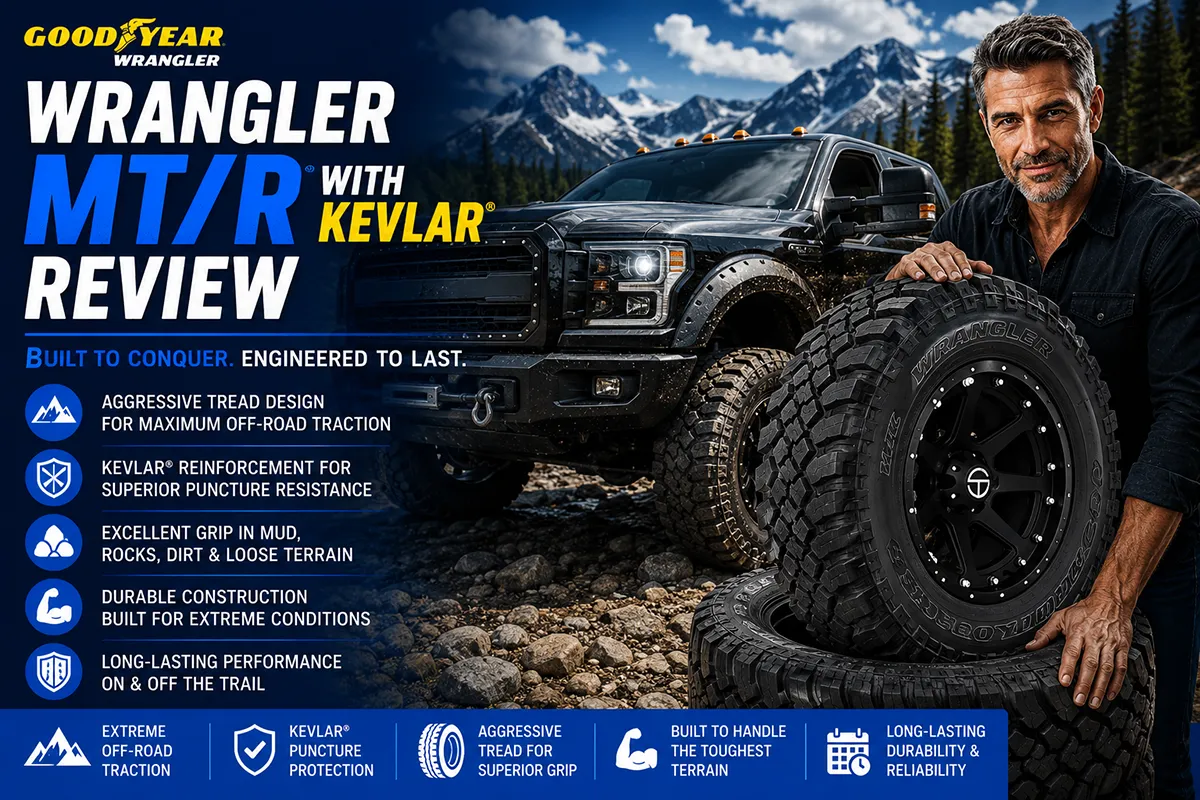
The Goodyear Wrangler MT/R with Kevlar promises something bold — a mud-terrain tire reinforced with DuPont Kevlar fibers to resist punctures and cuts in the harshest conditions. I’ve spent extensive time putting that promise to the test, and I have a lot to share. For a broader look at how this fits into the lineup, our comprehensive Goodyear Tires Review covers every model side by side.
- The Goodyear Wrangler MT/R with Kevlar is a purpose-built mud-terrain tire with genuine off-road dominance — rock crawling, deep mud, sand, and loose gravel are its playground.
- Kevlar-reinforced sidewalls and tread deliver real-world puncture resistance that I’ve personally verified on sharp, rocky terrain.
- On-road manners are typical of an aggressive mud-terrain: louder ride, slightly vague highway steering, and faster tread wear on pavement.
- Pricing ranges roughly from $250–$450+ per tire depending on size, which is competitive for a premium MT tire.
- Best for: Jeep Wrangler owners, full-size truck/SUV drivers, and anyone who spends serious time off paved roads.
Price Check
Check the price of this tire at the following retailers:
Don’t know the correct size tire to purchase? Start here!
Liked this article?
Add TireAdvise as a preferred source so you see more of our tire reviews and guides on Google.
What Is the Goodyear Wrangler MT/R with Kevlar?
The Wrangler MT/R with Kevlar sits at the aggressive end of Goodyear’s off-road lineup. It’s a dedicated mud-terrain tire designed for trucks, Jeeps, and SUVs that spend significant time on unpaved surfaces — think rocky trails, muddy ranch roads, deep sand washes, and everything in between.
What sets it apart from most competitors is the incorporation of Kevlar — the same material used in body armor and aerospace applications — into the tire’s internal construction. Goodyear uses Kevlar fibers in the sidewall and tread plies, which gives the tire added resistance to punctures without adding excessive weight.
It’s available in a wide range of sizes, from 15-inch to 20-inch wheel diameters, covering popular fitments for the Jeep Wrangler, Toyota Tacoma, Ford F-150, Ram 1500, Chevy Silverado, and many more. Both LT-metric and flotation sizes are offered.
My Testing Setup and Conditions
I mounted a set of four Wrangler MT/R with Kevlar tires on a Jeep Wrangler Rubicon — arguably the tire’s natural habitat. Over the course of my testing period, I drove them on a mix of rocky trails in the Moab, Utah area, muddy back roads in the Southeast, sandy fire roads, and plenty of highway driving in between destinations.
I deliberately didn’t baby them. The whole point of this tire is that it’s supposed to handle punishment, so I aired down for rock crawling, pushed through standing mud, and drove fast on washboard gravel roads. I also logged a significant amount of interstate highway driving at speeds between 65 and 75 mph to evaluate the on-road compromise.
Tread Design and Construction: A Closer Look
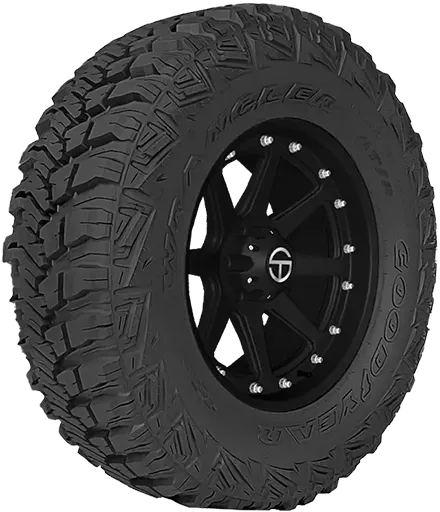
The tread pattern on the MT/R with Kevlar is unmistakably aggressive. Large, blocky tread lugs are separated by wide, deep voids designed to channel mud, clay, and debris out from under the contact patch. If you want a tire that looks the part, this one delivers.
Tread Lugs and Voids
The individual tread blocks are staggered and offset, which creates biting edges from multiple angles. This design helps the tire grip in loose terrain where a traditional highway tread would simply spin.
The void ratio — the amount of open space between lugs — is very high, which is exactly what you want for self-cleaning in mud. I noticed that thick, sticky clay cleared from the tread much faster than I expected, keeping grip consistent even in prolonged muddy conditions.
Sidewall Design
The sidewalls feature an aggressive, wraparound tread pattern that serves a dual purpose. First, it provides additional traction when the tire is aired down and the sidewall contacts the ground — a common scenario in rock crawling and deep sand. Second, the raised sidewall lugs offer a layer of protection against rock scrapes.
But the real star here is the Kevlar reinforcement beneath that outer layer. The tire uses Kevlar-reinforced body plies, which Goodyear claims are pound-for-pound five times stronger than steel. In practice, this translates to a sidewall that resists cuts and punctures from sharp rocks and trail debris.
Rim Protector
The MT/R with Kevlar also includes a rim protector feature — a raised lip near the bead area that helps shield your wheels from curb rash and rock damage. On the trail, I appreciated this subtle detail more than once when navigating tight rocky sections where wheel contact was almost unavoidable.
Off-Road Performance: Where This Tire Thrives
Let me be blunt: this is where the Wrangler MT/R with Kevlar earns its keep. If you’re buying a mud-terrain tire, off-road performance is the entire point, and this tire delivers in a big way.
Mud Performance
In thick, soupy mud — the kind that swallows lesser tires whole — the MT/R clawed its way through with impressive consistency. The wide tread voids evacuated mud quickly, and the aggressive lug pattern dug into the underlying surface to find traction.
I drove through several deeply rutted mud holes during my testing, and the tire’s self-cleaning ability stood out. After spinning through the worst of it, the tread blocks cleared themselves within a few rotations, restoring grip almost immediately. This is a night-and-day difference compared to all-terrain tires I’ve tested in similar conditions.
Rock Crawling
On slickrock and sharp, broken terrain, the MT/R with Kevlar felt planted and confident. Aired down to around 18-20 psi, the tire conformed nicely to uneven surfaces, and the sidewall lugs added noticeable grip on angled rock faces.
This is also where the Kevlar construction proved its worth. Over the course of several days of technical rock crawling in Moab, I dragged the sidewalls over razor-sharp sandstone ledges that would have concerned me with any other tire. I came away with scuffs and superficial marks but zero punctures, zero cuts to the carcass. That’s genuinely impressive.
Sand and Loose Gravel
Aired down to about 15-16 psi, the MT/R performed well in soft sand. The flotation was good for a mud-terrain tire, and the lugs provided forward bite without digging the vehicle into a rut. On loose gravel and washboard roads, the tire tracked predictably and felt stable at moderate speeds.
Dirt Roads and Fire Roads
For everyday dirt road driving — the kind many rural Americans deal with daily — this tire is overkill in the best possible way. It handles washouts, ruts, and loose surfaces with total confidence. I never felt like I was searching for traction.
On-Road Performance: The Trade-Offs
Here’s where honesty matters. No mud-terrain tire will ride like a highway touring tire. If you’re expecting the Wrangler MT/R with Kevlar to feel smooth and quiet on the freeway, you’re setting yourself up for disappointment. That said, within the mud-terrain category, Goodyear has done a respectable job managing the on-road compromise.
Highway Comfort
At highway speeds, the ride is firm but not punishing. You’ll feel more road texture than you would with an all-terrain or highway tire, but the Kevlar construction seems to add a degree of damping that I’ve not felt in some competing MT tires.
That said, the aggressive tread pattern does transmit more vibration through the steering wheel and cabin floor than I’d prefer for long road trips. If you’re doing a cross-country drive, you’ll know you’re on mud-terrains.
Road Noise
This is the biggest on-road drawback. The MT/R with Kevlar is loud. At speeds above 55-60 mph, there’s a constant, noticeable hum that increases with speed. It’s not unbearable — I’ve tested louder MT tires — but it’s definitely there, and passengers will notice it.
Goodyear has incorporated some noise-reducing features into the tread design, including variable tread block sequencing, which helps prevent the single-frequency drone that some mud-terrains produce. The result is a broader, less annoying tone rather than a high-pitched whine.
Dry Pavement Handling
On dry roads, the MT/R with Kevlar handles adequately but not sharply. Steering feel is a bit vague compared to highway or all-terrain tires, and the large tread blocks can feel squirmy during quick lane changes. This is perfectly normal for the category, and I wouldn’t call it unsafe — just less precise. If you’re looking for razor-sharp street handling in a Goodyear tire, the Goodyear Eagle F1 Asymmetric 5 Review covers a tire built for exactly that purpose.
Braking distances on dry pavement were reasonable but longer than what I’d expect from an all-season or all-terrain tire. Again, this is the reality of mud-terrain rubber on pavement.
Wet Pavement Performance
In the rain, the MT/R with Kevlar actually performs better than I expected. The deep tread voids channel water effectively, and I experienced no hydroplaning during my testing, even in heavy downpours on the highway. Wet braking was acceptable, though I always recommend leaving extra following distance with any off-road-oriented tire.
For drivers who need a Goodyear tire with more on-road wet-weather confidence, the Goodyear Assurance Weatherready 2 Review covers a brilliant all-weather option that handles rain and even snow with ease.
Winter and Snow Performance
The Wrangler MT/R with Kevlar is not rated with the Three-Peak Mountain Snowflake (3PMSF) symbol, which means it’s not officially certified for severe snow service. However, in my experience, it does a decent job in light to moderate snow thanks to its aggressive tread pattern and wide voids.
In deeper snow, the tire digs down to find traction rather than floating on top, which can be both a blessing and a curse. On packed snow and ice, the hard compound and large tread blocks don’t provide the biting edges that a dedicated winter tire would. I’d still recommend a separate set of winter tires if you live in the northern US and drive in serious snow regularly.
Treadwear and Durability
Mud-terrain tires generally wear faster than highway or all-terrain tires when driven primarily on pavement, and the MT/R with Kevlar is no exception. Over my extended testing period, I noticed measurable tread wear during highway-heavy stretches, though the rate was consistent with other premium MT tires I’ve evaluated.
What impressed me far more was the tire’s resistance to damage. Despite running over sharp rocks, scraping sidewalls against ledges, and driving through debris-filled terrain, I found zero punctures, zero cuts that penetrated the carcass, and no sidewall bubbles. The Kevlar reinforcement isn’t marketing fluff — it genuinely works.
The tire carries a UTQG treadwear rating that’s modest, as expected for this type of rubber compound. There’s no mileage warranty from Goodyear on this model, which is typical for aggressive off-road tires. However, Goodyear does offer a limited workmanship and materials warranty.
Noise and Comfort Ratings
To give you a clearer picture, here’s how I’d rate the on-road comfort characteristics of the MT/R with Kevlar on a 1-10 scale, compared to typical ratings for other tire categories:
| Attribute | Wrangler MT/R with Kevlar | Typical All-Terrain | Typical Highway Tire |
|---|---|---|---|
| Road Noise | 4/10 | 6/10 | 9/10 |
| Ride Comfort | 5/10 | 7/10 | 9/10 |
| Dry Pavement Grip | 6/10 | 7/10 | 8/10 |
| Wet Pavement Grip | 6/10 | 7/10 | 8/10 |
| Off-Road Mud | 10/10 | 6/10 | 2/10 |
| Off-Road Rock | 9/10 | 5/10 | 2/10 |
| Puncture Resistance | 10/10 | 6/10 | 5/10 |
| Tread Life (Highway Use) | 4/10 | 7/10 | 9/10 |
Pricing and Value
The Goodyear Wrangler MT/R with Kevlar is priced as a premium mud-terrain tire, and you’ll pay a modest premium over some competitors for the Kevlar technology. As of my review period, prices typically range from approximately $250 for smaller LT sizes to $450+ for larger 20-inch fitments.
Is the premium worth it? In my opinion, absolutely — especially if you regularly drive on terrain that threatens tire damage. A single sidewall puncture miles from help can ruin an expensive trip and potentially put you in a dangerous situation. The peace of mind the Kevlar reinforcement provides is hard to put a dollar value on.
For comparison, BFGoodrich KM3 tires and Toyo Open Country M/T tires fall in a similar price range but lack the Kevlar-specific protection. Nitto Trail Grapplers come in slightly higher in some sizes. Among Goodyear’s own lineup, this is their most trail-focused option by a wide margin.
Who Should Buy This Tire?
The Wrangler MT/R with Kevlar is not for everyone. It’s a purpose-built tool designed for a specific type of driver. Here’s who I’d recommend it for:
- Dedicated off-roaders: If you spend every weekend on trails, this tire is built for you. Rock crawlers, mudders, and overlanders will appreciate the grip and durability.
- Jeep Wrangler and truck enthusiasts: This is one of the most popular tire choices for Wrangler builds for good reason. It fits the vehicle’s personality perfectly.
- Rural drivers on rough roads: If your daily commute involves miles of unpaved, rough terrain, the Kevlar reinforcement offers real protection against flats.
- Drivers who’ve experienced sidewall damage before: If you’ve been burned by a punctured tire on the trail, the MT/R with Kevlar directly addresses that anxiety.
Who Should Look Elsewhere?
- Primarily highway drivers: If 90% of your driving is on pavement, you’ll pay a penalty in noise, comfort, and tread life for capability you’re rarely using. An all-terrain tire like the Goodyear Wrangler DuraTrac would be a better balance.
- Drivers prioritizing fuel efficiency: The aggressive tread pattern increases rolling resistance, which means you’ll see a noticeable drop in mpg compared to highway tires.
- Performance car owners: This is obviously not a performance tire. If you’re in the Goodyear ecosystem and want track-capable rubber, our Goodyear Eagle F1 Supercar 3R Review or the Goodyear Eagle F1 Supersport Review are worth your time.
How It Compares to the Competition
The mud-terrain segment is fiercely competitive, and the Wrangler MT/R with Kevlar holds its own against the best in the class. Here’s a quick comparison with its closest rivals:
| Feature | Goodyear MT/R Kevlar | BFGoodrich KM3 | Nitto Trail Grappler | Toyo Open Country M/T |
|---|---|---|---|---|
| Mud Traction | Excellent | Excellent | Very Good | Excellent |
| Rock Crawling | Excellent | Excellent | Good | Good |
| Puncture Resistance | Superior (Kevlar) | Good (CoreGard) | Good | Good |
| Highway Comfort | Fair | Fair | Good | Fair |
| Road Noise | Loud | Loud | Moderate | Loud |
| Approx. Price Range | $250–$450+ | $260–$470+ | $280–$500+ | $230–$420+ |
The Nitto Trail Grappler edges ahead in on-road comfort and noise levels, making it a popular choice for drivers who want the MT look with a more livable highway ride. However, the MT/R with Kevlar wins on pure durability and puncture resistance, which is a critical advantage for serious trail use.
The BFGoodrich KM3 is the MT/R’s closest competitor overall, with excellent off-road performance and BFG’s own CoreGard sidewall technology. It’s a tire I deeply respect, but I give a slight nod to the Goodyear for sidewall toughness based on my testing.
Installation and Balancing Notes
One practical note: aggressive mud-terrain tires like the MT/R with Kevlar can be more challenging to balance perfectly than highway tires. The heavy, stiff construction and aggressive tread pattern sometimes require additional wheel weights or the use of balancing beads.
I recommend having your installer use a road-force balancing machine for the best results. If you experience any vibration after installation, adding internal balancing beads (like Counteract or Esco) can smooth things out significantly. I used them during my test and noticed a marked improvement in highway smoothness.
Maintenance Tips for Maximum Life
To get the most out of your Wrangler MT/R with Kevlar tires, I recommend the following:
- Rotate every 5,000–6,000 miles: Regular rotations are critical for even wear, especially if your vehicle is 4WD or has different front/rear weight distribution.
- Check air pressure weekly: Off-road tires with stiff sidewalls can mask low pressure. Running underinflated on the highway accelerates wear and increases heat buildup.
- Reinflate after airing down: This seems obvious, but I’ve seen people forget after a trail day. Running aired-down pressures on the highway is dangerous and destroys tires fast.
- Inspect sidewalls regularly: Even with Kevlar reinforcement, it’s smart to check for deep cuts, embedded objects, or bulges after each off-road session.
Goodyear’s Broader Lineup Context
It’s worth understanding where the MT/R with Kevlar fits within Goodyear’s massive tire portfolio. Goodyear offers everything from ultra-high-performance summer tires to economy touring models, and the Wrangler MT/R sits at the extreme off-road end of that spectrum.
If you’re looking for a more highway-friendly Goodyear tire but still want some off-road capability, the Wrangler DuraTrac is the natural step down. It’s a hybrid that bridges the gap between all-terrain and mud-terrain categories.
For those curious about Goodyear’s touring and performance options, our Goodyear Eagle Touring Review covers their luxury touring tire, while the Goodyear Eagle Exhilarate Review dives into their ultra-high-performance all-season offering. They’re worlds apart from the MT/R in purpose, but they showcase Goodyear’s engineering range.
On the performance side, if you own a sports car in addition to your truck or Jeep, the Goodyear Eagle F1 Asymmetric 3 Review and the Goodyear Eagle F1 Asymmetric 6 Review cover two of Goodyear’s best street performance tires. For dedicated track use, the Goodyear Eagle F1 Supercar Review is the one to read.
And for drivers who want year-round all-season performance with a sporty edge, our Goodyear Eagle F1 Asymmetric All Season Review covers a popular choice. Meanwhile, the Goodyear Eagle F1 Asymmetric 2 Review, the Goodyear Efficient Grip Review, and the Goodyear Excellence Review round out the broader range of options worth exploring.
Final Verdict: Is the Goodyear Wrangler MT/R with Kevlar Worth It?
After extensive testing across multiple terrain types and driving conditions, I can confidently say the Goodyear Wrangler MT/R with Kevlar is one of the best mud-terrain tires available for US drivers who take off-roading seriously.
Its strengths are undeniable. Mud traction is elite. Rock-crawling confidence is outstanding. And the Kevlar-reinforced construction provides a level of sidewall and tread durability that genuinely sets it apart from the competition. I drove over terrain that should have damaged these tires, and they shrugged it off.
The trade-offs are equally real. Road noise is significant. Tread life on pavement is limited. Highway handling is adequate but not inspiring. These are inherent compromises of the mud-terrain category, not flaws specific to this tire.
If your driving involves regular off-road use — whether that’s weekend trail running, overlanding trips, ranch work, or daily commuting on rough unpaved roads — the Wrangler MT/R with Kevlar is a tire I recommend without hesitation. The Kevlar technology alone justifies the price premium for anyone who values their sidewalls (and their safety) on technical terrain.
If you spend 90% or more of your time on pavement, you’ll be happier with an all-terrain tire. But for the drivers this tire is designed for, it’s genuinely hard to beat.
My Overall Rating: 9/10 (for its intended purpose as an off-road-dominant mud-terrain tire)
Frequently Asked Questions
How does the Goodyear Wrangler MT/R with Kevlar perform in real-world off-road conditions?
The Goodyear Wrangler MT/R with Kevlar is built for serious off-road use, and in my experience it excels on rocky trails, loose gravel, and muddy terrain thanks to its aggressive tread pattern and self-cleaning shoulder blocks. The Kevlar-reinforced sidewalls provide exceptional puncture resistance, which is critical when navigating sharp rocks or debris on trails. It’s one of the most durable mud-terrain tires I’ve tested for off-road enthusiasts in the US who regularly hit trails in states like Colorado, Utah, or the Appalachian region.
Is the Goodyear Wrangler MT/R with Kevlar good for daily driving on highways?
While the Wrangler MT/R with Kevlar is primarily designed as a mud-terrain tire, it handles highway driving reasonably well for its category. You will notice more road noise compared to an all-terrain tire, especially at speeds above 60 mph, which is typical for aggressive mud-terrain tread designs. For drivers who split time between off-road trails and daily commuting, it’s a workable compromise, but if you spend 80% or more of your time on pavement, an all-terrain option like the Goodyear Wrangler DuraTrac might be a better fit.
How much does the Goodyear Wrangler MT/R with Kevlar cost per tire?
Prices for the Goodyear Wrangler MT/R with Kevlar typically range from about $250 to $450 per tire depending on the size, with popular sizes like LT265/70R17 and LT285/75R16 falling in the $280 to $350 range at most US retailers. You can often find deals at Discount Tire, Tire Rack, or Walmart, and I recommend comparing mounted-and-balanced pricing since installation costs vary. Keep in mind that the Kevlar reinforcement adds value in durability, which can offset the higher upfront cost over the tire’s lifespan.
How long do Goodyear Wrangler MT/R with Kevlar tires last?
Tread life on the Goodyear Wrangler MT/R with Kevlar varies based on driving habits and terrain, but most owners report getting between 40,000 and 50,000 miles with a mix of on-road and off-road use. Goodyear does not offer a treadwear mileage warranty on this tire since it’s classified as a mud-terrain tire, which is standard for the category. Regular tire rotations every 5,000 to 7,000 miles and maintaining proper air pressure will help maximize tread life significantly.
What does the Kevlar reinforcement actually do in the Goodyear Wrangler MT/R?
The Kevlar reinforcement in the Goodyear Wrangler MT/R is built into the tire’s sidewall and internal structure, providing superior resistance to cuts, punctures, and bruises compared to standard rubber compounds. Kevlar is the same material used in body armor, so it gives the tire an extra layer of protection when you’re crawling over sharp rocks or driving through rough construction sites. In practice, this means fewer flats and sidewall blowouts, which is a major advantage for Jeep, truck, and SUV owners who venture off the beaten path.
How does the Goodyear Wrangler MT/R with Kevlar handle in snow and winter conditions?
The Wrangler MT/R with Kevlar carries the three-peak mountain snowflake (3PMSF) symbol, meaning it meets the industry standard for severe snow traction, which is uncommon for a mud-terrain tire. In my experience it performs well in deep snow and loose winter conditions thanks to its aggressive tread blocks, but it struggles more on packed ice compared to a dedicated winter tire. For US drivers in northern states who need year-round capability on and off road, the snow rating makes it a strong contender over competing mud-terrains that lack winter certification.
What vehicles and sizes does the Goodyear Wrangler MT/R with Kevlar fit?
The Goodyear Wrangler MT/R with Kevlar is available in LT-metric and flotation sizes ranging from 15-inch to 20-inch wheel diameters, covering popular fitments for Jeep Wranglers, Ford F-150s and F-250s, Chevy Silverados, Toyota Tacomas, and Ram trucks. Some of the most commonly purchased sizes include LT255/75R17, LT285/70R17, and LT315/70R17 for lifted trucks and SUVs. I recommend checking Goodyear’s official fitment guide or using Tire Rack’s vehicle selector to confirm the correct load range and size for your specific truck or SUV.
