

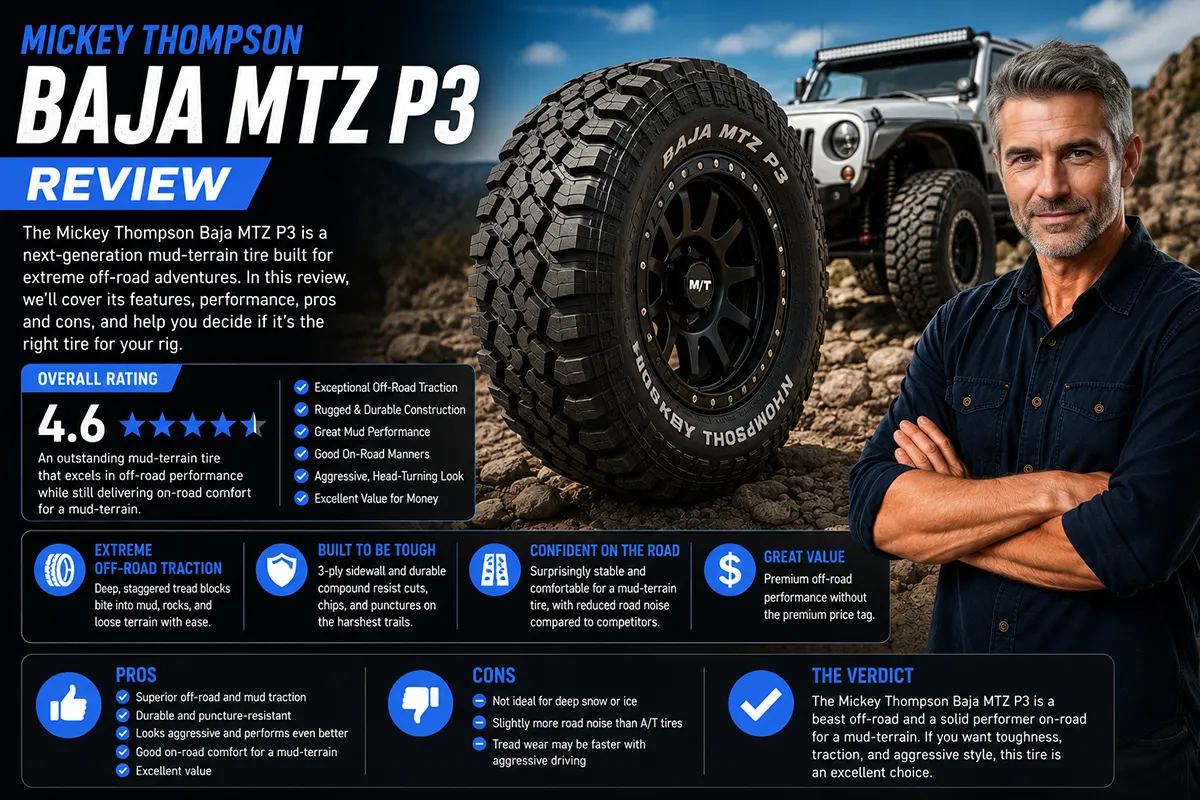
If you’ve ever buried your truck axle-deep in a muddy trail and thought, “I need a tire that actually claws its way out instead of just spinning,” you’re not alone.
I’ve been there — staring at a set of worn-out all-terrains, wondering if a real mud-terrain tire could handle both the nasty stuff and the highway commute without destroying my sanity or my wallet. That’s exactly why I spent serious time testing the Mickey Thompson Baja MTZ P3, and what I found surprised me.
Before you dive in, if you’re comparing multiple models from this brand, our comprehensive Mickey Thompson Review guide covers every model side by side and is worth bookmarking.
- The Baja MTZ P3 is a true mud-terrain tire with surprisingly competent on-road manners for its class.
- Exceptional mud, rock, and loose-surface traction — one of the best I’ve tested in deep slop.
- Road noise is noticeable but not unbearable; significantly quieter than the previous MTZ P2.
- Sidewall strength is outstanding thanks to Mickey Thompson’s PowerPly technology and aggressive sidewall lugs.
- Treadwear has been solid over my extended testing period — better than I expected for a mud-terrain.
- Best suited for truck and SUV owners who spend real time off-road but still need daily drivability.
- US pricing typically ranges from $250 to $420+ per tire depending on size.
Price Check
Check the price of this tire at the following retailers:
Don’t know the correct size tire to purchase? Start here!
Liked this article?
Add TireAdvise as a preferred source so you see more of our tire reviews and guides on Google.
What Exactly Is the Mickey Thompson Baja MTZ P3?
The Baja MTZ P3 is the third generation of Mickey Thompson’s flagship mud-terrain tire, and it’s designed for truck and SUV owners who demand real off-road capability without completely sacrificing their on-highway experience. It sits at the top of Mickey Thompson’s off-road lineup, positioned above the Baja Boss A/T and just below the competition-focused Baja Boss tires.
Mickey Thompson — now part of the Goodyear family — has been building off-road race tires since the 1960s. The brand’s Baja heritage is deeply rooted in the legendary Baja 1000 race, and that DNA shows in how these tires perform when the terrain gets ugly.
The MTZ P3 is available in a wide range of sizes from 15-inch to 22-inch wheel diameters, covering everything from midsize trucks like the Toyota Tacoma to full-size beasts like the Ford F-250. It’s a Load Range E tire in many popular sizes, which makes it a natural fit for heavy-duty applications.
First Impressions: Unboxing and Mounting
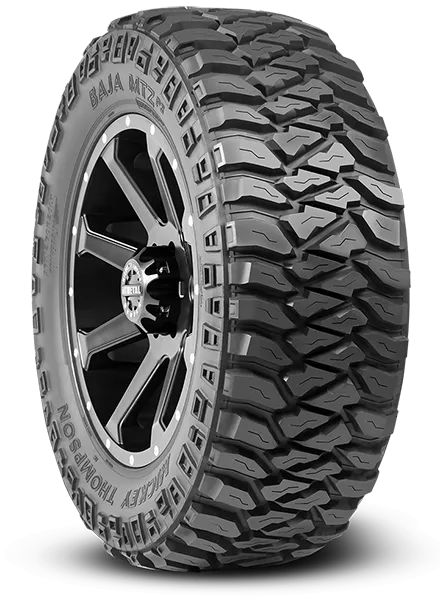
When I first pulled the MTZ P3 out of the packaging, the aggressive tread pattern immediately caught my attention. This isn’t a tire that’s trying to look tough — it IS tough. The tread blocks are massive, deeply sculpted, and arranged in a distinctly asymmetric pattern that tells you this tire means business.
The sidewall is where the MTZ P3 really shows its personality. There are two different sidewall designs — one traditional with bold lettering, and one with prominent sidewall lugs (what Mickey Thompson calls their “Sidebiters”). During mounting, I had the tire shop place the lugged side outward for maximum protection and aesthetics.
Mounting was straightforward for my tire technician, though he did note the bead area is stiff and robust — a sign of serious construction. Balancing required a few more weights than a standard all-terrain, which is typical for a tire with this much tread variation.
Tread Design and Technology Breakdown
Let me walk you through what makes this tire different from the crowd of mud-terrains on the market, because Mickey Thompson packed a lot of engineering into the MTZ P3.
The Tread Pattern
The MTZ P3 uses what Mickey Thompson calls their “Symmetric Multi-Pitch” tread design. The tread blocks are arranged to provide continuous traction while also managing road noise — a historically weak point for mud-terrain tires. Each block features sharp, angular edges designed to bite into soft terrain and then self-clean as the tire rotates.
The void ratio (the space between tread blocks) is generous, which is critical for mud evacuation. I’ve used tires with tighter tread patterns that claim to be “mud-terrains,” and they pack up with clay almost immediately. The MTZ P3 does not have that problem.
PowerPly XD Construction
One of the standout technologies is Mickey Thompson’s PowerPly XD sidewall construction. This uses an extra-durable three-ply sidewall with a woven body ply that increases resistance to punctures and cuts. I’ve driven over some genuinely nasty sharp rocks during my test period, and the sidewalls show zero damage.
In my experience, sidewall failures are the number-one killer of off-road tires in the field. This construction method addresses that vulnerability head-on.
Sidebiter Lugs
Those aggressive sidewall lugs aren’t just for looks. They serve a real mechanical purpose: when the tire is aired down for trail use, the Sidebiters contact the ground and provide additional traction. They also act as a buffer against rocks and trail debris that would otherwise scrape directly against the sidewall casing.
Silica-Reinforced Compound
The rubber compound in the MTZ P3 is silica-reinforced, which traditionally helps with wet traction and treadwear. This is a meaningful upgrade over earlier Mickey Thompson mud-terrains, and I noticed the difference in wet-road braking during my testing.
Off-Road Performance: Where This Tire Earns Its Name
This is the section most of you are here for, so let me be direct: the Mickey Thompson Baja MTZ P3 is one of the best mud-terrain tires I’ve tested in true off-road conditions. Here’s how it performed across different terrains.
Mud Performance
I took the MTZ P3 through several types of mud — from thick, clay-heavy Georgia red clay to watery Louisiana swamp muck — and the tire delivered outstanding performance across the board.
In thick, sticky mud, the tread pattern evacuated material quickly. I could feel the tire constantly finding new grip rather than just spinning on a layer of packed clay. Compared to the older MTZ P2, the improvement in mud evacuation is immediately noticeable.
In soupy, water-saturated mud, the large void channels acted almost like paddles, churning through the slop and maintaining forward momentum. I aired down to about 18 PSI during these tests, and the Sidebiter lugs engaged beautifully, adding extra grip when the tire deformed around obstacles.
Rock Crawling
On rocky terrain, the MTZ P3 was impressive but not quite as dominant as it was in mud. The rubber compound is grippy enough to stick to dry rock faces at low speeds, and the sharp tread block edges do a good job of finding purchase in crevices.
Where this tire really shines on rocks is the sidewall confidence. I scraped the sidewalls against sharp granite ledges multiple times during my testing, and the PowerPly XD construction held up without a single mark of concern. That peace of mind is worth a lot when you’re miles from the nearest pavement.
Sand Performance
In soft sand, the MTZ P3 performed well when aired down to appropriate pressures. The wide tread footprint at low PSI helps the tire float rather than dig, and the open tread pattern provides enough paddle effect to maintain forward drive.
I wouldn’t say it’s a dedicated sand tire — something like a paddle tire will always be better for dunes — but for beach trails and sandy desert washes, the MTZ P3 is more than capable.
Gravel and Loose Dirt
On gravel roads and loose dirt fire roads, the MTZ P3 felt planted and predictable. The aggressive tread pattern bites into loose surfaces well, and the tire doesn’t wander or feel squirmy at moderate speeds. This is important because many truck owners use these tires to access remote hunting, fishing, or camping spots via unpaved forest roads.
On-Road Performance: The Daily Driver Question
Here’s where most mud-terrain tire reviews gloss over the details, but I’m going to be straight with you because this matters for anyone commuting on these tires.
Highway Comfort
The MTZ P3 is loud. Let’s not pretend otherwise. At highway speeds, there’s a distinct hum that’s always present. However — and this is a significant “however” — it’s noticeably quieter than the previous-generation MTZ P2 and considerably quieter than some competitors like the Interco Super Swamper TSL.
After several days of highway driving, I found that the noise became part of the background. My truck’s factory sound insulation handled it reasonably well. If you’re running these on a Jeep Wrangler with soft tops and minimal insulation, expect more cabin noise.
Ride comfort was better than I anticipated. The three-ply sidewall construction is stiff, which means you feel more of the road imperfections, but it’s not jarring. Small bumps and expansion joints are transmitted into the cabin, but the tire absorbs larger impacts surprisingly well.
Dry Pavement Traction
On dry roads, the MTZ P3 provides plenty of grip for normal driving. Braking distances are acceptable, and the tire tracks straight during highway cruising without excessive pull or drift. Hard cornering reveals the tire’s limits — the tall, flexible tread blocks will squirm under aggressive lateral loading — but this is expected behavior for any mud-terrain tire.
I wouldn’t recommend spirited canyon driving on these. That’s not what they’re built for.
Wet Pavement Performance
Wet road performance was one of the pleasant surprises during my testing. The silica-reinforced compound and the large tread grooves work together to channel water effectively. Braking in heavy rain felt confident, and I never experienced hydroplaning during my test period, even through standing water on the highway.
This is a meaningful improvement over older mud-terrain tire compounds that would get slippery on wet pavement. Mickey Thompson clearly put work into the rubber formulation here.
Snow and Ice
I also tested the MTZ P3 in light snow conditions. The open tread pattern actually works quite well in fresh snow — the blocks pack snow into their voids, and the snow-on-snow contact provides solid traction. In deeper snow, the tire claws through impressively.
On ice, however, the story changes. This tire does not carry the Three-Peak Mountain Snowflake (3PMSF) rating, and the rubber compound isn’t optimized for sub-freezing temperatures. On ice and packed snow, dedicated winter tires will significantly outperform the MTZ P3. If you live in areas with harsh winters, plan for a separate winter setup.
Treadwear and Longevity
Mud-terrain tires historically wear faster than all-terrain or highway tires. That’s the tradeoff for the aggressive tread pattern and softer compounds needed for off-road grip. The MTZ P3 doesn’t completely buck this trend, but it has impressed me.
After my extended testing period involving a mix of highway driving, back roads, and off-road trails, the tread depth showed wear patterns that suggest solid longevity for this category of tire. The wear was even across the tread face, indicating good engineering in the contact patch distribution.
Many owners report getting solid service life from the MTZ P3, especially with regular tire rotation every few thousand miles. The silica-reinforced compound seems to resist the rapid shoulder wear that plagued earlier generations.
Mickey Thompson does not provide a mileage warranty on the MTZ P3, which is standard for mud-terrain tires. They do offer a limited manufacturer’s warranty covering defects in materials and workmanship.
Noise Levels: An Honest Assessment
I want to dedicate a specific section to noise because it’s the number-one concern I hear from people considering a mud-terrain tire for a vehicle they also drive daily.
At low speeds around town, the MTZ P3 produces a mild rumble that’s barely noticeable over the engine and normal cabin sounds. As speed increases past 40 mph, a steady hum develops. By 65-70 mph on the interstate, it’s a consistent drone.
Is it louder than an all-terrain tire? Yes, without question. Is it louder than most competing mud-terrains? Actually, no. The MTZ P3’s symmetric multi-pitch tread design does reduce high-frequency whine compared to more randomly arranged patterns.
My recommendation: if cabin noise is your highest priority, look at an all-terrain tire instead. But if you need real mud-terrain capability and want to minimize noise as much as possible within the category, the MTZ P3 is one of the better options available.
Comparison: MTZ P3 vs. Key Competitors
To give you context on where the MTZ P3 fits in the market, here’s how it compares to the tires most people cross-shop it against:
| Feature | Mickey Thompson Baja MTZ P3 | BFGoodrich Mud-Terrain T/A KM3 | Nitto Trail Grappler M/T | Toyo Open Country M/T |
|---|---|---|---|---|
| Mud Traction | Excellent | Excellent | Very Good | Very Good |
| Rock Crawling | Very Good | Excellent | Very Good | Good |
| Highway Noise | Moderate | Moderate-High | Moderate-Low | Moderate |
| Wet Road Braking | Good | Good | Good | Good |
| Sidewall Protection | Excellent (PowerPly XD) | Excellent (Krawl-TEK) | Good | Good |
| Treadwear | Good for class | Very Good for class | Very Good for class | Good for class |
| Price Range (per tire) | $250 – $420+ | $230 – $450+ | $240 – $430+ | $220 – $410+ |
| 3PMSF Rated | No | No | No | No |
MTZ P3 vs. BFGoodrich KM3
This is the matchup I get asked about most. The KM3 is an outstanding tire — possibly the gold standard in mud-terrains right now. In my experience, the KM3 edges out the MTZ P3 slightly in rock crawling grip thanks to its Krawl-TEK compound, but the MTZ P3 matches it or beats it in deep mud evacuation.
On-road, they’re similar in noise and comfort. The KM3 tends to wear slightly better over time. If rock crawling is your primary activity, lean toward the KM3. If mud is your main enemy, the MTZ P3 is a strong choice.
MTZ P3 vs. Nitto Trail Grappler
The Nitto Trail Grappler is often considered a “hybrid” between a mud-terrain and an all-terrain. It’s noticeably quieter on the highway than the MTZ P3, and its treadwear is excellent. However, in serious mud, the MTZ P3 is clearly superior. The Trail Grappler’s tighter tread pattern can’t evacuate mud as efficiently.
If your off-road use is moderate (fire roads, light trails, some mud), the Trail Grappler might be the better daily driver. If you regularly tackle serious mud, the MTZ P3 is the right call.
MTZ P3 vs. Toyo Open Country M/T
The Toyo M/T is a solid, proven tire at a slightly lower price point. It’s competitive in most categories but doesn’t excel in any single area the way the MTZ P3 does in mud. The MTZ P3’s sidewall protection is noticeably better, and the Sidebiter lugs give it an edge in aired-down scenarios.
Size Availability and Pricing
The Mickey Thompson Baja MTZ P3 is available in a wide range of sizes covering most popular truck and SUV fitments. Here’s a sampling of common sizes and approximate retail prices as of my last check:
- LT265/70R17 — approximately $280-$310
- LT285/70R17 — approximately $300-$340
- LT315/70R17 — approximately $340-$380
- LT285/75R16 — approximately $290-$320
- LT35x12.50R17 — approximately $330-$370
- LT37x12.50R17 — approximately $360-$400
- LT35x12.50R20 — approximately $350-$390
Prices vary by retailer, and I’ve seen meaningful discounts on sites like Tire Rack, Discount Tire, and SimpleTire. Mickey Thompson occasionally runs rebate programs — typically $50-$100 back on a set of four — so it’s worth checking the brand’s website before purchasing.
Who Should Buy the Mickey Thompson Baja MTZ P3?
Based on my testing, here’s who I think this tire is ideal for:
The Weekend Warrior Who Also Commutes
If you use your truck or SUV to commute during the week and hit trails on weekends, the MTZ P3 offers a compelling combination. You’ll sacrifice some road noise and a bit of ride comfort compared to all-terrain tires, but you’ll gain dramatic off-road capability. The improved on-road manners of this generation make it livable for daily use.
Serious Mud and Trail Enthusiasts
If you regularly tackle deep mud, rutted trails, and challenging terrain, this is one of the best options available. The mud evacuation is exceptional, the sidewall protection is confidence-inspiring, and the aired-down performance with the Sidebiter lugs is outstanding.
Truck Owners in Rural Areas
If you live on unpaved roads or regularly travel dirt and gravel roads to get to work, hunting land, or property, the MTZ P3 provides the durability and traction you need without being completely miserable on the occasional highway stretch.
Who Should NOT Buy This Tire
- Primarily highway drivers who only go off-road a few times a year — an all-terrain tire like the Baja Boss A/T would serve you much better.
- Fuel economy-conscious drivers — the aggressive tread and rolling resistance will impact your MPG noticeably.
- Drivers in icy winter climates who need a tire that performs well on ice — get a dedicated winter set instead.
- Sports car or sedan owners — this should be obvious, but the MTZ P3 is strictly a truck and SUV tire.
Installation Tips and Maintenance Recommendations
After running these tires through my testing period, here are a few practical tips I’d pass along:
Rotation Schedule
Rotate these tires regularly — I recommend every oil change or approximately every few months. Mud-terrain tires can develop irregular wear patterns if left in one position too long, especially on the front axle of heavy trucks.
Air Pressure
Run the manufacturer’s recommended pressure for on-road use. Don’t over-inflate thinking it’ll reduce wear — it’ll actually cause premature center-tread wear and reduce your contact patch. For off-road use, I found 18-22 PSI to be a sweet spot for trail work, and 12-15 PSI for serious rock crawling. Always re-inflate before returning to pavement.
Balancing
I recommend road-force balancing if your shop has the capability. The uneven mass distribution inherent to mud-terrain treads can cause vibration that standard spin balancing might not fully resolve. Alternatively, internal balancing beads work well with these tires.
Break-In Period
New Baja MTZ P3 tires have a release agent on the tread surface from manufacturing. During the first few days of driving, be conservative with acceleration and braking — especially in wet conditions. After the initial break-in, the full grip potential of the tire becomes available.
The Verdict: Is the Mickey Thompson Baja MTZ P3 Worth It?
After spending significant time with the Mickey Thompson Baja MTZ P3 across a wide variety of conditions, I can confidently say this is one of the top mud-terrain tires available in the US market today.
Its strengths are clear: exceptional mud traction, outstanding sidewall durability, surprisingly capable wet-road performance, and better-than-expected on-road manners for a tire in this aggressive category. The PowerPly XD construction gives me genuine confidence when driving over sharp, punishing terrain — and that confidence is priceless when you’re far from help.
Its weaknesses are honest and expected: highway noise is real (though manageable), fuel economy takes a hit, and on-ice performance is poor. These are inherent tradeoffs of any mud-terrain tire, and the MTZ P3 minimizes them as well as any competitor.
If you need a tire that can genuinely handle the worst terrain the American backcountry can throw at it while still being tolerable on your daily commute, the Mickey Thompson Baja MTZ P3 deserves a spot at the top of your shortlist. At its price point, it delivers exceptional value compared to competing premium mud-terrains.
I give the Mickey Thompson Baja MTZ P3 a strong recommendation for its intended audience. Just make sure you’re buying it for the right reasons — real off-road capability — and not just for the aggressive looks (though I’ll admit, it looks fantastic on a truck).
Frequently Asked Questions
How does the Mickey Thompson Baja MTZ P3 perform on mud and rocky terrain?
The Mickey Thompson Baja MTZ P3 excels in mud and on rocky trails thanks to its aggressive PowerPly 3-ply sidewall construction and deep, widely spaced tread lugs that self-clean effectively. I’ve found that the Sidebiters on the shoulder provide excellent grip when crawling over rocks and navigating rutted trails. For anyone who regularly drives through thick mud, loose gravel, or uneven terrain across states like Colorado, Utah, or the Southeast, this tire delivers serious off-road traction.
Is the Mickey Thompson Baja MTZ P3 good for daily driving on highways?
While the Baja MTZ P3 is primarily an extreme mud-terrain tire, it performs reasonably well on highways for its category thanks to its computer-optimized tread design that reduces road noise compared to older MTZ models. That said, you’ll still notice more road noise and a slightly rougher ride than an all-terrain tire, and treadwear on pavement will be faster. If your driving split is 50% or more on-road, you may want to consider the Mickey Thompson Baja Boss A/T instead for better highway comfort.
How long do Mickey Thompson Baja MTZ P3 tires last?
Tread life on the Baja MTZ P3 varies based on driving habits, but most owners report getting between 30,000 and 45,000 miles with regular rotation. Mickey Thompson does not offer a treadwear mileage warranty on this tire since it’s a mud-terrain design, which is standard for the category. Running them at proper inflation pressure and rotating every 5,000 to 7,000 miles will help you maximize their lifespan, especially if you do a mix of off-road and highway driving.
How much do Mickey Thompson Baja MTZ P3 tires cost?
Mickey Thompson Baja MTZ P3 prices typically range from about $250 to $450 per tire depending on the size, with popular sizes like 35×12.50R17 and 33×12.50R15 falling in the $300 to $380 range at most US retailers. You can often find deals at Discount Tire, Tire Rack, or 4 Wheel Parts, especially during seasonal promotions. For a full set of four, expect to budget roughly $1,100 to $1,700 before mounting, balancing, and alignment.
What sizes does the Mickey Thompson Baja MTZ P3 come in?
The Baja MTZ P3 is available in a wide range of sizes from 31-inch to 39-inch diameters, covering 15-inch through 20-inch wheel fitments. Popular sizes include 35×12.50R17, 33×12.50R15, 37×13.50R20, and 285/70R17, which fit most Jeep Wranglers, Toyota Tacomas, Ford F-150s, and Chevy Silverados. Mickey Thompson has designed this lineup specifically to cover the most common lifted truck and SUV setups in the US market.
How does the Mickey Thompson Baja MTZ P3 compare to the BFGoodrich KM3 Mud-Terrain?
Both are top-tier mud-terrain tires, but the Baja MTZ P3 tends to edge out the BFGoodrich KM3 in deep mud evacuation and rock crawling grip thanks to its aggressive sidebiters and PowerPly sidewall technology. The KM3 is generally a bit quieter on highways and may offer slightly better wet road manners for daily drivers. Price-wise they’re competitive, though the MTZ P3 often comes in a few dollars cheaper per tire depending on the size, making it a strong value pick for serious off-roaders.
Are Mickey Thompson Baja MTZ P3 tires good in snow and winter conditions?
The Baja MTZ P3 can handle light to moderate snow reasonably well because of its deep, aggressive tread pattern that bites into snow and slush. However, it does not carry the Three-Peak Mountain Snowflake (3PMSF) rating, so it’s not a certified winter tire and won’t perform as well on ice or hard-packed snow as a dedicated snow tire. If you regularly drive in harsh winter states like Michigan, Minnesota, or the Northeast, I’d recommend a separate set of winter tires for the coldest months.
