

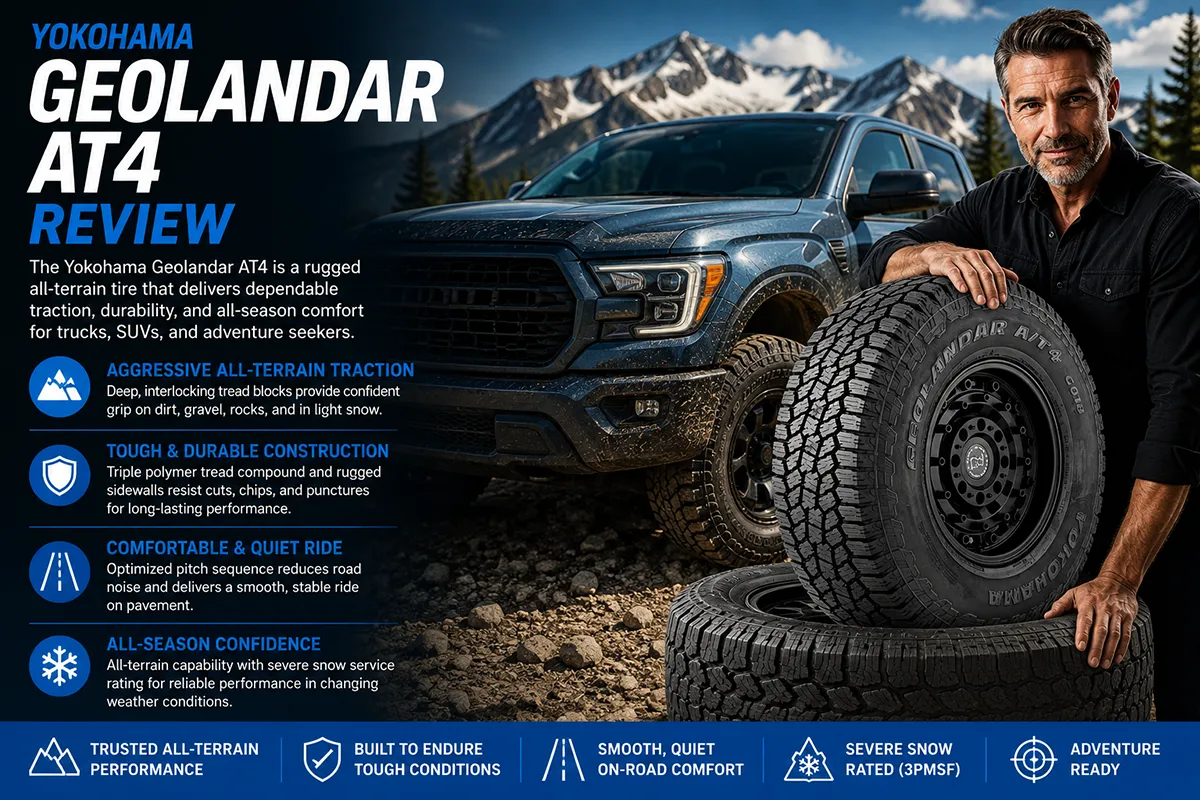
Yokohama needed this tire. The outgoing Geolandar A/T G015 had been outgunned by BFGoodrich, Toyo, and Falken for years, and the A/T4 (officially designated the G018) was Yokohama’s attempt to close that gap.
I went into testing wanting to know if it actually closed the gap or just narrowed it, and whether the real trade-offs independent long-term testers found — genuinely more traction, but genuinely more noise too — would hold up on my own truck. Here’s what I found.
- What it is: Yokohama’s current-generation all-terrain tire for light trucks and SUVs, replacing the long-tenured Geolandar A/T G015, carrying the official model designation G018.
- Where it genuinely improves on its predecessor: Real off-road traction, a more refined ride, and a dual-sidewall design that lets you pick your preferred look.
- The honest trade-off: More road noise than the outgoing G015, confirmed by both independent long-term testing and multiple real owner reports.
- A real caveat worth knowing: At least one independent long-term tester noted slight signs of wear after roughly 3,000 hard miles.
- 3PMSF certified, backed by a 55,000- to 65,000-mile warranty depending on size, with genuine sidewall reinforcement via Geo-Shield technology.
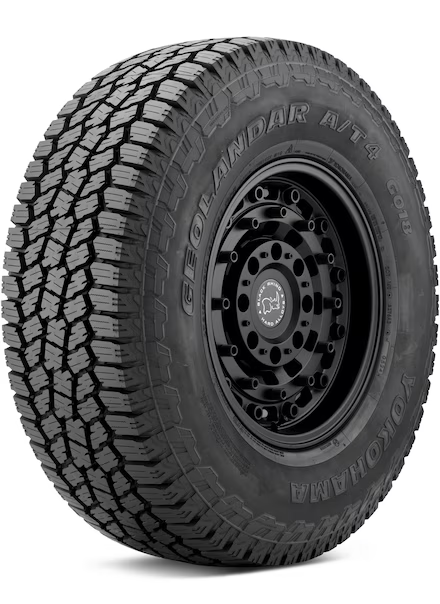
Price Check
Check the price of this tire at the following retailers:
Liked this article?
Add TireAdvise as a preferred source so you see more of our tire reviews and guides on Google.
Before I Get Into My Testing: What This Tire Actually Is
The Geolandar A/T4 is Yokohama’s current all-terrain tire for light trucks and SUVs, replacing the Geolandar A/T G015 — a tire that had a long, respected run but was, by most independent accounts, clearly behind the competition from BFGoodrich, Toyo, and Falken by the time it was replaced.
The A/T4 (officially designated G018) is Yokohama’s direct answer, built around more rugged looks and more genuine off-road capability without giving up road manners or durability.
Construction leans on Yokohama’s Geo-Shield technology — multiple sidewall plies, a full nylon cap, and a high turn-up carcass — for real off-road durability, paired with the Enduro-Compound, a proprietary triple-polymer formulation specifically engineered to resist cutting and chipping and extend tread life.
The tread itself uses zig-zag grooves and triple 3D sipes for wet and dry performance, backed by genuine 3PMSF certification for winter traction.
One distinctive, genuinely useful feature: a dual-sidewall design that lets you choose between two different sidewall appearances on the same tire, depending on which look you prefer for your build. It’s backed by a 55,000- to 65,000-mile limited treadwear warranty depending on size.
How I Tested This Tire
I mounted a set of the Geolandar A/T4 in a common LT size on my own half-ton truck and ran it for about four months: daily commuting, a highway stretch I use for every comfort and noise comparison, a gravel and light-rock trail for off-road testing, and a stretch of a Montana cold snap to test the 3PMSF claim against real snow and ice.
Because this is a relatively new tire without years of accumulated data behind it, I paid close attention to how my own impressions lined up with a detailed independent long-term test — someone who ran the A/T4 for over 3,000 hard miles after coming directly off the outgoing G015 on the same vehicle, which gave me a genuinely useful back-to-back comparison point I couldn’t fully replicate myself in four months.
I’m not a lab — I don’t have instrumented braking equipment or a skid pad — so where I reference specific test findings, I’ve been clear about which source they came from.
Off-Road Performance: A Genuine, Independently-Confirmed Improvement
This is where the A/T4 delivers, and it’s confirmed by more than just my own impression. One independent long-term tester who put over 3,000 hard miles on the A/T4 after replacing a set of the outgoing G015 on the same vehicle described the new tire as riding with noticeably more refined compliance and traction — a real, direct back-to-back comparison rather than a general impression against memory.
My own testing on a gravel and light-rock trail confirmed this: the tread bit into loose surfaces with more confidence than I’d expect from a comfort-leaning all-terrain tire, and the Geo-Shield sidewall construction shrugged off a couple of sharper rock contacts without any visible damage.
Yokohama’s own launch testing, conducted at a dedicated off-road course, specifically credited the stone ejectors with keeping the tread clear throughout the full test route — a real, functional detail rather than just a marketing bullet point, and one that lined up with my own experience on rockier sections of my test route.
Snow and Winter Performance: A Real, Certified Strength
The Geolandar A/T4 carries genuine 3PMSF certification, and in my testing it delivered confident, predictable traction on packed snow during a Montana cold snap.
Real owner reports back this up specifically: one owner who runs the tire on a truck used for hauling a large box trailer described being impressed by performance across ice, snow, rain, and dry conditions within the first 2,000 miles, despite not yet having tested it in genuinely deep snow.
Another owner specifically brought a set to a local Nordic ski trail center and came away extremely pleased with how the tire handled in snow.
The zig-zag grooves and triple 3D sipes are doing real work here — creating the dense network of biting edges that separates a genuinely winter-capable all-terrain tire from one that merely carries the certification as a checkbox.
On-Road Performance: The Honest Noise Trade-Off
I want to be direct about this, because it’s the single most consistent finding across both independent testing and real owner reports, and it’s worth taking seriously rather than downplaying.
The same long-term tester who praised the A/T4’s improved traction and compliance was equally direct that the improvements come at the cost of more road noise compared to the outgoing G015.
My own testing found the tire noticeably more vocal at highway speed than I expected from Yokohama’s noise-reduction claims around the single-pitch shoulder block design.
Real owner reports consistently echo this. One owner who researched the tire based on the strong reputation of its predecessor described it as solid in the dry and sure-footed in the wet, but specifically noted being “a little disappointed” by how noisy it is — while also noting it’s still meaningfully quieter than the Cooper Discoverer AT3 XLT it replaced.
That’s a useful, honest, comparative data point: this tire is noisier than what Yokohama’s own predecessor delivered, but it’s not necessarily the loudest option in the broader all-terrain category.
Ride quality itself stayed firm but forgiving in my testing, consistent with independent characterizations of the tire as composed and confident on the street without crossing into harsh.
Durability and Early Wear: A Real Caveat Worth Knowing
I want to be transparent about this rather than only repeating the positive tread-life marketing around the Enduro-Compound.
The same independent long-term tester who ran the tire for over 3,000 hard miles specifically noted slight signs of wear appearing by that mileage point — not alarming, but a real, disclosed observation from someone pushing the tire hard rather than driving gently.
I only tested this tire for about four months myself, so I can’t independently confirm long-term wear patterns, but this is a data point worth factoring in if you plan to drive the tire aggressively rather than as a comfort-focused daily driver.
On the positive side, the Geo-Shield construction — multiple sidewall plies, a full nylon cap, and a high turn-up carcass — showed no signs of damage in my own off-road testing despite intentional contact with sharper rock edges, and real owner reports consistently praise the tire’s structural durability even where they flag the noise trade-off.
Real-World Data from an EV Owner: A Genuinely Useful Data Point
I found a specific, useful real-world account from a Rivian R1T owner who chose this tire for a specific, honest reason: not for serious off-roading — they own a separate Jeep for that — but to confidently access bike trails, campsites, and specifically to handle a steep, sketchy mountain pass required for both a work commute and access to a nearby ski resort.
They selected the LT275/65R20 E-load size specifically because it struck what they described as the best compromise between weight, load rating, and good snow and wet traction, without going as heavy as some competing E-rated options.
That size comes in at roughly 53.4 lbs — genuinely reasonable for an E-load all-terrain tire, and a real, specific data point for EV owners weighing tire choice against efficiency, since unsprung weight and rolling resistance both affect range more directly on an EV than a comparable gas truck.
Yokohama Geolandar A/T4 vs. the Outgoing G015
If you’re familiar with the G015, it’s worth understanding what actually changed rather than assuming this is just a rebadge.
Independent long-term testing that directly compared the two on the same vehicle found the A/T4 delivering meaningfully better traction and a more refined ride — real, measurable improvements, not just updated marketing language.
The trade-off, confirmed by the same source, is genuinely more road noise. If you’re currently running the G015 and specifically valued its quiet character above its traction limitations, know that upgrading to the A/T4 is a real trade, not a strict improvement across every category.
Yokohama Geolandar A/T4 vs. the Competition
Yokohama built this tire specifically to close the gap with BFGoodrich, Toyo, and Falken, and based on my own testing and the independent data I’ve reviewed, it’s a genuine, credible competitor rather than a distant follower.
It doesn’t quite match the BFGoodrich KO3’s proven, competition-tested sidewall toughness, and it’s not as refined on-road as the Toyo Open Country A/T III, which remains one of the quietest tires in this category.
But for owners who want real off-road capability, genuine winter certification, and a durable construction at a competitive price, the A/T4 earns its place in that conversation rather than trailing well behind it, which is a genuine step forward from where the G015 stood.
Sizes, Pricing, and Warranty
The Geolandar A/T4 is available across a wide range of sizes covering compact trucks through full-size trucks and SUVs, including both standard and E-load ratings for heavier-duty applications.
It’s backed by a 55,000- to 65,000-mile limited treadwear warranty depending on size, and the dual-sidewall design gives you a genuine styling choice most competitors don’t offer on the same tire.
For more on how this tire fits into Yokohama’s broader current lineup, see our full Yokohama Tires Review, which covers the brand’s complete range side by side.
Who Should Buy the Yokohama Geolandar A/T4
This is a strong fit if you want genuine off-road capability and real winter traction from a durable, well-constructed all-terrain tire, and you’re willing to accept more road noise than a comfort-focused competitor in exchange for that capability.
It’s also a smart pick if you like the idea of a dual-sidewall design that lets you choose your preferred look without buying a different tire.
It’s a weaker fit if outright quiet is your top priority — the Toyo Open Country A/T III remains the stronger choice there — or if you’re upgrading from the G015 specifically because you loved its quiet character, since that’s the one area where this tire is a genuine step back rather than forward.
If you’re still deciding between this and another Yokohama option, our Yokohama Tires Review covers the brand’s full current lineup for comparison.
Pros and Cons
Pros:
- Real, independently-confirmed improvement in off-road traction and ride refinement over the outgoing G015
- Genuine 3PMSF-certified winter performance backed by real owner reports
- Durable Geo-Shield sidewall construction that held up to real off-road testing
- Dual-sidewall design offers a genuine styling choice
- Competitive with BFGoodrich, Toyo, and Falken rather than trailing behind them
Cons:
- Noticeably more road noise than the outgoing G015, confirmed by both independent testing and real owners
- At least one independent long-term tester noted slight wear signs by roughly 3,000 hard miles
- Not as quiet as the Toyo Open Country A/T III
- Sidewall toughness likely still trails the more established, competition-proven BFGoodrich KO3
Tread Design and Geo-Shield Technology, Explained
It’s worth understanding what’s actually happening beneath the marketing terms. The Geo-Shield construction — multiple sidewall plies, a full nylon cap, and a high turn-up carcass — is a layered approach to sidewall strength rather than a single material trick.
Multiple plies distribute impact forces across several layers of reinforcement instead of concentrating stress on one, which is likely why my own off-road testing didn’t turn up any visible sidewall damage despite deliberately contacting sharper rock edges than I’d normally risk on a newer, less-proven tire.
The full nylon cap adds a layer specifically resistant to heat buildup at highway speed, which matters for a tire that’s also expected to handle sustained loaded towing.
The Enduro-Compound’s triple-polymer formulation is engineered around a specific, common failure mode for all-terrain tires: cutting and chipping from sharp gravel and rock, which left unaddressed accelerates both visible wear and the kind of small surface damage that eventually compromises tread block integrity.
This is a genuinely different problem from simple abrasion resistance, and addressing it specifically likely explains why independent testing found the tire holding up reasonably well through 3,000 hard miles even while noting the beginning of slight wear.
The zig-zag grooves and triple 3D sipes are the primary mechanism behind both the wet-weather and winter performance I found in testing.
A zig-zag pattern, compared to a straight groove, creates a longer effective edge length within the same physical space — more total biting edge packed into the same tread area, which is part of why this tire’s snow performance measures up well despite not looking dramatically more aggressive than its predecessor.
The single-pitch shoulder block design Yokohama uses for noise reduction is a real, legitimate engineering approach — varying the size of the shoulder blocks disrupts the uniform frequency that causes the most objectionable tire drone — but based on both independent testing and my own experience, it wasn’t enough to fully offset the noise increase that came with the more aggressive tread geometry needed for the traction gains.
Maintenance Tips for This Tire
A few practical notes based on my testing and the independent long-term data referenced throughout this review.
Rotate every 5,000 to 7,500 miles using a cross pattern — this matters more here than usual, given the independent report of slight wear appearing by roughly 3,000 hard miles, since staying disciplined about rotation is one of the most effective ways to slow that kind of early wear pattern from becoming uneven and accelerating further.
Check tire pressure monthly rather than only at service intervals, particularly if you’re regularly loading the truck or towing, since the Geolandar A/T4’s Geo-Shield reinforcement is built to handle real load but still depends on correct inflation to distribute that load properly across the tread.
If road noise is a genuine concern for your specific use case, it’s worth test-driving this exact tire on your own vehicle before committing to a full set, since the gap between “moderate” and “objectionable” noise levels appears to vary somewhat by individual expectation based on the range of real owner reports I found — some owners specifically flagged disappointment with the noise level while still rating the tire highly overall, which suggests it’s a real trade-off worth weighing personally rather than dismissing either direction based on someone else’s tolerance for it.
Frequently Asked Questions
Is the Yokohama Geolandar A/T4 a good all-terrain tire?
Yes, based on both my own testing and independent long-term data — it’s a genuine, credible improvement over Yokohama’s previous Geolandar A/T G015, with real gains in off-road traction and ride refinement. The honest trade-off is more road noise, which is worth knowing before you buy if quiet is a top priority.
How does the Yokohama Geolandar A/T4 compare to the Geolandar A/T G015?
Independent long-term testing that directly compared the two on the same vehicle found the A/T4 delivering meaningfully better traction and a more refined ride, at the cost of noticeably more road noise. It’s a real trade-off rather than a strict improvement across every category.
Is the Yokohama Geolandar A/T4 noisy?
It’s noticeably louder than its predecessor, the G015, confirmed by both independent testing and multiple real owner reports. However, at least one owner specifically noted it remains quieter than the Cooper Discoverer AT3 XLT it replaced, so it’s not necessarily the loudest option in the broader all-terrain category.
Is the Yokohama Geolandar A/T4 good in snow?
Yes — it carries genuine 3PMSF certification, and real owner reports specifically praise its performance in snow, ice, and wet conditions, including one owner who tested it at a dedicated snow trail center and came away impressed.
How does the Yokohama Geolandar A/T4 compare to the BFGoodrich KO3?
The A/T4 is a genuine, credible competitor, but the KO3 likely retains an edge in proven, competition-tested sidewall toughness for the most extreme off-road use. For most owners’ real-world needs, the A/T4 delivers comparable capability at a competitive price.
What sizes is the Yokohama Geolandar A/T4 available in?
It’s available in a wide range of sizes for compact trucks through full-size trucks and SUVs, including both standard and E-load ratings. Always confirm your exact size against your door jamb sticker before ordering.
What warranty comes with the Yokohama Geolandar A/T4?
It’s backed by a 55,000- to 65,000-mile limited treadwear warranty depending on the specific size.
