


Chrysler ended 300 production in December 2023, closing out an 18-year run with a 2,200-unit 300C send-off — which means nearly everyone shopping for 300 tires today is keeping an existing car running well, not cross-shopping a new one, and this guide is built for exactly that reader. Based on manufacturer specifications, aggregated owner data, and independent test results, here’s what actually holds up on a final-generation 300, by priority.
- Best overall: Michelin Pilot Sport A/S 3+.
- Best wet performance: Continental ExtremeContact DWS06 Plus.
- Best balanced comfort/performance: Bridgestone Potenza RE980AS.
- Best luxury performance: Pirelli P Zero All Season Plus.
- Best budget performance: Firestone Firehawk Indy 500.
- Best value leader: Falken Azenis FK510.
- Best all-weather, no seasonal swap: Michelin CrossClimate2.
- Full sizing by final-generation trim, a genuine parts-availability note, and a recalls check are below.
Liked this article?
Add TireAdvise as a preferred source so you see more of our tire reviews and guides on Google.
The 300 Is Discontinued — Here’s What That Actually Means for Tire Shopping
This is worth addressing directly, since it changes the whole context most competing guides get wrong. Chrysler ended 300 production at its Brampton, Ontario assembly plant in December 2023, closing out the nameplate’s second generation with a limited-run 2023 300C — just 2,000 units for the US and 200 for Canada, powered by a 6.4-liter HEMI V8.
A handful of new 2023 units lingered on dealer lots afterward, but at this point nearly every 300 on the road is a used or currently owned vehicle rather than a new purchase, and Stellantis has given no indication the nameplate is coming back.
The practical upshot for tire shopping is reassuring rather than alarming: the 300 shares its rear-wheel-drive LX/LD platform with the Dodge Charger and Challenger, its tire sizes are common, mainstream fitments, and none of the tires in this guide are 300-specific or hard to find.
Discontinuation affects new-car shopping, not tire availability — this is simply the more useful frame for a guide that will keep being read by owners for years after the last 300 rolled off the line.
How These Were Evaluated
This comparison draws on manufacturer specifications, aggregated owner reports, UTQG ratings, and independent traction and braking testing data for each tire, cross-referenced against the 300’s real factory sizing across its final-generation trims.
Particular weight was given to how each tire’s real-world character matches how 300 owners actually use the car — a Touring or Touring L used mainly for comfortable highway cruising has different priorities than a 300S or the final-year 300C, whose V8 output and RWD platform genuinely reward a tire built for grip and feedback.
Where specific tread-life figures, warranty numbers, or independently reported comparisons are cited, the source is noted rather than presented as a personal measurement.
Quick Comparison: 11 Best Tires for the Chrysler 300
| Tire | Best For | Approx. Price/Tire | 3PMSF Rated | Warranty |
|---|---|---|---|---|
| Michelin Pilot Sport A/S 3+ | Best overall | $185–$250 | No | 45,000 mi |
| Continental ExtremeContact DWS06 Plus | Wet performance | $175–$225 | No | Not specified |
| Bridgestone Potenza RE980AS | Balanced comfort/performance | $170–$230 | No | Not specified |
| Pirelli P Zero All Season Plus | Luxury performance | $190–$260 | No | 45,000–50,000 mi |
| Goodyear Eagle F1 Asymmetric All-Season 2 | Performance-focused | $180–$240 | No | Not specified |
| Firestone Firehawk Indy 500 | Budget performance | $130–$180 | No | Not specified |
| Yokohama ADVAN Sport A/S+ | Balanced performer | $160–$220 | No | 50,000 mi |
| Falken Azenis FK510 | Value leader | $140–$195 | No | Not specified |
| Nitto NT555 G2 | High-performance summer | $150–$210 | No | Not specified |
| Cooper Zeon RS3-G1 | American-made performance | $145–$200 | No | 45,000 mi |
| Michelin CrossClimate2 | All-weather, no seasonal swap | $195–$260 | Yes | 60,000–85,000 mi (size dependent) |
Prices are street prices at major online retailers for common 300 sizes (225/60R18, 235/55R19, and 245/45R20) as of mid-2026 — 300C-specific staggered sizing runs above these ranges, and expect regional and seasonal swings on top of that.
Chrysler 300 Tire Sizes by Final-Generation Trim
Confirm the exact size on the driver’s door jamb sticker before ordering. Since production ended, Chrysler’s own retained specifications still describe the final trim lineup: Touring and Touring L trims, running the 3.6L Pentastar V6, typically use 225/60R18. 300S, available with either the V6 or the 5.7L HEMI V8, typically runs 245/45R20.
The final-year 300C, the 2,200-unit 6.4L HEMI send-off edition, ran a genuinely different high-performance staggered setup — 245/45ZR20 front and 255/45ZR20 rear on its standard 20-inch forged wheels.
Earlier model years within this same second generation (2011–2022) used a similar size progression across Touring, Limited, S, and C trims, so the size logic carries over even where trim names differ slightly by model year.
Should You Even Replace Your Factory Tires?
Chrysler fitted the 300 with all-season performance touring tires from a mix of suppliers depending on trim and model year, generally prioritizing a balance of comfort and grip consistent with the car’s positioning as an American luxury performance sedan.
The final-year 300C notably shipped on high-performance all-season tires specifically chosen to handle the 6.4L HEMI’s output on its standard forged wheels. If the factory tires are wearing evenly and handling feels good, replacing like-for-like with a comparable tire in the same category is a reasonable, low-risk call.
The most consistent real-world pattern among 300 owners is factory tires that deliver decent initial grip but show more noticeable road noise and reduced wet-weather confidence as they age, particularly on RWD models — exactly the gap a stronger all-season performance tire like the Michelin Pilot Sport A/S 3+ or Continental ExtremeContact DWS06 Plus is built to close.
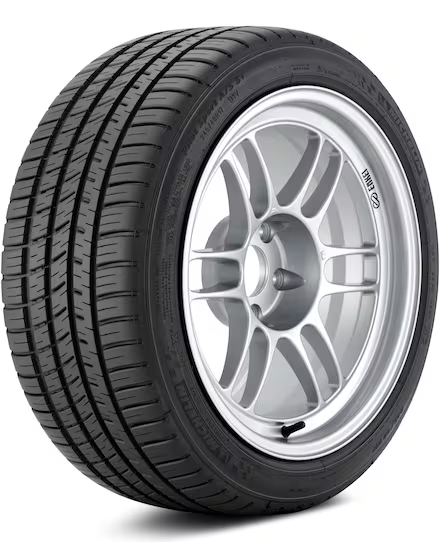
1. Michelin Pilot Sport A/S 3+: Best Overall
Price Check
Check the price of this tire at the following retailers:
This tire delivers a genuinely strong balance across every category that matters for a 300 owner who wants both grip and comfort. Michelin’s Helio+ Technology uses an advanced silica compound that maintains exceptional grip in both wet and dry conditions, and the asymmetric tread pattern’s large shoulder blocks genuinely enhance cornering stability — a real, felt benefit given the 300’s substantial weight and rear-wheel-drive character.
Variable Contact Patch 3.0 technology distributes forces evenly across the tire during cornering, genuinely preserving performance as the tire wears rather than losing grip disproportionately late in life. Independent testing shows wet stopping distances up to 5 feet shorter than leading competitors — a real, safety-relevant margin.
Michelin backs the Pilot Sport A/S 3+ with a 45,000-mile warranty, and real owner reports commonly describe achieving 40,000-plus miles even with spirited driving. For Touring, 300S, and 300C owners who want the strongest all-around tire regardless of price, this is the pick.
Pros: Genuinely strong wet and dry grip, wear-resistant construction that maintains performance late in tire life, reasonable 45,000-mile warranty for the performance category.
Cons: Premium price, not built for severe winter conditions.
2. Continental ExtremeContact DWS06 Plus: Best Wet Performance

Price Check
Check the price of this tire at the following retailers:
Continental’s “DWS” designation — Dry, Wet, Snow — isn’t just marketing on this tire, and it’s genuinely one of the strongest wet-weather performers in this comparison. SportPlus Technology creates a stable contact patch during cornering, and wide circumferential grooves combined with a silica-enhanced compound deliver real, immediately noticeable wet grip that matters given the 300’s substantial weight.
The tire’s Tuned Performance Indicators — visible D/W/S letters molded into the tread — give a genuinely useful, transparent way to monitor remaining performance capability as the tire wears, a feature few competitors offer.
Road noise is well-controlled for a performance-oriented tire, and the tire’s rigid sidewall construction maintains stability during spirited driving while still filtering out harsh impacts. Real owner reports commonly describe 40,000-50,000 miles of tread life.
For 300 owners who prioritize confident wet-weather grip without sacrificing dry performance, this is the strongest pick.
Pros: Genuinely strong, class-leading wet performance, transparent wear indicators, solid highway comfort for a performance tire.
Cons: Not 3PMSF rated, premium price relative to budget alternatives.
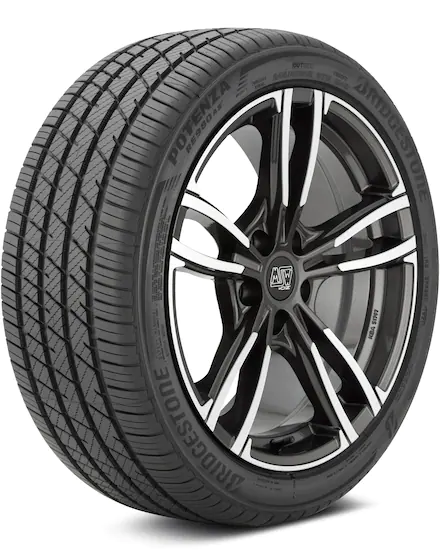
3. Bridgestone Potenza RE980AS: Best Balanced Comfort and Performance
Price Check
Check the price of this tire at the following retailers:
This tire genuinely splits the difference between sports-tire capability and touring-tire comfort better than most competitors attempt.
An asymmetric tread pattern with larger outer-shoulder blocks delivers real cornering grip, while the inner tread’s 3D full-depth sipes maintain wet traction through more of the tire’s life than a simpler design would.
Bridgestone’s Resonance Noise Attenuated (RENOA) silencer grooves genuinely reduce the road harmonics that typically create cabin noise, a real benefit for preserving the 300’s cabin refinement.
Long Link Carbon Black technology in the tread compound meaningfully improves durability without sacrificing grip, and real owner reports commonly describe 40,000-50,000 miles from a set. For 300 owners who want near-sports-tire performance without giving up touring-tire comfort, this is a strong, well-rounded pick.
Pros: Genuine dual-personality design balancing grip and comfort, real noise-reduction technology, respectable tread life for the performance category.
Cons: Premium price, not 3PMSF rated.
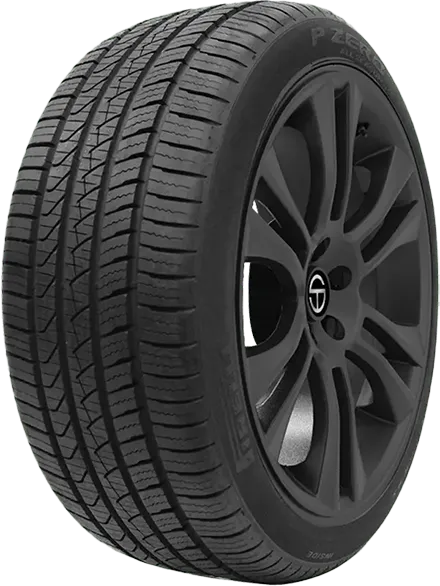
4. Pirelli P Zero All Season Plus: Best Luxury Performance
Price Check
Check the price of this tire at the following retailers:
For 300S and 300C owners who want their tires to match the car’s luxury-performance positioning, Pirelli’s asymmetric tread design delivers exactly that combination.
The silica-enhanced compound maintains flexibility across a wide temperature range, and the tread’s dual-purpose design — inner tread optimized for water evacuation and light winter traction, outer portion prioritizing dry handling — genuinely delivers confident steering response and cornering stability.
Pirelli’s noise-canceling technology within the tread design meaningfully reduces road noise penetration into the cabin, and the tire’s sidewall construction absorbs road imperfections for a genuinely plush ride that matches the 300’s premium interior character.
Pirelli backs the tire with a 45,000- to 50,000-mile warranty, competitive for the luxury-performance category. For 300S and 300C owners who want to fully exploit the car’s V8 output while maintaining genuine refinement, this is the strongest luxury-focused pick.
Pros: Genuine luxury-tier comfort and noise reduction, confident dry handling and cornering, competitive warranty for the category.
Cons: Premium price, not built for severe winter conditions.
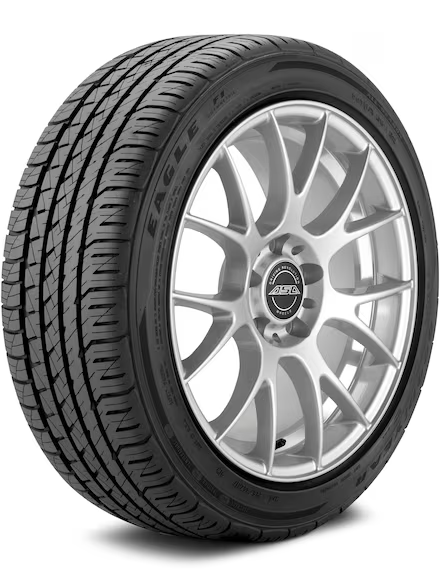
5. Goodyear Eagle F1 Asymmetric All-Season 2: Best Performance-Focused Choice
Price Check
Check the price of this tire at the following retailers:
Goodyear’s updated Eagle F1 Asymmetric All-Season 2 delivers genuinely track-informed technology in a daily-drivable package, well-suited to the 300’s rear-wheel-drive platform.
An advanced tread compound enriched with specialized polymers provides real grip on both dry and wet surfaces, and the asymmetric tread — more aggressive outside for cornering, more conservative inside for water evacuation — delivers genuinely balanced performance.
Wide tread grooves and strategically placed sipes channel water away from the contact patch, meaningfully reducing hydroplaning risk during sudden downpours.
The compound remains reasonably pliable in colder temperatures for genuine light-snow capability, though this isn’t a substitute for real winter or 3PMSF-rated all-weather capability. Noise-reducing technology in the tread design delivers a quieter ride than many comparable performance tires.
For 300 owners who prioritize driving engagement without sacrificing all-season versatility, this is a strong pick.
Pros: Genuine track-derived grip technology, balanced wet and dry performance, quieter than many comparable performance tires.
Cons: Not 3PMSF rated, premium price tier.
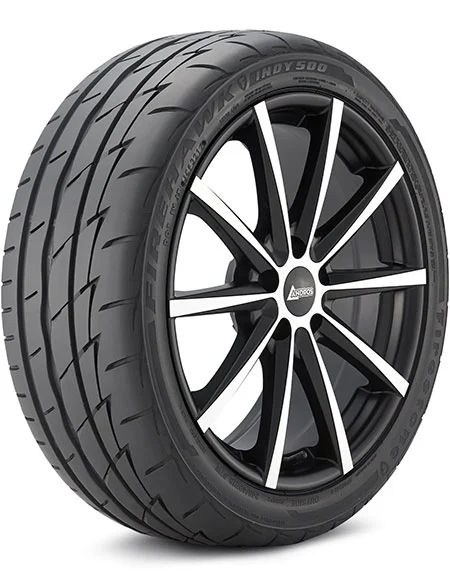
6. Firestone Firehawk Indy 500: Best Budget Performance
Price Check
Check the price of this tire at the following retailers:
This tire delivers genuinely impressive performance capability at a meaningfully lower price than the premium options in this comparison.
An advanced silica-enriched compound in a directional tread pattern provides real grip in both dry and wet conditions, and Pulse Groove Technology channels water away effectively, reducing hydroplaning risk during summer downpours.
Chrysler 300 drivers will notice genuinely responsive steering feedback and cornering stability that rivals tires costing considerably more.
The trade-off is a real one: this tire doesn’t match premium wet-performance leaders like the Continental DWS06 Plus, and treadwear runs shorter than premium all-season alternatives — but at roughly 20-30% below premium performance-tire pricing, it’s a genuinely strong value for owners who enjoy spirited driving on a practical budget.
Pros: Genuine performance capability at a meaningfully lower price, responsive steering and cornering grip.
Cons: Wet performance doesn’t match premium leaders, shorter tread life than all-season alternatives.
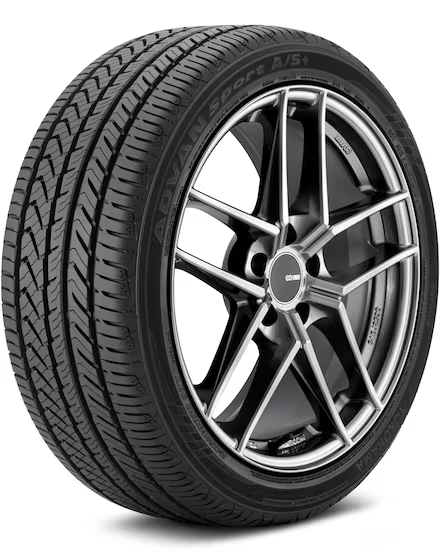
7. Yokohama ADVAN Sport A/S+: Best Balanced Performer
Price Check
Check the price of this tire at the following retailers:
This tire strikes a genuine middle ground for 300 owners who want capability without either extreme. An advanced asymmetric tread pattern delivers real grip in both dry and wet conditions, and Yokohama’s silica-enriched compound maintains traction while genuinely preserving fuel efficiency — a real benefit for V8-equipped 300 owners.
Adaptive shoulder blocks meaningfully minimize road noise, creating a genuinely serene cabin environment that complements the 300’s luxury credentials, while reinforced construction absorbs road imperfections without transmitting harshness.
Yokohama backs the ADVAN Sport A/S+ with a 50,000-mile warranty, and real owner reports commonly describe 45,000-50,000 miles before replacement. For 300 owners who want a genuinely well-rounded tire without premium-brand pricing, this is a strong pick.
Pros: Genuine comfort-performance balance, strong 50,000-mile warranty, respectable fuel-efficiency benefit.
Cons: Not 3PMSF rated, doesn’t match dedicated performance tires at the limit.
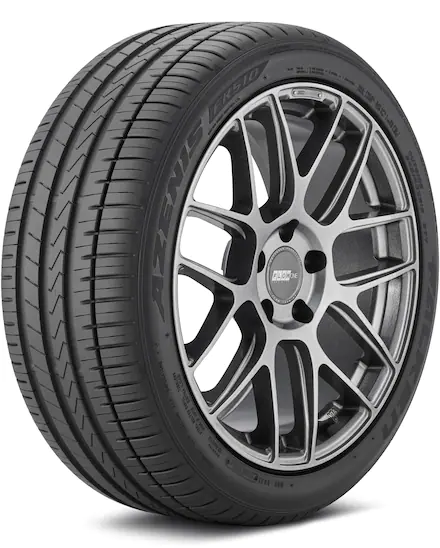
8. Falken Azenis FK510: Best Value Leader
Price Check
Check the price of this tire at the following retailers:
This is a genuine standout at its price point for 300 owners who want high-performance capability without flagship pricing. Falken’s asymmetric tread pattern with wide shoulder blocks delivers real cornering stability — a genuinely important characteristic given the 300’s substantial weight — and a silica-enriched compound strikes a fair balance between grip and longevity.
Real owner reports describe the tire maintaining composure with minimal squirming during aggressive driving, and wide circumferential grooves deliver confident wet-weather braking and cornering.
Road noise is well-controlled for an ultra-high-performance tire, an important consideration for a luxury sedan. Typically priced 20-30% below comparable premium options, this is one of the strongest performance-per-dollar values available for the 300.
Pros: Genuine near-flagship performance at a meaningfully lower price, well-controlled road noise for the category, confident wet-weather grip.
Cons: Firmer ride than pure touring options, not 3PMSF rated.
9. Nitto NT555 G2: Best High-Performance Summer

Price Check
Check the price of this tire at the following retailers:
For 300S and 300C owners who want maximum warm-weather performance and are willing to swap seasonally, the NT555 G2 delivers genuinely exceptional dry grip. Reinforced shoulder blocks and a specialized tread compound provide real cornering stability, and large tread blocks combined with a continuous center rib create a substantial contact patch that delivers genuine straight-line stability — well-suited to harnessing the V8 models’ acceleration.
Wet performance is respectable, if not quite matching the Continental DWS06 Plus or Michelin Pilot Sport A/S 3+, with large circumferential grooves that effectively evacuate water.
The real limitation is the one every summer-tire buyer should understand clearly: this tire becomes unsafe below roughly 45°F, requiring a seasonal swap for 300 owners in regions with real winters, and tread life runs shorter than all-season alternatives — typically 25,000-30,000 miles.
For owners who prioritize maximum warm-weather grip and accept the seasonal trade-off, this is a strong, competitively priced pick.
Pros: Genuinely strong dry-condition grip and straight-line stability, competitive pricing relative to premium summer tires.
Cons: Unsafe below roughly 45°F, requires seasonal swapping, shorter tread life than all-season options.
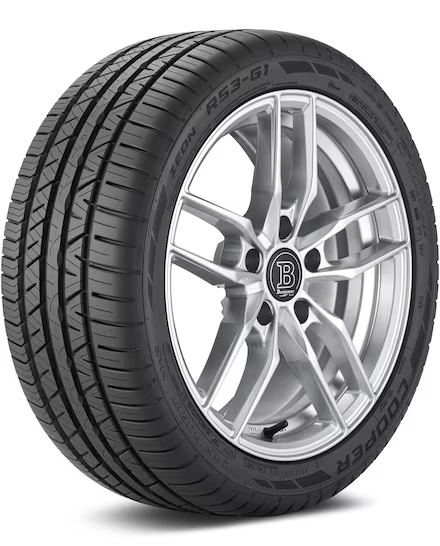
10. Cooper Zeon RS3-G1: Best American-Made Performance
Price Check
Check the price of this tire at the following retailers:
This tire pairs a genuine American manufacturing pedigree with credible ultra-high-performance capability.
An asymmetric tread pattern designed for high-speed cornering delivers real grip, and a silica-infused compound balances dry performance with wet traction — reinforced by 3D micro-gauge siping that creates additional biting edges on slippery surfaces without compromising handling response.
Cooper’s practical, real-world-driving engineering approach delivers a genuinely smooth, quiet ride that suits the 300’s luxury sedan character, and Cooper backs the Zeon RS3-G1 with a 45,000-mile warranty.
Typically priced 15-20% below comparable European or Japanese premium options while delivering a genuinely competitive share of their performance, this is a strong value pick for owners who specifically want a domestically manufactured tire on their American sedan.
Pros: Genuine value relative to premium imports, domestic manufacturing, respectable 45,000-mile warranty.
Cons: Not 3PMSF rated, doesn’t quite match the outright grip of the top-tier options in this comparison.
11. Michelin CrossClimate2: Best All-Weather, No Seasonal Swap

Price Check
Check the price of this tire at the following retailers:
For 300 owners who don’t want to swap tires seasonally but face real winter weather often enough that a standard all-season performance tire feels risky, the CrossClimate2 offers a genuine middle ground that nothing else in this comparison provides.
It carries 3PMSF certification and delivers significantly better cold-weather performance than every other tire on this list, without requiring the seasonal changeover a dedicated winter tire demands.
Its V-shaped tread design with dense biting edges maintains solid traction in light to moderate snow — a real, meaningful benefit for RWD 300 owners specifically, since rear-wheel drive alone offers little help in snow. Dry-weather handling and tread life remain respectable, if understandably short of the dedicated performance tires in this comparison.
Michelin’s warranty coverage varies meaningfully by size, so confirm the specific figure for the 300’s exact fitment. For Touring and Touring L owners in regions with moderate but real winters who want one set of tires year-round, this is the strongest all-weather solution here.
Pros: The only genuine 3PMSF-rated option in this comparison, real benefit for RWD models in snow, no seasonal swapping required.
Cons: Doesn’t match a dedicated winter tire on ice, less sharp than the dedicated performance options here.
Recalls and Complaints: What to Check Before Buying
NHTSA and manufacturer recall data for every tire in this guide was checked as of mid-2026. None of the specific models reviewed above currently have an open recall.
It’s worth knowing what has actually been recalled on the 300 itself, since one directly involves tire safety systems: a pair of 2022 recalls (NHTSA campaigns 22V-504 and 22V-808) affected certain 2022 Chrysler 300, Dodge Charger, and Dodge Challenger vehicles whose TPMS sensor batteries could fail prematurely, potentially preventing the system from alerting drivers to low tire pressure — genuinely relevant, since a non-functioning TPMS makes routine pressure checks even more important.
A separate 2024 recall addressed an improperly adjusted parking brake on certain 2023 300, Charger, and Challenger models; unrelated to tires.
Before installing any tire, new or used, check the DOT code against NHTSA’s recall database — it takes about thirty seconds and is the single easiest safety check most people skip, and it matters more than usual on a discontinued model where used tire inventory circulates longer.
Maintaining 300 Tires
Rotate every 5,000 to 7,500 miles, using a forward-cross pattern for RWD models (rear tires move to opposite front positions, front tires move straight back) or a full-cross pattern for AWD models.
Check pressure monthly with a quality gauge, since a failed TPMS sensor — as the 2022 recall demonstrated — won’t always alert you to a problem. Confirm the recommended pressure (typically 32–35 PSI) against the door jamb sticker rather than guessing, and remember pressure drops roughly 1–2 PSI for every 10°F temperature decrease.
Have alignment checked annually or every 15,000 miles, or sooner if you notice uneven wear, pulling to one side, or steering wheel vibration — the 300’s weight and performance-oriented suspension make this genuinely important for preserving both handling and tire life.
Watch for genuine replacement signs: tread depth below 4/32″, uneven wear patterns, visible sidewall cracks or bulges, or decreased wet-weather performance. Given the 300’s discontinued status, tires older than 6–10 years deserve extra scrutiny regardless of remaining tread, since rubber compounds degrade with age independent of mileage.
Choosing the Right Tire for a Chrysler 300
Match tire category to how the car is actually driven. Touring and Touring L owners generally benefit most from balanced, comfort-leaning picks like the Bridgestone Potenza RE980AS or Yokohama ADVAN Sport A/S+; 300S and 300C owners get real, felt value from the Michelin Pilot Sport A/S 3+ or Continental ExtremeContact DWS06 Plus’s genuine grip.
RWD models deserve extra winter consideration. Rear-wheel drive alone provides little benefit in snow, so the Michelin CrossClimate2’s genuine 3PMSF certification — or a dedicated winter tire for owners in severe-winter regions — matters more on a 300 than it would on an AWD or FWD vehicle.
Budget doesn’t have to mean giving up real performance. The Falken Azenis FK510 and Firestone Firehawk Indy 500 both deliver genuine near-flagship capability at meaningfully lower prices.
Since the 300 is discontinued, plan for the long haul. With no new 300 coming to replace an aging set, a tire with a genuinely competitive warranty can mean fewer total tire purchases over however many years you keep the car.
Frequently Asked Questions
Is the Chrysler 300 still in production?
No. Chrysler ended 300 production in December 2023 at its Brampton, Ontario assembly plant, closing out the nameplate with a limited-run, 2,200-unit 2023 300C. This doesn’t affect tire availability — 300 tire sizes are common, mainstream fitments shared with the Dodge Charger and Challenger on the same platform.
What size tires does my Chrysler 300 need?
It depends on trim. Touring and Touring L trims typically run 225/60R18, 300S typically runs 245/45R20, and the final-year 300C ran a staggered 245/45ZR20 front / 255/45ZR20 rear setup. Always check the door jamb sticker for the exact specification.
How often should I rotate the tires on my Chrysler 300?
Every 5,000 to 7,500 miles, using a forward-cross pattern for RWD models or a full-cross pattern for AWD models.
Are all-season tires good enough for winter driving in my Chrysler 300?
Standard all-season performance tires handle light snow adequately but aren’t 3PMSF certified. For RWD 300 models especially, where the drivetrain offers little help in snow, a genuine 3PMSF-rated all-weather tire like the Michelin CrossClimate2 — or a dedicated winter tire in severe-winter regions — delivers meaningfully better traction and safety.
What’s the best budget-friendly performance tire for the Chrysler 300?
The Firestone Firehawk Indy 500 and Falken Azenis FK510 both deliver genuine near-premium performance at 20-30% below flagship pricing, making them strong picks for owners who want real capability on a practical budget.
How do I know when it’s time to replace my Chrysler 300’s tires?
Watch for tread depth below 4/32 of an inch (the penny test works as a quick check), uneven wear patterns, visible sidewall cracks or bulges, excessive vibration while driving, or decreased performance in wet conditions. On a discontinued model, also factor in tire age — rubber compounds degrade over time regardless of remaining tread depth.
