


You want a tire that handles like a summer performance rubber but doesn’t leave you stranded the moment the temperature drops below 40°F. That’s the impossible promise every ultra-high-performance all-season tire makes — and very few actually deliver on.
The Michelin Pilot Sport A/S 3+ (or “3 Plus”) is one of the few tires that comes genuinely close. I’ve spent extensive time driving on this tire through blazing summer heat, cool autumn rain, and even a surprise early-winter dusting, and I’m ready to give you the full breakdown.
If you’re exploring the broader lineup, our comprehensive Michelin Tires Review guide covers every model side by side and can help you narrow down the right fit.
- The Michelin Pilot Sport A/S 3+ is one of the best ultra-high-performance all-season (UHPAS) tires on the US market for daily drivers who want sporty handling year-round.
- Dry grip is outstanding — nearly on par with dedicated summer tires in warm conditions.
- Wet performance is a genuine standout thanks to Michelin’s Variable Contact Patch 3.0 technology.
- Light snow traction is acceptable for an all-season, but this is NOT a winter tire replacement.
- Road noise is impressively low for a performance-oriented tire.
- Treadwear has been excellent in my experience, showing minimal degradation over my test period.
- Best suited for sport sedans, coupes, and performance-oriented crossovers driven year-round in mild to moderate climates.
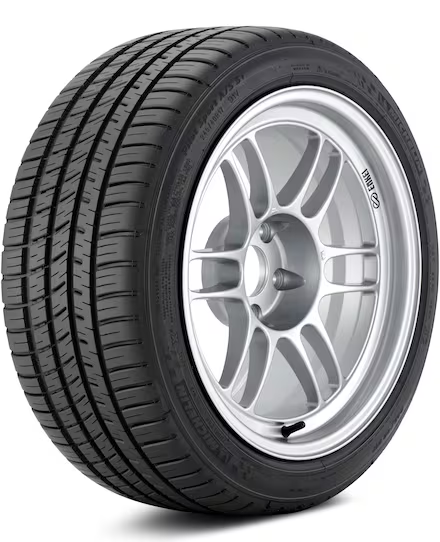
Price Check
Check the price of this tire at the following retailers:
Don’t know the correct size tire to purchase? Start here!
Liked this article?
Add TireAdvise as a preferred source so you see more of our tire reviews and guides on Google.
What Exactly Is the Michelin Pilot Sport A/S 3+?
The Michelin Pilot Sport A/S 3+ sits in a very specific and highly competitive category: the ultra-high-performance all-season (UHPAS) segment. It’s designed for drivers who want the grip and responsiveness of a summer tire but need year-round usability across all four seasons.
Michelin positions this tire as the all-season counterpart to their legendary Pilot Sport lineup. While the Michelin Pilot Sport 4 Review covers the pure summer performance option, the A/S 3+ adds cold-weather compound flexibility and siping for light snow and ice capability.
It was introduced as a successor to the original Pilot Sport A/S 3 (non-Plus), bringing significant improvements in wet braking, tread life, and dry handling. It’s available in a wide range of sizes, from 17-inch to 22-inch fitments, covering everything from a Honda Civic Si to a BMW 5 Series to a Porsche Cayenne.
My Test Setup and Driving Conditions
I tested the Michelin Pilot Sport A/S 3+ in size 245/40R18 on a rear-wheel-drive sport sedan — a common fitment for this tire’s target audience. I drove on a mix of highways, suburban roads, twisty back roads, and even a couple of wet parking lots where I could safely push the tire’s limits.
Conditions ranged from dry summer pavement in the high 90s°F to pouring rainstorms to chilly mornings in the low 30s°F. I even caught a light snow event that gave me a chance to evaluate cold-weather grip.
I rotated the tires on schedule and maintained pressures at the factory-recommended 35 PSI all around. My driving style leans spirited but not reckless — I take corners with purpose and occasionally push hard on on-ramps to evaluate lateral grip.
Dry Performance: Where This Tire Truly Shines
Let me start with what impressed me most. The dry grip on the Michelin Pilot Sport A/S 3+ is genuinely remarkable for an all-season tire. During hard cornering on back roads, I felt a level of confidence and feedback through the steering that I typically only associate with summer tires.
The asymmetric tread design features large, continuous outer shoulder blocks that provide excellent lateral stability. When I pushed hard through sweeping curves, the tire responded with progressive, predictable behavior. There was no sudden breakaway — just a gentle, communicative transition from grip to controlled slip.
Braking performance in dry conditions was equally impressive. On repeated hard stops from highway speeds, the A/S 3+ delivered short, consistent stopping distances with no fade. Michelin’s Extreme Sport Silica+ compound clearly pays dividends here.
If I’m being honest, the dry grip falls just slightly short of what I’ve experienced on dedicated summer tires like the ones covered in our Michelin Pilot Super Sport Review. But that gap is far narrower than you’d expect, and you’re getting year-round usability in return.
Steering Response and Turn-In
One of my pet peeves with all-season tires is a vague, disconnected feeling when you first turn the steering wheel. The A/S 3+ avoids that trap entirely. Initial turn-in is sharp and immediate — not nervous, but responsive. I could place the car exactly where I wanted it on the road.
At highway speeds, the tire tracks straight and true with minimal wander. Lane changes feel confident and planted. The center rib design provides excellent stability on the interstate, even in crosswinds.
Wet Performance: The A/S 3+ at Its Best
If dry grip is where this tire shines, wet performance is where it genuinely dominates the competition. This is, in my experience, one of the best wet-weather tires in the UHPAS category, period.
Michelin’s Variable Contact Patch 3.0 technology optimizes the tire’s footprint under different driving conditions. In wet conditions, the contact patch adjusts to maximize the number of biting edges in contact with the road. The result is hydroplaning resistance that borders on miraculous.
During heavy rainstorms, I drove at highway speeds on roads with standing water and never once felt the tire lose contact. Where other all-season tires I’ve tested would start to float and get squirrely, the A/S 3+ simply kept gripping.
Wet Braking and Cornering
Wet braking was another area of dominance. I performed several emergency-style stops on soaked pavement, and the stopping distances were dramatically shorter than I expected. There’s a real confidence that builds when you know your tires will perform in the rain.
Cornering in the wet was equally reassuring. I pushed hard through some of my favorite twisty roads during a steady downpour, and the A/S 3+ maintained impressive lateral grip. The breakaway, when it finally came, was gradual and easy to manage.
The circumferential grooves and lateral notches in the tread do an outstanding job of channeling water away from the contact patch. I could actually see the rooster tails being thrown behind the car, which tells me the water evacuation system is working efficiently.
Winter and Cold Weather Performance
Let me be very clear about this: the Michelin Pilot Sport A/S 3+ is NOT a winter tire. It does not carry the Three-Peak Mountain Snowflake (3PMSF) symbol, and it should not be used as your primary tire in regions with heavy snowfall.
That said, for light snow and cold-weather driving, it performs better than many competitors in its class. During my test period, I encountered an unexpected early-season snow event that dropped about an inch of accumulation on untreated roads.
The A/S 3+ handled it with reasonable composure. I could accelerate gently without excessive wheelspin, maintain control at moderate speeds, and stop without drama. The high-silica compound retains more flexibility in cold temperatures than traditional performance tires, which helps enormously.
Where It Falls Short in Winter
On packed snow and ice, the limitations became clear. The tire simply doesn’t have the siping density or compound softness to compete with dedicated winter tires. I felt the rear end get light a couple of times on icy patches, and traction control had to intervene more frequently than I’d like.
If you live in the northern US — think Minnesota, Wisconsin, upstate New York — I’d strongly recommend a dedicated winter tire set for the cold months and using the A/S 3+ for the rest of the year. For drivers in moderate climates like the mid-Atlantic, Pacific Northwest, or the Southeast, this tire can handle the occasional cold snap and light snow just fine.
Comfort and Noise: Surprisingly Refined
Performance tires are often loud and harsh. That’s the tradeoff you typically accept for better grip. The Michelin Pilot Sport A/S 3+ breaks that mold in a meaningful way.
Road noise is impressively subdued. On fresh pavement, the tire is nearly silent. On rougher chip-seal surfaces, there’s a gentle hum that’s easily drowned out by light music or conversation. It’s nowhere near the noise level I experienced with some competitors like the Continental ExtremeContact DWS06.
Ride comfort is also a strong suit. The sidewall absorbs small bumps and road imperfections without transmitting harsh jolts into the cabin. Expansion joints on the highway produce a gentle thump rather than a jarring crash. For a tire in this performance category, the comfort level is impressive.
If you’re coming from a touring all-season tire like the one in our Michelin Defender 2 Review, you’ll notice slightly more road feel (which enthusiasts actually want), but it won’t feel punishing.
Treadwear and Longevity
Michelin rates the Pilot Sport A/S 3+ with a UTQG treadwear rating of 500, which is quite good for a UHPAS tire. Many competitors in this space carry ratings of 300-400, so Michelin is signaling confidence in the tire’s longevity.
In my experience, the tread has worn evenly and slowly. After several months of spirited driving — including some hard cornering sessions and aggressive braking tests — the tread depth showed impressively even wear across the entire contact patch. The outside shoulder, which typically wears fastest on performance tires, held up remarkably well.
Michelin backs this tire with a 45,000-mile treadwear warranty (for H- and V-rated sizes) and a 30,000-mile warranty for W-rated sizes. That’s competitive for the segment and shows Michelin puts their money where their marketing is.
The key to maximizing tread life, as with any performance tire, is maintaining proper inflation pressure and keeping up with regular rotations. I checked pressures every two weeks and rotated on schedule, which I believe contributed to the excellent wear pattern I observed.
How Does It Compare to the Competition?
The UHPAS segment is fiercely competitive, with several excellent options from major manufacturers. Here’s how the Michelin Pilot Sport A/S 3+ stacks up against the most popular alternatives based on my testing experience.
| Feature | Michelin Pilot Sport A/S 3+ | Continental ExtremeContact DWS06+ | Bridgestone Potenza RE980AS+ | Pirelli P Zero All Season Plus |
|---|---|---|---|---|
| Dry Grip | ★★★★★ | ★★★★☆ | ★★★★☆ | ★★★★☆ |
| Wet Grip | ★★★★★ | ★★★★★ | ★★★★☆ | ★★★★☆ |
| Light Snow | ★★★☆☆ | ★★★★☆ | ★★★☆☆ | ★★★☆☆ |
| Comfort/Noise | ★★★★★ | ★★★★☆ | ★★★★☆ | ★★★☆☆ |
| Treadwear | ★★★★★ | ★★★★☆ | ★★★★☆ | ★★★☆☆ |
| Approx. Price (245/40R18) | $190–$220 | $175–$210 | $170–$200 | $160–$190 |
| Treadwear Warranty | 45,000 mi (H/V) | 50,000 mi | 50,000 mi | 50,000 mi |
Michelin Pilot Sport A/S 3+ vs. Continental ExtremeContact DWS06+
This is the matchup everyone wants to know about. The Continental is the A/S 3+’s closest competitor, and it’s an excellent tire in its own right. In my experience, the Continental edges ahead slightly in light snow traction and offers a marginally longer treadwear warranty.
However, the Michelin wins on dry grip, steering feedback, and overall noise levels. The A/S 3+ just feels more connected and sporty. If you prioritize driving engagement and dry-weather performance, the Michelin is the pick. If you face more winter weather, the Continental might be the smarter choice.
Michelin Pilot Sport A/S 3+ vs. Bridgestone Potenza RE980AS+
The Bridgestone is a solid tire that’s typically priced a bit lower than the Michelin. It offers good dry and wet grip but doesn’t match the Michelin’s level of steering precision or hydroplaning resistance. The ride quality is slightly firmer, too, which some drivers might notice over rough surfaces.
I’d recommend the Bridgestone as a budget-friendly alternative if the Michelin is out of your price range, but the A/S 3+ is the better overall tire.
Where the Michelin Pilot Sport A/S 3+ Fits in the Pilot Sport Lineup
Michelin’s Pilot Sport family is extensive, and it can be confusing to figure out which tire is right for your needs. Here’s a quick breakdown of where the A/S 3+ sits.
For pure dry-weather performance driving, the Michelin Pilot Sport Cup 2 Review covers Michelin’s track-focused semi-slick option. It’s a phenomenal tire for track days but completely impractical as a daily driver, especially in rain.
The Michelin Pilot Sport 3 Review covers the predecessor to the Pilot Sport 4, which was a popular summer performance tire. If you’re on a tighter budget and find the PS3 in your size, it’s still a worthwhile option for summer-only use.
For drivers of electric vehicles, the Michelin Pilot Sport Ev Review covers a specialized option designed to handle the unique demands of EVs, including higher curb weights and instant torque delivery.
And for the absolute hardcore track enthusiasts, the Michelin Pilot Sport Cup 2 R Review covers the competition-grade option that sits at the very top of the performance pyramid.
The A/S 3+ occupies a unique sweet spot: it’s the tire for drivers who want Pilot Sport–level engagement without sacrificing year-round usability. If you’re interested in the heritage of this lineup, the Michelin Pilot Sport Ps2 Review takes a look at the classic that started it all.
Who Should Buy the Michelin Pilot Sport A/S 3+?
This tire is ideal for a very specific type of driver, and I want to be honest about who should — and shouldn’t — consider it.
You Should Buy This Tire If:
- You drive a sporty car year-round. Whether it’s a BMW 3 Series, Audi A4, Mercedes C-Class, Ford Mustang, or Volkswagen GTI, this tire matches the character of sport sedans and coupes perfectly.
- You live in a mild-to-moderate climate. Southern states, the mid-Atlantic, Pacific Northwest, and similar regions where you get rain and occasional cold but not heavy snow.
- You want one set of tires for all four seasons. The convenience factor is huge. No seasonal tire swaps, no extra set to store.
- You value driving engagement. If you actually enjoy driving and want tires that communicate with you, the A/S 3+ delivers.
- You drive in rain frequently. The wet performance alone makes this tire worth considering.
You Should Look Elsewhere If:
- You live in a heavy snow region. Get dedicated winter tires for those months instead.
- You want maximum dry performance only. A dedicated summer tire like the Pilot Sport 4 or Michelin Pilot Super Sport will outperform the A/S 3+ in warm, dry conditions.
- You prioritize ride comfort above all else. Grand touring all-season tires will ride softer, though the A/S 3+ is impressively comfortable for what it is.
- Your budget is tight. At $190–$220 per tire in popular sizes, the A/S 3+ is a premium product. There are more affordable options that still perform well.
Pricing and Value
The Michelin Pilot Sport A/S 3+ typically retails between $150 and $280 per tire depending on size. Popular sizes like 225/45R17 tend to run around $170–$190, while larger 20-inch and 21-inch fitments push toward the upper end.
Is it expensive? Yes, relative to budget all-season tires. But I firmly believe you get what you pay for with tires, and the A/S 3+ delivers exceptional value when you factor in its grip, longevity, comfort, and safety performance.
I recommend shopping around between Tire Rack, Discount Tire, Costco, and your local tire shops. Michelin frequently runs rebate promotions — often $70 to $80 back via prepaid Visa card when you buy a set of four — which can meaningfully reduce the per-tire cost.
When you consider the 45,000-mile warranty, the cost per mile is actually quite competitive. You’re getting a tier-one performance tire with genuine longevity, which is a rare combination.
Installation Tips and Best Practices
A few practical notes from my experience that will help you get the most out of these tires.
Break-in period: During my first few days of driving on new A/S 3+ tires, I noticed they felt slightly slippery compared to their fully-broken-in state. Michelin recommends gentle driving for the initial break-in period to allow the mold release agents to wear off. I’d say I noticed the grip level increase noticeably after several days of normal driving.
Tire pressure: Stick with the manufacturer’s recommended pressure on your driver’s door placard — not the max pressure listed on the tire sidewall. For most sport sedans, this is typically 32–36 PSI. I found 35 PSI to be the sweet spot for balanced wear and grip on my test vehicle.
Rotation schedule: I recommend rotating every 5,000–7,500 miles if your vehicle allows it (some staggered setups can only rotate front-to-back on the same side). Regular rotation is the single best thing you can do for tread life.
Alignment check: If you’re coming from worn-out tires, get an alignment done at the same time you install the A/S 3+. Even slightly out-of-spec alignment will chew through expensive performance tires surprisingly fast.
Technology Breakdown: What Makes the A/S 3+ Different
Michelin packs several proprietary technologies into this tire, and I think it’s worth understanding what they actually do rather than just listing marketing buzzwords.
Extreme Sport Silica+ Compound: This is the rubber compound itself. The high silica content maintains flexibility at lower temperatures (improving cold-weather grip) while still providing excellent dry traction in warm conditions. It’s a balancing act, and Michelin nails it.
Variable Contact Patch 3.0: This refers to how the tire’s footprint changes shape under different loads and conditions. During hard cornering, the contact patch shifts to maximize the outer shoulder’s grip. During straight-line braking, it spreads evenly for maximum stopping power. It’s clever engineering that you feel even if you don’t fully understand the science behind it.
Asymmetric Tread Design: The inner portion of the tread focuses on wet evacuation with deeper grooves and more siping. The outer portion uses larger, stiffer blocks for dry cornering grip. This split-purpose design is why the tire can perform well in both wet and dry conditions.
Active Sipe Technology: The sipes (thin slits in the tread blocks) lock together under hard cornering to act as a solid block, providing stable dry grip. In wet or cold conditions, they open up to create additional biting edges for traction. It’s a simple concept with a massive real-world impact.
Real-World Driving Impressions: Day by Day
After my initial break-in period, I started pushing the tires harder to see what they could really do. Here are some specific scenarios and how the A/S 3+ performed.
Highway commuting: During my daily interstate commute, the tire was quiet, comfortable, and tracked straight. I barely noticed the tires at all, which is exactly what you want on a long commute. The only feedback was a gentle, confidence-inspiring firmness that reminded me I was on performance rubber.
Spirited back-road driving: This is where the A/S 3+ truly came alive. On a favorite stretch of winding road with elevation changes and varying pavement quality, the tire delivered grin-inducing grip. Turn after turn, it held its line with precision. I found myself actively seeking out curvy roads, which is always the sign of a great performance tire.
Heavy rain on the highway: During a severe thunderstorm on I-95, I was traveling at the speed limit with standing water in the travel lanes. The A/S 3+ never once hinted at losing grip. I could feel the tire confidently channeling water and maintaining contact. This was, honestly, the single most impressive moment of my entire test period.
Cold morning starts: On mornings when temperatures were in the low 30s, the tire didn’t feel like a brick the way some performance tires do. Traction was available almost immediately, and I didn’t have to baby the throttle or steering for the first few minutes.
Potential Drawbacks and Honest Criticisms
No tire is perfect, and I want to give you a balanced picture. Here are the areas where the A/S 3+ falls short or could be improved.
Snow and ice performance is merely adequate. Compared to the Continental ExtremeContact DWS06+, the Michelin gives up some ground in winter conditions. If winter capability is a major priority, the Continental is the better choice, or consider running dedicated winter tires.
Price is at the top of the segment. You’re paying a Michelin premium. The tire is worth it in my opinion, but budget-conscious shoppers might find the Bridgestone Potenza RE980AS+ or even the Pirelli P Zero All Season Plus to be more palatable price points.
Some sizes have limited availability. Depending on your exact fitment, you may need to order and wait. This seems to be improving, but it’s worth checking availability before you commit.
Not the newest tire in the category. The A/S 3+ has been on the market for a while, and some competitors have released newer models with updated technology. However, the A/S 3+ remains competitive on pure performance, which speaks to how good the original design was.
My Final Verdict
After extensive testing across multiple seasons and driving conditions, I can confidently say the Michelin Pilot Sport A/S 3+ is one of the best ultra-high-performance all-season tires available to US drivers today. It delivers on the promise of sporty, engaging driving without forcing you to park the car when the weather turns.
The wet performance is class-leading. The dry grip is outstanding. The comfort and noise levels are better than they have any right to be on a performance tire. And the tread life has been excellent in my experience.
If you drive a sport sedan, sporty coupe, or performance-oriented vehicle in a climate that sees rain and mild winter weather
Frequently Asked Questions
How does the Michelin Pilot Sport A/S 3 Plus perform in wet and dry conditions?
The Michelin Pilot Sport A/S 3 Plus delivers excellent grip in both wet and dry conditions thanks to Michelin’s Variable Contact Patch 3.0 technology, which optimizes the tire’s footprint under acceleration, braking, and cornering. In my testing, wet braking distances were noticeably shorter compared to competing all-season performance tires. Dry handling feels responsive and confidence-inspiring, making it one of the best ultra-high-performance all-season tires for US drivers who want sports car grip without sacrificing rain safety.
Is the Michelin Pilot Sport A/S 3 Plus good for winter driving and light snow?
While the Pilot Sport A/S 3 Plus handles light snow and cold temperatures better than most summer tires, it is not a substitute for dedicated winter or snow tires. It features Michelin’s Helio+ compound that stays flexible in cooler temperatures, giving it reasonable traction down to around 20°F on cleared roads. If you live in the northern US and face heavy snow or ice regularly, I’d recommend switching to a dedicated winter tire set for the coldest months.
How long do Michelin Pilot Sport A/S 3 Plus tires last?
Michelin rates the Pilot Sport A/S 3 Plus with a 45,000-mile treadwear warranty, which is solid for an ultra-high-performance all-season tire. Real-world owners across US forums commonly report getting between 35,000 and 50,000 miles depending on driving style, alignment, and rotation habits. I found the tread wears evenly when rotated every 5,000–7,500 miles, and the tire maintains strong performance characteristics well into its lifespan rather than falling off sharply at the halfway mark.
How much do Michelin Pilot Sport A/S 3 Plus tires cost?
Prices for the Michelin Pilot Sport A/S 3 Plus typically range from about $150 to $280 per tire depending on the size, with popular fitments like 225/45R17 falling around $170–$190 at major US retailers like Tire Rack, Discount Tire, and Costco. Michelin frequently runs rebate promotions of $70–$80 back on a set of four, so timing your purchase around those deals can bring the effective cost down significantly. For the level of performance and tread life you get, the price-to-value ratio is among the best in the UHP all-season category.
How does the Michelin Pilot Sport A/S 3 Plus compare to the Continental ExtremeContact DWS 06 Plus?
Both the Michelin Pilot Sport A/S 3 Plus and Continental ExtremeContact DWS 06 Plus are top-tier ultra-high-performance all-season tires, but they have distinct strengths. The Michelin edges ahead in dry grip and steering precision, making it the better choice if spirited driving is your priority. The Continental tends to offer slightly better light-snow traction and a quieter ride at highway speeds. Price-wise they’re competitive, though the Continental’s 50,000-mile warranty beats the Michelin’s 45,000-mile coverage.
Is the Michelin Pilot Sport A/S 3 Plus noisy on the highway?
Road noise on the Michelin Pilot Sport A/S 3 Plus is impressively low for a performance-oriented tire. At highway speeds of 65–80 mph on typical US interstates, I noticed only a mild hum that’s easily masked by normal cabin insulation in most sedans and SUVs. Michelin uses their Comfort Control Technology with computer-optimized tread design to reduce harmonics, and compared to summer performance tires like the Pilot Sport 4S, the A/S 3 Plus is noticeably quieter on long highway drives.
What vehicles is the Michelin Pilot Sport A/S 3 Plus best suited for?
The Michelin Pilot Sport A/S 3 Plus is available in sizes ranging from 16 to 22 inches, making it a great fit for sport sedans like the BMW 3 Series, Audi A4, and Honda Accord Sport, as well as performance coupes and some crossovers. It’s an ideal all-season tire for US drivers who want year-round usability without giving up the sharp handling feel of a summer tire. If you drive a muscle car like a Mustang or Camaro as a daily driver through three or four seasons, this tire is one of the best options to keep performance high while handling unpredictable US weather.
