

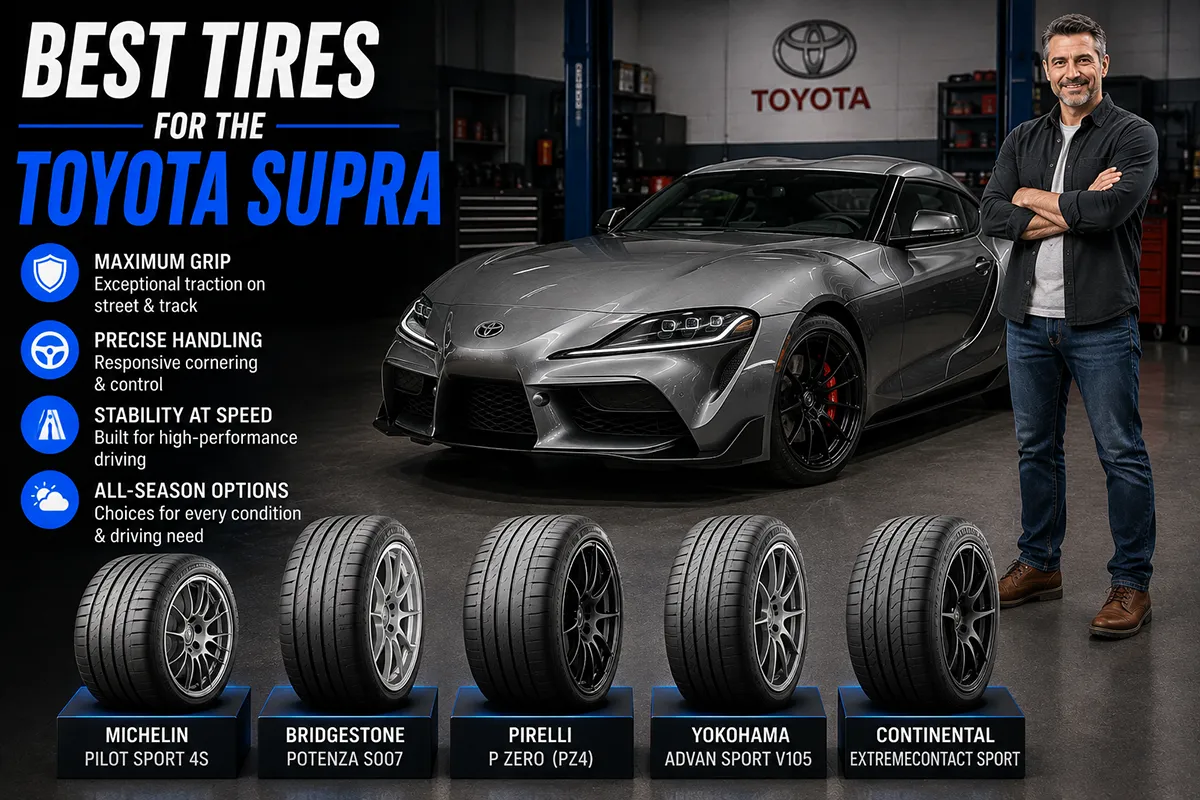
Toyota ended GR Supra production in March 2026, sending it off with a Final Edition after a seven-year run. That’s just a few months ago.
Its platform-sibling, the BMW Z4, ended at the same time from the same Austrian plant. That means most Supra owners today are maintaining a genuine modern icon, not shopping for a new one.
This guide is built for that reality. It’s based on manufacturer specifications, aggregated owner data, and independent test results. Here’s what actually holds up on a Supra, by generation and priority.
- Best overall performance: Michelin Pilot Sport 4S.
- Best balanced value: Continental ExtremeContact Sport.
- Best factory-matched choice: Bridgestone Potenza S007A.
- Best Italian engineering: Pirelli P Zero PZ4.
- Best track-ready option: Goodyear Eagle F1 SuperSport.
- Best budget performance: Falken Azenis FK510.
- Best dedicated winter: Michelin Pilot Alpin PA4.
- Full sizing by generation and an honest note on the GR Supra’s retirement are below.
Liked this article?
Add TireAdvise as a preferred source so you see more of our tire reviews and guides on Google.
Production Has Ended — Here’s What That Actually Means
This is worth addressing directly, since it’s the single most important thing a current Supra tire guide needs to get right. Toyota confirmed the fifth-generation GR Supra’s production would end in March 2026, and sent the car off with a Final Edition trim featuring sharper chassis tuning, bigger brakes, and exclusive styling.
The GR Supra was always a joint effort with BMW, built on a shared platform at Magna Steyr’s plant in Graz, Austria, and using BMW’s B58 turbocharged inline-six. The Z4, its closest relative, ended production at the same facility around the same time.
Toyota hasn’t confirmed a direct successor. Speculation points to a possible sixth generation as far out as 2030, likely without BMW’s involvement this time.
There’s also a smaller, more recent change worth knowing if you own a 2020–2024 model: Toyota dropped the 2.0-liter turbocharged four-cylinder entirely for 2025, leaving the 3.0-liter inline-six as the sole engine for the car’s final two model years. If your Supra has the four-cylinder, you’re driving a genuinely distinct, now-discontinued sub-variant within an already-discontinued car.
None of this affects tire shopping. Supra tire sizes are mainstream, widely stocked ultra-high-performance fitments, and every tire in this guide is easy to find.
How These Were Evaluated
This comparison draws on manufacturer specifications, aggregated owner reports, UTQG ratings, and independent traction and braking testing for each tire.
We cross-referenced everything against the Supra’s real factory sizing across its A70, A80, and A90/A91 generations.
Particular weight went to how each tire’s real-world character matches how Supra owners actually drive. This rear-wheel-drive platform rewards a tire that balances precise turn-in with real, usable traction under power — whether that power comes from a classic turbo inline-six or the modern B58.
Where specific figures or comparisons are cited, the source is noted rather than presented as a personal measurement.
Quick Comparison: 11 Best Tires for the Toyota Supra
| Tire | Best For | Approx. Price/Tire | Speed Rating | Typical Tread Life |
|---|---|---|---|---|
| Michelin Pilot Sport 4S | Best overall performance | $250–$340 | Y | 20,000–25,000 mi |
| Continental ExtremeContact Sport | Balanced value | $200–$270 | Y | 30,000-plus mi |
| Bridgestone Potenza S007A | Factory-matched choice | $230–$300 | Y | Not specified |
| Pirelli P Zero PZ4 | Italian engineering | $240–$320 | Y | Not specified |
| Yokohama ADVAN Sport A/S+ | Japanese precision | $190–$260 | Y | Not specified |
| Goodyear Eagle F1 SuperSport | Track-ready performance | $220–$300 | Y | Not specified |
| Falken Azenis FK510 | Budget performance | $160–$230 | Y | 15,000–20,000 mi |
| Nitto NT555 G2 | High-performance street | $190–$260 | Y | Not specified |
| Firestone Firehawk Indy 500 | Affordable performance | $150–$210 | Y | Not specified |
| Toyo Proxes Sport | All-around performance | $180–$250 | Y | Not specified |
| Michelin Pilot Alpin PA4 | Dedicated winter | $220–$290 | H | Seasonal (no summer warranty) |
Prices are street prices at major online retailers for common A90-generation Supra sizes (255/35R19 front, 275/35R19 rear) as of mid-2026. Expect regional and seasonal swings, and remember front and rear sizes differ on the staggered A90, so budget for two separate purchases.
Toyota Supra Tire Sizes by Generation
Confirm the exact size on the driver’s door jamb sticker before ordering. Sizing varies meaningfully across the Supra’s three US generations.
A70 (1986–1992) typically ran 225/50R16 front and 245/45R16 rear, with some Turbo models running slightly wider rear tires.
A80 (1993–2002) typically ran 235/45R17 front and 255/40R17 rear, with wider setups available on performance-oriented trims.
A90/A91 (2019–2026) runs a staggered 255/35R19 front and 275/35R19 rear across its entire production run — the same sizing every model year, including the Final Edition.
Speed rating matters more here than on most vehicles in our catalog. A W rating (168 mph) is the practical minimum for a stock Supra, with a Y rating (186 mph) recommended for modified or performance-oriented cars — never compromise on this, especially on a tuned A90.
Load index requirements on the A90 typically run a minimum of 93 (about 1,433 lbs) at the front and 95 (about 1,521 lbs) at the rear, reflecting both the car’s weight and the forces generated during hard acceleration, cornering, and braking.
Should You Even Replace Your Factory Tires?
Bridgestone Potenza S007A is genuine factory equipment on many A90 Supras, chosen by Toyota engineers specifically to complement the car’s suspension tuning and power delivery — Michelin Pilot Super Sport has also served as factory equipment on certain trims and model years.
If your factory tires are wearing evenly and the car still feels sharp, replacing like-for-like with a comparable factory-spec option is a reasonable, low-risk choice.
That said, the Supra has a genuinely dedicated enthusiast community that experiments freely with alternatives, and several tires in this comparison rival or exceed the factory picks in specific categories.
1. Michelin Pilot Sport 4S: Best Overall Performance

Price Check
Check the price of this tire at the following retailers:
This is Michelin’s flagship ultra-high-performance tire, and it’s a genuinely strong match for the Supra’s capabilities across generations.
An asymmetric tread pattern with a rigid outer shoulder delivers precise steering response and cornering stability — critical when pushing a Supra through winding roads. The inner portion uses a specialized compound and tread design that channels water away effectively, maintaining real wet-weather confidence.
Michelin’s dual-compound technology genuinely separates this tire from competitors. The outer tread’s racing-derived compound provides tenacious dry grip that handles the Supra’s power output, while the inner tread’s silica-infused compound maintains real traction in wet conditions.
Despite its performance focus, this tire offers surprisingly long-lasting treadwear — many owners report 20,000–25,000 miles of use. Thermal stability from Michelin’s Dynamic Response Technology prevents performance degradation during extended track sessions, a genuine benefit for owners who occasionally visit the circuit.
Pros: Genuine wet and dry grip balance, respectable tread life for an ultra-high-performance tire, consistent performance under repeated hard driving.
Cons: Premium price, not built for winter conditions.
2. Continental ExtremeContact Sport: Best Balanced Value

Price Check
Check the price of this tire at the following retailers:
This tire strikes a genuinely well-rounded balance between performance and practicality for Supra owners.
Continental’s SportPlus Technology maintains real grip even during aggressive driving, and an asymmetric tread with large outer shoulder blocks provides remarkable stability during high-speed cornering — a genuine benefit for Supra owners who enjoy pushing their car.
Ride quality is where this tire truly separates itself from harder-edged competitors. Noise-reducing technology and a specially designed internal structure absorb road imperfections, delivering a significantly more comfortable ride than many rivals — genuinely useful for Supra owners who daily-drive their car alongside weekend spirited runs.
Continental backs this tire with a 30,000-mile treadwear warranty, exceptional for a high-performance summer tire, at a price meaningfully below premium alternatives like the Pilot Sport line.
Pros: Genuine comfort for a performance tire, strong 30,000-mile warranty, meaningful value relative to flagship options.
Cons: Not built for winter conditions, doesn’t quite match the absolute limit of top-tier options.
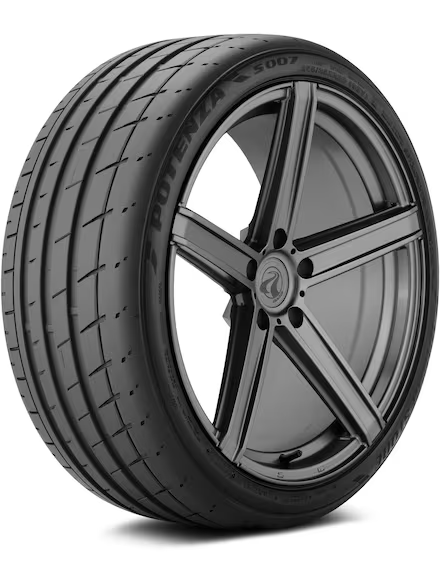
3. Bridgestone Potenza S007A: Best Factory-Matched Choice
Price Check
Check the price of this tire at the following retailers:
This tire comes as genuine original equipment on several Supra models — Toyota engineers specifically selected it to complement the car’s performance characteristics.
A specialized tread compound balances grip with longevity, a rare combination in performance tires, and an asymmetric tread pattern with rigid outside shoulder blocks provides exceptional cornering stability, letting drivers push through turns with real confidence.
Steering response is a genuine standout. High-tension carcass plies and a reinforced sidewall design translate inputs to the road surface with minimal delay — immediate feedback that matters when piloting a precision instrument like the Supra at speed.
An optimized contact patch maintains consistent pressure distribution throughout aggressive maneuvers, keeping more rubber on the road when it matters most, and predictable limit behavior gives drivers real confidence exploring the car’s performance envelope.
Pros: Genuinely engineered specifically for Toyota’s suspension tuning, exceptional steering response, predictable behavior at the limit.
Cons: Premium price, not built for winter conditions.
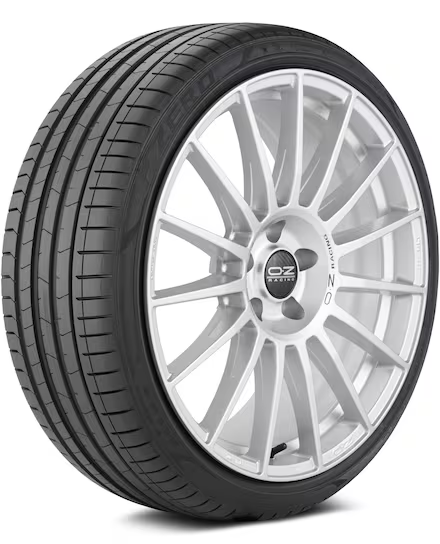
4. Pirelli P Zero PZ4: Best Italian Engineering
Price Check
Check the price of this tire at the following retailers:
This tire delivers genuine Italian racing heritage combined with everyday usability that complements the Supra’s dual nature as both track weapon and grand tourer.
An asymmetric tread pattern maintains real contact-patch integrity even at extreme velocities, delivering unwavering confidence at high speed with minimal wandering. Pirelli’s nano-composite compound technology ensures the tire stays pliable across temperatures, providing consistent performance from spirited canyon driving to casual commuting.
Pirelli’s noise-canceling system genuinely reduces road noise transmission by up to 25% compared to standard performance tires — a real benefit for Supra owners who appreciate the car’s grand touring side and want the inline-six or turbo four’s exhaust note front and center rather than tire roar.
Enhanced handling precision rounds out the package, with a rigid sidewall construction and optimized contact patch delivering lightning-quick steering response and real feedback through the wheel.
Pros: Genuine high-speed stability, real noise-reduction technology, confident wet and dry grip across temperatures.
Cons: Premium price, not built for winter conditions.
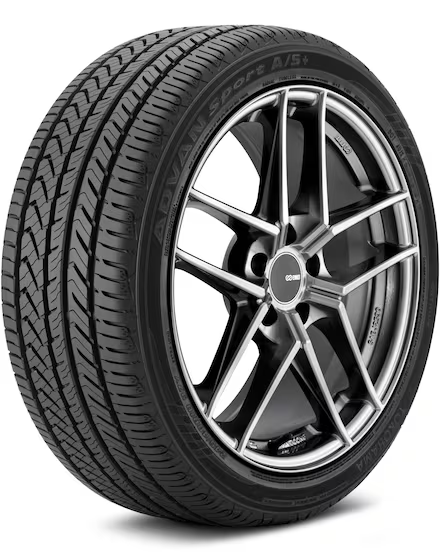
5. Yokohama ADVAN Sport A/S+: Best Japanese Precision
Price Check
Check the price of this tire at the following retailers:
This tire delivers genuine Japanese engineering precision, developed specifically for high-performance sports cars like the Supra.
An asymmetric tread pattern maximizes road contact during aggressive cornering, and a specialized compound with micro silica and polymer enhancements delivers real grip on both dry and wet surfaces.
What genuinely distinguishes this tire is its behavior on winding roads. Reinforced shoulder blocks provide immediate steering response and stability through tight corners, and this responsiveness doesn’t come at the expense of comfort — the tire genuinely absorbs road imperfections while maintaining real feedback.
Wet-weather performance is a real strength, with four wide circumferential grooves efficiently channeling water away to significantly reduce hydroplaning risk. This tire also delivers a genuinely reasonable price-to-performance ratio relative to premium European brands.
Pros: Genuine steering precision with real comfort, confident wet-weather grip, meaningful value relative to premium alternatives.
Cons: Premium price relative to budget options, not built for winter conditions.
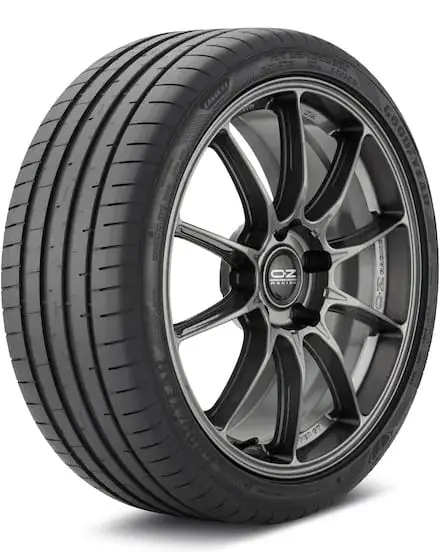
6. Goodyear Eagle F1 SuperSport: Best Track-Ready Performance
Price Check
Check the price of this tire at the following retailers:
This tire represents the pinnacle of track-focused rubber that remains fully street-legal for the Supra.
Rigid outer shoulder blocks provide remarkable stability during high-speed turns, letting the Supra hold its line with real precision even under extreme lateral forces — translating to genuinely faster corner exits and improved lap times for track day enthusiasts.
Feedback and response create a real, direct connection between driver and road. Every steering input delivers an immediate, predictable reaction, giving genuine confidence to push closer to the car’s limits — particularly valuable in technical sections or during quick directional changes.
An advanced tread compound with race-derived polymers remains grippy across a wide temperature range, delivering consistent performance from the first lap to the last. Despite its track focus, this tire maintains reasonable street comfort and noise levels, with real wet-weather capability that surpasses many dedicated track tires.
Pros: Genuine track-derived grip and steering feedback, wide operating temperature range, more street-usable than the track focus suggests.
Cons: Premium price, firmer ride than pure street-oriented options.
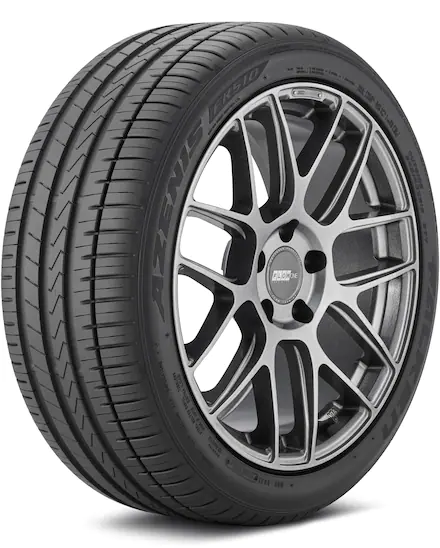
7. Falken Azenis FK510: Best Budget Performance
Price Check
Check the price of this tire at the following retailers:
This tire proves that high performance doesn’t require emptying your wallet, delivering genuine quality without the premium price tag.
An asymmetric tread pattern with wide shoulder blocks maximizes road contact during aggressive cornering, and a hybrid undertread design combines different compounds and construction techniques to create real stability at speed while still communicating road feedback.
Falken’s 4D Nano Design technology genuinely optimizes the interaction between silica and rubber at the molecular level, enhancing wet grip while improving wear resistance — real, meaningful benefits for a budget-tier tire.
Circumferential grooves and lateral slits efficiently evacuate water, reducing hydroplaning risk even in heavy downpours, making this tire genuinely suitable for year-round use in most climates. Real owner reports describe minimal difference from premium options in everyday driving despite the meaningfully lower price.
Pros: Genuine near-premium performance at a meaningfully lower price, confident wet-weather grip, respectable comfort.
Cons: Doesn’t quite match top-tier options at the absolute limit, not built for winter conditions.
8. Nitto NT555 G2: Best High-Performance Street Tire

Price Check
Check the price of this tire at the following retailers:
This tire has earned genuine popularity among Supra owners seeking high-performance street rubber without breaking the bank.
An enhanced tread design featuring large tread blocks and a continuous center rib delivers real straight-line stability — genuinely important when unleashing the Supra’s power. Large circumferential grooves efficiently channel water away, significantly reducing hydroplaning risk while maintaining wet-condition grip.
Reinforced shoulder blocks provide real cornering stability, resisting deformation under lateral forces and letting drivers push through twisty roads with confidence. A silica-enriched compound strikes a genuine balance between dry performance and wet traction, offering respectable tread life relative to other high-performance options.
Many owners report this tire delivers roughly 90% of premium-brand performance at a considerably lower price — genuine value that’s made it a common sight at Supra meets and track days alike.
Pros: Genuine straight-line stability, confident wet-weather grip, meaningful value relative to premium brands.
Cons: Not built for winter conditions, doesn’t quite match flagship tires at the absolute limit.
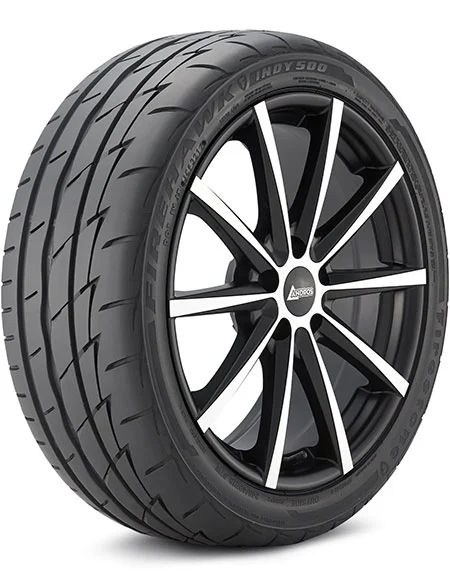
9. Firestone Firehawk Indy 500: Best Affordable Performance
Price Check
Check the price of this tire at the following retailers:
This tire delivers genuinely compelling performance for Supra owners who want spirited-driving capability without premium-tier pricing.
A silica-enriched compound and asymmetric tread pattern maximize road contact during aggressive driving, and the tire maintains real composure during hard cornering, providing predictable feedback that lets you confidently push the car closer to its limits.
Wet performance is respectable for the price — wide circumferential grooves and strategic siping channel water away effectively, reducing hydroplaning risk. It doesn’t quite match premium options like the Pilot Sport 4S in the rain, but it provides genuine confidence when conditions aren’t ideal.
Real owner reports describe roughly 80–90% of premium-tire performance at 60–70% of the cost — a compelling ratio that’s made this a frequent recommendation on Supra forums for budget-conscious enthusiasts.
Pros: Genuine dry-condition grip at a meaningfully lower price, respectable wet performance for the category, strong value proposition.
Cons: Wet performance trails premium alternatives, not built for winter conditions.
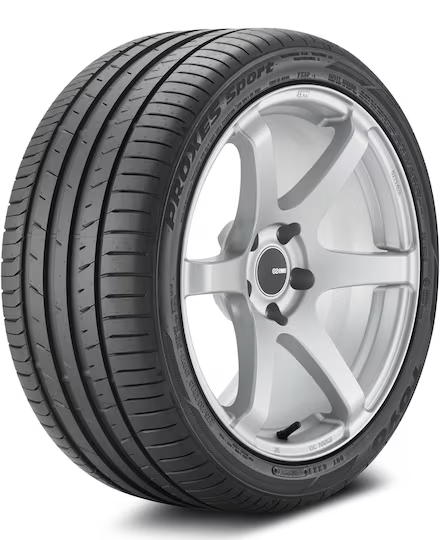
10. Toyo Proxes Sport: Best All-Around Performance
Price Check
Check the price of this tire at the following retailers:
This tire offers a genuinely harmonious balance of capabilities that suit both daily driving and spirited weekend excursions.
Crisp turn-in response and predictable handling on dry pavement complement the Supra’s chassis dynamics well, and the tire maintains real, impressive grip in wet conditions thanks to an optimized tread pattern and wide circumferential grooves that efficiently evacuate water.
An advanced silica-based compound enhances traction across temperature ranges while contributing to genuinely respectable treadwear characteristics — the high-silica content particularly shines in wet, cooler conditions.
A high-rigidity structure with reinforced sidewalls transfers the Supra’s power to the ground efficiently while maintaining shape under cornering loads, translating to sharper steering response. Perhaps most surprisingly for a performance tire, this delivers a remarkably quiet, comfortable ride through variable pitch tread designs.
Pros: Genuine balance of dry and wet performance, sharp steering response, surprisingly quiet and comfortable ride.
Cons: Not built for winter conditions, doesn’t match dedicated track tires at the outright limit.
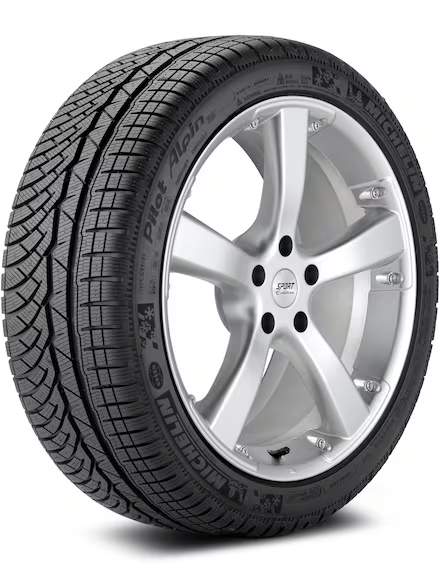
11. Michelin Pilot Alpin PA4: Best Dedicated Winter
Price Check
Check the price of this tire at the following retailers:
For Supra owners who refuse to garage their car during colder months, this tire represents the premium choice for maintaining safety without fully sacrificing the driving experience.
Unlike typical winter tires that can feel mushy and unresponsive, this tire genuinely preserves much of the handling precision Supra drivers value. A specialized winter compound remains flexible in freezing temperatures, and a directional tread pattern with high-density sipes creates thousands of biting edges for real snow and ice traction.
Michelin’s Helio+ compound, infused with sunflower oil, enhances grip on snow-covered and icy surfaces without compromising durability. Reinforced construction supports the Supra’s performance capabilities, genuinely preventing the vague, disconnected sensation often associated with winter tires.
For Supra owners in cold-weather regions, this isn’t merely an option — it’s a genuine necessity that transforms a potentially garage-bound sports car into a year-round driving machine.
Pros: Genuine handling precision retention for a winter tire, real snow and ice traction, preserves much of the Supra’s character.
Cons: Seasonal use only, premium price, not built for aggressive dry-weather performance.
Maintaining Supra Tires
Check pressure at least monthly, and always before any spirited driving session. The A90 typically calls for 35 PSI front and 38 PSI rear when cold, but confirm against your door jamb sticker since values vary by model year and tire choice.
Rotate side-to-side, not front-to-back, on staggered setups. The A90’s staggered sizing means front and rear tires can’t be swapped across axles — rotate left-to-right on the same axle every 5,000–7,000 miles. Non-staggered older Supras can follow a more conventional pattern every 5,000 miles.
Have alignment checked annually, or sooner after hitting a significant pothole or curb, noticing the car pull to one side, or seeing uneven wear patterns. A performance alignment with proper camber settings is worth considering for track-day use.
Watch for genuine replacement signs: tread depth below 4/32″, uneven or scalloped wear patterns, sidewall cracking, or decreased wet-weather performance.
Store seasonal tires properly. Clean thoroughly, store in a cool, dry location away from direct sunlight and ozone sources, and maintain roughly 50% normal air pressure during storage.
Choosing the Right Tire for a Toyota Supra
Match tire category to how the car is actually driven. Daily-driven Supras benefit most from the Continental ExtremeContact Sport or Falken Azenis FK510’s balance of grip and comfort. Owners chasing maximum track capability get real, felt value from the Goodyear Eagle F1 SuperSport or Michelin Pilot Sport 4S.
Don’t skip winter tires facing real cold. Summer performance tires become dangerously hard below roughly 45°F. The Michelin Pilot Alpin PA4 delivers a genuine, safety-relevant traction advantage no summer tire in this comparison fully replicates.
Budget doesn’t have to mean giving up real performance. The Firestone Firehawk Indy 500 and Nitto NT555 G2 both deliver genuine capability at meaningfully lower prices.
Since GR Supra production has ended, prioritize tires with proven longevity where performance allows. Fewer total tire purchases matter more on a car that’s now firmly a modern icon.
Frequently Asked Questions
Is the Toyota GR Supra still in production?
No. Toyota ended GR Supra production in March 2026 with a Final Edition send-off, closing out a seven-year run built in partnership with BMW. No direct successor has been confirmed, though a sixth generation is rumored as far out as 2030.
What size tires does my Toyota Supra need?
It depends on generation. A70 (1986–1992) typically ran 225/50R16 front and 245/45R16 rear. A80 (1993–2002) typically ran 235/45R17 front and 255/40R17 rear. A90/A91 (2019–2026) runs 255/35R19 front and 275/35R19 rear throughout its entire production run. Always check the door jamb sticker for your exact specification.
What tires come on the Toyota Supra from the factory?
Bridgestone Potenza S007A serves as genuine factory equipment on many A90 models, chosen specifically to match the car’s suspension tuning, with Michelin Pilot Super Sport also used on certain trims and model years.
How often should I rotate the tires on my Toyota Supra?
Due to the A90’s staggered setup, rotation is limited to side-to-side on the same axle every 5,000–7,000 miles. Non-staggered older Supras can follow a conventional rotation pattern every 5,000 miles.
What’s the best tire for track days with my Supra?
The Goodyear Eagle F1 SuperSport is built specifically around track-day demands, with genuine motorsport-derived grip and steering feedback. The Michelin Pilot Sport 4S is a strong alternative that also maintains good street manners.
Do I need winter tires for my Toyota Supra?
If you live somewhere with regular snowfall or temperatures that frequently drop below 45°F, yes. The Michelin Pilot Alpin PA4 delivers genuine cold-weather safety while preserving much of the Supra’s handling character, something summer performance tires simply can’t offer once temperatures drop.
How do I know when it’s time to replace my Toyota Supra’s tires?
Watch for tread depth below 4/32 of an inch, uneven or scalloped wear patterns, sidewall cracking, or decreased wet-weather performance. Performance tires generally wear faster than touring tires, especially with spirited driving.
