

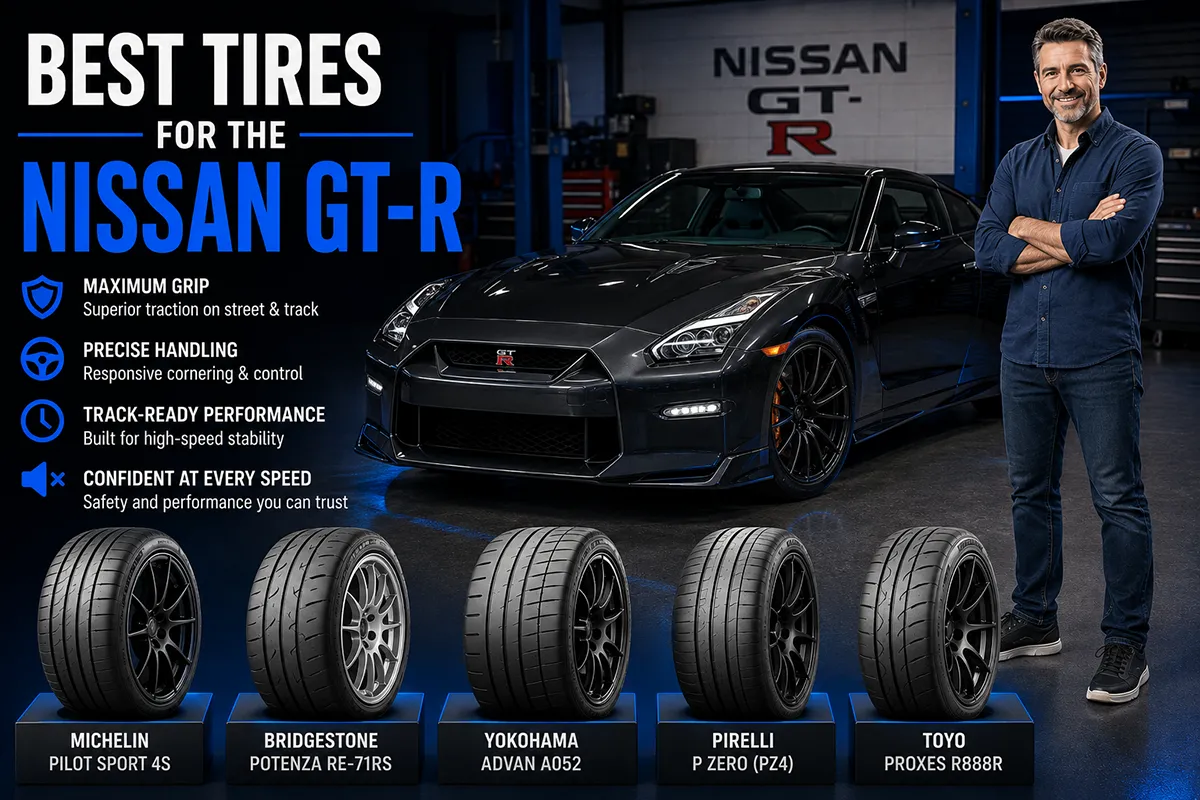
The R35 GT-R’s 18-year production run fully ended in August 2025, when the last car rolled off Nissan’s Tochigi, Japan assembly line. US sales had already ended after the 2024 model year.
That means most GT-R owners today are maintaining a genuine performance legend, not shopping for a new one. This guide is built for that reality.
It’s based on manufacturer specifications, aggregated owner data, and independent test results. Here’s what actually holds up on a GT-R, by priority.
- Best overall performance: Michelin Pilot Sport 4S.
- Best factory-matched choice: Bridgestone Potenza S007.
- Best Italian engineering: Pirelli P Zero PZ4.
- Best value performance: Continental ExtremeContact Sport.
- Best track day choice: Toyo Proxes R888R.
- Best for modified GT-Rs: Nitto NT555 G2.
- Best dedicated winter: Michelin Pilot Alpin PA4.
- Full sizing by fitment and an honest note on “Godzilla’s” retirement are below.
Liked this article?
Add TireAdvise as a preferred source so you see more of our tire reviews and guides on Google.
The R35 Is Officially Done — Here’s What That Means
This is worth knowing up front, since it’s the single most important thing a current GT-R tire guide needs to get right. Nissan built the R35 for 18 years, from 2007 through August 2025, when the very last car — a Midnight Purple Premium Edition T-Spec — rolled off the line in Tochigi, Japan, and went to a customer rather than Nissan’s private collection.
Nissan built roughly 48,000 R35s total. US sales ended earlier, after the 2024 model year, with the T-Spec Takumi and Skyline Edition serving as farewell trims for American buyers.
Nissan has confirmed a next-generation GT-R, codenamed R36, is planned — possibly electric, possibly arriving around 2028 based on the Hyper Force concept. Nothing is locked in yet, and there will be a real gap before it arrives.
None of this affects tire shopping. GT-R tire sizes are mainstream, widely stocked ultra-high-performance fitments, and every tire in this guide is easy to find. What retirement does change is that a GT-R is now firmly a modern legend, and tire choice matters more than ever for preserving both the driving experience and the car’s long-term value.
How These Were Evaluated
This comparison draws on manufacturer specifications, aggregated owner reports, UTQG ratings, and independent traction and braking testing for each tire.
We cross-referenced everything against the GT-R’s real factory staggered sizing.
Particular weight went to how each tire’s real-world character matches how GT-R owners actually drive. The ATTESA E-TS all-wheel-drive system and up to 600 horsepower reward a tire that can put real power down without being a track-only compromise for street use.
Where specific figures or comparisons are cited, the source is noted rather than presented as a personal measurement.
Quick Comparison: 11 Best Tires for the Nissan GT-R
| Tire | Best For | Approx. Price/Tire | Speed Rating | Typical Tread Life |
|---|---|---|---|---|
| Michelin Pilot Sport 4S | Best overall performance | $280–$380 | Y | 20,000–25,000 mi |
| Bridgestone Potenza S007 | Factory-matched choice | $260–$350 | Y | 15,000–20,000 mi |
| Pirelli P Zero PZ4 | Italian engineering | $270–$370 | Y | 15,000–20,000 mi |
| Yokohama ADVAN Sport A/S+ | Japanese engineering | $220–$300 | Y | 25,000–30,000 mi |
| Continental ExtremeContact Sport | Value performance | $200–$280 | Y | 30,000-plus mi |
| Toyo Proxes R888R | Track day choice | $250–$340 | Y | 5,000–8,000 mi (street) |
| Nitto NT555 G2 | Modified GT-Rs | $210–$290 | Y/W | 20,000–25,000 mi |
| Falken Azenis FK510 | Affordable performance | $170–$240 | Y/W | 15,000–20,000 mi |
| Dunlop SP Sport Maxx GT 600 DSST CTT | Run-flat security | $260–$350 | Y | 15,000–20,000 mi |
| Hankook Ventus S1 Evo3 | Korean value | $190–$260 | Y/W | 20,000–25,000 mi |
| Michelin Pilot Alpin PA4 | Dedicated winter | $250–$330 | H | Seasonal (no summer warranty) |
Prices are street prices at major online retailers for the GT-R’s staggered factory sizes as of mid-2026. Expect regional and seasonal swings, and remember front and rear sizes differ, so budget for two separate purchases.
Nissan GT-R Tire Sizes and Requirements
Confirm the exact size on the driver’s door jamb sticker before ordering. Every GT-R runs a staggered setup, with wider tires at the rear to match its all-wheel-drive power delivery.
Front: 255/40ZR20, consistent across the R35’s entire production run from 2009 through the final 2025 Japan-market cars.
Rear: 285/35ZR20, also consistent throughout production.
Speed rating matters more here than on almost any vehicle in our catalog. Every GT-R requires a Y or (Y) rating at minimum, good for speeds over 186 mph — genuinely necessary given the car’s real top speed can exceed 195–205 mph depending on trim.
Load index requirements typically run 94–98, reflecting both the car’s roughly 3,800–3,900-pound curb weight and the dynamic loads generated during hard acceleration, cornering, and braking through the AWD system.
Standard factory wheels run 20×9.5″ front and 20×10.5″ rear, with recommended tire width ranges of 245–265mm front and 275–305mm rear if you’re considering a size change. Some owners run wider setups — 295/35ZR20 or 305/35ZR20 rear for more traction, or track-focused 265/35ZR20 front and 305/30ZR20 rear for sharper cornering — but always verify clearance before committing.
Should You Even Replace Your Factory Tires?
Bridgestone Potenza S007 is genuine factory equipment on many GT-Rs, chosen by Nissan engineers specifically to handle the car’s power and AWD system. Dunlop’s SP Sport Maxx GT 600 DSST CTT run-flat, marked “NR1” on the sidewall, has also been factory-fitted on certain models.
If your factory tires are wearing evenly and the car still feels sharp, replacing like-for-like with a comparable factory-spec option is a reasonable, low-risk choice.
That said, the GT-R has a genuinely dedicated owner community that experiments freely with alternatives, and several tires in this comparison rival or exceed the factory picks in specific categories.
1. Michelin Pilot Sport 4S: Best Overall Performance

Price Check
Check the price of this tire at the following retailers:
This is Michelin’s flagship ultra-high-performance tire, and it’s a genuinely strong match for the GT-R’s capabilities.
An asymmetric tread pattern with a rigid outer shoulder delivers exceptional cornering stability — crucial when pushing a GT-R through tight turns. The inner portion uses a specialized compound and groove design optimized for wet conditions, giving drivers real confidence when weather turns unfavorable.
Michelin’s dual-compound technology genuinely separates this tire from competitors. The outer tread’s racing-derived compound provides tenacious dry grip that can handle the GT-R’s formidable power output, especially during hard launches, while the inner tread’s silica-infused compound maintains real traction in wet conditions.
Real owner reports describe 20,000–25,000 miles of street use before replacement, respectable for the category. Professional testing consistently places this tire at or near the top of ultra-high-performance summer tires for braking distance, lateral grip, and steering precision.
Pros: Genuine wet and dry grip balance, respectable tread life for an ultra-high-performance tire, consistent performance under the GT-R’s power.
Cons: Premium price, not built for winter conditions.
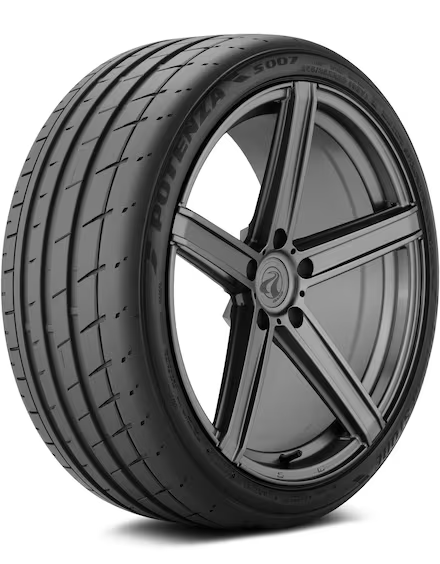
2. Bridgestone Potenza S007: Best Factory-Matched Choice
Price Check
Check the price of this tire at the following retailers:
This tire holds a genuine special place in the GT-R ecosystem as one of the factory-fitted options Nissan engineers chose specifically to handle the car’s power and sophisticated AWD system.
Factory sizing runs the GT-R’s standard staggered setup — 255/40R20 front, 285/35R20 rear — with load and speed ratings that genuinely exceed what’s needed even for aggressive driving.
An advanced asymmetric tread pattern with rigid outer shoulder blocks and continuous ribs enhances real cornering stability, while a higher void ratio in the inner tread maintains wet performance without compromising dry handling. Bridgestone’s Nano Pro-Tech compound maintains flexibility across temperatures while resisting the heat buildup common in high-performance driving.
Braking performance is a real strength, with excellent initial bite and minimal ABS intervention under hard stops. Progressive breakaway characteristics make this tire genuinely forgiving despite its high-performance envelope — valuable in a car where power can overwhelm the rear tires with traction control disabled.
Pros: Genuinely engineered specifically for the GT-R’s AWD system, exceptional high-speed stability, predictable limit behavior.
Cons: Premium price, moderate to high road noise, reduced performance below 45°F.
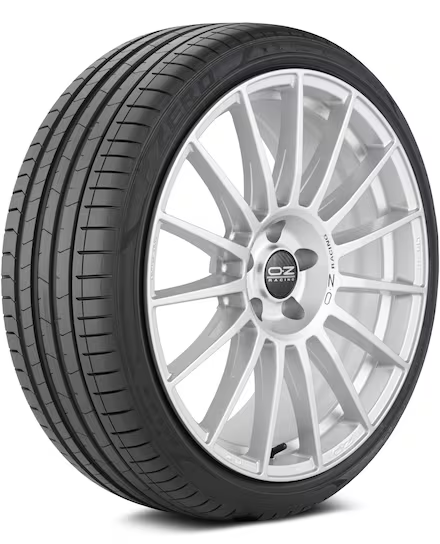
3. Pirelli P Zero PZ4: Best Italian Engineering
Price Check
Check the price of this tire at the following retailers:
This tire delivers genuine Italian craftsmanship tailored specifically for supercars like the GT-R.
A high-grip compound with enhanced silica content, combined with a three-layer carcass design and reinforced sidewalls, provides real stability during high-speed cornering and confident feedback through the steering wheel.
The asymmetric tread genuinely distinguishes this tire. Larger, more rigid outer shoulder blocks provide enhanced lateral grip during aggressive cornering, while the inner tread’s additional siping and optimized grooves efficiently evacuate water, maintaining grip even in wet conditions.
Pirelli’s noise-canceling system — sound-absorbing material applied to the inner tire wall — genuinely reduces cabin noise by up to 3 decibels. The tire also heats up quickly, reaching optimal operating temperature faster than many competitors, a real benefit for owners who enjoy occasional track days. Most owners report 15,000–20,000 miles of use.
Pros: Genuine handling precision matched to the GT-R’s power and AWD, real noise-reduction technology, quick warm-up for track use.
Cons: Premium price, not built for winter conditions.
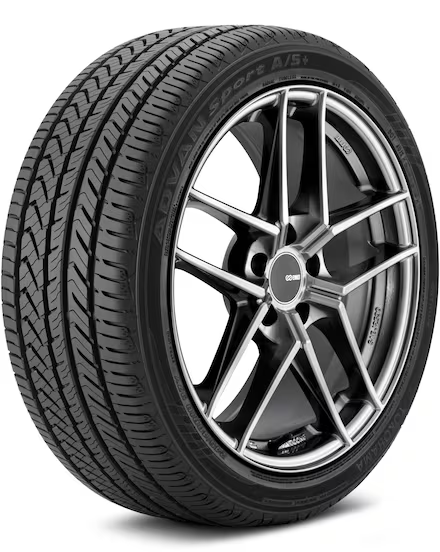
4. Yokohama ADVAN Sport A/S+: Best Japanese Engineering
Price Check
Check the price of this tire at the following retailers:
This tire delivers genuine Japanese engineering precision — a fitting pairing for a Japanese supercar.
Perfect sizing compatibility matches GT-R factory specifications precisely, in 255/40R20 front and 285/35R20 rear, with slightly wider options available for modified setups. An asymmetric tread with rigid outside shoulder blocks provides exceptional cornering stability at high speeds, and a specialized silica compound enhances wet grip significantly.
What genuinely distinguishes this tire is its noise and comfort balance. Unlike many ultra-high-performance tires that sacrifice comfort for grip, Yokohama’s noise-reducing technology minimizes road noise while maintaining responsive handling — a real benefit for GT-R owners who use their car for both track days and daily driving.
Real owner reports describe 25,000–30,000 miles of use before replacement, impressive given the performance level maintained throughout, and this tire typically prices below Michelin and Bridgestone alternatives while delivering comparable performance in many conditions.
Pros: Genuine value relative to premium alternatives, respectable comfort for a performance tire, strong real-world tread life.
Cons: Premium price relative to budget options, not built for winter conditions.
5. Continental ExtremeContact Sport: Best Value Performance

Price Check
Check the price of this tire at the following retailers:
This tire represents one of the strongest value propositions in the high-performance category for GT-R owners.
A specialized tread compound delivers exceptional grip in both dry and wet conditions, and an asymmetric pattern with large, rigid shoulder blocks provides real cornering stability. Wide circumferential grooves and optimized sipe design deliver genuinely strong wet-weather performance — an area where many performance tires fall short.
Continental’s SportPlus Technology maintains consistent handling as the tire heats up during spirited driving — real thermal stability that means predictable performance from the first corner to the last.
Durability is a real strength here. Continental backs this tire with a 30,000-mile treadwear warranty, genuinely impressive for an ultra-high-performance tire, and the twin steel belt construction with spirally wrapped nylon adds strength without compromising the noticeably comfortable ride.
Pros: Genuine wet-weather strength, strong 30,000-mile warranty, more accessible pricing than flagship alternatives.
Cons: Not built for winter conditions, doesn’t quite match the outright limit of top-tier options.
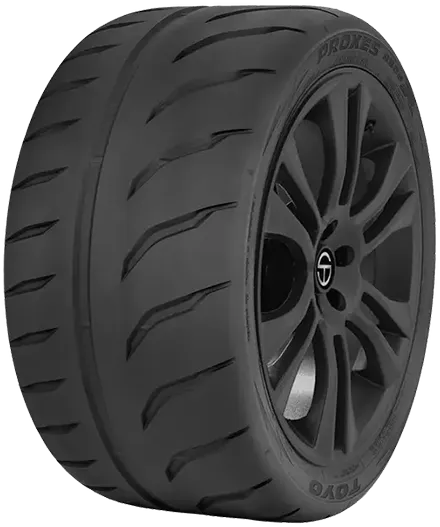
6. Toyo Proxes R888R: Best Track Day Choice
Price Check
Check the price of this tire at the following retailers:
This semi-slick tire represents the ultimate compromise between dedicated track rubber and street-legal performance for a GT-R.
With roughly 80% of the tire’s surface contacting the road, compared to around 60% for conventional performance tires, this delivers exceptional dry grip — genuinely faster corner entry speeds and improved stability through high-speed turns.
Track performance is where this tire truly shines. GT-R owners report lap-time improvements of 1–2 seconds per mile compared to conventional ultra-high-performance tires. Stiff sidewall construction maintains the GT-R’s precise steering feel even under extreme cornering loads, with predictable breakaway characteristics that make the car more manageable at the limit.
The honest trade-offs are real: wet-weather performance is significantly compromised, requiring extreme caution or a swap to conventional tires in rain, and street-mile life runs just 5,000–8,000 miles given the GT-R’s power and weight. Each track day is roughly equivalent to 1,000–1,500 street miles of wear.
Pros: Genuine track-derived grip and lap-time improvement, predictable limit behavior, fully street legal.
Cons: Significantly compromised wet performance, short street tread life, requires proper heat-cycle warm-up.
7. Nitto NT555 G2: Best for Modified GT-Rs

Price Check
Check the price of this tire at the following retailers:
For GT-R owners who’ve pushed their cars beyond factory specifications, this tire was engineered specifically with modified vehicles in mind.
Reinforced internal construction, with twin steel belts and a polyester casing, genuinely handles the immense torque and power that modified GT-Rs produce, preventing the tire deformation standard tires can experience under 600-plus-horsepower launches.
Drag performance is a real standout. A specialized tread compound delivers exceptional straight-line grip, and a large, continuous center rib provides remarkable stability during high-speed acceleration — genuinely useful for owners who frequent the drag strip or enjoy roll racing.
Despite its drag-focused design, handling remains respectable, with large outboard shoulder blocks and reinforced sidewalls delivering predictable cornering behavior — though it won’t match the pure cornering precision of track-focused alternatives. This tire also delivers this specialized performance at a meaningfully lower price than many competitors.
Pros: Genuine reinforced construction for modified power levels, strong straight-line grip, meaningful value relative to competitors.
Cons: Doesn’t match dedicated handling tires in pure cornering, not built for winter conditions.
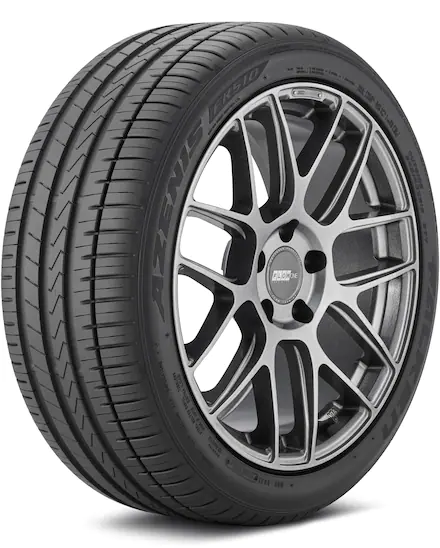
8. Falken Azenis FK510: Best Affordable Performance
Price Check
Check the price of this tire at the following retailers:
This tire delivers approximately 85–90% of the performance of premium-tier options at roughly 70% of the price — a genuinely compelling value proposition for GT-R owners.
A silica-enriched compound and asymmetric tread pattern work together to provide real grip in both dry and wet conditions. The gap to premium options like the Michelin Pilot Sport 4S is surprisingly minimal during spirited street driving.
Wet performance stands out as a real strength. Four wide circumferential grooves effectively channel water away from the contact patch, reducing hydroplaning risk even at higher speeds — genuinely useful for GT-R owners in regions with frequent rainfall.
Noise levels are well-managed for an ultra-high-performance tire, and most owners report 15,000–20,000 miles from a set when driven enthusiastically — competitive value considering the performance on offer.
Pros: Genuine near-premium performance at a meaningfully lower price, confident wet-weather grip, well-controlled road noise.
Cons: Doesn’t quite match premium tires at the absolute limit, moderate tread life.
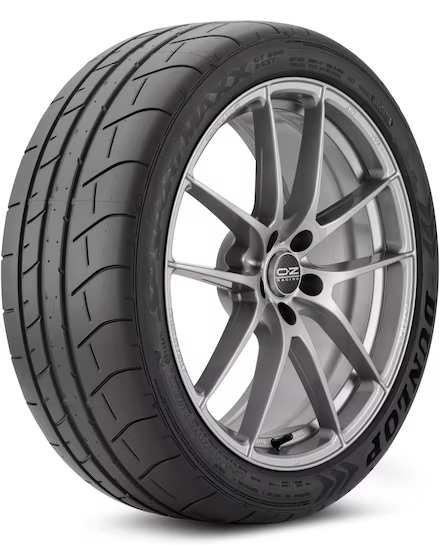
9. Dunlop SP Sport Maxx GT 600 DSST CTT: Best Run-Flat Security
Price Check
Check the price of this tire at the following retailers:
This tire was engineered in collaboration with Nissan specifically for the GT-R, and it’s one of the most sophisticated run-flat options available for the car.
DSST CTT (Dunlop Self-Supporting Technology with Carbon Fiber Technology) uses reinforced sidewalls that temporarily support the GT-R’s weight after complete pressure loss, allowing up to 50 miles of continued driving at reduced speed — genuine peace of mind rather than being stranded roadside.
Factory sizing matches the GT-R’s standard staggered setup, and these tires carry specific “NR1” sidewall markings, indicating specialized tuning for the car’s weight distribution, suspension geometry, and power delivery.
Despite the reinforced construction necessary for run-flat capability, real steering response and high-speed stability hold up well, though the ride is genuinely a bit firmer than non-run-flat alternatives. Most owners report 15,000–20,000 miles of tread life, with the added benefit of eliminating the need for a spare tire — real trunk space in an already storage-limited car.
Pros: Genuine run-flat security and continued-drivability after a puncture, factory-tuned for the GT-R specifically, saves trunk space.
Cons: Premium price, firmer ride than non-run-flat alternatives.
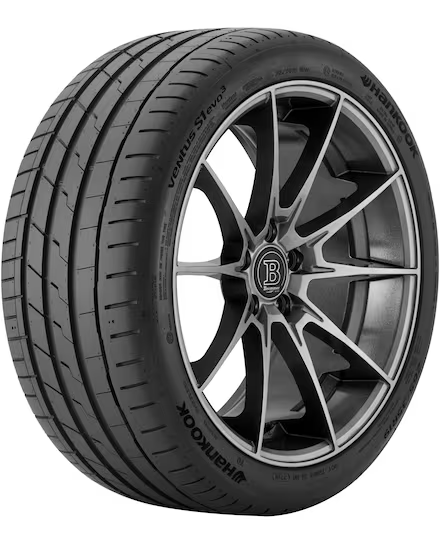
10. Hankook Ventus S1 Evo3: Best Korean Value
Price Check
Check the price of this tire at the following retailers:
This tire offers GT-R owners a genuinely compelling alternative to more established premium brands.
An advanced silica compound provides real benefits across multiple categories — enhanced grip in both dry and wet conditions alongside genuinely reduced rolling resistance, a rare combination.
Handling balance is where this tire truly stands out. An intricately designed asymmetric tread with optimized block stiffness delivers precise steering response and real cornering stability, maintaining composure during aggressive maneuvers while providing adequate steering feedback.
Wide circumferential grooves and optimized lateral channels deliver genuine wet-weather capability, efficiently evacuating water to reduce hydroplaning risk. Typically priced 15–20% below Michelin or Bridgestone alternatives while delivering rival performance, this tire offers real value without significant compromises on treadwear or road noise.
Pros: Genuine value at a meaningfully lower price, confident wet-weather performance, respectable comfort for daily driving.
Cons: Not built for winter conditions, less established track record than premium brands.
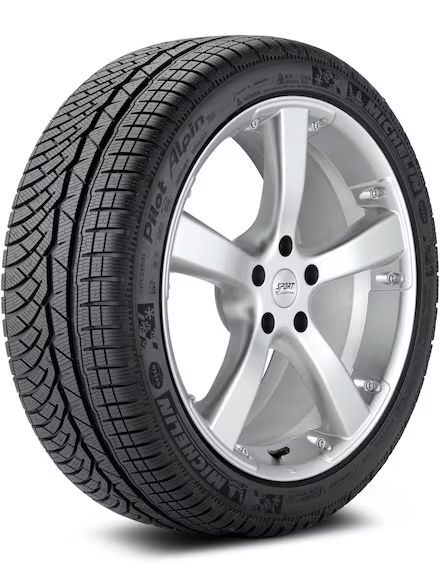
11. Michelin Pilot Alpin PA4: Best Dedicated Winter
Price Check
Check the price of this tire at the following retailers:
For GT-R owners who refuse to park the car when temperatures drop, this tire represents the premium choice for maintaining safety without fully sacrificing the driving experience.
Despite its winter focus, this tire maintains genuinely impressive dry handling characteristics while offering real snow traction and ice braking — a rare combination for a performance-caliber winter tire. An asymmetric tread pattern helps maintain much of the GT-R’s precise steering feel, even mounted with winter-specific rubber.
The GT-R’s sophisticated ATTESA E-TS all-wheel-drive system works best when paired with tires specifically designed for low-temperature conditions, and this tire’s compound stays genuinely pliable in freezing weather without sacrificing structural integrity.
Many GT-R owners who run this tire seasonally opt for a dedicated set of winter wheels, protecting their premium summer wheels from road salt and debris while allowing quick seasonal changes.
Pros: Genuine dry handling retention for a winter tire, real snow and ice traction, preserves much of the GT-R’s driving character.
Cons: Seasonal use only, premium price, not built for aggressive dry-weather performance.
Other Winter Options Worth Knowing
A few more winter-capable tires come up often in GT-R owner discussions, even without a full write-up here.
Bridgestone Blizzak LM-32 offers a strong balance between winter grip and high-speed stability, with owners reporting it preserves much of the GT-R’s character while adding real winter capability.
Pirelli Winter Sottozero 3 is an aggressive, directional Italian winter option particularly noted for maintaining high-speed stability.
Continental WinterContact TS 860 S uses Continental’s Black Chili compound technology, which adapts to temperature changes to optimize grip.
For owners who don’t want to swap tires seasonally, both the Michelin Pilot Sport All Season 4 and Continental ExtremeContact DWS 06 deliver reasonable three-season compromises with genuine light-snow capability, though neither replaces a dedicated winter tire in severe conditions.
Maintaining GT-R Tires
Check pressure at least monthly, and before any high-performance driving session. Adjust seasonally, since cold temperatures reduce pressure — always follow manufacturer recommendations adjusted for ambient temperature.
Rotate side-to-side, not front-to-back. The GT-R’s staggered setup means front and rear tires can’t be swapped across axles.
Have alignment checked every 10,000 miles, or sooner after hitting a significant road hazard. Pulling to one side or steering wheel vibration are early warning signs.
Inspect visually every two weeks. Watch for unusual wear patterns, sidewall cuts or cracks, embedded debris, and tread depth. Consider replacement at 4/32″ rather than waiting for the legal 2/32″ minimum, given the GT-R’s performance demands.
Preserve tread life deliberately. Let tires warm up before spirited driving, avoid aggressive launches for daily use, and consider a dedicated track-day tire set to preserve your street tires if you visit the circuit regularly.
Choosing the Right Tire for a Nissan GT-R
Match tire category to how the car is actually driven. Daily-driven GT-Rs benefit most from the Continental ExtremeContact Sport or Hankook Ventus S1 Evo3’s balance of grip and value. Owners chasing maximum track capability get real, felt value from the Toyo Proxes R888R or Michelin Pilot Sport 4S.
Speed rating isn’t optional on this car. Confirm any tire you consider carries at minimum a Y rating — the GT-R’s real top-end capability makes this a genuine safety requirement.
Consider Michelin Pilot Alpin PA4 or a comparable dedicated winter tire if you drive your GT-R year-round in a climate with real winters, rather than accepting a summer tire’s genuine unsafety below 45°F.
Since the R35 is now fully discontinued, prioritize tires with proven longevity where performance allows. Fewer total tire purchases matter more on a car that’s now firmly a modern legend.
Frequently Asked Questions
Is the Nissan GT-R still in production?
No. The R35 GT-R’s 18-year production run fully ended in August 2025 in Japan, its final sales market. US sales had already ended after the 2024 model year. Nissan has confirmed a next-generation GT-R (R36) is planned, possibly around 2028, but no official details have been released.
What size tires does my Nissan GT-R need?
Every GT-R runs the same staggered setup throughout its production run: 255/40ZR20 front and 285/35ZR20 rear. Confirm against your door jamb sticker, and remember a minimum Y speed rating is required.
What tires come on the Nissan GT-R from the factory?
Bridgestone Potenza S007 and Dunlop’s SP Sport Maxx GT 600 DSST CTT run-flat (marked “NR1”) have both served as genuine factory equipment, chosen specifically to handle the GT-R’s power and AWD system.
What’s the best tire for track days with my Nissan GT-R?
The Toyo Proxes R888R is built specifically around track-day demands, with genuine motorsport-derived grip and documented lap-time improvements. Expect significantly reduced street tread life and wet-weather compromise in exchange.
Can I use all-season tires on my Nissan GT-R?
It’s possible but generally not recommended for optimal performance. For owners in regions with mild winters who prefer not to swap seasonally, the Michelin Pilot Sport All Season 4 offers a reasonable compromise, though dedicated summer or winter tires deliver meaningfully better performance in their respective seasons.
How often should I rotate the tires on my Nissan GT-R?
The GT-R’s staggered setup means front and rear tires are different sizes, so rotation is limited to side-to-side rather than front-to-back.
How do I know when it’s time to replace my Nissan GT-R’s tires?
The legal minimum tread depth is 2/32″, but given the GT-R’s performance demands, consider replacement at 4/32″ to maintain optimal grip and safety. Watch for uneven wear, sidewall cracks or bulges, and any change in handling feel.
