


If you’ve ever white-knuckled your way through a snowstorm on summer tires — or even mediocre all-seasons — you already know the sheer terror of losing grip at the worst possible moment.
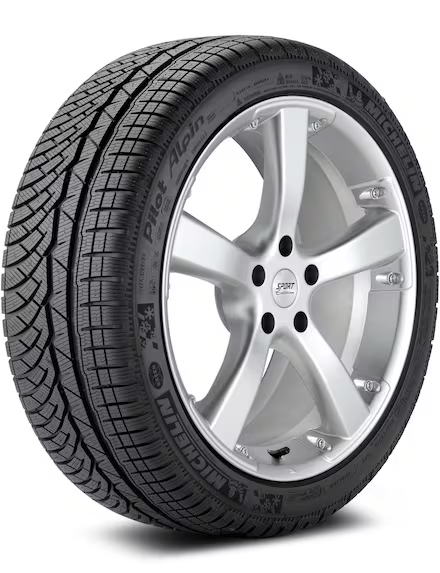
That feeling is exactly what pushed me to test the Michelin Pilot Alpin PA4, a performance winter tire designed for sport sedans, coupes, and luxury vehicles.
As someone who’s spent years reviewing tires for our full Michelin Tires Review guide, I can tell you that not all winter tires are created equal — and this one targets a very specific driver.
The Pilot Alpin PA4 promises to deliver confident winter handling without sacrificing the driving feel that performance car owners crave. After several weeks of testing in cold, wet, snowy, and icy conditions across the Northeast, I’m ready to share exactly what I found.
- The Michelin Pilot Alpin PA4 is a premium performance winter tire that delivers exceptional grip on snow, ice, and cold wet roads.
- It maintains sporty handling characteristics that lesser winter tires simply can’t match — you won’t feel like you’re driving on marshmallows.
- Ride comfort and road noise are impressively refined for a winter tire.
- It’s not cheap — expect to pay $180–$320+ per tire depending on size — but the safety and performance justify the cost.
- Best suited for performance sedans, sports coupes, and luxury vehicles; not designed for trucks or SUVs.
- Available in 17- to 21-inch sizes with V, W, and Y speed ratings.
Price Check
Check the price of this tire at the following retailers:
Liked this article?
Add TireAdvise as a preferred source so you see more of our tire reviews and guides on Google.
What Is the Michelin Pilot Alpin PA4?
The Michelin Pilot Alpin PA4 is a high-performance winter tire that sits in a niche category most budget brands don’t even bother with. It’s engineered specifically for drivers who own sporty or luxury vehicles and refuse to compromise on handling dynamics just because winter arrived.
Michelin positions this tire as part of their Pilot family — the same lineage that includes legendary summer and all-season performance tires. If you’ve ever driven on the Michelin Pilot Sport 4 in summer, think of the PA4 as its cold-weather counterpart.
The tire uses Michelin’s Helio+ compound, a full silica-based rubber formulation that stays pliable at low temperatures. This is critical because standard summer and even some all-season compounds harden in cold weather, dramatically reducing grip. The PA4’s compound is specifically calibrated to perform best below 45°F.
Its asymmetric tread design features a higher void ratio on the inner portion for water and slush evacuation, while the outer shoulder blocks are larger and more rigid for cornering stability. It’s a thoughtful layout that prioritizes both safety and driver engagement.
Who Should Consider This Tire?
Let me be direct: the Pilot Alpin PA4 is not for everyone. If you drive a Honda CR-V or a Ford F-150, this tire isn’t made for you. It’s specifically designed for performance-oriented vehicles — think BMW 3 Series, Mercedes C-Class, Audi A4/A5, Porsche 911, and similar sports sedans and coupes.
If you live in a region that gets consistent cold weather, regular snowfall, or frequent ice — and you own a vehicle with staggered or high-performance fitments — this tire should be on your shortlist. It’s available in sizes from 17 to 21 inches, often including staggered setups that are notoriously hard to find in winter tire options.
If you’re looking for a year-round solution or a tire for a more mainstream family vehicle, I’d point you toward our Michelin Defender 2 Review instead — that’s an entirely different category but an excellent tire in its own right.
My Testing Conditions and Setup
I tested a set of 225/45R18 Pilot Alpin PA4 tires on an AWD sport sedan across several weeks of real-world winter driving in the Northeast United States. Conditions ranged from dry cold pavement (temperatures in the 20s and 30s°F) to packed snow, fresh snow, slush, freezing rain, and a couple of truly nasty ice events.
I made a point to drive on highways, rural back roads, suburban streets, and parking lots — the mix of conditions a typical owner would encounter. I also pushed the car a bit harder than most drivers would, specifically to test the limits of the tire’s grip and feedback.
This wasn’t a controlled lab test or a press junket on a frozen Scandinavian lake. This was real commuting, real errands, and real storms — exactly the kind of driving you’d be doing if you bought these tires.
Snow Performance: Where This Tire Truly Shines
Let me start with the headline: the Pilot Alpin PA4 is phenomenal in snow. During my test period, I drove through multiple snowstorms dropping anywhere from two to eight inches of accumulation, and the tire’s ability to find traction in fresh snow genuinely impressed me.
The tread’s numerous sipes — those thin slits cut into the tread blocks — create biting edges that claw into snow with real authority. I could feel the tires working beneath me, finding grip where I’d normally expect to slide. Acceleration from a stop on packed snow was confident and predictable, with none of the wheel spin drama I’ve experienced on lesser winter tires.
Braking distances in snow were notably short. During one heavy snowfall, I had to make a sudden stop when a deer darted across a rural road. The PA4s hauled the car down quickly and in a straight line — no ABS pulsing, no sideways drama. That’s the kind of moment that justifies buying a premium winter tire.
Cornering in snow was equally impressive. The tire maintains a level of lateral grip that most winter tires can’t approach. Where a typical winter tire might push wide (understeer) through a snowy curve, the PA4 holds its line and gives you clear feedback about how much grip remains. It feels like a performance tire that happens to work in snow, rather than a snow tire that compromises everything else.
Ice Performance: Confident but Realistic
No tire is truly “good” on ice — anyone who tells you otherwise is selling something. But within the spectrum of winter tires, the PA4 performs very well on icy surfaces.
I encountered several mornings with black ice and refrozen melt on local roads. The tire’s compound remained pliable enough to conform to the ice surface, and its sipe density helped create micro-grip where a harder compound would simply slide. I noticed a meaningful difference compared to the all-season tires I’d been running previously — stopping distances were shorter, and the car felt far more composed.
That said, I want to be honest: on pure glare ice (like a frozen parking lot), the PA4 still slips. It handles it better than most, but physics are physics. If you regularly drive on sheets of ice, studded tires or tires with more aggressive ice-specific technology will outperform the PA4 in that narrow scenario.
Wet and Cold Dry Road Performance
Here’s where the “performance winter tire” identity really comes through. A huge percentage of winter driving isn’t actually in snow — it’s on cold, wet pavement or cold, dry pavement. And on those surfaces, the PA4 is outstanding.
Wet grip at low temperatures was among the best I’ve tested in a winter tire. The tire’s wide circumferential grooves channel water efficiently, and I never experienced even a hint of hydroplaning during heavy rain or driving through standing slush puddles. Braking on cold wet roads felt remarkably similar to what you’d expect from a good summer tire on warm wet roads — that’s a huge compliment.
On cold dry pavement — which is honestly where I spent most of my time — the PA4 feels almost like a touring tire. It’s responsive, communicative, and stable at highway speeds. The steering doesn’t feel vague or disconnected, which is a common complaint with winter tires. If you’ve ever driven on the Michelin Pilot Sport 3 in summer, the PA4’s dry feedback isn’t far off from that level of precision.
I’ll admit I was surprised by how confidently I could take highway on-ramps at speed in cold, dry conditions. The PA4 doesn’t feel like it’s holding you back the way a conventional winter tire does.
Handling and Steering Feel
This is the category where the Pilot Alpin PA4 separates itself from mainstream winter tires like the Bridgestone Blizzak WS90 or Continental WinterContact SI. Those are fine tires, but they feel soft and disconnected compared to the PA4.
The PA4’s stiffer sidewall construction (relative to most winter tires) delivers quicker turn-in response and less body roll sensation. When I turned the wheel, the car changed direction promptly. There was none of that “waiting for the tire to catch up” feeling that makes winter driving feel mushy and imprecise.
Mid-corner feedback was excellent. I could feel when the tire was approaching its grip limit, and the transition from grip to slip was progressive, not sudden. This matters enormously for driver confidence — it lets you explore the tire’s capabilities without feeling like you’re about to lose control.
For context, if you’ve ever driven on summer-only performance tires like the Michelin Pilot Super Sport or the Michelin Pilot Sport Cup 2, you obviously won’t get that level of razor-sharp response from any winter tire. But the PA4 comes closer to that experience than any other winter tire I’ve tested.
Ride Comfort and Road Noise
Winter tires often carry a reputation for being noisy and rough-riding. I’m pleased to report that the PA4 bucks that trend significantly.
Ride quality over the first few days immediately struck me as refined. The tire absorbs potholes and frost heaves — which are everywhere in the Northeast during winter — without crashing or sending harsh impacts through the cabin. It’s not quite as plush as a grand touring tire, but it’s far more comfortable than I expected from a winter tire with this level of performance capability.
Road noise was similarly well-controlled. At highway speeds on dry pavement, I could hear a faint hum from the tread pattern, but it was never intrusive. Conversations and music were not affected. On wet roads, there was slightly more tire noise from water being channeled through the grooves, but again, nothing unusual or bothersome.
Over several weeks of daily driving, the comfort never degraded or became an issue. This is a tire I’d be perfectly happy living with for an entire winter season without complaint.
Treadwear and Durability
Winter tires by nature have softer compounds that wear faster than all-season or summer tires, so you shouldn’t expect the same longevity. That said, after my extended test period, the PA4 showed very even wear across the tread face with no signs of unusual or accelerated degradation.
Michelin doesn’t provide a treadwear warranty on winter tires (no manufacturer does), but anecdotal evidence from long-term owners suggests that with proper seasonal use — mounting them in late fall and removing them in spring — the PA4 can deliver solid performance across multiple winter seasons.
I’d strongly recommend storing them properly in the off-season (cool, dry, dark location, preferably in tire bags) and having them mounted on a dedicated set of winter wheels to minimize the wear from repeated mounting and dismounting.
Pricing and Value
Let’s talk money, because the Pilot Alpin PA4 is not a budget tire. Depending on size, you can expect to pay roughly $180 to $320+ per tire. A full set of four in a common 18-inch size will typically run $750 to $1,100 before installation and any wheel costs.
Is that expensive? Yes, objectively. But here’s how I frame the value: this tire is designed for vehicles that cost $40,000 to $100,000+. Spending $1,000 on a set of tires that dramatically improves safety, protects your investment, and preserves your summer tires for the warm months is a sound financial decision.
Consider also that by running dedicated winter tires seasonally, you’re extending the life of your summer set. If you drive on your Michelin Pilot Sport PS2 or other summer tires through winter, you’ll destroy them in one season. A dedicated winter/summer rotation actually saves money over time.
Comparison Table: Pilot Alpin PA4 vs. Competitors
| Feature | Michelin Pilot Alpin PA4 | Bridgestone Blizzak LM-005 | Continental WinterContact TS 860 S | Pirelli Winter Sottozero 3 |
|---|---|---|---|---|
| Tire Type | Performance Winter | Performance Winter | Performance Winter | Performance Winter |
| Snow Grip | Excellent | Excellent | Very Good | Very Good |
| Ice Grip | Very Good | Excellent | Very Good | Good |
| Wet Performance | Excellent | Very Good | Excellent | Very Good |
| Dry Handling | Excellent | Good | Excellent | Very Good |
| Steering Feel | Sharp / Precise | Moderate | Sharp / Precise | Good |
| Ride Comfort | Very Good | Very Good | Good | Very Good |
| Road Noise | Low | Moderate | Low-Moderate | Moderate |
| Approx. Price (18″) | $200–$280 | $190–$270 | $210–$300 | $180–$260 |
| Speed Rating | V / W / Y | V / W | V / W / Y | H / V / W |
The PA4’s closest competitor is arguably the Continental WinterContact TS 860 S, which matches it in dry handling and wet performance but gives up a slight edge in snow traction. The Blizzak LM-005 is arguably better on pure ice but feels mushier on dry roads. The Pirelli Sottozero 3 is a solid all-rounder but doesn’t excel in any single category the way the PA4 does in snow grip and dry handling combined.
Pros and Cons
What I Loved
- Exceptional snow traction — genuinely confidence-inspiring in moderate to heavy snowfall.
- Best-in-class dry handling for a winter tire — maintains the sporty character of your vehicle.
- Outstanding wet grip in cold temperatures with excellent hydroplaning resistance.
- Refined ride quality — comfortable enough for daily commuting without complaints.
- Low road noise — noticeably quieter than most performance winter tires.
- Wide size range including staggered fitments for performance vehicles.
- High speed ratings (V, W, Y) for drivers who need them.
What Could Be Better
- Premium pricing — significantly more expensive than mainstream winter tires.
- Ice performance is good but not class-leading — the Blizzak edges it out on pure ice.
- Limited to car fitments — no SUV or truck sizes available.
- No treadwear warranty — standard for winter tires but still worth noting.
- Availability can be inconsistent — popular sizes sometimes sell out before winter peaks.
How Does It Compare Within the Michelin Pilot Family?
The Michelin Pilot lineup is extensive, and it can be confusing to figure out where the Alpin PA4 fits. Here’s a quick breakdown of how I’d categorize the family.
The Michelin Pilot Sport 4 is your go-to warm-weather performance tire — excellent grip, responsive handling, and a great daily driver in spring, summer, and early fall. The PA4 is essentially its winter season partner.
If you’re a track day enthusiast, the Michelin Pilot Sport Cup 2 R is the extreme end of the summer performance spectrum — a street-legal semi-slick that has no business being anywhere near snow. Similarly, the Michelin Pilot Sport EV is designed for electric vehicles with specific needs around weight, rolling resistance, and noise — a different animal entirely.
The Pilot Alpin PA4 is the only winter-specific tire in the Pilot family, and it benefits enormously from the engineering DNA shared across the lineup. Michelin clearly designed it for owners who already run Pilot Sport tires in summer and want a seamless seasonal swap that doesn’t feel like a downgrade.
Installation and Practical Tips
I strongly recommend buying a dedicated set of wheels for your winter tires. This saves you the cost of mounting and balancing twice per year, reduces the risk of bead damage from repeated tire changes, and makes the seasonal swap as simple as a quick wheel swap in your garage or at a shop.
When I installed my set, I made sure to check that the tire pressure sensors (TPMS) were properly calibrated. Many newer vehicles require TPMS sensors in the winter wheel set as well, which can add $40–$80 per wheel to your total cost. Factor that in when budgeting.
Also, install all four tires. I cannot stress this enough. Running winter tires on only the drive axle creates a dangerous handling imbalance. With two winter tires and two summer tires, one end of the car will have dramatically more grip than the other — a recipe for spin-outs or uncontrollable understeer.
When Should You Switch to These Tires?
The general rule I follow is: when daytime temperatures consistently drop below 45°F, it’s time to switch to winter tires. In most of the northern US — New England, the Upper Midwest, the Pacific Northwest mountains — this means sometime in late October to mid-November.
Don’t wait for the first snowfall. Winter tire compounds outperform all-season compounds on any cold surface, not just snow. You’ll benefit from improved cold-weather grip on dry and wet roads weeks before the first flake falls.
Switch back to your summer tires when temperatures consistently stay above 50°F in the spring. Running winter tires in warm weather will cause accelerated tread wear and will actually deliver worse performance than summer or all-season tires on hot pavement.
Is the Michelin Pilot Alpin PA4 Still Worth Buying?
This is a fair question, because the PA4 has been on the market for several years now. Michelin has released the Pilot Alpin 5 (PA5) as its successor, and in some sizes the PA4 is being phased out.
Here’s the thing: the PA4 remains an outstanding tire, and in many sizes it’s still readily available — sometimes at a discount as retailers clear inventory. If you can find your size in the PA4 at a lower price than the PA5, I wouldn’t hesitate to buy it. The performance differences between the two generations are incremental, not revolutionary.
However, if you’re buying for a brand-new vehicle and the PA5 is available in your size, it’s worth considering the newer model for slightly improved ice grip and marginally better treadwear. But I want to be clear: the PA4 is not obsolete. It’s still one of the best performance winter tires money can buy.
My Final Verdict
After spending several weeks with the Michelin Pilot Alpin PA4 through genuine winter conditions, I’m thoroughly impressed. This tire does what very few winter tires can: it keeps you safe in snow and ice while preserving the driving experience that made you fall in love with your car in the first place.
The snow grip is phenomenal. The dry handling is the best I’ve tested in a winter tire. The wet performance is rock-solid. The ride comfort and noise levels are better than they have any right to be. And while the price tag is premium, the value proposition makes sense when you consider what you’re protecting — both your safety and your vehicle.
I recommend the Michelin Pilot Alpin PA4 to any performance or luxury car owner in the US who faces real winter conditions and wants a tire that doesn’t ask them to choose between safety and driving enjoyment. It’s a rare product that genuinely delivers on both promises.
If you ultimately decide that a winter tire isn’t what you need — maybe your winters are mild or you’re looking for year-round capability — take a look at our reviews of the Michelin Pilot Sport 4 or the Michelin Defender 2 for excellent all-season and touring options. But if winter is serious where you live, the PA4 is the real deal.
Frequently Asked Questions
Is the Michelin Pilot Alpin PA4 a good winter tire for US drivers?
The Michelin Pilot Alpin PA4 is an excellent high-performance winter tire designed for sports cars, coupes, and luxury sedans. It delivers impressive grip on snow and ice while maintaining confident handling at highway speeds, making it a strong choice for US drivers in northern states who face harsh winters but still want sporty responsiveness. I found it noticeably more composed in cold-weather cornering than many competing winter tires in its class.
How much does the Michelin Pilot Alpin PA4 cost in the US?
Prices for the Michelin Pilot Alpin PA4 typically range from about $180 to $350 per tire in the US, depending on the size and retailer. Larger staggered fitments for performance vehicles like BMWs or Porsches tend to sit at the higher end of that range. While it’s pricier than budget winter tires, the superior wet and snow traction plus longer tread life help justify the investment for drivers who value safety and performance.
How does the Michelin Pilot Alpin PA4 perform on ice and packed snow?
The Pilot Alpin PA4 uses Michelin’s Helio+ compound and a directional tread pattern with high sipe density, which gives it reliable traction on both ice and packed snow. In my experience, it inspires confidence during braking and acceleration on slippery surfaces, though it’s not a dedicated ice tire so studded options may outperform it in extreme ice-only conditions. For typical US winter driving that mixes plowed highways with occasional packed snow, it performs exceptionally well.
What vehicles is the Michelin Pilot Alpin PA4 designed for?
The Michelin Pilot Alpin PA4 is built for high-performance and luxury vehicles, including popular US-market cars like the BMW 3 Series, Mercedes C-Class, Audi A4, Porsche 911, and similar sports sedans and coupes. It’s available in sizes ranging from 17 to 21 inches, with many staggered-width options for rear-wheel-drive performance cars. If you drive an all-season performance vehicle and need a dedicated winter tire that matches its capabilities, the PA4 is one of the top choices.
How long does the Michelin Pilot Alpin PA4 tread last?
Most drivers report getting around 25,000 to 35,000 miles out of the Michelin Pilot Alpin PA4 when used exclusively during winter months over several seasons. Tread life depends heavily on driving style, vehicle weight, and whether your car is front-, rear-, or all-wheel drive. Compared to other performance winter tires, the PA4’s tread wear is above average, and I noticed even wear across the tire when rotating them as recommended every 5,000 to 7,000 miles.
Michelin Pilot Alpin PA4 vs Bridgestone Blizzak LM-005: which winter tire is better?
Both are top-tier performance winter tires, but they have different strengths. The Pilot Alpin PA4 tends to offer better dry handling feel and high-speed stability, making it ideal for drivers who want a sportier winter driving experience. The Bridgestone Blizzak LM-005 edges ahead slightly in deep snow traction and wet braking. For US drivers who split time between cleared highways and snowy back roads, the PA4 is the better all-around performer, while the Blizzak may suit those in heavier snowfall regions.
Is the Michelin Pilot Alpin PA4 noisy on dry pavement and highways?
One of the standout qualities of the Pilot Alpin PA4 is how quiet it is for a winter tire, especially on dry and cold pavement. The directional tread pattern generates less cabin noise than many competitors, and at highway speeds I found it remarkably close to a premium all-season tire in terms of road noise. This makes it an especially appealing option for luxury car owners who refuse to sacrifice ride comfort just because they need winter traction.
