

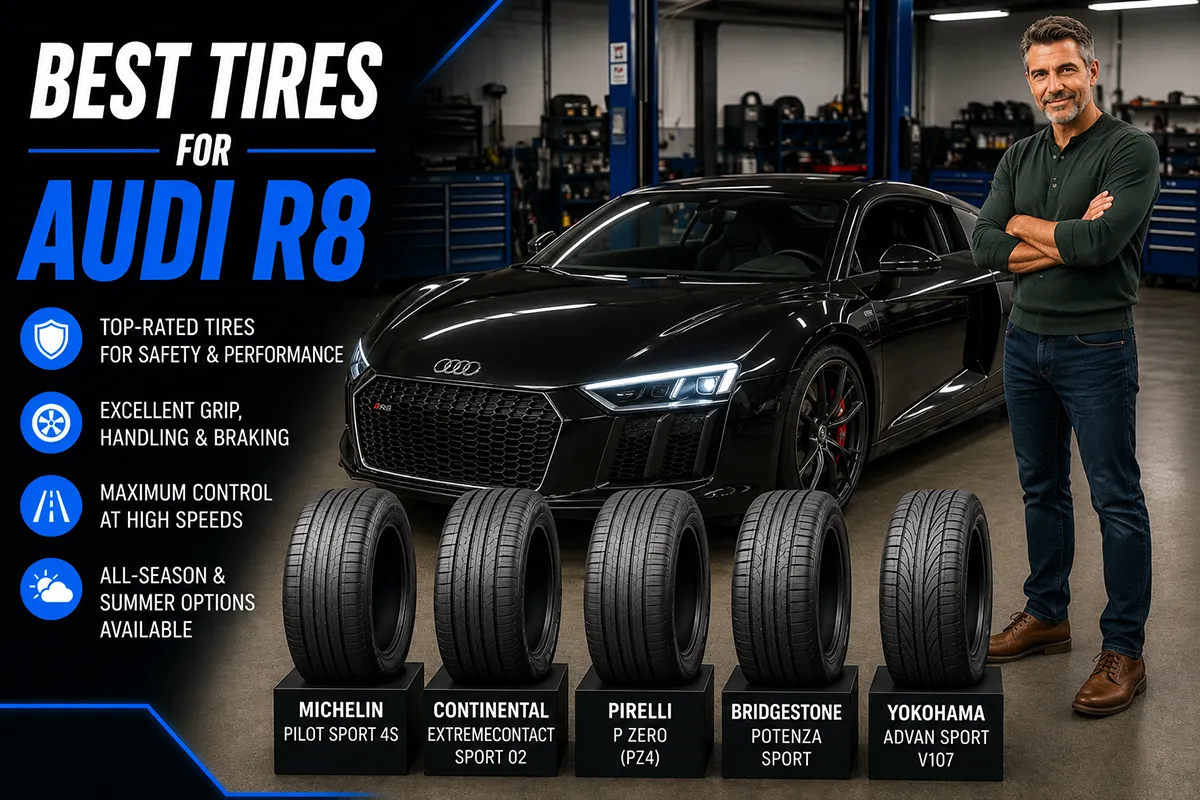
Audi built the last R8 in March 2024, closing out a 17-year run with no direct successor confirmed. That means most R8 owners today are maintaining a genuine modern-classic supercar, not shopping for a new one.
This guide is built for that reality. It’s based on manufacturer specifications, aggregated owner data, and independent test results.
Here’s what actually holds up on an R8, by priority.
- Best overall performance: Michelin Pilot Sport 4S.
- Best OEM-grade choice: Pirelli P Zero.
- Best balance of performance and value: Continental ExtremeContact Sport.
- Best track-focused option: Bridgestone Potenza S-007A.
- Best advanced grip technology: Goodyear Eagle F1 SuperSport.
- Best value performance: Hankook Ventus S1 Evo3.
- Best all-season, no seasonal swap: Michelin Pilot Sport All Season 4.
- Full sizing by generation and an honest note on the R8’s discontinuation are below.
Liked this article?
Add TireAdvise as a preferred source so you see more of our tire reviews and guides on Google.
The R8 Is Discontinued — Here’s What That Actually Means
This is worth addressing directly, since most competing guides get it wrong. Audi built the final R8 — a Vegas Yellow V10 Performance Quattro Edition — in March 2024 at its Böllinger Höfe plant in Germany, following a production extension after the discontinuation announcement triggered a surge in final orders.
Across two generations and roughly 46,000 units worldwide, the R8 ran from 2006 through 2024. Audi hasn’t confirmed a direct successor, though speculation about a future electric halo car continues.
None of this is bad news for tire shopping. R8 tire sizes are mainstream, widely stocked ultra-high-performance fitments, and every tire in this guide is easy to find.
What discontinuation does change is that a used R8 is now firmly a collector-adjacent car. Tire choice matters more than ever for preserving both the driving experience and the car’s long-term value.
How These Were Evaluated
This comparison draws on manufacturer specifications, aggregated owner reports, UTQG ratings, and independent traction and braking testing for each tire.
We cross-referenced everything against the R8’s real factory staggered sizing across its V8, V10, and V10 Plus configurations.
Particular weight went to how each tire’s real-world character matches how R8 owners actually drive. The mid-engine platform and quattro all-wheel drive reward a tire that balances front-end turn-in precision with real rear-end traction under power.
Where specific figures or comparisons are cited, the source is noted rather than presented as a personal measurement.
Quick Comparison: 11 Best Tires for the Audi R8
| Tire | Best For | Approx. Price/Tire | Speed Rating | Typical Tread Life |
|---|---|---|---|---|
| Michelin Pilot Sport 4S | Best overall performance | $300–$400 | Y | 25,000–30,000 mi |
| Pirelli P Zero | OEM-grade choice | $280–$380 | Y | 20,000–25,000 mi |
| Continental ExtremeContact Sport | Performance and value | $220–$300 | Y | 25,000-plus mi |
| Bridgestone Potenza S-007A | Track-focused | $260–$350 | Y | 15,000–20,000 mi |
| Goodyear Eagle F1 SuperSport | Advanced grip technology | $250–$330 | Y | 20,000–25,000 mi |
| Yokohama ADVAN Sport A/S+ | Japanese engineering | $220–$300 | Y | 25,000–30,000 mi |
| Dunlop Sport Maxx RT2 | Responsive handling | $210–$290 | Y/W | 20,000-plus mi |
| Hankook Ventus S1 Evo3 | Value performance | $180–$250 | Y/W | 20,000–25,000 mi |
| Toyo Proxes Sport | Underrated value | $190–$260 | Y | 20,000-plus mi |
| Nitto NT555 G2 | Mid-range ultra-high performance | $200–$270 | Y/W | 20,000–25,000 mi |
| Michelin Pilot Sport All Season 4 | All-season, no seasonal swap | $230–$310 | Y | 30,000-plus mi |
Prices are street prices at major online retailers for common R8 staggered sizes as of mid-2026. Expect regional and seasonal swings, and remember front and rear sizes differ, so budget for two separate purchases.
Audi R8 Tire Sizes and Requirements
Confirm the exact size on the driver’s door jamb sticker before ordering. Every R8 runs a staggered setup, with wider tires at the rear to match the mid-engine platform’s power delivery.
Front: commonly 235/35R19 or 245/30R20, depending on generation and trim.
Rear: commonly 295/30R19 or 305/30R20.
Speed rating matters more here than on almost any other vehicle in our catalog. Most R8 models require a (Y) rating at minimum, good for speeds over 186 mph — especially important for V10 variants capable of exceeding 200 mph. Using an underrated tire isn’t just a performance compromise; it’s a genuine safety risk at the R8’s real top-end capability.
Load index requirements typically run 91–93 at the front and 93–97 at the rear, reflecting both the car’s static weight and the dynamic loads generated during hard acceleration, cornering, and braking.
Should You Even Replace Your Factory Tires?
Pirelli is the primary factory-fit brand across most R8 generations, with tires carrying an “AO” marking on the sidewall — Audi Original — indicating a variant tuned specifically for the car.
If your factory tires are wearing evenly and the car still feels sharp, replacing like-for-like with a current Pirelli P Zero is a reasonable, low-risk choice.
That said, the R8 has a genuinely enthusiastic owner community that experiments freely with alternatives, and several tires in this comparison rival or exceed the factory pick in specific categories.
1. Michelin Pilot Sport 4S: Best Overall Performance

Price Check
Check the price of this tire at the following retailers:
This is Michelin’s flagship ultra-high-performance tire, and it’s a genuinely strong match for the R8’s capabilities.
A hybrid belt of aramid and nylon delivers exceptional stability even at the R8’s highest speeds. The asymmetric tread’s rigid outer shoulder with massive blocks provides real, remarkable cornering stability — critical when pushing the car through tight turns.
Michelin’s bi-compound tread uses a specialized silica compound on the outer shoulder for dry grip, with a different compound on the inner portion that genuinely excels in wet weather. That dual approach keeps the R8 planted regardless of road conditions.
Real owner reports describe razor-sharp steering response and minimal treadwear even under aggressive driving, with 25,000–30,000 miles typical from a set — genuinely impressive for the category.
Pros: Genuine wet and dry grip balance, razor-sharp steering response, respectable tread life for an ultra-high-performance tire.
Cons: Premium price, not built for winter conditions.
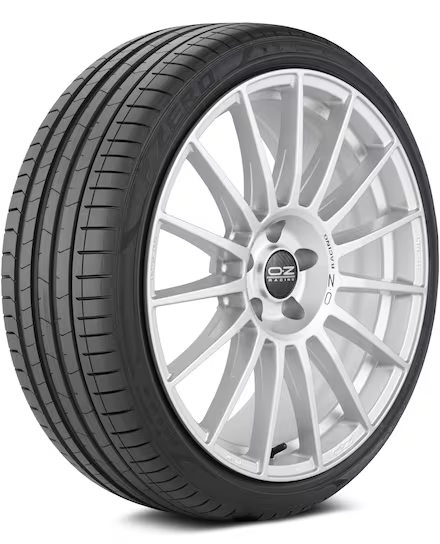
2. Pirelli P Zero: The OEM-Grade Choice
Price Check
Check the price of this tire at the following retailers:
The Pirelli P Zero is genuine factory equipment on many R8 models, developed with a “marked” AO designation specifically tuned for the car.
The asymmetric tread pattern provides real, remarkable cornering stability even at high speeds, and Pirelli’s specialized compound strikes a genuine balance between traction and longevity — addressing a common weak spot in high-performance tires generally.
On track, the P Zero draws on real racing heritage: precise steering response and consistent performance across multiple hot laps, maintaining composure as temperatures rise during aggressive driving sessions.
What genuinely distinguishes the P Zero as an OEM choice is street comfort. Noise-dampening technology reduces road roar, and a relatively forgiving ride absorbs minor road imperfections without sacrificing the connected feel R8 owners expect.
Pros: Genuine OE-grade tuning heritage specific to the R8, consistent track performance, real street comfort for a performance tire.
Cons: Premium price, not built for winter conditions.
3. Continental ExtremeContact Sport: Best Performance and Value

Price Check
Check the price of this tire at the following retailers:
This tire represents a genuine sweet spot for R8 owners — exceptional performance without the flagship price tag of some competitors.
Continental’s SportPlus Technology maintains grip consistency even as the tire wears, delivering predictable handling throughout the tire’s life. The asymmetric tread’s large outer shoulder blocks provide real cornering stability, letting drivers exploit the R8’s mid-engine balance with confidence.
Typically priced 10–15% below comparable Michelin or Pirelli options while delivering an estimated 90–95% of the performance, this is a genuinely compelling value proposition. Many owners report 25,000-plus miles with proper rotation and alignment.
Wet performance is a real strength — Continental’s Traction Grooves effectively evacuate water and resist hydroplaning, maintaining an estimated 85–90% of dry performance in wet conditions.
Pros: Genuine near-flagship performance at a meaningfully lower price, strong wet-weather grip, well-managed heat buildup during extended runs.
Cons: Not built for winter conditions, doesn’t quite match the top-tier options at the absolute limit.
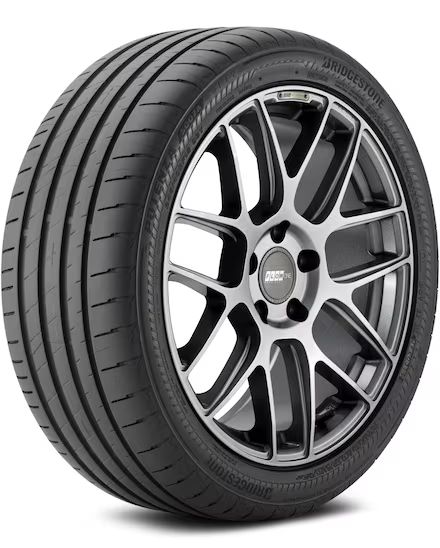
4. Bridgestone Potenza S-007A: Best Track-Focused Option
Price Check
Check the price of this tire at the following retailers:
TireRack SimpleTire PriorityTire AmazonDon’t know the correct size tire to purchase? Start here!
For R8 owners who genuinely push their car on track, this tire delivers real motorsport-derived capability.
The advanced asymmetric tread’s rigid outside shoulder blocks maintain contact-patch integrity under extreme lateral forces — exactly what’s needed for high-speed corners. Real owner reports describe exceptional steering feedback, allowing precise corrections at the limit.
Heat management is where this tire genuinely excels. Bridgestone’s Nano Pro-Tech technology maintains molecular bonds even as track temperatures climb, delivering consistent performance across multiple hot laps.
For street use, the S-007A offers more real versatility than the track focus suggests — firmer than touring options but with acceptable comfort, and wide circumferential grooves deliver respectable wet performance. Most owners report 15,000–20,000 miles with mixed street and occasional track use.
Pros: Genuine track-derived grip and heat management, real steering feedback at the limit, more street-usable than the track focus implies.
Cons: Shorter tread life than touring-focused options, not built for winter conditions.
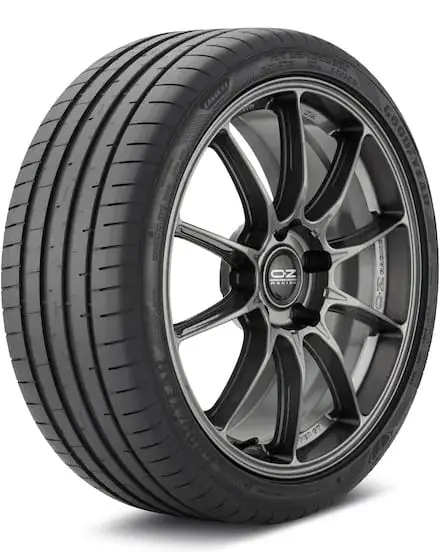
5. Goodyear Eagle F1 SuperSport: Best Advanced Grip Technology
Price Check
Check the price of this tire at the following retailers:
Goodyear’s flagship performance tire brings genuine motorsport-derived technology to the R8.
Dynamic Racing Carcass construction, adapted from Goodyear’s racing program, optimizes the contact patch during aggressive cornering, keeping more rubber on the road exactly when it matters. Sidewall stiffness is precisely calibrated to complement the R8’s suspension geometry, delivering direct steering response without sacrificing ride quality.
An adaptive compound genuinely responds to conditions — balanced hardness for everyday longevity, becoming more pliable as temperatures rise during spirited driving to dramatically increase grip.
Wet performance hasn’t been overlooked. Power braking blocks maintain road contact even with water present, and wide circumferential grooves channel it away effectively — a real complement to the R8’s quattro system.
Pros: Genuine adaptive-compound technology, direct steering response without harshness, confident wet-weather grip.
Cons: Premium price, not built for winter conditions.
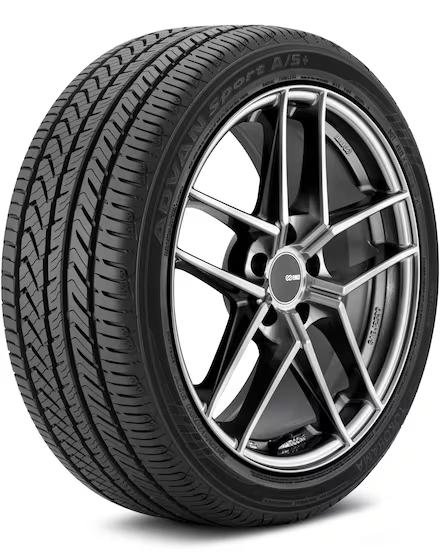
6. Yokohama ADVAN Sport A/S+: Best Japanese Engineering
Price Check
Check the price of this tire at the following retailers:
This tire showcases Yokohama’s precision engineering, offering R8 owners a genuine blend of performance characteristics.
An asymmetric tread with rigid outside shoulder blocks significantly enhances cornering stability, while optimized water-drainage channels in the inner tread combat hydroplaning without compromising dry performance.
Yokohama’s compound technology maintains grip across a wide temperature range — genuinely consistent whether during spirited canyon driving or extended highway cruising.
Real owner reports describe precise steering response and predictable handling, with road-condition feedback that doesn’t introduce excessive cabin harshness. Typically priced 10–15% below comparable Michelin or Pirelli options, and delivering 25,000–30,000 miles, this represents genuine value at the premium-performance tier.
Pros: Genuine temperature-range consistency, precise steering feedback without excessive harshness, meaningful value relative to premium alternatives.
Cons: Premium price relative to budget options, not built for winter conditions.
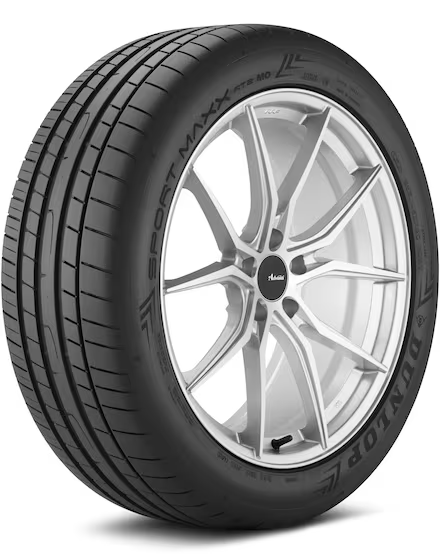
7. Dunlop Sport Maxx RT2: Best Responsive Handling
Price Check
Check the price of this tire at the following retailers:
This tire delivers genuinely quick steering response through Dunlop’s adaptive compound technology, creating a real, felt connection between driver and road.
A rigid sidewall construction combined with an optimized contact patch ensures steering inputs translate immediately to directional changes. A specialized “Dynamic Response” casing maintains shape integrity even under extreme lateral forces.
Dry grip is exceptional — large, solid outer shoulder blocks deliver outstanding cornering stability, while a central continuous rib enhances straight-line stability at the R8’s considerable top speed.
Temperature management is a real strength too. The Sport Maxx RT2 reaches optimal operating temperature quickly but resists overheating during extended spirited driving, making it a genuine fit for occasional track days on a primarily street-driven R8.
Pros: Genuinely quick, direct steering response, strong dry cornering stability, good temperature management for occasional track use.
Cons: Not built for winter conditions, premium price.
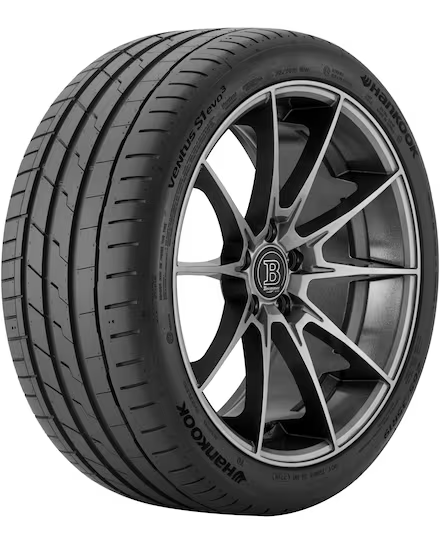
8. Hankook Ventus S1 Evo3: Best Value Performance
Price Check
Check the price of this tire at the following retailers:
This tire represents one of the strongest value propositions in the ultra-high-performance segment for R8 owners, typically priced 20–30% less than premium competitors.
An advanced silica compound and asymmetric tread deliver genuine grip in both dry and wet conditions, with reinforced sidewall construction maintaining stability during high-speed cornering.
In direct comparisons with tires like the Pilot Sport 4S or P Zero, the Ventus S1 Evo3 typically falls just 5–10% behind in ultimate grip — a gap that’s barely perceptible for R8 owners who enjoy spirited driving without regular track use.
Real owner reports describe 20,000–25,000 miles of use, comparable to many premium alternatives, with performance holding up more consistently through the tire’s life than many budget competitors.
Pros: Genuine near-premium performance at a meaningfully lower price, respectable tread life, consistent performance throughout its lifespan.
Cons: Not built for winter conditions, falls slightly behind flagship tires at the absolute limit.
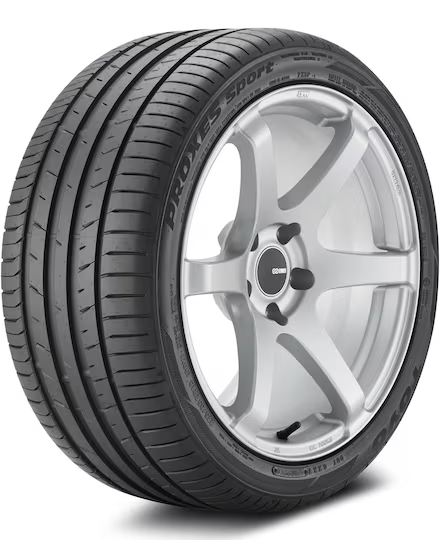
9. Toyo Proxes Sport: Best Underrated Value
Price Check
Check the price of this tire at the following retailers:
Don’t know the correct size tire to purchase? Start here!
This tire often flies under the radar, but it represents a genuinely compelling option for R8 owners seeking exceptional performance without a premium-brand price tag.
An advanced silica compound strikes a real balance between grip and longevity — particularly valuable given the R8’s power output and resulting tire wear. The asymmetric tread’s rigid outer shoulder blocks provide exceptional cornering stability.
Dry handling is genuinely direct and communicative, with a gap to tires like the Pilot Sport 4S that’s minimal in everyday spirited driving. Where the Proxes Sport truly shines is wet performance — four wide circumferential grooves and optimized sipe design deliver confident, trust-inspiring wet-weather grip.
Typically priced 15–20% below premium European options while delivering an estimated 90–95% of their performance, many owners report a slightly more compliant ride than ultra-high-performance alternatives, with progressive, predictable breakaway characteristics when pushed beyond the limit.
Pros: Genuine wet-weather strength, meaningful value relative to premium alternatives, progressive and predictable limit behavior.
Cons: Not built for winter conditions, less widely stocked than more established brands.
10. Nitto NT555 G2: Best Mid-Range Ultra-High Performance

Price Check
Check the price of this tire at the following retailers:
This tire delivers genuinely impressive dry grip through an advanced silica-enriched compound and reinforced shoulder blocks, maintaining contact-patch stability when pushing the R8’s limits.
An asymmetric tread pattern with large outboard blocks enhances steering response and handling precision, while a continuous center rib improves straight-line stability at high speeds.
Typically priced 15–25% less than comparable European brands, this represents a real cost advantage — particularly meaningful given the R8’s staggered setup requires purchasing different front and rear sizes.
The honest trade-off: wet-weather performance is adequate for most conditions but can be challenged by extremely heavy rain or standing water more than premium alternatives. For R8 owners who primarily drive in dry or mildly wet conditions, this limitation rarely matters. Real owner reports describe 20,000–25,000 miles with mixed driving.
Pros: Genuine dry-grip performance, meaningful cost advantage given the R8’s staggered sizing, reinforced construction for durability.
Cons: Wet performance trails premium alternatives in heavy rain, not built for winter conditions.
11. Michelin Pilot Sport All Season 4: Best All-Season, No Seasonal Swap

Price Check
Check the price of this tire at the following retailers:
For R8 owners who want to avoid a seasonal tire changeover, or who use their R8 as a genuine daily driver in a variable climate, this tire offers a real, defensible alternative to a dedicated summer tire.
An asymmetric tread with rigid outer shoulder blocks delivers responsive steering and exceptional cornering grip that genuinely rivals dedicated summer tires in dry conditions. Michelin’s silica-infused compound absorbs road imperfections while keeping noise and vibration well-controlled.
Michelin’s EverGrip Technology maintains wet-braking performance even as the tire wears, and real owner reports describe 30,000-plus miles from a set — genuinely strong longevity for the category, backed by a 45,000-mile warranty.
It won’t match a dedicated summer tire’s absolute peak grip, and it’s not a substitute for a real winter tire in severe snow. But for R8 owners who want one set of tires that handles nearly everything short of genuine winter conditions, this is the strongest no-swap solution.
Pros: Genuine near-summer-tire dry performance, real wet and light-winter capability, strong 45,000-mile warranty.
Cons: Doesn’t match dedicated summer tires’ outright peak grip, not a substitute for a real winter tire.
Tire Maintenance Tips for Audi R8 Owners
Check pressure at least monthly, and before any high-performance driving session. Recommended PSI is typically 30–35 for the front and 32–37 for the rear, but confirm against the door jamb sticker. Pressure changes roughly 1 PSI for every 10°F temperature swing.
Rotate side-to-side, not front-to-back. The R8’s staggered setup means front and rear tires can’t be swapped across axles. Rotate left-to-right at roughly 5,000–7,500-mile intervals to promote even wear.
Have alignment checked every 10,000 miles, or sooner after hitting a significant road hazard like a pothole. Pulling to one side or steering wheel vibration are early warning signs.
Inspect visually every two weeks. Watch for unusual wear patterns, sidewall cuts or cracks, embedded debris, and tread depth. Consider replacement at 4/32″ rather than waiting for the legal 2/32″ minimum, given the R8’s performance demands.
Preserve tread life deliberately. Avoid aggressive launches for daily driving, let tires warm up before spirited driving, use tire cradles if storing the car for extended periods, and consider a dedicated track-day tire set to preserve your street tires.
Choosing the Right Tire for an Audi R8
Match tire category to how the car is actually driven. Daily-driven R8s benefit most from the Continental ExtremeContact Sport or Hankook Ventus S1 Evo3’s balance of grip and value. Owners chasing maximum track capability get real, felt value from the Bridgestone Potenza S-007A or Michelin Pilot Sport 4S.
Speed rating isn’t optional on this car. Confirm any tire you consider carries at minimum a (Y) rating — the R8’s real top-end capability makes this a genuine safety requirement, not a nice-to-have.
Consider the Michelin Pilot Sport All Season 4 if you daily-drive your R8 in a climate with real seasonal variation, rather than accepting a summer tire’s genuine unsafety below 45°F.
Since the R8 is discontinued, prioritize tires with proven longevity where performance allows. Fewer total tire purchases matter more on a car that’s now firmly a modern classic.
Frequently Asked Questions
Is the Audi R8 still in production?
No. Audi built the final R8 in March 2024, ending 17 years and two generations of production with no direct successor confirmed. Speculation continues about a future electric halo car, but nothing has been officially announced.
What size tires does my Audi R8 need?
It depends on generation and trim. Front sizing is commonly 235/35R19 or 245/30R20; rear sizing is commonly 295/30R19 or 305/30R20. The R8 always runs a staggered setup. Always check the door jamb sticker for your exact specification.
Can I use all-season tires on my Audi R8?
Yes, and it’s a reasonable choice for daily-driven cars in variable climates. The Michelin Pilot Sport All Season 4 delivers dry performance close to dedicated summer tires while adding genuine wet and light-winter capability a summer tire can’t offer.
What’s the best tire for track days with my Audi R8?
The Bridgestone Potenza S-007A is built specifically around track-day demands, with genuine motorsport-derived heat management and cornering stability. The Michelin Pilot Sport 4S is a strong alternative that also maintains good street manners.
How often should I rotate the tires on my Audi R8?
Every 5,000 to 7,500 miles, rotating side-to-side rather than front-to-back, since the R8’s staggered setup means front and rear tires are different sizes.
What tire comes on the Audi R8 from the factory?
Pirelli is the primary factory supplier across most R8 generations, with vehicle-specific “AO” (Audi Original) marked variants developed in partnership with Audi.
How do I know when it’s time to replace my Audi R8’s tires?
The legal minimum tread depth is 2/32″, but given the R8’s performance demands, consider replacement at 4/32″ to maintain optimal grip and safety. Watch for uneven wear, sidewall cracks or bulges, and any handling issues or vibration.
