

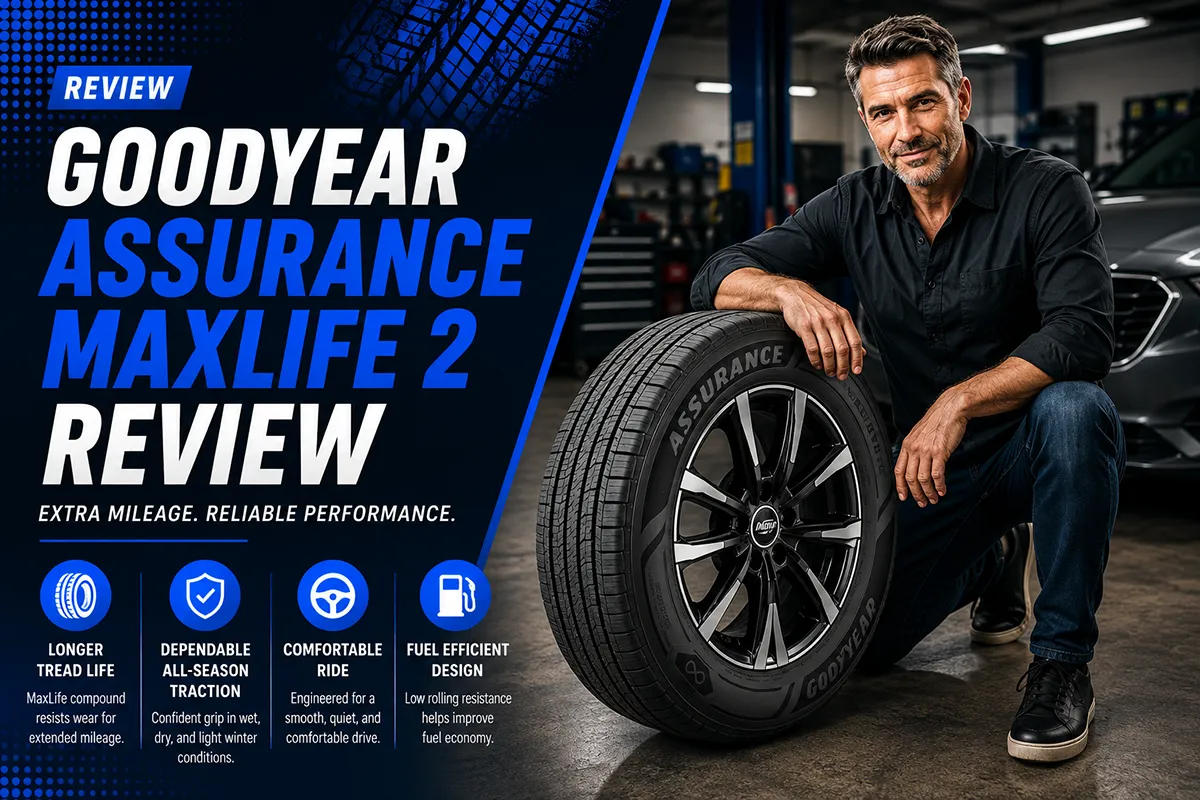
Goodyear is calling the Assurance MaxLife 2 its longest-lasting tire ever, backed by an 85,000-mile warranty and a fresh redesign of an already popular commuter tire — but the warranty number and the tire’s actual measured tread life tell two different stories. This review draws on manufacturer specifications, independently reported test data, and aggregated owner feedback to sort out where the MaxLife 2 genuinely delivers and where the marketing gets ahead of the results.
- What it is: A premium all-season touring tire launched in July 2025, replacing the original Assurance MaxLife, which Goodyear is phasing out.
- Warranty: 85,000 miles — the longest Goodyear currently offers, and higher than the Michelin Defender2’s 80,000-mile figure.
- The catch: Independently reported real-world median tread life currently trails the warranty claim by a meaningful margin, and trails the Defender2’s real-world mileage by roughly 30%.
- Best for: Sedans, hybrids, crossovers, and luxury SUVs prioritizing comfort and low replacement frequency over performance or serious winter capability.
- Not for: Drivers who need strong snow or ice traction, or who want responsive, performance-oriented handling.
- Full performance breakdown and a direct Defender2 comparison are below.
Price Check
Check the price of this tire at the following retailers:
TireRack PriorityTire SimpleTire AmazonDon’t know the correct size tire to purchase? Start here!
Liked this article?
Add TireAdvise as a preferred source so you see more of our tire reviews and guides on Google.
How This Review Was Put Together
This review draws on Goodyear’s own manufacturer specifications and technical materials, independently reported test data covering wet braking, dry braking, dry handling, snow braking, and ice braking, aggregated owner feedback collected across major retailers and enthusiast forums, and real-world tread-life tracking data reported by tire retailers.
Because the MaxLife 2 launched in mid-2025, it doesn’t yet have the multi-year ownership history that older tires in this category have accumulated, so figures describing real-world tread life and long-term reliability should be read as an early but growing dataset rather than a final verdict — this review updates that context explicitly rather than presenting early numbers as settled fact.
Where a claim is Goodyear’s own marketing language rather than independently verified data — such as specific percentage comparisons to competitors in Goodyear’s press materials — that distinction is called out rather than repeated as fact.
What’s New Compared to the Original Assurance MaxLife
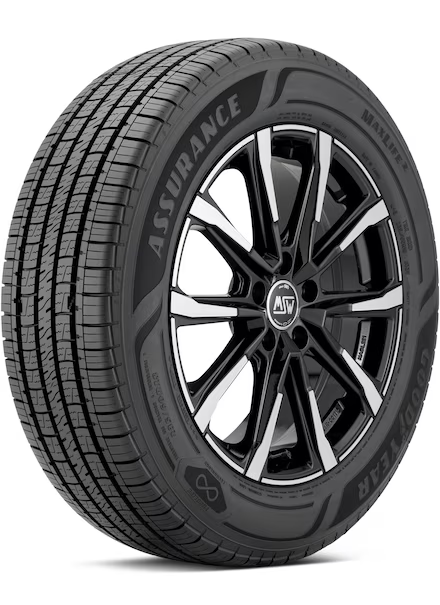
The Assurance MaxLife 2 isn’t a badge refresh — it’s a genuine redesign built around Goodyear’s TredLife Technology, which combines an updated tread compound with a revised tread pattern aimed specifically at durability and all-weather traction.
Four deep circumferential grooves paired with zigzag sipes are designed to maintain confident grip in wet and dry conditions as the tire wears, rather than losing capability disproportionately in its later life. A built-in Wear Gauge, carried over and refined from the original MaxLife, gives owners a simple visual way to track remaining tread depth without needing a separate gauge or the penny test.
Goodyear also expanded the size range meaningfully: 58 sizes are available at launch, with more W-speed-rated and XL (extra load) fitments added specifically to support heavier and higher-performance vehicles that weren’t well covered by the outgoing MaxLife.
This means the MaxLife 2 now reaches further into crossover and luxury SUV territory — Goodyear specifically lists compatibility with vehicles like the BMW X5, Mercedes-Benz GLE, Toyota Camry, Honda Accord, Ford Explorer, and Toyota RAV4.
Independent real-world testing, including a four-month evaluation on a Lexus SUV, has reported a genuinely noticeable reduction in road noise compared to the outgoing tire, alongside improved water evacuation and sharper handling response.
Specifications at a Glance
| Spec | Goodyear Assurance MaxLife 2 |
|---|---|
| Category | Premium touring all-season |
| Sizes available | 58 |
| Treadwear warranty | 85,000 miles (140,000 km) |
| UTQG treadwear rating | 820 |
| 3PMSF rated | No |
| Speed ratings | Includes expanded W-rated and XL fitments |
| Approx. price per tire | $145–$240, size dependent |
| Replaces | Original Goodyear Assurance MaxLife |
| Key competitors | Michelin Defender2, Continental PureContact LS, General AltiMax RT43, Bridgestone Ecopia EP422 Plus, Firestone Champion Fuel Fighter |
Wet Performance
The MaxLife 2’s wide circumferential grooves and zigzag sipe pattern deliver genuinely confident wet-weather traction for a touring tire, and independent aggregated testing places its wet-braking performance in a respectable middle tier — stopping roughly 4% longer than premium-category rivals but shorter than mid-range competitors, which is a fair result for a tire prioritizing tread life over ultimate grip.
Owner reports consistently describe stable handling and predictable braking in rain, and Goodyear’s own engineering explicitly targets hydroplaning resistance through the tire’s water-evacuation channel design.
Where the wet-performance picture gets more specific is in direct comparison against its closest premium rival: in independently reported wet-braking tests, the Michelin Defender2 stopped in 160 feet against the MaxLife 2’s 165 feet — a real but modest 3% advantage for Michelin, not a dramatic gap. For most everyday driving conditions, the MaxLife 2’s wet performance is dependable rather than class-leading.
Dry Performance and Handling
Dry handling is close to a wash between the MaxLife 2 and its main rival: independently reported testing shows both tires scoring essentially equally in dry handling, with the MaxLife 2 holding a small edge in dry braking distance.
Aggregated testing places its overall dry-braking score at a respectable 77 out of 100 relative to premium and mid-range competitors. This is consistent with the tire’s design brief — the MaxLife 2 isn’t chasing sporty responsiveness, but it delivers confident, predictable dry-road manners appropriate for daily commuting and highway cruising.
Winter and Snow Performance
This is the category where the MaxLife 2’s limitations show up most clearly, and where several owner reports and independent aggregated data agree closely.
The tire is not 3PMSF certified, and in independently reported snow-braking testing it stopped roughly 13.7% longer than premium-category rivals and about 4.2% longer than mid-range competitors — a real, meaningful gap rather than a marginal one.
Aggregated owner feedback on the original MaxLife (the closest available comparison point given how recently the MaxLife 2 launched) found that while light snow traction was generally adequate, a meaningful share of owners reported reduced confidence in deeper snow and on ice.
For drivers in regions with occasional light snow, the MaxLife 2’s all-season capability will likely be sufficient. For anyone facing sustained winter conditions, regular snowfall, or icy roads, this tire should be paired with a dedicated winter tire on a second set of wheels rather than relied on as a year-round solution — the performance gap here is real enough to matter for safety, not just comfort.
Ride Comfort and Noise
Comfort is consistently the strongest, most agreed-upon category across independent testing and owner feedback alike. Real-world reporting, including an extended evaluation swapping the MaxLife 2 onto a previously road-noisy SUV, describes a dramatic and immediately noticeable drop in cabin noise levels — more pronounced than the typical improvement expected from simply fitting fresh tires.
Owner reviews collected across major retailers echo this consistently, frequently describing the ride as quiet and smooth on both highway and city surfaces, with several owners specifically noting the noise level held steady rather than increasing as the tire wore.
Tread Life and the 85,000-Mile Warranty: What the Data Actually Shows
This is the section most competing reviews skip entirely, and it’s the single most important thing to understand before buying this tire based on its headline warranty figure. Goodyear backs the MaxLife 2 with an 85,000-mile limited treadwear warranty — a genuinely strong number, and higher than the Michelin Defender2’s 80,000-mile coverage.
But warranty mileage and UTQG treadwear rating tell a more complicated story together: the MaxLife 2 carries a UTQG treadwear rating of 820, while the Defender2 carries a higher 840 rating, meaning Michelin’s own government-mandated wear-testing data suggests longer expected tread life despite the shorter advertised warranty.
It helps to understand why these two numbers can point in different directions. The UTQG treadwear rating comes from a standardized government test, run under consistent conditions on a specific test course, and it’s designed to let shoppers compare wear rates across brands on a like-for-like basis.
The mileage warranty, by contrast, is a manufacturer’s own promise, set independently through each brand’s internal engineering and business decisions about what they’re willing to guarantee — a longer warranty number doesn’t automatically mean a manufacturer’s own wear testing actually supports a higher figure.
Manufacturers set warranty mileage in part as a competitive and marketing decision, not solely as a direct translation of internal wear data, which is exactly the gap this comparison surfaces.
Independently reported real-world tread-life data, based on retailer treadwear tracking, reinforces this: reported median mileage showed the Defender2 lasting around 70,000 miles against roughly 50,000 miles for the MaxLife 2 — a real-world gap of about 30% in Michelin’s favor, despite Goodyear’s longer warranty promise on paper.
This doesn’t mean the MaxLife 2 is a poor tire; it means the warranty figure functions more as a strong promise than a fully realized outcome in independently tracked real-world use so far, and it’s worth factoring that gap into any purchase decision built primarily around the 85,000-mile number.
It’s also worth remembering the MaxLife 2 is still a relatively new tire, launched in mid-2025, so the sample size behind this real-world data will continue to grow and could shift as more owners report longer-term results — and it’s worth noting that if a tire genuinely wears out well short of its warranted mileage, most manufacturers, including Goodyear, offer prorated warranty credit toward a replacement set, which meaningfully softens the practical downside even if the headline number doesn’t fully play out.
Goodyear Assurance MaxLife 2 vs Michelin Defender2
These two tires are the natural head-to-head comparison in this category, and neither wins outright across every metric:
- Wet braking: Michelin Defender2, by a modest 3% margin (160 ft vs 165 ft).
- Dry handling: Essentially tied.
- Dry braking: Slight edge to the MaxLife 2.
- UTQG treadwear rating: Michelin Defender2 (840) over MaxLife 2 (820).
- Advertised warranty: MaxLife 2 (85,000 mi) over Defender2 (80,000 mi).
- Reported real-world median mileage: Michelin Defender2, by a meaningful margin (roughly 70,000 mi vs roughly 50,000 mi).
- Noise and comfort: Both genuinely strong; the MaxLife 2’s redesign specifically closed most of the gap that existed with the outgoing MaxLife.
The practical takeaway: if long-term tread life is the deciding factor and independently reported real-world data matters more to you than the warranty number on paper, the Defender2 currently has the stronger track record.
If you specifically want the longest advertised warranty available and value comfort and dry performance highly, the MaxLife 2 remains a genuinely competitive, well-rounded choice — just don’t treat the 85,000-mile figure as a guarantee.
How the MaxLife 2 Stacks Up Against the Rest of the Field
The Defender2 is the obvious head-to-head rival, but it isn’t the only tire cross-shopped against the MaxLife 2.
Goodyear’s own positioning, along with retailer fitment data, places this tire in competition with the Continental PureContact LS, General AltiMax RT43, Bridgestone Ecopia EP422 Plus, and Firestone Champion Fuel Fighter, among others. It’s worth understanding where the MaxLife 2 sits relative to that broader field rather than just its single closest rival.
Against the Continental PureContact LS, the MaxLife 2’s longer advertised warranty is a genuine advantage for owners planning to keep a vehicle for the long haul, though the PureContact LS has built a strong independent reputation for comfort and low noise that rivals what the MaxLife 2’s redesign specifically targeted.
Against budget-tier options like the General AltiMax RT43 and Firestone Champion Fuel Fighter, the MaxLife 2 sits in a clearly higher price tier, and that gap is reflected in the details — better comfort engineering, a more sophisticated tread compound, and the added convenience of the built-in Wear Gauge, none of which the budget-tier tires in this comparison offer.
The Bridgestone Ecopia EP422 Plus competes most directly on fuel-efficiency positioning; both tires target low rolling resistance, though the MaxLife 2’s broader size range and expanded W-speed and XL fitments give it an edge in vehicle compatibility for heavier crossovers and hybrids.
The practical read: within this competitive set, the MaxLife 2 earns its premium-tier price primarily through comfort, warranty length, and fitment breadth rather than through class-leading wet, dry, or winter performance numbers. That’s a legitimate value proposition for the right buyer, but it’s worth being clear-eyed about what you’re actually paying for.
Pros and Cons
Pros:
- Genuinely strong comfort and noise reduction, independently confirmed in real-world testing
- Competitive dry handling and braking performance
- Longest advertised warranty in Goodyear’s current lineup, at 85,000 miles
- Expanded size range with more W-speed-rated and XL fitments for modern crossovers, hybrids, and heavier vehicles
- Built-in Wear Gauge simplifies tread-depth monitoring
Cons:
- Not 3PMSF certified; measurably weaker snow and ice braking than premium winter-capable rivals
- Independently reported real-world tread life currently trails the advertised warranty and trails the Michelin Defender2 by a meaningful margin
- Lower UTQG treadwear rating than its closest premium competitor despite the longer warranty claim
- Not built for performance-oriented or spirited driving
Who Should Buy the Goodyear Assurance MaxLife 2
This tire makes the most sense for commuters, family sedan and crossover owners, and hybrid or EV drivers who prioritize a quiet, comfortable ride and want to minimize how often they think about tire replacement, in regions without severe, sustained winter conditions.
It’s a genuinely strong fit for vehicles like the Toyota Camry, Honda Accord, and Ford Explorer, all of which Goodyear specifically lists as compatible fitments, and it’s also a reasonable replacement option for SUVs like the GMC Acadia that see mostly on-road, family-oriented use — see our best tires for GMC Acadia guide for trim-specific context.
It’s a weaker fit for drivers who face regular heavy snow or icy roads without a seasonal winter-tire swap, and for anyone whose primary decision driver is squeezing the maximum possible advertised warranty mileage out of a purchase — the real-world data available so far suggests that number is more aspirational than guaranteed.
A useful way to think about fit: if your annual mileage is high and your driving is mostly steady highway and suburban commuting on dry-to-wet pavement, the MaxLife 2’s comfort and dry/wet balance will likely serve you well for years, and the longer warranty gives you a real cushion even if actual mileage lands short of 85,000.
If you live somewhere with real winters and don’t want to run a second set of dedicated snow tires, the measurable snow-braking gap here is large enough that it’s worth cross-shopping a 3PMSF-rated all-weather tire instead — even one with a shorter advertised warranty — since the safety trade-off in that scenario outweighs the convenience of a single, longer-lasting tire.
Recalls and Complaints
NHTSA and manufacturer recall data was checked as of mid-2026. The Assurance MaxLife 2 does not currently have an open recall. It’s worth noting Goodyear has issued recalls on other, unrelated tire lines in the past — including a 2020 recall on certain Fortera HL tires over a belt-width manufacturing defect — but nothing on record affects the MaxLife 2 specifically.
As always, checking the DOT code on any tire, new or used, against NHTSA’s recall database takes about thirty seconds and is worth doing regardless of brand reputation.
Maintaining Your Assurance MaxLife 2 Tires
Rotate every 5,000 to 7,000 miles to help even out wear and get closer to the tire’s full advertised tread life, since uneven wear is one of the most common reasons owners fall short of a warranty’s advertised mileage.
Check pressure at least monthly, against the door jamb sticker rather than the maximum PSI printed on the tire sidewall — correct inflation matters more for a tire whose main selling point is longevity, since underinflation is one of the fastest ways to shorten tread life regardless of the compound underneath it.
Use the built-in Wear Gauge or the penny test to track tread depth over time, and watch for uneven wear patterns that could signal an alignment issue rather than normal aging — see our guide on reading your tire’s wear patterns if you notice something that doesn’t look like even wear.
Have alignment checked annually, since even slight misalignment can meaningfully undercut a long-warranty tire’s main value proposition by accelerating wear on one side of the tread.
Frequently Asked Questions
Is the Goodyear Assurance MaxLife 2 worth the 85,000-mile warranty claim?
The warranty itself is real and Goodyear’s longest currently offered, but independently reported real-world tread-life data currently shows median mileage closer to 50,000 miles rather than the full 85,000 — a meaningful gap. The tire is still a solid, comfortable all-season option; just don’t treat the headline number as a guarantee of actual results.
How does the Goodyear Assurance MaxLife 2 compare to the Michelin Defender2?
The two are close competitors overall. The MaxLife 2 has a slightly higher advertised warranty and a small edge in dry braking, while the Defender2 has a higher UTQG treadwear rating, a modest wet-braking advantage, and a meaningfully stronger real-world tread-life track record so far.
Is the Goodyear Assurance MaxLife 2 good in snow?
It handles light snow adequately for an all-season touring tire but is not 3PMSF certified and shows a real, measurable gap in snow-braking performance compared to winter-capable rivals. Drivers in regions with sustained winter conditions should consider a dedicated winter tire rather than relying on this tire year-round.
What vehicles is the Goodyear Assurance MaxLife 2 designed for?
Goodyear specifically lists compatibility with vehicles including the BMW X5, Mercedes-Benz GLE, Toyota Camry, Honda Accord, Ford Explorer, and Toyota RAV4, spanning 58 sizes from family sedans to luxury SUVs and hybrids.
Does the Goodyear Assurance MaxLife 2 replace the original Assurance MaxLife?
Yes. The MaxLife 2 is a full redesign that directly replaces the original Assurance MaxLife, which Goodyear is phasing out. The original may still be available at a lower price at some retailers while remaining stock lasts.
How much does the Goodyear Assurance MaxLife 2 cost?
Prices generally range from about $145 to $240 per tire depending on size, with larger and higher-load fitments toward the upper end of that range.
