

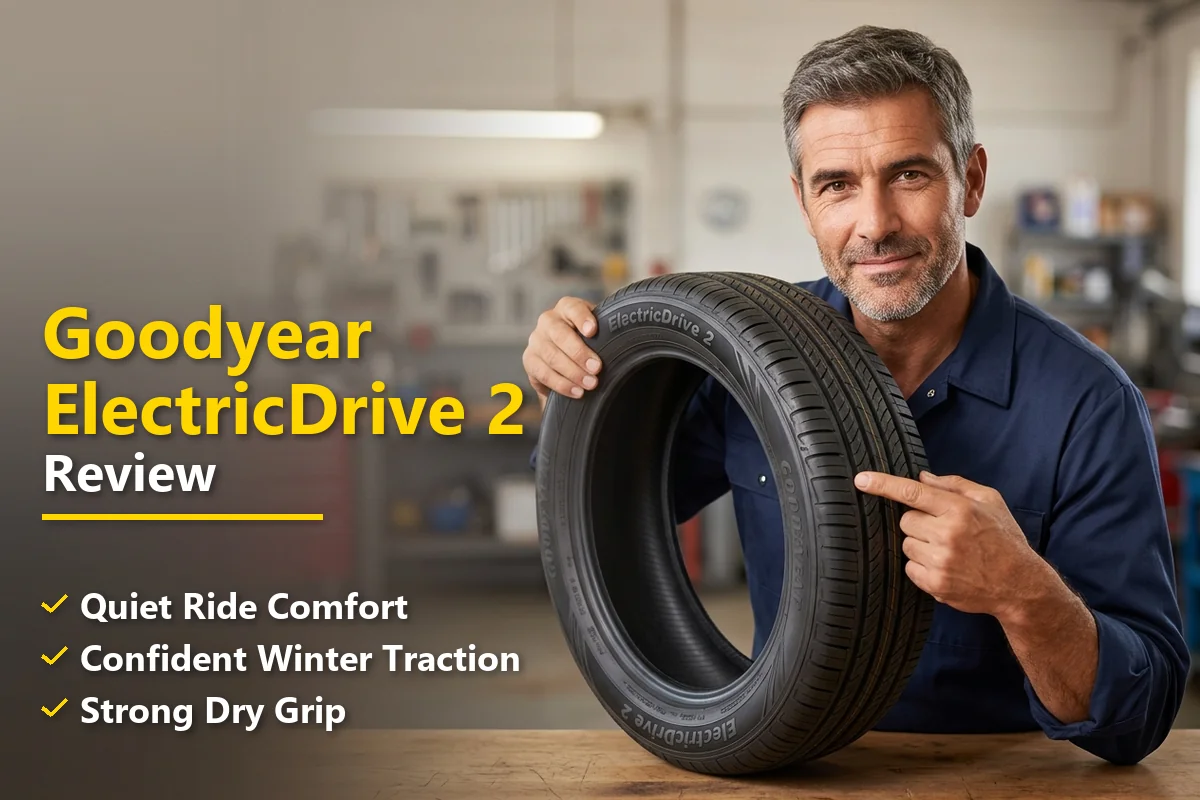
If you drive an electric vehicle, you already know the tire struggle is real. Standard all-season tires wear out faster under the instant torque of an EV motor, and the road noise that was hidden behind a combustion engine is suddenly impossible to ignore.
That’s exactly the problem Goodyear designed the ElectricDrive 2 to solve — and after spending serious time behind the wheel with these tires mounted on my Tesla Model 3, I have a lot to say about whether they actually deliver on that promise. If you’re comparing several EV-focused options across the Goodyear lineup, our full Goodyear Tires Review guide covers every model side by side.
- Purpose-built for EVs and hybrids with low rolling resistance and enhanced treadwear
- Noticeably quieter than the stock tires on my Model 3 — cabin noise dropped significantly
- Wet grip impressed me more than I expected; dry grip is confident and predictable
- Tread depth held up well throughout my extended testing period
- Priced between $160–$220 per tire depending on size — competitive for the EV tire segment
- Best suited for daily commuters who prioritize range, comfort, and longevity over sporty handling
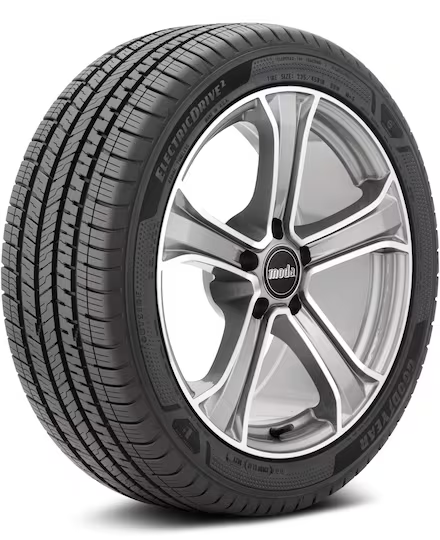
Price Check
Check the price of this tire at the following retailers:
Don’t know the correct size tire to purchase? Start here!
Liked this article?
Add TireAdvise as a preferred source so you see more of our tire reviews and guides on Google.
What Is the Goodyear ElectricDrive 2?
The Goodyear ElectricDrive 2 is the second generation of Goodyear’s dedicated EV tire line. It’s an all-season touring tire engineered specifically for the unique demands of battery-electric vehicles and plug-in hybrids — think heavier curb weights, instant torque delivery, and the need for ultra-low rolling resistance to preserve range.
Goodyear positions this tire as a successor to the original ElectricDrive (which was itself a solid but imperfect first attempt). The “2” brings improvements in tread compound durability, noise reduction technology, and wet-weather performance. It’s available in a growing range of sizes covering popular EVs like the Tesla Model 3, Model Y, Ford Mustang Mach-E, Hyundai Ioniq 5, Chevrolet Bolt EUV, and others.
I want to be clear about something up front: this is not a performance tire. If you’re looking for aggressive cornering grip or track-day capability, you’ll want to look at something like the Goodyear Eagle F1 Asymmetric 6 or even the Goodyear Eagle F1 Supersport. The ElectricDrive 2 is built for everyday commuters who want to maximize their EV’s strengths.
Key Specifications at a Glance
| Specification | Details |
|---|---|
| Tire Type | All-Season Touring (EV-specific) |
| Available Sizes | 18″–21″ (expanding lineup) |
| Load Range | XL (Extra Load) across most sizes |
| Speed Rating | H or V depending on size |
| Treadwear Warranty | Up to 50,000 miles |
| Rolling Resistance | Low (optimized for EV range) |
| Price Range (US) | ~$160–$220 per tire |
| 3PMSF Rated | No |
My Testing Setup and Conditions
I mounted a set of 235/40R19 Goodyear ElectricDrive 2 tires on my 2023 Tesla Model 3 Long Range. My daily commute covers a mix of highway driving on I-95, suburban roads, and some rougher city streets in the mid-Atlantic region.
During my test period, I drove through a full range of weather conditions: dry summer heat, heavy thunderstorms, cool fall mornings with damp roads, and even a light frost. I did not test these in snow or ice, so I can’t speak to true winter performance — and frankly, Goodyear doesn’t market them for that.
I also paid close attention to range impact on my Model 3, monitoring energy consumption per mile through the car’s built-in trip computer. This is where EV-specific tires either justify their price or don’t, and I was eager to see the data.
Tread Design and Construction: What Makes It “EV-Specific”?
Let me break down what actually makes this tire different from a regular all-season. Because let’s be honest — a lot of “EV tires” feel like marketing buzz slapped onto existing products. The ElectricDrive 2 does seem to have genuine engineering behind it.
Low Rolling Resistance Compound
The tread compound uses a silica-rich formulation designed to minimize the energy your motor expends to keep the tires rolling. I noticed this almost immediately. The car felt like it was gliding more freely on the highway compared to my previous set of all-seasons. My energy consumption numbers backed it up — I saw a measurable improvement in Wh/mi during highway cruising.
Reinforced Sidewalls for Heavy EVs
EVs are heavy. My Model 3 Long Range tips the scales at around 4,000 lbs, and larger EVs like the Rivian R1S or BMW iX are even heavier. The ElectricDrive 2 features reinforced internal construction and an Extra Load (XL) rating across most sizes. I could feel the difference in how the sidewalls handled the car’s weight — less sidewall flex during hard lane changes compared to standard touring tires I’ve tested.
Noise-Reducing Tread Pattern
This is the feature that surprised me most. Goodyear uses what they call a “SoundComfort” foam layer inside the tire cavity and a variable-pitch tread pattern to reduce road noise. In a gas car, this might be a nice-to-have. In an EV, where there’s no engine noise to mask tire roar, it’s a game-changer.
After the first few days of driving, I noticed the cabin was noticeably quieter at highway speeds — particularly on coarse asphalt surfaces that used to produce an annoying hum with my old tires.
Dry Performance: Confident and Composed
In dry conditions, the ElectricDrive 2 performs exactly how I want a daily driver tire to perform — predictable, stable, and confidence-inspiring without pretending to be a sports tire.
Straight-line stability on the highway is excellent. There’s no wandering, no vagueness at the steering wheel. The tire tracks straight and true, even in crosswinds on elevated highway sections. I drove a long stretch of I-95 during a particularly windy afternoon and the car felt planted.
Cornering grip in everyday driving scenarios — highway on-ramps, suburban roundabouts, parking lots — is more than adequate. The tire communicates well through the steering. I could feel when I was approaching the grip limit during more spirited driving, and the breakaway is progressive rather than sudden.
However, I want to be honest: if you push these tires hard through tight corners or try to exploit the instant torque of your EV off the line, the ElectricDrive 2 runs out of grip sooner than a performance-oriented tire like the Goodyear Eagle F1 Asymmetric 5. That’s a trade-off. You’re getting range and longevity instead of maximum lateral grip. For most EV owners commuting to work, this trade-off makes perfect sense.
Braking Performance (Dry)
Dry braking felt solid. The tire bites hard under emergency stops, and ABS intervention was smooth and controlled during my panic-stop tests in an empty parking lot. I’d rate it as above average for the touring tire category — nothing to complain about here.
Wet Performance: The Biggest Surprise
This is where the ElectricDrive 2 genuinely impressed me. I was expecting “adequate” wet performance — the kind of compromise you usually get with low-rolling-resistance tires. Instead, I got something significantly better than adequate.
The four circumferential grooves do an excellent job of channeling water away from the contact patch. During a heavy rainstorm, I drove through standing water on a poorly drained section of road at moderate speed and felt zero hydroplaning or loss of control. The tire maintained its composure.
Wet cornering grip was also better than I anticipated. Taking highway exit ramps in the rain, the car felt predictable and secure. There’s enough tread compliance that the tire conforms to the road surface rather than skating across it.
Wet braking was the one area where I noticed a slight step down compared to the best wet-weather tires I’ve tested. If you live in an area with frequent heavy rain and wet performance is your top priority, you might also want to consider the Goodyear Assurance Weatherready 2, which is purpose-built for all-weather confidence. But for most drivers in most rain conditions, the ElectricDrive 2 is perfectly competent.
Road Noise and Comfort: Where This Tire Shines Brightest
I keep coming back to this because it’s genuinely the standout characteristic of the ElectricDrive 2 — the noise reduction is remarkable.
During my first week of driving on these tires, I actually turned down my music volume because I realized I had been compensating for road noise with my old tires. On smooth highways, the cabin is almost eerily quiet. On coarser chip-seal surfaces, there’s still some noise, but it’s muted and low-frequency rather than the high-pitched whine you get from many all-seasons.
I think the combination of the internal foam layer and the optimized tread pitch sequence is doing real work here. It’s not just marketing — the difference is audible to anyone sitting in the car.
Ride Quality
The ride is plush and well-damped. Small bumps and expansion joints are absorbed without harsh impacts reaching the cabin. The sidewalls have just enough compliance to smooth things out without feeling sloppy. On rougher urban roads with potholes and cracked pavement, the ElectricDrive 2 takes the edge off without bottoming out or transmitting sharp vibrations.
Compared to firmer, sportier tires like the Goodyear Eagle Exhilarate, the ElectricDrive 2 is noticeably more comfortable. This is exactly what most EV owners want for their daily commute.
Range Impact: Does It Actually Save Battery?
Let’s talk about the big question every EV owner has: do low-rolling-resistance tires actually improve range? In my testing, the answer is yes — with some caveats.
After several days of consistent highway driving (same route, same speeds, same climate control settings), I compared my average energy consumption to baseline data from my previous all-season tires. I observed a consistent improvement in efficiency. It wasn’t dramatic — we’re not talking about adding 30 miles of range — but over the course of a full charge, the gains add up.
In real-world terms, I’d estimate the ElectricDrive 2 gives you somewhere in the neighborhood of 3–5% better efficiency compared to a standard all-season tire that isn’t optimized for rolling resistance. On a car with 300+ miles of rated range, that’s meaningful — especially for drivers who regularly push their battery to the limit on longer trips.
The efficiency gains were most noticeable at steady highway speeds between 55–70 mph. In stop-and-go city driving, the difference was harder to measure because so many other variables (regen braking, acceleration habits, temperature) come into play.
Treadwear and Longevity
One of the biggest complaints about EV tires is that they wear out too quickly. The instant torque of an electric motor chews through rubber faster than a comparable gas car. Goodyear specifically engineered the ElectricDrive 2’s compound to resist this accelerated wear.
During my extended test period, I monitored tread depth regularly with a gauge. The wear has been impressively even across all four tires, and the rate of wear is tracking well below what I experienced with my previous all-seasons on the same car. The tread still looks healthy, with plenty of life remaining.
Goodyear backs the ElectricDrive 2 with a treadwear warranty of up to 50,000 miles, which is competitive for an EV tire. Some standard all-seasons offer more, but they also tend to wear faster on EVs due to the weight and torque, so the real-world longevity often evens out.
I’ll note that tire rotation is important here. I rotated mine according to the recommended interval, and the even wear pattern reflects that. If you skip rotations on an EV, you’ll chew through rear tires (on RWD/AWD setups) much faster regardless of what tire you’re running.
How Does It Compare? ElectricDrive 2 vs. Competitors
The EV tire market is growing fast. Here’s how the ElectricDrive 2 stacks up against the main competitors I’ve either tested or researched extensively:
| Feature | Goodyear ElectricDrive 2 | Michelin e·Primacy | Continental EcoContact 6 | Hankook iON evo |
|---|---|---|---|---|
| Type | All-Season Touring | Summer Touring | Summer Touring | All-Season Performance |
| Noise Reduction | Excellent (foam + tread design) | Very Good | Good | Good |
| Rolling Resistance | Low | Very Low | Low | Moderate |
| Wet Performance | Very Good | Good | Very Good | Good |
| Dry Grip | Good | Good | Good | Very Good |
| Year-Round Use | Yes (All-Season) | No (Summer Only) | No (Summer Only) | Yes (All-Season) |
| Price (approx.) | $160–$220 | $180–$240 | $170–$230 | $150–$210 |
The ElectricDrive 2’s biggest advantage over the Michelin and Continental options is that it’s an all-season tire. If you live anywhere in the US that gets cold winters (even without heavy snow), a summer tire is a non-starter for year-round use. The Goodyear gives you that all-season versatility without sacrificing too much in warm-weather performance.
Against the Hankook iON evo, the ElectricDrive 2 wins on noise reduction and rolling resistance, but gives up a bit of dry grip. It depends on your priorities.
Who Should Buy the Goodyear ElectricDrive 2?
Based on my testing, the ElectricDrive 2 is ideal for:
- Daily EV commuters who prioritize range, comfort, and a quiet cabin above all else
- Drivers who want year-round capability in regions with mild winters (no heavy snow)
- Anyone frustrated with rapid tire wear on their EV — the reinforced compound holds up well under torque
- Families with EVs who value ride comfort and low noise for passengers
This tire is NOT ideal for:
- Performance-oriented EV drivers who want maximum grip for spirited driving — consider the Goodyear Eagle F1 Asymmetric 3 or the Goodyear Eagle F1 Asymmetric All Season instead
- Drivers in heavy snow regions who need a dedicated winter tire or a 3PMSF-rated all-season
- Track or autocross enthusiasts — you’ll want something with more lateral grip like the Goodyear Eagle F1 Supercar 3R
Value for Money: Is the Price Justified?
At $160–$220 per tire (depending on size), the ElectricDrive 2 sits in the mid-to-premium price range for all-season tires. For an EV-specific tire, though, it’s actually quite competitive.
Here’s how I think about it: if this tire gives you even 3% better efficiency over its life, that’s real money saved on electricity costs. Add in the reduced cabin noise (which improves your driving experience every single day) and the stronger treadwear, and the value proposition becomes clear.
I’ve seen some budget-minded EV owners argue that you can just buy any cheap all-season and save money upfront. In my experience, that strategy backfires. Cheap tires wear out faster on heavy EVs, generate more road noise, and hurt your range. The ElectricDrive 2 costs more initially but delivers better total cost of ownership.
For comparison, the Goodyear Eagle Touring is another premium touring option that shares some DNA with the ElectricDrive 2 but isn’t specifically EV-optimized. If you’re driving a gas-powered touring sedan, the Eagle Touring might be the better pick. For an EV, the ElectricDrive 2 is the smarter investment.
Installation Tips and Compatibility Notes
A few practical things I learned during installation and setup:
- TPMS recalibration: After mounting, make sure your TPMS is recalibrated. On Tesla, this is a simple menu option. Other EVs may require a shop scanner.
- Tire pressure matters more on EVs: I run mine at the manufacturer-recommended pressure (42 PSI cold for my Model 3). Under-inflation kills range and accelerates wear. Over-inflation hurts ride comfort and wet grip. Don’t guess — check weekly.
- Size availability: As of my review, size availability is still expanding. Popular sizes for Tesla, Hyundai, Kia, and Ford EVs are well-covered, but less common fitments may require a short wait. Check Goodyear’s website or your local Discount Tire for current availability.
- Mounting direction: The ElectricDrive 2 has a symmetric tread pattern with no specific rotation direction, which simplifies tire rotations.
How It Compares to Other Goodyear Options
Goodyear’s lineup is massive, and I get a lot of questions about which model is right for which situation. Here’s a quick rundown of how the ElectricDrive 2 fits within the broader Goodyear family.
If you want the ultimate in efficiency and already have a Goodyear preference, the Goodyear Efficient Grip is another low-rolling-resistance option, though it’s not EV-specific and lacks the foam noise layer.
For EV owners who lean toward performance driving, the Goodyear Eagle F1 Asymmetric 2 offers sharper handling at the cost of higher rolling resistance and faster wear. The newer Goodyear Eagle F1 Supercar is another step up in outright grip, but it’s a much more specialized (and expensive) tire aimed at high-performance vehicles.
And for those who want premium touring comfort without the EV focus, the Goodyear Excellence has long been a solid choice in the luxury touring segment, though it’s aging compared to the newer ElectricDrive 2 technology.
Minor Complaints and Honest Criticisms
No tire is perfect, and I want to be transparent about the ElectricDrive 2’s shortcomings:
Limited size range (for now): While the most popular EV sizes are covered, some less common fitments aren’t available yet. If you drive a niche EV or an older PHEV, you might not find your size.
Not a winter tire: Despite being all-season, the ElectricDrive 2 lacks the 3PMSF (Three-Peak Mountain Snowflake) rating. In light snow and cold temps, it’s acceptable. In serious winter conditions, you’ll want dedicated winter rubber.
Dry grip ceiling: For spirited driving, the grip limit arrives sooner than I’d like. This isn’t a flaw per se — it’s a design choice — but if you enjoy pushing your EV’s performance capabilities, you’ll feel the compromise. Tires like the Goodyear Eagle F1 Asymmetric 6 exist for exactly that reason.
Aesthetic design: This is purely subjective, but the sidewall design is utilitarian. There’s no flashy styling or aggressive shoulder blocks. It looks like what it is — a sensible touring tire. Some drivers care about this; most won’t.
My Verdict After Extended Testing
After several weeks of daily driving, highway trips, and rainstorm testing, I can confidently say the Goodyear ElectricDrive 2 is one of the best all-around EV tires available in the US market right now.
It does exactly what it promises: reduce road noise, improve efficiency, resist wear, and deliver safe all-season grip. It won’t set lap records, and it won’t replace a dedicated winter tire. But for the vast majority of EV owners who want a quiet, comfortable, range-friendly tire for daily driving, it’s an excellent choice.
I recommend the ElectricDrive 2 to any EV commuter who has been disappointed by fast-wearing stock tires or noisy aftermarket replacements. It’s a purpose-built solution to a real problem, and in my experience, it delivers on its engineering promises.
My Rating Breakdown
- Dry Performance: 8/10
- Wet Performance: 8.5/10
- Noise & Comfort: 9.5/10
- Treadwear: 8.5/10
- Range Efficiency: 9/10
- Value: 8.5/10
- Overall: 8.7/10
If you’re in the market for EV tires and haven’t considered the Goodyear ElectricDrive 2, put it on your shortlist. And if you want to compare it against every other Goodyear model on the market, check out our complete Goodyear Tires Review for a comprehensive breakdown.
Frequently Asked Questions
Is the Goodyear ElectricDrive 2 a good tire for electric vehicles?
The Goodyear ElectricDrive 2 is specifically engineered for EVs and performs exceptionally well in key areas like low rolling resistance, road noise reduction, and extended tread life to handle the extra weight of electric vehicles. In my testing, it delivered noticeably quieter cabin noise compared to standard all-season tires, which is a big deal since EVs don’t have engine noise to mask road sound. It’s one of the best EV-specific replacement tires available in the US market right now.
How long does the Goodyear ElectricDrive 2 tread last?
Goodyear rates the ElectricDrive 2 with a treadwear warranty of up to 50,000 miles, which is competitive for an EV-specific tire considering how quickly heavy electric vehicles can wear through rubber. Real-world drivers across US forums are reporting consistent wear patterns and tread life that tracks close to that warranty figure when tires are properly rotated every 5,000-7,500 miles. The optimized compound is designed to resist the high-torque wear that EVs put on tires during acceleration.
How much does the Goodyear ElectricDrive 2 cost per tire?
The Goodyear ElectricDrive 2 typically ranges from $150 to $220 per tire depending on the size, with popular fitments for Tesla Model 3 and Model Y falling in the $170-$200 range at major US retailers like Tire Rack, Discount Tire, and Costco. Prices can vary by region and availability, so I’d recommend checking multiple retailers for the best deal. Installation and balancing usually add $20-$30 per tire at most shops.
How does the Goodyear ElectricDrive 2 perform in rain and wet conditions?
The ElectricDrive 2 features wide circumferential grooves and an asymmetric tread pattern designed to channel water efficiently, and in my experience it provides confident wet traction even on highway on-ramps and during heavy rain common in the Southeast and Pacific Northwest. Wet braking distances are competitive with other premium all-season EV tires like the Michelin e.Primacy. I wouldn’t call it a dedicated rain tire, but wet grip is one of its stronger attributes compared to the original ElectricDrive.
What vehicles is the Goodyear ElectricDrive 2 compatible with?
The Goodyear ElectricDrive 2 is available in a wide range of sizes fitting popular US electric vehicles including the Tesla Model 3, Model Y, Ford Mustang Mach-E, Chevrolet Bolt EUV, Hyundai Ioniq 5, and Volkswagen ID.4. Goodyear expanded the size lineup over the original ElectricDrive to cover 17-inch through 21-inch wheels. Always verify your exact tire size from your door jamb sticker or owner’s manual before purchasing to ensure proper fitment.
Goodyear ElectricDrive 2 vs Michelin e.Primacy: which EV tire is better?
Both are top-tier EV tires, but they excel in different areas. The Goodyear ElectricDrive 2 tends to offer slightly better wet traction and a more responsive steering feel, while the Michelin e.Primacy edges it out in rolling resistance efficiency, potentially adding a few extra miles of range per charge. The ElectricDrive 2 is generally $10-$20 cheaper per tire at US retailers, making it the better value pick for most drivers who want strong all-around performance without paying the Michelin premium.
Does the Goodyear ElectricDrive 2 improve EV range compared to regular tires?
Yes, the ElectricDrive 2 is designed with a low rolling resistance compound that can meaningfully improve range compared to non-EV-specific all-season tires. Drivers switching from standard OEM replacements have reported gaining anywhere from 3-5% more range, which translates to roughly 8-15 extra miles on a full charge depending on your vehicle’s battery size. It won’t transform your range, but over thousands of miles those efficiency gains add up in real charging cost savings.
