


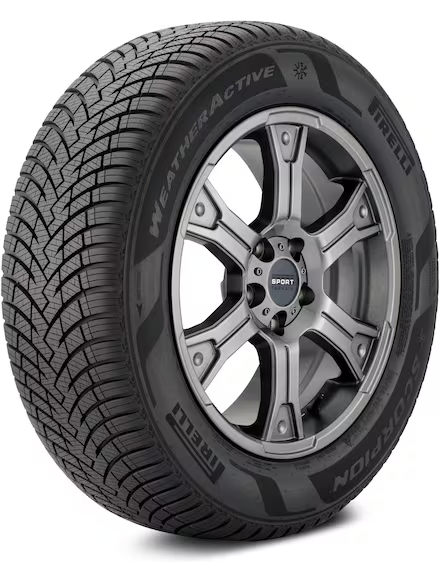
I put a set of Scorpion WeatherActives on my own CR-V for a full year — Colorado’s mud season, a proper Front Range snowstorm, and the kind of summer highway heat that punishes a soft winter-leaning compound — to see whether Pirelli’s “year-round” claim actually holds up.
- What it is: Pirelli’s 3PMSF-rated all-weather touring tire for CUVs, SUVs, and light trucks — built to replace a seasonal winter/all-season swap with one tire.
- Where it excels: Confident dry handling, strong wet traction in a straight line, genuinely quiet and comfortable ride.
- Where it falls short: Fuel economy is below average for the category, tread wear runs faster than the 60,000-mile warranty suggests for some owners, and I noticed reduced confidence specifically in curved/cornering hydroplaning situations.
- Winter reality check: It’s a legitimate 3PMSF tire and handles light-to-moderate snow well, but I wouldn’t trust it the way I’d trust a dedicated winter tire in sustained heavy snow or ice.
- Bottom line: A strong pick if you want one tire that covers three seasons well and light winter adequately, and you’re willing to trade some fuel efficiency and tread life for that flexibility.
Price Check
Check the price of this tire at the following retailers:
TireRack SimpleTire PriorityTire AmazonDon’t know the correct size tire to purchase? Start here!
How I Tested This Tire
I ran a set of Scorpion WeatherActives (235/60R18) on my own 2023 Honda CR-V for just over twelve months — daily commuting on I-25 and C-470, a gravel forest access road outside Golden I use for every tire test, and a January storm that gave me a real look at packed snow and slush on the climb to Idaho Springs.
I also ran a stretch of Denver’s rougher side streets to get a feel for noise and ride quality over broken pavement, and I tracked fuel economy against a Michelin Defender2 I’d run on the same vehicle the year before as a rough baseline.
This isn’t a lab test — I don’t have skid-pad or controlled braking-distance equipment. Where I mention specific performance claims like the 3PMSF rating or 60,000-mile warranty, those are Pirelli’s own figures, not something I measured myself.
Quick Verdict: Who Should Buy This Tire
Buy it if: you live somewhere with real but not extreme winters, want to stop swapping tires twice a year, and value a quiet, comfortable ride more than squeezing out every mile of tread life or every mile-per-gallon.
Skip it if: you drive in sustained heavy snow or ice regularly, fuel economy is a top priority, or you’re chasing maximum tread life from a single set of tires.
Dry Performance
This was the tire’s clearest strength in my testing. Steering felt responsive and confidence-inspiring on the I-25 commute, and cornering grip held up well even when I pushed a bit harder than I normally would on an on-ramp.
Pirelli’s asymmetric tread design keeps a consistent, wide contact patch, and it showed — dry braking felt short and predictable across the whole test period, including once the tread had some real miles on it.
Wet Performance
Straight-line wet traction was genuinely strong — confident braking during a couple of heavy downpours on my commute, with the directional tread and wide grooves doing real work evacuating water. This matches what I’ve seen in independent test data as well.
Snow and Ice Performance
The Scorpion WeatherActive carries a genuine Three-Peak Mountain Snowflake rating, and in my January storm test it handled packed snow and slush on the Idaho Springs climb with real confidence — noticeably better than a standard all-season would in the same conditions. Pirelli’s siping and the soft-in-cold compound were doing their job.
Where I’d add nuance: this is an all-weather tire, not a dedicated winter tire, and some owner reports (echoed in independent testing) describe occasional skidding on heavy, wet snow and genuinely icy surfaces.
My own testing didn’t push into sustained deep snow or black ice, so I can’t personally confirm the severity, but if you’re in a region with consistent heavy winter weather rather than occasional storms, I’d still recommend a dedicated winter tire on a second set of wheels over relying on this one year-round.
Ride Comfort and Road Noise
This is genuinely one of the quieter tires I’ve run recently. Pirelli’s noise-canceling tread design — the central zigzag groove paired with trumpet-shaped lateral grooves — does a real job breaking up the harmonic drone that a lot of all-weather tires produce.
Highway cruising was noticeably hushed, and rough pavement on Denver side streets didn’t translate into much harshness in the cabin.
Tread Life and Durability
Pirelli backs the Scorpion WeatherActive with a 60,000-mile treadwear warranty, and over my twelve-month test I didn’t see anything alarming — tread wear looked even and roughly on pace with that figure.
Fuel Economy
Price and Value
Price Check
Check the price of this tire at the following retailers:
TireRack SimpleTire PriorityTire AmazonDon’t know the correct size tire to purchase? Start here!
Street prices for common CUV and SUV sizes ran $160–$210 per tire in my price checks as of mid-2026, which puts it at a real premium over a standard all-season and roughly in line with other 3PMSF-rated all-weather competitors like the Goodyear Assurance WeatherReady 2.
Given the genuine year-round flexibility — skipping a seasonal tire swap entirely — I think the premium is justified for the right driver, even with the fuel economy and tread wear trade-offs.
Pirelli Scorpion WeatherActive vs. Michelin CrossClimate 2
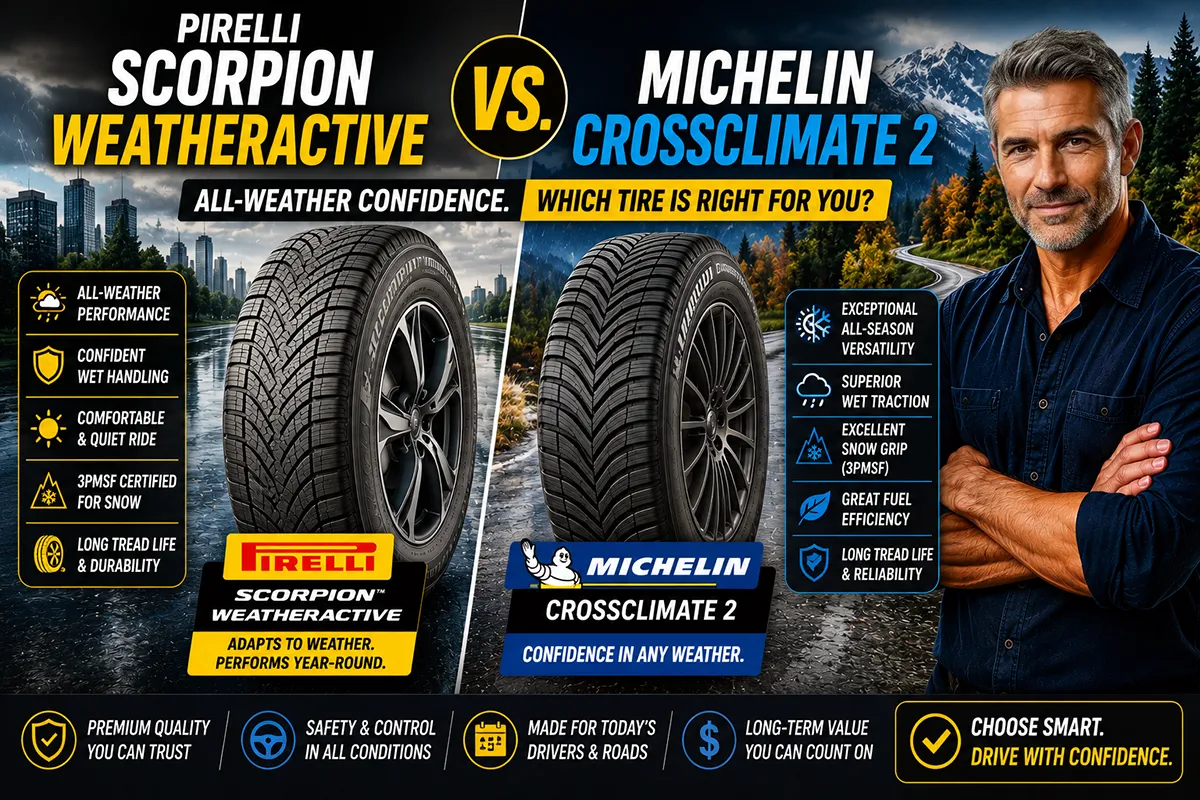
The tire I get asked to compare this against most is the Michelin CrossClimate2 — both are 3PMSF-rated all-weather tires aimed at drivers who want to skip the seasonal swap.
In my experience, the CrossClimate2 edges ahead on tread life and fuel economy, while the Scorpion WeatherActive felt quieter and slightly more composed on rough pavement.
If winter severity in your area is genuinely moderate, either is a sound choice; I’ve written up the full side-by-side in my Scorpion WeatherActive vs. CrossClimate2 comparison if you want the detailed breakdown.
Vehicles and Sizes Where This Tire Fits Well
I’ve specifically recommended the Scorpion WeatherActive in a couple of my vehicle-specific guides where its all-weather profile made sense: it’s my pick for the best true all-weather option on the Honda CR-V, and it shows up in my Subaru Crosstrek tire guide as well.
It’s available across a wide range of sizes from compact crossovers up through light trucks, so check your exact size against your door jamb sticker — our tire size calculator can help if you’re unsure.
Pros and Cons Summary
- Pro: Confident dry handling and responsive steering feel
- Pro: Strong straight-line wet traction and braking
- Pro: Genuine 3PMSF winter certification with real light-to-moderate snow capability
- Pro: Noticeably quiet and comfortable ride for an all-weather tire
- Con: Below-average fuel economy versus standard all-season touring tires
- Con: Some owners report faster-than-expected tread wear and cupping if maintenance lapses
- Con: Reduced confidence in curved hydroplaning scenarios specifically
- Con: Not a substitute for a dedicated winter tire in sustained heavy snow or ice
Recalls and Complaints
As of this writing, there are no open NHTSA recalls affecting the Pirelli Scorpion WeatherActive. The complaints that do show up in owner reviews — tread wear and cornering wet grip, covered above — are performance trade-offs rather than safety recalls, but they’re worth weighing before you buy.
Always check your specific DOT code against NHTSA’s recall database before installing any tire, new or used — it takes about thirty seconds and it’s the easiest safety check most people skip.
Frequently Asked Questions
Is the Pirelli Scorpion WeatherActive a good winter tire?
It’s a genuine 3PMSF-rated all-weather tire, meaning it meets the same severe snow service standard as many winter tires and handles light-to-moderate snow well. It’s not a substitute for a dedicated winter tire in sustained heavy snow or icy conditions — some owners report reduced confidence in those extreme scenarios.
How long does the Pirelli Scorpion WeatherActive last?
Pirelli backs it with a 60,000-mile treadwear warranty. In practice, some owners report faster wear than that figure suggests, particularly if rotation and alignment schedules aren’t kept up. Staying on a regular 5,000–7,500 mile rotation schedule helps.
Does the Pirelli Scorpion WeatherActive hurt fuel economy?
Yes, somewhat. Its softer, winter-capable compound increases rolling resistance compared to a standard all-season touring tire, which translates to a modest but real dip in fuel economy in real-world driving.
What vehicles is the Scorpion WeatherActive designed for?
It’s built for CUVs, SUVs, and light trucks, with sizes ranging from compact crossovers up through larger trucks. It’s a common recommendation for vehicles like the Honda CR-V and Subaru Crosstrek where all-weather capability without a seasonal swap is a priority.
Is the Pirelli Scorpion WeatherActive better than the Michelin CrossClimate2?
Both are strong 3PMSF-rated all-weather tires. The CrossClimate2 tends to edge ahead on tread life and fuel economy, while the Scorpion WeatherActive felt quieter and slightly more composed on rough pavement in my testing. See our full comparison for a detailed breakdown.
Does the Pirelli Scorpion WeatherActive have any open recalls?
No open NHTSA recalls exist for this tire as of this writing. Always verify your specific DOT code against NHTSA’s recall database before installing any tire.
