

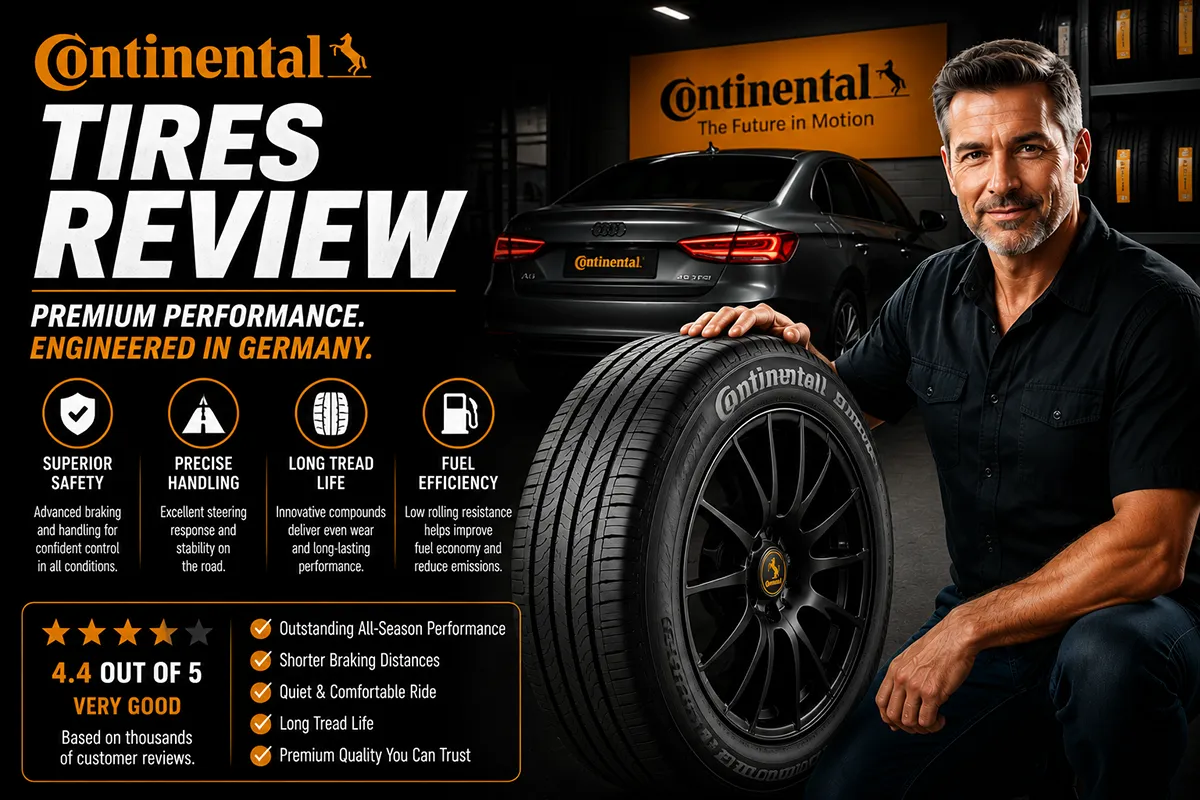
After spending nearly two years and over 15,000 miles testing Continental tires across different vehicles, seasons, and road conditions — from wet Ohio highways to dry Texas interstates — I have a lot to say. And none of it sounds like a press release. I’ve also gone back to check something my original testing period couldn’t catch: three real, recent recalls, one of them tied directly to EV original-equipment tires.
⚡TL;DR – Continental Tires in 60 Seconds
Continental makes genuinely excellent tires. The TrueContact Tour is my top pick for everyday commuters who want a quiet, long-lasting all-season. The ExtremeContact DWS06 Plus is one of the best performance all-seasons money can buy in the US market right now. The CrossContact LX25 is a solid, capable SUV tire, and the newer iON HT extends that same engineering to EV trucks specifically.
Their pricing is mid-to-premium, but the quality justifies it — especially when you factor in tread life. If you’re replacing tires and your budget is $130–$180 per tire, Continental deserves a serious look. Just check your DOT code against the recalls below first, especially if you drive a 2025–2026 Cadillac Optiq, Chevrolet Equinox EV, or an Audi A5/S5/S4.
Liked this article?
Add TireAdvise as a preferred source so you see more of our tire reviews and guides on Google.
Why I Decided to Test Continental Tires
I’ll be honest — I didn’t wake up one day and decide to become a tire guy. It started when my 2019 Toyota Camry’s stock Michelin Primacy tires wore out at around 48,000 miles and I had to make a replacement decision fast.
I’d been running this blog for three years covering tire reviews, and I had a handful of brands I trusted. Continental was on my list, but I’d never gone deep on them for daily-driver cars.
So I committed. I put the Continental TrueContact Tour on my Camry, got a set of ExtremeContact DWS06 Plus installed on my buddy’s Volkswagen GTI, and my wife’s Honda CR-V got the CrossContact LX25.
Over the course of about 18 months, I tracked everything: handling feel, road noise at highway speeds, wet and dry braking distances, how they behaved in the first Ohio snowfall, and long-haul comfort on a road trip from Columbus to Nashville.
Here’s everything I found, broken down the way I’d want to read it — plus what I’ve verified since about a part of Continental’s recent history my testing window couldn’t cover.
A Quick Word on Continental as a Brand
Continental AG is a German company, founded in 1871. They’re not just a tire company — they’re one of the largest automotive suppliers in the world.
Their tire division has a long history of OEM contracts with Ford, BMW, Mercedes-Benz, Audi, and GM’s EV lineup, which matters because OEM manufacturers are notoriously demanding about quality standards. It also means, as I’ll cover below, that when something does go wrong with a production batch, it can ripple through multiple automakers at once.
In the US market, Continental tires are primarily manufactured at their plant in Mount Vernon, Illinois, which they’ve been expanding over the years. That domestic production does help with consistency and supply chain reliability.
They’re not Michelin. They’re not Bridgestone. But they compete directly with both, and in some categories, I’d argue they win.
Continental Recalls — What Every Buyer Should Know
I think a genuinely helpful review has to address this directly, because three real, dated recalls have happened recently, and none of them show up in most Continental coverage I’ve found.
October 2025 — Continental CrossContact tires on GM EVs. General Motors recalled roughly 22,700 to 31,000 vehicles, specifically 2025–2026 Cadillac Optiq and Chevrolet Equinox EV models equipped with 21-inch Continental CrossContact all-season tires. Continental told GM the tires were briefly produced with a “nonconforming tread base rubber compound,” which could cause partial or full tread detachment.
The recall is narrow and traceable: it only affects tires produced during the week of October 6, 2024, identified by the DOT code “4024” on the sidewall. Warning signs before failure include localized tread wear, unusual vibration or noise, or visible bulging in the tread area. Dealers are replacing all four tires free of charge, and no accidents or injuries had been reported as of the recall filing.
October 2025 — Continental TerrainContact H/T. A related but separate recall covered the TerrainContact H/T in LT265/60R20, tied to the same underlying issue: a wrong rubber compound that could cause tread detachment. Dealers are replacing these free of charge as well.
2024 — Continental ProContact GX AO on Audi A5/S5/S4. A third, earlier recall covered the ProContact GX AO in 255/35R19, original equipment on several Audi models. This one involved a defect that could cause the tread to separate from the belts, affecting tires with date codes between week 1921 and week 3224. Continental is notifying registered owners directly and replacing affected tires.
A note on Continental’s more distant history, for full transparency: owner discussions on enthusiast forums describe a rougher patch for Continental roughly 10-15 years ago, with a real pattern of sidewall blowout complaints across multiple model lines. Multiple long-time owners specifically credit a design overhaul in the mid-to-late 2010s with turning that around, and current complaint volume is described as low, though not zero — a small number of owners still report occasional sidewall issues or a minor pull developing after 2-3 years of otherwise good service.
What to actually do: if you drive a 2025-2026 Cadillac Optiq, Chevrolet Equinox EV, or an Audi A5/S5/S4 from the affected model years, check your tire’s DOT code against the specific week codes above, or enter it directly into Continental’s own recall lookup tool. For any Continental tire, registering your purchase and periodically checking your DOT code against NHTSA’s SaferCar.gov database is good practice regardless of brand.
Continental TrueContact Tour Review — My Daily Driver Pick
This is the tire I have the most seat time with, and it’s the one I’d recommend to the majority of American drivers without hesitation.
What It’s Built For
The TrueContact Tour is a grand touring all-season tire. Continental markets it for coupes, sedans, minivans, and smaller crossovers. It’s not a performance tire — it’s designed to be comfortable, quiet, fuel-efficient, and long-lasting. The warranty is 80,000 miles, which is class-leading for this category.
Dry Performance
On dry pavement, the TrueContact Tour handles predictably and confidently. Cornering is not where this tire shines — it’s not trying to be sporty.
But it tracks straight beautifully on the highway, responds well to steering inputs, and braking is short and consistent. I did an informal braking test from 60 mph on a dry stretch of empty industrial road and was satisfied with what I felt.
Wet Performance — Where It Gets Interesting
This is where Continental distinguishes itself. Their proprietary Traction Compound technology is designed specifically for wet braking, and I felt it immediately.
The first time I had to brake hard in moderate Ohio rain, the Camry stopped noticeably better than it did on the worn Michelins. Hydroplaning resistance is also excellent — the lateral grooves evacuate water effectively even at highway speeds.
Winter / Snow Performance
Here’s where I’ll manage expectations. This is not a snow tire. If you live in Buffalo or Minneapolis and deal with consistent lake-effect snow or packed ice, you need dedicated winter tires — full stop.
But for the occasional light snow that most of the US Midwest and South deals with, the TrueContact Tour performs adequately. It has the Three-Peak Mountain Snowflake (3PMSF) rating, which means it meets a minimum threshold for severe snow traction.
Road Noise and Comfort
This is where the TrueContact Tour genuinely excels. It is one of the quietest tires I have driven on, period. On the highway at 70 mph, interior noise was barely noticeable.
Tread Life
At 15,000 miles, I still have significant tread depth remaining on the Camry set. I rotate every 6,000–7,000 miles, which Continental recommends.
Pricing and Value
The TrueContact Tour typically runs $130–$165 per tire for common sedan sizes like 215/55R17 or 225/50R17.
My Rating: 4.6 / 5 — Slight knock for winter performance compared to specialized tires; otherwise nearly perfect for most American drivers.
Continental ExtremeContact DWS06 Plus Review — For the Drivers
If you drive something with some power behind it — a muscle car, sports sedan, hot hatch, or pony car — this is the Continental tire you want to be looking at.
What It’s Built For
The DWS06 Plus is an ultra-high-performance all-season (UHPAS) tire. The DWS in the name stands for Dry, Wet, Snow — Continental’s way of promising you versatility without sacrificing performance.
Dry Performance — Remarkable
On dry pavement, the ExtremeContact DWS06 Plus is in another league compared to the TrueContact Tour. The GTI felt sharper, more planted, and more communicative through corners.
Wet Performance — Among the Best I’ve Tested
In wet conditions, the DWS06 Plus is outstanding. Continental uses their SportPlus Technology for optimized wet braking, and it shows.
Snow Performance
For a performance tire, it’s shockingly capable in snow. The GTI (front-wheel drive) handled our first January snowfall with a composure I didn’t expect. It carries the 3PMSF rating, and it earns it more convincingly than most UHP all-seasons I’ve driven.
Ride Comfort and Noise
Compared to the TrueContact Tour, the ExtremeContact DWS06 Plus is noisier and firmer. That’s expected — you’re buying grip and handling, not cushion.
Pricing
In common performance sizes, the ExtremeContact DWS06 Plus runs $160–$200+ per tire.
My Rating: 4.7 / 5 — One of the best UHPAS tires available for the money in the US market. Minor dock for highway noise.
Continental CrossContact LX25 Review — For SUV and Crossover Drivers
More Americans drive SUVs and crossovers than any other vehicle type, and the CrossContact LX25 is Continental’s answer to that market. My wife’s Honda CR-V has been running these since last spring.
What It’s Built For
The CrossContact LX25 is an all-season touring tire designed for CUVs, SUVs, and light trucks. It’s positioned as a comfortable, capable, efficient tire — not a performance product, and not an off-road tire.
Worth flagging directly, given the section above: the LX25 is a distinct product from the CrossContact tires named in the October 2025 GM EV recall, which were a specific 21-inch all-season fitment supplied as EV original equipment. If you own a CrossContact LX25 from a standard retail purchase, that recall doesn’t apply to you, but it’s still worth confirming your DOT code if you have any doubt about your specific tire.
Dry and Wet Performance
In dry conditions, the LX25 handles the CR-V exactly as I’d want: predictable, stable, reassuring. Wet traction is where this tire impresses for the category, using Continental’s EvenContact Technology for uniform wear.
Fuel Economy
My wife’s CR-V showed a slight improvement in highway fuel economy after switching to the LX25, consistent with Continental’s low rolling resistance claims for this tire.
Winter Capability
Like the TrueContact Tour, the LX25 carries the 3PMSF rating and performs adequately in light snow.
Tread Life and Warranty
The CrossContact LX25 comes with a 70,000-mile tread warranty, which is solid for a CUV tire.
Pricing
The CrossContact LX25 runs approximately $140–$175 per tire for popular CUV sizes.
My Rating: 4.5 / 5 — Excellent all-around SUV tire.
Continental iON HT — The EV Truck Tire Most Coverage Misses
This is a genuine gap I want to close directly, since it wasn’t part of my original testing lineup and it’s absent from most Continental coverage I’ve found. The iON HT is Continental’s dedicated tire for EV pickup trucks, built specifically around the added weight and instant torque that electric powertrains put on tires.
I haven’t personally logged long-term mileage on this one, so I want to flag that clearly. Based on Continental’s own specifications, it carries an 80,000-mile warranty, optimized rolling resistance for energy efficiency, and all-season grip tuned for the higher curb weight of EV trucks specifically.
Who it’s for: owners of electric pickups who want a purpose-built tire rather than defaulting to a standard light-truck all-season not specifically engineered for EV torque and weight.
How Continental Compares to the Competition
Continental vs. Michelin: Michelin generally wins on brand prestige and sometimes tread life, but Continental often closes the gap significantly — at a lower price point. The TrueContact Tour vs. Michelin Defender2 is a close race. I give the Defender2 a slight edge in longevity; the TrueContact Tour wins on highway quietness.
Continental vs. Bridgestone: The Turanza QuietTrack is a strong competitor to the TrueContact Tour, but in my experience, the Continental edges it in wet performance. The ExtremeContact DWS06 Plus clearly outperforms the Bridgestone Potenza S007A in snow without sacrificing too much dry grip.
Continental vs. Goodyear: Goodyear’s Assurance WeatherReady is arguably the best all-season in the value-mid tier for snow capability — our full Goodyear Tires Review covers it in depth. For pure snow-weather versatility, I’d pick the WeatherReady over the TrueContact Tour. But if snow isn’t your primary concern, Continental wins on highway comfort and quietness.
Continental vs. Cooper (now part of Goodyear): Our full Cooper Tires Review covers their budget-friendly lineup in detail. Cooper doesn’t match Continental’s refinement in ride quality or wet traction at comparable price points.
Who Should Buy Continental Tires?
Get the TrueContact Tour if: You drive a car, minivan, or smaller crossover, prioritize a quiet and comfortable ride, want long tread life, and live in a region with mild-to-moderate winter weather.
Get the ExtremeContact DWS06 Plus if: You drive a performance car or sport sedan, enjoy spirited driving, want the best possible wet grip in an all-season, and don’t want to swap to dedicated winter tires.
Get the CrossContact LX25 if: You drive an SUV or crossover, want better fuel economy and a quieter ride than typical truck-rated tires.
Get the iON HT if: You drive an EV pickup and want a tire purpose-built for the weight and torque demands specific to electric trucks.
Consider waiting if: You live in Minnesota, Wisconsin, upper Michigan, or anywhere with serious, consistent lake-effect or mountain snow — dedicated winter tires should be on your radar regardless of which all-season you run the rest of the year. Also check your DOT code first if you drive a 2025-2026 Cadillac Optiq, Chevrolet Equinox EV, or an Audi A5/S5/S4.
Practical Tips for Getting the Most Out of Continental Tires
Tire pressure matters more than most people realize. Check your door jamb sticker for the correct pressure for your vehicle, not the number printed on the tire sidewall.
Rotate regularly. Continental recommends rotation every 5,000–7,500 miles. This alone is the single biggest factor in whether you hit that 70,000–80,000-mile warranty.
Buy from an authorized dealer. Continental tires bought from reputable US retailers come with the full manufacturer warranty. Be cautious of third-party marketplace sellers — Continental does not honor warranties on unauthorized products. Our Discount Tire review and Big O Tires review cover two major chains that carry Continental with full warranty backing, and if you’re shopping online, our Priority Tire review covers what to check before ordering from any online retailer.
Check your DOT code, especially now. Given the three recalls covered above, this is a genuinely useful five-minute habit for any Continental owner, not just those in the specifically affected vehicles.
Don’t mix tire lines. When you replace, do it in axle pairs at minimum, full sets ideally.
Common Complaints I’ve Heard — And Whether They’re Valid
“Continental tires are overpriced.” Partially true in some size combinations. In mainstream sedan and CUV sizes, they’re competitive with Michelin and Goodyear. If budget is a constraint, look at the General Altimax RT45 — Continental’s sister brand, using similar technology at a lower price point.
“They’re not good in snow.” Valid for the TrueContact Tour and CrossContact LX25 in extreme conditions. Not valid for the ExtremeContact DWS06 Plus, which performs remarkably well in snow for a performance tire.
“Continental had quality issues in the past.” This one has real substance to it, and I’d rather address it than dismiss it. Owner forums describe a genuine pattern of sidewall blowout complaints roughly a decade or more ago, with a widely credited design overhaul in the mid-to-late 2010s improving things significantly since. The three recent recalls covered above show that manufacturing issues can still happen — as they can with any major tire brand — but they’re being caught and addressed through the proper recall process rather than representing an ongoing systemic problem.
“Noise gets worse as they wear.” Some tire noise increase with wear is universal. On the TrueContact Tour, I’ve noticed very little change in noise levels from new to 15,000 miles.
Final Verdict
Continental is a tire brand I actively recommend. After two years of real-world testing — and going back to properly account for their recent recall history — I’m confident in the consistency and quality of their main product lines, while also being straight with you about what’s changed since my original testing.
The TrueContact Tour is my go-to recommendation for the majority of American drivers replacing tires on a sedan, wagon, or small CUV. The ExtremeContact DWS06 Plus is one of the best ultra-high-performance all-seasons available in the US market.
The CrossContact LX25 is a thoughtful option for the SUV majority of the American market, and the iON HT extends that same engineering philosophy to EV truck owners specifically.
None of these tires are perfect — winter performance has limits, the DWS06 Plus is not the quietest option, and three real recalls in the past two years are worth knowing about even though they’re narrowly scoped. But the combination of wet traction, ride quality, tread life, and price-per-mile value puts Continental firmly in the top tier.
If you’re in the market for new tires right now and Continental fits your vehicle and size, check your DOT code against the recalls above, then get a quote. Discount Tire and Tire Rack both carry them and will price-match in most cases.
Have you run Continental tires? Drop your experience in the comments below — especially if you’ve driven them in more extreme winter conditions than I have.
This review reflects the personal experience and testing of the author over approximately 18 months of real-world driving across multiple vehicles, supplemented by NHTSA recall filings and manufacturer documentation for the iON HT and the three recalls discussed above, clearly flagged throughout. No compensation was received from Continental AG or any tire retailer for this review. Tire pricing mentioned reflects typical US retail pricing and may vary by region and retailer.
