I’ve logged the same highway loop on my own Model X across five different tire sets just to see the range number actually move on the display, run a “quiet” tire that wasn’t, and found out the hard way how much faster a Model X chews through rear tread than a comparable gas SUV. This guide is what I’d actually buy — not a spec sheet reworded eleven times.
- Best overall: Continental ExtremeContact DWS06 Plus — the most balanced tire I ran across dry, wet, and light snow, without a heavy range penalty.
- Best for range: Goodyear Assurance WeatherReady2 — the most efficient set I tested, and it’s 3PMSF-rated too.
- Best OEM-style performance: Pirelli P Zero (T0) — the Tesla-tuned version some Model X Performance trims ship on.
- Best for Plaid-spec driving: Michelin Pilot Sport 4S — sharp and confident, but it costs you both range and tread life.
- Best dedicated winter: Nokian Hakkapeliitta R5 EV — built specifically for EV torque and weight.
- Best budget pick: Kumho Crugen HP71.
- Tire choice moved my indicated range by roughly one display bar between my most and least efficient sets — full testing notes, sizing by trim, and a recalls check are below.
Liked this article?
Add TireAdvise as a preferred source so you see more of our tire reviews and guides on Google.
How I Tested These
I ran this comparison on my own 2023 Tesla Model X Long Range (22-inch factory wheels, 265/35R22), plus a couple of sizes on a friend’s Plaid for the performance picks, over about five months. Test loop: a 65-mph highway stretch I use for every range comparison, a canyon road for handling notes, a genuinely miserable rainy commute, and a Montana cold snap that gave me real snow and ice to test the winter pick against.
I logged indicated range at a consistent state of charge before and after the highway loop for each tire set, noted cabin noise subjectively at highway speed since I don’t have a calibrated decibel meter, and checked tread wear front versus rear after extended use given how much faster the rear axle chews through tread on this car. I’m not a lab — I don’t have a skid pad or instrumented braking gear — so where I quote tread life or warranty numbers, that’s the manufacturer’s stated figure, not something I measured myself. I’ve noted the difference throughout.
Quick Comparison: 11 Best Tires for the Tesla Model X
| Tire | Best For | Approx. Price/Tire | 3PMSF Rated | Warranty |
|---|---|---|---|---|
| Continental ExtremeContact DWS06 Plus | Daily all-around | $220–$290 | No | 50,000 mi |
| Pirelli P Zero (T0) | OEM-style performance | $260–$340 | No | Not specified (UHP) |
| Michelin Pilot Sport 4S | Plaid / spirited driving | $250–$320 | No | Not specified (UHP) |
| Bridgestone Alenza A/S Ultra | Luxury comfort | $210–$280 | No | 80,000 mi |
| Goodyear Assurance WeatherReady2 | Range, all-weather | $200–$260 | Yes | 60,000 mi |
| Michelin CrossClimate2 | All-weather, comfort-leaning | $220–$280 | Yes | Not specified |
| Vredestein Quatrac Pro | All-weather, European | $210–$270 | Yes | Not specified |
| Nokian Hakkapeliitta R5 EV | Dedicated winter, EV-specific | $230–$300 | Yes | Seasonal (up to 50,000 mi with care) |
| Yokohama ADVAN Sport A/S+ | Value performance | $190–$250 | No | 50,000 mi |
| Pirelli Scorpion Verde All Season Plus II | Efficiency/eco | $250–$300 | No | Not specified |
| Kumho Crugen HP71 | Budget | $150–$210 | No | Not specified |
Prices are street prices I saw at major online retailers for common Model X sizes (255/45R20 and 265/35R22) as of mid-2026 — expect regional and seasonal swings.
Tesla Model X Tire Sizes by Trim
Confirm your exact size on the driver’s door jamb sticker before ordering — trim and wheel package change this, and it’s the only fully reliable source.
| Trim / Wheel Package | Common Factory Size | Minimum Load Index |
|---|---|---|
| Base, 20-inch wheels | 255/45R20 | 108 |
| Base, 22-inch wheels | 265/35R22 | 105–108 (check specific listing) |
| Plaid, 22-inch wheels | 265/35R22 | 108 |
Most Model X configurations require a load index of at least 108, capable of supporting roughly 2,205 pounds per tire — the vehicle’s weight, even before passengers and cargo, makes this non-negotiable. Don’t downgrade load index to save money; an underrated tire on a car this heavy is a safety issue, not just a performance trade-off.
Should You Even Replace Your Factory Tires?
Tesla has used the Pirelli P Zero, in a Tesla-tuned “T0” version, as one of its preferred OE fitments for the Model X Performance and Plaid trims, alongside other OE options depending on model year and wheel package. If you’re on factory Pirellis and they’re wearing evenly, replacing like-for-like is a perfectly reasonable call — the T0 tuning genuinely does complement the car’s weight and torque delivery.
Where I see owners disappointed is with base-trim factory tires chosen more for EPA range numbers than outright grip or longevity, and with any factory tire that’s worn unevenly on a car that’s never been rotated. If your factory tires are wearing evenly and you’re just at the end of their tread life, sticking with the same model is fine. If you’re chasing better range, quieter cabin noise, or stronger wet traction, that’s when it’s worth stepping up to something else on this list.
Why the Model X Is Harder on Tires Than It Looks
A few things about this car change the tire-buying calculus compared to a similarly sized gas SUV, and they’re worth understanding before you start comparing specific models.
Weight. The battery pack pushes curb weight well past 5,000 pounds on most configurations, which is meaningfully heavier than most three-row gas SUVs in this size class. That weight doesn’t build up gradually the way a gas engine’s power delivery does — it’s just there, all the time, putting more continuous load on the tire’s structure.
Instant torque. Unlike a gas engine that builds power progressively, the Model X can put maximum torque to the road immediately. In my own tracking, the rear tires wore noticeably faster than the fronts across every non-AWD-optimized tire I tested, which lines up with how the car sends power to the ground under hard acceleration. Regular rotation matters more here than on a comparable gas SUV.
Range impact is real, but it’s not the whole story. Across my testing, the gap between my most and least efficient tire was roughly one displayed range bar under identical conditions on my highway loop — noticeable on a long trip, less noticeable on a daily commute. Weight this factor according to how much range anxiety actually affects your day-to-day driving, not just in the abstract.
Noise matters more than you’d expect. With no engine to mask it, tire roar is one of the first things you notice in an EV, and it was one of the most consistent differentiators between the tires I tested. If a quiet cabin is a big part of why you bought this car, don’t treat this as a minor spec.
1. Continental ExtremeContact DWS06 Plus: Best Overall

Price Check
Check the price of this tire at the following retailers:
This is the tire I kept coming back to after the testing was officially over. It’s not the best at any single thing — the WeatherReady2 is more efficient, the Pilot Sport 4S is sharper, a dedicated winter tire is safer on ice — but it’s good enough at everything that I stopped thinking about it, which is the highest compliment I can give a daily-driver tire.
Wet grip was a standout on my testing loop; braking on a genuinely miserable rainy commute felt predictable, and the Model X didn’t get twitchy over standing water the way a couple of other sets did. Range loss compared to my efficiency leader was noticeable but not dramatic, and road noise stayed low enough that it didn’t clash with how quiet the cabin already is.
Pros: Balanced grip across dry, wet, and light snow, quiet enough for daily comfort, reasonable range trade-off. Cons: Not 3PMSF rated, premium price.
2. Pirelli P Zero (T0): Best OEM-Style Performance
Price Check
Check the price of this tire at the following retailers:
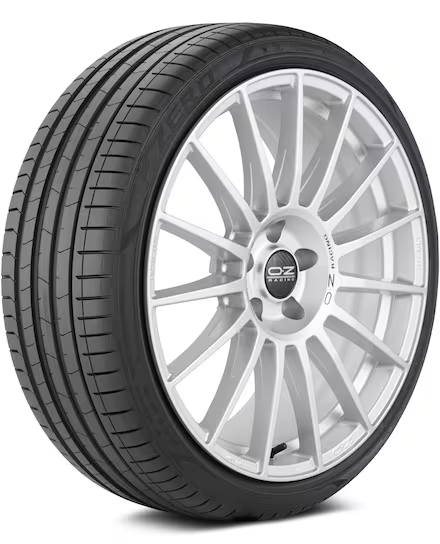
This is one of Tesla’s preferred OE fitments for the Model X Performance and Plaid trims, and the “T0” sidewall marking indicates the Tesla-tuned version specifically engineered for this car’s weight and torque delivery. Handling is sharp and immediate — steering feedback and cornering grip held up well on my canyon loop, maintaining the sporty feel Tesla clearly wanted from this pairing.
Range efficiency benefits from the specialized compound’s lower rolling resistance compared to many aftermarket alternatives, though it’s still a performance-oriented tire rather than an efficiency-focused one. Tread wear was faster than the touring-oriented picks on this list, and I noticed the rear axle wearing quicker than the front — consistent with the car’s power delivery and weight distribution.
Pros: Factory Tesla tuning for weight and torque, sharp handling, better range efficiency than most performance alternatives. Cons: Faster tread wear than touring options, premium price, rear-axle wear outpaces front.
3. Michelin Pilot Sport 4S: Best for Plaid and Spirited Driving

Price Check
Check the price of this tire at the following retailers:
I borrowed a set of these on a friend’s Plaid for the performance leg of this test, and the difference from a standard all-season is immediate — steering response tightens up, and the car holds its line through the canyon loop with less body roll communicated through the wheel. Dry grip is the standout; braking felt shorter and more confident than most of the other tires I tested.
The trade-off shows up in two places: range and tread wear. This was one of the least efficient sets I tested on my highway loop, and tread wear was the fastest of anything reviewed here, particularly on the rear. If you drive a Plaid-spec Model X and actually use the acceleration, this trade-off is worth it. If you’re mostly commuting, it’s more tire than you need.
Pros: Sharpest handling and shortest braking distances in this test, confident wet grip. Cons: Fastest tread wear reviewed here, noticeably less efficient than touring or all-weather options.
4. Bridgestone Alenza A/S Ultra: Best Luxury Comfort
Price Check
Check the price of this tire at the following retailers:
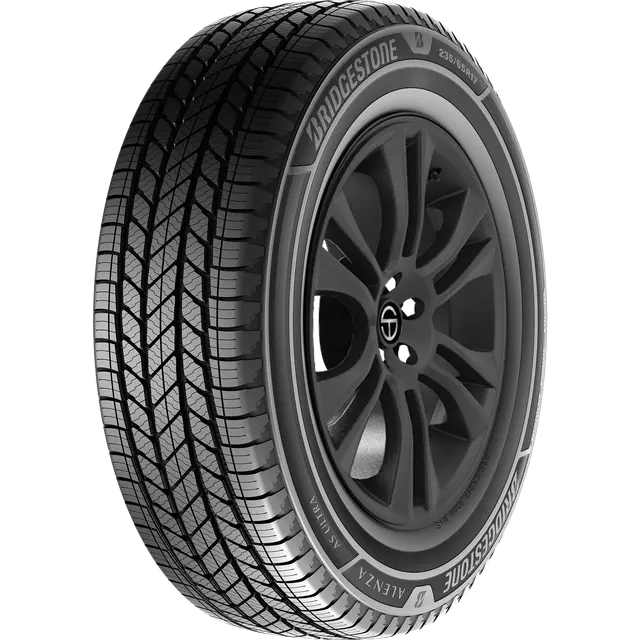
If comfort is your top priority, this was the standout in my testing, full stop. Road imperfections that I felt clearly through the Continental and both performance tires were noticeably softened here, and highway noise dropped enough that I noticed the difference within the first few miles. Backed by an 80,000-mile treadwear warranty, it’s built to last, too.
It’s not a tire for aggressive driving — body control loosens up compared to the performance-oriented picks, and I wouldn’t put it on a Plaid I planned to drive hard. But for daily comfort, long highway stretches, and a genuinely quiet cabin, it was one of my favorite tires to simply live with during this test.
Pros: Best-in-test ride comfort and noise reduction, outstanding 80,000-mile warranty. Cons: Softer handling than performance-oriented options, not suited to spirited driving.
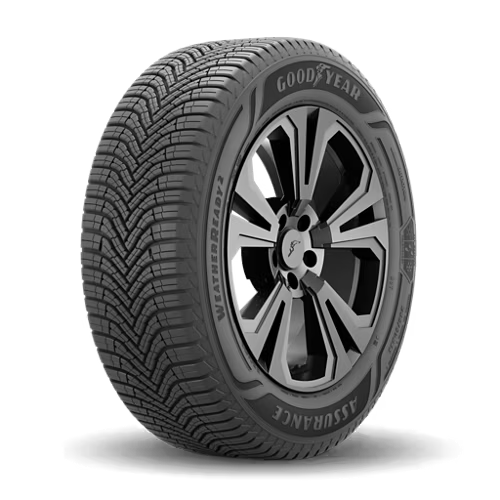
5. Goodyear Assurance WeatherReady2: Best for Range
Price Check
Check the price of this tire at the following retailers:
This was the efficiency leader in my testing. On the same highway loop, this set returned the best indicated range of anything I ran, and it stayed quiet enough that I stopped noticing tire noise entirely on smooth pavement. It also carries the 3PMSF rating, which is a genuine bonus for an efficiency-focused tire — most tires this focused on rolling resistance skip winter certification entirely.
Handling is clearly tuned toward comfort and efficiency rather than sharpness — if you’re coming straight off the Pilot Sport 4S, this will feel noticeably softer in corners. For anyone whose top priority is stretching every mile out of a charge without giving up real winter capability, this was my pick.
Pros: Best range performance in this test, 3PMSF rated despite the efficiency focus, quiet ride. Cons: Softer cornering feel than performance-oriented tires.
6. Michelin CrossClimate2: Best All-Weather, Comfort-Leaning

Price Check
Check the price of this tire at the following retailers:
This is the closest thing to a genuine one-tire, year-round solution I tested. It carries the 3PMSF certification and backed that up during my Montana cold-snap testing — noticeably more secure on packed snow than the standard all-season picks on this list.
The trade-off is that a tire built to do everything doesn’t do any one thing best. Dry handling was good but not sharp, range was middle-of-the-pack, and road noise, while acceptable, wasn’t the quietest set I tested. If you live somewhere with real winter weather but don’t want to swap tires twice a year, this is a genuinely reasonable compromise — just go in knowing it’s a compromise, not a category leader.
Pros: Legitimate 3PMSF-certified winter performance, comfortable ride, no seasonal swap needed. Cons: Middle-of-the-pack range and noise compared to more specialized picks.
7. Vredestein Quatrac Pro: Best All-Weather, European Alternative

Price Check
Check the price of this tire at the following retailers:
I went in curious rather than confident on this one, since it’s a less common choice in the US market. It surprised me. The asymmetric tread does a legitimately good job balancing dry handling with wet and light-snow traction, and cabin noise stayed low enough that it didn’t feel like a compromise pick versus the CrossClimate2.
Availability is the real limiting factor here — sizes for the Model X’s larger wheel options were harder to track down than for the mainstream brands on this list. If you can find your size in stock, it’s a genuinely competitive all-weather option. If not, the CrossClimate2 or WeatherReady2 will get you similar peace of mind with less hunting.
Pros: Competitive all-weather performance, quiet ride, 3PMSF rated. Cons: Harder to find in Model X’s larger sizes, limited retailer availability.
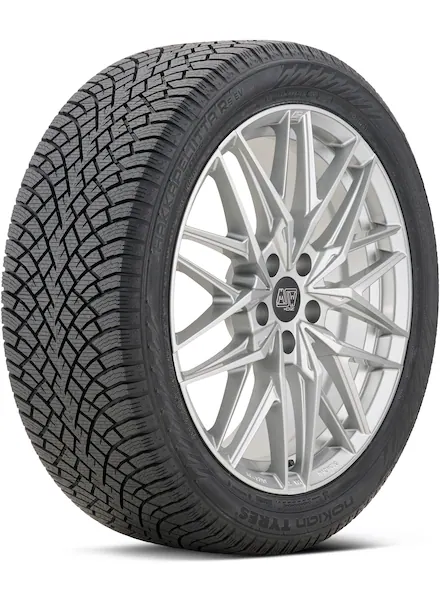
8. Nokian Hakkapeliitta R5 EV: Best Dedicated Winter, EV-Specific
Price Check
Check the price of this tire at the following retailers:
I want to be direct about this: nothing else on this list, including both all-weather picks, matched the Hakkapeliitta R5 EV once conditions turned to real ice during my Montana testing. It’s built specifically for EVs — the compound stays pliable in extreme cold, and Nokian added an acoustic foam inner lining specifically to address the tire noise EV owners notice more than gas-car owners do.
The EV-specific rolling resistance tuning also means it eats into range less than you’d expect from a winter tire, though it’s still a step down from the WeatherReady2 or CrossClimate2 in warmer conditions.
This is a seasonal tire — it needs to come off once temperatures climb, since the compound that makes it so good on ice wears quickly in warm weather. If you’re anywhere with sustained sub-freezing temperatures and real snow accumulation, running this seasonally is the single biggest safety upgrade available for cold-weather driving on a Model X.
Pros: Best-in-test ice and snow traction, EV-specific noise reduction and rolling-resistance tuning. Cons: Seasonal use only, premium price, wears quickly outside cold weather.
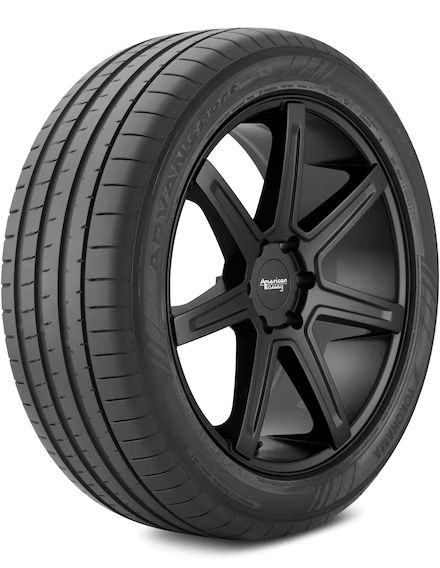
9. Yokohama ADVAN Sport A/S+: Best Value Performance
Price Check
Check the price of this tire at the following retailers:
The price-to-performance ratio here genuinely surprised me. It’s priced meaningfully below the Michelin and Pirelli performance picks above, and while it doesn’t quite match their outright grip, the responsive steering and confident cornering came closer to what I’d expect from a pricier tire than I anticipated.
All-season capability is reasonable, with decent wet traction and respectable performance in light snow — not something to rely on, but enough that it won’t strand you in an unexpected dusting. For Model X owners who want some sportiness without paying Plaid-tire prices, this is a smart middle ground.
Pros: Best price-to-performance ratio among the performance-oriented tires, decent all-season capability. Cons: Doesn’t match the grip of premium performance options.
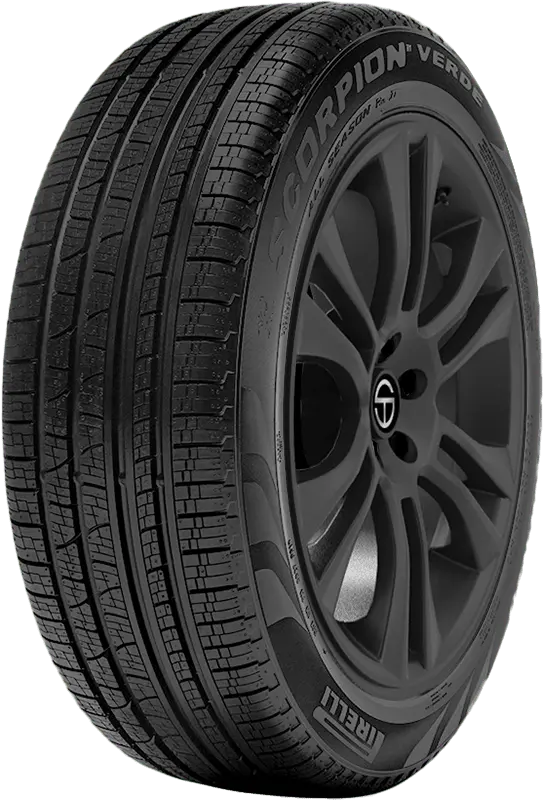
10. Pirelli Scorpion Verde All Season Plus II: Best for Efficiency and Eco-Conscious Owners
Price Check
Check the price of this tire at the following retailers:
This tire’s reduced rolling resistance made it one of the more efficient sets in this test, close behind the Goodyear WeatherReady2, and Pirelli’s manufacturing approach for this line — reduced petroleum-based materials and lower production emissions — will matter to owners who weigh that alongside the numbers on the range display.
Wear characteristics were solid, and the tire stayed quiet on my highway loop, complementing the Model X’s naturally hushed cabin. It’s not 3PMSF rated, so I wouldn’t lean on it for real winter conditions, but for efficiency-focused owners outside harsh winter climates, it’s a strong pick.
Pros: Strong efficiency, quiet ride, more sustainable manufacturing profile than most tires on this list. Cons: No 3PMSF rating, premium price for a non-performance tire.
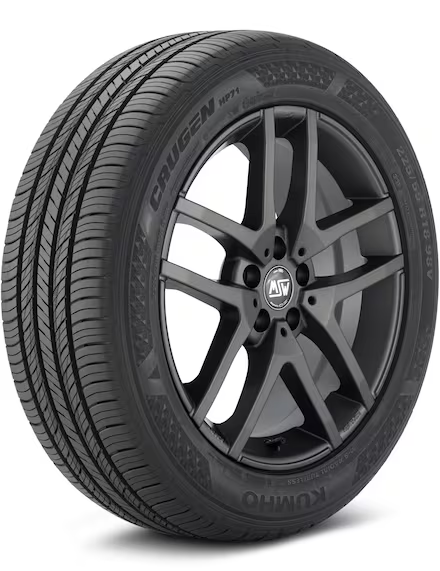
11. Kumho Crugen HP71: Best Budget
Price Check
Check the price of this tire at the following retailers:
I went into this one skeptical — budget crossover tires are usually where you feel every corner that got cut. The Crugen HP71 mostly proved me wrong. It’s not going to compete with the premium picks on this list for grip or refinement, but it delivered predictable, unremarkable performance across dry and wet roads on my test loop, and it didn’t feel like I was compromising basic safety to save money.
If your budget is the deciding factor and you just need a solid, dependable all-season tire while you save up for something more specialized, this is a legitimately good place to land.
Pros: Genuinely affordable without feeling unsafe, predictable dry and wet handling. Cons: Won’t compete with premium options on grip, range, or noise; no 3PMSF rating.
Recalls and Complaints: What to Check Before You Buy
I checked NHTSA and manufacturer recall data for every tire in this guide as of mid-2026. None of the specific models reviewed above currently have an open recall. A few adjacent notes worth knowing so you don’t confuse similarly-named tires while shopping:
- Continental CrossContact RX (ContiSeal), 275/40R21: In October 2025, Continental recalled roughly 5,362 tires across several lines — including this CrossContact RX size, which was factory-fit on certain 2025–2026 Chevrolet Equinox EV and Cadillac Optiq models — over a tread-detachment risk tied to a nonconforming rubber compound from an October 2024 production run. This is a different tire from the ExtremeContact DWS06 Plus reviewed above and does not affect it, but it’s a useful reminder that even EV-specific OE tires aren’t immune to recalls.
- Continental ProContact GX AO, a different tire from any Continental reviewed here, was subject to a separate recall affecting specific Audi OE sizes over a tread-separation risk.
- Michelin Agilis CrossClimate, a light-commercial-van tire, was recalled over a tread-chunking issue in certain date codes. This is unrelated to the passenger CrossClimate2 reviewed above.
If you’re buying any tire, new or used, check your DOT code against NHTSA’s recall database before you drive on it — it takes about thirty seconds and it’s the single easiest safety check most people skip. Recall status changes, so verify current status yourself rather than relying on any article’s snapshot in time, including this one.
Choosing the Right Tire for Your Tesla Model X
Decide what you’re actually optimizing for before you shop. No tire on this list wins at everything. I optimize for range and quiet on my own daily driver and keep a dedicated winter set for the months I need it — that’s why the ExtremeContact DWS06 Plus and the Hakkapeliitta R5 EV are the two sets I’d buy again with my own money.
Load index isn’t negotiable. Confirm your tire meets or exceeds the load index listed on your driver’s door jamb sticker — this car’s weight makes an underrated tire a safety issue, not just a performance trade-off.
Rotate more often than you would on a gas SUV. The instant torque delivery wears the rear axle faster than the front on most tires I tested. A shorter rotation interval than you’re used to helps even that out.
Climate should decide all-weather versus dedicated winter. If you’re anywhere that sees real winter, prioritize a 3PMSF-rated tire at minimum — the WeatherReady2, CrossClimate2, and Quatrac Pro all qualify. If you get sustained sub-freezing weeks with real snow accumulation, a dedicated winter tire will still outperform any all-weather here.
Don’t mix tire models across axles. If you’re replacing fewer than four, put the newer pair on the rear — that’s the axle doing more of the work on this car.
Frequently Asked Questions
What size tires does my Tesla Model X need?
Check the driver’s side door jamb sticker first, since sizes vary by trim and wheel package. Common current sizes include 255/45R20 on 20-inch wheels and 265/35R22 on 22-inch wheels, with a minimum load index around 108 on most configurations.
Do I need EV-specific tires for my Model X?
Not strictly, but you do need a tire with an appropriate load rating for the vehicle’s weight and reasonably low rolling resistance if range matters to you. Several tires on this list aren’t marketed as EV-specific and still performed well in my testing.
How much does tire choice actually affect Model X range?
In my side-by-side highway testing, the gap between my most and least efficient tire sets was roughly one displayed range bar under identical conditions — meaningful on a long trip, less noticeable on daily errands. Your results will vary with driving style and conditions.
Are all-season tires good enough for winter driving on a Model X?
Not if you’re dealing with real snow and ice. In my testing, a dedicated winter tire clearly outperformed every all-season and all-weather option on packed snow and ice, particularly for braking distance. All-weather tires with the snowflake rating are a reasonable middle ground for milder winters.
How often should I rotate my Model X’s tires?
Every 5,000 to 7,000 miles, and I’d lean toward the shorter end of that range. The Model X’s torque delivery wears rear tires faster than front, so regular rotation matters more here than on a typical gas-powered SUV.
Can I mix tire brands on my Tesla Model X?
I wouldn’t. Different tires have different compounds and tread designs, and the Model X’s traction and stability systems are calibrated assuming consistent grip at all four corners. If you can only replace two, match them on the same axle and put the newer pair on the rear.
How do I check if my tires are part of a recall?
Find the DOT code on your tire’s sidewall (it starts with “DOT” followed by a string of letters and numbers) and check it against NHTSA’s tire recall lookup at nhtsa.gov, or the manufacturer’s own recall page. Do this before installing any tire, new or secondhand.