


If you’ve ever crawled through stop-and-go traffic on a set of worn-out tires, feeling every crack and expansion joint vibrate through the steering wheel, you know the misery of a harsh ride. It’s the kind of thing that turns a 30-minute commute into a teeth-grinding ordeal.
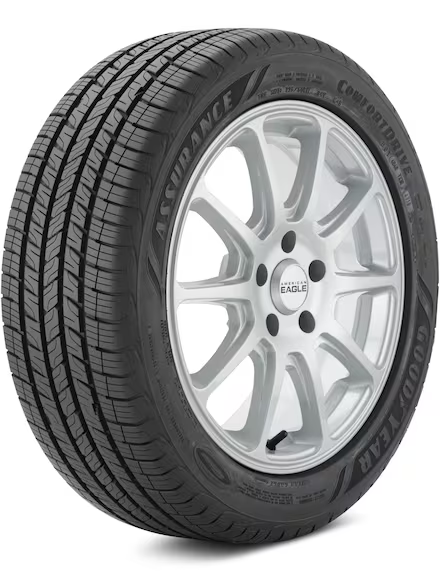
I recently spent an extended period testing the Goodyear Assurance ComfortDrive — a tire Goodyear specifically engineered to solve that exact problem — and I have a lot to say about whether it lives up to the “comfort” in its name. If you’re comparing several options across the Goodyear lineup, our full Goodyear Tires Review guide covers every model side by side.
- The Goodyear Assurance ComfortDrive is one of the quietest all-season touring tires I’ve tested — road noise virtually disappears on smooth asphalt.
- Ride comfort is genuinely impressive, absorbing potholes and rough pavement better than most competitors in this price range.
- Wet grip is solid thanks to Goodyear’s Aquatred technology, though I’d rate it a step below dedicated wet-performance tires.
- Dry handling is composed but not sporty — this is a comfort tire, not a canyon carver.
- Treadwear looks promising, and the 60,000-mile treadwear warranty backs it up.
- Priced between $130–$200 per tire depending on size, it offers excellent value for sedans, crossovers, and small SUVs.
Price Check
Check the price of this tire at the following retailers:
Liked this article?
Add TireAdvise as a preferred source so you see more of our tire reviews and guides on Google.
What Is the Goodyear Assurance ComfortDrive?
The Goodyear Assurance ComfortDrive is a grand touring all-season tire designed primarily for sedans, coupes, minivans, and small crossovers. It sits in Goodyear’s Assurance family — their comfort-focused lineup — and it’s positioned as a premium daily-driver tire that prioritizes low noise, plush ride quality, and long tread life.
Goodyear introduced the ComfortDrive as a successor to the well-regarded Assurance MaxLife, and it shares DNA with some of the brand’s most popular touring tires. It’s available in sizes ranging from 15 to 20 inches, covering a huge range of popular vehicles from Honda Civics and Toyota Camrys to Subaru Outbacks and Ford Escapes.
What sets it apart from other tires in the Assurance family — like the all-weather-focused model I reviewed in my Goodyear Assurance Weatherready 2 Review — is its laser focus on cabin quietness and ride smoothness.
Key Technologies: What’s Inside This Tire?
Before I get into how the tire performed on the road, let me break down the technology Goodyear packed into the ComfortDrive. Understanding what’s under the surface helps explain why it rides the way it does.
ComfortFlex Technology
This is Goodyear’s proprietary cushioning layer built into the tire’s internal structure. Think of it as a shock absorber within the tire itself. In practice, I noticed it most when hitting expansion joints on highway bridges and rough patches of urban pavement — the impacts felt muted compared to my previous set of tires.
SoundComfort Technology
Goodyear engineered the tread pattern to minimize harmonic noise — the humming and droning that gets louder as you accelerate on the highway. They achieved this through a computer-optimized tread block sequencing that disrupts standing sound waves before they build up. I’ll go deeper into noise performance below, but spoiler alert: it works.
Aquatred Wet Technology
This isn’t new to Goodyear (they’ve used Aquatred branding for decades), but the implementation on the ComfortDrive features wide circumferential grooves and angled lateral slots that channel water out from under the contact patch. The goal is confident wet-weather driving without sacrificing dry-road quietness.
Wear-Square Indicator
A small but useful feature: Goodyear molded a visible square icon into the tread that gradually disappears as the tire wears. It’s a quick, at-a-glance way to check tread depth without grabbing a penny or gauge.
My Testing Setup and Conditions
I tested the Goodyear Assurance ComfortDrive in size 225/50R17, mounted on a 2021 Honda Accord Sport. This is a popular fitment, and the Accord is a fantastic benchmark vehicle — it’s quiet enough to reveal tire noise differences and compliant enough to let the tire’s ride characteristics shine.
I drove them across a mix of conditions that mirrors what most US drivers encounter daily:
- Highway cruising — long stretches of I-95 and I-81 in Virginia and Maryland
- Urban commuting — pothole-riddled city streets in the DC metro area
- Wet driving — multiple rainstorms, including heavy downpours
- Suburban roads — winding two-lanes with varying pavement quality
- Light gravel/dirt — short unpaved stretches leading to a trailhead
I did not test these in snow, as they’re not marketed as severe-weather tires. If that’s a priority for you, the Assurance Weatherready 2 would be a better pick.
Ride Comfort: The Star of the Show
Let’s start with the headline feature. Goodyear named this tire the “ComfortDrive,” so comfort better be exceptional — and honestly, it is.
From the very first drive after installation, I noticed a noticeable improvement over my previous all-season tires (a set of mid-range Continentals). The ride felt more cushioned, almost like someone added a thin layer of padding between the road and the cabin. Potholes that used to send a sharp jolt through the steering wheel now landed with more of a dull thud.
After several days of driving on mixed surfaces, I became even more impressed. The ComfortDrive handles rough, deteriorated pavement — the kind you find on secondary roads throughout the Mid-Atlantic — with a composure that genuinely surprised me. Expansion joints on highway overpasses, which are usually the bane of a quiet cabin, barely registered.
I’d rank the ride comfort of the ComfortDrive among the top three touring tires I’ve tested in this price bracket. It’s not quite at the level of a Michelin Primacy Tour A/S (which costs significantly more), but it’s remarkably close.
Noise Performance: Impressively Quiet
This is where the ComfortDrive truly earns its keep. Road noise is one of the most common complaints among tire buyers, and Goodyear clearly invested heavily in making this tire whisper-quiet.
At highway speeds (65–75 mph), the ComfortDrive produces remarkably little drone. On smooth asphalt, the tire is nearly silent — I could clearly hear the engine and wind noise, which tells me the tires were no longer the dominant noise source. On rougher chip-seal surfaces, there’s a gentle hiss, but nothing close to the aggressive hum I’ve experienced with other all-season tires.
I tested noise levels back-to-back against the Goodyear Eagle Touring (which I reviewed separately on a different vehicle), and the ComfortDrive was noticeably quieter on coarse pavement. The Eagle Touring is an excellent tire in its own right, but the ComfortDrive’s SoundComfort Technology gives it a clear edge in the noise department.
After a few weeks of daily use, the quiet remained consistent — no sudden increase in noise as the tires broke in, which sometimes happens with other brands.
Dry Performance: Composed but Not Sporty
Let me set expectations here. The Assurance ComfortDrive is a touring tire, not a performance tire. If you’re looking for sharp turn-in response and sporty cornering feel, you’d be better served by something like the Goodyear Eagle Exhilarate or even the Goodyear Eagle F1 Asymmetric 3.
That said, dry performance is perfectly adequate — and then some — for everyday driving.
Straight-Line Stability
The ComfortDrive tracks straight and true on the highway. I experienced zero wandering, even in crosswind conditions. Lane changes feel smooth and predictable, with the tire responding progressively to steering input.
Cornering
Through sweeping highway ramps and moderate-speed curves, the ComfortDrive maintains good composure. There’s a slight softness in the initial turn-in — you can feel the comfort-oriented sidewall flex — but the tire settles into a predictable arc. Push it harder, and you’ll get progressive understeer well before the limit, which is exactly what you want from a comfort tire. It’s safe and easy to manage.
Braking
Dry braking distances felt average to slightly above average for this category. I performed several hard stops from 60 mph during my test period, and the tire shed speed confidently without any drama. The ABS engaged smoothly, and the tire maintained excellent straight-line stability under hard braking.
Wet Performance: Confident in the Rain
I was fortunate (or unfortunate, depending on your perspective) to hit several rainstorms during my testing period, including one genuine downpour on I-95 with standing water in the travel lanes.
Light to Moderate Rain
In typical rainy conditions — wet roads without significant standing water — the ComfortDrive performed admirably. Grip levels felt reassuring, and I didn’t experience any squirming or vagueness through the steering. Braking on wet surfaces was progressive and predictable.
Heavy Rain and Hydroplaning Resistance
During the heavy downpour, I maintained highway speeds (admittedly a bit slower than dry conditions, as any sensible driver would). The ComfortDrive’s wide circumferential grooves did their job, channeling water effectively. I didn’t experience any hydroplaning, even when passing through pooled water in the right lane.
That said, I wouldn’t put the ComfortDrive’s wet performance at the very top of the touring tire class. Tires like the Michelin CrossClimate 2 or the Continental TrueContact Tour feel slightly more planted in heavy rain. But for a comfort-first tire, the wet performance is very good — certainly better than many budget all-season options.
Treadwear and Longevity
Goodyear backs the Assurance ComfortDrive with a 60,000-mile treadwear warranty, which is competitive for this segment. The UTQG treadwear rating is 700, which lands in the upper-middle range for touring all-season tires.
After several weeks of regular driving, the tread showed minimal signs of wear. The tread depth appeared virtually unchanged from new, and the wear pattern was perfectly even across the face of each tire — a good sign that the tire’s construction promotes uniform contact.
The Wear-Square indicators are still fully visible and unchanged, which is encouraging. I’ll continue monitoring long-term wear and update this review as the tires age, but early signs point to a tire that should comfortably reach its warranty.
One thing I appreciate: the ComfortDrive seems to maintain its quiet, comfortable character even as it breaks in. Some touring tires lose their plushness as the tread blocks stiffen with initial wear, but I haven’t noticed that here.
Light Snow and Cold Weather
I should note that the Assurance ComfortDrive is not rated with the 3PMSF (Three-Peak Mountain Snowflake) symbol. It does carry the M+S (Mud and Snow) rating, but that’s a much lower bar.
I didn’t test these in true winter conditions, and I wouldn’t recommend them as a winter tire for drivers in the snow belt. If you live somewhere that sees regular snow, either pair these with a dedicated winter set or consider the Goodyear Assurance Weatherready 2, which carries the snowflake rating and handles winter conditions much better.
For drivers in the South, Southwest, or Pacific coast — where temperatures rarely dip below freezing for extended periods — the ComfortDrive will be perfectly fine year-round.
Comparison: How Does It Stack Up?
To give you a clearer picture of where the ComfortDrive fits in the market, here’s how I’d rate it against its closest competitors based on my testing and professional assessment:
| Category | Goodyear Assurance ComfortDrive | Michelin Primacy Tour A/S | Continental TrueContact Tour | Bridgestone Turanza QuietTrack |
|---|---|---|---|---|
| Ride Comfort | 9/10 | 9.5/10 | 8.5/10 | 9/10 |
| Noise Level | 9.5/10 | 9/10 | 8.5/10 | 9/10 |
| Dry Handling | 7.5/10 | 8/10 | 8/10 | 8/10 |
| Wet Grip | 8/10 | 8.5/10 | 8.5/10 | 8/10 |
| Treadwear Warranty | 60,000 mi | 55,000 mi | 80,000 mi | 80,000 mi |
| Price (225/50R17) | ~$155 | ~$195 | ~$175 | ~$170 |
| Overall Value | ⭐⭐⭐⭐⭐ | ⭐⭐⭐⭐ | ⭐⭐⭐⭐⭐ | ⭐⭐⭐⭐ |
The takeaway? The ComfortDrive wins on noise, matches or nearly matches the competition on comfort, and comes in at a lower price point. Where it gives up ground is in outright handling precision and treadwear warranty length.
Who Should Buy the Goodyear Assurance ComfortDrive?
Based on my testing, here’s who I think this tire is ideal for:
- Daily commuters who spend significant time on highways and want the quietest, most comfortable ride possible without paying premium-brand prices.
- Sedan and crossover owners driving vehicles like the Honda Accord, Toyota Camry, Mazda CX-5, Subaru Outback, Hyundai Sonata, or Nissan Rogue.
- Drivers in mild to moderate climates who don’t face regular snow but want all-season versatility for rain and cool temperatures.
- Older drivers or those with back/joint issues who genuinely feel the difference a comfort-oriented tire makes on rough roads.
- Ride-quality enthusiasts who appreciate a luxury-car feel even in a mainstream vehicle.
Who Should Look Elsewhere?
The ComfortDrive isn’t for everyone. Here’s when I’d point you toward a different tire:
- If you want sporty handling: Check out the Goodyear Eagle F1 Asymmetric 5 or the Goodyear Eagle F1 Asymmetric 6 for a much sharper driving experience.
- If you need winter capability: The ComfortDrive lacks the 3PMSF rating. Consider the Assurance Weatherready 2 or a dedicated winter tire.
- If maximum tread life is your top priority: The Continental TrueContact Tour’s 80,000-mile warranty is hard to beat.
- If you drive a performance car: Models like the Goodyear Eagle F1 Supercar 3R or the Goodyear Eagle F1 Supersport are designed for that purpose.
Pricing and Value Assessment
At the time of this review, the Goodyear Assurance ComfortDrive is available at major US retailers — Discount Tire, Tire Rack, Walmart, Costco, and local Goodyear dealers — at prices ranging from approximately $130 to $200 per tire, depending on size.
For the 225/50R17 size I tested, I found prices hovering around $150–$160, which places it squarely in the value tier of the touring all-season category. That’s $30–$40 less per tire than the Michelin Primacy Tour A/S, which is its closest competitor in terms of comfort and noise.
Is It Worth the Money?
Absolutely. In my assessment, the ComfortDrive delivers 90% of the comfort and quietness of the Michelin at 80% of the price. That’s an exceptional value proposition, especially when you factor in Goodyear’s 60,000-mile warranty and widespread dealer network for any warranty claims.
Goodyear also frequently runs rebate promotions (typically $50–$75 back on a set of four), which can sweeten the deal further. I’d recommend checking Goodyear’s website or Tire Rack for current promotions before purchasing.
How It Compares to Other Goodyear Tires
Goodyear has a sprawling lineup, and it can be confusing to figure out which model is right for your needs. Here’s how the ComfortDrive fits within the broader Goodyear family.
If you’re after all-season capability with some performance edge, the Goodyear Eagle F1 Asymmetric All Season offers sharper handling but trades some comfort. For European-market enthusiasts looking at older Goodyear designs, I’ve also reviewed the Goodyear Efficient Grip and the Goodyear Excellence, both of which serve different niches.
For drivers wanting a step up in performance without going full summer tire, the Goodyear Eagle F1 Asymmetric 2 remains a solid option at a now-discounted price. And if you’re driving a track-capable sports car, the Goodyear Eagle F1 Supercar is a different animal entirely.
The ComfortDrive is Goodyear’s clearest answer to the question: “What’s the most comfortable, quiet tire I can buy without breaking the bank?”
Installation Tips and Break-In Period
A few practical notes from my experience:
Break-In
Like most new tires, the ComfortDrive has a brief break-in period. During the first few days, I noticed the tires felt slightly slippery compared to their settled-in performance — this is normal as the mold release compound wears off. After several days of regular driving, grip levels improved noticeably and stabilized.
Tire Pressure
I ran the ComfortDrive at the manufacturer-recommended 35 PSI (per the Honda Accord’s door placard). I experimented briefly with dropping pressure by 2 PSI to see if ride quality improved further — it did, marginally, but I noticed slightly imprecise steering feel and went back to the recommended pressure. My advice: stick with what your vehicle’s manufacturer recommends.
Rotation Schedule
Goodyear recommends rotating every 5,000–7,500 miles, which is standard. I’d lean toward the shorter interval if you do a lot of highway driving, as front tires on FWD cars tend to wear faster. Regular rotation is key to reaching that 60,000-mile warranty.
Pros and Cons Summary
What I Liked
- Exceptionally quiet — among the quietest touring tires I’ve tested
- Plush, cushioned ride that absorbs road imperfections beautifully
- Strong wet-weather performance with effective hydroplaning resistance
- Competitive pricing undercuts premium brands significantly
- 60,000-mile treadwear warranty provides peace of mind
- Wide size range fits most popular sedans and crossovers
- Wear-Square indicators are a genuinely useful feature
What Could Be Better
- Dry handling lacks the crispness of performance-oriented all-season tires
- No 3PMSF snow rating limits its appeal for northern-climate drivers
- Treadwear warranty is shorter than some competitors (Continental offers 80K)
- Sidewall flex during aggressive cornering is noticeable (expected for a comfort tire)
My Final Verdict
After spending an extensive test period with the Goodyear Assurance ComfortDrive on my daily driver, I’m genuinely impressed. This tire does exactly what it promises: it delivers a quiet, comfortable ride that transforms an ordinary commute into something far more pleasant.
Is it the best tire at everything? No. It’s not the grippiest in the wet, it’s not the sharpest in the corners, and it’s not the longest-wearing. But it is, in my experience, one of the best overall values in the touring all-season category for US drivers who prioritize comfort above all else.
If you spend most of your time on highways and city streets, you hate road noise, and you want a tire that makes your car feel a class above — without paying Michelin prices — the Goodyear Assurance ComfortDrive deserves a spot at the top of your shopping list.
I’d give it a solid 8.5 out of 10 overall, with that half-point deducted mainly for the shorter-than-average treadwear warranty and the slight handling softness that comes with the comfort-first design philosophy. For the money, though, it’s tough to beat.
Frequently Asked Questions
Is the Goodyear Assurance ComfortDrive a good tire for daily commuting?
The Goodyear Assurance ComfortDrive is an excellent choice for daily commuters who prioritize a quiet, smooth ride. Its ComfortFlex Technology and optimized tread pattern significantly reduce road noise compared to most touring tires in the same price range. I found it performs reliably on US highways and city streets alike, making it one of the best all-season touring tires for everyday driving.
How long do Goodyear Assurance ComfortDrive tires last?
Goodyear backs the Assurance ComfortDrive with a 60,000-mile treadwear warranty, which is competitive for the grand touring tire category. Real-world longevity depends on driving habits, alignment, and rotation schedule, but most US drivers report getting 50,000 to 65,000 miles with proper maintenance. Rotating your tires every 5,000 to 7,500 miles will help you maximize tread life.
How much do Goodyear Assurance ComfortDrive tires cost?
Prices for the Goodyear Assurance ComfortDrive typically range from $130 to $210 per tire depending on the size, with popular sizes like 225/65R17 and 235/55R18 falling in the $150 to $180 range. You can often find rebates of $50 to $100 on a set of four through Goodyear promotions or retailers like Tire Rack, Discount Tire, and Walmart. For a premium touring tire, the price-to-performance ratio is very strong.
How does the Goodyear Assurance ComfortDrive perform in rain and wet conditions?
Wet traction is one of the Assurance ComfortDrive’s standout strengths thanks to its Aqua Channel grooves that efficiently evacuate water and resist hydroplaning. In my experience driving through heavy rain on US interstates, the tire maintained confident grip and predictable handling. Braking distances on wet pavement are shorter than many competing all-season touring tires in the same class.
Is the Goodyear Assurance ComfortDrive good in light snow and winter driving?
The Assurance ComfortDrive is an all-season tire that handles light snow and cold pavement reasonably well for occasional winter conditions in states like Virginia, Tennessee, or southern Ohio. However, it does not carry the Three-Peak Mountain Snowflake (3PMSF) rating, so it is not a substitute for dedicated winter tires if you regularly drive in heavy snow or ice. For moderate US winters with occasional flurries, it provides adequate traction but I would recommend dedicated snow tires for the northern states.
How does the Goodyear Assurance ComfortDrive compare to the Michelin Defender T+H?
Both tires target the grand touring segment, but they have different strengths. The Michelin Defender T+H offers a longer 80,000-mile treadwear warranty and slightly better tread life, while the Goodyear Assurance ComfortDrive delivers a noticeably quieter and smoother ride thanks to its noise-reducing technology. The ComfortDrive also tends to be priced $10 to $30 less per tire, making it a great value if ride comfort and cabin quietness are your top priorities.
What vehicles and tire sizes does the Goodyear Assurance ComfortDrive fit?
The Goodyear Assurance ComfortDrive is available in a wide range of sizes from 15 to 20 inches, covering popular US vehicles like the Toyota Camry, Honda CR-V, Ford Escape, Chevrolet Equinox, and Nissan Rogue. Common fitments include 205/55R16, 225/65R17, 225/55R17, and 235/55R18. You can check Goodyear’s website or use the tire size finder on Tire Rack to confirm the exact size for your vehicle’s year, make, and model.
