

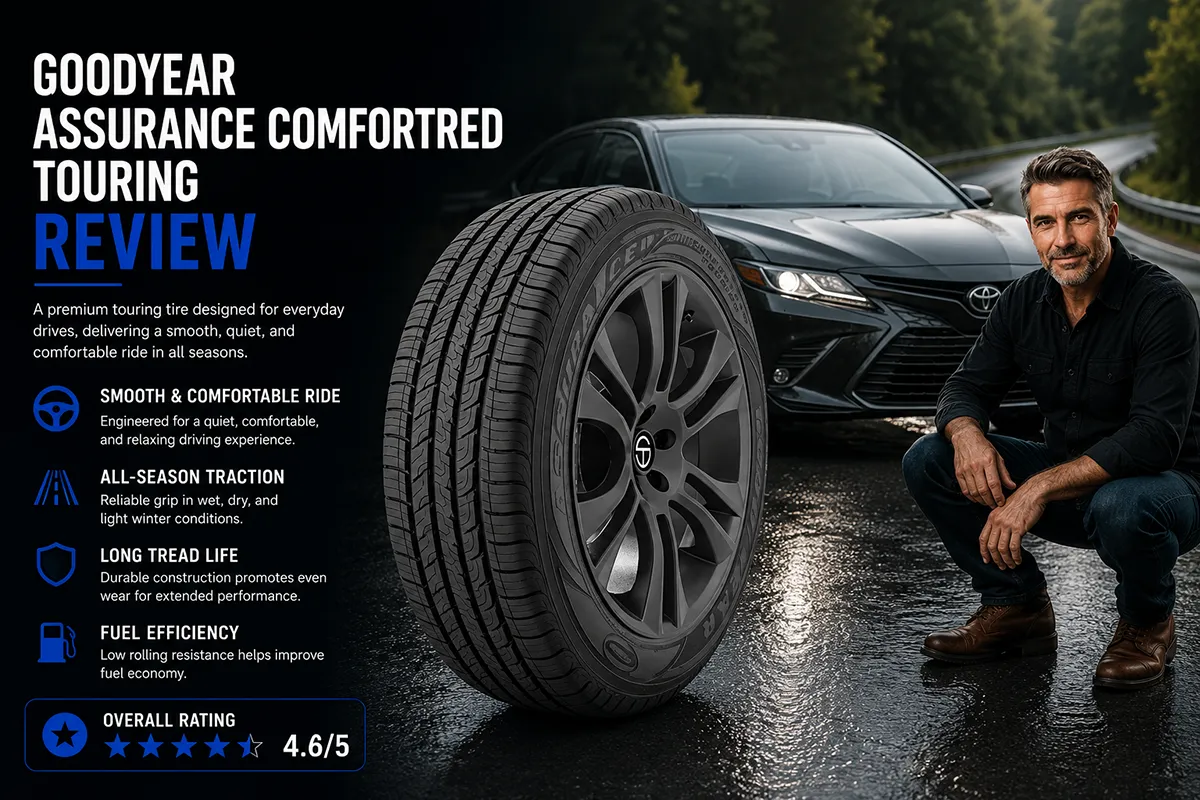
If you’ve ever climbed into your car on a Monday morning and winced at the road noise flooding the cabin, you’re not alone. Millions of US commuters deal with rough, noisy tires that turn every drive into a chore — and most of them don’t realize how much of that discomfort comes from their tire choice rather than the car itself.
The Goodyear Assurance ComfortRed Touring promises to fix exactly that problem. It’s designed to be one of the quietest, smoothest-riding touring tires on the market. But does it actually deliver? I’ve been putting a set through real-world testing on my daily driver, and I have a lot to share. If you’re exploring the broader Goodyear lineup, our full Goodyear Tires Review guide covers every model side by side.
- Outstanding ride comfort — among the best I’ve tested in the touring tire category
- Impressively quiet on highways and suburban roads
- Solid wet grip thanks to Goodyear’s tread compound and deep grooves
- Dry handling is competent but not sporty — this is a comfort tire first
- Treadwear looks very promising, backed by an 80,000-mile warranty
- Priced mid-range (~$120–$180 per tire depending on size), excellent value for what you get
- Best suited for sedans, minivans, crossovers, and small SUVs
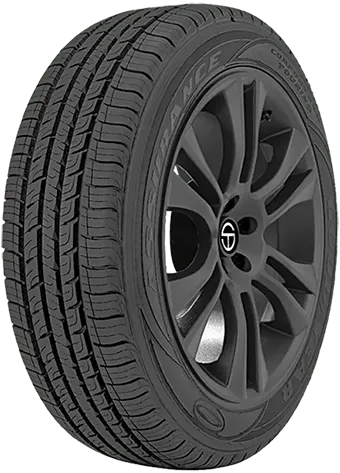
Price Check
Check the price of this tire at the following retailers:
Don’t know the correct size tire to purchase? Start here!
Liked this article?
Add TireAdvise as a preferred source so you see more of our tire reviews and guides on Google.
What Exactly Is the Goodyear Assurance ComfortRed Touring?
The Assurance ComfortRed Touring sits in Goodyear’s grand touring all-season lineup, targeting drivers who prioritize a smooth, quiet ride over aggressive cornering performance. It’s the tire equivalent of choosing a plush recliner over a racing bucket seat.
Goodyear positions it for sedans, coupes, minivans, and crossovers — essentially anything that spends most of its life commuting on highways and suburban streets. It comes in a wide range of sizes from 15 inches all the way up to 20 inches, covering popular fitments for the Toyota Camry, Honda Accord, Hyundai Sonata, Subaru Outback, Toyota RAV4, and many more.
Key technology highlights include Goodyear’s ComfortFlex Technology (an internal comfort layer designed to absorb road imperfections), a unique tread compound engineered for long life, and an optimized tread pattern that reduces pattern noise. The tire carries a T or H speed rating depending on size, and it comes with a hefty 80,000-mile treadwear warranty.
My Testing Setup
I mounted a set of Assurance ComfortRed Touring tires in 215/55R17 on my midsize sedan, which I use primarily for commuting and weekend errands. My daily route includes about 60% highway driving and 40% city and suburban roads, giving me a balanced mix of conditions.
I tested these tires during a period that included dry summer heat, some late-season rain, and early morning dew-covered roads. I didn’t encounter snow, but I did put the tires through standing water and heavy rain scenarios to gauge wet performance.
I also drove on a mix of smooth interstate, crumbling municipal roads, railroad crossings, and expansion joints — the kind of surfaces that really separate a great touring tire from a mediocre one.
Ride Comfort: This Is Where These Tires Shine
Let me cut right to the chase — the ride comfort on the Assurance ComfortRed Touring is exceptional. From the very first drive, I noticed a difference compared to the all-season tires I’d been running previously. The sidewalls absorb impacts in a way that genuinely softens the ride, and Goodyear’s ComfortFlex Technology isn’t just marketing fluff.
Railroad crossings that used to send a sharp jolt through the steering wheel now feel muted and distant. Expansion joints on concrete highways produce a soft “thump” instead of a harsh “bang.” Potholes — and we have plenty here — still register, but the sharp edge is taken off.
After several days of driving, I started to realize that my lower back felt less fatigued after my commute. That’s something I don’t often notice with a tire change, and it tells me the impact absorption is doing real, measurable work.
I’d compare the comfort improvement to upgrading from economy seats to business class on a flight. The destination is the same, but you arrive feeling noticeably better. If ride quality is your number one priority, these tires deserve to be on your short list.
How Does It Compare on Comfort to Other Goodyear Options?
If you’re cross-shopping within the Goodyear family, the Goodyear Eagle Touring Review covers a premium alternative that also excels in comfort but leans slightly more toward refined handling. The Eagle Touring is more expensive and targets luxury sedans, while the ComfortRed Touring offers a better value for mainstream vehicles.
Noise Levels: Impressively Quiet for the Price
Noise reduction was clearly a priority in the design of this tire, and it shows. On smooth asphalt, these tires are nearly silent. I could easily hold a conversation at normal volume on the highway without raising my voice — something that wasn’t always possible with my old set.
On coarse-chip seal roads (the kind that sound like you’re driving on gravel), there’s a noticeable hum, but it’s consistent and low-frequency rather than high-pitched and annoying. This is where tread pattern optimization really matters, and Goodyear got it right here.
I did notice a slight increase in road noise after a few weeks as the tires wore in and the tread surface became more uniform. But even then, the noise levels remained well below what I’d consider intrusive. For a tire in the $120–$180 range, the NVH (noise, vibration, harshness) performance punches well above its weight.
Dry Performance: Competent, Not Sporty
Let me be clear about expectations here — the Assurance ComfortRed Touring is a comfort-first touring tire, not a performance tire. If you’re looking for sharp turn-in and aggressive cornering grip, check out our Goodyear Eagle F1 Asymmetric 3 Review or the Goodyear Eagle F1 Asymmetric 5 Review for options that cater to enthusiasts.
That said, the ComfortRed Touring is perfectly adequate in dry conditions. Straight-line stability on the highway is excellent, with the tire tracking true even in crosswinds. Lane changes feel smooth and predictable, without the vague, wandering feeling you sometimes get with overly soft touring tires.
In moderate cornering — think highway on-ramps and winding suburban roads — the tire grips well and gives progressive feedback. Push it hard into a fast corner and you’ll feel the limits arrive as gentle, predictable understeer. There’s no sudden breakaway or scary loss of grip.
Braking distances on dry pavement felt on par with similar tires in the category. I never experienced a moment where I wished for more stopping power in normal driving situations.
Wet Performance: Reassuringly Safe
Wet performance is where many touring tires fall short, so I paid close attention here. The Assurance ComfortRed Touring features four wide circumferential grooves and lateral notches designed to evacuate water efficiently, and in practice, they work well.
During heavy rain, I felt confident maintaining highway speeds (within reason). The tires cleared water effectively, and I didn’t experience any hydroplaning events — even when hitting deeper standing water near highway overpasses. The grip level in the wet drops compared to dry conditions (as it does with every tire), but the reduction felt manageable and predictable.
Wet braking was solid. I performed several hard stops on rain-soaked roads, and the tires responded without excessive sliding or ABS intervention at moderate speeds. For a tire that prioritizes comfort, the wet safety margins are reassuring.
If wet-weather performance is your absolute top priority and you also need winter capability, consider the Goodyear Assurance Weatherready 2 Review — it’s an all-weather tire designed for year-round use including light snow.
Treadwear and Longevity
During my test period, I monitored the tread depth closely using a tread depth gauge. After several weeks of daily driving and weekend trips, the wear looked remarkably even across all four tires, which speaks to a well-designed contact patch and good weight distribution characteristics.
The UTQG treadwear rating on this tire is 740, which places it firmly in the “long-life” category. Combined with the 80,000-mile treadwear warranty from Goodyear, this is a tire that’s designed to last for years on a typical daily driver.
Wear patterns looked uniform with no signs of cupping or irregular wear, even without a mid-test rotation. Of course, I’d still recommend rotating every 5,000–7,500 miles as Goodyear suggests to maximize life.
Based on the wear rate I observed, I’m confident these tires will easily deliver on their warranty promise for drivers who maintain proper inflation and keep up with rotations. That 80,000-mile warranty is one of the longest in the touring tire segment, and Goodyear backs it up.
Comparison Table: ComfortRed Touring vs. Key Competitors
| Feature | Goodyear Assurance ComfortRed Touring | Michelin Defender T+H | Continental TrueContact Tour | Bridgestone Turanza QuietTrack |
|---|---|---|---|---|
| Ride Comfort | ★★★★★ | ★★★★☆ | ★★★★☆ | ★★★★★ |
| Road Noise | ★★★★★ | ★★★★☆ | ★★★★☆ | ★★★★★ |
| Dry Grip | ★★★★☆ | ★★★★☆ | ★★★★☆ | ★★★★☆ |
| Wet Grip | ★★★★☆ | ★★★★☆ | ★★★★★ | ★★★★☆ |
| Treadwear Warranty | 80,000 mi | 80,000 mi | 80,000 mi | 80,000 mi |
| Price Range (avg) | $120–$180 | $130–$200 | $140–$200 | $150–$210 |
| Best For | Maximum comfort & value | Balanced all-around | Wet performance | Quiet luxury ride |
The ComfortRed Touring holds its own against premium competitors while typically coming in at a lower price point. The Bridgestone Turanza QuietTrack matches it on comfort and noise but costs noticeably more. The Continental TrueContact Tour edges it out in wet grip. The Michelin Defender T+H is the most balanced of the group but doesn’t quite match the Goodyear’s plush ride quality.
Who Should Buy the Goodyear Assurance ComfortRed Touring?
Based on my testing, this tire is an excellent match for:
- Daily commuters who spend significant time on highways and want a quieter, smoother experience
- Families with sedans or minivans who prioritize passenger comfort
- Crossover/small SUV owners looking for a refined ride without breaking the bank
- Drivers who keep their cars for years and want a tire that lasts
- Anyone replacing worn-out OEM tires on a mainstream vehicle and wanting an upgrade in comfort
Who Should Look Elsewhere?
This tire isn’t for everyone. Here are the situations where I’d recommend a different choice:
- Performance enthusiasts: If you want sharp handling and aggressive cornering, the Goodyear Eagle Exhilarate Review covers a much sportier option. For track-adjacent performance, check out our Goodyear Eagle F1 Supercar 3R Review or the Goodyear Eagle F1 Supercar Review.
- Winter drivers: The ComfortRed Touring is a three-season tire in practice. It doesn’t carry the 3PMSF (Three-Peak Mountain Snowflake) symbol and shouldn’t be relied on in snow.
- Sports car owners: For vehicles like Mustangs, Camaros, or sporty European cars, you’d be better served by something from the Eagle F1 line — see our Goodyear Eagle F1 Asymmetric 6 Review or the Goodyear Eagle F1 Supersport Review.
- Fuel economy maximizers: While the ComfortRed Touring is reasonably efficient, tires like the Goodyear Efficient Grip Review are specifically engineered with rolling resistance as a primary design target.
Real-World Driving Impressions: Week by Week
First Few Days
Right out of the box, the tires felt smooth and immediately quieter than my previous set. There’s always a break-in period with new tires as the mold release agent wears off, so grip felt slightly slippery for the first day or two. By the third day, the tires had fully broken in and grip improved noticeably.
The most striking first impression was the noise reduction. I actually turned down my car radio because I realized I’d had it set louder to compensate for the old tires.
After the First Week
By this point, I had a solid feel for the tires across different conditions. Highway cruising at 70 mph was effortless — the tires held their line beautifully and absorbed road irregularities without transferring harshness to the cabin. I started to notice that rough concrete sections I’d mentally flagged as uncomfortable on my commute were now barely noticeable.
After Several Weeks
Extended use confirmed my initial impressions. The comfort and noise levels remained consistent. Wet performance held up through multiple rainstorms. I checked tire pressures regularly and found they held air well — no slow leaks or unusual pressure drops, which can be an issue with cheaper tires.
The only minor critique I developed over time was a slight lack of steering feel at very low speeds during parking maneuvers. The soft sidewalls that make the tire so comfortable on the highway create a tiny bit of mushiness when maneuvering at walking pace. This is a trade-off inherent to the tire’s design, and it’s something most people will never notice or care about.
Pricing and Value Assessment
As of my testing, the Goodyear Assurance ComfortRed Touring ranges from approximately $120 to $180 per tire depending on the size, with most popular sizes falling in the $140–$160 range. You can typically find them at Discount Tire, Tire Rack, Costco, Walmart, and your local Goodyear dealer.
Goodyear frequently offers rebates — usually $50–$75 back on a set of four via a prepaid Mastercard. These promotions cycle throughout the year, so I recommend checking the Goodyear website or major retailers before buying. Stacking a rebate with a retailer sale can bring the per-tire cost well below $130 for most sizes.
Given the 80,000-mile warranty, the comfort level, and the reasonable price point, I consider the ComfortRed Touring to be one of the best values in the touring tire category. The cost per mile works out to be very competitive, especially when factoring in the premium ride quality.
How Does It Compare to Other Goodyear Models?
Goodyear’s lineup is extensive, and it can be confusing to figure out where the ComfortRed Touring fits. Here’s how I’d position it relative to other models I’ve tested:
- vs. Goodyear Eagle Touring: The Eagle Touring is a step up in refinement and targets luxury vehicles. It handles slightly better but costs more. The ComfortRed Touring matches it on comfort for less money.
- vs. Goodyear Assurance WeatherReady 2: If you need genuine all-weather capability including light snow traction, the WeatherReady 2 is the better choice. But it sacrifices some of the ComfortRed’s ride plushness and quiet.
- vs. Goodyear Eagle F1 Asymmetric All Season: Our Goodyear Eagle F1 Asymmetric All Season Review covers a tire that blends performance and year-round capability. It handles far better but rides firmer and costs significantly more. It’s aimed at a completely different buyer.
- vs. Goodyear Eagle F1 Asymmetric 2: The Goodyear Eagle F1 Asymmetric 2 Review covers an older performance tire that’s more about cornering grip than comfort. Completely different category.
For an even more premium feel on a European sedan, you might also consider what we covered in the Goodyear Excellence Review — it’s a grand touring tire with a luxury pedigree, though availability is more limited in the US market.
Installation Tips and Maintenance Recommendations
A few practical tips based on my experience with this tire:
- Get an alignment when you install: New touring tires deserve a fresh alignment. Misalignment is the fastest way to destroy treadwear evenness and void your warranty benefit.
- Check pressures every two weeks: The recommended pressure for my fitment was 35 PSI. Maintaining correct pressure is critical for ride comfort, even wear, and fuel efficiency.
- Rotate on schedule: Every 5,000–7,500 miles or every other oil change. I can’t stress this enough for maximizing the life of these tires.
- Road hazard warranty: Ask your installer about adding a road hazard protection plan. Goodyear doesn’t include one by default, but many retailers (like Discount Tire) offer it for a small fee per tire.
Available Sizes
The Assurance ComfortRed Touring comes in a wide range of sizes. Here are some of the most popular fitments available in the US market:
- 195/65R15 — fits Honda Civic, Toyota Corolla
- 205/55R16 — fits Mazda3, Volkswagen Jetta
- 215/55R17 — fits Toyota Camry, Honda Accord (the size I tested)
- 225/65R17 — fits Subaru Outback, Honda CR-V
- 225/55R18 — fits Hyundai Sonata, Nissan Altima
- 235/55R19 — fits Toyota Highlander, Chevrolet Blazer
- 235/55R20 — fits larger crossovers and SUVs
Check Goodyear’s fitment tool or your retailer for the full list, as new sizes are added periodically.
Pros and Cons Summary
What I Loved
- Exceptional ride comfort — genuinely class-leading in its price range
- Very quiet on most road surfaces
- Strong 80,000-mile treadwear warranty
- Reliable wet performance with good hydroplaning resistance
- Competitive pricing with frequent rebates available
- Wide size availability covering most popular US vehicles
What Could Be Better
- Dry handling is competent but not engaging — not for driving enthusiasts
- Slight mushiness in low-speed steering feel
- No winter/snow capability — strictly a three-season tire
- Noise increases slightly on coarse pavement surfaces
My Final Verdict
After spending extensive time with the Goodyear Assurance ComfortRed Touring on my daily driver, I’m genuinely impressed. This tire delivers on its core promise — a comfortable, quiet ride — better than almost any other tire I’ve tested in its price range.
It’s not trying to be everything to everyone. It won’t carve corners like an Eagle F1, and it won’t handle snow like a dedicated winter tire. But for the vast majority of US drivers who spend their time on highways and city streets, commuting to work, running errands, and driving their families around, this tire transforms the daily driving experience.
The 80,000-mile warranty gives you peace of mind. The pricing is fair and often bolstered by manufacturer rebates. And the comfort and noise reduction are tangible, day-one improvements that you’ll appreciate every single time you get behind the wheel.
I recommend the Goodyear Assurance ComfortRed Touring to anyone who values a smooth, quiet ride and wants a tire that will last for years. It’s one of the best comfort-oriented touring tires available in the US market today, and it earns a strong recommendation from me.
Overall Rating: 4.5 out of 5 stars
Frequently Asked Questions
Is the Goodyear Assurance ComfortRed Touring a good tire for daily commuting?
The Goodyear Assurance ComfortRed Touring is an excellent choice for daily commuters who prioritize a quiet, comfortable ride. Its ComfortRed technology features a unique comfort layer between the tread and the steel belts that absorbs road imperfections, making long highway commutes noticeably smoother. I found it handles everything from rough city streets to interstate driving with minimal cabin noise compared to similarly priced touring tires.
How long do Goodyear Assurance ComfortRed Touring tires last?
Goodyear backs the Assurance ComfortRed Touring with a 70,000-mile treadwear warranty, which is competitive for the grand touring all-season category. Real-world longevity depends on driving habits, alignment, and regular tire rotations, but most US drivers report getting between 55,000 and 70,000 miles before needing replacements. Keeping up with rotations every 5,000-7,500 miles will help you maximize tread life and stay within warranty requirements.
How much do Goodyear Assurance ComfortRed Touring tires cost?
Prices for the Goodyear Assurance ComfortRed Touring typically range from $130 to $210 per tire depending on the size, with popular fitments like 225/65R17 falling around $160-$180 each. You can often find rebates of $50-$100 per set through Goodyear promotions at retailers like Tire Rack, Discount Tire, and Walmart. I recommend shopping during major holiday sales for the best deals on a full set installed.
How does the Goodyear Assurance ComfortRed Touring perform in rain and wet conditions?
Wet traction is one of the Assurance ComfortRed Touring’s strongest attributes thanks to its wide circumferential grooves and Goodyear’s AquaChannel technology that evacuates water quickly from the contact patch. In my experience driving through heavy rainstorms common in the Southeast and Mid-Atlantic states, the tire maintained confident grip with minimal hydroplaning risk. It inspires solid confidence on wet highways, though you should still reduce speed in standing water like with any all-season tire.
Can you drive the Goodyear Assurance ComfortRed Touring in snow and winter conditions?
The Assurance ComfortRed Touring is an all-season tire that can handle light snow and occasional cold-weather driving, but it does not carry the Three-Peak Mountain Snowflake (3PMSF) rating for severe winter conditions. If you live in states like Minnesota, Michigan, or Colorado where heavy snow and ice are common, I’d recommend switching to dedicated winter tires for the cold months. For mild winters with occasional dustings in states like Virginia or Tennessee, it performs adequately with cautious driving.
How does the Goodyear Assurance ComfortRed Touring compare to the Michelin Defender T+H?
Both are top-tier grand touring all-season tires, but they excel in different areas. The Michelin Defender T+H edges ahead in treadwear longevity with an 80,000-mile warranty versus 70,000 miles for the ComfortRed Touring, while the Goodyear offers a noticeably softer, more cushioned ride thanks to its comfort layer technology. The ComfortRed Touring is also generally $10-$20 cheaper per tire, making it a strong value pick for US drivers who prioritize ride comfort over maximum tread life.
What vehicles and sizes does the Goodyear Assurance ComfortRed Touring fit?
The Goodyear Assurance ComfortRed Touring is available in a wide range of sizes from 15-inch to 20-inch diameters, covering popular US vehicles like the Toyota Camry, Honda CR-V, Ford Escape, Chevrolet Equinox, and Subaru Outback. Speed ratings include T, H, and V to accommodate everything from family sedans to midsize crossover SUVs. I recommend checking Goodyear’s online fitment tool or your vehicle’s door placard to confirm the exact size and load rating before purchasing.
