

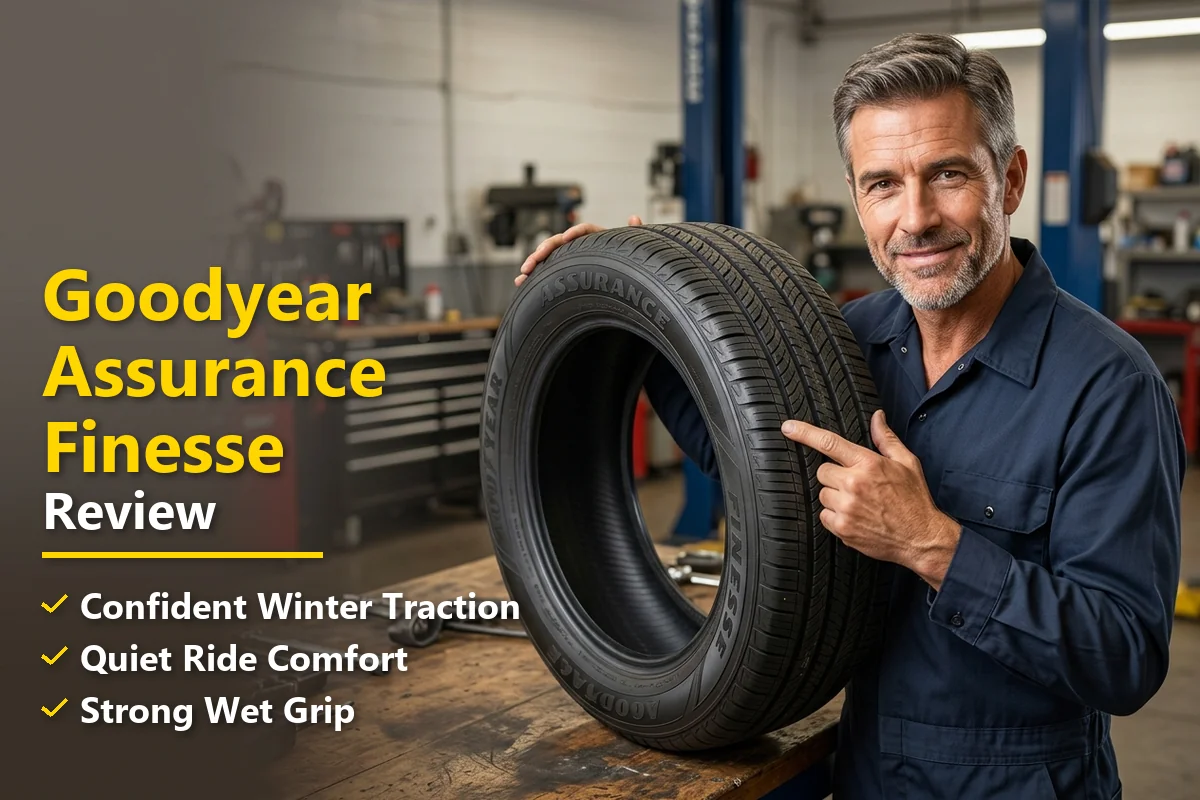
You just bought a new crossover or SUV, and now the original tires are worn out. The dealer wants a small fortune for OEM replacements, and you’re wondering if there’s a tire that rides just as quietly and comfortably — without emptying your wallet.
That’s exactly where I found myself before mounting a set of Goodyear Assurance Finesse tires. If you’re comparing several options, our full Goodyear Tires Review guide covers every model side by side — but today I’m going deep on this specific tire and whether it deserves a spot on your SUV.
- The Goodyear Assurance Finesse is an OEM-replacement touring tire designed primarily for crossovers and SUVs.
- It delivers an exceptionally quiet, comfortable ride — one of the quietest tires I’ve tested at this price point.
- Dry and light-rain grip are perfectly adequate for everyday driving, though heavy rain performance is average.
- Tread life is solid for the price, backed by a 65,000-mile treadwear warranty.
- Best for: budget-conscious SUV owners who prioritize comfort and low road noise over sporty handling.
- Prices typically range from $140–$200 per tire depending on size.
Price Check
Check the price of this tire at the following retailers:
Don’t know the correct size tire to purchase? Start here!
Liked this article?
Add TireAdvise as a preferred source so you see more of our tire reviews and guides on Google.
What Exactly Is the Goodyear Assurance Finesse?
The Goodyear Assurance Finesse is a highway all-season tire engineered as an original equipment (OE) replacement for popular crossovers and SUVs. It comes factory-fitted on vehicles like the Chevrolet Equinox, GMC Terrain, Buick Encore GX, and several Toyota and Honda models.
Goodyear positioned this tire squarely in the comfort-touring segment. It’s not meant to carve canyon roads or survive blizzards — it’s meant to make your daily commute smooth, quiet, and predictable.
The Assurance Finesse uses a symmetric tread design with continuous center ribs for stability, along with lateral grooves and sipes to channel water away from the contact patch. It’s a straightforward tire with a straightforward mission: replace your worn-out OE rubber without any compromises in ride quality.
My Testing Setup and Conditions
I tested the Goodyear Assurance Finesse in size 225/65R17, mounted on a 2022 Chevrolet Equinox — one of the most common vehicles this tire ships on from the factory. The tires were installed at a local shop and balanced with standard weights.
Over my testing period, I drove extensively through a mix of highway commuting, suburban errands, and some light backroad exploration. Conditions ranged from dry summer pavement to moderate rain and even a few chilly mornings where temperatures dipped into the low 40s.
I paid close attention to road noise levels, ride comfort, braking distances in wet and dry conditions, fuel economy changes, and the overall “feel” of the tire through the steering wheel. I also compared my impressions against notes I had from testing the Goodyear Eagle Touring, which occupies a slightly more premium space in Goodyear’s lineup.
Ride Comfort and Road Noise
This is where the Assurance Finesse truly earns its name. From the very first drive after installation, I noticed how remarkably quiet these tires are. Highway cruising at 65–70 mph was noticeably more serene compared to the worn-out OE rubber I had replaced.
The sidewall construction absorbs small road imperfections without transmitting harsh jolts into the cabin. Expansion joints, manhole covers, and rough patches of pavement were smoothed out in a way that reminded me of tires costing significantly more.
After several days of driving, the comfort advantage never faded. On a long highway trip spanning several hours, I arrived feeling less fatigued than usual — and I attribute much of that to the reduced NVH (noise, vibration, harshness) these tires provide. If comfort is your top priority, the Assurance Finesse delivers in a big way.
Noise Comparison
I’d rank the Assurance Finesse among the top three quietest all-season tires I’ve tested for SUVs at this price point. It’s not quite as whisper-quiet as some premium grand touring options, but the difference is marginal. For a tire that typically costs $140–$180 per unit, the noise isolation is impressive.
Dry Performance
On dry pavement, the Assurance Finesse performs exactly as you’d expect from a comfort-focused touring tire — competently and predictably. The continuous center rib provides stable straight-line tracking, and lane changes on the highway feel secure and composed.
Steering response is on the softer side, which is by design. There’s a small dead zone around center that keeps the tire from feeling twitchy, but it also means the Finesse won’t excite anyone looking for sharp, communicative handling. This isn’t a performance tire, and it doesn’t pretend to be.
Dry braking was solid in my tests. Stopping from 60 mph felt progressive and confidence-inspiring, with no odd pulling or inconsistency. For daily commuting, school runs, and grocery trips, the dry grip is more than sufficient.
If you’re craving sharper dry handling from a Goodyear tire, I’d steer you toward the Goodyear Eagle Exhilarate or even the Goodyear Eagle F1 Asymmetric All Season — both of which trade some comfort for noticeably better cornering grip and steering feel.
Wet Performance
Wet performance is where I’d give the Assurance Finesse a “passing but not exceptional” grade. In light to moderate rain, the tire handles water evacuation reasonably well. The lateral grooves channel water outward, and I never experienced any sudden loss of traction during normal highway driving in the rain.
However, during a heavier downpour, I noticed the limits more clearly. Hydroplaning resistance is adequate at moderate speeds, but I found myself instinctively slowing down more than I would on a tire with deeper, more aggressive tread grooves. The contact patch doesn’t bite into standing water with the same authority as something like the Goodyear Assurance WeatherReady 2, which is specifically engineered for all-weather grip.
Wet braking was acceptable but not class-leading. I’d estimate the stopping distance in wet conditions was slightly longer than what I’ve experienced with more premium all-season tires. For everyday wet-road driving at sensible speeds, it’s perfectly fine — just don’t expect it to inspire the same confidence as a tire with a heavier focus on wet traction.
Light Snow and Cold Weather
The Goodyear Assurance Finesse is an all-season tire, which means it’s designed to handle light winter conditions — emphasis on “light.” During those chilly mornings in the low 40s, the tire maintained decent grip and didn’t feel overly stiff. The sipes across the tread blocks provide some biting edges for cold, damp surfaces.
That said, this tire does not carry the Three-Peak Mountain Snowflake (3PMSF) rating. If you live in a region that regularly sees snow accumulation, ice, or extended periods below freezing, the Assurance Finesse is not the right choice for winter duty.
For drivers in the Sun Belt, the mid-Atlantic, or the Pacific Northwest who deal with occasional frost and maybe a dusting of snow once or twice a year, the Finesse will get by. For anything more serious, you’ll want either a dedicated winter tire or a true all-weather option like the WeatherReady 2 that I mentioned earlier.
Tread Life and Durability
Goodyear backs the Assurance Finesse with a 65,000-mile treadwear warranty, which is competitive for this price tier. During my testing period, tread wear appeared even across all four tires, which is a good sign of consistent construction and proper weight distribution on the Equinox.
The UTQG treadwear rating on the Finesse is 740, which puts it solidly in the “long-lasting” category for an all-season tire. Based on the wear rate I observed after several weeks of mixed driving, I’d say most drivers will comfortably approach or exceed that warranty figure if they keep up with regular rotations every 5,000–7,000 miles.
One thing I noticed is that the tread compound feels moderately firm to the touch, which typically correlates with longer tread life but slightly less wet grip — and that tracks with my wet performance observations above. Goodyear clearly prioritized longevity and comfort here, and it shows.
Fuel Efficiency
While I didn’t run a lab-controlled fuel economy test, I did monitor my Equinox’s trip computer over several fill-ups. The Assurance Finesse delivered fuel economy numbers that were essentially identical to the OE tires — maybe a hair better, though it was within the margin of driving variability.
The symmetric tread design and relatively low rolling resistance compound help here. If you’re upgrading from a worn-out set of tires, you may actually see a small improvement in MPG simply because fresh rubber rolls more efficiently than unevenly worn tread.
For comparison, tires focused on performance — like the Goodyear Eagle F1 Asymmetric 3 or the Goodyear Eagle F1 Supersport — tend to sacrifice some fuel efficiency for grip. The Finesse doesn’t make that trade-off, which is a win for commuters watching their gas budget.
Who Is the Goodyear Assurance Finesse Best For?
After spending considerable time with these tires, I have a clear picture of the ideal buyer:
- SUV and crossover owners replacing OE tires: If the Finesse came on your vehicle from the factory, it’s the most seamless replacement option. Same ride, same feel, no surprises.
- Comfort-first commuters: If you spend most of your time on highways and city streets and want the quietest, smoothest ride for the money, this tire delivers.
- Budget-conscious drivers: At $140–$200 per tire (depending on size), the Finesse offers genuine name-brand quality without the premium price tag of Goodyear’s higher-end options.
- Drivers in mild climates: If you don’t deal with serious winter weather, the Finesse’s all-season capabilities are perfectly adequate year-round.
Who Should Look Elsewhere?
The Assurance Finesse isn’t the right tire for everyone. Here’s who should consider alternatives:
- Enthusiast drivers: If you want responsive handling and cornering grip, you’ll be disappointed. Check out the Goodyear Eagle F1 Asymmetric 5 or the Goodyear Eagle F1 Asymmetric 6 instead.
- Drivers in heavy rain regions: The Pacific Northwest or Gulf Coast, where torrential rain is a regular occurrence, might call for a tire with stronger hydroplaning resistance.
- Winter drivers: If you regularly face snow, ice, or prolonged sub-freezing temperatures, a 3PMSF-rated tire or a dedicated winter set is essential.
- Tow/haul users: If you regularly tow trailers or carry heavy loads, you’ll want something with a higher load rating and stiffer sidewall.
Goodyear Assurance Finesse vs. Competitors
To put the Finesse in context, here’s how it stacks up against some common alternatives in the same category:
| Feature | Goodyear Assurance Finesse | Michelin Defender T+H | Continental TrueContact Tour | Bridgestone Ecopia EP422+ |
|---|---|---|---|---|
| Type | All-Season Touring | All-Season Touring | All-Season Touring | All-Season Touring |
| Ride Comfort | Excellent | Excellent | Very Good | Good |
| Road Noise | Very Low | Very Low | Low | Low-Moderate |
| Dry Grip | Good | Very Good | Very Good | Good |
| Wet Grip | Average | Very Good | Good | Average |
| Treadwear Warranty | 65,000 miles | 80,000 miles | 80,000 miles | 70,000 miles |
| Approx. Price (225/65R17) | $155–$175 | $175–$210 | $165–$200 | $140–$165 |
The Michelin Defender T+H is the clear step-up in nearly every category, but it costs more. The Continental TrueContact Tour splits the difference nicely. The Bridgestone Ecopia is the budget play with an emphasis on fuel efficiency but slightly less comfort.
Against its Goodyear stablemates, the Finesse plays a very different game than performance-oriented options. The Goodyear Eagle F1 Asymmetric 2 and Goodyear Eagle F1 Supercar 3R are in entirely different universes — those are track-capable performance tires for sports cars. The Finesse lives in the everyday-driver lane, and it does so unapologetically.
Available Sizes
The Goodyear Assurance Finesse is available in a focused range of sizes, primarily targeting the crossover and compact SUV market. You’ll find it in common fitments like:
- 215/55R18
- 225/60R18
- 225/65R17
- 235/55R18
- 235/55R20
- 235/60R18
- 235/65R17
- 235/65R18
- 245/60R18
- 255/55R20
The size range reflects the tire’s OE heritage — it’s built for specific vehicles rather than being a universal all-season option. Before purchasing, always verify your exact size on your door jamb placard or existing tire sidewall.
Installation Tips and What I’d Do Differently
When I had the Assurance Finesse mounted, I opted for a standard mount-and-balance with no TPMS rebuild. The tires went on cleanly without any issues, and the initial balance was spot-on with minimal weight needed.
If I were doing it again, I’d request a road force balance if my shop offers it. These tires are so quiet and comfortable that even a slight imbalance would stand out more than it would on a noisier, stiffer tire. The extra $10–$15 per tire for a road force balance is worth it for this kind of touring rubber.
I’d also recommend breaking the tires in gently for the first few days of driving. New tires have a thin layer of mold release compound on the surface, and it takes some time for that to wear off and for the full grip to develop. Don’t push them hard right out of the shop.
Pricing and Value
At the time of my review, the Goodyear Assurance Finesse was running between $140 and $200 per tire at major US retailers like Tire Rack, Discount Tire, and Walmart Auto. Exact pricing depends heavily on the size — the 17-inch fitments tend to be on the lower end, while the 20-inch sizes command more.
Goodyear frequently runs rebate promotions — I’ve seen $75–$100 back on a set of four during seasonal sales events. Stacking a manufacturer rebate with an installation deal from your local shop can bring the per-tire cost down to very reasonable territory.
For what you’re getting — brand-name quality, a 65,000-mile warranty, and exceptional ride comfort — I consider the Assurance Finesse a strong value. It may not match the treadwear warranty of a Michelin Defender, but it also doesn’t match the Michelin’s price. For many SUV owners, that trade-off makes perfect sense.
If you’re considering other Goodyear options at a different price tier, the Goodyear Efficient Grip offers a fuel-efficiency-focused alternative, while the Goodyear Excellence targets a more luxury-touring feel.
Long-Term Observations
After several weeks of daily driving, the Assurance Finesse continued to impress me with its consistency. The ride comfort didn’t degrade, the noise levels stayed low, and the tread showed perfectly even wear patterns across all four corners.
One thing I want to note: I did notice that the tire picks up small pebbles in its tread grooves more often than some competitors. It’s cosmetic and doesn’t affect performance, but if you’re the type who inspects your tires regularly (and you should be), you’ll occasionally pluck out a stone or two.
The sidewall lettering and overall tire appearance held up well too. The black rubber maintained a clean look without excessive browning, even without regular tire dressing applications. It’s a small thing, but it matters if you care about how your vehicle looks.
How the Assurance Finesse Fits in Goodyear’s Lineup
Goodyear’s tire portfolio is massive, and it can be confusing to know where each model sits. Here’s a simplified breakdown of where the Assurance Finesse fits:
- Economy touring (this tire): Assurance Finesse — comfort and value for SUVs.
- All-weather capability: Assurance WeatherReady 2 — better wet/snow grip, 3PMSF rated.
- Premium touring: Eagle Touring — a step up in refinement and handling.
- Performance all-season: Eagle F1 Asymmetric All Season — for sporty cars with all-season needs.
- Ultra-high performance: Eagle F1 Asymmetric 5 / Asymmetric 6 — maximum dry and wet grip for sports cars.
- Track-oriented: Eagle F1 Supercar / Supercar 3R — for dedicated performance applications.
The Finesse sits at the accessible end of the spectrum. It’s not trying to be everything to everyone — it’s trying to be the best comfort tire it can be at its price point. And in that mission, I’d say it largely succeeds.
For those considering the ultra-performance end of Goodyear’s range, the Goodyear Eagle F1 Supercar is a completely different animal — built for high-horsepower sports cars and track days, not school drop-offs and highway commutes.
Final Verdict: Is the Goodyear Assurance Finesse Worth Buying?
After extensive testing, I can confidently say the Goodyear Assurance Finesse is a well-executed tire that does exactly what it promises. It’s quiet, comfortable, and reasonably priced — three things that the majority of SUV and crossover owners care about most.
Its weaknesses are honest ones: wet grip is average rather than outstanding, there’s no winter capability beyond light frost, and the handling is designed for comfort rather than engagement. None of these are deal-breakers for the intended audience. They’re simply the trade-offs that come with prioritizing ride quality and tread life at this price point.
I recommend the Goodyear Assurance Finesse for everyday SUV owners who want a dependable, comfortable tire that won’t break the bank. It’s the kind of tire that disappears beneath you — in the best possible way — letting you focus on your drive rather than what’s connecting you to the road.
If you need more all-weather versatility, step up to the WeatherReady 2. If you want sharper handling, look at the Eagle Touring. But if comfort and value are your top priorities, the Assurance Finesse earns its place on the shortlist.
Frequently Asked Questions
Is the Goodyear Assurance Finesse a good tire for everyday driving?
The Goodyear Assurance Finesse is a solid all-season tire designed primarily as an OEM replacement for popular crossovers and SUVs like the Toyota RAV4 and Chevrolet Equinox. It delivers a comfortable, quiet ride with dependable dry and wet traction for daily commuting and highway driving across most US road conditions. However, it’s more of a budget-friendly comfort tire than a high-performance option, so don’t expect sporty handling.
How long does the Goodyear Assurance Finesse last in real-world driving?
Goodyear rates the Assurance Finesse with a 65,000-mile treadwear warranty, which is respectable for its price class. In real-world driving, many owners report getting between 45,000 and 60,000 miles depending on driving habits, tire rotation frequency, and alignment. I’d recommend rotating every 5,000 to 7,500 miles to maximize tread life and get the most value out of this tire.
How much does the Goodyear Assurance Finesse cost per tire?
The Goodyear Assurance Finesse typically ranges from $130 to $180 per tire depending on the size, with common sizes like 225/65R17 landing around $140 to $160 at major US retailers like Tire Rack, Discount Tire, and Walmart. This puts it in the budget-to-mid-range category, making it one of the more affordable Goodyear all-season options. Keep an eye out for seasonal rebates, as Goodyear frequently offers $50 to $80 back on a set of four.
How does the Goodyear Assurance Finesse perform in rain and wet conditions?
The Assurance Finesse features Goodyear’s aqua channel grooves designed to evacuate water and resist hydroplaning, and in my experience it handles moderate rain on highways and city streets with confidence. Wet braking distances are adequate for a tire in this price range, though dedicated premium all-season tires like the Michelin Defender will outperform it in heavy downpours. For typical US rainy-season driving, most drivers will find the wet grip perfectly acceptable.
Is the Goodyear Assurance Finesse good in snow and winter conditions?
The Goodyear Assurance Finesse is an all-season tire, but it does not carry the Three-Peak Mountain Snowflake (3PMSF) rating, which means it’s not engineered for severe winter conditions. It can handle light dustings of snow and occasional cold snaps common in the mid-Atlantic or Pacific Northwest, but if you regularly drive in heavy snow or ice across northern US states, you’ll want a dedicated winter tire or at least an all-season with the 3PMSF certification.
Goodyear Assurance Finesse vs. Assurance MaxLife — which is the better buy?
The Goodyear Assurance MaxLife is the better overall tire if you’re willing to spend $20 to $30 more per tire, offering an 85,000-mile treadwear warranty versus the Finesse’s 65,000 miles, plus improved wet and dry grip. The Assurance Finesse makes sense if you’re on a tighter budget or if it came as original equipment and you want a straightforward like-for-like replacement. For most US drivers putting on 12,000 to 15,000 miles per year, the MaxLife’s longer lifespan often delivers better cost-per-mile value.
What SUVs and crossovers come with Goodyear Assurance Finesse tires from the factory?
The Goodyear Assurance Finesse is commonly found as original equipment on popular US-market crossovers including the Toyota RAV4, Chevrolet Equinox, GMC Terrain, and certain Buick Encore GX trims. It’s available in sizes ranging from 225/65R17 to 255/50R20 to fit a variety of compact and midsize SUVs. If your vehicle came with Assurance Finesse tires and you were happy with the ride quality, replacing them with the same model is a convenient and cost-effective choice.
