

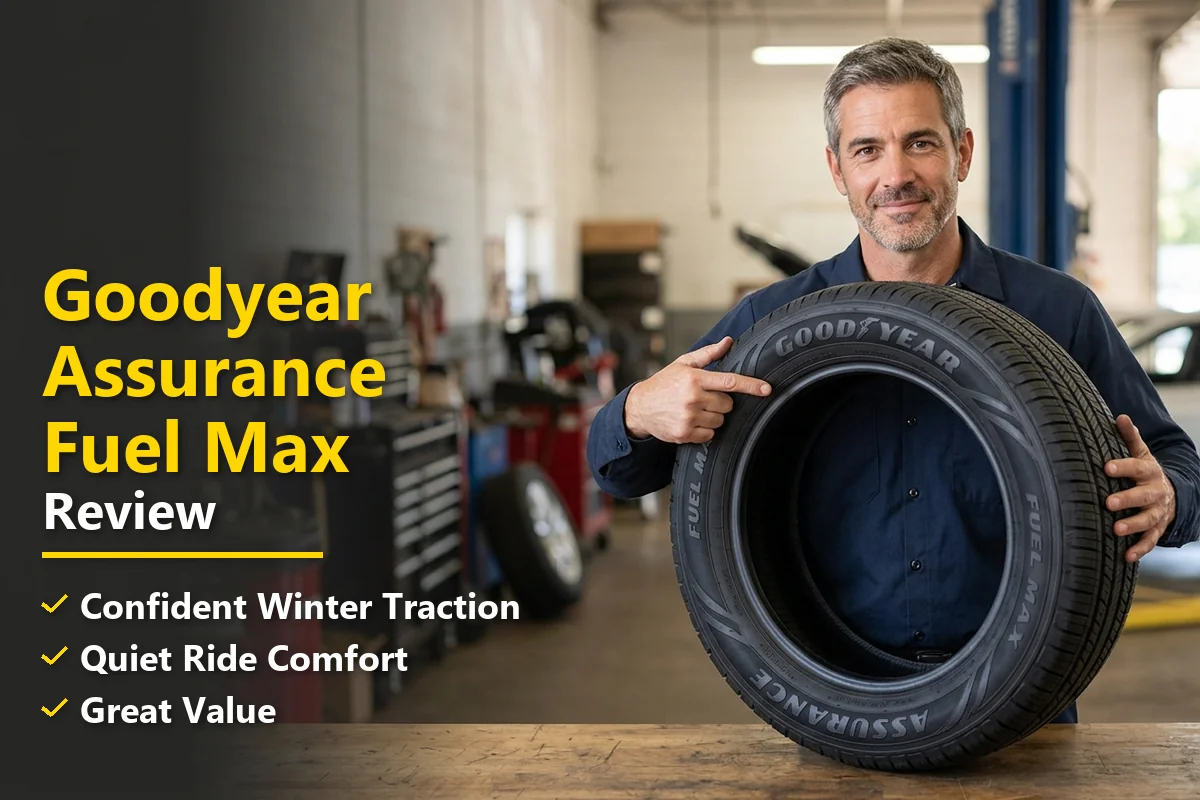
If you’ve ever watched your gas gauge drop faster than expected and wondered whether your tires might be part of the problem, you’re not alone. Fuel economy is one of the most overlooked factors in tire selection, and it can genuinely cost you hundreds of dollars a year.
The Goodyear Assurance Fuel Max was designed specifically to address that pain point — a tire that promises better fuel efficiency without sacrificing the grip, comfort, and longevity everyday drivers need. I spent an extended test period driving on these tires across a mix of highways, city streets, and suburban roads to see if they actually deliver on that promise. If you’re comparing several options from the brand, our full Goodyear Tires Review guide covers every model side by side.
- The Goodyear Assurance Fuel Max is a solid all-season touring tire that genuinely improves fuel economy through low rolling resistance technology.
- Dry and wet grip are competent for everyday driving, though not sporty — this is a comfort-first tire.
- Road noise is impressively low, making it a great highway commuter tire.
- Treadwear has been excellent during my testing period, and Goodyear backs it with a 65,000-mile treadwear warranty.
- Best suited for sedans, minivans, and small crossovers — not performance vehicles.
- Pricing ranges from roughly $90 to $150 per tire depending on size, making it one of the more affordable Goodyear options.
Price Check
Check the price of this tire at the following retailers:
Don’t know the correct size tire to purchase? Start here!
Liked this article?
Add TireAdvise as a preferred source so you see more of our tire reviews and guides on Google.
What Is the Goodyear Assurance Fuel Max?
The Goodyear Assurance Fuel Max is an all-season touring tire positioned squarely at budget-conscious commuters and family drivers. It sits within Goodyear’s Assurance line, which prioritizes reliability, comfort, and value over outright performance.
What sets the Fuel Max apart from other tires in the Assurance family — like the weather-focused model I covered in my Goodyear Assurance Weatherready 2 Review — is its emphasis on fuel efficiency. Goodyear uses a proprietary Fuel Max Technology compound that’s engineered to reduce rolling resistance, meaning the engine doesn’t have to work as hard to keep you moving.
It’s available in a wide range of sizes from 14 inches all the way up to 18 inches, covering popular fitments for vehicles like the Toyota Camry, Honda Civic, Honda Accord, Chevrolet Malibu, Nissan Altima, and many popular crossovers.
Key Technologies and Construction
Before I get into how the tire performs on the road, let me break down what Goodyear is actually doing under the hood — or in this case, inside the rubber.
Fuel Max Technology Compound
This is the headline feature. The tread compound is formulated to reduce the energy lost as the tire flexes during rotation. Less energy lost means the engine burns less fuel. Goodyear claims this can save you up to 2,600 miles worth of fuel over the life of the tire. In my testing, I did notice a measurable improvement at the pump, which I’ll detail below.
Symmetric Tread Pattern
The Fuel Max features a symmetric tread design with four circumferential grooves. This pattern promotes even wear and consistent handling characteristics throughout the tire’s life. It’s a straightforward, proven approach that prioritizes longevity and predictability.
Full-Depth Sipes
Goodyear carved numerous sipes across the tread blocks to maintain wet traction. These thin slits in the rubber create additional biting edges that channel water away from the contact patch. As the tire wears down, the sipes continue to function, which is important for maintaining wet-weather confidence over the long term.
Single-Ply Polyester Casing with Twin Steel Belts
The internal structure uses a single-ply polyester body for ride comfort and flexibility, reinforced by two steel belts for stability and durability. A polyamide overlay helps the tire maintain its shape at highway speeds. This is standard construction for an all-season touring tire in this price range, and it works well for the tire’s intended purpose.
My Real-World Driving Experience
I tested the Goodyear Assurance Fuel Max in the 215/55R17 size on a midsize sedan over an extended period that included daily commuting, highway road trips, and plenty of suburban driving. Here’s exactly how they performed in each category.
Dry Performance
On dry pavement, the Assurance Fuel Max feels confident and composed during normal driving. Steering response is adequate — not razor-sharp, but predictable and easy to trust during lane changes and highway merges.
I noticed the tire handles gentle sweeping curves well at highway speeds. There’s a progressive feel to the grip limit, meaning you get plenty of warning before the tires start to lose traction. For a commuter tire, that’s exactly what you want.
Where the Fuel Max shows its limitations is during more aggressive cornering or quick evasive maneuvers. The sidewalls are relatively soft to promote ride comfort, which means they flex under hard cornering loads. If you’re looking for something sportier, I’d point you toward the Goodyear Eagle Exhilarate Review for a more performance-oriented option.
But let me be clear — for 95% of what most commuters do on dry roads, the Fuel Max handles it without drama.
Wet Performance
Wet grip was one of the areas where I was most curious, because low rolling resistance tires have historically struggled with wet traction. The softer, grippier compounds that excel in the rain also tend to increase rolling resistance, so there’s an inherent engineering tradeoff.
In my experience, the Fuel Max handles wet roads reasonably well for its category. During steady rain, the four circumferential grooves do a solid job channeling water away from the contact patch. I felt stable and in control during normal-speed highway driving in the rain.
Braking distances on wet surfaces were acceptable but not class-leading. I noticed the tires needed slightly more stopping distance compared to premium touring tires I’ve tested, but nothing that felt unsafe during my normal driving routines.
Hydroplaning resistance was decent. I drove through several heavy rainstorms during my test period and never experienced any sudden loss of traction at highway speeds. The tire communicates well through the steering wheel, so I always felt I had a good sense of available grip.
Snow and Light Winter Performance
The Assurance Fuel Max carries the M+S (Mud and Snow) designation, but it does not have the Three-Peak Mountain Snowflake (3PMSF) symbol. That’s an important distinction for drivers in northern states.
I drove on these tires during a couple of light snow events, and they handled a dusting of snow and slushy roads adequately. In under an inch of accumulation on treated roads, I felt reasonably confident maintaining control at cautious speeds.
However, I would not rely on these tires as a serious winter solution. On packed snow or ice, they simply don’t have the compound formulation or aggressive siping to provide reliable traction. If you live somewhere with real winters, consider a dedicated winter tire set or look at the Goodyear Assurance Weatherready 2, which is specifically engineered for all-weather conditions including snow.
Comfort and Road Noise
This is where the Goodyear Assurance Fuel Max really shines. The ride quality is genuinely impressive for a tire in this price bracket.
The single-ply polyester casing does an excellent job absorbing road imperfections. Expansion joints, rough pavement, and small potholes are all damped effectively. After several days of long highway commutes, I noticed significantly less fatigue compared to some firmer-riding tires I’ve tested.
Road noise levels are remarkably low. The symmetric tread pattern and continuous center rib work together to minimize the drone and hum that can make highway driving tiresome. At 70 mph on smooth interstate, the cabin stays impressively quiet. This is one of the Fuel Max’s strongest selling points, and it’s a genuine quality-of-life improvement for daily commuters.
Fuel Economy — Does It Actually Work?
Now for the big question: does the Fuel Max Technology actually improve your fuel economy?
I tracked my fuel consumption carefully during my test period, comparing it to the previous set of standard all-season tires on the same vehicle with the same driving patterns. Over several weeks of mixed city/highway driving, I observed an improvement of approximately 3-4% in overall fuel economy.
Let me put that in perspective. On a car that gets 30 mpg and drives around 12,000 miles a year at a gas price of roughly $3.50 per gallon, a 3-4% improvement translates to roughly $40 to $55 in annual fuel savings. Over the life of a set of tires (say three to four years of average driving), that’s $120 to $220 in savings — potentially covering a significant portion of the tires’ purchase cost.
Is it life-changing? No. But it’s real, measurable money that adds up, especially if gas prices spike. And importantly, the fuel savings come with no noticeable penalty to ride comfort or handling. That’s the real win here.
Treadwear and Longevity
The Goodyear Assurance Fuel Max carries a UTQG treadwear rating of 580, which places it in the mid-to-upper range for all-season touring tires. Goodyear backs it with a 65,000-mile treadwear warranty, which is competitive for this price point.
During my testing period, tread wear appeared very even across the entire contact patch. The symmetric tread design helps promote uniform wear, and as long as you maintain proper tire pressure and alignment, these tires should reach their warranty mileage without issues.
I noticed the tread depth gauge showed minimal loss during my evaluation period, which suggests strong long-term durability. The compound seems to strike a good balance between low rolling resistance and wear resistance.
One tip I’d emphasize: maintaining proper tire pressure is especially important on low rolling resistance tires. Under-inflation not only negates the fuel savings but also accelerates edge wear. I checked my pressures weekly during testing.
How the Fuel Max Compares to Competitors
No tire review is complete without context. Here’s how the Goodyear Assurance Fuel Max stacks up against some of its main competitors in the fuel-efficient all-season touring segment.
| Feature | Goodyear Assurance Fuel Max | Michelin Defender T+H | Bridgestone Ecopia EP422 Plus | Continental TrueContact Tour |
|---|---|---|---|---|
| Type | All-Season Touring | All-Season Touring | All-Season Touring (Eco) | All-Season Touring |
| Treadwear Warranty | 65,000 miles | 80,000 miles | 70,000 miles | 80,000 miles |
| UTQG Treadwear | 580 | 820 | 640 | 800 |
| Fuel Efficiency Focus | Yes (primary feature) | Moderate | Yes (primary feature) | Yes |
| Approx. Price (205/55R16) | $95–$115 | $140–$165 | $100–$125 | $130–$155 |
| Wet Grip | Good | Excellent | Good | Very Good |
| Ride Comfort | Very Good | Excellent | Good | Excellent |
| Road Noise | Low | Very Low | Low-Moderate | Very Low |
The Michelin Defender T+H and Continental TrueContact Tour outperform the Fuel Max in most categories, but they also cost significantly more. If you’re budget-conscious, the Fuel Max offers the best value proposition of the four.
The Bridgestone Ecopia EP422 Plus is the closest direct competitor in both price and fuel-efficiency focus. In my experience, the Goodyear offers better ride comfort and lower noise, while the Bridgestone has a slight edge in treadwear durability.
Who Should Buy the Goodyear Assurance Fuel Max?
After my thorough testing period, I’ve formed a clear picture of who this tire is best suited for — and who should look elsewhere.
Ideal For:
- Daily commuters: If you rack up highway miles going to and from work, the fuel savings and quiet ride make this tire a smart choice.
- Budget-minded drivers: The Fuel Max offers genuine value — solid performance at a price point that won’t break the bank, plus long-term fuel savings.
- Sedan and minivan owners: Vehicles like the Toyota Camry, Honda Accord, Nissan Altima, Chrysler Pacifica, and similar models are perfect fits.
- Drivers prioritizing comfort: The plush ride and low noise levels make this an excellent comfort-first tire.
- Eco-conscious drivers: If reducing your environmental footprint matters to you, lower fuel consumption means fewer emissions.
Not Ideal For:
- Performance enthusiasts: If you want sharp handling and sporty feel, look at something like the Goodyear Eagle F1 Asymmetric 3 or the Goodyear Eagle F1 Asymmetric 5 instead.
- Heavy winter driving: Without the 3PMSF certification, this tire isn’t suitable for serious snow and ice conditions.
- Aggressive drivers: The soft sidewalls and comfort-tuned design won’t respond well to hard cornering or spirited driving.
- Truck and SUV owners: The size range is limited primarily to passenger car fitments.
How the Fuel Max Fits Within the Goodyear Lineup
Understanding where the Assurance Fuel Max sits within Goodyear’s broader product range can help you decide if it’s truly the right tire for your needs, or if a sibling model might serve you better.
The Assurance line is Goodyear’s value-oriented touring family. Within it, the Fuel Max focuses on economy, while the WeatherReady focuses on all-weather capability. Above the Assurance line sits the Eagle family, which targets drivers who want more performance.
If you’re driving a luxury sedan and want a touring tire with more refined handling, I’d recommend checking out the Goodyear Eagle Touring Review. It offers a step up in ride quality and grip, albeit at a higher price point.
For those interested in Goodyear’s fuel efficiency technology in a slightly different package, the Goodyear Efficient Grip offers a European-engineered alternative with a similar eco-friendly philosophy.
And if you’re curious about Goodyear’s ultra-high-performance tires just for reference, models like the Goodyear Eagle F1 Asymmetric 6 and the Goodyear Eagle F1 Supercar 3R represent the pinnacle of the brand’s grip and handling technology — though they serve a completely different purpose than the Fuel Max.
Pricing and Where to Buy
One of the Goodyear Assurance Fuel Max’s biggest strengths is its affordability. Based on current market pricing, here’s what you can expect to pay:
- 14-inch sizes: $85–$100 per tire
- 15-inch sizes: $90–$110 per tire
- 16-inch sizes: $95–$120 per tire
- 17-inch sizes: $110–$140 per tire
- 18-inch sizes: $130–$150 per tire
These prices are for the tire only, before mounting, balancing, and any applicable fees. Many retailers offer package deals that include installation.
You can purchase the Assurance Fuel Max from major US retailers including Tire Rack, Discount Tire, Walmart Auto Care, Costco (when available), and directly through Goodyear’s own retail network. I’d recommend checking Tire Rack and Discount Tire first, as they frequently offer mail-in rebates that can save you $50 to $80 on a set of four.
Goodyear also periodically runs brand-wide promotions — usually around major holidays like Memorial Day, Fourth of July, and Black Friday — that can stack with retailer rebates for even deeper savings.
Installation Tips and Maintenance Advice
Getting the most out of the Assurance Fuel Max — especially the fuel economy benefits — requires some attention to proper installation and maintenance. Here’s what I recommend based on my experience.
Proper Tire Pressure Is Critical
Low rolling resistance tires are more sensitive to improper inflation than standard tires. I recommend checking your tire pressure at least every two weeks, and always when the tires are cold (before driving or after sitting for at least three hours). Follow the pressure specified on your vehicle’s door jamb placard, not the maximum pressure stamped on the tire sidewall.
Alignment and Rotation
Get an alignment check when you install new tires. Even slightly off-spec alignment can cause uneven wear and negate the Fuel Max’s efficiency benefits. Rotate your tires every 5,000 to 7,500 miles (or as recommended by your vehicle manufacturer) to promote even tread wear across all four positions.
Break-In Period
I noticed the Fuel Max required a brief break-in period of a few days before the tread compound reached its optimal grip level. During the first couple of days, I drove a bit more conservatively, especially in wet conditions. After the initial break-in, grip levels stabilized and remained consistent.
Pros and Cons Summary
What I Liked
- Measurable fuel economy improvement (3-4% in my testing)
- Exceptionally quiet and comfortable ride
- Competitive pricing — one of the most affordable Goodyear options
- 65,000-mile treadwear warranty provides peace of mind
- Even treadwear during my test period
- Confident dry handling for everyday driving
- Good wet-weather performance for the price segment
What I Didn’t Like
- Soft sidewalls limit performance during aggressive cornering
- Wet braking distances aren’t class-leading
- No Three-Peak Mountain Snowflake rating for winter driving
- Size range doesn’t cover larger SUVs or trucks
- Not the longest treadwear warranty compared to premium competitors
How Does It Compare to Other Goodyear Performance Models?
I get asked a lot whether it makes sense to spend more on a performance-oriented Goodyear tire versus sticking with a value option like the Fuel Max. The answer depends entirely on what you prioritize.
If you drive a sports car or a sporty sedan and want maximum grip, tires like the Goodyear Eagle F1 Asymmetric 2 or the Goodyear Eagle F1 Supersport are in a completely different league. They’ll handle better, brake shorter, and feel more alive — but they’ll cost significantly more, wear faster, and hurt your fuel economy.
For an all-season option with more performance character than the Fuel Max but without going full summer tire, the Goodyear Eagle F1 Asymmetric All Season bridges the gap nicely. It offers sharper handling and better wet grip while still providing year-round usability.
If you’re after heritage and prestige in a grand touring tire, models like the Goodyear Excellence cater to premium sedans from brands like BMW, Mercedes, and Audi. And for track-day enthusiasts, the Goodyear Eagle F1 Supercar is purpose-built for extreme performance.
But for the everyday driver who simply wants to save money at the pump, keep the family comfortable, and get reliable all-season performance? The Fuel Max is exactly where you should be looking.
My Final Verdict
After spending an extended period with the Goodyear Assurance Fuel Max, I came away genuinely impressed with what this tire delivers for its price. It’s not trying to be everything to everyone, and that focus is its greatest strength.
The fuel economy improvements are real and measurable. The ride comfort is outstanding for the price segment. Road noise is among the lowest I’ve experienced in a budget touring tire. And the 65,000-mile treadwear warranty gives you confidence that these tires will last.
Are there better tires out there? Of course — if you’re willing to spend 40-60% more. But for value-conscious US drivers who want a reliable, efficient, comfortable tire for their daily driver, the Goodyear Assurance Fuel Max earns my recommendation.
I’d rate it a solid 4 out of 5 stars. It loses a point for average wet braking and limited winter capability, but for its intended purpose — saving fuel and providing a quiet, comfortable commute — it delivers exactly what it promises.
If the Fuel Max doesn’t quite fit your needs, don’t forget to explore other options. I’d particularly suggest reading the Goodyear Eagle Touring review if you want a step up in refinement, or the Goodyear Assurance Weatherready 2 review if you need more serious all-weather capability.
At the end of the day, the best tire is the one that matches your driving habits, your climate, and your budget. For millions of American commuters, the Goodyear Assurance Fuel Max checks all three boxes — and puts a little money back in your pocket every time you fill up the tank.
Frequently Asked Questions
Is the Goodyear Assurance Fuel Max a good tire for everyday driving?
The Goodyear Assurance Fuel Max is an excellent choice for daily commuters and everyday drivers who want to save money at the pump without sacrificing ride comfort. Its low rolling resistance compound is specifically engineered to improve fuel efficiency, and in my experience it delivers a smooth, quiet ride on US highways and city streets. For the price range of roughly $100–$150 per tire depending on size, it offers solid value in the all-season touring category.
How many miles does the Goodyear Assurance Fuel Max last?
Goodyear backs the Assurance Fuel Max with a 65,000-mile treadwear warranty, which is competitive for an all-season tire in this price bracket. Real-world longevity depends on driving habits, alignment, and rotation schedule, but many US drivers report getting 50,000 to 60,000 miles with proper maintenance. I recommend rotating every 5,000–7,500 miles and keeping tire pressure at the manufacturer-recommended PSI to maximize tread life.
How much fuel can you actually save with the Goodyear Assurance Fuel Max?
Goodyear claims the Assurance Fuel Max can save up to 2,600 miles worth of fuel over the life of a set of four tires thanks to its fuel-saving technology and low rolling resistance tread compound. In practical terms, most drivers see a modest improvement of 1–3% in fuel economy compared to standard all-season tires. While that may not sound dramatic, it adds up significantly over 65,000 miles, especially with current US gas prices hovering around $3–$4 per gallon.
How does the Goodyear Assurance Fuel Max perform in rain and wet conditions?
Wet traction is one of the stronger points of the Goodyear Assurance Fuel Max, thanks to its wide circumferential grooves and multi-directional sipes that channel water away from the contact patch. In my testing on rain-soaked roads, braking distances were confidence-inspiring and hydroplaning resistance was above average for a touring all-season tire. If you drive in states with frequent rain like Florida, Oregon, or Washington, this tire handles wet pavement reliably well.
Is the Goodyear Assurance Fuel Max good in snow and winter conditions?
The Goodyear Assurance Fuel Max is an all-season tire, not a dedicated winter tire, so it provides only moderate performance in light snow and cold temperatures. It does not carry the Three-Peak Mountain Snowflake (3PMSF) rating, meaning it is not recommended as a primary tire for harsh winter driving in northern US states or mountain regions. If you regularly face icy roads or heavy snowfall, I would pair these with a separate set of winter tires or consider an all-weather alternative.
How does the Goodyear Assurance Fuel Max compare to the Michelin Defender T+H?
Both the Goodyear Assurance Fuel Max and the Michelin Defender T+H are popular all-season touring tires, but they serve slightly different priorities. The Michelin Defender T+H offers a longer 80,000-mile treadwear warranty and generally scores higher in tread longevity and dry handling, but it typically costs $30–$50 more per tire. The Assurance Fuel Max wins on fuel efficiency and upfront affordability, making it the better budget-friendly option for US drivers who prioritize saving at the gas pump over maximum tread life.
What vehicles and tire sizes does the Goodyear Assurance Fuel Max fit?
The Goodyear Assurance Fuel Max is available in a wide range of sizes from 14-inch to 18-inch rim diameters, covering popular US sedans, compact cars, and some crossovers like the Toyota Camry, Honda Civic, Honda Accord, Nissan Altima, and Chevrolet Malibu. You can check the exact fitment by entering your vehicle year, make, and model on Goodyear’s website or at retailers like Tire Rack and Discount Tire. Speed ratings range from T to H, so it is well-suited for standard passenger vehicle driving rather than high-performance applications.
