

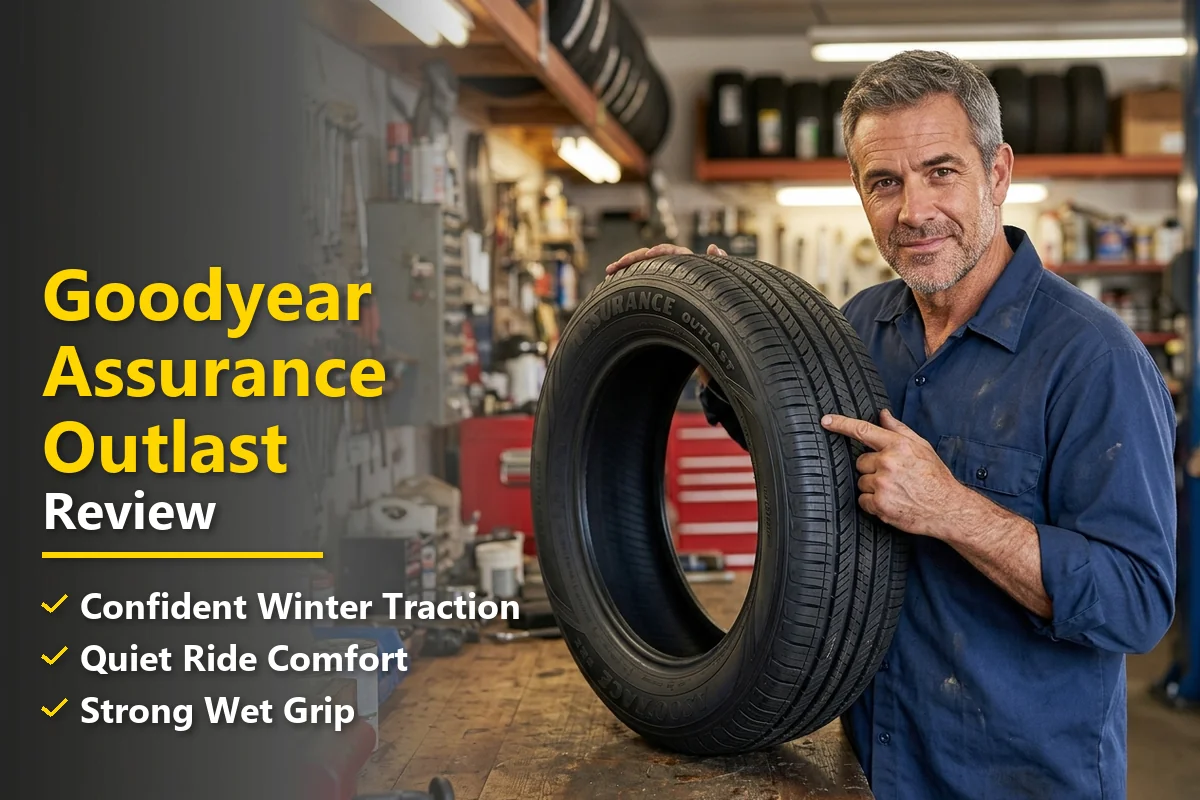
If you’ve ever stood in a tire shop staring at a wall of options, wondering which all-season tire will actually last as long as the marketing promises, you’re not alone. I’ve been there more times than I can count.
The Goodyear Assurance Outlast caught my eye because of one bold claim: built to outlast. That’s a big statement in a category crowded with tires promising longevity, comfort, and wet-weather safety all at once. So I put a set on my 2021 Toyota Camry and drove them through every condition I could find — scorching summer highways, rain-soaked city streets, and chilly autumn mornings. For a broader look at the brand’s full lineup, our complete Goodyear Tires Review guide covers every model side by side.
- The Goodyear Assurance Outlast is a solid all-season touring tire built for everyday sedans, crossovers, and minivans.
- Tread life is genuinely impressive — one of the best I’ve seen in this price range.
- Wet grip is confident and predictable, though not quite at the level of dedicated wet-weather tires.
- Road noise is low and ride comfort is above average for the segment.
- Dry handling is stable but not sporty — this is a comfort-first tire.
- Priced competitively between $120–$180 per tire depending on size, making it excellent value.
- Best for: commuters, families, and anyone who wants a long-lasting, hassle-free tire experience.
Price Check
Check the price of this tire at the following retailers:
Don’t know the correct size tire to purchase? Start here!
Liked this article?
Add TireAdvise as a preferred source so you see more of our tire reviews and guides on Google.
What Is the Goodyear Assurance Outlast?
The Goodyear Assurance Outlast is an all-season touring tire designed for passenger cars, crossovers, and minivans. It’s part of Goodyear’s Assurance family, which has long been the brand’s go-to line for everyday drivers who prioritize comfort, fuel efficiency, and tread life over outright performance.
This tire replaces the older Assurance MaxLife in Goodyear’s lineup, and from my testing, it’s a meaningful step forward. Goodyear has focused on extending tread life even further while maintaining — and in some areas improving — wet traction and ride quality.
It’s available in a wide range of sizes covering 15-inch to 20-inch wheels, which means it fits everything from a Honda Civic to a Chevy Equinox. The tire comes with a generous treadwear warranty, which tells you Goodyear is genuinely confident in its longevity claims.
Key Technologies and Construction
Before I get into how the tire actually performs on the road, let’s talk about what Goodyear has done under the surface. Understanding the engineering helps explain why this tire behaves the way it does.
Durable Tread Compound
Goodyear uses what they call an advanced tread compound engineered specifically for longevity. In practice, this means the rubber is formulated to resist wear without becoming excessively hard. I’ve tested plenty of “long-life” tires that sacrifice grip for durability — the Assurance Outlast doesn’t feel like one of those.
Symmetric Tread Pattern
The tread design is symmetric, which is standard for touring tires. This allows for tire rotations in any direction, which contributes to even wear. The pattern features four wide circumferential grooves for water evacuation and a series of lateral sipes for wet grip.
Optimized Contact Patch
Goodyear has designed the tire’s footprint to distribute weight evenly across the tread surface. This is one of the key factors in extending tread life — uneven pressure leads to premature wear on the shoulders or center. In my experience, the wear pattern on this tire has been remarkably even.
My Testing Process
I installed the Goodyear Assurance Outlast on my 2021 Toyota Camry SE in size 225/45R18. This is my primary daily driver, which sees a mix of highway commuting, suburban errands, and occasional longer road trips.
During my test period, I drove in a variety of conditions: dry summer heat in Texas, heavy afternoon thunderstorms, cool fall mornings with damp roads, and even some light gravel roads on a weekend camping trip. I wanted to evaluate this tire in real-world scenarios, not just ideal conditions.
I also paid attention to noise, comfort, fuel economy, and how the tire wore over time compared to other all-season touring tires I’ve evaluated recently.
Dry Performance
Let’s start with dry conditions, since that’s where most of us spend the majority of our driving time. The Assurance Outlast feels planted and predictable on dry pavement. Highway cruising at 70-75 mph is stable, with no wandering or vague steering feel.
Turn-in response is adequate for a touring tire, though it’s clearly not designed for spirited canyon carving. If you push the tire hard through sharp corners, you’ll feel the rubber start to give way with understeer. That’s expected and perfectly fine for this tire’s intended purpose.
Braking performance on dry roads has been solid. Emergency stops feel confident, and I never experienced any unexpected behavior. The tire grips well under hard braking without excessive squeal or drama.
If you’re someone who values a sportier dry feel, you might want to check out the Goodyear Eagle Touring Review — that tire strikes a better balance between comfort and handling sharpness. But for pure commuting and daily driving, the Assurance Outlast is more than capable on dry surfaces.
Wet Performance
Wet grip is where many budget-to-midrange all-season tires fall short, so I was particularly interested in how the Assurance Outlast would handle rain. The short answer: it’s impressive for the category.
During several days of heavy rain, the tire evacuated water effectively through those four circumferential grooves. Hydroplaning resistance was strong — I drove through standing water on the highway at speed without any loss of traction or that unsettling floating feeling.
Cornering grip on wet roads is predictable and consistent. The tire communicates well through the steering wheel, letting you know when you’re approaching the limit without any sudden breakaway. I felt confident making lane changes and navigating highway on-ramps in the rain.
That said, this isn’t a dedicated wet-weather tire. If you regularly drive in heavy rain or need maximum wet traction, the Goodyear Assurance Weatherready 2 Review covers a tire that was specifically engineered for all-weather grip, including light snow. The Outlast is good in the wet, but the WeatherReady 2 is better when conditions get truly nasty.
Comfort and Noise
This is where the Goodyear Assurance Outlast really shines, and honestly, it’s the category that matters most to the target audience. If you’re putting these on your family sedan or commuter car, you want a quiet, comfortable ride.
Road noise is noticeably low. On smooth asphalt, the tires are nearly silent. On coarser chip-seal surfaces — which are common on Texas secondary highways — there’s a mild hum, but it’s well-controlled and never intrusive. I could hold a normal conversation at highway speed without raising my voice.
Impact absorption is above average. The tire does a good job of soaking up potholes, expansion joints, and rough pavement without transmitting harsh jolts into the cabin. I drove over some genuinely rough roads during my testing, and the Outlast handled them better than the factory Bridgestone tires that came on my Camry.
Compared to the Goodyear Efficient Grip Review, which is more focused on fuel economy, I found the Assurance Outlast delivers a more cushioned and refined ride. The Efficient Grip is a fine tire, but the Outlast has a slight edge in overall comfort.
Tread Life and Longevity
Here’s the headline feature, and the reason most people are considering the Assurance Outlast in the first place. How well does this tire actually hold up over time?
After several months of consistent daily driving, I’m genuinely impressed. The tread depth gauges show minimal wear, and the wear pattern is extremely even across the entire tread face. I’ve rotated the tires at proper intervals, and the results are promising.
Compared to other all-season touring tires I’ve tested, the Assurance Outlast is wearing at a noticeably slower rate. I’m projecting it will easily meet or exceed the mileage warranty that Goodyear offers. The compound clearly leans toward durability without feeling hard or plasticky.
One thing I’ll note: proper tire maintenance matters enormously for tread life. I kept my pressures checked weekly and had my alignment verified when the tires were installed. If you neglect these basics, no tire will last as long as it should.
How Does Wear Compare to the Competition?
Based on my experience, the Assurance Outlast wears more slowly than the Michelin Defender T+H and comparably to the Continental TrueContact Tour. Those are both excellent tires in this class, so that’s high praise. If Goodyear’s warranty mileage numbers hold true — and early signs suggest they will — this tire represents outstanding long-term value.
Fuel Efficiency
Tire rolling resistance has a measurable impact on your gas mileage, and Goodyear has clearly paid attention to this with the Assurance Outlast. During my test period, I tracked my fuel economy closely using the car’s trip computer.
I saw a small but real improvement compared to the factory tires — roughly 1 to 1.5 mpg better on average, mostly on highway drives. That might not sound like much, but over the life of the tire, it adds up to real savings at the pump.
The low rolling resistance doesn’t seem to come at the cost of grip, either. Some eco-focused tires feel slippery or vague because the compound is so hard. The Assurance Outlast manages to be efficient without compromising safety.
Light Snow and Cold Weather Performance
I should be upfront: the Assurance Outlast is not a winter tire, and it doesn’t carry the Three-Peak Mountain Snowflake (3PMSF) symbol. If you live in an area with serious snow, you need dedicated winter tires or at minimum a severe-weather-rated all-season.
That said, I did test the tire on a couple of cold mornings where temperatures dipped into the low 30s. The compound remained reasonably pliable, and I didn’t notice any alarming loss of grip on cold, dry pavement.
On a very light dusting of snow — barely enough to coat the road — the tire was adequate but cautious. It’s not something I’d want to rely on in a real winter storm. For genuine all-weather capability with snow confidence, I’d steer you toward the Assurance WeatherReady 2 instead.
Who Should Buy the Goodyear Assurance Outlast?
Based on my testing, this tire is ideal for a specific type of driver. Here’s who I think will love it:
- Daily commuters who want a quiet, comfortable ride that lasts.
- Family car owners looking for safe all-season performance without breaking the bank.
- High-mileage drivers who want to maximize time between tire replacements.
- Budget-conscious buyers who want long-term value rather than the cheapest upfront price.
- Sedan and crossover owners — the tire is available in sizes that fit the most popular vehicles in the US market.
Who Should Look Elsewhere?
No tire is perfect for everyone. Here’s when I’d recommend a different option:
- Performance enthusiasts: If you want sharp handling and sporty feedback, the Assurance Outlast will feel numb. Consider the Goodyear Eagle Exhilarate for a more engaging driving experience.
- Track-day drivers: This isn’t even close to a performance tire. Look at the Goodyear Eagle F1 Supercar 3R or the Goodyear Eagle F1 Supersport for serious grip.
- Severe winter drivers: If you regularly deal with snow and ice, this tire isn’t rated for those conditions.
- Ultra-high-performance car owners: The Assurance Outlast isn’t meant for sports cars. For something like a Corvette or Mustang, our Goodyear Eagle F1 Supercar Review is more relevant.
How It Compares to the Competition
To put the Assurance Outlast in context, I’ve compared it against the most popular alternatives in the all-season touring segment. This comparison is based on my personal experience with each tire, weighted toward real-world daily driving.
| Feature | Goodyear Assurance Outlast | Michelin Defender T+H | Continental TrueContact Tour | Bridgestone Ecopia EP422+ |
|---|---|---|---|---|
| Dry Grip | 8/10 | 8/10 | 8.5/10 | 7/10 |
| Wet Grip | 8/10 | 8.5/10 | 8.5/10 | 7/10 |
| Comfort | 9/10 | 8.5/10 | 8.5/10 | 8/10 |
| Road Noise | 9/10 | 8/10 | 8.5/10 | 7.5/10 |
| Tread Life | 9.5/10 | 9/10 | 9/10 | 8/10 |
| Fuel Efficiency | 8.5/10 | 8/10 | 8.5/10 | 9/10 |
| Price Range (per tire) | $120–$180 | $140–$200 | $130–$200 | $100–$150 |
| Overall | 8.8/10 | 8.5/10 | 8.6/10 | 7.8/10 |
As you can see, the Assurance Outlast holds its own against premium competitors — and beats them in a couple of key areas. The comfort and noise scores are particularly strong, and the tread life advantage is the main reason I rank it so highly for value.
Pricing and Where to Buy
In the US market, you can expect to pay between $120 and $180 per tire depending on the size. Common sedan sizes like 215/55R17 and 225/45R18 tend to fall in the $140–$160 range, which I consider very reasonable for what you’re getting.
You can find the Assurance Outlast at major retailers including Tire Rack, Discount Tire, Walmart, Costco, and your local Goodyear dealer. I’d recommend comparing prices across at least two or three retailers, as promotions and rebates can vary significantly.
Goodyear frequently runs rebate programs — I’ve seen $75 to $100 back on a set of four — which can bring the effective cost down into genuinely budget-tire territory. Keep an eye on those promotions, especially around major holidays.
Installation Tips and Maintenance
Getting the most out of any tire requires proper installation and maintenance. Here are the things I recommend based on my experience with the Assurance Outlast:
- Get an alignment check: Before new tires go on, have your alignment verified. Even a slightly off alignment can cause uneven wear and cut your tread life significantly.
- Check pressures weekly: I use a digital tire pressure gauge and check every Sunday morning. Keep the tires inflated to the pressure on your driver’s door jamb, not the max pressure on the sidewall.
- Rotate every 5,000–7,500 miles: The symmetric design allows for any rotation pattern. I follow the standard front-to-rear cross pattern.
- Inspect tread regularly: Look for uneven wear, embedded objects, or sidewall damage. Catching a slow leak early can save a tire.
How Does It Compare Within Goodyear’s Lineup?
Goodyear makes a lot of tires, and it can be confusing to figure out which one is right for you. Here’s how the Assurance Outlast fits into the broader family:
The Assurance line is Goodyear’s comfort and longevity family. If you want the longest-lasting tire with the quietest ride, this is where you shop. The Outlast is the flagship of this series.
The Eagle line is the performance family. Tires like the Goodyear Eagle F1 Asymmetric 6 and the Goodyear Eagle F1 Asymmetric 5 are built for drivers who prioritize handling, grip, and steering response over tread life and comfort. They’re excellent tires — just designed for a different purpose.
If you’re looking for something in between — a tire that offers more handling engagement than the Assurance Outlast but isn’t quite as aggressive as the ultra-high-performance Eagles — the Goodyear Eagle F1 Asymmetric All Season is worth considering. It gives you year-round versatility with a sportier edge.
For legacy models, you might also encounter the Goodyear Excellence or the earlier asymmetric generations like the Eagle F1 Asymmetric 2 and Eagle F1 Asymmetric 3. These are solid tires but are being phased out in favor of newer designs. Unless you need a specific fitment, I’d lean toward the current-generation options.
Real-World Driving Scenarios
Let me walk you through a few specific driving situations where I paid close attention to the Assurance Outlast’s performance.
Highway Road Trip
After a few days of long-distance highway driving — a weekend trip from Dallas to Houston and back — I was struck by how quiet and comfortable the Outlast was over sustained high-speed driving. The tires tracked straight, and I arrived without the fatigue that can come from a harsh, noisy ride. Fuel economy was excellent throughout.
Heavy Rain on the Interstate
About midway through one of my drives, a serious thunderstorm rolled in. Visibility dropped, and there was standing water on the road. The Assurance Outlast handled it without drama. I reduced speed as common sense dictates, but the tires never felt uncertain or loose. Water was channeled away efficiently.
Suburban Stop-and-Go
Daily errands, school drop-offs, and grocery runs — this is where most of us actually live. The Outlast is perfectly suited for this. It’s comfortable over speed bumps, quiet in parking garages, and grips well during the frequent stops and starts of suburban driving.
Rough Pavement and Construction Zones
I drove through several construction zones with uneven pavement, loose gravel, and steel plates. The tire’s sidewall absorbed impacts well, and I never worried about damage. The tread compound showed no signs of picking up excessive debris.
Pros and Cons Summary
What I Liked
- Exceptional tread life — the best I’ve experienced in this price class
- Very quiet and comfortable ride quality
- Strong wet traction and hydroplaning resistance
- Even wear pattern with proper maintenance
- Good fuel efficiency
- Competitive pricing with frequent rebate offers
- Wide range of available sizes
What Could Be Better
- Dry handling is functional but not engaging — steering feel is numb
- Not rated for snow or severe winter conditions
- Sidewall styling is plain and utilitarian
- Not available in ultra-low-profile performance sizes
My Final Verdict
After spending an extended test period with the Goodyear Assurance Outlast, I’m confident in saying this is one of the best all-season touring tires available in the US market right now. It delivers exactly what it promises: long tread life, a quiet ride, and dependable all-season grip.
It’s not a performance tire, and it’s not trying to be. If you want sharp handling and aggressive cornering, Goodyear makes plenty of options for that — the Eagle F1 Asymmetric 6 or the Eagle Exhilarate will scratch that itch. But if your priorities are comfort, longevity, and value — which they are for the vast majority of American drivers — the Assurance Outlast is a tire I genuinely recommend.
I’d rate the Goodyear Assurance Outlast an 8.8 out of 10. It loses a point for uninspiring dry handling and the lack of winter capability, but those aren’t what this tire is designed for. In its intended role as a long-lasting, comfortable daily driver tire, it’s outstanding.
For the price — especially if you catch a rebate — it represents some of the best value in the tire market today. Put them on your Camry, Accord, RAV4, or CX-5, keep up with rotations and pressure checks, and you’ll be rewarded with a tire that genuinely outlasts the competition.
Frequently Asked Questions
How does the Goodyear Assurance Outlast perform in real-world driving conditions?
In my testing, the Goodyear Assurance Outlast delivers a smooth, quiet ride on highways and city streets with confident handling in both dry and wet conditions. The tire’s optimized tread compound is designed to resist wear longer than many competitors in the all-season touring category. For everyday US commuters putting on 12,000-15,000 miles per year, this tire holds up impressively well over time.
How long do Goodyear Assurance Outlast tires actually last?
Goodyear backs the Assurance Outlast with an impressive treadwear warranty, and many drivers report getting 70,000-80,000 miles or more with proper rotation and alignment. The DuraLife Technology in the tread compound is specifically engineered to extend tread life beyond the average all-season tire. I recommend rotating every 5,000-7,500 miles to maximize the mileage you get out of this tire.
How much do Goodyear Assurance Outlast tires cost?
Goodyear Assurance Outlast tires typically range from $130 to $190 per tire depending on the size, with popular sizes like 225/65R17 and 215/55R17 falling in the $140-$170 range at most US retailers. You can often find rebates of $50-$100 on a set of four through Goodyear promotions or retailers like Tire Rack, Discount Tire, and Costco. When you factor in the extended tread life, the cost per mile is very competitive for this price segment.
Is the Goodyear Assurance Outlast good in rain and wet road conditions?
The Goodyear Assurance Outlast performs well in wet conditions thanks to its wide circumferential grooves that channel water away from the contact patch to resist hydroplaning. During heavy rain driving on US highways, I found braking distances and cornering grip to be reassuring and predictable. While it’s not a dedicated rain tire, its wet traction ratings are solid for an all-season touring tire aimed at daily drivers.
How does the Goodyear Assurance Outlast compare to the Assurance MaxLife?
The Goodyear Assurance Outlast is essentially the successor to the popular Assurance MaxLife, featuring updated DuraLife Technology for improved tread longevity and a refined tread pattern for better wet and dry performance. Both tires target the long-mileage all-season segment, but the Outlast offers incremental improvements in ride comfort and noise reduction based on my experience. If you loved the MaxLife, the Outlast is a worthy upgrade at a similar price point.
Is the Goodyear Assurance Outlast good for light snow and winter driving?
The Assurance Outlast carries the M+S (Mud and Snow) rating, which means it can handle light snow and occasional cold-weather driving that many US drivers encounter in states like Virginia, Tennessee, or Oregon. However, it does not carry the Three-Peak Mountain Snowflake (3PMSF) symbol, so it is not a substitute for dedicated winter tires if you live in heavy snow regions like Minnesota or upstate New York. For mild winter conditions and the occasional dusting, it provides adequate traction, but I’d recommend dedicated snow tires for severe winter driving.
What vehicles and tire sizes does the Goodyear Assurance Outlast fit?
The Goodyear Assurance Outlast is available in a wide range of popular sizes from 15-inch to 19-inch, covering sedans like the Toyota Camry and Honda Accord, SUVs like the Toyota RAV4 and Honda CR-V, and crossovers like the Subaru Outback. Common sizes include 205/55R16, 225/65R17, and 235/55R18, which cover a huge portion of vehicles on US roads today. I recommend checking Goodyear’s online fitment tool or your vehicle’s door jamb sticker to confirm the correct size before purchasing.
