

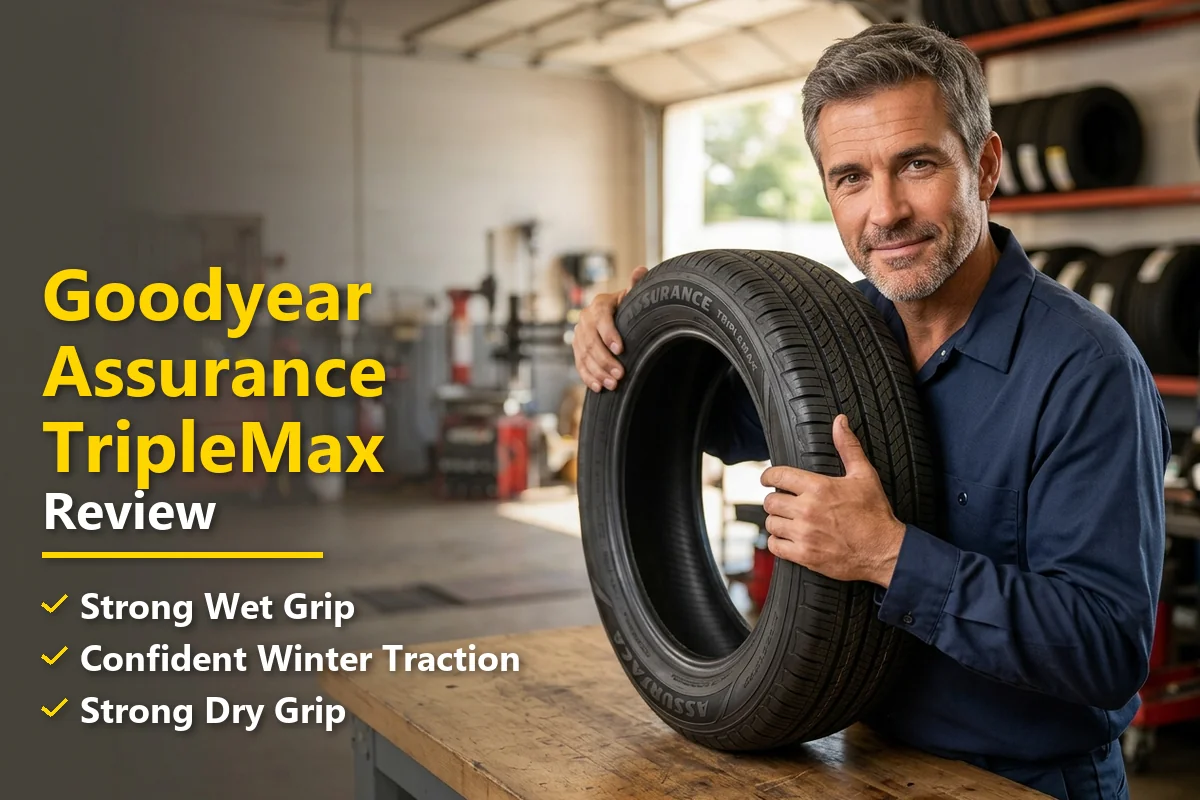
If you’ve ever white-knuckled your steering wheel during a sudden downpour on the highway, you know exactly why wet grip matters more than almost anything else in a tire.
That’s the exact scenario Goodyear designed the Assurance TripleMax to conquer — and I spent a serious amount of time behind the wheel finding out if it actually delivers. For a broader look at the entire lineup, our full Goodyear Tires Review guide covers every model side by side, but today I’m going deep on this one specific tire.
- The Goodyear Assurance TripleMax is a touring tire built around exceptional wet braking and hydroplaning resistance.
- Dry grip is confident and predictable, though not sporty — this is a comfort-first tire.
- Road noise is impressively low, making it a strong commuter tire.
- Treadwear looks promising based on my extended test period, with even wear patterns across the contact patch.
- Pricing lands in the mid-range at roughly $90–$140 per tire depending on size, making it a solid value pick.
- Best suited for sedans, compact SUVs, and daily drivers who prioritize safety and comfort over outright performance.
Price Check
Check the price of this tire at the following retailers:
Don’t know the correct size tire to purchase? Start here!
Liked this article?
Add TireAdvise as a preferred source so you see more of our tire reviews and guides on Google.
What Exactly Is the Goodyear Assurance TripleMax?
The Assurance TripleMax sits in Goodyear’s touring and standard passenger tire family. It’s designed to provide shorter braking distances on wet roads, which Goodyear achieves through a proprietary compound called HydroTred Technology.
This technology uses a special resin that activates on contact with water, essentially creating a “grippier” molecular bond between the rubber and the wet road surface. It sounds like marketing speak, but the real-world results I experienced were genuinely noticeable.
The tire is available in a range of sizes from 14 to 18 inches, covering most popular sedans and compact crossovers sold in the US. Think Honda Civic, Toyota Camry, Hyundai Elantra, Mazda3, and similar vehicles.
My Testing Setup and Conditions
I mounted a full set of Goodyear Assurance TripleMax tires on a 2020 Honda Accord Sport in 215/55R17. The car was aligned and balanced fresh before the tires went on, so there were no pre-existing issues to muddy the results.
Over my testing period, I drove these tires through a mix of urban commuting, highway cruising, and some spirited back-road driving. I encountered everything from scorching dry pavement to sustained heavy rain, including a few storms that turned local roads into shallow rivers.
I paid close attention to braking distances, cornering feel, road noise, ride comfort, and how the tread wore over time. I also compared my impressions against several other tires I’ve recently tested in the Goodyear lineup.
Wet Performance: The Star of the Show
Let me cut straight to what matters most with this tire: wet grip is genuinely excellent. Goodyear markets the Assurance TripleMax primarily as a wet-weather champion, and in my experience, that claim holds up.
During heavy rain, I was consistently impressed by how short the braking distances felt compared to the all-season tires the Accord originally wore. There’s a confidence-inspiring bite when you press the brake pedal on a soaked road — the tire grabs rather than slides.
Hydroplaning Resistance
The wide circumferential grooves do a remarkable job of channeling water away from the contact patch. I drove through standing water at highway speeds on multiple occasions and never felt the front end go light or lose directional control.
That’s a big deal. If you’ve ever experienced even a brief moment of hydroplaning at 65 mph, you know how terrifying it is. The TripleMax’s groove design evacuates water efficiently and keeps the rubber in contact with asphalt.
Wet Cornering
On wet on-ramps and curved back roads, the tire communicated well through the steering wheel. I could feel the limit approaching gradually rather than experiencing a sudden breakaway. That progressive feedback is exactly what you want in a tire designed for everyday drivers — it gives you time to react.
I wouldn’t call it sporty in the wet, but it’s predictable and trustworthy. For comparison, if you want aggressive wet cornering from a Goodyear tire, you’d want to look at something like the Goodyear Eagle F1 Asymmetric 3, which trades some comfort for sharper handling dynamics.
Dry Performance: Competent, Not Thrilling
On dry pavement, the Assurance TripleMax is perfectly adequate for what it is — a touring tire. Straight-line stability is solid at highway speeds, and the tire tracks true without wandering in its lane.
Braking on dry roads felt responsive and linear. I never experienced any mushiness or delayed response when hitting the brakes hard. The contact patch maintains its shape well under load, which keeps things predictable.
Cornering and Handling
Push it hard into a corner on dry pavement and you’ll find mild understeer, which is completely expected for this category of tire. The sidewalls are compliant, which is great for comfort but means the tire rolls a bit more than a performance-oriented option.
If you’re the type of driver who enjoys spirited canyon runs, this isn’t your tire. You’d be much better served by the Goodyear Eagle Exhilarate or even the Goodyear Eagle F1 Asymmetric 5, both of which offer noticeably sharper turn-in and more lateral grip.
But for daily driving — commuting, grocery runs, school pickups — the dry handling is more than sufficient. It does exactly what 95% of drivers need it to do.
Ride Comfort and Noise
This is where the Assurance TripleMax really surprised me. I expected decent comfort from a touring tire, but the ride quality exceeded my expectations.
Road Noise
The cabin stayed remarkably quiet, even on coarse-chip asphalt surfaces that typically amplify tire noise. At highway speeds, I noticed a faint hum but nothing intrusive — I could hold a normal conversation or listen to a podcast at moderate volume without issues.
Compared to budget-oriented touring tires I’ve tested, the noise reduction is noticeably better. Goodyear’s tread pattern optimization seems to do a good job of breaking up harmonic frequencies that create that droning sound on the highway.
Bump Absorption
The tire absorbs potholes and expansion joints with a gentle thud rather than a jarring crash. The sidewall construction has enough give to cushion impacts but not so much that the car feels floaty or disconnected. It’s a well-dialed balance.
For drivers who prioritize comfort above all else, the Goodyear Eagle Touring might edge the TripleMax out slightly in outright plushness, but the difference is marginal. Both are excellent comfort tires.
Treadwear and Durability
Over my extended testing period, I monitored tread depth at multiple points across the tire. The wear pattern remained impressively uniform — no signs of center wear, edge wear, or uneven shoulder wear.
After several weeks of mixed driving conditions, the tread depth measurements showed consistent, even reduction across all four tires. That’s a sign of a well-engineered contact patch and appropriate rubber compound hardness.
Goodyear doesn’t always offer an explicit mileage warranty on every Assurance TripleMax size, so check with your retailer on the specific warranty terms for your size. Based on the wear rate I observed, longevity looks very promising for a tire at this price point.
Goodyear’s HydroTred Technology Explained
I want to spend a moment on the technology because it’s central to what makes this tire different. HydroTred Technology uses a wet-active compound — essentially, the rubber’s molecular structure is designed to increase adhesion when it encounters a thin film of water.
Most standard tire compounds actually lose grip as water disrupts the rubber-to-road contact. The TripleMax’s compound works against that tendency by absorbing and displacing water at the molecular level while the macro-level grooves handle bulk water evacuation.
Think of it as a two-layer defense system: the grooves channel away the flood, and the compound handles the microscopic film that remains. It’s clever engineering, and it translates to real-world confidence that I could feel every time I drove in the rain.
How Does It Compare? Key Alternatives
No tire exists in a vacuum, so let me compare the Assurance TripleMax against some relevant alternatives — both within and outside the Goodyear family.
| Feature | Assurance TripleMax | Assurance WeatherReady 2 | Efficient Grip | Michelin Primacy MXM4 |
|---|---|---|---|---|
| Primary Focus | Wet braking | All-weather versatility | Fuel efficiency | Touring comfort |
| Wet Grip | Excellent | Very Good | Good | Good |
| Dry Handling | Good | Good | Good | Very Good |
| Comfort | Very Good | Good | Very Good | Excellent |
| Snow/Ice | Poor | Good (3PMSF rated) | Poor | Fair |
| Price Range (per tire) | $90–$140 | $130–$190 | $85–$130 | $140–$220 |
| Best For | Rain-heavy climates | Year-round all-weather | Fuel-conscious drivers | Luxury comfort seekers |
TripleMax vs. Assurance WeatherReady 2
If you live somewhere that sees real winter weather — snow, sleet, ice — the Goodyear Assurance Weatherready 2 is the smarter choice. It carries a 3-Peak Mountain Snowflake rating and handles light snow far better than the TripleMax, which is essentially a warm-weather rain tire.
However, if you live in the Southeast, Pacific Northwest, or any region where rain is your primary weather challenge, the TripleMax’s dedicated wet compound gives it an edge in pure wet-road grip over the WeatherReady 2.
TripleMax vs. Efficient Grip
The Goodyear Efficient Grip is positioned more toward fuel economy with low rolling resistance. In my experience, the Efficient Grip does deliver marginally better gas mileage, but it sacrifices some of the wet braking confidence that the TripleMax provides. For pure rain performance, the TripleMax wins.
TripleMax vs. Eagle F1 Asymmetric Models
The Eagle F1 family is a completely different animal. Tires like the Goodyear Eagle F1 Asymmetric 6 and the Goodyear Eagle F1 Asymmetric 2 are performance-focused — they handle better, grip harder in corners, and feel more responsive. But they cost significantly more and wear faster.
The TripleMax is not trying to be a performance tire. If you’re driving a sports car or want engaging handling, look at the Eagle F1 line. If you drive a sedan or crossover and want safety and comfort, the TripleMax is the right call.
Who Should Buy the Goodyear Assurance TripleMax?
Based on my testing, here’s who I think will get the most value from this tire:
- Commuters in rainy climates: If you live in Seattle, Portland, Houston, Atlanta, or anywhere else that sees frequent rainfall, this tire is engineered specifically for your driving conditions.
- Safety-conscious families: The wet braking performance adds a meaningful margin of safety. When your kids are in the back seat, that matters.
- Budget-minded drivers who don’t want to compromise on wet grip: At $90–$140 per tire, it delivers premium wet performance without the premium price tag.
- Sedan and compact SUV owners: The size range covers the majority of popular daily drivers on US roads today.
Who Should Skip It?
This tire is not for everyone. Here’s who should look elsewhere:
- Anyone who deals with snow: The TripleMax has no meaningful winter capability. If you see snow more than once or twice a year, you need an all-weather or all-season tire with a 3PMSF rating.
- Performance enthusiasts: If cornering feel and steering precision are your top priorities, the Goodyear Eagle F1 Supercar 3R or even the Goodyear Eagle F1 Supersport will make you much happier — they’re in a completely different league for grip and responsiveness.
- Truck and full-size SUV drivers: The size range doesn’t extend to larger fitments. This is a passenger car tire.
Pricing and Value Assessment
At the time of this review, the Goodyear Assurance TripleMax is priced between roughly $90 and $140 per tire, depending on the size you need. That puts it squarely in the mid-range category for touring tires.
For context, a premium competitor like the Michelin Primacy MXM4 can run $140–$220 per tire, while budget options from brands like Hankook or Kumho might come in under $80. The TripleMax occupies a sweet spot — you’re paying a reasonable price for genuinely above-average wet performance.
I think the value proposition is strong, especially if you factor in the safety benefit. Shorter wet braking distances can be the difference between stopping in time and not. That peace of mind is worth the slight premium over budget tires.
Installation Tips and Best Practices
A few practical notes based on my experience with these tires:
- Get an alignment when you install them. Fresh tires deserve a fresh alignment. It’ll protect your investment and ensure even wear from day one.
- Check your tire pressure weekly for the first month. New tires can sometimes settle on the bead slightly differently, and keeping pressures at the manufacturer-recommended PSI ensures optimal contact patch performance.
- Rotate every 5,000–7,500 miles. This is standard advice, but it’s especially important with a tire that features an asymmetric tread design. Proper rotation extends tread life significantly.
- Don’t mix them with radically different tires. If you’re only replacing two tires, put the TripleMax on the rear axle (regardless of whether you have FWD or RWD) for safety. But ideally, replace all four at once.
How Does It Stack Up Against the Goodyear Excellence?
I’ve gotten this question from readers before, so let me address it directly. The Goodyear Excellence is positioned as a premium touring tire, often fitted as original equipment on European sedans. It offers a slightly more refined ride and a touch more dry handling precision.
However, the TripleMax beats it in raw wet grip, in my opinion. The HydroTred compound gives the TripleMax a tangible advantage when the roads are soaked. If wet-weather safety is your number one concern, the TripleMax is the better buy — and it typically costs less, too.
A Note on the Eagle F1 All-Season Alternative
Some readers shopping in this space might also consider the Goodyear Eagle F1 Asymmetric All Season. It’s a more performance-oriented option that covers a broader range of conditions, including light snow. However, it comes at a higher price point and doesn’t quite match the TripleMax’s dedicated wet-weather compound for pure rain driving.
If your budget allows and you want a tire that handles a wider range of conditions with more dynamic handling, the Eagle F1 All-Season is worth a look. But for focused wet performance at a lower cost, the TripleMax remains my pick.
For Supercar and Track Day Drivers — Look Elsewhere
I want to be absolutely clear: the Assurance TripleMax is not a performance tire by any stretch. If you’re shopping for something with serious track capability, the Goodyear Eagle F1 Supercar is built specifically for high-performance applications. It’s a completely different product for a completely different driver.
The TripleMax is a commuter tire. A family tire. A safety-focused tire. And it excels in that role.
Final Verdict: Should You Buy the Goodyear Assurance TripleMax?
After spending an extended period driving on the Goodyear Assurance TripleMax through every weather condition I could find, I’m confident recommending it to a specific type of driver.
If you prioritize wet-weather safety, want a comfortable and quiet ride for daily commuting, and drive a sedan or compact crossover, this tire delivers outstanding value. The HydroTred compound isn’t just marketing — it produces a measurable, felt difference in wet braking and hydroplaning resistance.
It’s not a performance tire. It’s not a winter tire. It doesn’t try to be everything to everyone. What it does do — keep you safe and comfortable on wet roads — it does exceptionally well.
I’d rate it a 4.2 out of 5 overall. It loses a fraction for limited winter capability and a lack of sporty handling feel, but for its intended purpose, it’s one of the best values in Goodyear’s lineup right now.
For drivers who want more handling sharpness from a Goodyear tire without going full performance, the Goodyear Eagle F1 Asymmetric 5 remains an excellent middle ground worth considering.
But for pure rain-day confidence at a price that won’t break the bank? The Assurance TripleMax has earned my recommendation.
Frequently Asked Questions
Is the Goodyear Assurance TripleTred (TripleMax) a good tire for everyday driving in the US?
Yes, the Goodyear Assurance TripleMax is an excellent all-season touring tire designed for everyday commuters and family sedans. I’ve found it delivers a smooth, quiet ride on US highways and city streets, with reliable traction in both dry and wet conditions. It’s a solid choice if you’re looking for a dependable replacement tire that balances comfort with safety.
How does the Goodyear Assurance TripleMax perform in wet and rainy conditions?
The Goodyear Assurance TripleMax is specifically engineered for superior wet braking performance, which is one of its biggest selling points. Its unique tread compound uses a grip-enhancing resin that activates on wet roads, helping reduce stopping distances in the rain. If you drive frequently in states with heavy rainfall like Florida, Washington, or the Pacific Northwest, this tire is a particularly smart pick.
How much does the Goodyear Assurance TripleMax cost in the US?
Goodyear Assurance TripleMax tires typically range from $90 to $150 per tire in the US, depending on the size and retailer. Prices vary at dealers like Discount Tire, Tire Rack, and Walmart, so I recommend comparing quotes and watching for seasonal rebates. Installation and balancing usually add $15–$25 per tire, so factor that into your total replacement cost.
How long does the Goodyear Assurance TripleMax last in terms of tread life?
Most drivers report getting between 40,000 and 55,000 miles out of a set of Goodyear Assurance TripleMax tires with proper maintenance, though Goodyear does not advertise a specific mileage warranty on this model in all markets. Tread life depends heavily on driving habits, alignment, and regular tire rotations every 5,000–7,500 miles. I’d recommend checking tread depth periodically, especially after 30,000 miles, to stay on top of replacement timing.
How does the Goodyear Assurance TripleMax compare to the Michelin Defender or Continental TrueContact?
Compared to the Michelin Defender T+H and Continental TrueContact Tour, the Goodyear Assurance TripleMax excels in wet braking but may trail slightly in overall tread life and dry handling precision. The Michelin Defender typically offers a longer mileage warranty, while the Continental TrueContact delivers a quieter ride. However, the TripleMax often comes in at a lower price point, making it a strong value option for budget-conscious US drivers who prioritize wet weather safety.
What vehicles and tire sizes does the Goodyear Assurance TripleMax fit?
The Goodyear Assurance TripleMax is available in a range of popular sizes from 14-inch to 17-inch rims, fitting sedans and compact cars like the Honda Civic, Toyota Corolla, Hyundai Elantra, and Mazda3. Common sizes include 185/65R15, 195/65R15, and 205/55R16. I recommend checking your vehicle’s door placard or owner’s manual for the exact OEM tire size before ordering.
Is the Goodyear Assurance TripleMax good for light snow and winter driving?
The Goodyear Assurance TripleMax is an all-season tire that can handle light snow and cold pavement, but it is not a substitute for dedicated winter or snow tires. If you live in northern US states with harsh winters like Minnesota, Michigan, or New England, I’d strongly recommend switching to a dedicated winter tire for temperatures consistently below 40°F. For mild winter climates in the South or mid-Atlantic, the TripleMax should handle occasional cold snaps and light frost reasonably well.
