

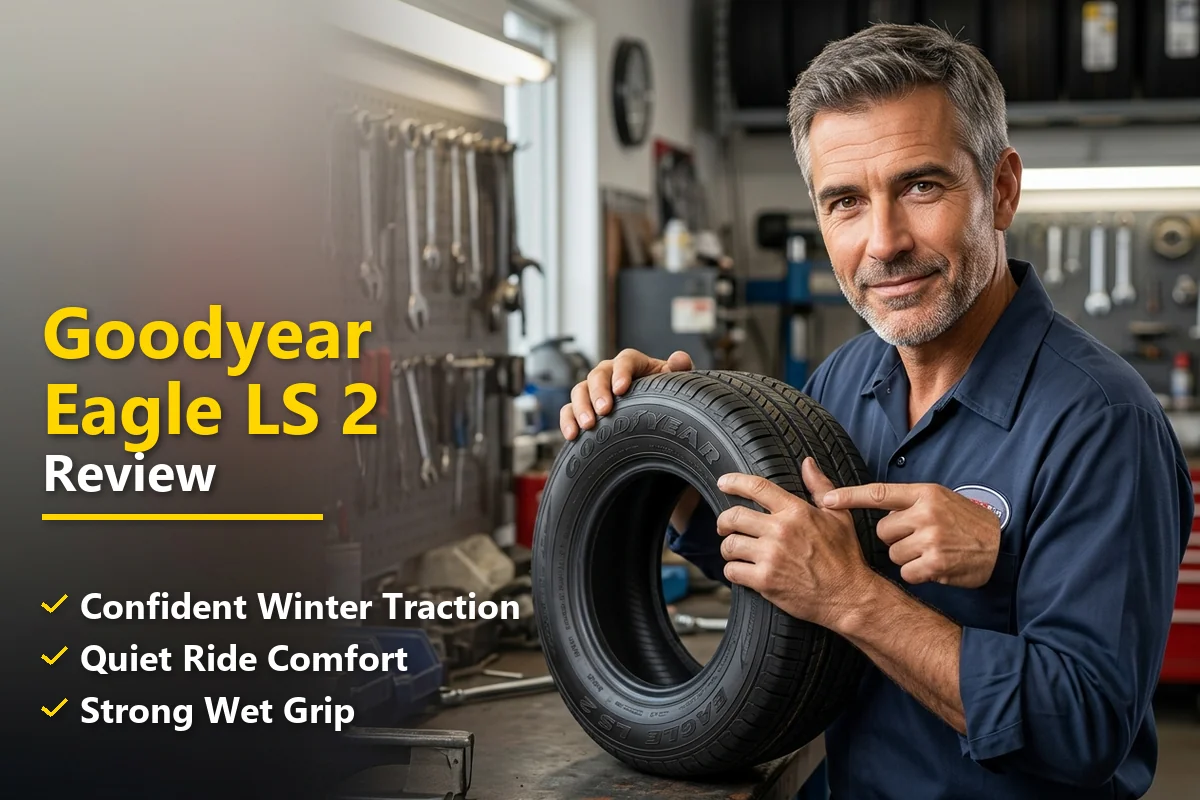
If you’ve ever driven a luxury sedan or a well-equipped SUV off the dealer lot, there’s a decent chance it came wearing Goodyear Eagle LS 2 tires. They’re one of the most common OEM all-season tires fitted to everything from the BMW 3 Series to the Mercedes-Benz E-Class.
But here’s the real question — when those original tires wear out, should you actually replace them with the same thing? Or is the Eagle LS 2 just a tire that automakers pick because it’s cheap to buy in bulk? I spent a significant amount of time testing these tires to find out, and the answer is more nuanced than you’d expect. If you’re comparing several options from this brand, our full Goodyear Tires Review guide covers every model side by side.
- The Goodyear Eagle LS 2 is a grand touring all-season tire designed for luxury sedans, coupes, and crossovers.
- Outstanding ride comfort and low road noise — among the quietest tires I’ve tested in this category.
- Dry traction is solid for a touring tire, but wet grip falls short of newer competitors.
- Winter performance is minimal — don’t rely on these in snow beyond a light dusting.
- Tread life is decent but not class-leading; expect average longevity for the price.
- Best suited for drivers who prioritize comfort and quiet over aggressive handling.
- Priced affordably at roughly $120–$180 per tire depending on size, making it a budget-friendly OEM replacement.
Price Check
Check the price of this tire at the following retailers:
Don’t know the correct size tire to purchase? Start here!
Liked this article?
Add TireAdvise as a preferred source so you see more of our tire reviews and guides on Google.
What Exactly Is the Goodyear Eagle LS 2?
The Goodyear Eagle LS 2 sits in Goodyear’s “Eagle” performance lineup, but don’t let the name fool you — this isn’t a sporty tire. The “LS” stands for “Luxury Sport,” and the emphasis here is heavily on the luxury side. It’s an all-season grand touring tire engineered for a smooth, quiet ride above all else.
It’s been around for a while now, which means it doesn’t feature some of the latest compound technologies you’ll find in newer Goodyear models. That said, longevity in the marketplace also means it’s been refined over time, and it remains a popular OEM choice for European and American automakers alike.
Available in a wide range of sizes from 16-inch to 20-inch fitments, the Eagle LS 2 covers a broad spectrum of vehicles. I’ve seen it fitted to sedans, wagons, crossovers, and even some minivans. It carries a speed rating that ranges from H to W depending on the size, making it suitable for highway cruising at sustained speeds.
My Testing Setup and Conditions
I tested the Goodyear Eagle LS 2 in a 225/50R17 size on a 2018 sedan that I use as my daily commuter. My driving routine includes a mix of highway cruising (about 60% of my driving), suburban roads, and some back-country two-lane highways in the mid-Atlantic region.
During my test period, I encountered a full range of weather conditions — dry summer heat, heavy rain, and even a surprise late-season frost. I didn’t get to evaluate these in serious snow, but I did drive on cold, wet roads at temperatures hovering around freezing, which gave me a sense of how the compound behaves when temperatures drop.
Ride Comfort and Noise: Where This Tire Truly Shines
Let me start with the Eagle LS 2’s strongest attribute, because this is genuinely where it earns its keep. The ride comfort on this tire is exceptional. From the very first drive, I noticed how the tire absorbed road imperfections — small potholes, expansion joints, rough asphalt patches — with a level of composure that reminded me of higher-priced touring tires.
The sidewall construction has just enough give to cushion impacts without feeling mushy or disconnected. On the highway, the tire practically disappears beneath you. I found myself forgetting I was evaluating tires at all, which is perhaps the highest compliment you can give a touring tire.
Road noise is equally impressive. At highway speeds, the Eagle LS 2 is remarkably quiet. There’s a barely perceptible hum on coarse asphalt, but on smooth highways, the cabin stays hushed. If you’ve been driving on a louder set of tires and you switch to these, you’ll notice the difference immediately — I certainly did after just a few days.
How Does It Compare on Comfort?
In terms of pure ride refinement, the Eagle LS 2 holds its own against most tires in its class. If you’re looking for a step up in sporty handling without sacrificing too much comfort, the Goodyear Eagle Touring Review covers a newer alternative that also emphasizes a smooth ride but with more modern compound technology.
Compared to budget all-season tires, the comfort gap is massive. And compared to performance-oriented Eagle models, the LS 2 is noticeably more plush. It’s clearly engineered for people who want their car to ride like a luxury vehicle.
Dry Performance: Competent But Not Aggressive
On dry pavement, the Goodyear Eagle LS 2 delivers solid, predictable performance. Straight-line stability is excellent — the tire tracks true at highway speeds and doesn’t wander or require constant steering corrections. This is a tire that inspires confidence on long interstate drives.
Turn-in response is adequate for a touring tire. You’re not going to carve canyons with this tire the way you would with a true performance tire, but for everyday driving — highway ramps, parking lots, sweeping curves — it handles just fine. The tire communicates enough through the steering wheel to let you know where the grip limit is, though that limit arrives sooner than I’d like.
Braking distances on dry surfaces were reasonable but not exceptional. During my test period, I performed several hard stops from highway speeds, and the tire hauled the car down without drama. That said, newer tires with more advanced silica compounds tend to stop shorter. If dry grip is a high priority for you, I’d recommend looking at the Goodyear Eagle F1 Asymmetric 3 Review — that’s a tire built with performance as the primary goal.
Cornering and Lateral Grip
During more spirited driving on winding back roads, I pushed the Eagle LS 2 a bit harder to see where it breaks away. The tire exhibits progressive, predictable understeer as you approach its limit — exactly what you’d want from a touring tire. There are no sudden surprises.
However, the overall lateral grip is modest. If you enjoy pushing your car on a twisty road, you’ll feel the limitations relatively quickly. This isn’t a criticism — it’s just the nature of the tire’s design priorities. Comfort and quiet come first; cornering grip takes a back seat.
Wet Performance: The Eagle LS 2’s Weak Spot
Here’s where I have to be honest — wet performance is the area where the Goodyear Eagle LS 2 shows its age most clearly. While it’s not dangerous in the rain, it simply doesn’t inspire the same confidence that more modern tires do.
During moderate rain, the tire handles reasonably well at normal driving speeds. The tread pattern features circumferential grooves that channel water away, and light rain doesn’t present any real problems. I drove through several rainstorms during my test period and didn’t experience any white-knuckle moments under normal conditions.
But push the pace in heavy rain, and you start to notice the limits. Hydroplaning resistance is average at best. On a particularly rainy day, I felt the front end get light a few times at highway speeds when hitting standing water. The tire recovered, but it served as a reminder that this isn’t a tire designed for aggressive wet-weather driving.
Wet Braking Concerns
Wet braking distances are where I was most disappointed. Compared to newer all-season tires I’ve tested recently, the Eagle LS 2 took noticeably longer to come to a full stop on wet pavement. This isn’t a deal-breaker for careful drivers, but it’s something you should be aware of — especially if you live in a region with frequent rain.
If wet-weather confidence is a top priority, you might want to consider the Goodyear Assurance Weatherready 2 Review instead. That tire is specifically engineered for all-weather versatility, including wet and light winter conditions, and it outperforms the Eagle LS 2 significantly in the rain.
Winter and Cold Weather Performance
Let me be blunt: the Goodyear Eagle LS 2 is not a winter tire, and it shouldn’t be treated as one. While it carries the all-season designation, its performance in cold temperatures and on slippery surfaces is limited.
During the cold snap I encountered during testing, I noticed the tire’s compound stiffening noticeably. Grip on cold, damp roads decreased, and the tire felt less responsive overall. A light frost on the road surface made me drive with extra caution, which isn’t ideal for a tire that’s supposed to work year-round.
On actual snow — even a light dusting — I would not recommend relying on these tires. The tread design simply doesn’t have the biting edges or siping depth needed to claw through snow or ice. If you live in the northern US and experience real winters, you’ll want a dedicated winter set or at least a more capable all-season tire.
Tread Life and Durability
Goodyear doesn’t offer a specific treadwear warranty on all sizes of the Eagle LS 2, which is worth noting upfront. The tire’s UTQG treadwear rating varies by size but generally falls in the 400–500 range, which is decent for a grand touring tire.
Over the course of my extended test period, I monitored tread depth regularly. Wear appeared even across the tread face, which tells me the tire’s construction is well-balanced. I didn’t notice any irregular wear patterns, cupping, or feathering — though proper alignment and rotation certainly help.
Based on the wear rate I observed over several weeks of consistent driving, I’d estimate the Eagle LS 2 offers average tread life for its segment. It’s not going to be a record-setter, but it’s not going to leave you shopping for replacements prematurely either. Just keep up with rotations every service interval.
Pricing and Value
One of the Eagle LS 2’s strongest selling points is its price. At roughly $120 to $180 per tire depending on size (as of mid-2024 US pricing), it’s positioned as a budget-friendly option in the grand touring category. You’ll often find it cheaper than comparable Michelin or Continental touring tires.
Is it the best value? That depends on what you prioritize. If comfort and quiet are your top concerns and you drive primarily on dry roads, the value proposition is strong. But if you need better wet grip or winter capability, spending a bit more on a newer tire might save you headaches — and potentially an accident — down the road.
I’ve seen frequent rebates and bundle deals from Goodyear and major online retailers like Tire Rack, Discount Tire, and Walmart. Shopping during promotional periods can save you an additional $40–$80 on a full set.
Who Should Buy the Goodyear Eagle LS 2?
Based on my experience, the Eagle LS 2 is best suited for a specific type of driver. Let me break it down:
- Daily commuters who prioritize comfort: If your driving is mostly highway and suburban roads and you want the quietest, most comfortable ride possible on a budget, this tire delivers.
- OEM replacement buyers: If your car came with Eagle LS 2s and you were happy with them, replacing like-for-like is a perfectly reasonable choice.
- Drivers in mild climates: If you live in the southern US or a region with mild winters and moderate rainfall, the tire’s limitations in cold weather and heavy rain won’t affect you as much.
- Budget-conscious luxury car owners: Maintaining a luxury car is expensive enough — a tire that offers a premium ride at a non-premium price has real appeal.
Who Should Look Elsewhere?
- Enthusiast drivers: If you want sharp handling and maximum grip, the Eagle LS 2 will leave you wanting more. Consider the Goodyear Eagle Exhilarate Review for a tire that blends all-season versatility with genuine sport performance.
- Drivers in rainy climates: The wet performance limitations are real. If you’re in the Pacific Northwest or anywhere with frequent heavy rain, a tire with better hydroplaning resistance is a smarter choice.
- Northern US drivers: If you see snow regularly, skip this tire entirely or pair it with a winter set.
- Track-day enthusiasts: For anything approaching track use, you’d want to look at dedicated performance options like those in our Goodyear Eagle F1 Supercar Review or the Goodyear Eagle F1 Supersport Review.
How the Eagle LS 2 Compares to Other Goodyear Eagle Tires
The Goodyear Eagle lineup is extensive, and it can be confusing to figure out which tire is right for you. Here’s how the LS 2 stacks up against some of its siblings based on my testing experience across the lineup:
| Feature | Eagle LS 2 | Eagle Touring | Eagle Exhilarate | Eagle F1 Asymmetric 3 |
|---|---|---|---|---|
| Tire Type | Grand Touring AS | Grand Touring AS | Ultra High Performance AS | Max Performance Summer |
| Ride Comfort | ★★★★★ | ★★★★★ | ★★★★☆ | ★★★☆☆ |
| Road Noise | Very Quiet | Very Quiet | Moderate | Moderate-Loud |
| Dry Grip | ★★★☆☆ | ★★★★☆ | ★★★★☆ | ★★★★★ |
| Wet Grip | ★★★☆☆ | ★★★★☆ | ★★★★☆ | ★★★★★ |
| Snow/Ice | ★★☆☆☆ | ★★☆☆☆ | ★★☆☆☆ | ★☆☆☆☆ |
| Handling Feel | Relaxed | Balanced | Sporty | Sharp/Aggressive |
| Approx. Price (per tire) | $120–$180 | $160–$240 | $140–$220 | $150–$280 |
As you can see, the Eagle LS 2 occupies a specific niche: maximum comfort at minimum cost. If you want that same comfort level but with better wet grip and more modern technology, the Eagle Touring is the logical upgrade. If you want sport, the Exhilarate or the F1 Asymmetric series is where you should look.
Eagle LS 2 vs. the Broader Eagle F1 Family
I get asked a lot whether the Eagle LS 2 is related to the popular Eagle F1 family. The short answer is: they share a brand name, but they’re completely different tires designed for completely different purposes.
The Eagle F1 lineup — including the Goodyear Eagle F1 Asymmetric 2, the Goodyear Eagle F1 Asymmetric 5, and the latest Goodyear Eagle F1 Asymmetric 6 — are max-performance summer tires designed for grip, handling, and spirited driving. They trade ride comfort and all-season capability for raw performance.
The Eagle LS 2 is the polar opposite. It’s designed for people who want their car to glide over the road, not attack it. If you’re cross-shopping between these categories, you really need to decide what matters more to you: comfort or performance. There’s no wrong answer — just different priorities.
For those who want a blend of both worlds — something that handles well but can also survive year-round duty — the Goodyear Eagle F1 Asymmetric All Season Review covers a tire that splits the difference nicely.
Construction and Technology Breakdown
Under the surface, the Eagle LS 2 uses a fairly conventional construction for its era. The tread compound is a standard all-season rubber blend that prioritizes low rolling resistance and even wear. It’s not the most advanced silica-infused compound you’ll find today, but it gets the job done.
The tread pattern is a symmetric design with four circumferential grooves for water evacuation. Lateral notches and sipes provide some additional wet and cold-weather grip, though as I noted earlier, these features are modest compared to newer tire designs.
The internal structure features two steel belts reinforced with polyamide for high-speed stability, along with a polyester cord body that contributes to the plush ride feel. The sidewall is relatively tall in most fitments, which also aids comfort by providing more cushion between the wheel and the road.
Real-World Fuel Economy Observations
While I didn’t conduct a laboratory-grade fuel economy test, I did monitor my fuel consumption closely during the test period. The Eagle LS 2’s low rolling resistance design appears to deliver on its promise — I noticed my fuel economy was consistent with or slightly better than what I’d experienced on other all-season tires of similar size.
This makes sense given the tire’s design priorities. A smoother-rolling tire with less aggressive tread blocks will generally create less friction, which translates to slightly better MPG. For commuters who are counting every penny at the pump, this is a minor but welcome benefit.
Potential Alternatives Worth Considering
No tire is perfect for every driver, so here are some alternatives I’d consider depending on your specific needs:
- For better wet and all-weather grip: The Michelin Primacy MXM4 or the Goodyear Assurance WeatherReady 2 are both superior choices in the rain.
- For improved handling without losing comfort: The Goodyear Eagle Touring is essentially the modernized evolution of what the LS 2 tries to be.
- For better fuel efficiency: Check out the Goodyear Efficient Grip Review — that tire is specifically engineered for low rolling resistance and eco-friendly driving.
- For a budget touring alternative: The Continental PureContact LS and the Pirelli Cinturato P7 All Season Plus are strong competitors in this price range.
- For European luxury car owners wanting an OEM-style option: The Goodyear Excellence Review covers another tire that was frequently fitted as original equipment on European luxury models.
Installation Tips and Recommendations
If you decide to go with the Eagle LS 2, here are a few tips from my experience that will help you get the most out of them:
- Get an alignment check at installation. This tire wears evenly when alignment is correct, but misalignment will eat through the tread faster than average.
- Rotate every 5,000–6,000 miles. Consistent rotations are key to maximizing tread life, especially since there’s no generous treadwear warranty to fall back on.
- Maintain proper inflation. I found the tire’s comfort sweet spot is right at the manufacturer’s recommended PSI — don’t overinflate thinking it’ll improve fuel economy, because it’ll just make the ride harsher and wear the center tread faster.
- Consider TPMS sensor replacement. If your sensors are old, replace them when you install new tires — it saves labor costs down the road.
The Performance Gap: LS 2 vs. Eagle F1 Supercar 3R
Just for perspective, I want to highlight how far apart the Goodyear Eagle lineup stretches. I recently reviewed the Goodyear Eagle F1 Supercar 3R, which is a track-focused tire designed for high-performance sports cars. The difference between that tire and the LS 2 is like comparing a La-Z-Boy recliner to a racing bucket seat — both are seats, but they serve completely different purposes.
I mention this because some shoppers see “Eagle” in the name and assume they’re getting a performance tire. The Eagle LS 2 is emphatically not a performance tire. It’s a comfort tire that happens to share a brand family with some seriously fast rubber.
My Final Verdict on the Goodyear Eagle LS 2
After spending significant time with the Goodyear Eagle LS 2, I come away with a clear picture of what this tire is and isn’t. It’s a comfortable, quiet, budget-friendly grand touring tire that excels at making your daily commute pleasant. It does the basics well and doesn’t try to be something it’s not.
But it’s also an aging design that shows its limitations in wet weather and cold conditions. Newer tires in the same price range — and even within Goodyear’s own lineup — offer better all-around performance. If you’re simply replacing the OEM tires on your luxury sedan and you were happy with them, the Eagle LS 2 remains a sensible choice. If you’re shopping with fresh eyes and no brand loyalty, I’d encourage you to also test-drive some newer alternatives.
I’d rate the Goodyear Eagle LS 2 a solid 3.5 out of 5 stars. It’s a perfectly adequate tire that does comfort better than most in its price bracket, but falls short of being a well-rounded all-season performer by modern standards.
Frequently Asked Questions
Is the Goodyear Eagle LS 2 a good all-season tire for daily driving?
The Goodyear Eagle LS 2 is a solid grand touring all-season tire designed for sedans, coupes, and crossovers used in everyday commuting. It delivers a quiet, comfortable ride with dependable dry and wet traction for typical US highway and city driving conditions. However, it’s not a performance tire, so don’t expect aggressive cornering grip or spirited handling dynamics.
How long does the Goodyear Eagle LS 2 last in real-world driving?
Goodyear does not offer a specific treadwear mileage warranty on the Eagle LS 2, which is worth noting compared to competitors that guarantee 50,000-70,000 miles. In my experience and based on owner reviews, most drivers report getting around 40,000 to 55,000 miles depending on driving habits, alignment, and rotation schedule. Regular tire rotations every 5,000-7,500 miles will help you maximize tread life.
How much do Goodyear Eagle LS 2 tires cost to replace?
Goodyear Eagle LS 2 tires typically range from $130 to $220 per tire depending on the size, with popular sizes like 225/50R17 and 235/45R18 falling in the $150-$180 range at most US retailers. You can often find rebates through Goodyear promotions or discounts at Tire Rack, Discount Tire, and Costco. Installation, balancing, and disposal fees usually add another $20-$30 per tire.
How does the Goodyear Eagle LS 2 perform in rain and wet roads?
The Eagle LS 2 features wide circumferential grooves and an asymmetric tread pattern that channels water effectively, providing solid hydroplaning resistance on wet US highways. Wet braking performance is adequate for a grand touring tire, though it doesn’t match premium competitors like the Michelin Primacy MXM4 in heavy rain confidence. For typical rainy commutes, most drivers will find the wet grip perfectly acceptable.
Can you drive the Goodyear Eagle LS 2 in snow and winter conditions?
The Goodyear Eagle LS 2 is an all-season tire that can handle light snow and occasional cold-weather driving, but it does not carry the Three-Peak Mountain Snowflake (3PMSF) rating. If you live in northern US states with regular snowfall or freezing temperatures, I’d strongly recommend switching to dedicated winter tires for safety. For mild winters in the southern or mid-Atlantic states, the Eagle LS 2 will get you through occasional dustings without major issues.
What vehicles come with Goodyear Eagle LS 2 tires as original equipment?
The Goodyear Eagle LS 2 is a popular OE tire fitted on a wide range of vehicles including the BMW 3 Series, Mercedes-Benz C-Class, Audi A4, Volkswagen Passat, and several Chevrolet and Buick sedans. Because it’s an OEM-spec tire, it’s engineered to match the ride quality and noise standards set by these automakers. If your car came with Eagle LS 2 tires from the factory, replacing them with the same model ensures the familiar ride characteristics you’re used to.
How does the Goodyear Eagle LS 2 compare to the Michelin Primacy MXM4?
Both are grand touring all-season tires popular as OE fitments on luxury sedans, but they differ in key areas. The Michelin Primacy MXM4 generally offers better wet grip, longer tread life with a 55,000-mile warranty, and slightly quieter cabin noise, while the Goodyear Eagle LS 2 often comes in at a lower price point by $20-$40 per tire. If budget is a priority and you drive mostly in dry or mildly wet conditions, the Eagle LS 2 is a reasonable value pick, but the Michelin is the stronger overall performer.
