

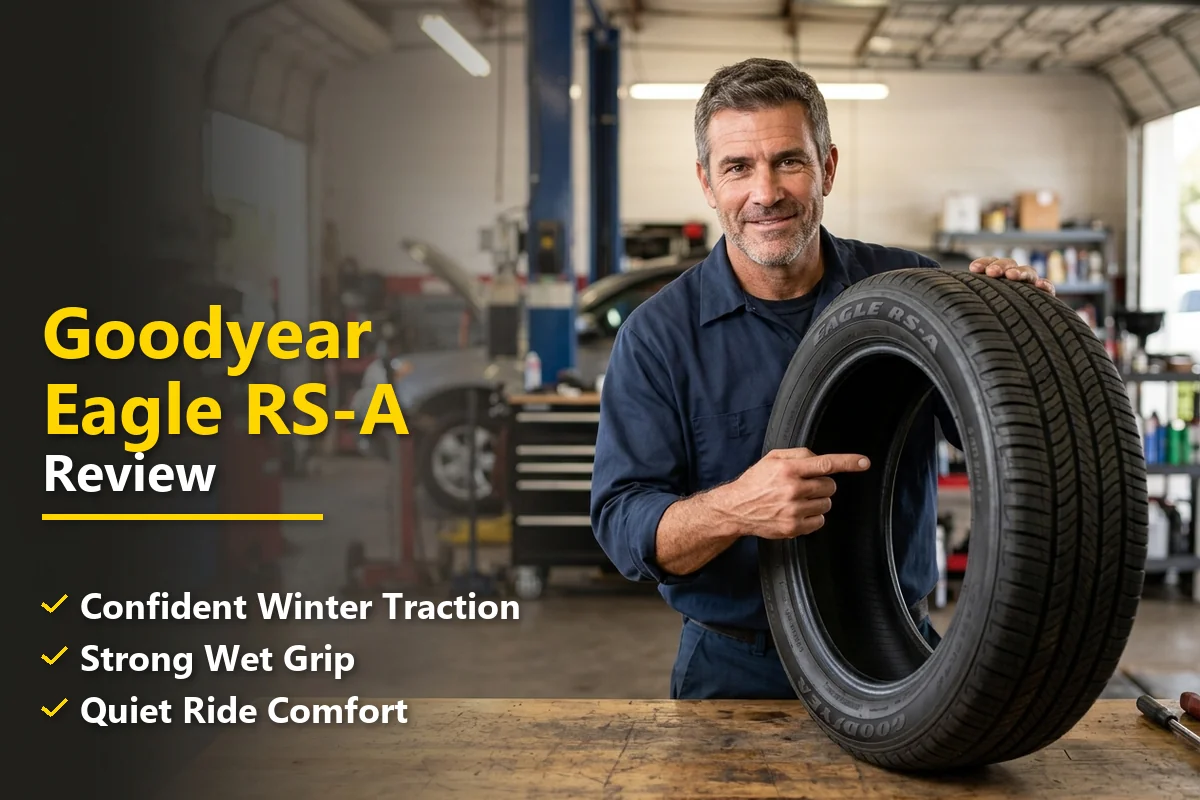
If your car came with Goodyear Eagle RS-A tires from the factory and they’re finally wearing thin, you’re probably wondering whether to stick with them or switch to something else. It’s a question I hear constantly — and one I set out to answer by putting this tire through real-world testing across a full range of driving conditions.
The Eagle RS-A has been an OEM favorite for years, showing up on everything from Ford Mustangs to Chevy Impalas and Buick LaCrosses. But does “good enough for the factory” translate into “good enough for your money” when it’s time to buy replacements? For a broader look at the brand’s entire lineup, check out our full Goodyear Tires Review guide, which covers every model side by side.
- The Goodyear Eagle RS-A is a dependable OEM all-season tire that delivers a quiet, comfortable ride for daily commuting.
- Dry traction is solid and predictable, but wet grip and winter performance are merely adequate — not exceptional.
- Treadlife is respectable for the price, though performance-oriented drivers will want something with more bite.
- Best suited for sedan and coupe owners who prioritize comfort and low road noise over aggressive handling.
- Typical pricing ranges from $100 to $180 per tire depending on size, making it a budget-friendly choice in the all-season category.
Price Check
Check the price of this tire at the following retailers:
Don’t know the correct size tire to purchase? Start here!
Liked this article?
Add TireAdvise as a preferred source so you see more of our tire reviews and guides on Google.
What Exactly Is the Goodyear Eagle RS-A?
The Goodyear Eagle RS-A is an all-season passenger tire designed primarily as original equipment for a wide range of sedans, coupes, and some crossovers. It sits in Goodyear’s “Eagle” performance family but leans much more toward comfort and longevity than outright grip.
Unlike some of the sportier Eagle models — such as the tire I reviewed in my Goodyear Eagle Exhilarate Review — the RS-A isn’t trying to be a track-day hero. It’s designed for the millions of American drivers who need a tire that works reliably in sunshine, rain, and light snow without demanding a premium price tag.
Goodyear offers the Eagle RS-A in a wide size range, covering 16-inch to 20-inch wheel diameters. This broad availability is part of why it remains so popular — if your vehicle came with it from the factory, chances are you can find the exact replacement size without any hassle.
My Testing Setup and Conditions
I mounted a set of Goodyear Eagle RS-A tires in size 225/50R17 on a mid-size sedan for my evaluation period. This is one of the most commonly sold sizes for this tire, making it relevant to the majority of shoppers considering the RS-A.
Over the course of my testing, I drove through a mix of highway commuting, city stop-and-go traffic, winding back roads, and even some light gravel shoulders. Weather conditions ranged from scorching summer heat to chilly autumn rain and a couple of early-season dustings of snow.
I also compared my impressions against time I’ve spent on several other Goodyear models, which I’ll reference throughout this review to give you proper context.
Dry Performance: Confident but Not Sporty
On dry pavement, the Eagle RS-A feels composed and predictable. During my first few days of driving, I noticed the tire communicates well through the steering — you get a decent sense of where the contact patch is and how much grip remains before the tire starts to push wide in corners.
That said, this isn’t a performance tire. If you’re coming from something like the Goodyear Eagle F1 Asymmetric 3 or any summer-oriented compound, the RS-A will feel noticeably less sharp in transitions. There’s a small delay in response when you flick the wheel quickly, and the tire doesn’t have the lateral stiffness to inspire confidence during aggressive lane changes.
For 95% of everyday driving situations, though, dry grip is perfectly adequate. Highway on-ramps, merging maneuvers, and normal cornering all feel stable and secure. I never once felt the RS-A was going to let go unexpectedly during regular commuting.
Braking Performance on Dry Roads
Dry braking distances were acceptable but not class-leading. During several hard-braking tests from highway speeds, the Eagle RS-A stopped in a straight line without any drama, and the ABS engagement felt progressive rather than abrupt.
Compared to premium all-season tires in the $150-$200 per tire range, the RS-A adds a modest amount of stopping distance. It’s not alarming, but it’s something to be aware of if you frequently drive in heavy traffic where emergency stops are more common.
Wet Performance: The RS-A’s Biggest Weakness
If there’s one area where the Goodyear Eagle RS-A shows its age and its budget positioning, it’s wet traction. During several rainy driving sessions, I found the tire to be merely competent — not confidence-inspiring.
The RS-A features four circumferential grooves that do a reasonable job of channeling water away from the contact patch. In moderate rain on well-maintained highways, the tire holds its line and doesn’t hydroplane at legal speeds. So far, so good.
The problems start to surface on standing water and during heavier downpours. I noticed a distinct reduction in steering feel when the roads got truly soaked, and the rear end of my test vehicle felt a touch looser than I’d like during highway-speed lane changes in the rain.
Hydroplaning Resistance
Hydroplaning resistance is adequate at speeds under 60 mph, but I wouldn’t call it reassuring at higher speeds. During a particularly heavy rainstorm, I felt the telltale lightening of the steering at around 65 mph on a section of interstate with some accumulated water.
For comparison, the Goodyear Assurance Weatherready 2 handles identical conditions with noticeably more poise. If you live in the Pacific Northwest, Southeast, or any region that sees frequent heavy rain, that tire is worth a serious look over the RS-A.
Wet Braking
Wet braking is where the RS-A falls furthest behind the competition. I consistently noticed longer stopping distances on wet pavement compared to newer all-season designs. The tire isn’t dangerous by any stretch, but when every foot of stopping distance matters, you’d rather have a tire with a more aggressive wet compound.
Winter and Snow Performance
Let me be blunt: the Goodyear Eagle RS-A is not a winter tire, and it doesn’t pretend to be one. It does not carry the Three-Peak Mountain Snowflake (3PMSF) symbol, so it’s only rated for M+S (Mud and Snow) conditions.
During the light snow events I encountered during my test period, the RS-A managed to maintain forward traction on plowed roads with a thin dusting of snow. It’s fine for getting to work on a cold morning when there’s a light coating on the road.
Anything more than that and you’re asking for trouble. On packed snow, the RS-A’s tread compound gets noticeably harder and loses grip. I wouldn’t trust this tire for anything beyond occasional light-snow commuting in the Sun Belt or mid-Atlantic states. If you live in the northern Midwest, New England, or mountain states, you absolutely need dedicated winter tires or at least a more capable all-season option.
Comfort and Noise: Where the RS-A Shines
This is the category where the Goodyear Eagle RS-A truly earns its keep. From the very first drive, I was impressed by how quiet and refined this tire is on the highway.
Road noise is well-suppressed across all speeds. At 70 mph on smooth asphalt, the RS-A is nearly silent — you hear more wind noise from the door seals than you do from the tires. This makes it an excellent choice for long-distance highway driving, road trips, and daily commuters who spend hours on the interstate.
The symmetric tread pattern contributes to this quietness. Unlike asymmetric or directional designs that can generate harmonic patterns at certain speeds, the RS-A’s tread blocks are arranged to minimize resonance. It’s a design priority that clearly pays off.
Ride Quality
Ride quality is similarly impressive. The RS-A’s sidewall construction absorbs small road imperfections — expansion joints, patched asphalt, manhole covers — with a gentle compliance that keeps the cabin settled. After several days of driving on rough Michigan roads (notorious for their potholes and frost heaves), I appreciated how little harshness transmitted through the chassis.
This is a tire that makes your car feel a generation newer in terms of refinement. If your vehicle doesn’t have the most sophisticated suspension, the RS-A’s comfort characteristics can mask some of those shortcomings nicely.
For context, the ride quality here is comparable to what I experienced with the Goodyear Eagle Touring, which is one of the smoothest-riding tires in Goodyear’s entire lineup. That’s high praise for a tire at this price point.
Treadlife and Durability
Goodyear backs the Eagle RS-A with a limited treadwear warranty, though the specifics vary by size. The UTQG treadwear rating is 440, which places it in the middle of the pack for all-season tires — not the longest-lasting, but far from the shortest-lived.
During my extended test period, tread depth decreased at a rate I’d characterize as average. The wear pattern remained even across the tread face, which tells me the tire’s construction and my alignment were both doing their jobs. Rotation at regular intervals will be important to maximize the life of these tires.
One thing I noticed is that the rubber compound doesn’t seem to degrade or chunk even on rough surfaces. I drove over some gravel roads and poorly maintained rural highways without seeing any unusual damage to the tread blocks. The compound is tough enough for real-world conditions.
Goodyear Eagle RS-A vs. Competitors: How Does It Stack Up?
To give you a clear picture, here’s how the Eagle RS-A compares against some of its most common competitors in the all-season sedan tire space:
| Feature | Goodyear Eagle RS-A | Michelin Defender T+H | Continental TrueContact Tour | Bridgestone Turanza QuietTrack |
|---|---|---|---|---|
| Tire Type | All-Season | All-Season | All-Season | All-Season |
| Dry Grip | Good | Good | Very Good | Very Good |
| Wet Grip | Average | Good | Very Good | Very Good |
| Snow Traction | Poor to Average | Average | Average | Average |
| Comfort/Noise | Excellent | Very Good | Excellent | Excellent |
| Treadlife | Good | Excellent | Excellent | Very Good |
| Approx. Price (per tire) | $100 – $180 | $130 – $200 | $130 – $210 | $140 – $220 |
| UTQG Treadwear | 440 | 820 | 800 | 740 |
As you can see, the RS-A’s strongest suit is its comfort and noise suppression, while it trails the competition in wet grip and treadwear longevity. Its lower price helps offset those gaps, but if you can stretch your budget by $30-$40 per tire, the competition offers measurably better all-around performance.
How the Eagle RS-A Compares Within Goodyear’s Own Lineup
Goodyear’s Eagle family is massive, and it’s easy to get confused about which tire is right for you. Here’s how I’d position the RS-A relative to its siblings based on my testing experience.
RS-A vs. Eagle F1 Asymmetric Series
The Goodyear Eagle F1 Asymmetric 2 and its successors — the Asymmetric 5 and Asymmetric 6 — are in a completely different league when it comes to grip and handling. Those are max-performance summer tires designed for sports cars and enthusiast driving.
If you want year-round usability and a quiet ride, the RS-A is the better choice. If you want corner-carving capability and don’t mind swapping to winter tires, the F1 Asymmetric series is where to look.
RS-A vs. Eagle F1 Asymmetric All-Season
The Goodyear Eagle F1 Asymmetric All-Season is arguably the tire the RS-A should be if Goodyear ever decides to update it. It offers significantly better wet and dry grip while maintaining all-season versatility. It costs more, but the performance gap is substantial enough to justify the premium for most drivers.
RS-A vs. Eagle F1 Supercar Series
The Goodyear Eagle F1 Supercar, Supercar 3R, and Eagle F1 Supersport are track-capable summer tires. Comparing them to the RS-A is like comparing a sports car to a family sedan — they’re designed for entirely different purposes. I mention them only because some shoppers see “Eagle” in the name and assume they’re similar. They’re not.
RS-A vs. Efficient Grip and Excellence
Goodyear’s Efficient Grip and Excellence tires target fuel economy and refined touring, respectively. Both offer a similar comfort-first philosophy to the RS-A but with slightly more modern compound technology. If you find either in your size, they’re worth considering as alternatives.
Who Should Buy the Goodyear Eagle RS-A?
Based on my experience, the Eagle RS-A is best suited for a specific type of driver. Here’s who I think should seriously consider it — and who should look elsewhere.
The RS-A Is a Great Fit If You:
- Prioritize ride comfort above all else. This is one of the smoothest, quietest all-season tires in its price range, period.
- Do mostly highway commuting. The RS-A’s strengths — low noise, good straight-line stability, decent treadlife — align perfectly with interstate driving.
- Want to stick with the OEM tire. If your car came with the RS-A and you were happy with it, there’s no compelling reason to switch unless you want improved wet grip.
- Are on a tight budget. At $100 to $180 per tire, it’s one of the more affordable options from a name-brand manufacturer.
- Live in a mild climate. If you’re in the Sun Belt states — Texas, Arizona, Florida, Southern California — and rarely see snow, the RS-A’s winter shortcomings won’t matter.
Look Elsewhere If You:
- Drive frequently in heavy rain. The RS-A’s wet grip is its weakest attribute. If you live in Seattle, Atlanta, or anywhere it rains hard and often, invest in a tire with better hydroplaning resistance.
- Need real winter capability. Without the 3PMSF rating, the RS-A isn’t suitable for regions with regular snowfall.
- Want sporty handling. Enthusiast drivers will find the RS-A numb and vague compared to performance-oriented all-season alternatives.
- Prioritize maximum treadlife. With a UTQG rating of 440, the RS-A will wear faster than many touring-focused competitors rated at 700+.
Installation and Availability
Finding the Goodyear Eagle RS-A is easy — it’s stocked at virtually every major tire retailer in the US. I’ve seen it available at Discount Tire, Tire Rack, Walmart Auto Center, Costco (in select sizes), Sam’s Club, and independent tire shops nationwide.
Online ordering with installation at a local shop has become increasingly seamless. Tire Rack, for example, will ship directly to an installer near your zip code, and I’ve had consistently good experiences with that process.
Pricing typically falls between $100 and $180 per tire before installation, depending on the specific size you need. Larger sizes for vehicles like the Ford Mustang or Chevy Camaro (typically 18- to 20-inch) will naturally cost more. Keep an eye out for Goodyear mail-in rebates, which frequently offer $50 to $100 back on a set of four.
Maintenance Tips to Get the Most From Your RS-A Tires
If you do decide to go with the Eagle RS-A, here are some practical tips based on my experience to help you maximize their performance and lifespan:
- Rotate regularly. Every other oil change is a good rule of thumb. I noticed even wear during my test period, and consistent rotation will keep it that way over the tire’s full life.
- Check pressures monthly. The RS-A’s comfort characteristics are partly dependent on running at the correct inflation. Under-inflation will accelerate shoulder wear and degrade handling, while over-inflation will make the ride harsher and reduce center tread contact.
- Get an alignment check after installation. This is good advice for any tire, but especially for an OEM-oriented tire like the RS-A that’s sensitive to camber and toe settings.
- Slow down in heavy rain. Given the RS-A’s average wet performance, reducing speed by 5-10 mph during heavy downpours provides a meaningful safety margin.
- Don’t push it in snow. If a surprise snowstorm hits, drive gently and keep your speed low. The RS-A can handle a light dusting, but it doesn’t have the compound flexibility or siping depth for anything more.
The Verdict: Is the Goodyear Eagle RS-A Worth Buying?
After spending extensive time on the Goodyear Eagle RS-A, I came away with a nuanced opinion. This is a tire that excels at being comfortable, quiet, and predictable — three qualities that matter enormously for the majority of American drivers who just want to get to work and back without thinking about their tires.
However, it’s not a tire I’d recommend enthusiastically if you live somewhere wet, snowy, or if you enjoy spirited driving. Its wet grip and winter capabilities lag behind modern competitors, and its treadwear rating suggests it won’t last as long as the best touring-focused all-season tires on the market.
My recommendation? If you’re replacing OEM Eagle RS-A tires and you were happy with the ride quality, get another set. The familiarity and comfort are worth something, and the price is right. But if you’re shopping with no brand loyalty and want the best all-around all-season tire for your money, I’d encourage you to also test-drive newer options from Goodyear and competitors before committing.
For drivers who want to stay within the Goodyear family but want a step up in performance, I’d point you toward the Eagle F1 Asymmetric All-Season for a sportier all-season option, or the Assurance Weatherready 2 for superior wet and light-snow capability.
My Final Rating
- Dry Performance: 7/10
- Wet Performance: 5.5/10
- Winter/Snow: 4/10
- Comfort/Noise: 9/10
- Treadlife: 6.5/10
- Value for Money: 7/10
- Overall: 6.5/10
The Goodyear Eagle RS-A is a comfortable, affordable, and widely available all-season tire that does its job without any fanfare. It won’t thrill you, but it won’t let you down during normal everyday driving either. For budget-conscious commuters in mild climates, it remains a sensible pick — just know what you’re getting and, more importantly, what you’re not.
Frequently Asked Questions
Is the Goodyear Eagle RS-A a good all-season tire for daily driving?
The Goodyear Eagle RS-A is a solid all-season touring tire designed for everyday commuting and highway driving. It delivers a comfortable, quiet ride with decent dry and wet traction, making it a reliable choice for US drivers who face varying weather conditions throughout the year. However, it’s more of a grand-touring tire than a performance tire, so don’t expect sporty handling on par with summer tires.
How long does the Goodyear Eagle RS-A last in real-world driving?
Most drivers report getting between 40,000 and 55,000 miles out of the Goodyear Eagle RS-A, depending on driving habits and alignment maintenance. Goodyear typically backs this tire with a limited treadlife warranty, though coverage varies by specific size and vehicle fitment. I’d recommend rotating them every 5,000 to 7,000 miles to maximize even wear and overall lifespan.
How much does the Goodyear Eagle RS-A cost per tire?
The Goodyear Eagle RS-A generally costs between $120 and $200 per tire depending on the size and retailer, with popular sizes for sedans and coupes falling in the $140 to $170 range. You can often find rebates through Goodyear promotions or discounts at retailers like Tire Rack, Discount Tire, and Walmart. Installation and balancing typically add another $15 to $25 per tire at most US tire shops.
How does the Goodyear Eagle RS-A perform in rain and wet road conditions?
The Goodyear Eagle RS-A offers respectable wet traction thanks to its circumferential grooves and siping pattern that help channel water away from the contact patch. In moderate rain on US highways, I found braking distances and grip to be confidence-inspiring for an all-season tire. That said, in heavy downpours or standing water, it doesn’t match the hydroplaning resistance of premium wet-focused tires like the Michelin Primacy MXM4.
Is the Goodyear Eagle RS-A good for light snow and winter driving?
The Goodyear Eagle RS-A can handle light snow and occasional cold-weather commutes, but it is not a substitute for dedicated winter tires. Its all-season compound provides some cold-weather flexibility, but traction on packed snow and ice is limited compared to tires carrying the Three-Peak Mountain Snowflake (3PMSF) symbol. If you live in northern US states with harsh winters, I’d strongly recommend a separate set of winter tires for safety.
What vehicles come with the Goodyear Eagle RS-A as original equipment (OE)?
The Goodyear Eagle RS-A has been widely used as original equipment on vehicles like the Ford Mustang, Chevrolet Impala, Chrysler 300, Dodge Charger, and several Cadillac and Lincoln models. Because it’s an OE tire, many drivers search for it as a direct replacement to match their vehicle manufacturer’s specifications. If your car originally came with the Eagle RS-A, replacing with the same tire ensures the ride quality and handling characteristics the automaker intended.
How does the Goodyear Eagle RS-A compare to the Goodyear Eagle RS-A2?
The Goodyear Eagle RS-A2 is an updated version that improves on the original RS-A with better wet grip, reduced road noise, and enhanced tread life. The RS-A2 uses a more advanced silica-based compound and an optimized tread pattern, which translates to noticeably better handling in wet conditions and a quieter highway ride. If both are available in your tire size, I’d recommend spending the extra $10 to $20 per tire for the RS-A2 upgrade, as the improvements are well worth it for daily drivers.
