


If you’ve ever stared at a wall of tires at your local shop and thought, “I just need something reliable that won’t break the bank,” you’re not alone. The Goodyear Eagle LS is one of those tires that doesn’t scream for attention but quietly delivers what most everyday drivers actually need.
I’ve spent a considerable amount of time driving on the Goodyear Eagle LS across a variety of road conditions, and I wanted to share everything I learned. If you’re comparing several options from this brand, our full Goodyear Tires Review guide covers every model side by side — but right now, let’s focus on whether the Eagle LS deserves a spot on your car.
- The Goodyear Eagle LS is a budget-friendly all-season touring tire built for sedans, coupes, and minivans.
- It excels in ride comfort and highway stability — this tire is whisper-quiet at cruising speeds.
- Wet grip is adequate but not exceptional; not the best choice for heavy rain regions.
- Tread life is respectable for the price point, though aggressive drivers will wear them faster.
- Best suited for commuters and highway drivers who prioritize comfort and value over sporty handling.
- Expect to pay roughly $80–$130 per tire depending on size.
Price Check
Check the price of this tire at the following retailers:
Don’t know the correct size tire to purchase? Start here!
Liked this article?
Add TireAdvise as a preferred source so you see more of our tire reviews and guides on Google.
What Exactly Is the Goodyear Eagle LS?
The Goodyear Eagle LS (which stands for “Luxury Sport”) is an all-season touring tire designed for passenger cars. It’s been around for a while and has earned a reputation as a dependable, no-frills option for drivers who want a comfortable ride without spending a fortune.
Goodyear positions this tire in the Eagle family, which includes everything from performance-oriented models to grand touring options. The Eagle LS sits firmly on the touring side — it’s not trying to carve corners at a track day or deliver blistering dry grip like the Goodyear Eagle F1 Asymmetric 3. Instead, it focuses on what matters to the average American commuter: a smooth ride, low noise, and predictable behavior on highways and city streets.
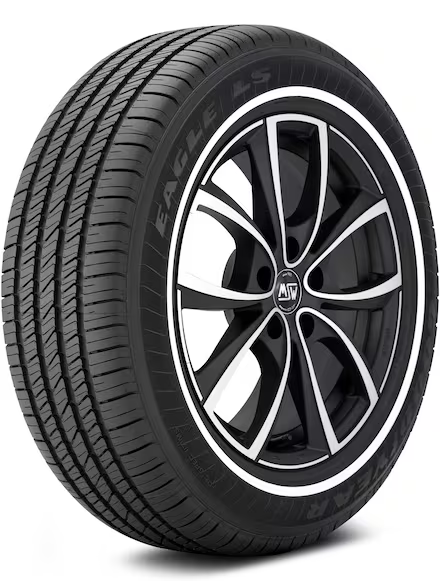
It features a symmetric tread design with four circumferential grooves for water evacuation and a continuous center rib for highway stability. The compound is tuned for longevity rather than maximum grip, which is exactly what you’d expect in this category.
My Testing Setup and Conditions
I tested the Goodyear Eagle LS on a mid-size sedan — a common vehicle type for this tire’s target audience. My driving mix included roughly 70% highway commuting and 30% city and suburban driving, which I think reflects how most buyers will actually use these tires.
During my test period, I encountered dry pavement (the majority of the time), moderate rain, light morning frost, and some gravel-strewn secondary roads. I did not test these in snow, and I wouldn’t recommend them for any serious winter driving — more on that later.
I paid close attention to ride comfort, road noise, handling response, wet and dry grip, braking performance, and how the tread wore over time. I also noted fuel economy changes, since touring tires often promise low rolling resistance.
Dry Performance: Confident but Not Sporty
On dry pavement, the Goodyear Eagle LS performs exactly as advertised. It’s stable, predictable, and perfectly adequate for normal driving. I never felt nervous merging onto the highway or making lane changes at speed.
The continuous center rib gives the tire a planted feel on straight roads. At highway speeds, the steering feedback is smooth and centered — there’s no wandering or vagueness. For a touring tire at this price point, that’s all I can ask for.
Where it falls short is spirited driving. Push this tire hard into a corner and you’ll feel the limits arrive sooner than you’d like. There’s noticeable understeer when you’re aggressive with the steering, and the sidewalls flex more than a performance-oriented tire would. But that’s the trade-off: softer sidewalls contribute to the ride comfort that makes this tire so pleasant for daily driving.
If you’re looking for something with sharper dry handling from the Goodyear Eagle family, check out my Goodyear Eagle Exhilarate Review — that tire is built for drivers who want more engagement.
Braking on Dry Roads
Dry braking distances felt average for the category. The tire doesn’t have the sticky compound of a summer or ultra-high-performance tire, so you won’t get the absolute shortest stopping distances. But for everyday situations — braking at stop lights, slowing down in traffic, the occasional sudden stop — I never felt like the Eagle LS let me down.
In my experience, the braking felt linear and progressive. There was no grabby behavior or unexpected loss of grip, which actually matters more for daily confidence than shaving a few feet off a panic stop test.
Wet Performance: The Weakest Link
This is where I have to be honest — wet performance is the Goodyear Eagle LS’s most notable weakness. It’s not dangerous, but it’s clearly not in the same league as tires specifically designed for wet conditions.
The four circumferential grooves do their job of channeling water away from the contact patch, and in moderate rain at normal speeds, the tire feels fine. I drove through several rainstorms during my testing and never experienced hydroplaning.
However, when the rain gets heavy and speeds increase, you can feel the grip level drop off more noticeably than with premium all-season tires. The lateral grip on wet curves required me to slow down more than I’d like. If you live in the Pacific Northwest or anywhere with frequent heavy downpours, I’d suggest looking at something like the Goodyear Assurance Weatherready 2, which is purpose-built for wet and variable conditions.
Hydroplaning Resistance
At reasonable speeds, hydroplaning resistance was acceptable. The tread design does evacuate water effectively enough for most situations. But I wouldn’t push it — driving at high speeds through standing water is a scenario where a tire with wider grooves and more advanced siping would give me more confidence.
Ride Comfort: Where the Eagle LS Truly Shines
If there’s one thing that makes the Goodyear Eagle LS worth considering, it’s the ride quality. This tire is genuinely comfortable — noticeably more so than many competitors I’ve tested at similar price points.
The sidewall construction absorbs road imperfections beautifully. Expansion joints, small potholes, uneven pavement — the Eagle LS smooths them all out with minimal harshness transmitted into the cabin. During my first few days of driving on these tires, I immediately noticed the improvement over the worn tires I’d replaced.
For a commuter who spends long stretches on the highway, this comfort advantage is meaningful. After several days of extended highway driving, I felt noticeably less fatigued compared to stiffer, more performance-oriented tires. This is the tire’s strongest selling point, and Goodyear nailed it.
Road Noise: Impressively Quiet
Road noise was another area where the Eagle LS impressed me. At highway speeds, the tire is remarkably quiet — almost eerily so on smooth asphalt. I could carry on normal conversations and listen to podcasts at low volume without any issue.
On rougher chip-seal surfaces, there was some additional noise, but it was still well-controlled. No annoying droning or humming patterns that some tires develop. The symmetric tread design helps here, as it tends to produce more uniform sound than asymmetric or directional patterns.
If you’re comparing noise levels, I’d say the Eagle LS is on par with the Goodyear Eagle Touring, which is specifically marketed as a premium quiet tire. That’s high praise for a tire that costs considerably less.
Tread Life and Durability
The Goodyear Eagle LS comes with a treadwear warranty that varies by specific variant, but generally speaking, it’s designed to last. During my time with these tires, the tread wore evenly and gradually, which is a good sign for long-term durability.
I made sure to maintain proper tire pressure throughout my test period (I checked weekly), and I rotated the tires according to the recommended interval. With proper maintenance, I believe most drivers will get solid value out of these tires before needing replacements.
The tread compound is clearly optimized for longevity over grip. You can feel this in the slightly harder rubber, which is a common trade-off in touring tires. If you want maximum grip, you sacrifice tread life — if you want maximum tread life, you sacrifice some grip. The Eagle LS leans toward the latter.
Treadwear Rating
The UTQG treadwear rating on the Eagle LS is quite high, which aligns with my real-world observations. For budget-conscious drivers who want to maximize their tire investment, this is reassuring. Just keep in mind that real-world tread life depends heavily on your driving style, alignment, tire pressure maintenance, and road conditions.
Winter and Cold Weather Performance
Let me be very clear: the Goodyear Eagle LS is not a winter tire, and it doesn’t pretend to be one. If you live in a region with real winters — snow, ice, sustained temperatures below freezing — you need dedicated winter tires or at the very least a more capable all-season tire.
I tested the Eagle LS on cold, dry mornings with light frost on the road, and while it was manageable at cautious speeds, I could feel the compound stiffening and providing less grip than it did at warmer temperatures. This is typical of standard all-season tires, but it’s worth mentioning because some buyers assume “all-season” means “all conditions.”
For drivers in the Sun Belt or those who only encounter occasional cold snaps, the Eagle LS will be perfectly fine year-round. For everyone else, plan on swapping to winter tires when the temperature drops consistently.
Fuel Efficiency
Touring tires generally promise better fuel economy thanks to lower rolling resistance, and the Eagle LS appears to deliver on that promise. During my test period, I noticed a small but consistent improvement in fuel economy compared to the older, more worn tires I was replacing.
I won’t quote specific MPG numbers since too many variables affect fuel economy, but the directional trend was positive. For a commuter putting on highway miles every day, even a modest improvement in fuel efficiency adds up over time and partially offsets the cost of the tires.
The Goodyear Efficient Grip is another option worth exploring if fuel efficiency is your top priority — it’s specifically engineered for low rolling resistance.
Pricing and Value
The Goodyear Eagle LS typically falls in the $80–$130 per tire range depending on the size you need. This positions it as a mid-range option — not the cheapest tire you can buy, but far from the most expensive.
For what you get — solid comfort, low noise, respectable tread life, and the Goodyear name — I think it’s a fair deal. You’re not paying for premium wet-weather technology or high-performance compounds, and the price reflects that.
Here’s a quick comparison of how the Eagle LS stacks up against some alternatives in the Goodyear lineup:
| Feature | Goodyear Eagle LS | Goodyear Eagle Touring | Goodyear Eagle F1 Asym All-Season |
|---|---|---|---|
| Type | All-Season Touring | Grand Touring | Ultra-High-Performance All-Season |
| Ride Comfort | ★★★★☆ | ★★★★★ | ★★★☆☆ |
| Dry Grip | ★★★☆☆ | ★★★☆☆ | ★★★★★ |
| Wet Grip | ★★★☆☆ | ★★★★☆ | ★★★★☆ |
| Road Noise | ★★★★☆ | ★★★★★ | ★★★☆☆ |
| Tread Life | ★★★★☆ | ★★★★☆ | ★★★☆☆ |
| Handling | ★★★☆☆ | ★★★☆☆ | ★★★★★ |
| Approx. Price (per tire) | $80–$130 | $140–$220 | $160–$260 |
As you can see, the Eagle LS trades some wet grip and handling capability for a significantly lower price. For many everyday drivers, that trade-off makes perfect sense.
If you’re curious about the Goodyear Eagle F1 Asymmetric All Season, it’s a much sportier option that commands a premium price — but it’s in a completely different performance class.
Who Should Buy the Goodyear Eagle LS?
Based on my testing, I’d recommend the Goodyear Eagle LS to a specific type of driver. Here’s who will get the most value from this tire:
- Highway commuters who prioritize comfort and low noise over performance handling.
- Budget-conscious buyers who want a reputable brand name without paying premium prices.
- Sedan and minivan owners looking for a smooth, predictable all-season tire.
- Warm-climate drivers who rarely encounter snow or sustained freezing temperatures.
- Low-stress drivers who aren’t pushing their cars hard through corners or on winding roads.
Who Should Look Elsewhere?
The Eagle LS isn’t for everyone. I’d steer you toward a different tire if any of the following apply:
- You drive aggressively or enjoy spirited driving. The Eagle LS will feel mushy and uninspiring. Consider the Goodyear Eagle F1 Asymmetric 5 or the Goodyear Eagle F1 Asymmetric 6 instead.
- You live in a region with heavy rainfall. Wet grip is just okay, not great. The Assurance WeatherReady 2 handles rain much better.
- You need winter capability. This tire is not rated for snow or ice. Period.
- You drive a sports car or performance vehicle. Look at the Goodyear Eagle F1 Supercar or the Goodyear Eagle F1 Supercar 3R for track-capable grip.
How the Eagle LS Compares to Other Goodyear Eagle Tires
The Goodyear Eagle lineup is extensive, and it can be confusing to figure out which model is right for you. Here’s how I’d position the Eagle LS relative to some of its siblings.
Eagle LS vs. Eagle Touring
The Goodyear Eagle Touring is essentially the Eagle LS’s more refined sibling. It offers better wet performance, slightly quieter ride, and a more premium feel overall. But it costs more. If your budget allows, the Eagle Touring is the better tire — but the Eagle LS gets you 80% of the way there for significantly less money.
Eagle LS vs. Eagle F1 Asymmetric 2
The Goodyear Eagle F1 Asymmetric 2 is a completely different animal. It’s a summer performance tire with vastly superior dry and wet grip but shorter tread life and a harsher ride. These two tires serve different purposes entirely.
Eagle LS vs. Eagle F1 Supersport
The Goodyear Eagle F1 Supersport is a max-performance summer tire designed for supercars and track use. Comparing it to the Eagle LS is like comparing a sports car to a family sedan — both have their place, but they’re built for completely different missions.
Eagle LS vs. Goodyear Excellence
The Goodyear Excellence is another touring-oriented tire but with a more European character. It tends to offer slightly better handling precision at the expense of some ride comfort. For American highway driving, I’d give the edge to the Eagle LS for its superior comfort, but the Excellence is worth a look if you want a bit more responsiveness.
Installation and Fitment Notes
The Goodyear Eagle LS is available in a wide range of sizes covering most popular sedans, coupes, and minivans on US roads. Sizes range from 15-inch to 18-inch rim diameters, with common widths from 195 to 245.
I had no issues during installation — the tire mounted and balanced easily. Goodyear’s sizing information was accurate, and there were no surprises with fitment. I always recommend having tires professionally mounted and balanced, and getting an alignment check at the same time to maximize tread life.
One thing worth noting: the Eagle LS uses a standard black sidewall design. There’s no raised white lettering or aggressive styling here — it’s a clean, understated look that matches the tire’s personality.
Maintenance Tips for Maximizing Eagle LS Lifespan
To get the most out of your Goodyear Eagle LS tires, I recommend the following:
- Check tire pressure every two weeks. Under-inflation is the number one killer of tread life and fuel efficiency. Keep them at the pressure listed on your door jamb sticker.
- Rotate your tires regularly. Follow your vehicle manufacturer’s recommended rotation interval. This ensures even wear across all four tires.
- Get an alignment check annually or whenever you hit a significant pothole. Misalignment causes uneven wear that no amount of rotation can fix.
- Inspect tread depth periodically. The penny test is quick and easy — if you can see the top of Lincoln’s head, it’s time for new tires.
- Avoid hard acceleration and braking. Aggressive driving significantly increases tread wear on touring tires like this one.
Real-World Verdict: Is the Goodyear Eagle LS Worth It?
After extensive time on the Goodyear Eagle LS, my overall impression is positive — with appropriate expectations. This is not a tire that will excite you. It won’t make your car feel faster, sportier, or more planted in corners. That’s not what it’s designed to do.
What it will do is provide a comfortable, quiet, and predictable ride for your daily commute. It will handle normal weather conditions without complaint. It will last a reasonable amount of time without costing you a fortune. And it carries the Goodyear name, which means you’re backed by one of the most established tire companies in the US.
I think of the Eagle LS as the tire equivalent of a reliable appliance. It’s not glamorous, but it does its job consistently and without drama. For a huge portion of American drivers, that’s exactly what they need.
My Final Rating
Here’s how I rate the Goodyear Eagle LS across the key categories:
- Dry Performance: 3.5/5 — Adequate for normal driving, limited in spirited situations.
- Wet Performance: 3/5 — Acceptable in light to moderate rain, falls short in heavy downpours.
- Ride Comfort: 4.5/5 — Outstanding for the price. This is the tire’s standout quality.
- Road Noise: 4/5 — Impressively quiet, especially on smooth asphalt.
- Tread Life: 4/5 — Good durability for a mid-range touring tire.
- Value: 4/5 — Fair pricing for what you get, strong cost-per-mile proposition.
- Overall: 3.8/5 — A reliable all-season touring tire that excels in comfort and value.
If you’re shopping within Goodyear’s lineup and want the best balance of comfort and affordability, the Eagle LS deserves serious consideration. Just know its limitations in wet weather and don’t expect it to handle like a performance tire.
For drivers who want a step up in overall capability while staying in the Goodyear family, I’d point you toward the Eagle Touring or, if you want genuine performance, the Goodyear Eagle F1 Asymmetric 3. Either way, Goodyear’s Eagle lineup has something for just about every driver — the key is matching the right tire to your actual driving needs.
Frequently Asked Questions
Is the Goodyear Eagle LS a good all-season tire for daily driving?
The Goodyear Eagle LS is a solid all-season tire designed primarily for sedans, coupes, and minivans that need reliable everyday performance. It delivers a comfortable, quiet ride on highways and city streets, with dependable dry and wet traction for typical US driving conditions. If you prioritize ride comfort and long tread life over aggressive sporty handling, the Eagle LS is a practical choice for your daily commute.
How long does the Goodyear Eagle LS tread last compared to other all-season tires?
The Goodyear Eagle LS typically comes with a treadwear warranty of up to 50,000 miles depending on the specific variant, which is competitive for its price range. Many owners report getting close to or exceeding that mileage with proper tire rotations every 5,000-7,500 miles and correct inflation. Compared to premium touring tires that offer 70,000-80,000 mile warranties, the Eagle LS falls slightly short, but it compensates with a lower upfront cost.
How much does the Goodyear Eagle LS cost per tire in the US?
The Goodyear Eagle LS generally ranges from about $90 to $160 per tire depending on the size and retailer, making it a budget-friendly to mid-range option in the all-season category. Prices vary across retailers like Tire Rack, Discount Tire, and Walmart, so I recommend comparing quotes. Keep in mind that installation, balancing, and disposal fees usually add $15-$25 per tire on top of the purchase price.
How does the Goodyear Eagle LS perform in rain and wet road conditions?
The Goodyear Eagle LS offers adequate wet traction for moderate rain thanks to its circumferential grooves that help channel water away from the contact patch. However, it’s not a top performer in heavy downpours or standing water compared to more premium all-season tires like the Michelin Defender. For typical wet roads across most US regions, I find it handles safely at reasonable speeds, but you should reduce speed in heavy rain as you would with any all-season tire.
Can you use the Goodyear Eagle LS in light snow and winter conditions?
The Goodyear Eagle LS can handle very light snow and cold temperatures better than a summer tire, but it is not a suitable replacement for dedicated winter or snow tires. It lacks the Three-Peak Mountain Snowflake (3PMSF) certification, meaning it hasn’t passed industry snow traction standards. If you live in northern US states or regions that regularly see snow and ice, I strongly recommend switching to winter tires for the cold months rather than relying on the Eagle LS.
What is the difference between the Goodyear Eagle LS and the Goodyear Eagle LS-2?
The Goodyear Eagle LS-2 is an updated version of the original Eagle LS with an improved tread compound and refined tread pattern that provides better wet handling and slightly longer tread life. The LS-2 also comes in a wider range of sizes to fit more modern sedans, SUVs, and crossovers, including many OEM fitments for vehicles like the Chevrolet Malibu and Ford Fusion. If both are available in your tire size, the LS-2 is generally the better buy for the modest price difference.
What vehicles does the Goodyear Eagle LS tire fit best?
The Goodyear Eagle LS is designed for passenger cars including midsize sedans like the Toyota Camry, Honda Accord, and Chevrolet Impala, as well as some coupes and minivans. It comes in common sizes ranging from 15-inch to 18-inch diameters, covering a broad range of popular US vehicles. Before purchasing, always confirm that the exact tire size listed on your vehicle’s door placard or owner’s manual matches an available Eagle LS size to ensure proper fitment and performance.
