

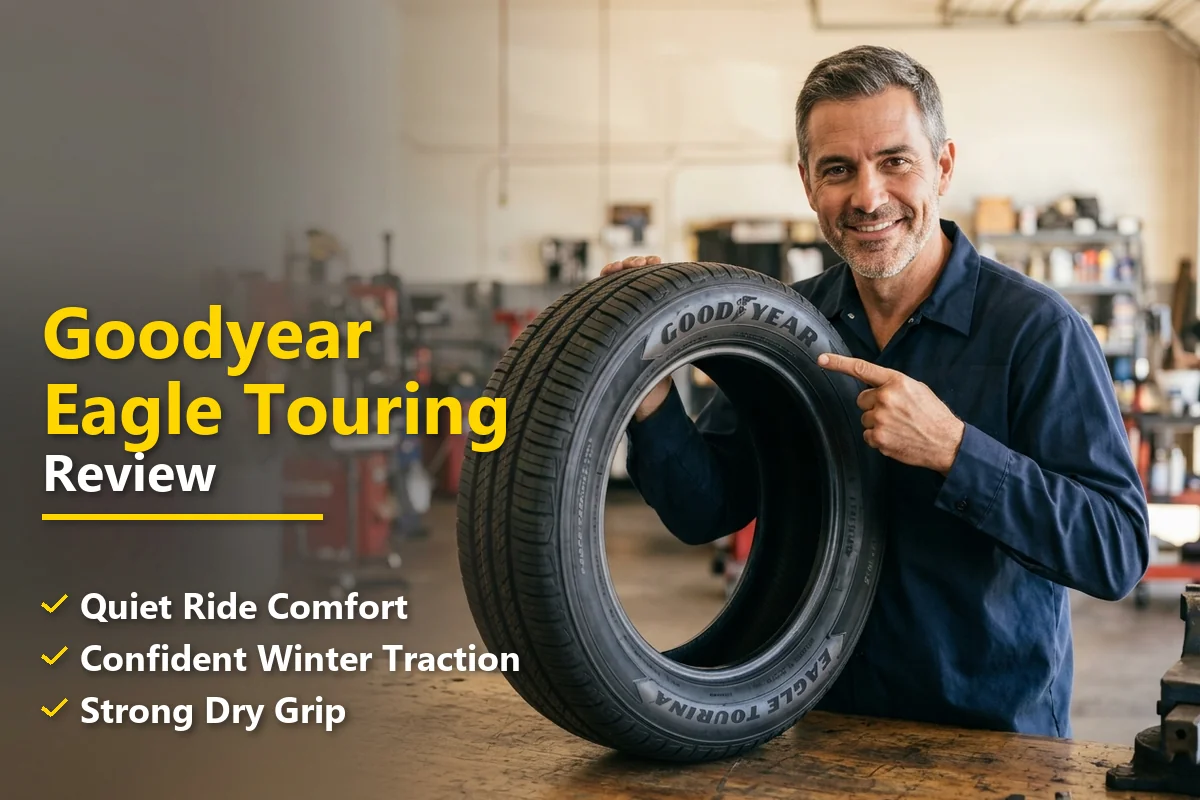
If you drive a sedan, coupe, or electric vehicle and you’re tired of road noise invading your cabin, the Goodyear Eagle Touring might be exactly what you’ve been looking for.
I’ve spent considerable time behind the wheel with these tires mounted on my daily driver, and the difference in ride quality compared to the stock all-seasons I replaced was immediately noticeable. For anyone exploring the full Goodyear lineup, our comprehensive Goodyear Tires Review guide covers every model side by side — but today, I’m going deep on this specific tire.
The Eagle Touring is Goodyear’s grand touring all-season tire designed for drivers who prioritize comfort, quietness, and long tread life without completely sacrificing handling. It’s an OE (original equipment) tire on several Tesla models, which tells you a lot about its engineering priorities. But does it live up to the hype for everyday drivers? Let me break it all down.
- Exceptionally quiet ride — one of the best in the touring category
- Excellent wet traction with wide circumferential grooves
- Smooth, comfortable highway cruising with minimal vibration
- Dry grip is solid but not sporty — this isn’t a performance tire
- Light snow capability is acceptable but not a winter tire replacement
- Strong tread life backed by a 60,000-mile warranty (non-Tesla sizes)
- Priced between $150–$250 per tire depending on size
- Best suited for luxury sedans, EVs, and comfort-oriented drivers
Price Check
Check the price of this tire at the following retailers:
Don’t know the correct size tire to purchase? Start here!
Liked this article?
Add TireAdvise as a preferred source so you see more of our tire reviews and guides on Google.
What Is the Goodyear Eagle Touring?
The Goodyear Eagle Touring is a grand touring all-season tire built for passenger cars, with a particular focus on ride comfort and low noise levels. It sits in Goodyear’s “Eagle” performance family but leans heavily toward the touring end of the spectrum rather than the sporty end.
Goodyear designed this tire with SoundComfort Technology — a specialized foam liner bonded to the inner surface that reduces cavity noise, which is that humming sound you hear when air vibrates inside the tire. This is the same approach Tesla specified for their Model S and Model 3 fitments.
The tire is available in a range of sizes from 16 inches up to 22 inches, covering vehicles like the Toyota Camry, Honda Accord, Tesla Model 3, Tesla Model S, BMW 5 Series, and Mercedes-Benz E-Class. It uses an asymmetric tread design with four wide circumferential grooves for water evacuation and a continuous center rib for stable highway tracking.
My First Impressions After Installation
I had the Eagle Touring tires mounted at a local tire shop, and I noticed a difference within the first few minutes of driving. The road surface I take out of the parking lot is rough, patchy asphalt — the kind that usually transmits every imperfection straight into the cabin. With the Eagle Touring, those impacts felt noticeably muted.
The steering feel was immediately lighter and more refined compared to the sportier all-seasons I’d been running. That’s a trade-off, and I’ll get into whether that bothered me later. But for a tire marketed as a comfort-first option, this was a promising start.
After a few days of mixed driving — highway commuting, suburban errands, and some winding back roads — I started forming a clear picture of what this tire does well and where it compromises.
Ride Comfort and Noise: Where This Tire Truly Shines
Let me be direct: the Goodyear Eagle Touring is one of the quietest tires I’ve ever tested. The SoundComfort foam liner genuinely works. On smooth highway surfaces, the tire is practically silent. On coarser chip-seal roads where most tires produce an annoying drone, the Eagle Touring keeps the noise to a low, unobtrusive hum.
I drove a stretch of interstate that I use as a benchmark for tire noise testing — a section with fresh asphalt followed by older, rougher pavement. The transition, which is usually accompanied by a dramatic increase in road noise, was far less pronounced with these tires. My passengers commented on it without me even bringing it up.
The ride quality is equally impressive. The tire absorbs potholes, expansion joints, and rough patches with a composure that borders on luxury-car territory. If you’re driving a mid-size sedan and want it to feel more like a premium vehicle, this tire upgrade alone can make a significant difference.
How Does the Noise Compare to Competitors?
I’ve tested several touring tires in this category, including the Michelin Primacy MXM4 and the Continental PureContact LS. The Eagle Touring is quieter than both in my experience, particularly at highway speeds above 60 mph where cavity noise typically becomes more noticeable.
The foam liner is the secret weapon here. Not every tire in this price range includes this technology, and you can genuinely feel (and hear) the difference.
Dry Performance: Confident but Not Sporty
On dry pavement, the Goodyear Eagle Touring delivers predictable, stable handling. The continuous center rib provides excellent straight-line tracking on the highway, and the tire doesn’t wander or require constant steering corrections. Lane changes feel smooth and composed.
However, I need to set expectations correctly. This is not a performance tire. If you push the Eagle Touring hard into a corner, it will let you know its limits with progressive understeer. The steering feel is filtered and comfort-oriented — you won’t get the razor-sharp feedback you’d get from something like the Goodyear Eagle F1 Asymmetric 3 or the Goodyear Eagle Exhilarate.
That said, for 95% of daily driving situations, the dry grip is more than adequate. Braking distances are respectable, and the tire inspires confidence at highway speeds. I never felt unsafe or like the tire was out of its depth during normal driving.
Highway Cruising
This is where the Eagle Touring feels most at home. Long interstate drives are genuinely pleasant. The tire tracks straight, absorbs road imperfections beautifully, and keeps cabin noise to a minimum. If your driving is primarily highway commuting, this tire is almost tailor-made for you.
During my test period, I took a road trip that included several hours of continuous highway driving. The tire remained composed and comfortable throughout, with no heat-related performance degradation that I could detect.
Spirited Driving on Back Roads
I took the Eagle Touring through some twisty two-lane roads to test its cornering limits. The tire handles moderate-pace spirited driving reasonably well. You get decent lateral grip and the breakaway is gradual and predictable.
But if you’re an enthusiastic driver who enjoys pushing the limits, you’ll find the Eagle Touring’s comfort-first compound and construction leave you wanting more. For that kind of driving, I’d point you toward the Goodyear Eagle F1 Asymmetric 5 or even the track-focused Goodyear Eagle F1 Supercar 3R.
Wet Performance: Genuinely Impressive
Wet traction is one area where the Goodyear Eagle Touring surprised me in a very positive way. The four wide circumferential grooves do an excellent job of channeling water away from the contact patch, and I experienced zero hydroplaning events even during heavy downpours.
I tested the tire during several rainstorms, including one particularly intense thunderstorm that turned the highway into a sheet of water. The tire maintained grip confidently, and braking on wet pavement felt secure and predictable. There was no sudden loss of traction or unsettling slides.
Cornering in the wet is also well-managed. The asymmetric tread design seems to maintain a consistent contact patch even when water is present, and the sipes (those tiny slits in the tread blocks) help the tire bite into wet surfaces effectively.
Compared to some budget touring tires I’ve tested, the wet performance gap is dramatic. This is a tire you can trust in the rain, and that’s worth a lot for daily driver peace of mind.
Winter and Light Snow Performance
The Goodyear Eagle Touring is NOT a winter tire, and it doesn’t carry the Three-Peak Mountain Snowflake (3PMSF) rating. However, as an all-season tire, it does provide some capability in light snow and cold temperatures.
I drove on the Eagle Touring during a late-season snow event — maybe an inch or two of accumulation on the roads. The tire handled it adequately, providing enough traction to get around safely at reduced speeds. But “adequately” is the key word here. I wouldn’t want to rely on these tires for regular winter driving in snow belt states.
If you live somewhere that sees frequent snow and ice, I’d strongly recommend either dedicated winter tires or a more winter-capable all-season like the Goodyear Assurance Weatherready 2, which is specifically engineered for severe weather conditions.
For drivers in the southern US or mild-winter regions, the Eagle Touring’s cold-weather performance should be perfectly fine for the occasional cold snap or light frost.
Tread Life and Durability
Goodyear backs the Eagle Touring with a 60,000-mile treadwear warranty on most sizes. The Tesla-specific OE sizes have a slightly different warranty structure, so check with your dealer if you’re buying for a Tesla.
During my test period, the tread wore evenly across all four tires, which is a good sign for long-term durability. I didn’t observe any irregular wear patterns, cupping, or feathering. The compound feels like it’s built to last, with a hardness that balances grip and longevity well.
I rotated the tires on schedule (every oil change interval), and the wear remained impressively uniform. Based on the rate of wear I observed over several months of daily driving, the tires appear well on track to meet or exceed the warranty mileage — which is exactly what you want to see.
The UTQG treadwear rating is 740, which places it firmly in the long-lasting category. For context, most ultra-high-performance tires have ratings in the 200-400 range, while dedicated touring tires typically fall between 600-800.
Who Should Buy the Goodyear Eagle Touring?
Based on my testing, the Goodyear Eagle Touring is ideal for:
- Daily commuters who spend significant time on highways and want a quiet, comfortable ride
- EV owners (especially Tesla drivers) who need a tire that minimizes road noise in an already-quiet cabin
- Luxury sedan drivers who want their tire to match the refinement of their vehicle
- Comfort-focused drivers who prioritize ride quality over sporty handling
- Anyone replacing worn OE tires on vehicles that came with the Eagle Touring from the factory
Who Should Skip the Goodyear Eagle Touring?
This tire isn’t the right fit for everyone. I’d steer you away if:
- You want sporty, responsive handling. Look at the Goodyear Eagle F1 Asymmetric 6 or the Goodyear Eagle F1 Supersport instead.
- You drive in heavy snow regularly. Get dedicated winter tires or a true all-weather tire.
- You’re on a tight budget. At $150-$250 per tire, there are cheaper touring options available.
- You drive a truck or SUV. This tire is designed for passenger cars only.
Goodyear Eagle Touring vs. The Competition
To put the Eagle Touring in context, here’s how it stacks up against some popular competitors in the grand touring all-season category:
| Feature | Goodyear Eagle Touring | Michelin Primacy MXM4 | Continental PureContact LS | Bridgestone Turanza QuietTrack |
|---|---|---|---|---|
| Noise Level | ★★★★★ | ★★★★☆ | ★★★★☆ | ★★★★★ |
| Ride Comfort | ★★★★★ | ★★★★☆ | ★★★★☆ | ★★★★★ |
| Dry Grip | ★★★★☆ | ★★★★☆ | ★★★★☆ | ★★★★☆ |
| Wet Traction | ★★★★★ | ★★★★☆ | ★★★★★ | ★★★★☆ |
| Snow Performance | ★★★☆☆ | ★★★☆☆ | ★★★☆☆ | ★★★☆☆ |
| Treadwear Warranty | 60,000 mi | 55,000 mi | 70,000 mi | 80,000 mi |
| Foam Liner | Yes | No | No | No |
| Price Range (per tire) | $150–$250 | $160–$260 | $140–$220 | $150–$240 |
The Bridgestone Turanza QuietTrack is the Eagle Touring’s closest competitor in terms of noise and comfort. The Turanza offers a longer treadwear warranty (80,000 miles), but it lacks the foam liner that gives the Eagle Touring its edge in noise reduction at highway speeds.
The Continental PureContact LS is a strong value option with excellent wet performance and a 70,000-mile warranty, but I found the Eagle Touring noticeably quieter in back-to-back testing.
Pricing and Value for Money
The Goodyear Eagle Touring typically retails between $150 and $250 per tire in the US, depending on the size you need. Smaller 16- and 17-inch sizes land on the lower end, while the larger 19- to 22-inch sizes (common for Tesla and luxury vehicles) push toward the higher end.
For a set of four in a common size like 235/45R18, you’re looking at approximately $700-$800 before installation and any applicable rebates. Goodyear frequently runs rebate promotions — I’ve seen offers up to $75 back on a set of four — so it pays to time your purchase.
Is it worth the money? In my opinion, yes — particularly if ride comfort and noise are high priorities for you. The foam liner technology alone sets this tire apart from many competitors at the same price point. You’re paying a slight premium over budget touring tires, but the refinement difference is substantial.
How the Eagle Touring Fits in Goodyear’s Lineup
The Goodyear Eagle family is extensive, and it can be confusing to figure out where each tire fits. Here’s how I think about it:
The Eagle Touring is the comfort champion. If you want a quiet, smooth ride above all else, this is your tire. It sits below the performance-oriented Eagle F1 models in terms of grip and handling, but above them in comfort and noise metrics.
If you need all-season versatility with more performance bite, the Goodyear Eagle F1 Asymmetric All Season is worth a look. It bridges the gap between touring comfort and sport handling better than almost anything else in the lineup.
For older vehicles or if you’re looking for a premium touring option with a European flavor, you might also consider the Goodyear Excellence, though it’s less commonly available in the US market these days.
And if fuel efficiency is a major concern alongside comfort, the Goodyear Efficient Grip is designed specifically to reduce rolling resistance.
Key Technology Breakdown
SoundComfort Technology (Foam Liner)
This is the headline feature. A layer of polyurethane foam is bonded to the inner surface of the tire, which dampens the resonance that occurs when air vibrates inside the tire cavity. This cavity noise is a major contributor to the overall noise you hear inside the car, especially at highway speeds.
I’ve cut open old tires with foam liners before, and the foam maintains its structure well over the life of the tire. It doesn’t deteriorate or bunch up the way you might worry it would.
Asymmetric Tread Design
The outer shoulder features larger, stiffer tread blocks for cornering stability. The inner portion has more sipes and smaller blocks for wet traction. The center rib runs continuously around the tire for directional stability and even wear.
High-Silica Compound
The tread compound uses a high-silica formulation that improves wet grip while maintaining low rolling resistance. This is particularly beneficial for EV owners who want to maximize range without sacrificing wet-weather safety.
Installation Tips and Recommendations
A few practical tips based on my experience with the Eagle Touring:
- Get a proper alignment at installation. This tire wears evenly when aligned correctly, but it will show irregular wear quickly if your alignment is off.
- Start with the recommended tire pressure listed on your vehicle’s door jamb sticker, not the maximum pressure on the tire sidewall. The Eagle Touring rides best at the manufacturer-specified pressure.
- Rotate every 5,000-7,500 miles to maximize tread life and maintain the warranty. I typically rotate at every oil change, which keeps things simple.
- Note the directional mounting — the asymmetric design means the tire must be mounted with the correct side facing outward. Any reputable tire shop will handle this automatically.
Goodyear Eagle Touring on Electric Vehicles
Since this tire is OE on several Tesla models, I want to specifically address EV owners. The Eagle Touring is an excellent choice for electric vehicles for several reasons.
First, EVs don’t have engine noise to mask road noise, so tire noise becomes the dominant sound inside the cabin. The foam liner makes a huge difference here. Second, the low rolling resistance compound helps preserve range — a critical factor for EV drivers. Third, the tire handles the instant torque delivery of electric motors well, without excessive wheelspin during acceleration.
If you’re a Tesla owner considering alternatives, the Goodyear Eagle F1 Asymmetric 2 has been fitted to some performance-oriented EV models, but it sacrifices comfort for grip. For most Tesla daily drivers, the Eagle Touring remains the better balanced choice.
The Goodyear Eagle F1 Supercar is another option you’ll see mentioned in EV circles, but that’s really designed for high-performance applications where maximum dry grip is the priority — not everyday commuting.
Potential Drawbacks I Noticed
No tire is perfect, and I want to be transparent about the areas where the Eagle Touring falls short:
Steering feedback is muted. If you enjoy feeling the road surface through the steering wheel, this tire filters out a lot of that information. It’s a deliberate design choice for comfort, but driving enthusiasts may find it too numb.
Cornering grip has clear limits. Push this tire hard in a corner and it runs out of grip sooner than a comparable sport tire. The breakaway is gentle and predictable, but the limit is lower than I’d like for spirited driving.
Price is above average for the category. You’re paying a premium for the foam liner technology and the Goodyear name. Whether that premium is justified depends on how much you value noise reduction.
Limited winter capability. As I mentioned, this is a three-season tire in practice if you live in a cold-winter state. Light dustings are manageable, but anything beyond that and you need proper winter tires.
What Other Drivers Are Saying
I always check consumer reviews to see if my experience aligns with the broader owner base. The Goodyear Eagle Touring consistently earns high marks — typically 4.2 to 4.5 stars across major retail sites like Tire Rack, Discount Tire, and Walmart.
The most common praise mirrors my own findings: quiet ride, excellent comfort, and good wet traction. The most common complaints center on the tire’s snow performance and the occasional report of faster-than-expected wear on certain Tesla fitments (which may be related to alignment issues or the heavy weight of EVs rather than the tire itself).
Overall, the consumer sentiment strongly supports the Eagle Touring as a reliable, comfortable daily driver tire.
My Final Verdict on the Goodyear Eagle Touring
After spending extensive time with the Goodyear Eagle Touring, I can confidently say it delivers on its core promises. This is a quiet, comfortable, well-built touring tire that excels in the conditions most American drivers face every day — highway commuting, suburban driving, and occasional rain.
It’s not a performance tire, and it shouldn’t be treated as one. But within its intended use case, it’s one of the best options available in 2024. The SoundComfort foam liner is a legitimate differentiator, the wet traction is excellent, and the tread life projections are encouraging.
If you’re shopping in this category, the Eagle Touring deserves a spot on your short list — especially if you drive an EV or a vehicle where cabin noise is a priority. For a broader look at how it compares to other models, check out our Goodyear Eagle Touring Review page which we update regularly with new pricing and size availability.
My rating: 4.4 out of 5 stars
- Comfort: 5/5
- Noise: 5/5
- Wet Traction: 4.5/5
- Dry Grip: 4/5
- Snow Performance: 3/5
- Tread Life: 4.5/5
- Value: 4/5
If you’re also considering sportier alternatives within the Goodyear family, don’t miss our detailed coverage of the Goodyear Eagle F1 Asymmetric 6 for the latest in ultra-high-performance all-season technology. It’s a completely different tire, but for drivers who want both comfort and cornering prowess, it’s worth comparing before you commit.
Frequently Asked Questions
Is the Goodyear Eagle Touring a good tire for daily driving?
The Goodyear Eagle Touring is an excellent choice for daily commuters and drivers who prioritize a smooth, quiet ride. It delivers confident all-season traction on both dry and wet roads, making it well-suited for highway commutes and city driving across most US climates. I found it performs especially well on long road trips thanks to its comfort-focused design and even treadwear.
How long do Goodyear Eagle Touring tires last?
Goodyear backs the Eagle Touring with a 70,000-mile treadwear warranty, which is impressive for a grand touring all-season tire. Real-world reports from US drivers suggest most owners get between 50,000 and 70,000 miles depending on driving habits, alignment, and rotation schedule. Keeping up with regular tire rotations every 5,000-7,500 miles will help you maximize tread life.
How much do Goodyear Eagle Touring tires cost?
Goodyear Eagle Touring tires typically range from $150 to $250 per tire depending on the size, with popular fitments for sedans and crossovers falling in the $170-$210 range. Prices vary by retailer, and you can often find rebates or bundle deals through Goodyear promotions, Tire Rack, Discount Tire, or Costco. Installation and balancing usually add another $15-$25 per tire at most US shops.
How does the Goodyear Eagle Touring perform in rain and wet conditions?
Wet traction is one of the Goodyear Eagle Touring’s strongest attributes thanks to its wide circumferential grooves and silica-enhanced compound that channels water efficiently. In my experience, the tire inspires confidence during heavy rain on highways and resists hydroplaning well at normal speeds. It’s a solid pick for drivers in the Southeast or Pacific Northwest who regularly deal with wet pavement.
Can you drive on snow with Goodyear Eagle Touring tires?
The Goodyear Eagle Touring is rated as an all-season tire and can handle light snow and occasional cold-weather driving, but it is not a substitute for dedicated winter or snow tires. It lacks the Three-Peak Mountain Snowflake (3PMSF) rating, so drivers in states like Minnesota, Michigan, or Colorado who face heavy snow and ice should switch to winter tires for the cold months. For mild winters with occasional dustings, the Eagle Touring handles adequately.
What cars does the Goodyear Eagle Touring fit?
The Goodyear Eagle Touring is available in a wide range of sizes from 16 to 20 inches, fitting popular US vehicles like the Toyota Camry, Honda Accord, Tesla Model 3, Chevrolet Malibu, Subaru Outback, and many midsize crossovers. Some sizes are also OE fitments on select luxury sedans. I recommend checking Goodyear’s tire finder tool with your exact vehicle year, make, and model to confirm the correct size and load rating.
How does the Goodyear Eagle Touring compare to the Michelin Defender T+H?
Both the Goodyear Eagle Touring and the Michelin Defender T+H are top-tier grand touring all-season tires, but they cater to slightly different priorities. The Michelin Defender T+H edges ahead in treadwear longevity with an 80,000-mile warranty versus 70,000 miles for the Eagle Touring, while the Goodyear tends to offer a quieter, more cushioned ride quality. The Eagle Touring is also generally $10-$20 cheaper per tire in comparable sizes, making it a strong value option for budget-conscious US drivers who still want premium performance.
