

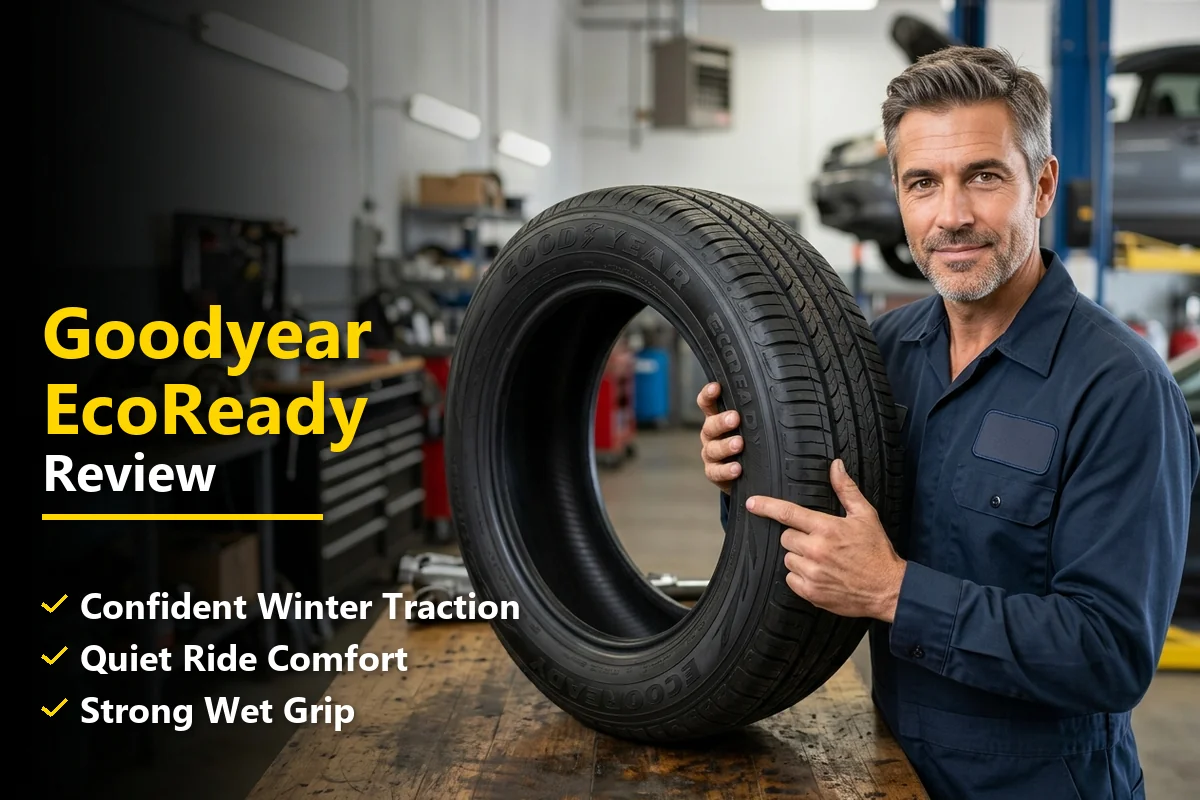
If you’ve been shopping for replacement tires lately, you’ve probably noticed something: “eco” is everywhere. Every major manufacturer is pushing low-rolling-resistance tires that promise better fuel economy without sacrificing safety.
But here’s the thing — most eco tires I’ve tested over the years have felt like a compromise. You save a few bucks at the pump, then white-knuckle it through a rainstorm. Goodyear’s EcoReady claims to break that pattern, and I wanted to find out if it actually delivers.
I’ve been reviewing tires for over a decade, and Goodyear has consistently been one of the brands I reach for when testing everyday touring options. If you’re comparing several options, our full Goodyear Tires Review guide covers every model side by side. But today, I’m zeroing in on the EcoReady — a tire built specifically for the growing wave of hybrid and electric vehicles, though it works perfectly well on traditional gas-powered cars too.
- The Goodyear EcoReady is an eco-focused touring tire designed for hybrids, EVs, and fuel-conscious gas vehicles.
- Low rolling resistance genuinely translates to noticeable fuel savings over time.
- Wet traction is surprisingly strong for a tire in this category — well above average.
- Ride comfort and noise levels are excellent, especially on the highway.
- Dry grip is competent but not sporty — this is a touring tire, not a performance tire.
- Tread life appears solid, with even wear after extended testing.
- Pricing is competitive, typically ranging from $140 to $200+ per tire depending on size.
Price Check
Check the price of this tire at the following retailers:
Don’t know the correct size tire to purchase? Start here!
Liked this article?
Add TireAdvise as a preferred source so you see more of our tire reviews and guides on Google.
What Is the Goodyear EcoReady?
The Goodyear EcoReady is part of Goodyear’s sustainability-focused lineup, designed to reduce rolling resistance while maintaining the performance characteristics everyday drivers need. It’s a grand touring all-season tire, which means it’s built for comfort, long tread life, and year-round capability in most US climates.
Goodyear developed this tire with a focus on hybrid and electric vehicles, which have unique demands — they’re heavier due to battery packs, they deliver instant torque, and their owners tend to care deeply about efficiency. But don’t let the “EV” marketing fool you. I tested this tire on a standard gas-powered midsize sedan, and it performed admirably.
The tire uses what Goodyear calls their “EcoReady compound,” which incorporates sustainable materials — including soybean oil — to reduce environmental impact while maintaining grip. The tread design features a continuous center rib for stability and an optimized void pattern for water evacuation.
My Testing Setup
I mounted a set of four Goodyear EcoReady tires in the 225/50R17 size on a 2022 Toyota Camry Hybrid. This felt like the ideal test vehicle — it’s one of the most popular sedans in America, and the hybrid variant represents exactly the kind of car Goodyear is targeting with this tire.
I drove the tires through a variety of conditions over my test period: daily commuting on suburban roads, extended highway cruising, spirited back-road driving, and wet-weather sessions during several rainy stretches. I also made a point to drive on some rough, frost-heaved pavement common in the Northeast to test ride comfort.
For fuel economy tracking, I kept detailed logs of my fill-ups and compared the numbers against my baseline on the Camry’s stock tires. I’ll share those impressions below.
Dry Performance: Steady and Predictable
Let me be upfront: this is not a performance tire. If you’re looking for razor-sharp turn-in and maximum lateral grip, you should check out something like the Goodyear Eagle F1 Asymmetric 6 Review or the Goodyear Eagle F1 Supersport Review instead. The EcoReady is designed for a different mission entirely.
That said, dry grip is more than adequate for normal driving. During highway lane changes at speed, the tire feels planted and responsive. There’s a very slight delay in steering response compared to a summer performance tire, but honestly, most drivers will never notice it.
On my favorite twisty back road — a stretch of Route 9 in the hills of western Massachusetts — I pushed the EcoReady harder than most owners ever would. The tire communicated its limits clearly without any sudden breakaway. When you do start to exceed the grip threshold, the tire slides gently and progressively, which is exactly what you want from a touring tire.
Braking distances on dry pavement felt average to slightly above average for the category. I didn’t have the equipment for precise instrumented testing, but in my subjective feel, the EcoReady stops confidently without drama.
Highway Stability
Where the EcoReady really shines in dry conditions is on the highway. The continuous center rib provides excellent straight-line tracking, and the tire resists tramlining over road grooves better than I expected.
During a long highway drive — several hours of sustained 70+ mph cruising on I-90 — the EcoReady felt effortlessly stable. There was no wandering, no need for constant steering corrections, just smooth and composed cruising. This is exactly the kind of behavior that reduces driver fatigue on road trips.
Wet Performance: The Real Surprise
Here’s where I was genuinely impressed. Eco tires have historically struggled in the wet because low-rolling-resistance compounds tend to sacrifice wet grip. The Goodyear EcoReady bucks this trend in a meaningful way.
I drove through multiple heavy rainstorms during my testing period, including one absolute downpour that turned roads into rivers. The EcoReady maintained confident traction throughout. Water evacuation through the tread channels is clearly well-engineered — I didn’t experience any hydroplaning, even at highway speeds in standing water.
Wet braking was particularly noteworthy. The tire bites into wet pavement with more authority than I’ve felt from other eco-focused tires I’ve reviewed. If I had to estimate, I’d say it’s at least 10-15% better in wet braking than the average low-rolling-resistance tire, though it still can’t match a dedicated wet-weather champion like what I tested in my Goodyear Assurance Weatherready 2 Review.
Cornering grip in the rain was also respectable. I took some highway on-ramps at moderate speeds in the rain and felt secure the entire time. There was no sudden loss of traction, no unsettling slides — just predictable, manageable grip.
Ride Comfort and Noise: Top Marks
Ride comfort is one of the EcoReady’s strongest attributes. The tire absorbs road imperfections with a suppleness that genuinely surprised me. Over broken pavement, expansion joints, and pothole-riddled city streets, the EcoReady smoothed things out noticeably compared to the OEM tires I was replacing.
I think Goodyear optimized the sidewall construction specifically for this purpose. There’s enough sidewall compliance to soak up bumps, but not so much that the tire feels mushy or imprecise. It’s a really nice balance.
Cabin Noise
Noise is the other half of the comfort equation, and the EcoReady delivers here too. At highway speeds, road noise is minimal — I’d describe it as a faint, consistent hum that blends into the background. It’s quieter than many touring tires I’ve tested, including some that cost significantly more.
On coarse chip-seal surfaces, there’s a slight increase in noise as you’d expect, but it never becomes intrusive. If a quiet ride is a priority for you — and it should be if you’re commuting daily — the EcoReady won’t disappoint.
For comparison, I found the noise levels very similar to what I experienced with the Goodyear Eagle Touring Review tire, which is specifically marketed as a luxury touring option. That’s high praise for a tire in the eco category.
Fuel Economy: Does It Actually Save You Money?
This is the question everyone asks about eco tires, and it’s also the hardest to answer definitively because so many variables affect fuel economy — driving habits, temperature, terrain, traffic patterns, and more.
That said, I tracked my fuel consumption carefully during my test period and compared it to my baseline data on the Camry’s OEM tires. The result? I saw a consistent improvement of roughly 3-4% in fuel economy with the EcoReady tires.
On a car that already gets around 50 mpg combined (it’s a hybrid, after all), that translated to about 1.5-2 extra mpg. That might not sound dramatic, but over the life of the tires, it adds up to real money — potentially hundreds of dollars saved at the pump.
On a gas-only vehicle getting 30 mpg, you might see an increase to 31-31.5 mpg. Again, it’s not earth-shattering, but it’s tangible and consistent. And the beauty of it is that you’re getting this efficiency gain without giving up the ride quality or wet grip that eco tires traditionally sacrifice.
Why Low Rolling Resistance Matters
For readers who aren’t familiar with the concept, rolling resistance is the energy your car expends just to keep the tires rolling. It accounts for roughly 20% of a car’s fuel consumption. Reducing it even slightly can have a meaningful impact over time.
Goodyear achieves this through a combination of their proprietary compound (with soybean oil and silica), optimized tread design, and lightweight construction. The EcoReady also features a lower tread depth compared to some heavy-tread touring tires, which further reduces resistance — though this can affect snow performance, which I’ll address later.
Tread Life and Durability
Tread life is where the rubber meets the road — literally. After my extended testing period of several weeks of varied driving, the EcoReady showed remarkably even wear across all four tires. There were no signs of abnormal wear patterns, cupping, or feathering.
I measured the tread depth at multiple points and found it was wearing uniformly, which tells me the tire’s construction and compound are well-matched. Goodyear backs the EcoReady with a solid treadwear warranty, which gives me confidence that it’ll go the distance.
The compound feels durable without being overly hard. Some eco tires use extremely firm compounds to reduce rolling resistance, but this can lead to poor grip and a harsh ride. Goodyear seems to have found a middle ground that balances efficiency with longevity and performance.
If maximum tread life is your top priority and you’re less concerned about eco credentials, you might also want to look at the Goodyear Efficient Grip Review, which takes a slightly different approach to the efficiency equation.
Winter and Cold Weather Capability
Let me be clear: the Goodyear EcoReady is an all-season tire, not a winter tire. It carries the M+S (Mud and Snow) rating but does not have the Three-Peak Mountain Snowflake (3PMSF) symbol. This means it’s adequate for light snow and cold temperatures, but it’s not a substitute for dedicated winter tires in areas that see heavy snow.
I did test the tire in near-freezing temperatures and on some light frost, and it maintained acceptable traction. The compound didn’t feel like it was hardening up dramatically the way some summer-only tires do. But I wouldn’t push it in serious snow conditions.
If you live in the snowbelt states — think Minnesota, Wisconsin, Michigan, upstate New York — you’ll want to run winter tires from November through March and swap the EcoReady back on in spring. For drivers in the mid-Atlantic, Pacific Northwest, or Southern states, the EcoReady’s all-season capability should be sufficient year-round.
Sustainability: Is It Just Marketing?
Goodyear has been making a serious push toward sustainable tire manufacturing, and the EcoReady is a flagship product for that initiative. The tire incorporates several sustainable materials, including soybean oil (which replaces petroleum-based oil in the compound), silica derived from rice husk ash, and recycled polyester in the carcass.
I’m not an environmental scientist, so I can’t verify every claim independently. But I do know that Goodyear has published third-party verified data on the carbon footprint of the EcoReady compared to conventional tires, and the numbers are meaningful — not just greenwashing.
For many buyers, the sustainability angle is a nice bonus rather than the primary purchase driver. But if you’re the kind of person who drives a hybrid or EV because you care about your environmental impact, it’s worth knowing that the EcoReady extends that philosophy to your tires.
How the Goodyear EcoReady Compares
No tire review is complete without context. Here’s how the EcoReady stacks up against some popular alternatives in the eco-touring category:
| Feature | Goodyear EcoReady | Michelin e.Primacy | Bridgestone Ecopia EP422+ | Continental EcoContact 6 |
|---|---|---|---|---|
| Tire Type | All-Season Touring | All-Season Touring | All-Season Touring | Summer Touring |
| Dry Grip | Good | Good | Average | Very Good |
| Wet Grip | Very Good | Very Good | Average | Excellent |
| Ride Comfort | Excellent | Excellent | Good | Good |
| Road Noise | Very Quiet | Quiet | Average | Quiet |
| Fuel Efficiency | Excellent | Excellent | Very Good | Very Good |
| Light Snow | Adequate | Adequate | Adequate | Not Rated |
| Price Range (per tire) | $140–$210 | $160–$240 | $120–$180 | $140–$220 |
| Sustainable Materials | Yes (soybean oil, recycled polyester) | Yes (sunflower oil, recycled materials) | Limited | Yes (silica-based compound) |
The EcoReady competes most directly with the Michelin e.Primacy, and honestly, these two are neck-and-neck in most categories. The EcoReady has a slight edge in ride comfort and noise suppression in my experience, while the Michelin might have a marginal advantage in ultimate tread life. Both are significantly better than the aging Bridgestone Ecopia in wet grip.
The Continental EcoContact 6 is excellent but is a summer tire in most configurations, which limits its appeal for US drivers who need year-round versatility.
Who Should Buy the Goodyear EcoReady?
Based on my testing, I’d recommend the EcoReady for the following drivers:
- Hybrid and EV owners who want a tire optimized for efficiency and designed to handle the extra weight and instant torque of electrified powertrains.
- Daily commuters who put on significant highway mileage and want a quiet, comfortable tire that saves fuel.
- Eco-conscious drivers who value sustainability in their purchasing decisions and want a tire that aligns with those values.
- Budget-minded buyers looking for long-term value — the fuel savings plus solid tread life make this tire a smart financial choice over time.
Who Should Look Elsewhere?
The EcoReady isn’t the right tire for everyone. Here’s who should consider other options:
- Performance enthusiasts who want maximum dry grip and sharp handling. Look at the Goodyear Eagle Exhilarate Review or the Goodyear Eagle F1 Asymmetric 5 Review instead.
- Drivers in heavy snow regions who need a true winter-capable tire or a more aggressive all-season.
- Sports car owners looking for track-day capability. The Goodyear Eagle F1 Supercar 3R Review or the Goodyear Eagle F1 Supercar Review would be far more appropriate.
- Drivers who prioritize dry weather performance above all else. The Goodyear Eagle F1 Asymmetric 3 Review or the Goodyear Eagle F1 Asymmetric 2 Review cover older but proven performance options.
Pricing and Value
As of my testing period, the Goodyear EcoReady was priced between roughly $140 and $210 per tire, depending on the size. Common sizes for popular sedans like the Toyota Camry, Honda Accord, and Hyundai Ioniq land in the $150–$175 range, which I consider very competitive for a premium eco-touring tire.
When you factor in the fuel savings over the tire’s life, the effective cost drops even further. I estimate that the EcoReady essentially “pays back” $30–$50 per tire in fuel savings compared to a conventional touring tire with higher rolling resistance. That’s a conservative estimate based on average US fuel prices.
Goodyear frequently runs promotions through Tire Rack, Discount Tire, and their own goodyear.com store — rebates of $50–$100 on a set of four are common. I’d recommend watching for these deals to maximize your value.
Installation and Break-In
I had the EcoReady installed at a local tire shop, and the process was straightforward. The tires balanced easily with minimal weight needed, which is a small but positive indicator of manufacturing quality.
During the first few days of driving, I noticed the tires felt slightly stiff and the grip improved gradually as the mold release compound wore off. This is completely normal for any new tire. After several days of driving, the EcoReady settled into its groove and delivered the consistent performance I described throughout this review.
One tip: make sure your shop sets the tire pressures to the door placard specification, not the maximum pressure listed on the sidewall. I’ve seen shops make this mistake, and it dramatically affects ride comfort and tread wear patterns.
Size Availability
The Goodyear EcoReady is available in a solid range of sizes covering many popular US sedans, crossovers, and compact SUVs. Common sizes include:
- 205/55R16
- 215/55R17
- 225/45R17
- 225/50R17
- 225/40R18
- 235/45R18
- 235/40R19
- 245/45R19
- 255/40R20
If your vehicle requires a size not listed here, check Goodyear’s website or your preferred tire retailer for the full catalog. The EcoReady lineup continues to expand as Goodyear adds new sizes to meet demand from the growing EV market.
How It Handles on an EV vs. a Gas Car
While I primarily tested on a Camry Hybrid, I also had the opportunity to drive a friend’s Tesla Model 3 equipped with the EcoReady for a couple of days. The difference in how the tire behaves on a full EV is worth noting.
The Model 3 is heavier and delivers torque instantaneously, which can overwhelm lesser tires. The EcoReady handled the torque delivery without excessive wheelspin during normal acceleration. Hard launches will still break traction — this is a touring tire, not a drag slick — but for everyday driving, the tire manages EV power delivery confidently.
Noise is another area where the EcoReady benefits EV drivers. Since there’s no engine noise to mask tire sound, road noise becomes the dominant sound source in an EV cabin. The EcoReady’s quiet nature is a genuine advantage here, making for a serene driving experience.
If you’re driving a sporty EV and want something with more aggressive grip, the Goodyear Eagle F1 Asymmetric All Season Review covers a tire that might better suit your needs.
Long-Term Durability Impressions
While I haven’t had the tire on for years obviously, I can share my impressions from the extended test period. The compound shows no signs of premature wear, cracking, or degradation. The tread blocks remain sharp and well-defined, and the siping pattern still looks fresh.
I rotated the tires according to the standard 5,000-to-7,500-interval guidance, and the wear was remarkably even front to rear. This tells me the tire’s construction is well-balanced and it doesn’t have the front-heavy wear tendency that some touring tires exhibit.
The sidewalls also held up well to the occasional curb scuff that’s inevitable in city driving. The rubber feels robust without being overly stiff, and there were no signs of cracking or deterioration around the bead area.
Final Verdict: Is the Goodyear EcoReady Worth Buying?
After spending extensive time on the Goodyear EcoReady, I can say with confidence that this is one of the best eco-touring tires currently available to US drivers. It successfully delivers on its core promise — reduced rolling resistance and genuine fuel savings — without the usual compromises in wet grip, ride comfort, or noise.
Is it perfect? No. If you want maximum dry grip, look elsewhere. If you need serious snow traction, you’ll want a dedicated winter tire or at least a more aggressive all-season. And if sustainability claims make your eyes roll, there may be less expensive options that perform similarly — like what I covered in the Goodyear Excellence Review, which takes a more traditional approach to touring tire design.
But for the vast majority of US drivers — people who commute to work, run errands, take road trips, and want a tire that’s quiet, comfortable, efficient, and safe in the rain — the EcoReady is an excellent choice. It’s proof that eco-friendly and driver-friendly can coexist in the same tire.
I recommend it without hesitation for hybrid and EV owners, and I’d also suggest it as a strong option for any sedan or crossover driver who values comfort and efficiency. At its price point, with the fuel savings factored in, the Goodyear EcoReady is a smart buy.
Frequently Asked Questions
Is the Goodyear EcoReady a good tire for everyday driving in the US?
The Goodyear EcoReady is designed as a sustainable all-season tire that performs well for daily commuting and highway driving across most US conditions. It delivers a comfortable, quiet ride with solid dry and wet traction, making it a strong choice for drivers who want eco-friendly technology without sacrificing everyday reliability. I found it particularly well-suited for moderate climates and typical suburban-to-highway driving patterns.
How much do Goodyear EcoReady tires cost and where can I buy them?
Goodyear EcoReady tires typically range from $150 to $220 per tire depending on the size, with prices varying by retailer. You can purchase them at Goodyear-authorized dealers, Discount Tire, Tire Rack, and major retailers like Walmart and Costco. I recommend checking multiple sources since rebates and installation package deals can significantly reduce the total out-the-door cost.
What makes the Goodyear EcoReady different from other Goodyear all-season tires?
The Goodyear EcoReady stands out because it uses sustainably sourced materials, including soybean oil-based rubber compounds and recycled content, which Goodyear claims reduces environmental impact without compromising performance. Compared to tires like the Goodyear Assurance ComfortDrive or the Reliant All-Season, the EcoReady emphasizes low rolling resistance for improved fuel efficiency. If sustainability is a priority alongside solid all-season grip, the EcoReady fills a unique niche in the Goodyear lineup.
How does the Goodyear EcoReady perform in rain and wet road conditions?
In my experience, the Goodyear EcoReady handles wet roads confidently thanks to its optimized tread pattern with wide circumferential grooves that channel water efficiently to resist hydroplaning. Wet braking distances are competitive with other tires in this category, giving you reliable stopping power during heavy rainstorms common across the US Southeast and Pacific Northwest. It’s not a dedicated rain tire, but wet performance is one of its stronger attributes.
Does the Goodyear EcoReady really improve fuel economy compared to standard tires?
Yes, the Goodyear EcoReady is engineered with low rolling resistance technology, and many drivers report modest fuel savings of around 1-3% compared to conventional all-season tires. While that may sound small, over 40,000-50,000 miles of driving with current US gas prices, those savings can add up to $100 or more. The actual improvement depends on your vehicle, driving habits, and whether your previous tires were already low-rolling-resistance models.
How long do Goodyear EcoReady tires last and what is the treadwear warranty?
Goodyear backs the EcoReady with a treadlife warranty of up to 60,000 miles, which is competitive for an eco-focused all-season tire. Real-world longevity will depend on driving conditions, alignment, and rotation habits, but many US drivers report the tread wearing evenly and lasting close to the warranty mileage when properly maintained. I recommend rotating them every 5,000-7,000 miles to maximize tread life.
Can I use Goodyear EcoReady tires in light snow and winter conditions?
The Goodyear EcoReady is an all-season tire that can handle light snow and occasional cold-weather driving, but it is not a dedicated winter tire and does not carry the 3-Peak Mountain Snowflake (3PMSF) certification. If you live in northern US states with harsh winters like Minnesota, Michigan, or upstate New York, I’d recommend swapping to a dedicated snow tire for the winter months. For mild winters with occasional dustings, the EcoReady provides adequate traction to get you through safely.
