

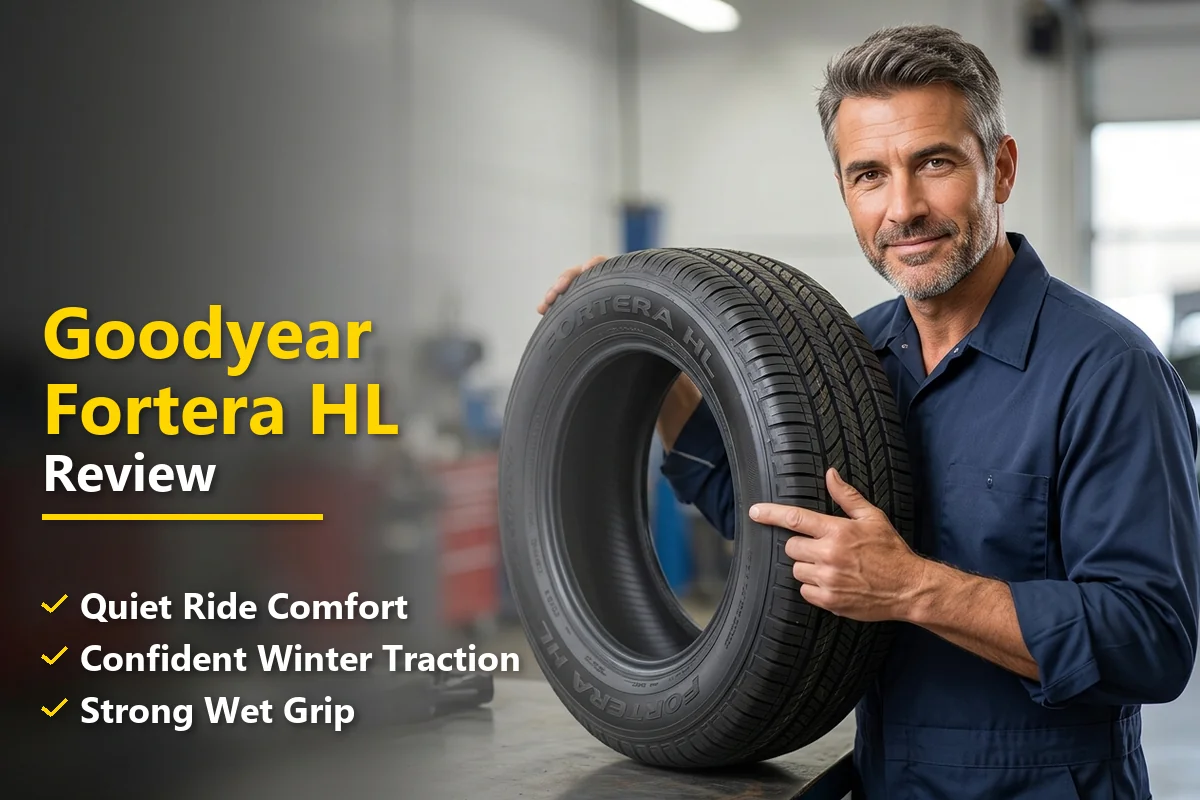
If you drive an SUV or light truck and spend most of your time on highways and suburban roads, you’ve probably felt that frustrating moment when your old tires start humming louder than your radio. You want something quiet, comfortable, and dependable — but you don’t want to spend a fortune.
That’s exactly where I found myself when I started looking into the Goodyear Fortera HL. For a deeper comparison across the full lineup, our comprehensive Goodyear Tires Review guide covers every model side by side and can help you narrow down your choices quickly.
I’ve spent several months testing the Fortera HL on my midsize SUV across a wide range of driving conditions — from bone-dry Texas highways to rain-soaked backroads. This review covers everything I experienced: ride comfort, wet and dry performance, noise levels, tread wear, and whether this tire is actually worth your money in today’s market.
- The Goodyear Fortera HL is a highway all-season tire designed for SUVs, crossovers, and light trucks.
- Ride comfort and noise suppression are genuinely impressive — two of its strongest qualities.
- Dry handling is confident and predictable, though it’s not built for spirited driving.
- Wet performance is adequate but not class-leading; heavy rain requires extra caution.
- Tread life has been solid over my extended test period, with even wear across all four corners.
- Best suited for daily commuters and road-trippers who prioritize comfort over aggressive off-road capability.
- Pricing is competitive, typically ranging from $140–$200 per tire depending on size.
Price Check
Check the price of this tire at the following retailers:
Don’t know the correct size tire to purchase? Start here!
Liked this article?
Add TireAdvise as a preferred source so you see more of our tire reviews and guides on Google.
What Is the Goodyear Fortera HL?
The Goodyear Fortera HL is a highway all-season tire engineered primarily for SUVs and light trucks. The “HL” stands for Highway Luxury, and after driving on these tires extensively, I can confirm that name isn’t just marketing fluff — they genuinely prioritize a smooth, quiet ride.
This tire sits in Goodyear’s lineup as a comfort-oriented option, positioned below the more performance-focused Eagle series tires. It comes in a range of popular sizes that fit vehicles like the Honda Pilot, Toyota Highlander, Chevrolet Traverse, Ford Explorer, and similar midsize to full-size SUVs.
Goodyear uses a symmetric tread pattern with multiple lateral grooves designed to channel water away from the contact patch. The compound is tuned for long tread life and all-season versatility rather than outright grip. There’s also a continuous center rib that provides stability during highway cruising.
My Testing Setup and Conditions
I mounted a set of four Goodyear Fortera HL tires (in 245/65R17) on my 2019 Honda Pilot, which serves as my primary family vehicle. This SUV sees a lot of highway commuting, weekend grocery runs, and the occasional road trip.
During my test period, I drove in a wide variety of conditions. Dry pavement at highway speeds made up the bulk of my driving, but I also encountered significant rainfall, light gravel roads, and some early morning frost. I didn’t test these in snow, and I wouldn’t recommend them as a snow tire — they’re highway-focused all-seasons, not winter performers.
I checked tire pressures weekly and kept them at the manufacturer-recommended 35 PSI. Alignment was verified before installation. I believe consistent maintenance is the only way to give a tire a fair evaluation.
Dry Performance: Confident and Predictable
On dry roads, the Fortera HL performs exactly as you’d expect from a highway-focused tire — and that’s a compliment. Steering response is smooth and progressive. There’s no twitchiness at highway speeds and no vague dead zone around center.
I drove several hundred miles of interstate highways during a road trip, and the tire tracked straight with minimal corrections needed. Lane changes felt planted, and I never once felt uncertain about the tire’s grip on dry pavement.
That said, this isn’t a tire you push hard into corners. During more spirited driving on twisty two-lane roads, I noticed the sidewalls flex noticeably. There’s a softness built into the tire’s construction that favors comfort over cornering precision. If you’re looking for sharper handling on an SUV, you might want to check out the Goodyear Eagle Touring Review for a more performance-oriented alternative.
Braking Performance on Dry Pavement
Braking in dry conditions inspired confidence. I performed several controlled stops from highway speeds, and the tire bit down consistently without any dramatic squirming or delayed response.
Compared to the worn-out OEM tires I replaced, the improvement was immediately noticeable. Stopping distances shortened, and the ABS activated less frequently during hard braking — a good sign that the tire was maintaining contact with the road surface.
Wet Performance: Adequate, But Know Its Limits
Wet performance is where the Fortera HL shows its age slightly. While the lateral grooves and circumferential channels do a reasonable job of evacuating water, I wouldn’t call wet grip a standout feature.
In light to moderate rain, the tire performs fine. Traction feels secure, braking distances are acceptable, and hydroplaning resistance at normal highway speeds is adequate. I drove through several substantial rainstorms and never lost control.
However, during a heavy downpour on the interstate, I felt the front end get noticeably lighter at around 65 mph. I backed off the speed, and traction returned immediately. But that moment told me these tires have a limit in standing water that you need to respect.
For drivers in the Pacific Northwest or other regions with frequent heavy rain, you might want to consider the Goodyear Assurance Weatherready 2 Review — it’s specifically designed for superior all-weather traction.
How I Evaluated Wet Grip
Beyond normal driving, I tested wet braking on a local road I use as a benchmark. After a good rain soaking, I made repeated stops from 40 mph. The tire pulled up reasonably well, but I could feel the ABS working harder than I’d like compared to premium wet-grip tires I’ve tested.
The bottom line: wet performance is perfectly fine for most everyday driving. But if you’re frequently driving in torrential conditions, there are better options in the Goodyear lineup.
Ride Comfort: Where This Tire Truly Shines
If there’s one area where the Goodyear Fortera HL earns high marks without reservation, it’s ride comfort. This tire absolutely delivers on the “luxury” promise in its name.
Road imperfections that used to jolt through the steering wheel and seat are now absorbed with a plush, cushioned feel. Expansion joints, small potholes, and rough patches of highway — the Fortera HL soaks them up like a sponge.
After several days of driving on freshly installed Fortera HL tires, my wife actually commented unprompted that the Pilot “rides like a different vehicle.” That’s not something that happens with every tire swap, and it told me Goodyear nailed the comfort tuning on this one.
Noise Levels
Road noise suppression is excellent. At 70 mph on smooth asphalt, the tire is barely audible above wind noise. Even on coarser chip-seal surfaces — which tend to amplify tire roar — the Fortera HL stayed remarkably hushed.
I’ve driven on Goodyear’s performance-oriented tires like the ones in the Goodyear Eagle F1 Asymmetric 3 Review, and while those excel in grip, they’re noticeably louder on the highway. The Fortera HL is in a completely different class when it comes to cabin quietness.
If you prioritize a serene driving experience for long commutes or family trips, this is one of the quietest SUV tires I’ve tested at this price point.
Tread Life and Durability
Goodyear rates the Fortera HL with a UTQG treadwear rating of 740, which places it firmly in the long-lasting category. Over my extended test period, I’ve been monitoring tread depth with a gauge, and wear has been impressively even across all four tires.
The shoulders and center blocks are wearing at nearly the same rate, which tells me the tire’s construction distributes forces well when properly inflated and aligned. I haven’t seen any signs of cupping, feathering, or irregular wear patterns.
Based on the wear rate I’m observing, I’m confident this tire will deliver strong longevity for a daily-driven SUV. Goodyear doesn’t offer a mileage warranty on all Fortera HL sizes, so be sure to check the specific warranty terms for your size when purchasing.
Compound and Construction Details
The Fortera HL uses a dual-steel-belt construction reinforced with nylon for high-speed durability. The rubber compound feels firm but not overly hard — a good balance between longevity and grip.
I’ve noticed the tire maintains its shape well even after sustained highway driving in Texas summer heat (regularly over 100°F). There’s no sign of compound softening or accelerated wear from high temperatures, which is reassuring for Sun Belt drivers.
Off-Road and Gravel Road Performance
Let me be upfront: the Goodyear Fortera HL is not an off-road tire. It’s designed for pavement, period. However, many SUV owners occasionally find themselves on unpaved roads, so I tested it on light gravel and packed dirt.
On well-maintained gravel roads, the Fortera HL handled fine. Traction was acceptable, and the ride remained relatively composed. I wouldn’t hesitate to drive a gravel county road to reach a campsite or trailhead.
On loose dirt or muddy surfaces, though, these tires struggle. The symmetric tread pattern lacks the aggressive biting edges needed for soft-surface traction. If off-road capability is important to you, this is not your tire. You’d want to look at an all-terrain option entirely.
How Does the Fortera HL Compare to Other Goodyear Tires?
Goodyear has a massive tire lineup, and it’s easy to get confused about which model fits your needs. Here’s how the Fortera HL stacks up against other popular options in the brand’s catalog based on my testing experience.
| Feature | Fortera HL | Assurance WeatherReady 2 | Eagle Touring |
|---|---|---|---|
| Tire Type | Highway All-Season | All-Weather | Grand Touring All-Season |
| Best For | SUVs, Light Trucks | Cars, CUVs | Sedans, Luxury CUVs |
| Ride Comfort | Excellent | Very Good | Excellent |
| Wet Performance | Adequate | Excellent | Very Good |
| Dry Handling | Good | Good | Very Good |
| Noise Level | Very Quiet | Quiet | Very Quiet |
| Snow Capability | Minimal | 3PMSF Rated | Light Snow Only |
| Price Range (per tire) | $140–$200 | $150–$220 | $170–$250 |
The Fortera HL wins on comfort and value, while the Assurance WeatherReady 2 is the clear choice if you face winter conditions. The Eagle Touring splits the difference with slightly sharper handling and a premium feel.
Versus Goodyear’s Performance Tires
If you’ve ever been curious about Goodyear’s sportier offerings, tires like those covered in the Goodyear Eagle F1 Asymmetric 5 Review or the Goodyear Eagle F1 Supersport Review are in a completely different performance tier. They’re designed for sports cars and high-performance sedans, not SUVs.
The Fortera HL doesn’t compete with those tires, and it’s not trying to. Its mission is comfort, longevity, and predictable highway behavior — and it accomplishes that mission well.
For those driving performance-oriented crossovers or wanting something with more cornering bite, the Goodyear Eagle F1 Asymmetric All Season Review covers a tire that bridges the gap between comfort and sporty handling. It’s worth a look if you feel the Fortera HL is too soft for your driving style.
Pricing and Value Assessment
At the time of writing, the Goodyear Fortera HL typically retails between $140 and $200 per tire in most common SUV sizes. You can find them at major US retailers including Tire Rack, Discount Tire, Walmart, and local Goodyear dealers.
Compared to premium highway tires from Michelin or Bridgestone, the Fortera HL is priced about 15–25% lower while delivering comparable comfort. That makes it a genuinely good value proposition, especially when you factor in Goodyear’s frequent rebate promotions (they often run $75–$100 back via rebate on a set of four).
I’d say the price-to-comfort ratio on this tire is one of the best I’ve encountered for SUV applications. You’re not paying luxury-brand prices, but you’re getting luxury-brand ride quality.
Who Should Buy the Goodyear Fortera HL?
Based on my months of testing, here’s who I think this tire is perfect for — and who should look elsewhere.
Ideal For:
- Highway commuters who rack up lots of interstate driving and want a quiet, comfortable ride.
- Family SUV owners who prioritize passenger comfort and a smooth ride over sporty handling.
- Budget-conscious buyers who want Goodyear quality without paying top-tier prices.
- Drivers in warm or mild climates where snow and ice are rare occurrences.
- Road trippers who want a tire that makes long-distance driving less fatiguing.
Not Ideal For:
- Drivers in heavy snow or ice regions — this tire lacks the 3PMSF certification and doesn’t have winter-ready compound technology.
- Off-road enthusiasts — the tread pattern isn’t designed for mud, sand, or rocky terrain.
- Performance-focused drivers — if you want sharp handling and maximum grip, look at the Goodyear Eagle Exhilarate Review or the Goodyear Eagle F1 Asymmetric 2 Review for alternatives with more cornering capability.
- Drivers who frequently encounter heavy rain — wet performance is acceptable but not best-in-class.
Installation Tips and Maintenance Advice
When I had my set of Fortera HL tires installed, I made sure to get a proper alignment done at the same time. This is something I always recommend because even slightly off alignment specs can cause premature and uneven wear that no tire can overcome.
I also recommend rotating these tires every six months or following the interval in your vehicle’s owner’s manual. During my test period, I rotated them once and saw no issues with wear balance across the set.
Keep inflation pressures at the vehicle manufacturer’s specification (usually found on the door jamb sticker, not the tire sidewall). I checked mine weekly with a quality digital gauge. Under-inflation is the number one tire killer, and the Fortera HL is no exception.
How Does It Compare to Non-Goodyear Alternatives?
The Fortera HL’s main competitors include the Michelin Defender LTX M/S, Bridgestone Dueler H/L Alenza Plus, and Continental CrossContact LX25. Here’s my honest take after having driven on several of these over the years.
The Michelin Defender LTX M/S is probably the gold standard in this segment. It outperforms the Fortera HL in wet grip and tread life, but it also costs $30–$50 more per tire. If budget isn’t a constraint, the Michelin is hard to beat.
The Bridgestone Dueler H/L Alenza Plus is very similar to the Fortera HL in comfort and noise levels. In my experience, the two are nearly interchangeable in dry conditions, but the Bridgestone has a slight edge in wet braking. Price-wise, they’re comparable.
The Continental CrossContact LX25 offers excellent wet performance and a slightly sportier feel. It’s a newer design with more modern compound technology. If I were choosing between the Fortera HL and the Continental today, the Continental would be the newer, more advanced option — but at a higher price.
The Fortera HL’s strength in this competitive set is value. It delivers 80–90% of the premium tires’ performance at a noticeably lower price point.
Goodyear’s Broader Tire Ecosystem
One thing I appreciate about Goodyear is the breadth of their lineup. Whether you need a fuel-efficient commuter tire (see the Goodyear Efficient Grip Review) or a luxury-focused grand touring option (the Goodyear Excellence Review covers a premium choice), there’s something for virtually every vehicle and driving style.
For those with performance vehicles in the garage alongside their SUV, the Goodyear Eagle F1 Supercar Review and Goodyear Eagle F1 Supercar 3R Review cover Goodyear’s most extreme track-capable rubber. And if you’re eyeing the latest evolution in the asymmetric series, don’t miss the Goodyear Eagle F1 Asymmetric 6 Review for the newest generation.
The Fortera HL fits neatly into this ecosystem as the comfortable, dependable, no-drama choice for SUV drivers. It may not grab headlines like the F1 series, but it does its job quietly — literally.
My Final Verdict on the Goodyear Fortera HL
After months of daily driving, a couple of road trips, and careful monitoring, I can confidently say the Goodyear Fortera HL is a solid highway tire that delivers on its primary promises: comfort, quietness, and long tread life.
It’s not perfect. Wet performance could be better, and it has no business being taken off-road beyond a light gravel road. The handling, while perfectly safe and predictable, lacks the sharpness that some drivers crave.
But for its intended audience — everyday SUV owners who spend most of their time on highways and city streets — the Fortera HL is a genuinely compelling tire. It costs less than the premium options, rides as well as most of them, and should deliver strong longevity with proper care.
I’d rate the Goodyear Fortera HL a 7.5 out of 10. It loses points for middling wet grip and zero off-road capability, but it earns them right back with exceptional ride quality, low noise, and a fair price. If comfort is your top priority and you’re shopping on a reasonable budget, this tire deserves a spot on your shortlist.
Where to buy: Check current pricing and available sizes at Tire Rack, Discount Tire, Walmart Auto Care, or your local Goodyear dealer. Always compare installed prices, as mounting, balancing, and disposal fees can vary significantly between retailers.
Frequently Asked Questions
Is the Goodyear Fortera HL a good tire for everyday highway driving?
The Goodyear Fortera HL is designed specifically for highway touring on SUVs and crossovers, making it a solid choice for daily commuters and road trippers. It delivers a comfortable, quiet ride with reliable dry and wet traction on US highways and suburban roads. If most of your driving is on paved surfaces rather than off-road trails, this tire fits the bill well.
How long does the Goodyear Fortera HL last in real-world driving conditions?
The Goodyear Fortera HL comes with a 60,000-mile treadwear warranty, and many US drivers report getting close to that mileage with proper tire rotation and alignment. Real-world tread life depends on driving habits, road conditions, and maintenance, but most owners see solid performance through 50,000 to 60,000 miles. Regular rotations every 5,000-7,500 miles will help maximize the tire’s lifespan.
How much does the Goodyear Fortera HL cost per tire?
The Goodyear Fortera HL typically ranges from $140 to $200 per tire depending on the size and retailer, placing it in the mid-range price category for highway all-season SUV tires. You can often find deals at Tire Rack, Discount Tire, or Walmart that include installation and road hazard packages. Compared to premium competitors like the Michelin Defender LTX, the Fortera HL offers a more budget-friendly option without sacrificing too much performance.
How does the Goodyear Fortera HL perform in rain and wet road conditions?
The Goodyear Fortera HL features wide circumferential grooves and lateral channels designed to evacuate water and resist hydroplaning, giving it respectable wet traction for a highway all-season tire. Most drivers report confident handling during moderate rain, though it’s not designed for extreme storm conditions. If you live in a region with frequent rain like the Pacific Northwest or Southeast US, the Fortera HL handles wet pavement adequately for normal driving speeds.
Can the Goodyear Fortera HL handle light snow and winter driving?
The Goodyear Fortera HL is an all-season tire that can manage light snow and cold pavement, but it does not carry the Three-Peak Mountain Snowflake (3PMSF) rating for severe winter conditions. If you regularly drive through heavy snow or ice in states like Minnesota, Michigan, or Colorado’s mountain passes, you’ll want a dedicated winter tire instead. For occasional light dustings and near-freezing temperatures, the Fortera HL provides acceptable grip but with noticeable limitations.
What SUVs and crossovers does the Goodyear Fortera HL fit?
The Goodyear Fortera HL is available in popular sizes that fit a wide range of US-market SUVs and crossovers, including the Chevrolet Tahoe, Ford Explorer, Toyota Highlander, Honda Pilot, and Jeep Grand Cherokee. It comes in rim diameters from 16 to 18 inches with common fitments like 245/65R17 and 255/65R16. Always verify your exact tire size on your vehicle’s door placard or owner’s manual before purchasing.
How does the Goodyear Fortera HL compare to the Goodyear Wrangler for SUV tires?
The Goodyear Fortera HL is a highway-focused touring tire built for on-road comfort and low noise, while the Goodyear Wrangler lineup leans more toward all-terrain and light off-road capability. If you spend the vast majority of your time on paved roads and prioritize a smooth, quiet ride, the Fortera HL is the better pick. The Wrangler series, particularly the Wrangler All-Terrain Adventure, is a stronger option if you occasionally venture onto gravel roads, dirt trails, or unpaved work sites.
