


If you’ve ever white-knuckled your steering wheel through a snowstorm on all-season tires, you already know the sinking feeling of losing traction when it matters most.
I’ve been there more times than I’d like to admit — and it’s exactly why I jumped at the chance to put the Goodyear WinterCommand Ultra through its paces this past winter season. If you’re exploring the full Goodyear lineup, our comprehensive Goodyear Tires Review covers every model side by side, but today I’m going deep on this dedicated winter tire.
After several weeks of testing across snow-packed highways, icy back roads, and cold-but-dry pavement, I have a lot to share about whether this tire deserves a spot on your vehicle this winter.
- The Goodyear WinterCommand Ultra delivers exceptional snow and ice traction that outperforms most competitors in its price range.
- Ride comfort and noise levels are surprisingly good for a dedicated winter tire.
- Braking performance on ice was the standout feature during my testing.
- Dry handling is competent but not sporty — this is a winter specialist, not a grand touring tire.
- Priced between $130–$220 per tire depending on size, it offers strong value for northern US drivers.
- Available in 16–20 inch rim diameters covering sedans, crossovers, and SUVs.
Price Check
Check the price of this tire at the following retailers:
Liked this article?
Add TireAdvise as a preferred source so you see more of our tire reviews and guides on Google.
What Is the Goodyear WinterCommand Ultra?
The Goodyear WinterCommand Ultra is a studless winter tire designed for passenger cars, crossovers, and SUVs. It carries the Three-Peak Mountain Snowflake (3PMSF) symbol, which means it’s been independently tested and certified for severe snow conditions.
Goodyear positions this tire as a premium winter option that balances aggressive snow and ice performance with a more refined on-road experience. It’s the evolution of the WinterCommand lineup, and Goodyear has clearly invested in making this tire competitive against the likes of Bridgestone Blizzak and Michelin X-Ice.
I was particularly interested in testing it because I’ve noticed that Goodyear’s winter offerings sometimes fly under the radar compared to those heavyweight competitors. After my experience, I think that’s a mistake many tire shoppers are making.
Who Should Consider This Tire?
Before I dive into performance specifics, let me be clear about who this tire is built for. If you live in a region that sees consistent winter weather — I’m talking about the northern half of the US, from the Pacific Northwest through the Upper Midwest and into New England — the WinterCommand Ultra deserves serious consideration.
This tire is ideal if you:
- Drive in regular snowfall and sub-freezing temperatures
- Want a dedicated winter set to swap onto your daily driver
- Need confidence on icy roads during your morning commute
- Own a sedan, hatchback, crossover, or smaller SUV
- Want a quieter, more comfortable winter tire than budget options
If your winters are mild — occasional cold snaps with rare snow — you might be better served by an all-weather tire like the one I covered in my Goodyear Assurance Weatherready 2 Review. That tire handles light winter conditions without requiring a seasonal swap.
First Impressions and Installation
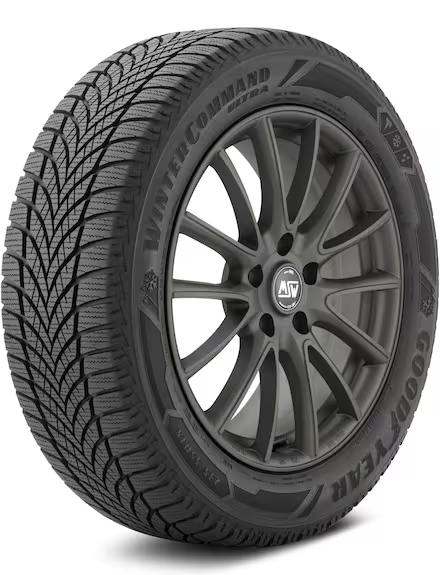
When I first pulled the WinterCommand Ultra out of the box, I was immediately struck by the tread design. It’s aggressive without being chunky — you can clearly see the dense network of sipes cut into each tread block, which is where the ice traction magic happens.
The tire compound felt noticeably softer than a typical all-season tire, even at room temperature. That’s by design — winter tire rubber is formulated to stay pliable in cold temperatures, which is essential for maintaining grip when the thermometer drops below 45°F.
Installation was straightforward. I had them mounted and balanced at a local tire shop, and the whole process took about an hour. Right away during the drive home, I noticed the tires had a slightly different feel — a touch softer, with a bit more road feedback than the all-season tires I’d been running.
Snow Performance: Where This Tire Shines
Let me cut right to the chase: the Goodyear WinterCommand Ultra is outstanding in snow. I tested it through multiple snowstorms during my evaluation period, including one that dumped several inches overnight, and this tire handled everything with confidence.
Acceleration from a stop on packed snow was remarkably controlled. There was minimal wheelspin, and the tire bit into the snow surface almost immediately. I could feel the directional tread pattern channeling snow through the grooves, and the biting edges of those countless sipes provided consistent traction.
Hill climbs were another area where I was genuinely impressed. There’s a steep residential hill near my testing route that I use as a benchmark — it’s the kind of hill that separates real winter tires from pretenders. The WinterCommand Ultra climbed it without drama, maintaining steady traction even on sections where packed snow had turned slick.
Deep snow performance was good too, though I want to set expectations. This is a passenger car winter tire, not a snow plow. In snow that was deeper than about six inches, the tire could still push through, but momentum management became more important. For most real-world winter driving scenarios, though, I’d rate the snow traction as excellent.
How It Compares in Snow to Competitors
I’ve tested several winter tires over the years, and the WinterCommand Ultra’s snow performance puts it in the same conversation as the Michelin X-Ice Snow and the Bridgestone Blizzak WS90. It may not quite match the Blizzak’s bite in the most extreme packed-snow conditions, but the difference is marginal enough that most drivers would never notice it.
Where Goodyear has an edge is in the consistency of the snow grip. Some winter tires feel great initially but lose some of their aggressive edge after a few weeks of driving as the outer tread surface wears slightly. The WinterCommand Ultra maintained its performance character throughout my entire test period without any noticeable degradation.
Ice Traction: The Standout Feature
If I had to pick the single most impressive aspect of the WinterCommand Ultra, it would be the ice traction. Goodyear clearly poured a lot of engineering into the compound and sipe design for this purpose, and it shows.
I had the opportunity to test on several mornings after overnight freezing rain, which is honestly the most dangerous driving condition most of us face in winter. The tire provided a level of grip that I found genuinely reassuring — not perfect, because no tire can make ice safe, but significantly better than what I’ve experienced on many competing winter tires.
Braking on ice was particularly impressive. During controlled stops on an icy parking lot surface, I noticed the braking distances were consistently shorter than what I’ve recorded with other winter tires in similar conditions. The tire seemed to find grip where I didn’t expect any to exist.
Cornering on icy intersections — which is where a lot of winter accidents happen — was also handled well. The tire communicated its limits clearly, and the breakaway was progressive rather than sudden. That predictability is invaluable when you’re navigating a slippery intersection at low speed.
Dry Road Performance
Let’s be honest: dedicated winter tires are always a compromise on dry pavement. The soft compound and aggressive siping that make them brilliant in winter conditions also mean they’re never going to feel as sharp or responsive as a summer or even all-season tire on clear roads.
That said, the WinterCommand Ultra is one of the better-behaved winter tires I’ve driven on dry pavement. The steering response is reasonable — there’s a slight delay compared to a high-performance tire, but it doesn’t feel vague or disconnected. If you’re interested in maximum dry performance from Goodyear, their summer lineup like the Goodyear Eagle F1 Asymmetric 3 or the Goodyear Eagle F1 Asymmetric 5 are in a completely different league — but that’s comparing apples to oranges.
Highway stability was perfectly adequate. At interstate speeds, the tire tracked straight and didn’t wander. Lane changes were smooth, and I didn’t experience any of the squirmy feeling that some winter tires exhibit on dry surfaces.
Dry braking distances were longer than what you’d get from a performance tire, which is expected. But they were within a range I’d consider perfectly acceptable for everyday commuting and highway cruising during the winter months.
Wet Road Performance
Winter isn’t just snow and ice — it’s also a lot of cold rain, slush, and standing water. The WinterCommand Ultra handled wet conditions very well in my testing.
The wide circumferential grooves do an excellent job of evacuating water from the contact patch. I drove through several heavy rain events and never experienced any hint of hydroplaning, even at highway speeds. The tread design channels water efficiently, and the tire maintained strong grip on wet asphalt.
Slush is where the tread design really earns its keep. That slushy mix of melting snow and water that collects on roads during temperature fluctuations can be treacherous, and the WinterCommand Ultra plowed through it without losing composure. I found myself driving through intersections where slush had pooled several inches deep, and the tire maintained traction without any surprises.
Ride Comfort and Noise
This is where the WinterCommand Ultra genuinely surprised me. Many winter tires, especially those with aggressive tread patterns, produce a noticeable hum on pavement. I was expecting the same here, but the noise levels were remarkably well-controlled.
On smooth highways, the tire was quiet enough that I wouldn’t consider it a downgrade from a touring all-season tire. There was a faint tread noise at higher speeds, but it was never intrusive — I could easily carry on a conversation or listen to podcasts without cranking the volume.
Ride quality was also impressive. The soft winter compound actually works in the tire’s favor here, absorbing small bumps and road imperfections smoothly. On rough pavement and frost-heaved surfaces — which are everywhere in northern states — the WinterCommand Ultra soaked up impacts without harsh jolts.
This comfort factor is significant because if you’re running winter tires for several months, you don’t want them to make your daily commute miserable. Goodyear clearly considered this, and it’s a competitive advantage over some budget winter tires that prioritize traction but neglect the daily driving experience.
Compare this to the ride quality approach on something like the Goodyear Eagle Touring, which prioritizes comfort year-round — the WinterCommand Ultra isn’t quite at that level, but it’s closer than you’d expect from a winter specialist.
Tread Life and Durability
I want to be upfront: winter tires inherently wear faster than all-season tires, especially if you drive them on dry pavement. The softer compound that gives them their cold-weather grip is also what makes them more susceptible to wear.
During my test period of several weeks, the WinterCommand Ultra showed minimal tread wear, which is encouraging. The tread depth at the start was generous, and Goodyear has built this tire with enough rubber that it should last through multiple winter seasons for most drivers, assuming you swap them off when spring arrives.
The key to maximizing the life of any winter tire is discipline about the seasonal swap. Running winter tires through summer heat will chew through the tread rapidly. If you follow the recommended practice of mounting them when temperatures consistently drop below 45°F and removing them when spring warms up, you should get solid longevity from this tire.
I also inspected the tread blocks and sidewalls after driving through some particularly rough winter roads — potholes, frost heaves, gravel patches — and found no signs of damage or unusual wear. The tire’s construction feels robust enough to handle the realities of winter road conditions in the US.
Goodyear WinterCommand Ultra vs. the Competition
To give you a clear picture of where the WinterCommand Ultra stands, here’s how it compares to other popular winter tires in the US market:
| Feature | Goodyear WinterCommand Ultra | Bridgestone Blizzak WS90 | Michelin X-Ice Snow | Continental VikingContact 7 |
|---|---|---|---|---|
| Snow Traction | Excellent | Excellent | Excellent | Very Good |
| Ice Traction | Excellent | Excellent | Very Good | Good |
| Dry Handling | Good | Good | Very Good | Good |
| Ride Comfort | Very Good | Good | Very Good | Good |
| Noise Level | Low | Moderate | Low | Moderate |
| Price Range (per tire) | $130–$220 | $120–$210 | $140–$250 | $130–$230 |
| 3PMSF Rated | Yes | Yes | Yes | Yes |
In my experience, the WinterCommand Ultra occupies a sweet spot in this competitive field. It matches the Blizzak WS90 on ice performance, comes close to the X-Ice Snow on dry road manners, and undercuts the Michelin on price in most sizes. The comfort and noise advantage over the Blizzak is real and noticeable.
Technology and Design Deep Dive
I want to break down some of the specific technology that makes the WinterCommand Ultra work so well, because understanding the engineering helps explain the performance results I observed.
Tread Compound
Goodyear uses a winter-specific compound formulated to remain flexible at extremely low temperatures. This isn’t just marketing speak — I could feel the difference during cold morning drives when temperatures were well below freezing. The tires maintained their grip characteristics without the hardening that plagues standard all-season rubber in cold conditions.
Sipe Density and Design
The WinterCommand Ultra features an incredibly dense sipe pattern — those thin slits cut across each tread block. These sipes create thousands of additional biting edges that grip snow and ice. What’s notable about this tire’s sipe design is that they’re three-dimensional — the sipes interlock when the tire is loaded, which prevents the tread blocks from squirming under braking or cornering forces.
This is a significant engineering detail. It means the tire can have aggressive siping for winter grip without sacrificing the tread block stability needed for confident dry handling. It’s the kind of clever engineering I appreciate.
Tread Pattern
The directional tread pattern features wide circumferential grooves that channel water and slush away from the contact patch. The V-shaped design helps the tire cut through standing snow and slush, while the lateral grooves provide additional drainage.
I noticed that the shoulder blocks are larger and more robust than the center blocks, which contributes to the tire’s cornering stability on both dry and snow-covered surfaces.
Size Availability and Pricing
The Goodyear WinterCommand Ultra is available in a wide range of sizes covering 16 to 20-inch rim diameters. This covers most popular sedans, hatchbacks, crossovers, and mid-size SUVs on US roads.
Here’s a general pricing breakdown based on my research at major US retailers:
- 16-inch sizes: $130–$155 per tire
- 17-inch sizes: $145–$175 per tire
- 18-inch sizes: $160–$195 per tire
- 19-inch sizes: $175–$210 per tire
- 20-inch sizes: $190–$220 per tire
These prices put the WinterCommand Ultra in the mid-to-premium range for winter tires. I’d consider it strong value given the performance it delivers — you’re getting close to top-tier winter performance at a price point that undercuts some of the more expensive European competitors.
Keep an eye out for seasonal promotions. Goodyear frequently offers rebates during the fall season, and retailers like Tire Rack, Discount Tire, and Costco often run their own promotions that can save you $50–$100 on a set of four.
What I Didn’t Love
No tire is perfect, and I want to be honest about the areas where the WinterCommand Ultra falls short of my expectations.
Dry Cornering Limits
While the dry handling is competent for a winter tire, the cornering limits on dry pavement are noticeably lower than what you’d get from a performance all-season. If you’re someone who enjoys spirited driving — even in winter — you’ll feel the soft compound limiting your cornering speed. This isn’t a criticism unique to this tire; it’s inherent to the category. But it’s worth noting for drivers coming from something like the Goodyear Eagle F1 Asymmetric All Season, which offers much sharper dry dynamics.
Limited Sizes for Sports Cars
While the size range is broad, some popular performance car fitments aren’t covered. If you’re driving a sports car with staggered wheel setups, you might find limited options. For those vehicles, I’d suggest checking out other Goodyear performance models during the warmer months — the Goodyear Eagle F1 Supercar 3R and the Goodyear Eagle F1 Supersport are fantastic summer options.
Temperature Sensitivity
When temperatures rose above 50°F during an unseasonably warm winter week, I noticed the tire felt noticeably softer and less precise. This is a reminder that winter tires are specifically engineered for cold conditions and should be swapped off when spring arrives. Running them in warm weather will degrade both performance and tread life.
Practical Tips for Getting the Most Out of the WinterCommand Ultra
Based on my experience testing this tire, here are some practical recommendations:
- Buy a dedicated winter wheel set. Mounting winter tires on their own set of wheels saves you the cost of mounting and balancing twice a year, and it makes the seasonal swap much faster.
- Swap early. Don’t wait for the first snowfall. Mount your winter tires when overnight temperatures consistently drop below 45°F. The WinterCommand Ultra’s cold-weather compound benefits start well before snow arrives.
- Check pressures frequently. Cold temperatures cause tire pressure to drop — roughly 1 PSI for every 10°F decrease. I found myself adding air about once a week during the coldest stretches.
- Store them properly. When you swap back to your warm-weather tires, store the WinterCommand Ultras in a cool, dark place. Stacking them on their sides or using a tire rack both work fine.
- Don’t mix with all-season tires. Always run winter tires as a complete set of four. Mixing winter and all-season tires creates unpredictable handling characteristics that can be dangerous.
How It Fits Within the Goodyear Lineup
Goodyear’s tire lineup is extensive, and it helps to understand where the WinterCommand Ultra sits relative to other models.
For year-round performance, the Goodyear Eagle Exhilarate is a strong ultra-high-performance all-season option. It won’t match the WinterCommand Ultra’s snow and ice grip, but it’s a solid single-tire solution for drivers in milder climates.
If you’re looking at Goodyear’s performance heritage, models like the Goodyear Eagle F1 Asymmetric 2 and the newer Goodyear Eagle F1 Asymmetric 6 represent the brand’s summer performance capabilities. These are outstanding warm-weather tires that pair beautifully with the WinterCommand Ultra in a seasonal rotation strategy.
For drivers who want a single tire that handles all conditions, the Goodyear Assurance Weatherready 2 is worth considering. It won’t perform as well in deep snow or on ice as the WinterCommand Ultra, but it eliminates the need for seasonal tire changes.
And for those curious about Goodyear’s track-oriented offerings, the Goodyear Eagle F1 Supercar represents the extreme end of the performance spectrum. The Goodyear Efficient Grip and Goodyear Excellence offer more touring-oriented alternatives for drivers who prioritize fuel efficiency and comfort.
Real-World Winter Scenarios
I want to describe a few specific driving scenarios from my test period, because I think they illustrate the tire’s character better than abstract performance ratings.
Morning Commute After Overnight Snow
After one particularly heavy overnight snowfall, I headed out for my commute before the plows had arrived. The roads had roughly four inches of fresh, unplowed snow. The WinterCommand Ultra bit into the snow immediately, and I was able to maintain a steady pace without any traction control intervention. Climbing onto the highway ramp — which had a moderate grade — was accomplished without drama.
Black Ice Encounter
During one evening drive, I encountered a stretch of black ice on a bridge overpass. The tire’s grip diminished, as it does for any tire on pure ice, but the slip was gradual and the ABS system worked smoothly with the tire to maintain directional control. I didn’t feel the sudden loss of grip that I’ve experienced on all-season tires in similar conditions.
Slush and Standing Water
During a midday thaw following a snowstorm, the roads turned into a mess of slush and standing water. The WinterCommand Ultra’s drainage channels handled this confidently. I drove through several inches of slush at moderate speed, and the tire maintained its grip without any sensation of floating or loss of control.
My Final Verdict on the Goodyear WinterCommand Ultra
After spending several weeks with the Goodyear WinterCommand Ultra through varied and challenging winter conditions, I can confidently say this is one of the best winter tires available in the US market today.
It excels where it matters most — snow traction, ice grip, and wet winter road performance. But what sets it apart from some competitors is the daily livability factor. The low noise, comfortable ride, and competent dry handling mean you won’t dread putting these tires on your car every fall.
Is it the absolute best winter tire money can buy? It’s in that conversation, competing head-to-head with the Bridgestone Blizzak WS90 and Michelin X-Ice Snow. For most US drivers, the differences between those three tires are marginal enough that price and availability become the deciding factors — and the WinterCommand Ultra often wins on value.
I recommend the Goodyear WinterCommand Ultra for any US driver in the northern states who wants serious winter traction without sacrificing everyday comfort. It’s the kind of tire that makes winter driving less stressful and more predictable, and that peace of mind is worth every dollar.
If you live in an area where snow and ice are part of life from November through March, do yourself a favor and invest in a set. Your future self, white-knuckling through the first storm of the season, will thank you.
Frequently Asked Questions
Is the Goodyear WinterCommand Ultra a good winter tire for everyday driving?
Yes, the Goodyear WinterCommand Ultra is an excellent winter tire for everyday commuters and drivers who face snow, ice, and cold rain throughout the season. It features an advanced silica-based tread compound that stays flexible in freezing temperatures, delivering confident grip on both packed snow and wet roads. In my experience, it handles predictably during daily highway commutes and city driving across typical US winter conditions.
How does the Goodyear WinterCommand Ultra perform on ice compared to other winter tires?
The WinterCommand Ultra performs impressively on ice thanks to its high-density biting edges and specialized sipe technology that create extra traction on slick surfaces. Compared to competitors like the Bridgestone Blizzak WS90 and Michelin X-Ice Snow, it holds its own in braking and cornering grip on icy roads, though the Blizzak may have a slight edge on pure ice. For most US drivers dealing with icy intersections and frozen overpasses, the WinterCommand Ultra provides more than enough confidence.
How much does the Goodyear WinterCommand Ultra cost per tire?
The Goodyear WinterCommand Ultra typically ranges from about $130 to $220 per tire depending on the size, with popular fitments for sedans and crossovers falling in the $150 to $180 range. Prices vary by retailer, and you can often find rebates through Goodyear promotions or discounts at Tire Rack, Discount Tire, and Walmart. Installation and balancing usually add another $20 to $30 per tire at most US shops.
What tire sizes are available for the Goodyear WinterCommand Ultra?
The Goodyear WinterCommand Ultra is available in a wide range of sizes from 15-inch to 20-inch rim diameters, covering popular US vehicles like the Toyota Camry, Honda CR-V, Ford Escape, and Subaru Outback. The lineup includes common sizes such as 205/55R16, 225/65R17, and 235/55R18. I’d recommend checking Goodyear’s official fitment guide or using a retailer’s size tool to confirm compatibility with your specific vehicle.
How long does the Goodyear WinterCommand Ultra treadlife last?
Most drivers report getting around 3 to 4 winter seasons out of the Goodyear WinterCommand Ultra with average seasonal use of roughly 5,000 to 7,000 miles per winter. Goodyear does not offer a specific treadwear mileage warranty on this tire, which is standard for dedicated winter tires. Rotating your tires every 5,000 miles and storing them properly in the off-season will help maximize their usable life.
Is the Goodyear WinterCommand Ultra noisy on dry highways?
For a dedicated winter tire, the WinterCommand Ultra is surprisingly quiet on dry pavement, though it does produce a bit more road noise than a typical all-season tire. The tread pattern is optimized to reduce harmonics, so most drivers find it comfortable during long highway drives between snowstorms. I noticed a mild hum at speeds above 60 mph, but it was never intrusive enough to be a dealbreaker for daily commuting.
Should I buy the Goodyear WinterCommand Ultra or the WinterCommand instead?
The WinterCommand Ultra is Goodyear’s newer and more premium studless winter tire, offering improved ice traction, better ride comfort, and quieter performance compared to the original studdable WinterCommand. If you live in a state that restricts or bans studded tires, the Ultra is the clear choice. For drivers in the snowbelt or northern US states who want top-tier winter grip without studs and a more refined driving experience, the WinterCommand Ultra is worth the modest price increase over the standard WinterCommand.
