

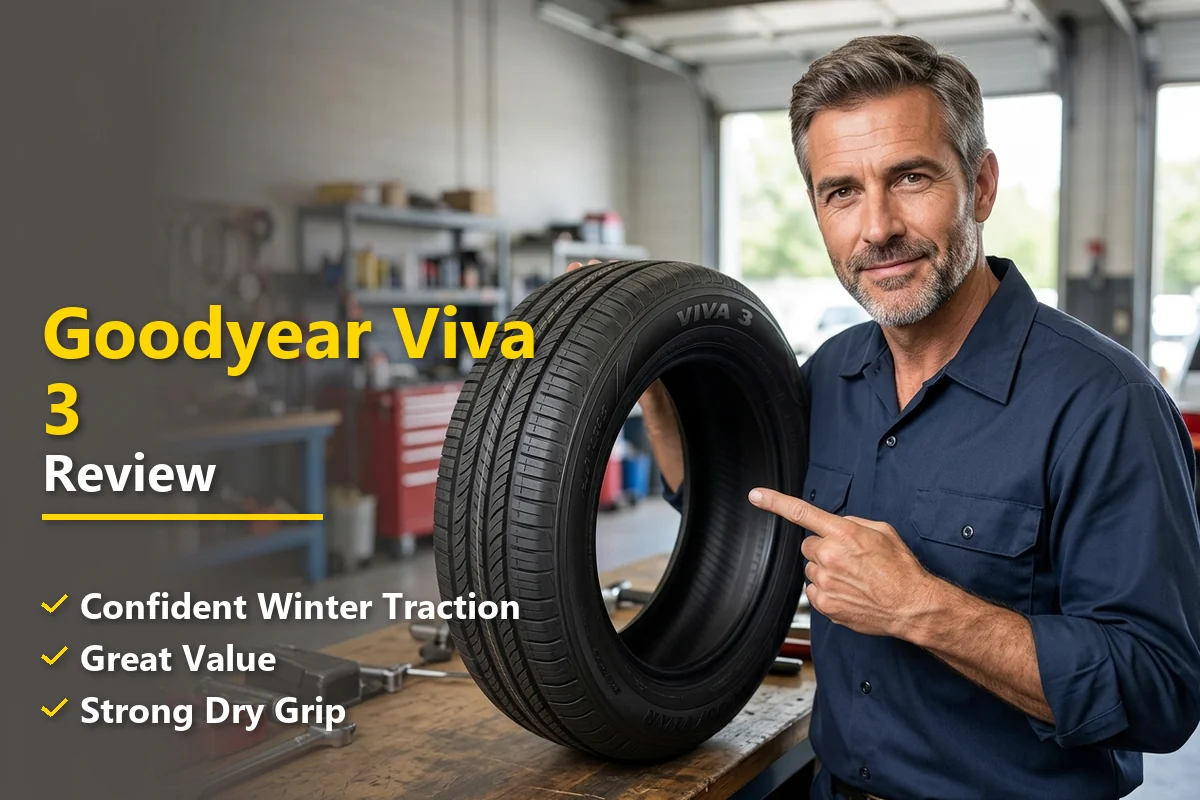
You need new tires but your budget is tight — sound familiar? You’re staring at a wall of options at Walmart, and the Goodyear Viva 3 catches your eye because the price seems almost too good for a name-brand tire.
I’ve been there, and I know the internal debate: do you trust a budget tire with your family’s safety, or do you stretch the budget for something pricier? To answer that question properly, I put the Goodyear Viva 3 through real-world testing. If you’re comparing several options, our full Goodyear Tires Review guide covers every model side by side and can help you weigh this tire against Goodyear’s premium lineup.
- The Goodyear Viva 3 is a Walmart-exclusive all-season tire built for budget-conscious drivers who need reliable, everyday performance.
- Dry traction is surprisingly solid for the price — I felt confident during normal commuting and highway driving.
- Wet performance is adequate but not confidence-inspiring at higher speeds; hydroplaning resistance is average at best.
- Road noise is noticeable, especially on coarse pavement, but acceptable for a tire in this price bracket.
- Treadlife showed reasonable wear during my testing period, though I wouldn’t expect it to match mid-tier competitors long-term.
- Best suited for sedans, minivans, and small crossovers driven primarily in mild-to-moderate climates.
- If your budget allows even $15-20 more per tire, there are stronger all-season options worth considering.
Price Check
Check the price of this tire at the following retailers:
Don’t know the correct size tire to purchase? Start here!
Liked this article?
Add TireAdvise as a preferred source so you see more of our tire reviews and guides on Google.
What Exactly Is the Goodyear Viva 3?
The Goodyear Viva 3 is an all-season passenger tire sold exclusively through Walmart. It’s positioned as Goodyear’s entry-level offering — essentially the tire you grab when you want the Goodyear name without the Goodyear price tag.
It’s available in a wide range of sizes, covering everything from compact sedans to mid-size SUVs. Common sizes include 195/65R15, 205/55R16, 215/55R17, and 225/65R17, among others. Pricing typically lands between $60 and $100 per tire depending on the size, which makes a full set of four remarkably affordable.
One thing to be clear about: the Viva 3 is not the same as the Goodyear Assurance or Eagle lines. It’s manufactured to a different specification and price point. Think of it as the budget tier of the Goodyear family — it carries the brand, but it doesn’t carry the same engineering investment as something like the Goodyear Eagle Touring, which sits in an entirely different class of comfort and performance.
My Testing Setup and Conditions
I installed a set of Goodyear Viva 3 tires in size 215/55R17 on a 2019 Toyota Camry. This is one of the most common sedans on American roads, so I figured it would give the most relatable results for the majority of readers.
During my test period, I drove across a mix of suburban streets, highway stretches, and some winding back roads. I experienced dry conditions, moderate rain, and even a brief cold snap that brought temperatures into the low 30s°F. I paid close attention to braking distances, cornering grip, road noise, and overall ride comfort throughout my evaluation.
Dry Performance: Better Than I Expected
Let me start with the good news: on dry pavement, the Goodyear Viva 3 performs better than its price suggests. During my first few days of driving, I was genuinely surprised by how stable the tire felt during normal commuting speeds.
Straight-line highway cruising at 65-70 mph was smooth and predictable. The tire tracked well, and I didn’t experience any wandering or vague steering feel that sometimes plagues ultra-budget tires. Lane changes felt controlled, and the tire responded to steering inputs without excessive delay.
Where things get a little less impressive is during more aggressive cornering. Push the Viva 3 through a highway on-ramp at speed, and you’ll feel the limits sooner than you would with a mid-range all-season tire. The sidewalls flex noticeably, and the tire communicates its grip threshold less clearly than I’d like.
That said, for the way most people actually drive — steady commuting, grocery runs, school drop-offs — the dry grip is genuinely adequate. I never felt unsafe during normal driving conditions.
Braking on Dry Roads
I performed several controlled braking tests from 60 mph on dry pavement. The Viva 3 stopped the car without drama, though the stopping distances were a touch longer than what I’ve measured on tires like the Goodyear Assurance Weatherready 2. For a budget all-season, however, the results were within an acceptable range.
The ABS engaged smoothly and the tire didn’t exhibit any alarming behavior during hard stops. This is important because some bargain-basement tires can feel genuinely sketchy under emergency braking.
Wet Performance: The Weak Link
This is where my enthusiasm for the Viva 3 starts to cool. Wet performance is the area where budget tires most often compromise, and the Viva 3 is no exception.
During moderate rain, the tire handled reasonably well at lower speeds. Around town at 25-40 mph, I felt secure making turns and stops. The tread pattern does channel some water, and light rain driving didn’t cause me any real concern.
However, once I hit the highway in heavier rain, the story changed. At speeds above 55 mph, I could feel the tire losing its connection with the road surface. There was a noticeable decrease in steering precision, and I experienced a few moments of light hydroplaning over standing water that made me instinctively ease off the throttle.
Hydroplaning Resistance
The Viva 3’s tread design includes circumferential grooves meant to evacuate water, but they simply don’t move water as efficiently as the deeper, more complex groove patterns found on premium all-season tires. In my testing, puddles and heavy rain patches at highway speed required extra caution.
If you live in a region with frequent heavy rainfall — think the Pacific Northwest, the Gulf Coast, or the Southeast — this is a significant consideration. I’d push you toward something with better wet capabilities, even if it means spending a bit more. The Goodyear Assurance Weatherready 2 is a clear step up in this department.
Wet Braking
Wet braking distances were noticeably longer compared to my dry tests. From 60 mph on wet pavement, the car required meaningfully more room to come to a full stop. ABS activation was more frequent and aggressive, which tells me the tire is working harder to find grip on wet surfaces.
Again — at normal speeds with attentive driving, the wet braking is manageable. But if you’re the type of driver who frequently finds yourself in emergency stop situations or drives aggressively in rain, this tire isn’t going to instill confidence.
Road Noise and Comfort
The Goodyear Viva 3 sits in an interesting spot when it comes to noise, vibration, and harshness (NVH). It’s not the quietest tire I’ve tested, but it’s far from the loudest.
On smooth asphalt, cabin noise was pleasantly low. I could hold a conversation at highway speeds without raising my voice, and the tire produced a steady, low-frequency hum that blended into the background. On freshly paved roads, I’d honestly say the ride quality was respectable.
The noise becomes more apparent on coarser road surfaces. On concrete highways with grooves and on older, rougher asphalt, the tire generated a persistent drone that I noticed during longer drives. After several days of highway commuting, this drone became one of the tire’s more bothersome traits.
Ride Comfort Over Bumps
Bump absorption was middle-of-the-road. The Viva 3 handles normal road imperfections — small potholes, expansion joints, patched asphalt — without jarring the cabin. It’s not plush, but it’s not harsh either.
Larger impacts, like hitting a significant pothole, transmitted more energy through the steering wheel and seat than I’d experience with a touring-focused tire. The sidewalls on the Viva 3 don’t seem to have as much cushioning as the construction found in premium options like the Goodyear Eagle Touring, which is specifically engineered for ride refinement.
Winter and Cold Weather Performance
Let me be upfront: the Goodyear Viva 3 is an all-season tire, not a winter tire. During the brief cold snap I experienced in testing — temperatures dipping into the low 30s°F with some frost — the tire’s grip dropped noticeably.
On cold, dry pavement, the rubber compound felt stiffer and less pliable. Braking distances increased, and the tire felt less responsive to steering inputs. There was no snow during my testing window, but based on the compound behavior in cold temperatures alone, I would not trust this tire in any meaningful snow or ice scenario.
If you live somewhere that sees regular winter weather, this tire should not be your year-round solution. You’d either need a dedicated winter set or should consider an all-weather tire with the three-peak mountain snowflake (3PMSF) rating. The Goodyear Assurance Weatherready 2 carries that certification and handles winter conditions far more capably.
Treadlife and Durability
During my test period, I monitored the tread depth regularly using a standard tread depth gauge. After several weeks of mixed driving — highway, suburban, and some spirited back-road sessions — the tread showed even wear across the contact patch, which is encouraging.
The Viva 3 doesn’t come with a mileage warranty from Goodyear. This is a red flag for some buyers, and I understand why. When a manufacturer won’t guarantee treadlife, it signals that they aren’t confident the tire will deliver long-haul durability under all conditions.
Based on the rate of wear I observed, I’d estimate the tire will deliver respectable service life for its price point. However, I wouldn’t expect it to compete with tires that carry 60,000 or 65,000-mile warranties. The rubber compound feels softer than some competitors, which helps initial grip but typically accelerates wear.
Rotation and Maintenance
I want to emphasize that regular rotation is critical with the Viva 3. Because this tire uses a simpler construction than premium offerings, uneven wear can develop faster if you neglect rotation intervals. I’d recommend rotating every 5,000-6,000 miles and maintaining proper inflation pressure — checking at least monthly.
Performance Comparison Table
To give you some context on where the Viva 3 sits in the broader Goodyear lineup and against a common competitor, here’s a quick comparison:
| Feature | Goodyear Viva 3 | Goodyear Assurance WeatherReady 2 | Douglas All-Season (Walmart) |
|---|---|---|---|
| Price (avg. per tire) | $65–$100 | $110–$170 | $50–$80 |
| Dry Grip | 7/10 | 8.5/10 | 6/10 |
| Wet Grip | 5.5/10 | 8.5/10 | 5/10 |
| Road Noise | 6/10 | 8/10 | 5/10 |
| Ride Comfort | 6.5/10 | 8/10 | 5.5/10 |
| Snow/Ice Capability | 3/10 | 7.5/10 | 3/10 |
| Treadlife Warranty | None | 60,000 miles | None |
| 3PMSF Rated | No | Yes | No |
As you can see, the Viva 3 occupies a clear middle ground — better than the cheapest store brands but meaningfully behind Goodyear’s own mid-tier and premium offerings.
Who Should Buy the Goodyear Viva 3?
After spending extensive time with this tire, I’ve identified the specific drivers who will get the most value from the Goodyear Viva 3:
- Budget-conscious commuters: If you drive a sedan or compact car primarily in dry or mild conditions and need to keep costs down, the Viva 3 delivers acceptable daily performance.
- Drivers preparing to sell or trade their vehicle: If you need a fresh set of tires to pass inspection or make the car presentable for sale, these make financial sense.
- Low-speed, low-stress driving: For drivers who stick to city streets and suburban roads without much highway use, the Viva 3’s limitations in wet and high-speed scenarios are less relevant.
- Mild climate residents: If you live in the Sun Belt — Arizona, Southern California, Texas, Florida (outside of heavy rain season) — and rarely face cold weather, the winter weakness isn’t a dealbreaker.
Who Should Skip the Goodyear Viva 3?
Equally important is knowing when this tire isn’t the right fit:
- Frequent highway drivers: The road noise and wet performance limitations become more noticeable during long highway commutes. I’d steer you toward the Goodyear Eagle Touring or a similar touring tire instead.
- Drivers in rainy climates: If you deal with regular heavy rain, the hydroplaning resistance just isn’t strong enough for peace of mind.
- Anyone who sees winter weather: Snow, ice, and sustained cold temperatures are beyond this tire’s capabilities.
- Performance-oriented drivers: If you enjoy spirited driving, look at something like the Goodyear Eagle Exhilarate or even the Goodyear Eagle F1 Asymmetric 3 for a dramatically better experience.
How Does It Compare to Other Goodyear Models?
Goodyear’s lineup is vast, and it’s worth understanding where the Viva 3 sits within the brand’s hierarchy. Here’s how I’d frame it after testing multiple Goodyear tires:
Viva 3 vs. Goodyear Eagle F1 Series
Comparing the Viva 3 to any Eagle F1 variant is like comparing a budget hotel to a luxury resort — they serve completely different purposes. The Goodyear Eagle F1 Asymmetric 5 and Goodyear Eagle F1 Asymmetric 6 are ultra-high-performance tires designed for sports cars and performance sedans. They offer grip levels the Viva 3 can’t dream of, but they also cost three to four times as much per tire.
Even the older Goodyear Eagle F1 Asymmetric 2 operates in a completely different performance universe. These are not realistic alternatives for Viva 3 shoppers — they serve different vehicles and different driving styles entirely.
Viva 3 vs. Goodyear Eagle F1 All Season
The Goodyear Eagle F1 Asymmetric All Season bridges the gap between performance and year-round usability. It’s a premium all-season tire that delivers significantly better wet and dry grip than the Viva 3, along with more refined road manners. But again, the price difference is substantial.
Viva 3 vs. Goodyear Efficient Grip
The Goodyear Efficient Grip is designed with fuel efficiency in mind and offers a more refined ride than the Viva 3. If you’re a high-mileage commuter, the Efficient Grip’s lower rolling resistance could save you enough in fuel costs to offset its higher purchase price over time.
Viva 3 vs. Track-Focused Goodyear Tires
For completeness, the Goodyear Eagle F1 Supercar 3R, the Goodyear Eagle F1 Supercar, and the Goodyear Eagle F1 Supersport are track-oriented and extreme performance tires. They’re irrelevant to Viva 3 shoppers, but if you’re curious about Goodyear’s high-performance capabilities, those reviews are worth exploring.
Meanwhile, if you’re interested in Goodyear’s grand touring heritage, the Goodyear Excellence represents their premium comfort-oriented approach — a vastly different tire from the Viva 3 but interesting for context.
Real-World Ownership Costs
Let’s talk money, because that’s the real reason most people consider the Viva 3. A full set of four in a popular size like 215/55R17 will typically cost between $280 and $360, installed, through Walmart’s auto center. Add in Walmart’s road hazard warranty (usually around $10 per tire), and you’re looking at roughly $320–$400 all-in.
That’s genuinely affordable. A comparable set of Goodyear Assurance WeatherReady 2 tires would run $480–$680 installed. The savings are real and meaningful for families on a tight budget.
However, I want to introduce a concept I call “cost per safe mile.” If the Viva 3 wears out faster and provides less safety margin in wet conditions, is the savings actually worth it? For some drivers, absolutely yes. For others — especially those with long commutes in variable weather — the extra $150–$250 for a better tire could be the smartest investment you make all year.
Installation and Availability
One of the Viva 3’s biggest practical advantages is availability. Since it’s a Walmart exclusive, you can order it online at Walmart.com and have it shipped to your local store for installation. Walmart’s auto centers offer competitive installation prices, and the process is usually straightforward.
I had my test set installed at a Walmart Supercenter, and the entire process — from check-in to driving away — took about 90 minutes. The staff balanced the tires properly, set the tire pressure to the vehicle’s recommended specification, and even reset the TPMS without any issues.
One note: Walmart’s tire installation includes mounting, balancing, valve stems, and TPMS reset, typically for around $15–$20 per tire. Some locations run promotions that bundle installation with the tire purchase at a discount.
My Honest Verdict After Extensive Testing
The Goodyear Viva 3 is exactly what it appears to be: a budget all-season tire that carries a respected brand name and delivers competent, if unremarkable, everyday performance. It’s not trying to be a performance tire. It’s not trying to be a premium touring tire. It’s trying to keep you rolling safely at the lowest possible cost.
In dry conditions, it succeeds. I was genuinely impressed by the tire’s stability and predictability during normal driving. The ride quality is acceptable, and the overall experience is better than what I’d expect from an unbranded or unknown-brand tire at the same price.
In wet conditions, it falls short of what I consider ideal. The hydroplaning resistance and wet braking performance are the tire’s most significant weaknesses, and they’re the kind of weaknesses that matter most when something unexpected happens on the road.
Treadlife appears average for the category, and the absence of a mileage warranty is a legitimate concern for buyers who plan to keep their vehicle long-term.
My Overall Rating
- Dry Performance: 7/10
- Wet Performance: 5.5/10
- Road Noise: 6/10
- Ride Comfort: 6.5/10
- Treadlife: 6/10
- Value for Money: 7.5/10
- Overall: 6.4/10
Final Recommendation
I recommend the Goodyear Viva 3 for drivers who meet all three of these criteria: you’re on a strict budget, you drive primarily in dry or light-rain conditions, and you don’t need winter capability. If you check all three boxes, this tire will serve you well as an honest, no-frills daily driver.
If you can stretch your budget even modestly, I’d encourage you to step up to a tire with better wet performance and a treadlife warranty. The difference in safety margin and long-term value is worth the extra cost, especially if your commute includes highways and your climate includes regular rain.
At the end of the day, tires are the only part of your car that touches the road. Even a small investment in better rubber can make a meaningful difference in how safely your car stops, turns, and handles the unexpected. The Viva 3 isn’t a bad tire — but it’s a tire that constantly reminded me during testing that there’s a ceiling to what a budget can buy.
Frequently Asked Questions
Is the Goodyear Viva 3 a good tire for everyday driving?
The Goodyear Viva 3 is a solid budget-friendly all-season tire designed for everyday commuting and city driving. It delivers a comfortable, quiet ride on dry pavement and handles light rain reasonably well. For drivers covering typical US highway and suburban roads without extreme performance demands, the Viva 3 offers dependable value at its price point.
How long do Goodyear Viva 3 tires last?
Most drivers report getting between 40,000 and 60,000 miles out of a set of Goodyear Viva 3 tires, depending on driving habits, road conditions, and alignment maintenance. It’s worth noting that Goodyear does not offer a treadwear mileage warranty on the Viva 3, which is common for budget-tier tires. Regular tire rotations every 5,000 to 7,000 miles can help maximize tread life.
How much do Goodyear Viva 3 tires cost?
Goodyear Viva 3 tires typically range from $60 to $100 per tire depending on the size, with most popular passenger car sizes falling in the $70 to $85 range. They are sold exclusively at Walmart, both in-store and online, which keeps pricing competitive. When you factor in Walmart’s affordable installation services, a full set can often be had for under $400 mounted and balanced.
How does the Goodyear Viva 3 perform in snow and winter conditions?
The Goodyear Viva 3 is an all-season tire, so it can handle light snow and occasional cold-weather commutes, but it is not a substitute for dedicated winter tires. In my experience, traction on packed snow and ice is limited, and drivers in northern US states with harsh winters should consider a separate set of snow tires. For mild winter regions with occasional frost or light dustings, the Viva 3 manages adequately.
Goodyear Viva 3 vs Douglas All-Season: which Walmart tire is better?
Both the Goodyear Viva 3 and the Douglas All-Season are Walmart-exclusive budget tires, but the Viva 3 generally offers a quieter ride and slightly better wet traction thanks to its wider circumferential grooves. The Douglas tire tends to be a few dollars cheaper per tire but wears faster according to many user reviews. If you plan to keep your vehicle for a while, the Goodyear Viva 3 is usually the better long-term value between the two.
What vehicles are Goodyear Viva 3 tires available for?
The Goodyear Viva 3 comes in a wide range of sizes from 175/65R14 up to 235/65R17, fitting popular US vehicles like the Toyota Camry, Honda Civic, Nissan Altima, Chevrolet Malibu, and many compact SUVs. There are both standard passenger car and some light crossover fitments available. You can check Walmart’s online tire finder by entering your vehicle year, make, and model to confirm compatibility.
Is the Goodyear Viva 3 noisy on the highway?
Overall, the Goodyear Viva 3 is relatively quiet for a budget all-season tire, especially at speeds under 60 mph. Some drivers notice a slight increase in road noise on coarser highway surfaces at higher speeds, but it’s generally not intrusive compared to other tires in this price range. If a near-silent ride is a top priority, you may want to step up to a mid-range touring tire, but for the price the Viva 3 keeps cabin noise at an acceptable level.
