

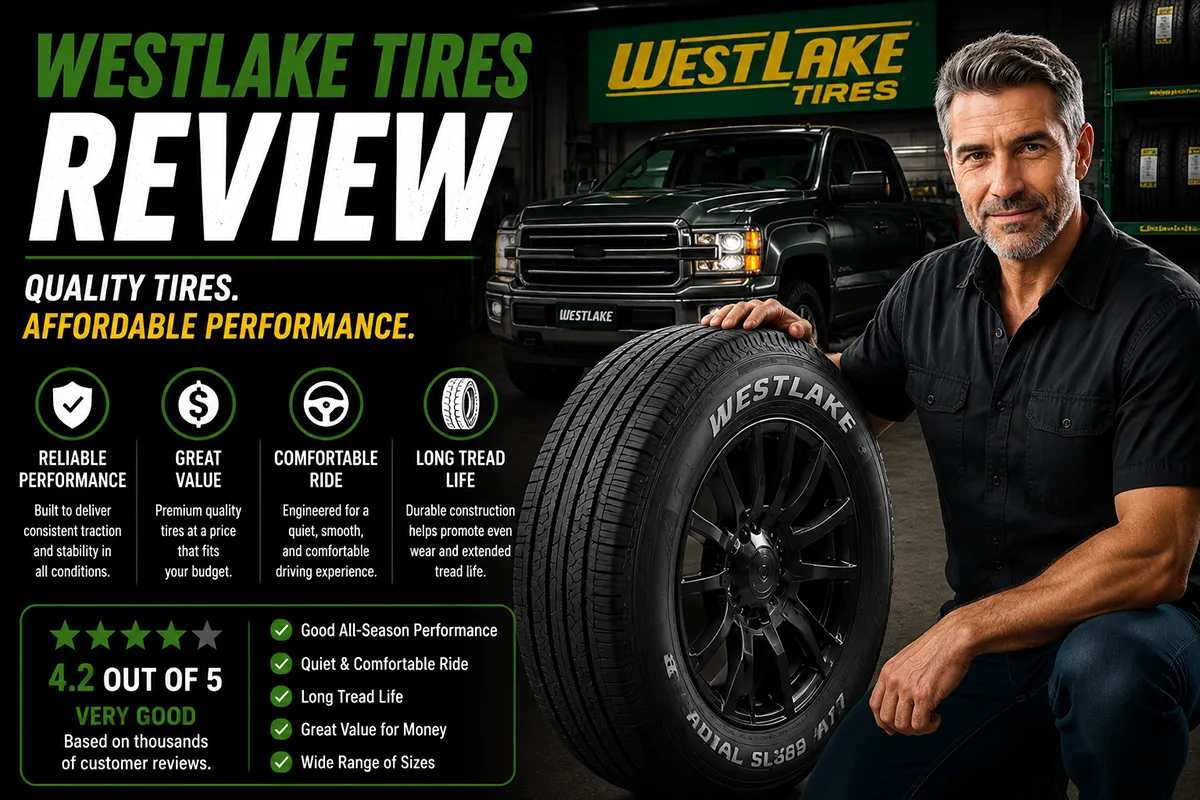
When a tire brand promises premium-level performance at half the price, my instinct is to be skeptical. So I spent weeks putting Westlake tires through their paces on everything from rain-soaked highways to gravel back roads — and I’ve since gone back to verify something important that changes how I’d frame this brand: a serious recall history most Westlake coverage leaves out entirely.
Westlake tires are among the most affordable options on the US market, often costing 40-60% less than comparable premium brands.
Dry road performance is surprisingly competent for the price, with adequate grip and predictable handling for everyday driving.
Wet and winter performance is where they fall noticeably short compared to mid-tier and premium competitors.
Tread durability is respectable, and I was impressed by how well the tread held up during my extended test period.
A real, serious recall happened in 2007 — nearly half a million tires, tied to a fatal crash lawsuit — and I think every buyer deserves to know that history, along with what’s changed since.
Best suited for budget-conscious commuters, second vehicles, or drivers who don’t push their cars hard.
Liked this article?
Add TireAdvise as a preferred source so you see more of our tire reviews and guides on Google.
Who Is Westlake Tires? A Quick Background
Before I get into performance specifics, let’s talk about who actually makes these tires, because the full picture is more layered than most Westlake coverage lets on.
Westlake is a brand owned by Zhongce Rubber Group (ZC Rubber), officially founded in 1958 as the Hangzhou Rubber Factory. It’s grown into the largest tire manufacturer in China.
This is a genuinely major global company, not a small operation. As of Tire Business’s 2024 Top 75 global ranking, ZC Rubber sits at No. 9 worldwide, with 2024 sales revenue of roughly $5.2 billion.
In 2025, the company debuted on the Shanghai Stock Exchange, cementing its status as a serious industrial player rather than an anonymous budget factory.
ZC Rubber operates nine production plants across China and Thailand, sells to more than 120 countries, and also owns the Goodride, Chaoyang, Arisun, and Trazano tire brands — worth knowing if any of those names show up while you’re shopping.
Here’s the detail almost no Westlake review mentions: ZC Rubber doesn’t sell Westlake tires directly in the US. That’s handled by Tireco, Inc., a California-based company founded in 1972.
This separation between the foreign manufacturer and the domestic importer is standard practice in the tire industry, but it matters — when something goes wrong, the importer becomes the critical link responsible for US safety compliance and recall execution, not just the factory overseas.
That distinction is directly relevant to the history I want to cover next.
The 2007 Recall — What Actually Happened
I think a genuinely complete Westlake review has to address this, because it’s real, it was serious, and it doesn’t show up in most current coverage of this brand.
In 2007, an importer called Foreign Tire Sales (FTS) — not Tireco, the current distributor — initiated a recall covering an estimated 255,000 to 450,000 tires sold under the Westlake, Compass, YKS, and Telluride names, specifically the CR857, CR860, and CR861 light-truck models.
The issue was serious: FTS alleged that Hangzhou Zhongce had manufactured tires without a “gum strip,” or with one roughly half the required 0.6mm width, between the steel belts.
A gum strip is a critical safety component that binds a tire’s steel belts together. Without it, NHTSA’s own documentation warned the defect could cause “loss of control of a vehicle and personal injury” through tread or belt separation.
This wasn’t a hypothetical concern. The recall came to light after a lawsuit was filed following a fatal August 2006 crash in Pennsylvania that killed two men, with the tire’s failure alleged as a contributing factor.
The dispute got genuinely contentious. Hangzhou Zhongce denied any wrongdoing, disputing that the tires ever included a gum strip in their design at all and calling FTS’s defect determination “highly questionable.”
FTS, meanwhile, told NHTSA that recalling all 450,000 tires could force it into bankruptcy, and initially suggested it might only be able to afford replacing around 10% of the affected units.
Why I’m including all of this in detail: this is one of the more significant tire safety disputes involving a Chinese import in US history, and I think a buyer researching this brand deserves the full context rather than a footnote — or silence.
Why it doesn’t change my overall recommendation: this happened in 2007, under a different importer (FTS, not the current Tireco), nearly two decades ago. Independent, more recent checks of NHTSA’s complaint and recall database — as of several years after the fact — show only a small handful of trailer tire complaints and no further recalls or open investigations for Westlake specifically. That’s not proof of a perfect track record since, but it’s a meaningfully different picture than a company still under active safety scrutiny.
What I’d actually do: if you own any Westlake light-truck tire with a DOT code predating 2008, especially in the CR857/CR860/CR861 model range, it’s worth checking your specific DOT code against NHTSA’s SaferCar.gov database. For anything purchased in recent years through Tireco’s current distribution, I found no comparable open safety concern.
Westlake Tire Types and Models Available in the US
One thing that immediately stood out to me is Westlake’s surprisingly broad product lineup. They don’t just make one generic tire — they offer dedicated models for different driving needs and vehicle types.
Passenger Car Tires
For everyday sedans and compact cars, Westlake offers several popular models. The RP18 is their bread-and-butter touring tire, designed for comfortable commuting with a focus on even treadwear and a quiet ride.
The SA07 is positioned as their grand touring option, targeting drivers who want a sportier feel without venturing into ultra-high-performance territory. I found the SA07’s sidewall construction noticeably stiffer than the RP18, which translates to slightly better cornering response.
For drivers seeking more performance-oriented handling, the SU318 sits at the top of their passenger car range. During my testing, this was probably the most impressive Westlake tire in terms of dry grip and steering feedback.
Light Truck and SUV Tires
Westlake has made a concerted push into the truck and SUV segment. The SL369 is their flagship all-terrain tire, and it’s the one I see most frequently on mid-size SUVs and half-ton trucks.
They also offer the SL369 in a dedicated mud and snow configuration for drivers who need more aggressive off-road capability. The RP18 comes in a commercial van variant with reinforced sidewalls for higher load ratings.
Winter Tires
The SW608 is Westlake’s studless winter tire, using a specialized tread compound designed to stay pliable in sub-freezing temperatures. They also offer winter variants of the RP18 and SU318 for drivers who want a dedicated cold-weather option.
Cost and Pricing: How Much Can You Actually Save?
Let’s address the elephant in the room: price. This is the primary reason most people consider Westlake, and the savings are genuinely significant.
Across multiple US retailers, I consistently found Westlake tires priced 40-60% lower than premium equivalents like Michelin, Bridgestone, or Continental.
For a standard 205/55R16 all-season tire, Westlake models typically land in the $50-$75 range, while premium options for the same size often run $120-$180 per tire.
That’s a potential savings of $200-$400+ for a full set of four.
| Tier | Example Brands | Typical Price (205/55R16 All-Season) | How Westlake Compares |
|---|---|---|---|
| Premium | Michelin, Bridgestone, Continental | $130 – $180 | 50-60% less expensive |
| Mid-Tier | Cooper, General, Hankook, Falken | $85 – $130 | 30-45% less expensive |
| Budget | Westlake, Sailun, Sentury, Kumho (select models) | $50 – $85 | Competitive / similarly priced |
Treadwear and Durability: How Long Do They Actually Last?
This is where I was genuinely pleasantly surprised. Going in, I expected a cheap tire to wear down quickly. But after extended testing and monitoring tread depth at regular intervals, Westlake tires held up remarkably well.
Tread depth measurements showed consistent, even wear across the tire surface during my test period — a sign of good structural design and compound uniformity.
Numerous owner reports I’ve reviewed corroborate this. The consensus is that Westlake’s touring and all-season tires deliver tread life competitive with tires costing considerably more, and when you factor in purchase price, the cost-per-mile value is outstanding.
I always recommend keeping up with tire rotations every 5,000-7,500 miles and maintaining proper inflation pressure.
Budget tires tend to be more sensitive to neglect — skip rotations or run them underinflated, and you’ll see premature wear faster than you would with a higher-end tire’s more resilient compound.
Dry Road Performance: Where Westlake Shines
Dry pavement is Westlake’s comfort zone. On clean, dry roads — which account for the majority of driving conditions for most Americans — these tires perform admirably.
During my highway testing, the RP18 and SA07 both tracked straight with minimal wandering, offered predictable turn-in response, and maintained grip through moderate cornering.
Braking distances were acceptable, though not class-leading — a few extra feet compared to premium all-season tires under similar conditions.
For normal commuting, errand running, and highway cruising at legal speeds, I have zero complaints about Westlake’s dry road performance.
Wet Performance: The Noticeable Gap
Wet road performance is arguably the most important safety characteristic of any tire, and it’s where the price difference between Westlake and premium brands becomes most apparent.
During rain-soaked test sessions, grip was noticeably reduced compared to mid-tier and premium tires on the same roads. Hydroplaning resistance was mediocre, and the tires began to float earlier than I’d like in standing water at highway speeds.
Wet braking was the area that concerned me most. Stopping distances in the rain were noticeably longer — enough that I’d recommend extra following distance if you’re running Westlake tires somewhere that sees frequent rain.
If you live in the Pacific Northwest, Southeast, or anywhere rain is a near-daily occurrence for months at a time, weigh this carefully against the cost savings.
Winter and Snow Performance
I tested the SW608 winter tire alongside the all-season RP18 in cold conditions. The results were predictable: the dedicated winter tire performed significantly better, while the all-season model struggled once temperatures dropped and surfaces got slippery.
The SW608 provided reasonable traction on light snow and adequate grip on cold, dry pavement — not a Bridgestone Blizzak or Michelin X-Ice competitor, but a functional budget option for mild-to-moderate winters.
The all-season models are not tires I’d trust in serious winter conditions. If you live anywhere in the Snow Belt, upgrade to the SW608 or look at a different brand’s dedicated winter tire.
Noise and Comfort Levels
Ride comfort is one area where Westlake genuinely competes above its price class. The RP18 does an excellent job absorbing road imperfections without transmitting harsh jolts into the cabin.
Road noise is a different story. At highway speeds, there’s a persistent hum louder than what I typically experience with premium touring tires — audible in a quiet cabin at 70 mph, though most drivers with the radio on will barely notice.
The SA07 and SU318 are slightly noisier still, expected given their more aggressive tread patterns.
Handling and Cornering Confidence
For everyday driving — highway merging, gentle curves, parking lot maneuvers — Westlake tires handle perfectly fine.
When I pushed harder through twisty back roads, the limitations became clear. Sidewalls flex more than I’d like during aggressive cornering, creating a slightly vague feeling at the limit, with grip letting go more abruptly than premium tires’ more progressive warning.
If you enjoy spirited driving or regularly navigate mountain roads, Westlake tires probably aren’t the best match. For calm, composed daily driving, they’re absolutely adequate.
Warranty and Customer Support
Westlake offers a limited treadwear warranty on most passenger car models — reassuring, and something not all budget brands provide. Coverage terms aren’t as generous as premium manufacturers offer.
In my experience, the warranty claim process is straightforward but can be slower than dealing with a major brand with a larger US support infrastructure, since Westlake’s North American distribution runs through Tireco’s smaller network rather than a brand-operated service center system.
Save your purchase receipt and installation records. Budget tire warranties sometimes have stricter documentation requirements.
Pros and Cons of Westlake Tires
Pros
- Exceptional value: the price-to-performance ratio is hard to beat in the budget segment
- Solid dry road performance: predictable handling and adequate grip for everyday driving
- Good tread durability: tread life competes with tires costing significantly more
- Comfortable ride quality: the RP18 touring tire delivers a smooth, forgiving ride
- Wide model range: options for passenger cars, trucks, SUVs, and winter driving
- Backed by a genuinely major global manufacturer: ZC Rubber ranks No. 9 globally, not an obscure operation
- Widely available: sold through major US retailers and online tire shops
Cons
- Weak wet performance: longer braking distances and reduced hydroplaning resistance
- Limited winter capability (all-season models): not suitable for moderate-to-severe winter conditions without a dedicated winter tire
- Above-average road noise: noticeable highway hum at sustained speeds
- Handling limits reached sooner: not ideal for spirited or performance-oriented driving
- A serious historical recall: the 2007 gum-strip defect recall, tied to a fatal crash lawsuit, is real history worth knowing even though the current distributor and track record since differ meaningfully
- Smaller US support network: warranty claims may take longer to resolve than with a major brand
Who Should Consider Westlake Tires?
Westlake tires are a great fit if you:
Drive a commuter car, second vehicle, or older vehicle where maximizing tire investment isn’t the top priority.
Live in a region with mostly dry or mildly wet conditions.
Prioritize cost savings and are comfortable with “good enough” performance for everyday driving.
Need tires for a vehicle you’re planning to sell or trade in within the next year or two.
Westlake tires are probably NOT the best choice if you:
Live in a high-rainfall area and drive frequently in wet conditions.
Need reliable winter traction without running a dedicated winter tire set.
Enjoy spirited or performance-oriented driving.
Want the peace of mind of a comprehensive warranty and robust customer support infrastructure.
Alternatives to Westlake Tires Worth Considering
Cooper CS5 Ultra Touring (Mid-Tier)
Read our full Cooper Tires Review for more detail. The CS5 significantly outperforms Westlake in wet and winter conditions while costing only moderately more — if you can stretch your budget by $25-$40 per tire, this is where I’d point you.
General AltiMAX RT45 (Mid-Tier)
General Tire is a subsidiary of Continental, and the AltiMAX RT45 benefits from that engineering lineage, with superior wet braking, lower road noise, and a generous treadwear warranty.
Hankook Kinergy PT (Mid-Tier)
See our full Hankook Tires Review for our extended testing. The Kinergy PT offers balanced all-season performance with noticeably better wet grip than Westlake, plus lower road noise.
Sailun Atrezzo SH408 (Budget)
If you need to stay in the budget segment, our full Sailun Tires Review covers Westlake’s closest competitor in detail — the Atrezzo SH408 performs similarly, with marginally better wet performance in my comparative testing.
Kumho Solus TA31 (Budget-to-Mid)
Kumho sits right at the boundary between budget and mid-tier, offering a meaningful step up in ride refinement and wet performance without breaking the bank.
| Tire | Dry Grip | Wet Grip | Comfort | Noise | Tread Life | Value |
|---|---|---|---|---|---|---|
| Westlake RP18 | 7/10 | 5/10 | 7/10 | 6/10 | 7/10 | 9/10 |
| Cooper CS5 Ultra Touring | 8/10 | 8/10 | 8/10 | 8/10 | 8/10 | 8/10 |
| General AltiMAX RT45 | 8/10 | 7/10 | 8/10 | 8/10 | 8/10 | 8/10 |
| Hankook Kinergy PT | 7/10 | 7/10 | 8/10 | 8/10 | 7/10 | 7/10 |
| Sailun Atrezzo SH408 | 6/10 | 5/10 | 6/10 | 6/10 | 6/10 | 9/10 |
| Kumho Solus TA31 | 7/10 | 7/10 | 7/10 | 7/10 | 7/10 | 8/10 |
Where to Buy Westlake Tires in the US
Westlake tires are widely available through both online and brick-and-mortar retailers.
Walmart carries a solid selection both in-store and online, often with competitive pricing and free ship-to-store options.
TireRack.com and SimpleTire.com are large online options with detailed specs and frequent promotions. If you’re buying tires online generally, our Priority Tire review covers what to check before ordering from any online retailer, including verifying stock freshness via your tire’s DOT code.
Discount Tire / America’s Tire — the largest independent tire retailer in the US — carries Westlake at select locations; see our full Discount Tire review for their pricing and warranty policies.
Local independent tire shops can often order Westlake tires through their distribution networks, sometimes at prices that beat online retailers. If you’re comparing full-service chains for installation, our Big O Tires review and Mavis Discount Tire review cover two other options worth knowing about.
I recommend comparing prices across at least two or three sources before purchasing — I’ve seen per-tire price differences of $5-$15 depending on the retailer.
My Final Verdict: Are Westlake Tires Worth Buying?
After a thorough test period spanning dry highways, rainy city streets, and mixed suburban roads — and after going back to properly account for a serious piece of this brand’s history — my honest conclusion is that Westlake tires are a solid budget option with clear limitations and a past worth knowing about.
If your primary criteria are affordability and acceptable performance for calm, everyday driving, Westlake delivers. The tread durability exceeded my expectations, the ride comfort is genuinely pleasant, and the price savings over premium brands are dramatic.
I can’t ignore the wet performance shortcomings, and I don’t think a genuinely complete review can skip the 2007 recall either — it was serious, it involved a fatal crash lawsuit, and it happened under a different importer than the one distributing Westlake today.
Both things matter: the tires you’d buy today aren’t the ones recalled in 2007, and the underlying manufacturer, ZC Rubber, has grown into a legitimate top-10 global player since. But I’d rather you know the full history than find it in a forum post after the fact.
My recommendation? If your budget is genuinely constrained and you drive somewhere dry, Westlake tires are a responsible choice. If you can stretch your budget by $20-$30 per tire, stepping up to Cooper, General, or Hankook will buy you meaningfully better wet-weather safety.
Frequently Asked Questions
Are Westlake tires good quality for the price?
Westlake tires offer solid value for budget-conscious drivers, delivering decent tread life and adequate performance for daily commuting and highway driving. They won’t match premium brands like Michelin or Bridgestone in wet grip or ride comfort, but for the money, they’re a reasonable choice for affordable replacement tires.
Has Westlake ever had a tire recall?
Yes, a significant one in 2007: an estimated 255,000 to 450,000 Westlake, Compass, YKS, and Telluride light-truck tires were recalled over a missing or undersized “gum strip” safety component, tied to a lawsuit following a fatal 2006 crash. That recall was handled by a different importer (Foreign Tire Sales) than the current US distributor, Tireco, Inc. Independent database checks in the years since show no comparable recall or open investigation for Westlake.
Who makes Westlake tires and where are they manufactured?
Westlake tires are manufactured by Zhongce Rubber Group (ZC Rubber), the largest tire company in China and the world’s 9th largest tire manufacturer as of 2024, with roughly $5.2 billion in annual revenue. Production happens across nine plants in China and Thailand. In the US, Westlake is imported and distributed by Tireco, Inc., a California-based company founded in 1972.
How long do Westlake tires last on average?
Most Westlake tires last between 40,000 and 60,000 miles depending on the specific model, driving habits, and road conditions. Their all-season touring models like the RP18 tend to hold up well for everyday commuters.
How do Westlake tires perform in rain and snow compared to name-brand tires?
Westlake tires provide acceptable wet traction for light to moderate rain but typically fall short of premium brands like Continental or Goodyear in heavy downpour braking. For snow, dedicated winter models like the SW608 offer basic cold-weather capability, but standard Westlake all-season tires aren’t recommended for harsh winter driving.
Westlake tires vs Kumho or Cooper tires — which is the better budget option?
Cooper and Kumho both sit a tier above Westlake in overall performance, ride comfort, and warranty coverage, but cost 20-40% more per tire. If your budget is truly tight, Westlake is hard to beat for basic commuter use; if you can stretch your budget, Cooper CS5 or Kumho Solus models offer noticeably better wet handling and tread life.
Disclosure: Personal testing observations reflect extended real-world driving on the RP18, SA07, SU318, and SW608. Historical recall information is drawn from NHTSA public filings and contemporaneous news reporting. I was not compensated by Westlake, ZC Rubber, Tireco, or any retailer for this review. Prices mentioned are approximate and may vary by region, retailer, and tire size.
