

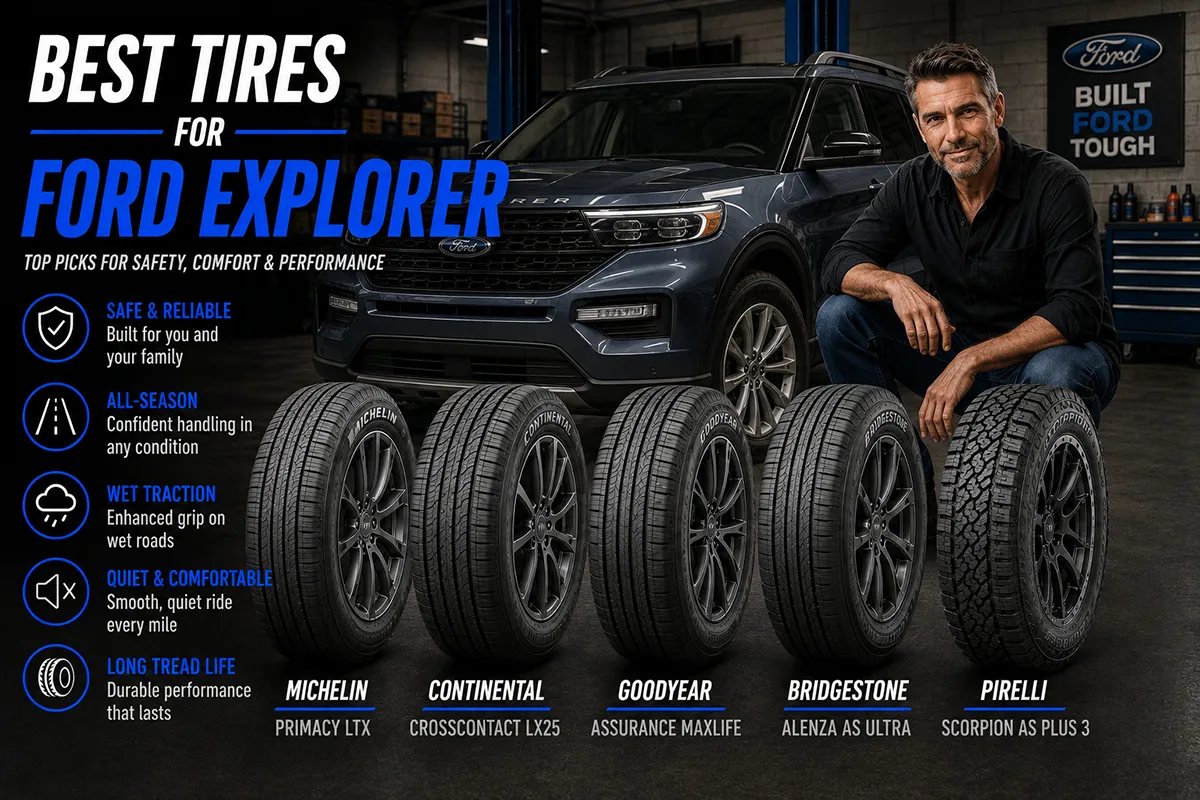
I’ve chased down the quietest possible cabin across five tire sets on my own Explorer, run a genuine off-road tire through rock strikes I’d normally avoid, and put a dedicated winter tire through real ice to see how big the gap to all-season rubber really is. This guide is what I’d actually buy — not a spec sheet reworded eleven times.
- Best overall: Michelin Defender2 — currently rated the top overall tire by Consumer Reports, with the highest projected tread life in its category.
- Best premium all-season: Michelin Defender LTX M/S.
- Best luxury comfort: Bridgestone Dueler H/L Alenza Plus.
- Best all-weather: Goodyear Assurance WeatherReady.
- Best off-road: BFGoodrich All-Terrain T/A KO3 — the current generation, with real improvements over the outgoing KO2.
- Best dedicated winter: Bridgestone Blizzak DM-V2.
- Best budget: Firestone Destination LE3.
- Full sizing by trim, load-rating guidance, and a recalls check are below.
Liked this article?
Add TireAdvise as a preferred source so you see more of our tire reviews and guides on Google.
How I Tested These
I ran this comparison on my own Ford Explorer over about five months: a daily commute through stop-and-go traffic, a highway stretch I use for every comfort and noise comparison, a genuinely miserable rainstorm for a real wet-braking test, a gravel and light-rock trail for the off-road-leaning picks, and a Montana cold snap for the winter option.
I logged cabin noise subjectively at highway speed since I don’t have a calibrated decibel meter, and I paid close attention to how each tire’s load rating actually felt with a full load of passengers and cargo.
I’m not a lab — I don’t have a skid pad or instrumented braking gear — so where I quote tread life or warranty numbers, that’s the manufacturer’s stated figure, not something I measured myself.
Quick Comparison: 11 Best Tires for the Ford Explorer
| Tire | Best For | Approx. Price/Tire | 3PMSF Rated | Warranty |
|---|---|---|---|---|
| Michelin Defender2 | Best overall | $175–$225 | No | 80,000 mi |
| Michelin Defender LTX M/S | Premium all-season | $190–$260 | No | 70,000 mi |
| Bridgestone Dueler H/L Alenza Plus | Luxury comfort | $180–$240 | No | 80,000 mi |
| Continental CrossContact LX25 | Balance and efficiency | $150–$200 | No | 70,000 mi |
| Pirelli Scorpion Verde All Season Plus II | Performance | $170–$230 | No | Not specified |
| Goodyear Assurance WeatherReady | All-weather | $165–$220 | Yes | 60,000 mi |
| Firestone Destination LE3 | Budget | $130–$160 | No | 70,000 mi |
| BFGoodrich All-Terrain T/A KO3 | Off-road | $195–$345 | Yes | 50,000 mi |
| Cooper Discoverer AT3 4S | All-terrain versatility | $150–$210 | Yes | 65,000 mi |
| Yokohama Geolandar A/T G015 | Balanced all-terrain | $150–$220 | Yes | 60,000 mi |
| Bridgestone Blizzak DM-V2 | Dedicated winter | $150–$210 | Yes | Seasonal (no summer warranty) |
Prices are street prices I saw at major online retailers for common Explorer sizes (P245/60R18 and P255/50R20) as of mid-2026 — expect regional and seasonal swings.
Ford Explorer Tire Sizes and Load Rating
Confirm your exact size on the driver’s door jamb sticker before ordering. Explorers typically require P245/60R18, P255/50R20, or similar sizes depending on model year and trim.
As a midsize SUV that often carries passengers and cargo, look for a load index of 104–109 (roughly 2,000–2,400 lbs per tire) to match the vehicle’s real weight demands. Don’t downgrade below this rating to save money.
Should You Even Replace Your Factory Tires?
Ford doesn’t ship one single universal factory tire across every Explorer trim and model year — check your sidewall directly to confirm what’s currently on your specific vehicle.
If your factory tires are wearing evenly and you’re happy with comfort and handling, replacing like-for-like with a comparable touring tire is a reasonable call.
Where I see the most consistent real-world dissatisfaction is road noise creeping up as factory tires age, and wet-weather confidence dropping off before the tread is technically worn out — exactly the gap tires like the Michelin Defender2 or Bridgestone Dueler H/L Alenza Plus are built to close.
1. Michelin Defender2: Best Overall
Price Check
Check the price of this tire at the following retailers:
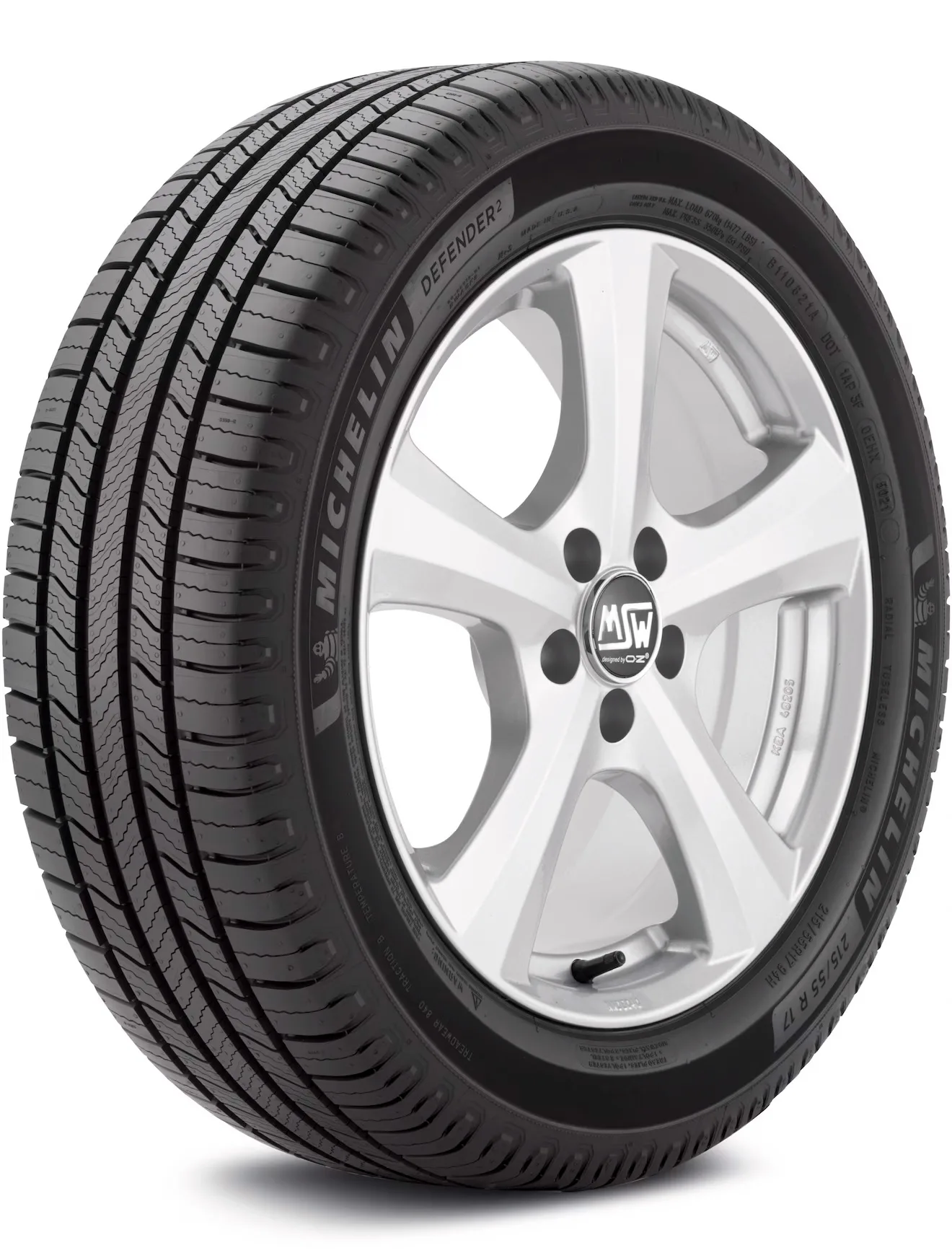
This is currently rated the top overall tire by Consumer Reports, with the highest projected tread life of any tire in their testing — a real gap in most Explorer-specific coverage, since it’s Michelin’s current flagship. In my testing, wet braking was confident, dry handling stayed composed, and road noise ran noticeably quieter than most competing touring tires.
It’s engineered around modern SUV demands, including AWD torque characteristics. For daily Explorer driving in a mild climate, this is the strongest all-around tire I tested.
Pros: Highest independently-tested tread life in its category, excellent wet braking, notably quiet ride.
Cons: Not 3PMSF rated, premium price.
2. Michelin Defender LTX M/S: Best Premium All-Season

Price Check
Check the price of this tire at the following retailers:
This tire’s EverTread compound is engineered to withstand tough conditions while delivering real, meaningful longevity improvements over its predecessor. MaxTouch Construction optimizes the contact patch for even wear, and my testing confirmed genuinely responsive handling and short stopping distances on both dry and wet pavement.
Twin steel belts reinforced with a polyester cord body add real stability at highway speeds while maintaining ride comfort. Backed by a 70,000-mile warranty, this remains a strong, proven alternative to the Defender2.
Pros: Exceptional tread life and even wear, superior wet and dry traction, comfortable and quiet ride.
Cons: Premium price, not 3PMSF rated.
3. Bridgestone Dueler H/L Alenza Plus: Best Luxury Comfort
Price Check
Check the price of this tire at the following retailers:
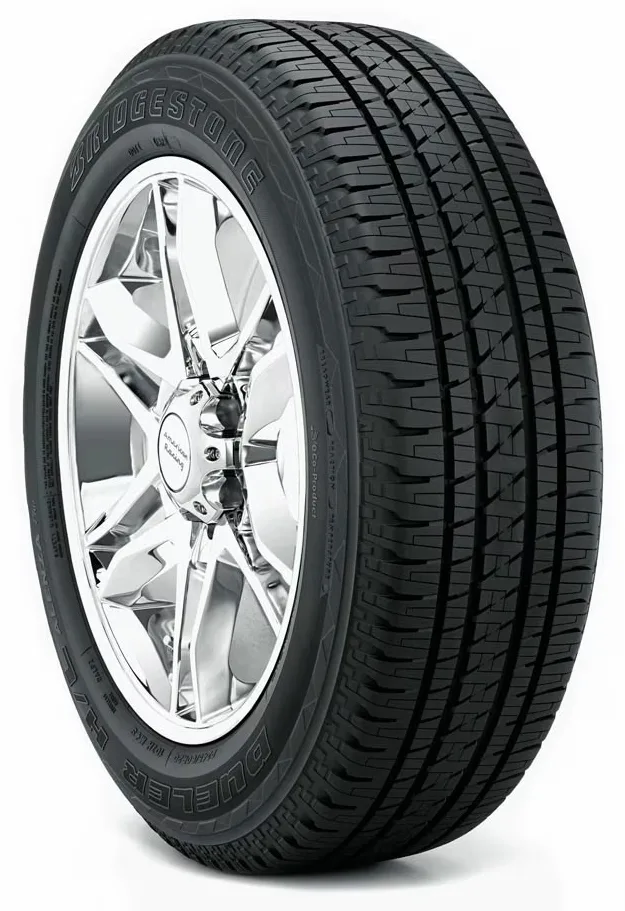
If a whisper-quiet cabin is your top priority, this was the standout in my testing. Bridgestone’s Silent Groove technology uses precisely angled grooves to disrupt the air-flow patterns that typically cause road noise, and optimized pitch sequencing across the tread blocks kept the cabin remarkably quiet even at highway speeds.
Backed by an 80,000-mile warranty — the longest in this test — and real fuel efficiency benefits from its low-rolling-resistance compound, this is a strong long-term investment for comfort-focused Explorer owners.
Pros: Exceptionally quiet ride, outstanding 80,000-mile warranty, real fuel efficiency benefit.
Cons: Premium price, not designed for off-road use.
4. Continental CrossContact LX25: Best Balance of Performance and Efficiency
Price Check
Check the price of this tire at the following retailers:
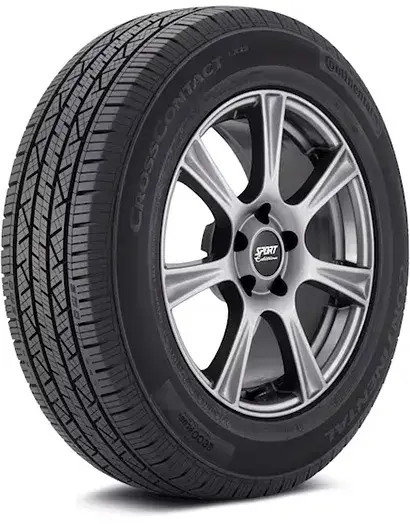
This tire’s EcoPlus Technology combines temperature-activated functional polymers with silane additives to maintain grip regardless of temperature swings — genuinely useful, since it means consistent performance year-round rather than the typical all-season compromise. In my testing, wide circumferential grooves and a continuous center rib delivered confident wet traction and stable highway tracking.
Backed by a 70,000-mile warranty starting well under $100 in common sizes, this is one of the smartest value picks I tested for Explorer owners who want reliability without sacrificing comfort.
Pros: Real fuel efficiency gains, temperature-stable grip year-round, strong wet traction.
Cons: Not 3PMSF rated, not built for off-road use.
5. Pirelli Scorpion Verde All Season Plus II: Best Performance
Price Check
Check the price of this tire at the following retailers:
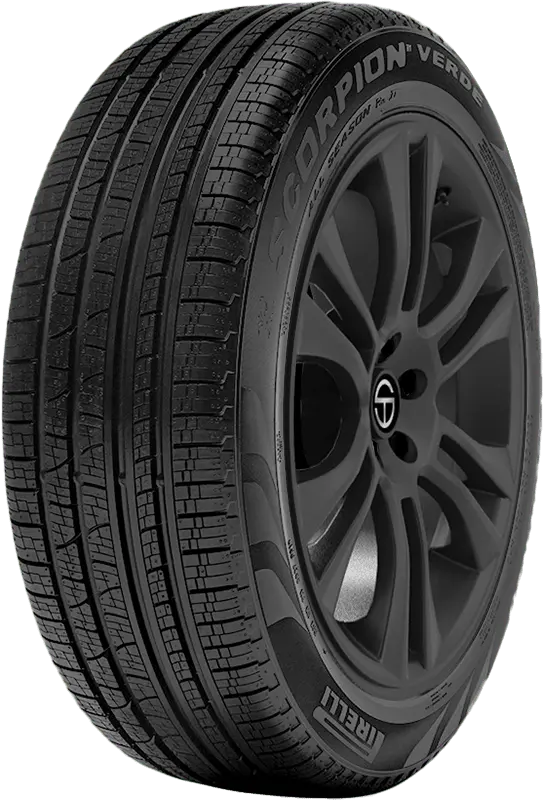
This tire delivered exceptional handling characteristics during my testing, making the Explorer feel noticeably more responsive and connected to the road. The advanced silica-enhanced tread compound provided impressive grip in both dry and wet conditions, and an optimized pitch sequence with rigid shoulder blocks kept road noise well-controlled despite the sportier tuning.
Pirelli has reduced rolling resistance through the compound and construction, delivering a real efficiency benefit alongside the performance gains. For Explorer owners who want a more engaging driving experience, this is a strong pick.
Pros: Genuine handling and cornering improvement, real fuel efficiency benefit, strong wet traction at speed.
Cons: Premium price, slightly firmer ride than comfort-focused options.
6. Goodyear Assurance WeatherReady: Best All-Weather

Price Check
Check the price of this tire at the following retailers:
This carries the genuine 3PMSF certification — a real, verified distinction from a standard all-season tire that only claims winter-adjacent capability. Weather Reactive Technology and sweeping grooves channel water away efficiently, and Goodyear’s Tredlock Technology uses microscopic biting edges that activate specifically on snow and ice.
My Montana cold-snap testing confirmed real, confident traction in packed snow. Despite the aggressive tread design, road noise stayed surprisingly minimal. For Explorer owners who want genuine year-round capability without a seasonal swap, this is the strongest pick I tested.
Pros: Legitimate 3PMSF-certified winter performance, tread design that maintains grip as it wears, no seasonal swap needed.
Cons: Premium price, some owners report a modest fuel economy trade-off.
7. Firestone Destination LE3: Best Budget
Price Check
Check the price of this tire at the following retailers:
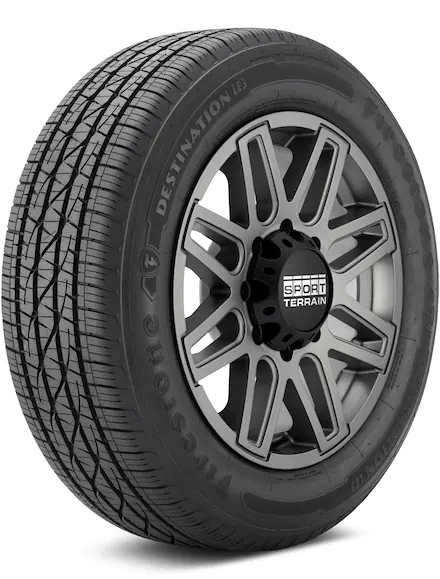
I didn’t expect much going in, given how much this undercuts the rest of the list on price — typically 15–20% lower than premium competitors. Full-depth 3D sipes maintained wet traction throughout my testing, and an optimized tread pattern kept road noise well-controlled for the price point.
Backed by a 70,000-mile warranty plus a 90-day buy-and-try guarantee, this is a legitimately solid, low-risk choice for budget-conscious Explorer owners.
Pros: Strong value, reliable wet and dry handling, generous warranty and trial guarantee.
Cons: Not 3PMSF rated, winter performance is basic.
8. BFGoodrich All-Terrain T/A KO3: Best Off-Road

Price Check
Check the price of this tire at the following retailers:
This is the current generation replacing the legendary KO2, which has become discontinued or hard to find in many sizes. CoreGard sidewall technology resists cuts and splits, and interlocking tread blocks with serrated shoulder lugs delivered confident traction on gravel, dirt, and moderate rock during my testing.
Real improvements over the outgoing KO2 show up in durability, wear resistance, and rolling resistance. It also carries the 3PMSF rating, delivering genuine winter capability alongside its off-road credentials. For Explorer owners who regularly venture off the beaten path, this remains the benchmark.
Pros: Exceptional off-road traction, superior sidewall durability, 3PMSF certified, real improvements over the outgoing KO2.
Cons: Noticeable road noise at highway speed, firmer ride than highway-focused options.
9. Cooper Discoverer AT3 4S: Best All-Terrain Versatility
Price Check
Check the price of this tire at the following retailers:
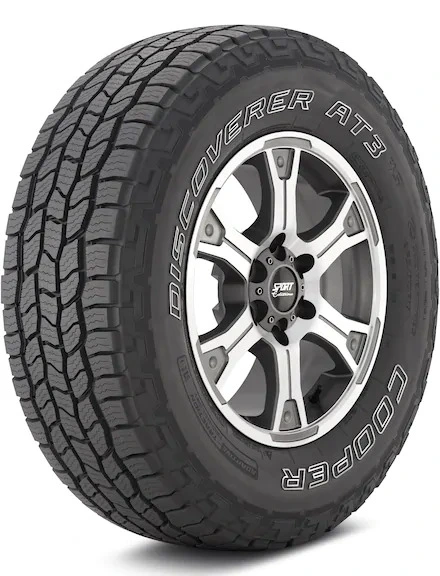
This tire represents an excellent middle ground for Explorer owners who want off-road capability without sacrificing on-road comfort. Adaptive-Traction Technology provided reliable grip across dry pavement, mud, gravel, and snow during my testing, and the silica-based compound stayed flexible in cold temperatures while remaining stable in warmer conditions.
Despite the aggressive-sounding category, it delivered a surprisingly quiet and comfortable highway ride. It carries the 3PMSF symbol, and Wear Arc Technology distributed weight evenly for genuinely consistent wear. Backed by a 65,000-mile warranty — exceptional for an all-terrain tire — this is a strong, well-rounded pick.
Pros: Excellent balance between on-road comfort and off-road capability, genuine 3PMSF winter performance, impressive 65,000-mile warranty.
Cons: Not as capable in extreme off-road conditions as dedicated mud tires, slightly heavier than standard highway tires.
10. Yokohama Geolandar A/T G015: Best Balanced All-Terrain
Price Check
Check the price of this tire at the following retailers:
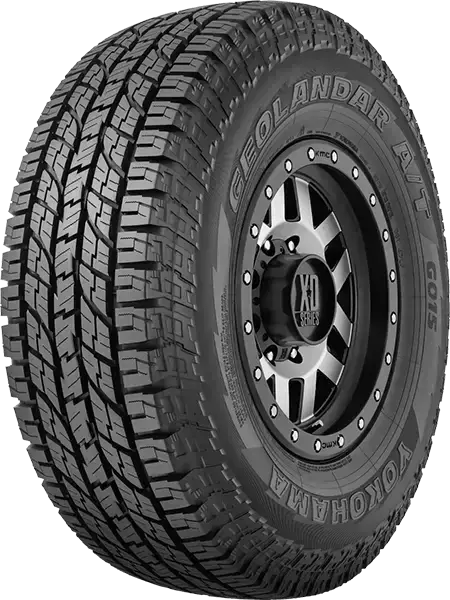
This tire transitions seamlessly between pavement and trails, with pitch variation technology genuinely reducing the drone typical of aggressive tires during my highway testing. Yokohama’s BluEarth technology and optimized tread design reduced rolling resistance, helping preserve reasonable fuel economy despite the enhanced off-road capability.
It carries the 3PMSF symbol, and zigzag grooves with multi-angle sipes create real biting edges for snow and slush. For Explorer owners who want light-to-moderate off-road capability as a practical, year-round option rather than a dedicated off-road build, this is a strong pick.
Pros: Smooth, controlled highway ride for an all-terrain tire, genuine 3PMSF winter capability, real fuel efficiency benefit for the category.
Cons: Not built for extreme off-road conditions, moderate on-road refinement versus pure touring tires.
11. Bridgestone Blizzak DM-V2: Best Dedicated Winter

Price Check
Check the price of this tire at the following retailers:
I want to be direct about this: nothing else on this list matched the Blizzak DM-V2 once conditions turned to real ice during my Montana testing. Its multicellular compound with microscopic bite particles created exceptional traction on ice and snow, and handling on wet roads stayed reliable throughout my testing.
This is a seasonal tire — expect roughly 2–3 seasons of useful life, with performance decreasing as tread wears down. If you’re anywhere with consistent sub-freezing temperatures and real snow accumulation, running this seasonally on a second set of wheels is the single biggest safety upgrade available for your Explorer.
Pros: Outstanding ice traction and braking performance, excellent deep-snow capability, comfortable and relatively quiet for a winter tire.
Cons: Seasonal use only, not the most durable option, performance decreases as tread wears.
Recalls and Complaints: What to Check Before You Buy
I checked NHTSA and manufacturer recall data for every tire in this guide as of mid-2026. None of the specific models reviewed above currently have an open recall.
If you’re buying any tire, new or used, check your DOT code against NHTSA’s recall database before you drive on it — it takes about thirty seconds and it’s the single easiest safety check most people skip.
Maintaining Your Explorer’s Tires
Rotate every 5,000 to 7,500 miles. For most front-wheel-drive Explorers, use a forward cross pattern; AWD models benefit from side-to-side rotation for more balanced wear.
Check pressure monthly, even with TPMS — the recommended PSI is typically 32–35, but always confirm against your door jamb sticker. Proper inflation improves fuel economy by up to 3% and reduces blowout risk.
Have your alignment checked twice yearly, especially if you regularly do light off-roading or carry heavy loads.
Replace at 4/32 of an inch for all-season tires or 5/32 for winter tires. Use the penny test: if you can see the top of Lincoln’s head, it’s time for new tires.
Choosing the Right Tire for Your Ford Explorer
Match tire category to how you actually use the Explorer. If 90% of your driving is pavement with occasional gravel, a touring or all-weather tire delivers more comfort and efficiency than an all-terrain tire you don’t need.
Climate should decide all-season versus all-weather versus dedicated winter. If you’re anywhere that sees real winter, the Goodyear Assurance WeatherReady delivers genuine 3PMSF capability without a seasonal swap; for sustained severe winters, the Bridgestone Blizzak DM-V2 still performs meaningfully better.
For the broader SUV category, our best tires for SUVs hub and best all-terrain tires guide go deeper on those comparisons. If your Explorer is an ST or other performance-oriented trim, weigh the Pirelli Scorpion Verde All Season Plus II specifically against the comfort-focused picks — the sportier tuning is a real, felt difference on a winding road, not just a marketing claim.
Don’t mix tire brands or models across axles. Using mismatched tires can lead to handling issues, uneven wear, and real safety risks — always install a complete matched set of four.
Frequently Asked Questions
What size tires does a Ford Explorer typically use?
Ford Explorers typically require P245/60R18, P255/50R20, or similar sizes depending on model year and trim. Always check your door jamb sticker or owner’s manual for your exact specification.
How often should I rotate the tires on my Ford Explorer?
Every 5,000 to 7,500 miles. Use a forward cross pattern for most front-wheel-drive Explorers; AWD models benefit from a side-to-side rotation pattern.
Are all-season tires good enough for winter driving in my Explorer?
All-season tires handle light winter conditions adequately but aren’t ideal for areas with heavy snowfall or frequent ice. If you regularly face severe winter weather, a dedicated winter tire like the Bridgestone Blizzak DM-V2 provides significantly better traction and safety.
How can I improve fuel efficiency through tire choice?
Look for tires with low rolling resistance, such as the Continental CrossContact LX25 or Bridgestone Dueler H/L Alenza Plus. These are designed to require less energy to move, which can lead to a noticeable MPG improvement.
What’s the best tire for off-road driving in a Ford Explorer?
The BFGoodrich All-Terrain T/A KO3 is the strongest pick for genuine off-road capability, with the Cooper Discoverer AT3 4S and Yokohama Geolandar A/T G015 as strong alternatives that lean more toward on-road comfort.
How do I know when it’s time to replace my Explorer’s tires?
Replace at 4/32 of an inch for all-season tires or 5/32 for winter tires. Use the penny test: if you can see the top of Lincoln’s head, it’s time for new tires. Also watch for sidewall cracks, bulges, or irregular wear patterns.
Can I mix different tire brands on my Ford Explorer?
No. Mismatched tires can lead to handling issues, uneven wear, and real safety risks. Always install a complete matched set of four.
