

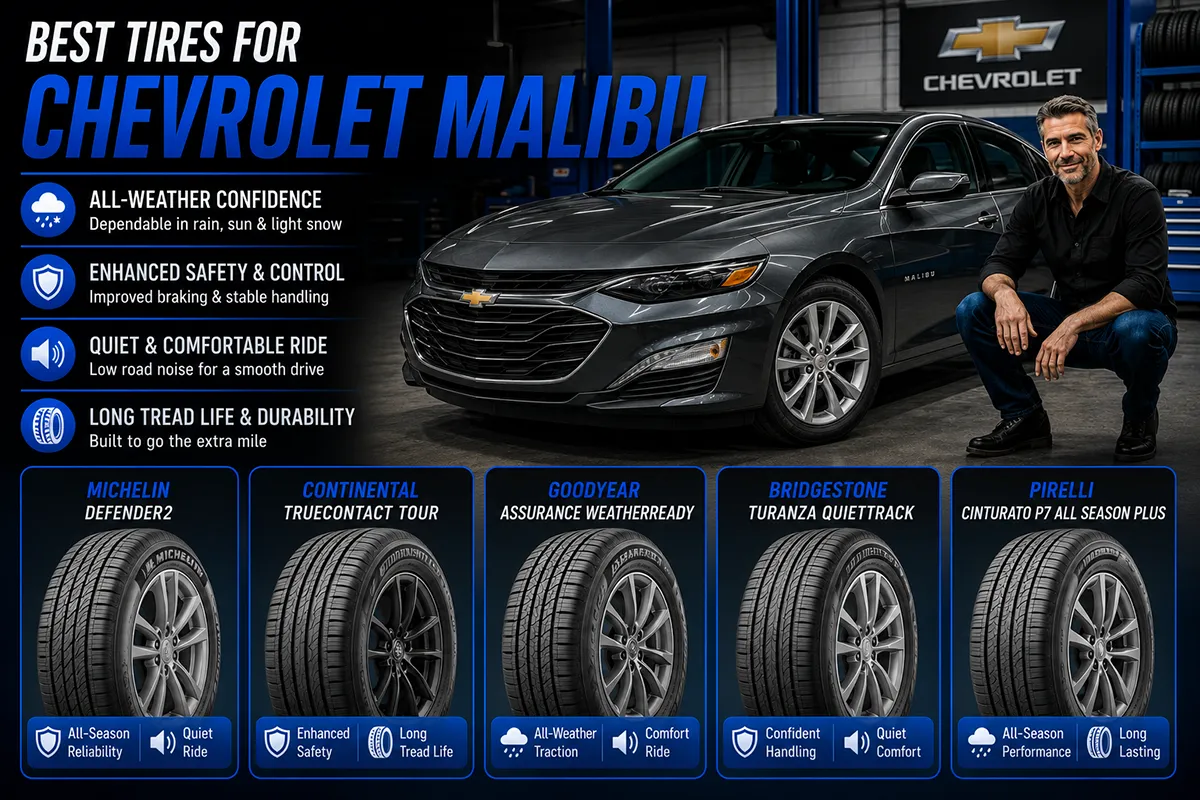
GM ended Malibu production in November 2024, with the 2025 model year the last one built — which means nearly everyone searching for Malibu tires today is keeping an existing car running well, not shopping for a new one, and this guide is built for exactly that reader. Based on manufacturer specifications, aggregated owner data, and independent test results, here’s what actually holds up on a final-generation Malibu, by priority.
- Best overall: Continental TrueContact Tour.
- Best for longevity: Michelin Defender T+H.
- Best for comfort and quiet: Bridgestone Turanza QuietTrack.
- Best value all-season: Pirelli P4 Four Seasons Plus.
- Best for varied weather: Goodyear Assurance WeatherReady2.
- Best budget-friendly: General AltiMax RT43.
- Best all-weather, no seasonal swap: Michelin CrossClimate2.
- Full sizing by final-generation trim, a genuine note on parts availability, and a recalls check are below.
Liked this article?
Add TireAdvise as a preferred source so you see more of our tire reviews and guides on Google.
The Malibu Is Discontinued — Here’s What That Actually Means for Tire Shopping
This is worth addressing directly, since it changes the whole context most competing guides get wrong. Chevrolet ended Malibu production at its Fairfax Assembly plant in Kansas in November 2024, and the 2025 model year was the last one built, closing out a nine-generation, 60-year nameplate as GM shifts that factory to EV production.
A handful of new 2025 units lingered on dealer lots into 2025, but at this point almost every Malibu on the road is a used or currently owned vehicle rather than a new purchase.
The practical upshot for tire shopping is reassuring rather than alarming: the Malibu was built on GM’s widely used E2 platform for nearly a decade, its tire sizes are common, mainstream fitments shared across dozens of other sedans and crossovers, and none of the tires in this guide are Malibu-specific or hard to find.
Discontinuation affects new-car shopping, not tire availability — this is simply the more useful frame for a guide that will keep being read by owners for years after the last Malibu rolled off the line.
How These Were Evaluated
This comparison draws on manufacturer specifications, aggregated owner reports, UTQG ratings, and independent traction and tread-wear testing data for each tire, cross-referenced against the Malibu’s real factory sizing across its final-generation trims.
Particular weight was given to how each tire’s real-world character matches how Malibu owners actually use the car — predominantly daily commuting and highway driving, where comfort, quiet, and fuel efficiency matter more than outright performance for most owners, alongside a smaller but real segment of owners who value more spirited handling from the RS trim’s sportier tuning.
Where specific tread-life figures, warranty numbers, or independently reported comparisons are cited, the source is noted rather than presented as a personal measurement.
Quick Comparison: 11 Best Tires for the Chevrolet Malibu
| Tire | Best For | Approx. Price/Tire | 3PMSF Rated | Warranty |
|---|---|---|---|---|
| Continental TrueContact Tour | Best overall | $110–$150 | No | 80,000 mi (T-speed sizes) |
| Michelin Defender T+H | Longevity | $130–$170 | No | 80,000 mi |
| Bridgestone Turanza QuietTrack | Comfort and quiet | $120–$160 | No | 80,000 mi |
| Pirelli P4 Four Seasons Plus | Value all-season | $85–$120 | No | 90,000 mi |
| Goodyear Assurance WeatherReady2 | Varied weather | $105–$145 | Yes | Not specified |
| Firestone Firehawk Indy 500 | Summer performance | $100–$140 | No | Not specified |
| Yokohama AVID Ascend GT | Balanced comfort/performance | $105–$145 | No | 85,000 mi (H/V sizes) |
| Cooper CS5 Ultra Touring | Mid-range | $85–$115 | No | 50,000–70,000 mi |
| General AltiMax RT43 | Budget | $70–$100 | No | 65,000–75,000 mi |
| Nokian Remedy WRG5 | All-weather alternative | $115–$155 | Yes | 45,000 mi |
| Michelin CrossClimate2 | All-weather, no seasonal swap | $130–$175 | Yes | 60,000–85,000 mi (size dependent) |
Prices are street prices at major online retailers for common Malibu sizes (205/65R16, 225/55R17, and 245/45R18) as of mid-2026 — expect regional and seasonal swings.
Chevrolet Malibu Tire Sizes by Final-Generation Trim
Confirm the exact size on the driver’s door jamb sticker before ordering. Since production ended, Chevrolet’s own configurator and several dealer resources still describe the final trim lineup, which simplified over the generation’s last few years: LS, RS, 1LT, and 2LT were the trims sold at the end of production, after the 2.0-liter turbo engine and Premier trim were dropped in favor of a single 1.5-liter turbocharged four-cylinder paired with a CVT across the board.
LS, the base trim, typically runs 16-inch wheels, commonly 205/65R16.
RS and 1LT trims commonly step up to 17-inch wheels, typically 225/55R17.
2LT, the final generation’s top trim after Premier was discontinued, commonly runs 18-inch wheels, typically 245/45R18. Earlier model years within this same ninth generation (2016–2021) used a similar size progression across L, LS, LT, and Premier trims, so the size logic carries over even where trim names differ slightly by model year — always confirm against your specific door jamb sticker rather than assuming based on trim name alone.
Should You Even Replace Your Factory Tires?
Chevrolet fitted the Malibu with all-season touring tires from a mix of suppliers depending on model year and trim, generally prioritizing comfort and fuel efficiency over outright performance, consistent with the car’s positioning as a daily-driver sedan.
If the factory tires are wearing evenly and handling feels good, replacing like-for-like with a comparable all-season touring tire is a reasonable, low-risk call.
The most consistent real-world pattern among Malibu owners is factory tires that deliver good initial comfort but show road noise creeping up as they age, alongside the occasional complaint about tread life falling short of expectations on base-trim tires — both are exactly the gaps a stronger all-season touring tire like the Continental TrueContact Tour or Michelin Defender T+H is built to close.
1. Continental TrueContact Tour: Best Overall
Price Check
Check the price of this tire at the following retailers:
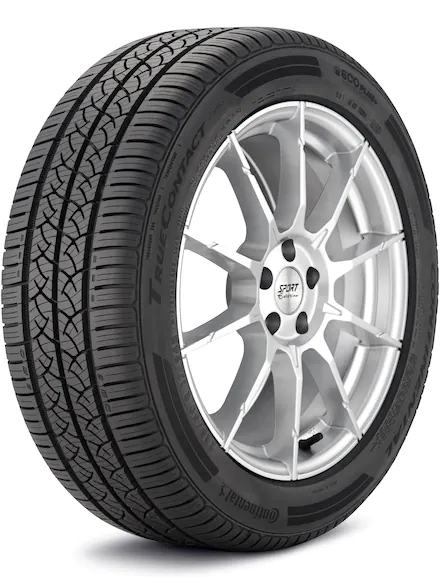
This tire delivers a genuinely strong balance across every category that matters for a daily-driver sedan. Continental’s EcoPlus Technology uses a temperature-activated polymer compound that improves both treadwear and fuel efficiency, and the tire’s low rolling resistance genuinely helps preserve the Malibu’s already respectable gas mileage.
A continuous center rib delivers real highway stability and steering response, while wide circumferential grooves and lateral siping channel water away from the contact patch, genuinely reducing hydroplaning risk. Continental’s ComfortRide Technology adds a cushioned layer beneath the tread that measurably reduces road vibration, and most T-speed-rated sizes carry an impressive 80,000-mile warranty — among the strongest in this comparison. For LS, RS, and 1LT owners who want one dependable tire for nearly everything, this is the strongest all-around pick.
Pros: Genuine fuel-efficiency benefit, strong 80,000-mile warranty on T-speed sizes, comfortable and quiet ride.
Cons: Not built for aggressive driving, no 3PMSF rating.
2. Michelin Defender T+H: Best for Longevity

Price Check
Check the price of this tire at the following retailers:
This tire delivers genuinely consistent performance throughout its life, thanks to Michelin’s MaxTouch Construction and IntelliSipe technology, which spread contact pressure evenly across the tread rather than letting it concentrate and cause premature wear. Michelin backs the Defender T+H with an 80,000-mile warranty, and real owner reports commonly describe achieving close to that full figure with regular rotation.
A silica-enhanced compound remains genuinely pliable in colder temperatures while staying stable in warm conditions, and Michelin’s Comfort Control Technology keeps road noise and vibration well-controlled, complementing the Malibu’s already quiet cabin. The tire’s rigid sidewall construction delivers predictable, responsive handling that suits the Malibu’s balanced chassis. For owners who plan to keep their Malibu running for years — a genuinely common situation now that the model is discontinued — this is the strongest longevity-focused pick.
Pros: Genuinely even wear pattern extends real-world tread life, strong 80,000-mile warranty, quiet and comfortable ride.
Cons: Premium price relative to budget options, not a substitute for a dedicated winter tire in severe conditions.
3. Bridgestone Turanza QuietTrack: Best for Comfort and Quiet
Price Check
Check the price of this tire at the following retailers:
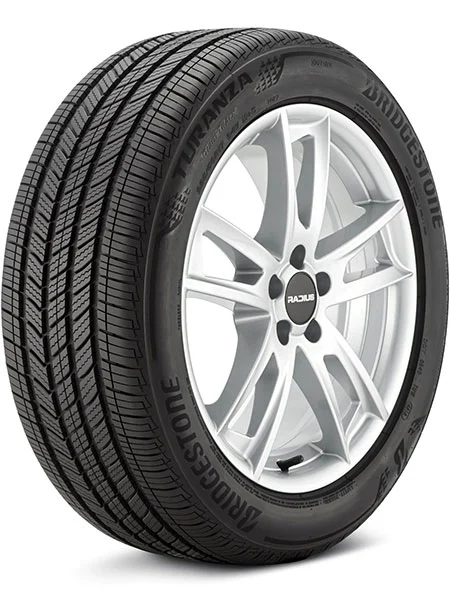
For Malibu owners who prioritize a peaceful cabin above all else, the Turanza QuietTrack is purpose-built for exactly that. Bridgestone’s QuietTrack technology uses non-uniform tread blocks and optimized pitch sequencing to genuinely disrupt sound wave patterns, resulting in a noticeably quieter cabin than standard touring tires.
Beyond noise reduction, a rounded contact patch and optimized casing design absorb road imperfections before they translate into cabin vibrations, and a silica-enhanced compound provides real wet traction through wide circumferential grooves and lateral notches. Bridgestone backs the Turanza QuietTrack with an 80,000-mile warranty, using NanoPro-Tech polymer technology to strengthen the rubber’s molecular bonds and genuinely slow the wear rate. For Malibu owners who noticed their factory tires getting louder as they aged, this is the tire built specifically to solve that.
Pros: Genuinely among the quietest touring tires available, strong 80,000-mile warranty, respectable wet-weather performance.
Cons: Not the sharpest handling option in this comparison, premium price for a non-performance tire.
4. Pirelli P4 Four Seasons Plus: Best Value All-Season

Price Check
Check the price of this tire at the following retailers:
This is a genuine standout for Malibu owners who want dependable all-season performance without premium-tier pricing. Pirelli’s silica-enhanced compound in an asymmetric pattern delivers confident traction across a wide range of conditions, and four wide circumferential grooves handle wet roads confidently, reducing hydroplaning risk.
Pirelli backs the P4 Four Seasons Plus with a genuinely strong 90,000-mile warranty — the longest in this comparison, and a real accomplishment for a tire at this price point. Real owner reports describe a comfortable, quiet ride with noise-reducing variable pitch technology, and low rolling resistance helps maintain the Malibu’s fuel economy. For budget-conscious Malibu owners who still want a trustworthy, well-rounded tire, this is the strongest value pick.
Pros: Genuine value at a lower price point, strongest warranty in this comparison at 90,000 miles, dependable all-season traction.
Cons: Not 3PMSF rated, doesn’t match premium tires on outright comfort refinement.
5. Goodyear Assurance WeatherReady2: Best for Varied Weather
Price Check
Check the price of this tire at the following retailers:
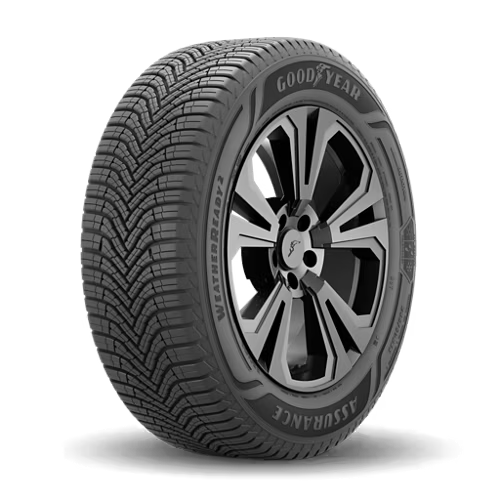
Goodyear has updated the Assurance WeatherReady to the WeatherReady2, and for Malibu owners who face genuinely unpredictable weather across the year, this remains one of the strongest single-tire solutions available. Goodyear’s Weather Reactive Technology uses a compound that stays flexible in cold temperatures while maintaining stability as conditions warm, and it carries genuine 3PMSF certification confirming real severe-snow capability rather than a loosely applied “all-weather” label.
Evolving Traction Grooves start as narrow sipes and gradually widen as the tire wears, genuinely extending wet-traction performance through the tire’s life, and 3D TredLock Technology blades add real grip on snow-covered roads. Real owner reports describe a smooth, quiet ride comparable to standard touring tires despite the added all-weather capability. For Malibu owners in regions with real but variable winters who don’t want a seasonal tire swap, this eliminates that compromise.
Pros: Genuine 3PMSF-rated versatility across seasons, sipes that improve rather than degrade with wear, comfortable ride.
Cons: Warranty mileage not specified by Goodyear, premium price relative to standard all-season tires.
6. Firestone Firehawk Indy 500: Best Summer Performance
Price Check
Check the price of this tire at the following retailers:
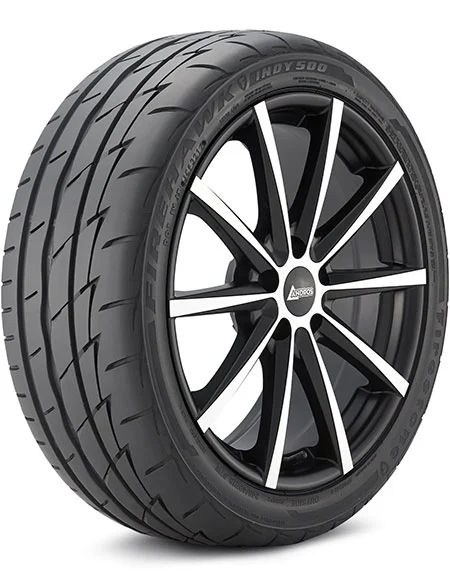
For Malibu owners — particularly RS trim drivers — who want a more engaging warm-weather driving experience, the Firehawk Indy 500 delivers genuine performance character. An asymmetric tread pattern with wide shoulder blocks maintains consistent road contact during aggressive cornering, and Firestone’s Pulse Groove Technology paired with a high-silica compound creates real, noticeably shorter dry stopping distances and sharper acceleration grip compared to standard all-season tires.
A stiff sidewall construction with twin high-tensile steel belts delivers precise steering feedback, genuinely connecting the driver to the road. The real limitation is one every summer-tire buyer should understand clearly: this tire becomes dangerously stiff below roughly 45°F, and Malibu owners in regions with real winters will need to swap to all-season or winter tires seasonally. Tread life also runs shorter than all-season alternatives, a fair trade-off for owners who prioritize the driving experience during warm months.
Pros: Genuine dry-condition grip and steering precision, real cornering confidence for spirited driving.
Cons: Unsafe below roughly 45°F, requires seasonal swapping, shorter tread life than all-season options.
7. Yokohama AVID Ascend GT: Best Balanced Comfort and Performance
Price Check
Check the price of this tire at the following retailers:
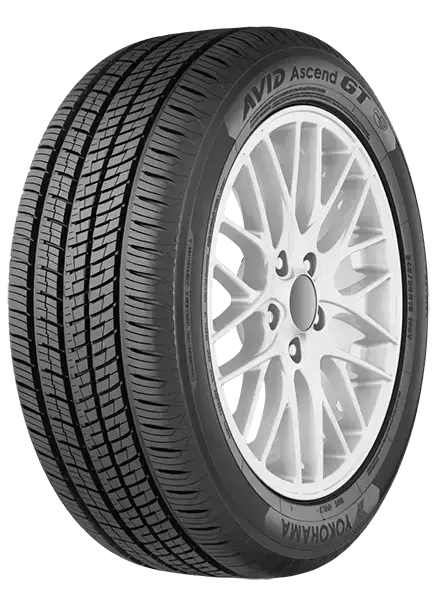
This tire strikes a genuine middle ground for Malibu owners who don’t want to fully commit to either pure comfort or pure performance. Yokohama’s Silent Ride technology uses a multi-pitch tread pattern that genuinely reduces road noise through frequency-canceling design, and the TriBLEND compound maintains flexibility in cold conditions while staying stable in heat.
Wide circumferential grooves and 3D sipes deliver real hydroplaning resistance and light-snow traction, and Yokohama’s BluEarth technology reduces rolling resistance for a genuine, measurable fuel-economy benefit — some owners report improvements approaching 2 mpg on the highway. Backed by an impressive 85,000-mile warranty on H- and V-rated sizes, this is a well-rounded pick for Malibu owners who want comfort, efficiency, and responsive handling in one tire.
Pros: Genuine noise reduction and comfort, real fuel-efficiency benefit, strong 85,000-mile warranty.
Cons: Premium price relative to budget options, not built for severe winter conditions.
8. Cooper CS5 Ultra Touring: Best Mid-Range Option
Price Check
Check the price of this tire at the following retailers:
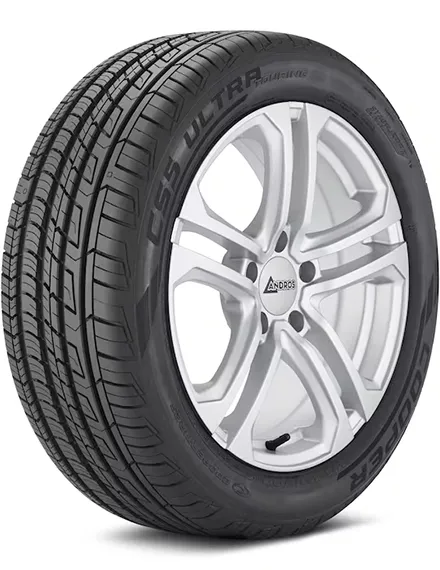
This tire delivers genuine value through thoughtful features not always found at its price point, most notably Cooper’s Wear Square visual indicator — a square-shaped tread marking that visibly changes shape as the tire wears, eventually forming an exclamation point at replacement time, taking real guesswork out of tread-life monitoring.
A silica-infused compound in an asymmetric pattern delivers confident traction in both wet and dry conditions, and 3D micro-gauge siping provides genuine additional grip in light winter conditions. Cooper backs the CS5 Ultra Touring with a 70,000-mile warranty on T-rated sizes (50,000 on H/V-rated versions), competitive coverage for the price, plus a 45-day road test guarantee. For Malibu owners who want solid performance without premium pricing, this is a genuinely well-rounded mid-range pick.
Pros: Genuine tread-wear monitoring convenience, competitive pricing for the features included, dependable all-season traction.
Cons: Road noise more noticeable than premium touring options, not 3PMSF rated.
9. General AltiMax RT43: Best Budget

Price Check
Check the price of this tire at the following retailers:
This is a genuine standout at its price point for Malibu owners who want dependable performance without breaking the bank. General’s Low Surface Abrasion Technology genuinely extends tread life beyond what the price point suggests, and the tire delivers solid, predictable dry handling with responsive steering feedback.
Wet traction is particularly noteworthy for a budget tire, with specially designed grooves that effectively channel water away from the contact patch. General backs the AltiMax RT43 with a 75,000-mile warranty on T-speed sizes (65,000 on H-speed), genuinely competitive coverage that matches or exceeds several mid-range alternatives. Road noise is well-controlled when new, though it does increase somewhat more noticeably with wear compared to premium options — a fair trade at roughly 20-30% below premium-brand pricing. For budget-conscious Malibu owners, this is the strongest value-for-money pick in this comparison.
Pros: Genuine value with strong warranty coverage for the price, respectable wet-weather traction.
Cons: Road noise increases more with wear than premium alternatives, not 3PMSF rated.
10. Nokian Remedy WRG5: Best All-Weather Alternative
Price Check
Check the price of this tire at the following retailers:
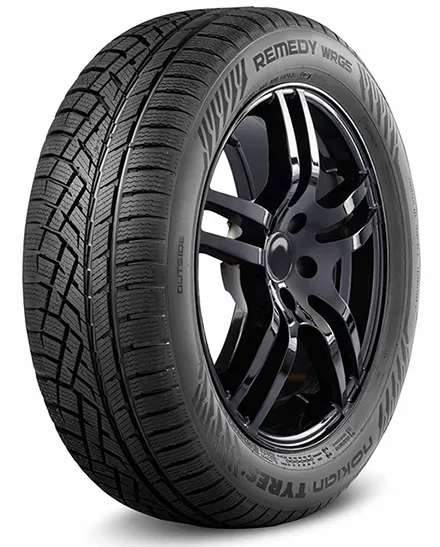
Nokian’s Finnish engineering pedigree shows up clearly in the Remedy WRG5, the successor to the WR G4, and for Malibu owners who want genuine all-weather capability without a seasonal tire swap, this delivers real severe-snow certification alongside comfortable daily-driving manners. Its asymmetric tread pattern with polished main grooves channels water and slush away efficiently, and Nokian’s Silent Sidewall Technology keeps the tire composed even as temperatures drop.
Stiff outer shoulder blocks maintain genuine cornering stability and steering response on dry pavement, while Centipede Siping creates additional biting edges that activate as the tire wears, maintaining winter grip through more of the tire’s life rather than losing it early. Nokian backs the Remedy WRG5 with a 45,000-mile warranty — shorter than several alternatives here, reflecting the softer, cold-optimized compound’s trade-off against pure longevity. For Malibu owners facing genuinely unpredictable weather who want true all-weather capability, this is a strong pick.
Pros: Genuine 3PMSF-rated severe-snow capability, comfortable quiet ride, strong cornering stability for an all-weather tire.
Cons: Shortest warranty in this comparison, premium price relative to standard all-season options.
11. Michelin CrossClimate2: Best All-Weather, No Seasonal Swap

Price Check
Check the price of this tire at the following retailers:
For Malibu owners who don’t want to swap tires seasonally but still face real winter weather often enough that a standard all-season tire feels risky, the CrossClimate2 offers a compelling middle ground. It carries genuine 3PMSF certification and provides significantly better cold-weather performance than a typical all-season tire, without requiring the seasonal changeover a dedicated winter tire demands.
Its V-shaped tread design with dense biting edges maintains solid traction in light to moderate snow while still delivering respectable dry-weather handling and tread life. Michelin’s warranty coverage varies meaningfully by size — confirm the specific figure for the Malibu’s common fitments before buying. For LS, RS, and 1LT owners in regions with moderate but real winters who want one set of tires they never have to think about swapping, this is the strongest single-tire solution in this comparison.
Pros: Genuine 3PMSF-rated winter capability without seasonal swapping, respectable dry handling and tread life, wide size availability.
Cons: Doesn’t match a dedicated winter tire on ice, warranty coverage varies significantly by size, premium price.
Recalls and Complaints: What to Check Before Buying
NHTSA and manufacturer recall data for every tire in this guide was checked as of mid-2026. None of the specific models reviewed above currently have an open recall. It’s worth knowing what has actually been recalled on the Malibu itself, since none of it involves tires: a 2026 recall (NHTSA campaign 26V212) affecting 2023–2025 Malibu vehicles concerns a rearview camera that may display a distorted or blank image, an earlier 2022–2023 recall involved an improperly welded front impact bar, and a 2024 recall addressed an incorrect owner’s manual in the glove box. None of these affect tire choice or performance.
Before installing any tire, new or used, check the DOT code against NHTSA’s recall database — it takes about thirty seconds and is the single easiest safety check most people skip, and it matters more than usual on a discontinued model where used tire inventory circulates longer.
Maintaining Malibu Tires
Rotate every 5,000 to 7,500 miles, using a cross-rotation pattern to account for the Malibu’s front-wheel-drive layout, where front tires typically wear faster due to steering and acceleration stress.
Check pressure at least monthly, typically 32–35 PSI, but always confirm against the door jamb sticker rather than the maximum pressure printed on the tire sidewall. Pressure changes roughly 1 PSI for every 10°F temperature swing.
Have alignment checked annually, or sooner after hitting a significant pothole or curb, and proper alignment can extend tire life by up to 20%.
Watch for genuine replacement signs: tread depth below 4/32″ (6/32″ if winter traction matters), uneven wear patterns, visible sidewall cracks or bulges, or decreased wet-weather performance. Given the Malibu’s discontinued status, tires older than 6–10 years deserve extra scrutiny regardless of remaining tread, since rubber compounds degrade with age independent of mileage.
Choosing the Right Tire for a Chevrolet Malibu
Match tire category to how the car is actually driven. LS and 1LT owners generally benefit most from comfort-focused picks like the Continental TrueContact Tour or Bridgestone Turanza QuietTrack; RS owners who enjoy the trim’s sportier tuning get real, felt value from the Firestone Firehawk Indy 500’s warm-weather grip.
Don’t skip winter tires facing real cold, or lean on a genuine 3PMSF-rated all-weather tire like the Goodyear Assurance WeatherReady2 or Michelin CrossClimate2 if a full seasonal swap isn’t practical.
Budget doesn’t have to mean compromise. The General AltiMax RT43 and Pirelli P4 Four Seasons Plus both deliver genuine value without sacrificing core safety performance.
Since the Malibu is discontinued, plan for the long haul. With no new Malibu coming to replace an aging set, a longer-warranty tire like the Michelin Defender T+H or Pirelli P4 Four Seasons Plus can mean fewer total tire purchases over however many years you keep the car.
Frequently Asked Questions
Is the Chevrolet Malibu still in production?
No. General Motors ended Malibu production in November 2024 at its Fairfax Assembly plant in Kansas, with the 2025 model year the last one built. This doesn’t affect tire availability — Malibu tire sizes are common, mainstream fitments shared with many other vehicles.
What size tires does my Chevrolet Malibu need?
It depends on trim. Final-generation LS trims typically run 205/65R16, RS and 1LT trims typically run 225/55R17, and 2LT (the top trim after Premier was discontinued) typically runs 245/45R18. Always check the door jamb sticker for the exact specification.
How often should I rotate the tires on my Chevrolet Malibu?
Every 5,000 to 7,500 miles, using a cross-rotation pattern appropriate for the Malibu’s front-wheel-drive layout.
Are all-season tires good enough for winter driving in my Chevrolet Malibu?
All-season tires handle light snow and moderately cold temperatures adequately, but for severe winter conditions with regular snowfall or temperatures consistently below 45°F, a dedicated winter tire or a genuine 3PMSF-rated all-weather tire like the Goodyear Assurance WeatherReady2 delivers meaningfully better traction and safety.
What’s the best budget-friendly tire option for the Chevrolet Malibu?
The General AltiMax RT43 delivers genuine value, typically priced 20-30% below premium brands while still offering solid wet and dry performance and a competitive warranty.
How do I know when it’s time to replace my Chevrolet Malibu’s tires?
Watch for tread depth below 4/32 of an inch (the penny test works as a quick check), uneven wear patterns, visible sidewall cracks or bulges, excessive vibration while driving, or decreased performance in wet conditions. On a discontinued model, also factor in tire age — rubber compounds degrade over time regardless of remaining tread depth.
