

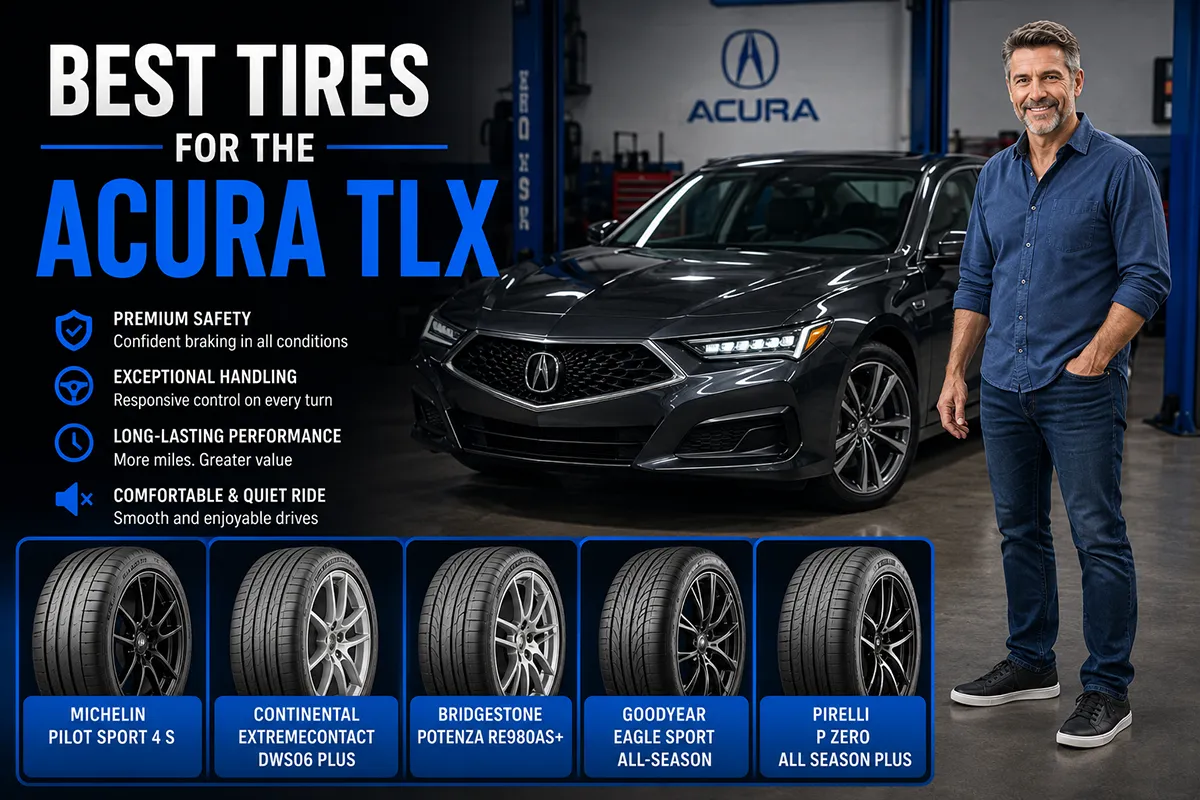
Acura discontinued the TLX after the 2025 model year, with production ending in July 2025. There’s no 2026 TLX, and no direct successor — the Integra now carries Acura’s sedan lineup forward.
That means most TLX owners today are maintaining a recently ended sport sedan, not shopping for a new one. This guide is built for that reality.
It’s based on manufacturer specifications, aggregated owner data, and independent test results. Here’s what actually holds up on a TLX, by priority.
- Best overall performance: Michelin Pilot Sport 4S.
- Best all-season excellence: Continental ExtremeContact DWS06 Plus.
- Best high-performance choice: Bridgestone Potenza Sport.
- Best OEM-grade luxury: Pirelli P Zero.
- Best value performance: Falken Azenis FK510.
- Best premium all-weather: Michelin CrossClimate 2.
- Best dedicated winter: Bridgestone Blizzak WS90.
- Full sizing by final-year trim and an honest note on the TLX’s discontinuation are below.
Liked this article?
Add TireAdvise as a preferred source so you see more of our tire reviews and guides on Google.
The TLX Is Discontinued — Here’s What That Actually Means
This is worth addressing directly, since it’s the single most important thing a current TLX tire guide needs to get right. Acura built the last TLX in July 2025, closing out this generation without a direct successor.
Declining sedan sales and the industry’s broader shift toward SUVs played the deciding role. Acura’s remaining sedan lineup is now the Integra and Integra Type S, while the brand focuses new development on models like the ADX and the upcoming RSX EV.
None of this is bad news for tire shopping. TLX tire sizes are mainstream, widely stocked fitments, and every tire in this guide is easy to find.
What discontinuation does change is that tread life and long-term value matter more than usual. There’s no new TLX to trade into if a tire choice doesn’t work out.
How These Were Evaluated
This comparison draws on manufacturer specifications, aggregated owner reports, UTQG ratings, and independent traction and tread-wear testing for each tire.
We cross-referenced everything against the final-year TLX’s real factory sizing across its Technology, A-Spec, and Type S trims.
Particular weight went to how each tire’s real-world character matches how TLX owners actually drive. The Type S’s turbocharged V6 and SH-AWD system reward a tire that can put real power down, while Technology and A-Spec owners generally prioritize comfort and refinement.
Where specific figures or comparisons are cited, the source is noted rather than presented as a personal measurement.
Quick Comparison: 11 Best Tires for the Acura TLX
| Tire | Best For | Approx. Price/Tire | Speed Rating | Warranty |
|---|---|---|---|---|
| Michelin Pilot Sport 4S | Best overall performance | $220–$290 | Y | 30,000 mi |
| Continental ExtremeContact DWS06 Plus | All-season excellence | $180–$240 | W/Y | 50,000 mi |
| Bridgestone Potenza Sport | High-performance choice | $210–$280 | Y | Not specified |
| Pirelli P Zero | OEM-grade luxury | $220–$290 | Y | Not specified |
| Goodyear Eagle F1 Asymmetric 5 | Balanced performance | $190–$250 | Y | Not specified |
| Yokohama ADVAN Sport A/S+ | Sport-focused all-season | $170–$230 | V/W | Not specified |
| Falken Azenis FK510 | Value performance | $150–$210 | W/Y | Not specified |
| Michelin CrossClimate 2 | Premium all-weather | $200–$260 | V/W | Not specified |
| Firestone Firehawk Indy 500 | Summer performance value | $140–$190 | V/W | Not specified |
| Dunlop Sport Maxx RT2 | Sporty daily driver | $170–$230 | W | Not specified |
| Bridgestone Blizzak WS90 | Dedicated winter | $150–$210 | Q | Seasonal (no summer warranty) |
Prices are street prices at major online retailers for common final-year TLX sizes (255/40R19 and the Type S’s 255/35R20) as of mid-2026. Expect regional and seasonal swings.
Acura TLX Tire Sizes by Final-Year Trim
Confirm the exact size on the driver’s door jamb sticker before ordering. The final (2025) lineup used a genuinely clean two-size structure.
Technology and A-Spec trims, both running the 272-horsepower 2.0T engine in FWD or AWD, commonly ran 255/40R19.
Type S, with its 355-horsepower turbocharged V6 and standard SH-AWD, stepped up to 255/35R20 — a lower-profile fitment matched to the trim’s sportier tuning and Brembo brakes.
Earlier model years used a wider range of sizes, from 225/55R17 on base trims up through 245/40R19 on performance packages, so always confirm against your specific model year rather than assuming final-year sizing applies.
Should You Even Replace Your Factory Tires?
Acura fitted the TLX with all-season touring tires on Technology and A-Spec trims, and a genuinely sportier setup on Type S to match that trim’s turbocharged V6 output.
If your factory tires are wearing evenly and the car still feels composed, replacing like-for-like with a comparable tire in the same category is a reasonable, low-risk call.
1. Michelin Pilot Sport 4S: Best Overall Performance

Price Check
Check the price of this tire at the following retailers:
This is Michelin’s flagship ultra-high-performance tire, and it’s a genuinely strong match for the TLX’s sport-tuned suspension.
A hybrid belt of aramid and nylon delivers exceptional stability at high speeds — particularly beneficial for the Type S with its turbocharged V6. The asymmetric tread’s large outer shoulder blocks maintain real contact-patch stability during aggressive cornering, letting TLX drivers confidently push through turns with minimal understeer.
Wet performance is a real strength. A silica-infused compound and deep circumferential grooves efficiently channel water away from the contact patch, meaningfully reducing hydroplaning risk even during heavy downpours.
Backed by a 30,000-mile warranty — exceptional for this performance category — the tire also includes noise-reducing technology that complements the TLX’s already quiet cabin. It effortlessly handles the Type S’s additional torque, providing the grip needed to properly utilize its SH-AWD system.
Pros: Genuine wet and dry grip balance, respectable tread life for an ultra-high-performance tire, real grip under the Type S’s added torque.
Cons: Premium price, not built for winter conditions.
2. Continental ExtremeContact DWS06 Plus: Best All-Season Excellence

Price Check
Check the price of this tire at the following retailers:
The “DWS” in this tire’s name stands for Dry, Wet, Snow — a genuine commitment to true all-season capability rather than just marketing.
An asymmetric tread with specialized silica-enhanced compound remains pliable in cold weather while resisting excessive softening in summer heat, delivering real, consistent steering response and road feel throughout seasonal changes.
Snow traction is a genuine surprise for a performance-oriented all-season tire. Continental’s “Traction Grooves” technology, with numerous biting edges and sipes, maintains real grip on light snow and slush — enough to eliminate the need for dedicated winter tires in many moderate-climate situations.
Backed by a 50,000-mile warranty through Continental’s Total Confidence Plan, plus road hazard coverage and a 60-day trial, this tire delivers genuine year-round capability without the hassle of seasonal changes.
Pros: Genuine dry/wet/snow versatility, strong 50,000-mile warranty with road hazard coverage, useful visible snow-capability wear indicators.
Cons: Not a substitute for dedicated winter tires in severe conditions, premium price.
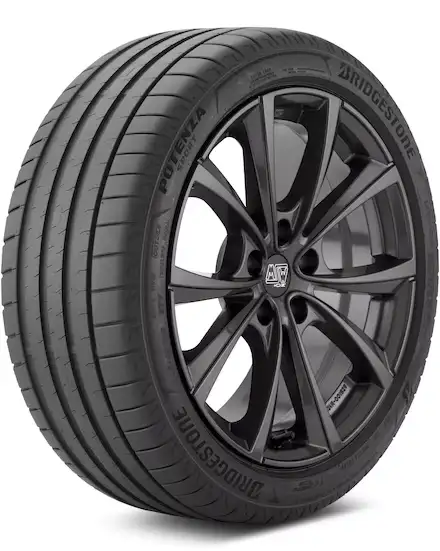
3. Bridgestone Potenza Sport: Best High-Performance Choice
Price Check
Check the price of this tire at the following retailers:
This tire draws on genuine track-derived technology, delivering handling characteristics that complement the TLX’s sporty nature well.
A specialized tread compound and optimized contact patch ensure steering inputs translate to immediate action, giving drivers a real, heightened sense of connection to the road — without sacrificing reasonable comfort for daily driving.
As a dedicated summer performance tire, it genuinely shines in warm, dry conditions. An advanced silica-enhanced compound provides confident traction on both dry and wet surfaces above 45°F, with real, shortened braking distances during acceleration and hard stops.
Cornering stability is a genuine standout — rigid sidewall construction minimizes flex during aggressive cornering, letting TLX drivers fully exploit the car’s handling capabilities with real, confidence-inspiring lateral grip.
Pros: Genuine track-derived grip and responsiveness, strong cornering stability, reasonable comfort for a summer performance tire.
Cons: Not built for winter conditions, premium price.
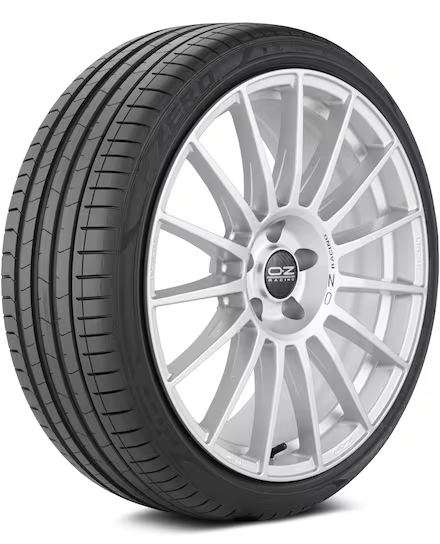
4. Pirelli P Zero: Best OEM-Grade Luxury
Price Check
Check the price of this tire at the following retailers:
The Pirelli P Zero has real OEM authenticity — it’s a genuine original-equipment option on many premium vehicles, tuned specifically to complement suspension geometry and handling characteristics.
The asymmetric tread’s large outer shoulder blocks deliver exceptional cornering stability at higher speeds, and a specialized compound with silica and performance-enhancing materials optimizes grip in both dry and wet conditions.
Despite its performance orientation, real noise-reduction technology has been built in. A variable pitch sequence minimizes road noise by preventing harmonics, and Pirelli’s Noise Cancelling System — sound-absorbing material inside the tire — reduces road noise by up to 25% on certain specifications.
Real owner reports describe 30,000–40,000 miles of tread life, respectable for this performance category, with reinforced sidewalls providing genuine protection against impacts and curb damage.
Pros: Genuine OE-grade tuning heritage, real noise-reduction technology, respectable durability for a performance tire.
Cons: Premium price, not built for winter conditions.
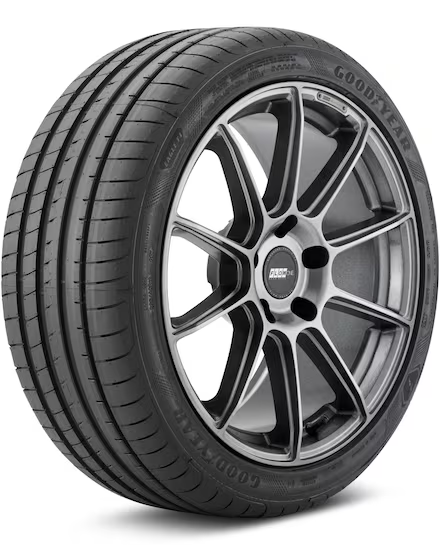
5. Goodyear Eagle F1 Asymmetric 5: Best Balanced Performance
Price Check
Check the price of this tire at the following retailers:
This tire delivers a genuine balance between performance and everyday usability, without significant compromises in either direction.
Wet-weather performance is where it truly shines — a high-silica tread compound maintains real grip on slick surfaces, and wide circumferential grooves efficiently channel water away, meaningfully reducing hydroplaning risk. Independent testing shows wet braking distances that rival dedicated performance tires.
A power-adaptive contact patch genuinely expands during aggressive cornering to maximize road contact, delivering precise steering feedback that complements the TLX’s sporty character while maintaining real stability during high-speed maneuvers.
Despite its performance credentials, comfort hasn’t been sacrificed. Noise-reducing technology in the tread pattern delivers a genuinely quiet ride, and many owners report 40,000-plus miles of service — strong value relative to comparably priced Michelin or Pirelli options.
Pros: Genuine wet-weather braking performance, well-controlled road noise, strong tread life for the price relative to premium competitors.
Cons: Premium price relative to budget options, not built for winter conditions.
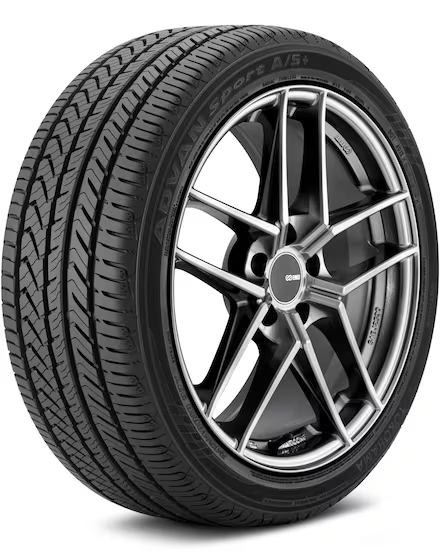
6. Yokohama ADVAN Sport A/S+: Best Sport-Focused All-Season
Price Check
Check the price of this tire at the following retailers:
This tire delivers genuine sporty handling without sacrificing all-season versatility, standing out in the ultra-high-performance all-season category.
An asymmetric tread with rigid outside shoulder blocks provides real responsiveness and cornering grip, and a silica-enriched compound strikes a genuine balance between performance and longevity. Unlike dedicated summer tires, the compound remains flexible in colder weather, delivering consistent performance across a wide temperature range.
Noise control is a real strength — optimized tread block sequencing and four circumferential grooves deliver a genuinely quiet ride that preserves the TLX’s luxury cabin experience even at highway speeds.
Light-snow performance is a genuine surprise for a performance-oriented all-season tire, with an intricate network of sipes providing meaningful traction on snow-covered roads — though it’s not a substitute for dedicated winter tires in severe conditions. Most owners report 40,000–45,000 miles from a set.
Pros: Genuine year-round versatility with sporty handling, well-controlled road noise, respectable tread life.
Cons: Not a substitute for dedicated winter tires in severe conditions, premium price.
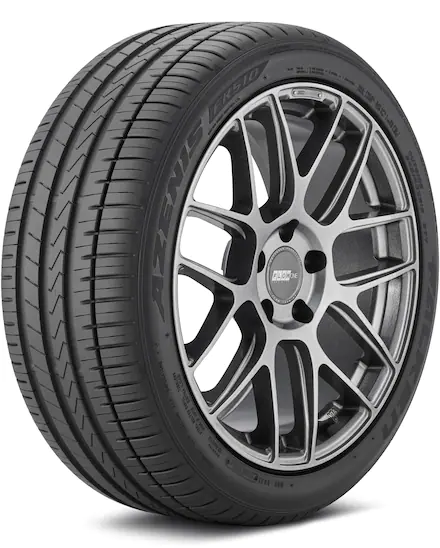
7. Falken Azenis FK510: Best Value Performance
Price Check
Check the price of this tire at the following retailers:
This tire delivers roughly 85–90% of the performance of premium-tier options at approximately 70–75% of the cost — a genuinely compelling value proposition for TLX owners.
A hybrid asymmetric tread pattern with wide outer shoulder blocks provides real cornering stability, and a silica-enriched compound strikes a genuine balance between grip and durability — addressing a common weak spot in performance tires generally.
Dry handling is genuinely responsive, rivaling tires costing significantly more, and wet performance holds up well too, with circumferential grooves efficiently channeling water away to maintain road contact.
Real owner reports describe 35,000–40,000 miles under normal driving — genuinely strong longevity for the performance category, and a meaningful cost-per-mile advantage over premium alternatives that offer only marginally better performance.
Pros: Genuine near-premium performance at a meaningfully lower price, respectable dry and wet grip, strong value relative to tread life.
Cons: Not built for winter conditions, doesn’t quite match the absolute pinnacle of premium options.
8. Michelin CrossClimate 2: Best Premium All-Weather

Price Check
Check the price of this tire at the following retailers:
This tire delivers genuine four-season capability without requiring seasonal tire changes — a real engineering achievement rather than a compromise.
Real 3-Peak Mountain Snowflake certification confirms genuine winter performance, backed by Michelin’s V-shaped tread design with directional grooves that actively adapt to changing road conditions. A thermal-adaptive compound remains pliable in cold temperatures while maintaining stability when temperatures rise.
Comfort is a genuine strength too — Michelin’s PIANO Noise Reduction Tuning technology minimizes road noise through carefully designed tread blocks, delivering a quieter cabin that complements the TLX’s luxury appointments.
Wet-road performance is a real strength, with the V-shaped tread channeling water efficiently while biting edges provide confident grip during light snow — genuinely useful for TLX owners who encounter occasional winter weather but don’t want dedicated winter tires.
Pros: Genuine 3PMSF-rated winter capability without seasonal swapping, real noise-reduction technology, eliminates seasonal tire-change hassle.
Cons: Premium price, doesn’t match dedicated winter tires in severe conditions.
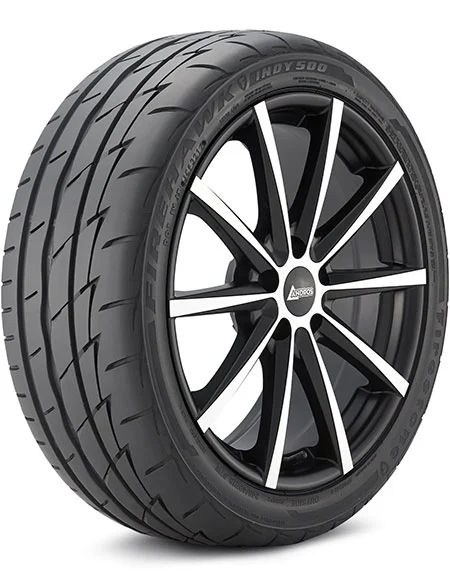
9. Firestone Firehawk Indy 500: Best Summer Performance Value
Price Check
Check the price of this tire at the following retailers:
This tire delivers genuinely impressive capabilities at a price typically 20–30% lower than premium competitors, punching well above its weight class.
Firestone’s Pulse Groove Technology, borrowed from motorsport applications, incorporates circumferential grooves that effectively channel water away from the contact patch, delivering real dry performance while maintaining adequate wet-weather capability.
Dry handling is where this tire truly shines. A silica-enriched compound and asymmetric tread work together to provide genuine grip during aggressive driving maneuvers, and wide shoulder blocks maximize road contact during acceleration, braking, and cornering.
The honest trade-off: wet performance, while adequate in light rain, shows real limitations in heavy downpours compared to premium alternatives. For TLX owners who want a genuine performance upgrade over stock all-season tires without premium pricing, this delivers roughly 80% of the performance at 60–70% of the cost.
Pros: Genuine dry-condition performance at a meaningfully lower price, responsive steering feedback, respectable cornering stability.
Cons: Wet performance trails premium alternatives in heavy rain, not built for winter conditions.
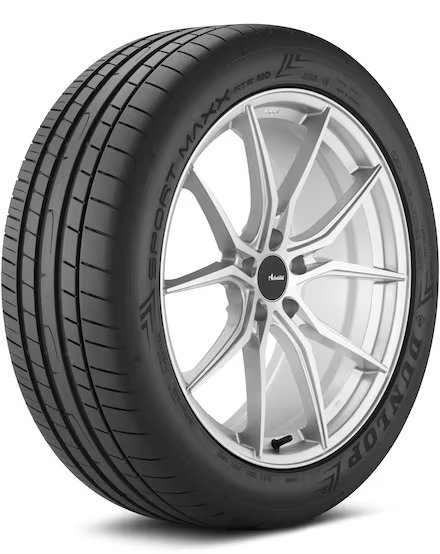
10. Dunlop Sport Maxx RT2: Best Sporty Daily Driver
Price Check
Check the price of this tire at the following retailers:
This tire represents a genuine middle ground for TLX owners who want sporty performance without sacrificing daily drivability.
An asymmetric tread pattern delivers real, quick steering response and exceptional cornering grip, aligning well with the TLX’s sporty character — particularly for A-Spec and Type S variants. Adaptive compound technology maintains real grip levels across varying temperatures.
Despite its performance credentials, genuine comfort hasn’t been sacrificed. Noise-reducing technologies keep road noise at acceptable levels even at highway speeds, and a slightly stiffer sidewall provides real feedback for spirited driving without introducing harshness.
Real owner reports describe 35,000–40,000 miles with proper rotation — a good compromise for a tire that delivers genuinely engaging performance characteristics matched well to the TLX’s SH-AWD system.
Pros: Genuine responsive handling with real daily comfort, well-controlled road noise, predictable grip levels for spirited driving.
Cons: Not built for winter conditions, doesn’t match class-leading longevity.
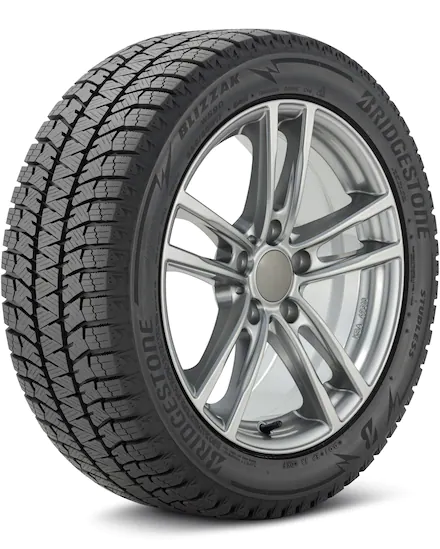
11. Bridgestone Blizzak WS90: Best Dedicated Winter
Price Check
Check the price of this tire at the following retailers:
Nothing in this comparison matches this tire once conditions turn to genuine ice, based on independently reported braking and traction testing across the winter category.
Bridgestone’s MultiCell compound technology, with bite particles that dig into ice and snow, provides real, exceptional traction on frozen surfaces — even with the TLX’s available SH-AWD, proper winter rubber genuinely matters for translating that system’s capability into actual traction.
An aggressive tread pattern channels snow and slush away from the contact patch, maintaining grip when it matters most, and real owner reports describe excellent braking performance and confident handling.
This is a seasonal tire that needs to come off once temperatures climb consistently above 45°F. For TLX owners anywhere with real, sustained winter conditions, running this seasonally on a second set of wheels is the single biggest safety upgrade available — and it genuinely preserves the TLX’s sophisticated handling dynamics that a worn all-season tire can’t deliver in the cold.
Pros: Best-in-comparison ice and snow traction, genuinely maximizes what SH-AWD can deliver in winter, confident real-world braking performance.
Cons: Seasonal use only, no summer tread warranty, premium price.
Maintaining Acura TLX Tires
Check pressure at least monthly, typically 32–35 PSI, but always confirm against the door jamb sticker rather than the tire’s maximum sidewall pressure. Measure when tires are cold, and don’t forget to check your spare.
Rotate every 5,000 to 7,500 miles, following a forward-cross pattern for most TLX configurations. For staggered fitments with different front and rear sizes, rotation is limited to side-to-side rather than front-to-back.
Have alignment checked annually, or sooner after hitting a significant pothole or curb. Watch for uneven wear, pulling to one side, or an off-center steering wheel.
Watch for genuine replacement signs: tread depth below 4/32″ (the penny test works as a quick check), uneven wear patterns, visible sidewall cracks or bulges, or decreased wet-weather performance. Consider replacement after 5 years regardless of tread depth, since rubber compounds degrade with age.
Choosing the Right Tire for an Acura TLX
Match tire category to the specific trim and how it’s actually driven. Technology and A-Spec owners generally benefit most from balanced picks like the Continental ExtremeContact DWS06 Plus or Yokohama ADVAN Sport A/S+. Type S owners get real, felt value from the Michelin Pilot Sport 4S or Bridgestone Potenza Sport’s sharper handling.
Don’t skip winter tires facing real cold. The Bridgestone Blizzak WS90 delivers a genuine, safety-relevant traction advantage no all-season tire in this comparison fully replicates, and it genuinely maximizes what SH-AWD can deliver in winter.
Budget doesn’t have to mean giving up real performance. The Falken Azenis FK510 and Firestone Firehawk Indy 500 both deliver genuine value without sacrificing core capability.
Since the TLX is discontinued, prioritize warranty coverage where it exists. A tire with genuinely strong tread-life backing, like the Continental ExtremeContact DWS06 Plus, means fewer total tire purchases over however many years you keep the car.
Frequently Asked Questions
Is the Acura TLX still in production?
No. Acura discontinued the TLX after the 2025 model year, with production ending in July 2025. There’s no direct successor — Acura’s sedan lineup is now the Integra and Integra Type S.
What size tires does my Acura TLX need?
It depends on trim and model year. The final-year (2025) Technology and A-Spec trims ran 255/40R19, while Type S ran 255/35R20. Earlier model years used a wider range of sizes, from 225/55R17 up through 245/40R19. Always check the door jamb sticker for your exact specification.
How often should I rotate the tires on my Acura TLX?
Every 5,000 to 7,500 miles, using a forward-cross pattern. Staggered fitments with different front and rear sizes can only be rotated side-to-side.
Are all-season tires good enough for winter driving in my TLX, even with SH-AWD?
All-season tires handle light winter conditions adequately, but even with SH-AWD, severe conditions call for a dedicated winter tire like the Bridgestone Blizzak WS90. All-wheel drive helps with acceleration, not braking or cornering on ice.
What’s the best tire for the Acura TLX Type S specifically?
The Michelin Pilot Sport 4S is the strongest pick, offering genuine grip that handles the Type S’s additional torque while providing the traction needed to properly use its SH-AWD system.
What’s the best budget-friendly tire option for the Acura TLX?
The Falken Azenis FK510 and Firestone Firehawk Indy 500 both deliver genuine value, offering strong performance-per-dollar at meaningfully lower prices than premium alternatives.
How do I know when it’s time to replace my Acura TLX’s tires?
Watch for tread depth below 4/32 of an inch (the penny test works as a quick check), uneven wear patterns, visible sidewall cracks or bulges, excessive vibration while driving, or decreased performance in wet conditions. On a discontinued model, also factor in tire age — rubber compounds degrade over time regardless of remaining tread depth.
