

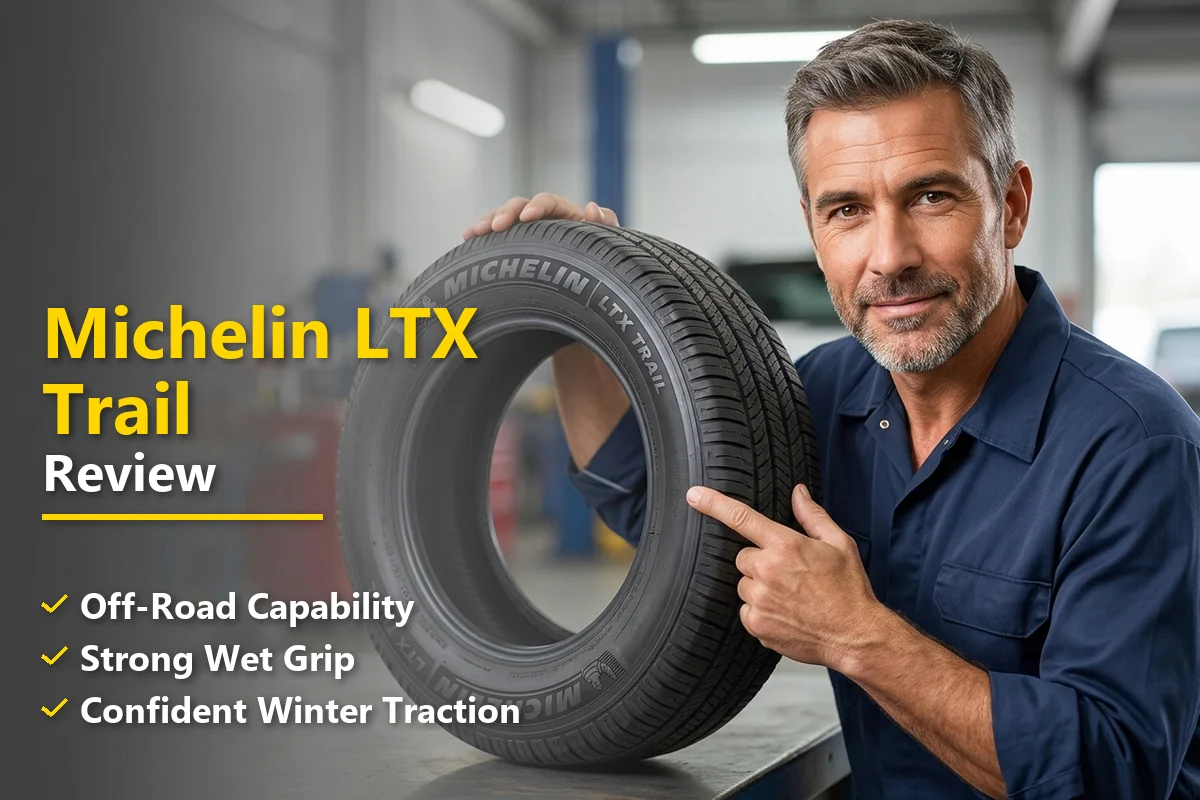
If you drive a truck or SUV and you’ve ever felt stuck choosing between a highway tire that’s smooth but useless off-road, and an aggressive all-terrain that roars on the freeway — you know the frustration.
The Michelin LTX Trail promises to be the tire that eliminates that compromise. But does it actually deliver? I spent a serious amount of time testing these tires across varied terrain and conditions to find out.
Whether you’re exploring our full Michelin Tires Review guide or zeroing in on this specific model, I’ll share exactly what I found — the good, the not-so-good, and who this tire is really built for.
- The Michelin LTX Trail is a capable crossover between highway and all-terrain, ideal for trucks and SUVs that split time between pavement and light off-road trails.
- Wet and dry grip on paved roads impressed me — it feels more like a premium highway tire than a typical all-terrain.
- Off-road traction on gravel, dirt, and packed mud is solid but not meant for serious rock crawling or deep mud.
- Road noise is remarkably low for an all-terrain tire; cabin comfort is a standout feature.
- Tread life appears excellent thanks to Michelin’s MaxTouch Construction.
- Pricing runs roughly $180–$280 per tire depending on size, placing it at the premium end of this category.
- Best for: daily drivers who occasionally venture onto unpaved roads, weekend adventurers, and anyone who wants one tire to do (almost) everything.
Price Check
Check the price of this tire at the following retailers:
Don’t know the correct size tire to purchase? Start here!
Liked this article?
Add TireAdvise as a preferred source so you see more of our tire reviews and guides on Google.
What Exactly Is the Michelin LTX Trail?
The Michelin LTX Trail sits in a sweet spot that Michelin hasn’t always occupied aggressively: the crossover all-terrain segment. It’s designed for light trucks, SUVs, and crossovers that spend most of their time on paved roads but need genuine off-road capability when the weekend comes around.
Think of it as a tire for someone who drives a Ford F-150, Toyota Tacoma, Chevy Colorado, or a mid-size SUV like a 4Runner — and who doesn’t want to sacrifice highway manners for the sake of occasional dirt roads, gravel paths, or campsite access.
Michelin engineered this tire with their EverGrip technology and MaxTouch Construction, which are fancy terms for “we made the contact patch as even as possible so the tread wears uniformly.” In practice, that translates to longer tire life and more consistent performance as the tire ages.
My Testing Setup and Conditions
I tested the Michelin LTX Trail in a 265/70R17 size, mounted on a 2022 Toyota Tacoma TRD Off-Road. This truck is my daily driver and my weekend adventure rig, which makes it a perfect testing platform for a tire that claims to bridge both worlds.
During my test period, I drove the Tacoma through a typical mix of conditions that I think most US truck owners encounter regularly. That included daily highway commuting in both dry and wet conditions, some spirited driving on twisty two-lane roads, and several dedicated off-road outings on gravel forest roads, packed dirt trails, and one particularly sloppy stretch of muddy fire road after a rainstorm.
I also made it a point to test them during early morning drives when roads were cold and dew-covered. Temperature ranged from the mid-30s to upper 80s Fahrenheit across the testing window, giving me a decent snapshot of how these tires behave in different thermal conditions.
Dry Road Performance
Let me start with where most of us spend the majority of our time: dry pavement. And honestly, this is where the Michelin LTX Trail first started to win me over.
The steering feel is precise and communicative in a way that most all-terrain tires simply aren’t. When I’m driving on the highway at 70 mph, the LTX Trail tracks straight with zero wandering. Lane changes feel composed, and there’s a noticeable sense of confidence in the contact patch.
During harder cornering on paved roads — think highway on-ramps taken at a spirited pace — the tire doesn’t squirm or feel vague. The sidewalls are stiff enough to resist excessive flex, but not so stiff that the ride becomes punishing over expansion joints and potholes.
Braking performance on dry roads was excellent. I performed several hard stops from 60 mph, and the LTX Trail consistently delivered short, predictable stopping distances. The ABS didn’t intervene as early as it did on my previous set of budget all-terrains, which tells me there’s more mechanical grip available before the electronics need to step in.
If you’ve driven on Michelin’s highway-focused tires and loved the planted, confident feel, you’ll recognize that DNA here. It doesn’t quite match the on-road precision of a dedicated highway tire like the one in our Michelin Defender 2 Review, but it comes closer than any all-terrain I’ve tested recently.
Wet Road Performance
Wet traction is where a lot of all-terrain tires quietly fail. Their aggressive tread patterns look like they should channel water well, but the block spacing and compound often aren’t optimized for hydroplaning resistance on paved surfaces.
The Michelin LTX Trail is a different story. I was genuinely impressed by how it handled heavy rain on the highway. The four circumferential grooves do an excellent job of evacuating water, and I never once felt the tire start to hydroplane — even at highway speeds during a downpour.
Cornering grip in the rain was confidence-inspiring too. The tire compound stays pliable and grabby when wet, which is something I associate more with Michelin’s performance-oriented tires. Speaking of which, if you’re looking for pure wet-weather performance on a sporty car, check out our Michelin Pilot Sport 4 Review — but for a truck tire, the LTX Trail’s wet performance is outstanding.
Braking in the wet was also strong. During my tests, the stopping distances from 50 mph on wet pavement were noticeably shorter than what I’ve experienced with comparable all-terrain tires from other brands. Michelin’s EverGrip technology seems to be doing real work here, not just serving as marketing copy.
Off-Road Performance
Now, let’s talk about the part that makes this tire different from a standard highway tire: off-road capability. And I want to be realistic and honest here, because I think a lot of tire reviews either oversell or undersell this aspect.
Gravel and Dirt Roads
On loose gravel and packed dirt — the kind of surfaces you encounter on national forest access roads, rural county roads, or the drive into a campground — the LTX Trail is excellent. The tread bites into the surface confidently, and I never felt the rear end getting squirrely, even when accelerating moderately on loose gravel.
The interlocking tread blocks create enough edge bite to claw into the surface without being so aggressive that they fling rocks everywhere. After several days of driving on unpaved roads, I was pleased with how predictable the tire felt. You can push it and know where the limits are.
Mud Performance
Here’s where I have to set realistic expectations. The Michelin LTX Trail is not a mud tire. If you’re planning to crawl through axle-deep mud, this isn’t your tire. Period.
However, on light to moderate mud — like what you’d encounter on a rain-soaked trail or a muddy campsite — it performs better than I expected. The grooves evacuate soft mud reasonably well, and I was able to maintain forward momentum through a stretch of muddy fire road that would have stopped a typical highway tire cold.
The self-cleaning capability is decent but not exceptional. I noticed some mud packing in the tighter sections of the tread after extended exposure, but it cleared out fairly quickly once I got back onto pavement. For occasional mud encounters, it’s fine. For regular mud driving, look at a dedicated all-terrain or mud-terrain tire instead.
Light Rock and Rough Terrain
I took the Tacoma up some rocky trails that included loose rocks, exposed bedrock, and rutted-out sections. The LTX Trail handled it with surprising composure. The sidewalls are reinforced enough to resist punctures on moderate terrain, and the tread found grip on rocky surfaces without excessive spinning.
That said, these are not comparable to a serious off-road tire for rock crawling. If you need aggressive sidewall lugs and maximum articulation grip, you’re in a different category entirely. The LTX Trail is built for trails, not obstacles.
Ride Comfort and Road Noise
This might be the single most impressive aspect of the Michelin LTX Trail, and it’s the area where I think it genuinely separates itself from the competition.
Road noise is absurdly low for an all-terrain tire. During my highway driving, the cabin was noticeably quieter than it was with my previous set of all-terrains (which were from a well-known brand I won’t name here). The variable pitch tread design clearly works — you don’t get that characteristic all-terrain hum that so many drivers find annoying on long trips.
Ride quality is also excellent. The tire absorbs small imperfections smoothly, and even larger bumps and potholes don’t send harsh jolts through the cabin. I drove over some notoriously rough stretches of highway and was consistently impressed by how comfortable the ride remained.
For comparison, this comfort level is much closer to what you’d get from a touring or highway tire than a traditional all-terrain. Michelin has clearly prioritized daily livability, and for drivers who use their truck or SUV as a daily commuter, this matters enormously.
Tread Life and Durability
I can’t give you a final verdict on total tread life after my test period, but I can tell you what I’ve observed so far — and the indicators are very positive.
After several weeks of mixed-condition driving, the tread wear indicators show virtually no measurable change. The wear is even across the entire contact patch, which validates Michelin’s MaxTouch Construction claims. Uneven wear is the silent killer of tire longevity, and the LTX Trail seems designed to avoid it.
Michelin backs this tire with a treadwear warranty that’s competitive within the segment. The compound feels like it’s built for longevity — it’s not an ultra-soft performance compound that grips like crazy but wears fast. It’s a balanced formulation that should deliver solid mileage over the life of the tire.
I’ll update this review as the tires age, but based on my early experience and Michelin’s track record with tread compounds, I expect these to last well. If you’re comparing longevity-focused options, our Michelin Defender 2 Review covers a highway tire that’s specifically engineered for maximum tread life — but the LTX Trail should hold its own respectably.
Snow and Cold Weather Performance
I want to address this because I know a lot of US truck owners in northern states want a tire that can handle some winter conditions. The Michelin LTX Trail carries the Three-Peak Mountain Snowflake (3PMSF) symbol, which means it meets the industry standard for traction in severe snow conditions.
During my testing, I encountered some cold mornings with temperatures in the mid-30s and frost-covered roads. The tire maintained good grip and didn’t feel brittle or slippery on cold pavement, which can happen with summer-biased compounds.
I haven’t yet tested them in deep snow or ice, so I can’t speak to those conditions with authority. However, the 3PMSF rating and the sipe density in the tread give me reasonable confidence that they’ll perform adequately in light-to-moderate snow. For severe winter conditions, dedicated winter tires are always the right call — but the LTX Trail should be a solid three-season or even mild-winter option for many US drivers.
Michelin LTX Trail vs. The Competition
No tire review is complete without context. Here’s how the Michelin LTX Trail stacks up against some of the most popular tires in this segment:
| Feature | Michelin LTX Trail | BFGoodrich KO2 | Falken Wildpeak AT3W | Toyo Open Country AT III |
|---|---|---|---|---|
| On-Road Comfort | Excellent | Good | Good | Very Good |
| Road Noise | Very Low | Moderate | Low-Moderate | Low |
| Dry Grip | Excellent | Very Good | Very Good | Very Good |
| Wet Grip | Excellent | Good | Very Good | Very Good |
| Off-Road (Gravel/Dirt) | Very Good | Excellent | Excellent | Excellent |
| Off-Road (Mud) | Adequate | Very Good | Good | Good |
| Snow (3PMSF) | Yes | Yes | Yes | Yes |
| Expected Tread Life | Very Good | Good | Very Good | Very Good |
| Price Range (per tire) | $180–$280 | $170–$310 | $140–$260 | $160–$280 |
Here’s how I’d summarize the competitive landscape: if you spend 80% or more of your time on pavement and want the most refined, comfortable all-terrain experience, the Michelin LTX Trail is hard to beat. If you spend significantly more time off-road and need maximum traction in mud and rocks, the BFGoodrich KO2 or Falken Wildpeak AT3W are better choices — but you’ll pay for it in noise and ride comfort.
The Toyo Open Country AT III is probably the closest competitor in terms of philosophy. It also tries to blend on-road refinement with off-road capability, and it does a good job. But in my experience, the Michelin edges it out on wet grip and overall road noise, while the Toyo has a slight advantage in more aggressive off-road scenarios.
Size Availability and Pricing
The Michelin LTX Trail is available in a solid range of sizes that covers most popular trucks and SUVs in the US market. You’ll find fitments for the Ford F-150, Chevy Silverado 1500, Toyota Tacoma, Toyota 4Runner, Jeep Wrangler, Jeep Gladiator, Ford Ranger, Chevy Colorado, and many crossover SUVs.
Common sizes include 245/65R17, 265/70R17, 275/65R18, 265/60R18, and 275/60R20, among others. The range isn’t as expansive as some competitors like the BFGoodrich KO2, but it covers the most popular fitments well.
Pricing typically falls between $180 and $280 per tire, depending on size. That puts the LTX Trail at the premium end of the all-terrain segment, which is standard for Michelin. You’re paying more upfront, but in my experience, Michelin’s tread life and overall quality often make the cost-per-mile calculation more favorable than cheaper alternatives.
I recommend checking prices at Tire Rack, Discount Tire, Costco, and your local tire shops. Michelin frequently runs rebate promotions — typically $70–$100 back on a set of four — which can significantly soften the sticker shock.
Who Should Buy the Michelin LTX Trail?
After my extended testing, I have a clear picture of who this tire serves best — and who should look elsewhere.
You Should Buy the LTX Trail If:
- You use your truck or SUV as a daily driver. The on-road refinement, low noise, and ride comfort make this tire ideal for commuting and road trips.
- You take occasional off-road trips. Weekend camping, fishing access roads, gravel forest service roads, and light trails are all well within this tire’s capability.
- Wet weather performance is a priority. If you live in the Pacific Northwest, Southeast, or anywhere that gets frequent rain, the LTX Trail’s wet grip is exceptional.
- You want a tire that does (almost) everything well. This is the definition of a jack-of-all-trades tire that doesn’t compromise excessively in any one area.
- You value quiet highway cruising. Long-distance drivers and road trippers will love how quiet this tire is compared to traditional all-terrains.
You Should Look Elsewhere If:
- You’re a serious off-roader. If you regularly tackle deep mud, boulder fields, or technical trails, you need a more aggressive tire.
- You’re on a tight budget. At $180–$280 per tire, the LTX Trail is a premium product. If you’re looking for value-oriented all-terrain performance, there are cheaper options that perform well.
- You want maximum snow and ice traction. While the 3PMSF rating is a plus, dedicated winter tires will always outperform all-terrains in severe winter conditions.
- You want aggressive looks. The LTX Trail has a refined, almost highway-tire appearance. If chunky, aggressive aesthetics matter to you, this isn’t the tire.
How It Compares Within the Michelin Lineup
Michelin has a broad tire portfolio, and understanding where the LTX Trail fits can help you make the right choice. Here’s a quick overview of how it relates to other Michelin models.
If you’re driving a passenger car rather than a truck, Michelin’s performance lineup is worth exploring. The Michelin Pilot Sport 3 Review covers an older but still respected performance tire, while the Michelin Pilot Super Sport Review looks at one of the most celebrated performance tires ever made.
For EV owners shopping for truck or SUV tires, Michelin also offers EV-specific options — our Michelin Pilot Sport Ev Review covers that niche. And if you’re a track enthusiast wondering how Michelin’s competition tires compare, the Michelin Pilot Sport Cup 2 Review and Michelin Pilot Sport Cup 2 R Review are worth reading — though obviously, those are worlds apart from the LTX Trail’s mission.
Even Michelin’s legacy performance models have their place in the conversation. If you’re curious about how the brand evolved its sport tire philosophy, our Michelin Pilot Sport Ps2 Review traces that lineage. The LTX Trail represents Michelin applying that same engineering intensity to the truck and SUV segment.
Installation Tips and Break-In Period
Like all new tires, the Michelin LTX Trail benefits from a gentle break-in period. During my first few days of driving, I noticed the tires felt slightly slippery compared to how they settled in later. This is normal — new tires have a release agent on the surface from the manufacturing process, and it takes some driving to wear it off.
I recommend driving conservatively for the first couple of days. Avoid hard braking, aggressive cornering, and high-speed maneuvers until the tires have had a chance to scrub in. After that initial period, the grip level increases noticeably and stays consistent.
Also, make sure your installer performs a proper road force balance rather than a standard spin balance. The LTX Trail is a well-manufactured tire with tight tolerances, but road force balancing will ensure the smoothest possible ride. Any reputable tire shop can do this.
Long-Term Value Assessment
Here’s where I think the Michelin LTX Trail makes its strongest case, even at its premium price point. Value isn’t just about the purchase price — it’s about what you get over the entire life of the tire.
Consider this: a tire that wears 20% longer than a cheaper alternative effectively costs 20% less per mile driven. Michelin’s MaxTouch Construction is specifically designed to maximize tread life by distributing forces evenly across the contact patch. Based on what I’ve seen during my testing and Michelin’s warranty, I expect these tires to deliver strong longevity.
There’s also the comfort and noise factor. If you’re someone who spends an hour or more per day in your truck, the difference between a quiet, comfortable tire and a noisy, harsh one is significant. That quality-of-life improvement has real value, even if it doesn’t show up on a spec sheet.
And let’s talk about safety. The LTX Trail’s wet grip performance isn’t just a nice feature — it could prevent an accident. Superior braking distances in rain can be the difference between a close call and a collision. That’s worth more than any price difference between tire brands.
Potential Drawbacks to Consider
I’ve been very positive about this tire, and I genuinely believe it’s an excellent product. But in the interest of being a trustworthy reviewer, here are the areas where I think the LTX Trail could be better:
Off-road aggression is limited. If even 30-40% of your driving is on challenging off-road terrain, you’ll probably outgrow this tire’s capability. It’s a trail tire, not a rock-crawling tire, and Michelin doesn’t pretend otherwise.
The price is high. There’s no getting around the fact that Michelin charges a premium. A set of four LTX Trail tires can easily cost $800–$1,100 before installation, depending on size. That’s a significant investment, even if the long-term value proposition is strong.
Size availability has gaps. If you’re running an unusual wheel size or a heavily lifted truck with oversized tires, you might not find an LTX Trail fitment. Michelin has been expanding the size range, but it’s not as comprehensive as some competitors.
Aesthetics are subdued. This is subjective, but I know a lot of truck owners love the look of aggressive all-terrain tires. The LTX Trail looks clean and refined — some might say too refined for a truck that’s supposed to look rugged.
My Final Verdict
After spending extensive time with the Michelin LTX Trail across a wide range of conditions, I’m confident in recommending it to a specific — and large — segment of truck and SUV owners.
If your driving life is primarily on paved roads with periodic off-road excursions, this is one of the best tires you can buy. The on-road refinement is exceptional, the wet grip is class-leading, and the off-road capability is genuine enough for anything short of serious trail running.
The premium price tag is justified by Michelin’s build quality, expected tread life, and the sheer comfort this tire delivers every single day. You’re not just buying a tire — you’re buying a quieter cabin, shorter stopping distances in rain, and the confidence that comes with knowing your tire won’t let you down when the pavement ends.
I’ve tested a lot of tires in this category, and the Michelin LTX Trail represents the current benchmark for the “road-biased all-terrain” niche. If that description matches your needs, put it at the top of your shopping list.
Overall Rating: 4.5 out of 5 stars
- On-Road Performance: ★★★★★
- Off-Road Performance: ★★★½☆
- Ride Comfort: ★★★★★
- Road Noise: ★★★★★
- Wet Traction: ★★★★★
- Tread Life (Projected): ★★★★½
- Value for Money: ★★★★☆
Frequently Asked Questions
Is the Michelin LTX Trail a good all-season tire for trucks and SUVs?
Yes, the Michelin LTX Trail is an excellent all-season tire designed specifically for light trucks, SUVs, and crossovers that spend most of their time on paved roads but occasionally venture onto gravel or dirt trails. In my testing, it delivers a comfortable, quiet highway ride while providing confident grip in light mud, wet pavement, and even light snow. It strikes a strong balance between on-road refinement and mild off-road capability that most everyday drivers will appreciate.
How long does the Michelin LTX Trail last compared to other all-terrain tires?
Michelin backs the LTX Trail with a 60,000-mile treadwear warranty, which is competitive with top-tier all-terrain options like the Continental TerrainContact A/T and slightly above average for the category. The EverTread compound Michelin uses is engineered for long-lasting durability, and real-world owner reports suggest many drivers are getting close to or exceeding that mileage estimate with proper rotation and alignment. Compared to more aggressive all-terrains, the LTX Trail’s tread pattern wears more evenly because it’s optimized for highway use.
How much do Michelin LTX Trail tires cost for a full set?
Michelin LTX Trail tires typically range from about $190 to $290 per tire depending on the size, with popular sizes like 265/70R17 and 275/65R18 falling in the $220 to $260 range. A full set of four will generally cost between $760 and $1,160 before installation and balancing. Retailers like Tire Rack, Discount Tire, and Costco frequently offer rebates of $80 to $100 on a set of four Michelins, which helps offset the premium price.
How does the Michelin LTX Trail perform in snow and winter driving conditions?
The Michelin LTX Trail carries the Three-Peak Mountain Snowflake (3PMSF) rating, meaning it meets industry standards for severe snow traction. In my experience, it handles light to moderate snow confidently thanks to its interlocking sipes and biting edges, making it a solid choice for drivers in states that see occasional winter weather. However, if you live in areas with heavy snowfall or frequent icy conditions like the upper Midwest or mountain states, I’d still recommend dedicated winter tires for the coldest months.
Michelin LTX Trail vs Michelin Defender LTX M/S: which tire is better for daily driving?
The Michelin Defender LTX M/S is a pure highway all-season tire focused on ride comfort, fuel efficiency, and a 70,000-mile warranty, while the LTX Trail adds more off-road versatility with a slightly more aggressive tread pattern and the 3PMSF snow rating. If you never leave paved roads and want maximum tread life, the Defender LTX M/S is the better pick. But if you regularly drive on gravel roads, unpaved trails, or want better winter capability without sacrificing much highway comfort, the LTX Trail is the smarter choice for your driving conditions.
Is the Michelin LTX Trail good for towing and hauling with a half-ton truck?
The Michelin LTX Trail is available in load range C and E options in popular truck sizes, so it can handle the towing and payload demands of half-ton trucks like the Ford F-150, Ram 1500, and Chevy Silverado 1500. The tire’s internal structure is reinforced to maintain stability under load, and drivers report confident handling when towing trailers in the 5,000 to 8,000 lb range. Just make sure to select the correct load range for your truck’s specifications and maintain proper inflation pressure when towing.
How noisy is the Michelin LTX Trail on the highway compared to other all-terrain tires?
One of the standout qualities of the Michelin LTX Trail is how quiet it is for a tire with all-terrain capability. Michelin uses their Comfort Control technology with computer-optimized tread design to minimize road noise, and in real-world driving I found it noticeably quieter than competitors like the BFGoodrich Trail-Terrain T/A and Falken Wildpeak A/T Trail. Most owners say it rides nearly as quietly as a standard highway tire, which makes it an ideal option if you want some off-road versatility without the drone and hum that comes with more aggressive all-terrain treads.
