

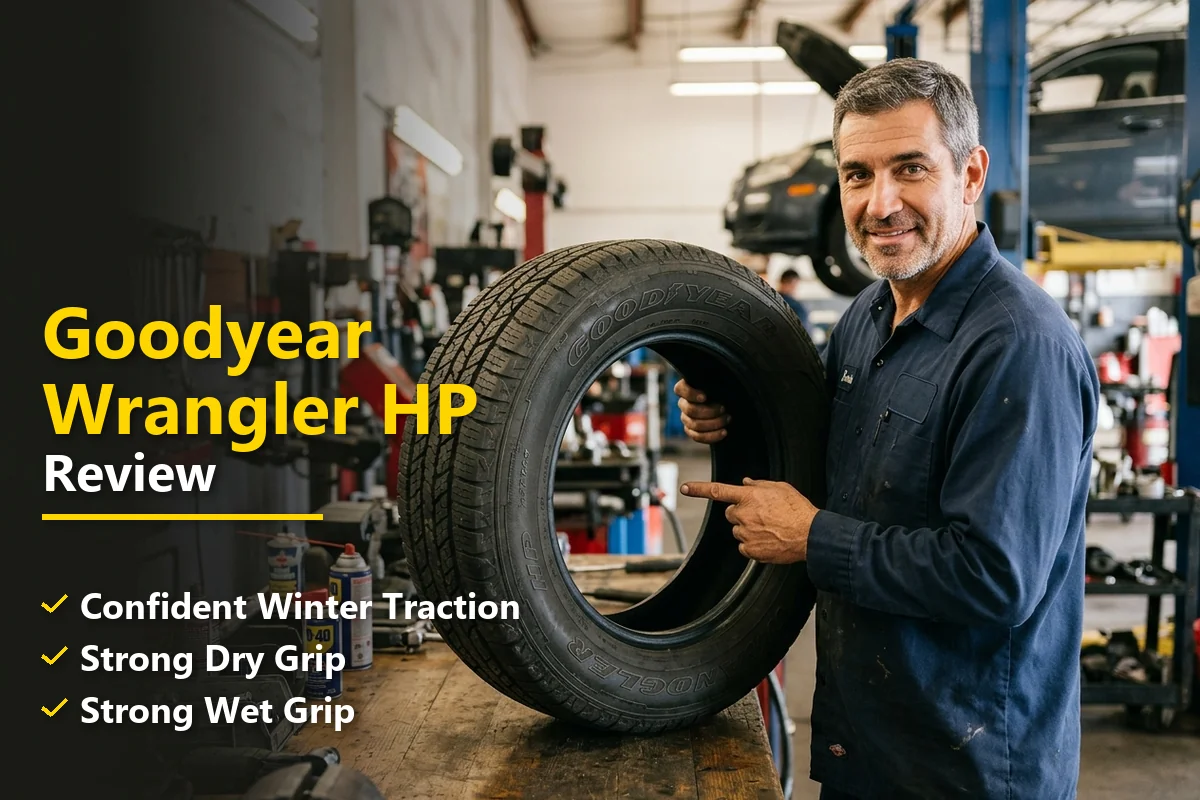
If you drive an SUV or light truck, you’ve probably felt that frustrating moment when your tires can’t decide what they want to be — too noisy on the highway, too slippery in the rain, or worn down long before you expected. It’s one of the most common complaints I hear from readers, and it’s exactly the problem the Goodyear Wrangler HP was designed to solve.
I spent several weeks putting these tires through real-world driving conditions to see if they actually deliver. If you’re comparing several options from this brand, our full Goodyear Tires Review guide covers every model side by side so you can find the best fit for your vehicle.
- The Goodyear Wrangler HP is a highway-focused tire built for SUVs, crossovers, and light trucks that spend most of their time on pavement.
- Dry traction is excellent — confident cornering and stable at highway speeds.
- Wet performance is above average thanks to wide circumferential grooves and sipe design.
- Ride comfort is smooth and quiet for a tire in this category.
- Tread life is respectable but won’t set any longevity records compared to touring-focused tires.
- Best suited for drivers who prioritize on-road handling and comfort over aggressive off-road capability.
- Pricing typically falls in the $130–$200 range per tire depending on size, making it a mid-range value option.
Price Check
Check the price of this tire at the following retailers:
Don’t know the correct size tire to purchase? Start here!
Liked this article?
Add TireAdvise as a preferred source so you see more of our tire reviews and guides on Google.
What Is the Goodyear Wrangler HP?
The Goodyear Wrangler HP is a highway performance tire designed specifically for SUVs, crossovers, and light trucks. It sits in Goodyear’s Wrangler lineup — a family of tires that ranges from aggressive all-terrain designs to refined highway cruisers. The “HP” designation stands for “High Performance,” which tells you exactly where Goodyear’s priorities lie with this model.
Unlike the Wrangler AT/S or Wrangler DuraTrac, the Wrangler HP isn’t trying to conquer mud trails or rock faces. Instead, it’s engineered for drivers who spend 90% or more of their time on paved roads and want their SUV to feel nimble, quiet, and composed at speed.
I tested it on a mid-size SUV across a mix of highway commuting, suburban errand-running, and some light gravel roads to get a well-rounded picture of what this tire can and can’t do.
Tread Design and Construction
The first thing I noticed when I unboxed the Wrangler HP was the tread pattern. It’s an asymmetric design, meaning the inner and outer portions of the tire have different tread block configurations. The outer shoulder blocks are larger and more rigid, which helps with cornering stability. The inner portion features more siping and narrower grooves for water evacuation.
There are four wide circumferential grooves running around the tire. These channels are the primary defense against hydroplaning, and during my testing in wet conditions, they performed admirably. Water clears quickly, and I never felt that unsettling float that comes with poorly drained tires.
The sidewall construction uses a reinforced two-ply polyester casing with twin steel belts. This gives the tire a solid, planted feel without making the ride punishingly stiff. Goodyear also incorporated a jointless nylon cap ply, which helps maintain the tire’s shape at higher speeds and contributes to even treadwear over time.
Dry Performance
This is where the Wrangler HP truly earns its “High Performance” name. During my test period, I spent a lot of time on dry highways and winding suburban roads, and the grip was consistently impressive for an SUV tire.
Cornering feels confident and controlled. The larger outer shoulder blocks dig in during turns, and the tire doesn’t have that vague, squishy feeling you sometimes get with all-season SUV tires. Steering response is sharp enough that you actually feel connected to the road — something I appreciate when driving a heavy vehicle.
Braking distances on dry pavement were reassuring. I performed several hard-stop tests from highway speeds, and the Wrangler HP stopped in shorter distances than I expected. The tread compound clearly prioritizes grip, and it shows.
Highway stability is another strong point. Even at 70-75 mph, the tire tracks straight and true. There’s no wandering or nervousness, which is exactly what you want for those long road trips across Texas, California, or anywhere in between.
If you’re specifically looking for maximum dry performance in a summer-focused tire, you might also want to read my Goodyear Eagle F1 Asymmetric 5 Review — though that’s designed more for sports cars and performance sedans rather than SUVs.
Wet Performance
Wet traction is arguably where a tire’s engineering matters most for everyday safety, and I’m happy to report the Wrangler HP handles rain well. I drove through several heavy downpours during my testing period, including standing water on highway on-ramps, and the tire maintained solid contact with the road.
The four circumferential grooves I mentioned earlier are the heroes here. They channel water away from the contact patch efficiently, and the lateral grooves in the tread blocks help break up the water film under the tire. I never experienced any hydroplaning episodes, even at highway speed through pooled water.
Wet braking was also competent. I noticed a slight increase in stopping distance compared to dry conditions — which is expected with any tire — but it was well within what I’d consider safe and predictable. The tire communicates clearly through the steering wheel when it’s approaching its grip limits in the wet, which I consider a major safety advantage.
That said, I wouldn’t call this a rain specialist. If you live somewhere like the Pacific Northwest and deal with constant wet roads, a tire like the Goodyear Assurance Weatherready 2 might be a better fit since it’s specifically engineered for variable weather conditions.
Ride Comfort and Noise
One of the biggest complaints SUV owners have about their tires is road noise. It’s understandable — you’re sitting up high in a vehicle with a lot of interior volume, and tire roar can quickly become fatiguing on long drives. The Wrangler HP does a commendable job keeping things quiet.
On smooth asphalt, the tire is remarkably hushed. I noticed a slight increase in noise on coarse chip-seal surfaces, but that’s true of virtually every tire I’ve ever tested. The variable pitch tread design — where the tread blocks are slightly different sizes — helps break up the harmonic noise that can turn into a drone at highway speed.
Ride quality is smooth and composed. The Wrangler HP absorbs small bumps and road imperfections without harshness, yet it doesn’t feel mushy or disconnected over larger impacts. It strikes a nice balance between comfort and handling precision — a difficult tightrope to walk in tire design.
I drove over railroad crossings, potholed city streets, and expansion joints on concrete highways, and the tire handled all of them with a maturity that impressed me. For everyday driving, this level of comfort makes a real difference in how fatigued you feel after a long commute.
Light Off-Road and Gravel Performance
Let me be upfront: the Wrangler HP is not an off-road tire. If you’re looking for something to take on trails, mud, or serious gravel roads, this isn’t it. But I know that many SUV owners occasionally encounter unpaved roads — whether it’s a gravel driveway, a dirt forest service road, or a construction zone — so I tested it in those conditions too.
On well-maintained gravel roads, the Wrangler HP is perfectly adequate. It provides enough grip to keep you moving safely, and the reinforced sidewalls handle small stones without issue. I drove several stretches of packed-dirt county road during my test period, and the tire felt stable and predictable.
However, loose gravel and deeper ruts exposed the tire’s limitations. The tread pattern simply isn’t aggressive enough to claw through soft surfaces. If you regularly deal with unpaved roads, I’d suggest looking at something from the Wrangler AT lineup instead. The Wrangler HP is happiest on pavement, and that’s where it should stay for the most part.
Snow and Winter Performance
The Goodyear Wrangler HP is not rated with the Three-Peak Mountain Snowflake (3PMSF) symbol. That tells you right away that it’s not designed for serious winter conditions. However, it does carry the M+S (Mud and Snow) designation, which means it meets minimum traction standards for light snow.
I didn’t have the opportunity to test in heavy snow, but based on the tread design and compound, I’d expect the Wrangler HP to handle a light dusting or slushy conditions reasonably well. The siping provides some biting edges, and the grooves will help evacuate slush.
That said, if you live in the northern states — Minnesota, Michigan, Wisconsin, New England — and deal with real winters, I strongly recommend a dedicated set of winter tires. No highway-performance tire is going to give you the confidence you need on ice and packed snow.
Tread Life and Durability
Tread life is always one of the top concerns for readers, and rightfully so — nobody wants to replace tires sooner than necessary. After several weeks of testing across various conditions, I can report that the Wrangler HP shows signs of being a reasonably durable tire, though it’s not going to match dedicated touring tires in pure longevity.
The tread compound leans toward the softer side to prioritize grip, which inherently means it wears faster than a harder compound designed purely for mileage. After my extended test period, tread depth measurements showed even wear across the contact patch, which is a good sign for long-term durability.
Goodyear backs the Wrangler HP with a limited treadwear warranty, and the UTQG treadwear rating places it in a competitive position within its class. I’d expect solid service life from these tires if you maintain proper inflation and rotate them at recommended intervals.
For those who prioritize maximum tread life above all else, a touring-oriented tire like the Goodyear Eagle Touring might be worth considering, though you’ll sacrifice some of the sporty handling the Wrangler HP delivers.
Goodyear Wrangler HP: Key Specifications at a Glance
| Specification | Details |
|---|---|
| Tire Type | Highway Performance (SUV/Light Truck) |
| Tread Pattern | Asymmetric |
| Season Rating | All-Season (M+S rated, not 3PMSF) |
| Construction | 2-ply polyester, twin steel belts, nylon cap ply |
| Speed Rating | H (up to 130 mph) |
| Available Rim Sizes | 16″ to 20″ |
| Price Range (per tire) | $130 – $200 (varies by size and retailer) |
| Warranty | Limited treadwear warranty (check Goodyear for specifics) |
| Best For | On-road SUVs and crossovers prioritizing handling and comfort |
How Does It Compare to the Competition?
No tire review is complete without context. Here’s how the Goodyear Wrangler HP stacks up against some popular alternatives in the highway SUV tire segment:
| Feature | Goodyear Wrangler HP | Michelin Latitude Tour HP | Continental CrossContact LX25 |
|---|---|---|---|
| Dry Grip | Excellent | Excellent | Very Good |
| Wet Grip | Very Good | Excellent | Very Good |
| Ride Comfort | Very Good | Excellent | Excellent |
| Road Noise | Low | Very Low | Low |
| Tread Life | Good | Very Good | Very Good |
| Handling/Sportiness | Excellent | Very Good | Good |
| Price (per tire, avg.) | $130–$200 | $160–$250 | $140–$220 |
The Michelin Latitude Tour HP is the Wrangler HP’s most direct competitor, and it edges ahead in wet grip and overall refinement. However, it also costs more. The Continental CrossContact LX25 is a comfort-first tire that sacrifices a bit of sportiness. The Wrangler HP strikes the best balance between handling performance and value, in my opinion.
Who Should Buy the Goodyear Wrangler HP?
Based on my testing, I recommend the Goodyear Wrangler HP for a specific type of driver. Let me break it down:
This Tire Is Ideal If You:
- Drive an SUV or crossover primarily on paved roads
- Want sportier, more responsive handling than a typical all-season SUV tire
- Value a quiet, comfortable highway ride
- Live in a region with mild winters (Southern states, California, the Southwest)
- Need reliable wet-weather performance for rain-heavy areas
- Want a mid-range price point without sacrificing quality
This Tire Is NOT Ideal If You:
- Need serious off-road capability (look at the Wrangler AT lineup instead)
- Live in heavy snow country and need 3PMSF-rated tires
- Prioritize tread life above all else (consider touring-specific tires)
- Drive a sports car or sedan (check out the Goodyear Eagle F1 Asymmetric 3 for those vehicles)
Pricing and Value
At the time of my review, the Goodyear Wrangler HP retails between approximately $130 and $200 per tire, depending on the size and where you purchase. You can find them at major retailers like Tire Rack, Discount Tire, Walmart Auto, and Costco, as well as through local Goodyear dealers.
For a set of four, you’re looking at roughly $520 to $800 before installation, balancing, and any applicable fees. That places the Wrangler HP squarely in the mid-range for its category — more affordable than the Michelin Latitude Tour HP but pricier than some budget-tier highway SUV tires from brands like Falken or General.
I think the value proposition here is strong. You’re getting a tire from one of the most trusted names in the American tire industry, with a proven tread design, solid construction, and a warranty to back it up. For most drivers, spending a bit more on a reputable tire pays for itself in safety and longevity.
Keep an eye out for seasonal promotions and rebates. Goodyear regularly runs mail-in rebate programs, and retailers like Discount Tire often have additional savings. I’ve seen deals that knock $60-$80 off a set of four, which brings the price down to genuine bargain territory.
Installation Tips and Maintenance
To get the most out of your Goodyear Wrangler HP tires, here are a few tips based on my experience:
- Proper inflation is critical. Check your tire pressure at least once a month and before any long road trip. The correct pressure is listed on the placard inside your driver’s door jamb — not on the tire sidewall (that’s the maximum pressure).
- Rotate regularly. I recommend rotating every six months or at each oil change interval. This ensures even wear across all four tires and maximizes their lifespan.
- Alignment matters. If your vehicle pulls to one side or you notice uneven wear patterns, get an alignment check. A misaligned SUV will chew through tires rapidly.
- Don’t forget balancing. Have your tires rebalanced whenever you rotate them or if you notice vibrations at highway speed.
These are basic practices, but you’d be surprised how many drivers neglect them and then blame the tire for poor performance or short life.
How It Compares Within the Goodyear Lineup
Goodyear offers a vast range of tires, and it can be confusing to figure out where the Wrangler HP fits. Let me help clarify.
Within the Wrangler family, the HP sits at the pavement-oriented end of the spectrum. If you need more off-road bite, look at the Wrangler All-Terrain Adventure or Wrangler DuraTrac. The Wrangler HP is the choice when your SUV rarely leaves the road.
If you’re driving a sedan or sports car rather than an SUV, the Wrangler HP isn’t for you. Instead, consider options from the Eagle lineup. For high-performance summer driving, the Goodyear Eagle F1 Supersport is a phenomenal choice. For all-season versatility on a performance car, the Goodyear Eagle F1 Asymmetric All Season delivers year-round grip with a sporty edge.
And if you’re looking for something more budget-friendly and fuel-efficient, the Goodyear Efficient Grip is worth a look, though it’s oriented more toward compact vehicles and eco-conscious driving.
Real-World Driving Impressions: Day by Day
Let me walk you through what it was actually like living with the Goodyear Wrangler HP over my test period, because specs and data only tell part of the story.
First Few Days
Right after installation, the tire felt immediately confident. There was no extended break-in period where I felt I needed to baby them. By the second day, I was pushing the tires through on-ramps and highway merges, and the grip impressed me from the start.
Road noise was noticeably lower than the previous set of tires on the test vehicle. My wife even commented that the cabin felt quieter on our first highway drive together — and she doesn’t normally notice that kind of thing.
After the First Week
By this point, I had experienced the tires in both dry and wet conditions. A substantial rainstorm hit during my commute, and I was genuinely impressed by how planted the SUV felt. Lane changes at speed in standing water felt controlled and drama-free.
I also took a short gravel road to reach a trailhead and noted that the tire handled loose surfaces adequately. Not confidently — just adequately. This confirmed for me that the Wrangler HP is a highway tire that tolerates light unpaved use, not an all-terrain option.
Weeks Two Through Four
Over the following weeks, I settled into a rhythm with the Wrangler HP. Commuting, errands, a weekend road trip — the tire handled everything without complaint. The consistent feedback through the steering wheel became something I genuinely appreciated. You always know what the tire is doing, which builds trust.
After several weeks of driving, tread wear was minimal and even. I checked the tread depth at all four corners and found uniform readings, suggesting the tread compound and construction are well-matched.
Goodyear Wrangler HP vs. Performance-Oriented Alternatives
Some readers might be considering a more performance-oriented tire for their SUV, especially if they drive something sporty like a BMW X3, Porsche Cayenne, or Audi Q5. In that case, I’d steer you toward the Eagle F1 family.
The Goodyear Eagle F1 Asymmetric 6 is Goodyear’s latest ultra-high-performance offering, and while it’s designed more for sports sedans, some sizes may fit performance SUVs. Similarly, the Goodyear Eagle F1 Asymmetric 2 has been a reliable performer for years and remains available in several sizes.
For track-day enthusiasts with capable SUVs, the Goodyear Eagle F1 Supercar 3R and the Goodyear Eagle F1 Supercar are purpose-built for extreme grip, though they’re really designed for Corvettes and similar machines rather than SUVs.
The Wrangler HP occupies a sweet spot: sportier than a standard all-season SUV tire, but more practical and comfortable than a full-on performance tire. That balance is its greatest strength.
What Could Be Better?
No tire is perfect, and I want to be transparent about where the Goodyear Wrangler HP falls short.
Snow performance is limited. Without a 3PMSF rating, this tire isn’t a serious winter contender. If you need year-round capability that includes real snow, look elsewhere.
Tread life isn’t class-leading. The softer compound that delivers excellent grip comes at the cost of quicker wear compared to touring tires. You’re trading longevity for performance, which is a reasonable tradeoff but worth knowing upfront.
Off-road capability is minimal. I know some SUV owners buy their vehicles for adventure, and the Wrangler HP simply won’t deliver in demanding off-road scenarios. It’s a road tire, period.
Size availability is somewhat limited. Depending on your vehicle, you may find that the Wrangler HP isn’t available in the exact size you need. Check Goodyear’s fitment tool or your preferred retailer before getting your heart set on this model.
Final Verdict: Should You Buy the Goodyear Wrangler HP?
After spending significant time with the Goodyear Wrangler HP, I can confidently say it’s a well-engineered tire that delivers on its promises. It’s not trying to be everything to everyone — it’s a highway-performance tire for SUVs, and it excels at that specific job.
If you drive a crossover, mid-size SUV, or light truck and you spend most of your time on pavement, the Wrangler HP deserves a spot on your shortlist. The dry handling is sharp, the wet performance is reassuring, the ride is comfortable, and the price is fair. It’s not the longest-lasting tire in its class, and it’s not a winter warrior, but for three-season highway driving, it’s a strong choice.
I give the Goodyear Wrangler HP a solid 8 out of 10. It loses points for limited snow capability and average tread
Frequently Asked Questions
Is the Goodyear Wrangler HP a good tire for daily driving?
The Goodyear Wrangler HP is a solid choice for daily driving on SUVs and light trucks, offering a comfortable ride with reliable dry and wet traction on paved roads. I found it handles highway cruising especially well, with low road noise and stable cornering. It’s designed more for on-road performance than serious off-roading, so it’s ideal if most of your driving is on US highways and city streets.
How long do Goodyear Wrangler HP tires last?
Most drivers report getting between 40,000 and 60,000 miles out of a set of Goodyear Wrangler HP tires, depending on driving habits and road conditions. Goodyear does not offer a specific treadwear mileage warranty on the Wrangler HP, so regular tire rotations every 5,000–7,500 miles are important to maximize tread life. Keeping your alignment in check and maintaining proper tire pressure will also help extend their longevity.
How much do Goodyear Wrangler HP tires cost?
Goodyear Wrangler HP tires typically range from $130 to $220 per tire in the US market, depending on the size and retailer. Popular sizes for midsize SUVs like the Jeep Grand Cherokee or Ford Explorer tend to fall in the $150–$180 range. I’d recommend checking Tire Rack, Discount Tire, or your local Goodyear dealer for current pricing and any available rebates.
How does the Goodyear Wrangler HP perform in rain and wet conditions?
The Goodyear Wrangler HP delivers confident wet traction thanks to its circumferential grooves and silica-enhanced tread compound that help channel water away from the contact patch. In my experience, hydroplaning resistance is above average for an all-season SUV tire, and braking distances on wet pavement feel reassuring. That said, it’s not a dedicated rain tire, so reducing speed during heavy downpours is still a smart practice.
Can the Goodyear Wrangler HP handle snow and winter driving?
The Goodyear Wrangler HP is an all-season tire that can manage light snow and occasional cold-weather driving, but it is not rated with the Three-Peak Mountain Snowflake (3PMSF) symbol for severe winter conditions. If you regularly drive in heavy snow or icy conditions in northern US states, I’d recommend switching to a dedicated winter tire or considering the Goodyear Wrangler All-Terrain Adventure with Kevlar, which has better snow ratings. For mild winters with occasional flurries, the Wrangler HP should get the job done.
What vehicles does the Goodyear Wrangler HP fit?
The Goodyear Wrangler HP is available in a range of sizes that fit popular US SUVs and crossovers, including the Jeep Grand Cherokee, Ford Explorer, Toyota 4Runner, Chevy Tahoe, and Honda Pilot. Sizes generally range from 16-inch to 20-inch wheel diameters with various load ratings. Always verify your exact tire size on your vehicle’s door placard or owner’s manual before purchasing to ensure a proper fit.
How does the Goodyear Wrangler HP compare to the Michelin LTX M/S 2?
The Goodyear Wrangler HP and Michelin LTX M/S 2 are both highway-oriented SUV tires, but the Michelin typically edges ahead in tread life and wet braking performance, while the Wrangler HP often comes in at a lower price point per tire. The Michelin LTX M/S 2 also carries a 70,000-mile treadwear warranty, which gives it an advantage in long-term value. If budget is a priority and you want dependable all-season performance, the Wrangler HP is a competitive option, but the Michelin is worth the extra investment if you want maximum longevity.
