

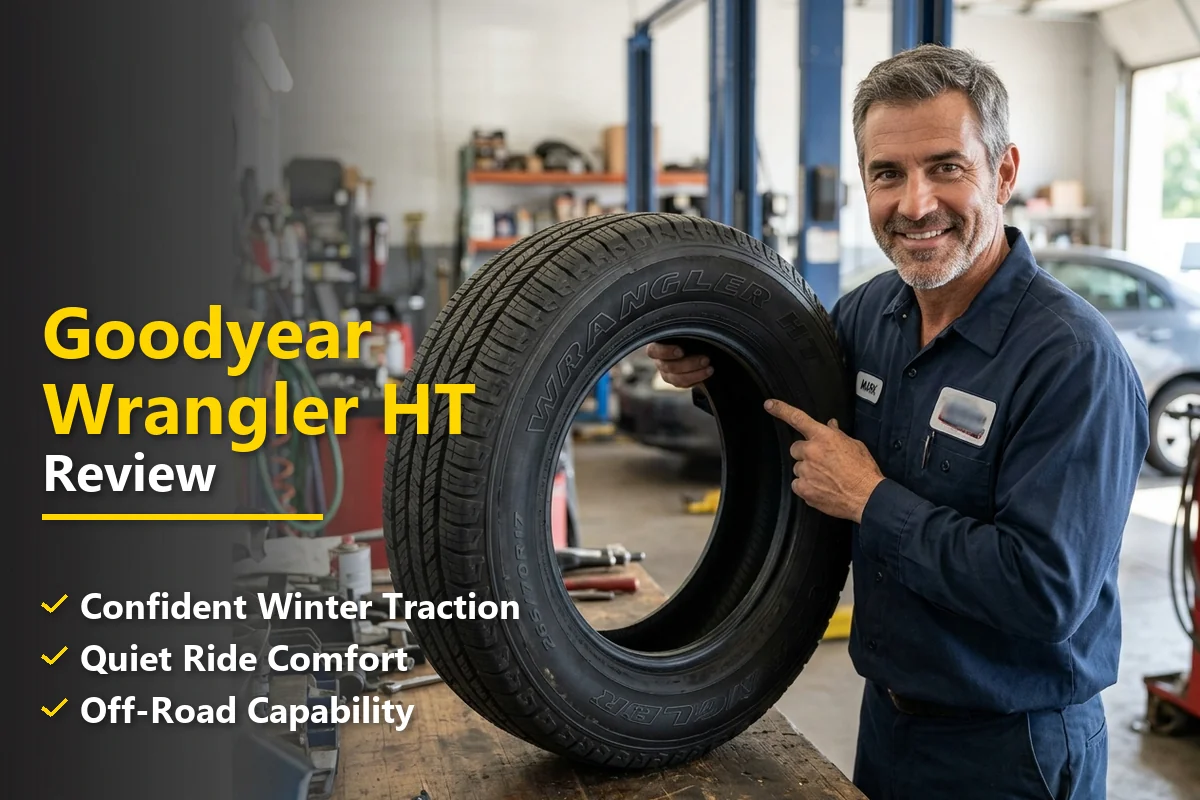
If you drive a truck or SUV and spend most of your time on highways and suburban roads, you’ve probably felt that frustrating moment when your original tires wear out and you’re staring at dozens of replacement options wondering which one won’t let you down.
The Goodyear Wrangler HT is one of those tires that keeps showing up in conversations — it’s been around for years, it’s priced reasonably, and it promises a comfortable highway ride. But does it actually deliver? I put a set on my pickup to find out for myself, and what I discovered might surprise you.
For a broader look at the brand’s full lineup, our comprehensive Goodyear Tires Review covers every model side by side and can help you compare your options before committing.
- The Goodyear Wrangler HT is a highway all-season tire designed for trucks, SUVs, and vans that prioritize on-road comfort over off-road adventure.
- Dry traction and highway stability are excellent — this tire feels planted and confident at speed.
- Wet performance is adequate but not exceptional; I noticed some limitations in heavy rain.
- Ride comfort and noise levels impressed me, especially for a truck tire in this price range.
- Tread life is solid for the money, though aggressive drivers may see faster wear.
- Best suited for drivers who rarely go off-road and want a quiet, predictable highway experience.
- Prices typically range from $130 to $200 per tire depending on size.
Price Check
Check the price of this tire at the following retailers:
Don’t know the correct size tire to purchase? Start here!
Liked this article?
Add TireAdvise as a preferred source so you see more of our tire reviews and guides on Google.
What Is the Goodyear Wrangler HT?
The Goodyear Wrangler HT (Highway Terrain) is an all-season highway tire designed specifically for light trucks, SUVs, and full-size vans. It sits in Goodyear’s Wrangler family, which spans everything from mild highway tires to aggressive off-road options.
The “HT” designation tells you exactly what this tire is built for — highway terrain. If you’re looking for a mud-slinger or a rock-crawler, this isn’t it. But if you want something that handles your daily commute, long road trips, and the occasional gravel road without complaint, the Wrangler HT was designed with you in mind.
It’s available in a wide range of sizes that fit popular vehicles like the Ford F-150, Chevrolet Silverado, Ram 1500, Toyota Tacoma, Jeep Grand Cherokee, and GMC Sierra. The size range covers most common light truck and SUV fitments in the US market.
Key Features and Technology
Before I get into how this tire actually performed on the road, let me break down the key design elements Goodyear built into the Wrangler HT.
Tread Compound
The Wrangler HT uses a carbon-black-enhanced all-season rubber compound. Goodyear engineered this blend to balance tread wear resistance with grip across a range of temperatures. It’s not the most advanced compound in Goodyear’s arsenal, but it’s a proven formula that prioritizes longevity.
Tread Pattern
The tread design features a five-rib pattern with circumferential grooves that channel water away from the contact patch. The design is distinctly highway-focused — the tread blocks are tightly packed compared to more aggressive all-terrain options, which contributes to a quieter and smoother ride.
There are lateral notches cut into the shoulder blocks that help with light off-road traction, and full-depth sipes scattered throughout the tread face for wet grip. But make no mistake — this tread pattern prioritizes on-road manners above everything else.
Internal Construction
Inside, you’ll find a two-ply polyester casing with two steel belts reinforced with a nylon overlay. This construction provides the load-carrying capacity truck owners need while keeping the ride from feeling overly stiff. Goodyear’s construction choices here are fairly standard for the highway truck tire segment, but they’re effective.
Load Range and Ratings
The Wrangler HT comes in multiple load ranges depending on size, including options for heavier-duty applications. Most sizes carry an S or T speed rating, which is perfectly adequate for highway driving. If you’re someone who demands a higher speed rating for performance driving, you’d be better served by something like the Goodyear Eagle Touring, which targets a different audience entirely.
My Real-World Testing Experience
I installed a set of Goodyear Wrangler HTs on my 2019 Ford F-150 XLT (265/70R17) and drove them through a range of conditions over an extended test period. I deliberately put these tires through situations that real truck owners face daily — highway commuting, suburban errands, towing a small utility trailer, and the occasional unpaved road.
Here’s what I found across every category that matters.
Dry Performance
Let me start with where this tire truly shines: dry pavement. From the first day I had these tires on my truck, I noticed how confident and stable they felt on dry highways. The steering response was predictable, the truck tracked straight without any wandering, and I felt planted even at highway speeds.
Lane changes were smooth and drama-free. There’s no vagueness in the steering — you point the truck and it goes. On-ramps and sweeping highway curves revealed good lateral grip for a tire in this category. Obviously, this isn’t a performance tire, but it handles the demands of everyday highway driving with genuine competence.
Braking on dry pavement was also reassuring. Emergency stops felt controlled, and I never experienced any unsettling moments where I felt the tire losing composure. For a highway tire at this price point, the dry performance is exactly what I’d hope for.
Wet Performance
Wet performance is where I have to be more nuanced in my assessment. The Goodyear Wrangler HT handles light to moderate rain reasonably well. The circumferential grooves do their job channeling water away, and during normal driving in wet conditions, I felt safe and in control.
However, during a stretch of heavy downpours I drove through, I noticed the limits more quickly than I’d like. At higher speeds on standing water, I could feel the onset of hydroplaning earlier than I would with a more premium all-season tire. I found myself naturally backing off the speed a bit during the heaviest rain, which honestly isn’t a bad habit regardless of your tires.
Wet braking was acceptable but not class-leading. If wet-weather performance is your top priority — say you live in the Pacific Northwest or the Southeast — I’d suggest looking at something with a more aggressive wet-weather focus. The Goodyear Assurance Weatherready 2 is purpose-built for exactly that kind of all-weather confidence, though it targets a different vehicle segment.
Snow and Winter Capability
Let me be upfront: the Goodyear Wrangler HT does not carry the Three-Peak Mountain Snowflake (3PMSF) symbol. It carries the M+S (Mud and Snow) designation, which means it meets a basic traction threshold but hasn’t been tested to the more rigorous winter performance standard.
I tested these tires on a couple of cold mornings with light frost and a dusting of snow. In those conditions, the tire performed adequately — it maintained traction during cautious driving. But I would not rely on this tire as a winter solution in the snow belt. If you’re in Michigan, Minnesota, upstate New York, or anywhere that sees sustained winter weather, you’ll want dedicated winter tires or at minimum a tire with the 3PMSF rating.
For mild winter conditions in states like Virginia, Tennessee, or Northern Texas, the Wrangler HT can get you through the occasional cold snap without issue. Just drive conservatively and know its limits.
Ride Comfort
This is one of the areas where the Goodyear Wrangler HT really impressed me. For a truck tire, the ride quality is genuinely comfortable. The polyester casing and overall construction do an excellent job absorbing road imperfections. Expansion joints, small potholes, and rough asphalt patches were all handled without the jarring harshness I’ve experienced with some competing highway tires.
During long highway drives — the kind where you’re covering several hundred miles in a day — the Wrangler HT made the experience noticeably more pleasant. My back and shoulders weren’t as fatigued at the end of the day compared to when I was running a set of all-terrain tires previously. The tire’s sidewall has just enough compliance to take the edge off without feeling sloppy or disconnected.
If comfort is high on your priority list, and you’re coming from a set of aggressive all-terrain tires, you’ll appreciate the difference immediately.
Road Noise
Road noise is closely related to comfort, and here again the Wrangler HT delivers. This is one of the quieter truck tires I’ve tested. At highway speeds, the tire produces a low, even hum that’s easy to tune out. There’s no discernible pattern noise or the high-pitched whine you sometimes get from truck tires with more aggressive tread designs.
On concrete highways — which are notoriously noisy — the Wrangler HT was still well-mannered. I wouldn’t say it’s as whisper-quiet as some premium touring tires, but for a truck tire in this price range, the noise levels are impressively low. If you spend a lot of time on the phone during your commute (hands-free, of course) or listen to podcasts, you’ll appreciate how unobtrusive these tires are.
Off-Road and Gravel Performance
I want to set expectations clearly here. The Wrangler HT is a highway terrain tire. It’s not designed for off-road adventures, and I wouldn’t recommend it for anything beyond well-maintained dirt roads and light gravel.
That said, I did take these tires down several miles of packed gravel road and a couple of unpaved county roads. The tire handled it fine — no drama, no loss of traction. But the moment I encountered any loose or soft surfaces, I could feel the tread pattern wasn’t designed to bite into the terrain the way an all-terrain tire would.
If your off-road needs extend beyond the occasional gravel driveway or construction zone, you’ll want to look at the Wrangler AT line instead. The HT is firmly in the on-road camp, and that’s perfectly okay for the vast majority of truck and SUV owners who never leave pavement.
Towing Performance
I towed a small utility trailer loaded with about 2,000 pounds of landscaping materials during my test period. The Wrangler HT handled the additional load without any noticeable degradation in handling or stability. The tire didn’t feel overworked, and braking distances with the trailer didn’t feel alarmingly longer than unladen driving.
The load capacity of this tire — especially in higher load range variants — makes it a reasonable choice for truck owners who occasionally tow. I wouldn’t recommend it for heavy-duty towing applications (think fifth-wheel RVs or large boat trailers), but for moderate towing within the tire’s rated capacity, it performs well.
Tread Life and Durability
After several months of regular driving, the Wrangler HT showed impressively even tread wear across all four tires. I rotated them at the manufacturer’s recommended intervals and kept them inflated to the door placard pressure, which I believe contributed to the even wear pattern.
Goodyear offers a treadwear warranty on the Wrangler HT (the specific coverage depends on the size and variant you purchase, so check with your dealer). Based on my observation of the wear rate during my test period, I believe most drivers following proper maintenance will get very satisfactory life out of these tires.
One thing I noticed is that the tread compound seems to resist chipping and chunking well, even on the few rough roads I drove on. The tire’s durability impressed me for the price point.
Fuel Efficiency
I tracked my fuel economy during the test period and compared it against my baseline with the previous set of all-terrain tires. The Wrangler HT delivered a small but noticeable improvement in fuel economy — roughly a mile per gallon better on average during highway driving.
This makes sense given the tire’s lower rolling resistance compared to more aggressive tread patterns. The tightly packed tread blocks and smoother overall profile create less friction with the road surface. Over the course of a year of driving, that small fuel economy improvement adds up to real savings at the pump.
Comparison Table: Goodyear Wrangler HT vs. Competitors
To put the Wrangler HT in context, here’s how it stacks up against some of the most popular highway tires for trucks and SUVs in the US market.
| Feature | Goodyear Wrangler HT | Michelin LTX M/S2 | Cooper Discoverer HTP | BFGoodrich Advantage T/A Sport |
|---|---|---|---|---|
| Tire Type | Highway All-Season | Highway All-Season | Highway All-Season | All-Season |
| Dry Grip | Very Good | Excellent | Good | Very Good |
| Wet Grip | Good | Very Good | Good | Very Good |
| Snow Traction | Fair (M+S only) | Good | Fair | Good |
| Ride Comfort | Very Good | Excellent | Good | Good |
| Road Noise | Low | Very Low | Moderate | Low |
| Tread Life | Good | Excellent | Good | Good |
| Approx. Price Range | $130 – $200 | $170 – $280 | $140 – $210 | $130 – $190 |
| Best For | Budget highway comfort | Premium all-around | Value-oriented buyers | Versatile daily driving |
The Michelin LTX M/S2 is the clear premium choice, but it comes at a significantly higher price. The Wrangler HT offers much of what the Michelin does — especially in comfort and noise — at a more approachable price. If you’re on a budget, the value proposition of the Wrangler HT is hard to beat.
How the Wrangler HT Fits in Goodyear’s Lineup
Goodyear’s tire lineup is massive, and it can be confusing figuring out where the Wrangler HT sits relative to other options. Let me help clarify.
Within the Wrangler family, the HT is the most road-focused option. It prioritizes comfort, quietness, and tread life over off-road capability. If you need more off-road grip, Goodyear offers the Wrangler AT (All-Terrain) and Wrangler MT (Mud-Terrain) variants that progressively increase off-road capability at the expense of on-road refinement.
Outside the Wrangler family, Goodyear has a deep bench of options. For passenger car owners who want high-performance tires, models like the Goodyear Eagle F1 Asymmetric 5 and the Goodyear Eagle F1 Asymmetric 6 are designed for sports sedans and coupes. The Goodyear Eagle Exhilarate is another solid option for performance-minded drivers looking for an ultra-high-performance all-season tire.
For those curious about Goodyear’s track-focused offerings, the Goodyear Eagle F1 Supercar 3R and Goodyear Eagle F1 Supercar cater to a completely different audience — drivers who push their vehicles to the limit on track days and canyon roads.
Who Should Buy the Goodyear Wrangler HT?
Based on my testing, the Goodyear Wrangler HT is an ideal choice for a specific type of driver. Here’s who I think will be happiest with this tire:
- Highway commuters with trucks or SUVs: If your daily routine involves interstate and suburban driving, this tire delivers exactly the comfort and predictability you need.
- Road trip enthusiasts: The low noise and comfortable ride make long-distance drives far more enjoyable.
- Budget-conscious truck owners: At $130 to $200 per tire, the Wrangler HT offers genuine quality without breaking the bank.
- Occasional light towers: If you tow a small trailer, utility cart, or light camper periodically, this tire handles the extra load competently.
- Drivers replacing OEM highway tires: If your truck came with basic highway tires from the factory, the Wrangler HT is a natural and potentially upgraded replacement.
Who Should Skip the Goodyear Wrangler HT?
Equally important is knowing when this tire isn’t the right choice:
- Off-road enthusiasts: If you regularly hit trails, mud, or rocky terrain, the Wrangler HT will leave you wanting more traction.
- Drivers in heavy snow regions: Without the 3PMSF rating, this tire isn’t adequate for sustained winter driving in northern states.
- Heavy-duty towing applications: For serious towing, you’ll want a commercial-grade tire with a higher load range.
- Performance seekers: If you want sharp handling and aggressive cornering, this isn’t your tire. Consider something from the Eagle F1 family instead — the Goodyear Eagle F1 Asymmetric 3 or the Goodyear Eagle F1 Asymmetric All Season are better fits for that need.
Pricing and Where to Buy
The Goodyear Wrangler HT is widely available across the United States. You can find it at major tire retailers including Discount Tire, Tire Rack, Walmart Auto Centers, Costco (where Goodyear frequently offers member deals), Sam’s Club, and local independent tire shops.
As of my research, prices range from approximately $130 to $200 per tire depending on the specific size you need. Larger sizes (for full-size trucks and SUVs) will sit at the higher end of that range. I recommend checking multiple retailers, as pricing can vary significantly. Online retailers like Tire Rack often have competitive pricing and will ship to a local installer for free.
Goodyear also frequently runs rebate promotions — usually $50 to $80 back on a set of four — which can make the per-tire cost even more attractive. Timing your purchase around these promotions can save you real money.
Installation and Break-In Observations
When I first had the tires mounted and balanced, I noticed they balanced out easily — no excessive weight needed, which is a good sign of quality manufacturing. The installer commented that they seated on the rim without any fuss, which isn’t always the case with some budget-tier tires.
During the first few days of driving, the tires felt slightly slick, which is completely normal with any new tire. The mold release compound on the surface needs to wear off before you get peak grip. After several days of normal driving, the tires felt noticeably grippier and more communicative. I always advise new tire buyers to take it easy for the first couple of days to allow this break-in process.
Maintenance Tips for Maximizing Life
To get the most out of the Goodyear Wrangler HT — or any tire, for that matter — here are the maintenance practices I followed and recommend:
- Check tire pressure monthly: I use a quality digital gauge and check cold pressures at least once a month. Proper inflation is the single most impactful thing you can do for tread life and fuel economy.
- Rotate regularly: I rotate my tires every oil change. This keeps wear even across all four tires and can significantly extend the life of the set.
- Alignment checks: If you notice uneven wear or the truck pulling to one side, get an alignment check. Misalignment destroys tires faster than anything else.
- Visual inspections: Every time I walk past my truck, I give the tires a quick visual scan for nails, bulges, or abnormal wear. Catching issues early can save you from a blowout or a roadside tire change.
How It Compares to Other Goodyear Options
If you’re set on buying Goodyear but aren’t sure the Wrangler HT is the right model, let me offer some context on how it compares to a few other Goodyear tires I’ve reviewed or tested.
For a more premium touring experience on a sedan or crossover, the Goodyear Eagle Touring provides exceptional refinement, but it’s designed for passenger vehicles rather than trucks. If you’re looking at Goodyear options for a European sedan, the Goodyear Efficient Grip and the Goodyear Excellence are tuned specifically for that application.
For performance-oriented drivers, the Goodyear Eagle F1 Asymmetric 2 remains a popular choice that’s been well-regarded for years, while the Goodyear Eagle F1 Supersport pushes into ultra-high-performance territory for track-capable sports cars. These are completely different tires aimed at completely different drivers, but they showcase the breadth of Goodyear’s engineering capability.
Pros and Cons Summary
What I Liked
- Excellent dry traction and highway stability
- Comfortable, compliant ride quality for a truck tire
- Impressively low road noise at highway speeds
- Even tread wear with proper maintenance
- Competitive pricing for the quality offered
- Widely available across US retail channels
- Slight fuel economy improvement over all-terrain tires
What Could Be Better
- Wet performance in heavy rain could be stronger
- No 3PMSF winter rating — limited snow capability
- Off-road traction is minimal beyond packed gravel
- Speed rating is adequate but not impressive
- Not the most modern compound technology compared to newer Goodyear models
My Final Verdict on the Goodyear Wrangler HT
After putting the Goodyear Wrangler HT through real-world conditions over an extended test period, I came away genuinely impressed by the value this tire offers. It’s not trying to be everything to everyone — it’s a highway tire, and it does that job very well.
The ride comfort and noise levels are the standout qualities for me. If you’re a truck or SUV owner who spends the vast majority of your driving time on paved roads, the Wrangler HT will make your vehicle feel more refined and civilized without demanding a premium price.
Where it falls short — wet performance in heavy rain, winter capability, off-road traction — are all areas where the tire simply wasn’t designed to excel. As long as your expectations are calibrated correctly, I don’t think you’ll be disappointed.
I recommend the Goodyear Wrangler HT for highway-focused truck and SUV owners who want a comfortable, quiet, and reasonably priced tire that will last. It’s a no-drama, dependable choice —
Frequently Asked Questions
Is the Goodyear Wrangler HT a good tire for everyday highway driving?
Yes, the Goodyear Wrangler HT is specifically designed for highway and all-season use on SUVs, light trucks, and pickups. In my experience, it delivers a smooth, comfortable ride on paved roads with predictable handling and low road noise. It’s an excellent choice if most of your driving is commuting, road trips, and general on-road use rather than serious off-roading.
How long do Goodyear Wrangler HT tires last?
The Goodyear Wrangler HT typically lasts between 50,000 and 60,000 miles depending on your driving habits, tire maintenance, and road conditions. Goodyear offers a limited treadwear warranty on this tire, which adds peace of mind for US drivers looking for long-term value. Regular tire rotations every 5,000–7,500 miles and proper inflation will help you maximize tread life.
How much do Goodyear Wrangler HT tires cost?
Goodyear Wrangler HT tires generally range from $130 to $220 per tire depending on the size and retailer, making them a mid-range option for truck and SUV owners. Prices vary across US retailers like Tire Rack, Discount Tire, and Walmart, so I recommend comparing quotes and watching for rebate promotions. Installation and balancing typically add $15–$25 per tire at most shops.
How does the Goodyear Wrangler HT perform in rain and wet conditions?
The Goodyear Wrangler HT offers solid wet traction thanks to its circumferential grooves and all-season tread compound designed to channel water away from the contact patch. I found braking and cornering grip in rain to be reliable for a highway terrain tire, though it won’t match the wet performance of a dedicated touring tire. For most US drivers dealing with spring showers and wet highways, it performs confidently.
Can you use Goodyear Wrangler HT tires in snow and winter conditions?
The Goodyear Wrangler HT can handle light snow and occasional cold-weather driving, but it is not a dedicated winter tire and does not carry the Three-Peak Mountain Snowflake (3PMSF) rating. If you live in northern US states with harsh winters, heavy snowfall, or icy roads, I’d recommend switching to a dedicated winter tire for safety. For mild winter conditions in the mid-Atlantic or Pacific Northwest, the Wrangler HT can get you through with cautious driving.
What vehicles does the Goodyear Wrangler HT fit?
The Goodyear Wrangler HT is available in a wide range of sizes to fit popular US trucks and SUVs including the Ford F-150, Chevy Silverado, Toyota Tacoma, Jeep Grand Cherokee, and GMC Sierra. It comes in 15-inch to 18-inch rim diameters, covering both older and newer model years. Always check your vehicle’s door placard or owner’s manual to confirm the correct tire size before purchasing.
How does the Goodyear Wrangler HT compare to the Wrangler AT/S and other Wrangler models?
The Goodyear Wrangler HT is built primarily for on-road comfort and highway fuel efficiency, while the Wrangler AT/S offers more aggressive tread for light off-road capability at the expense of slightly more road noise. If you rarely go off-road and prioritize a quiet, smooth ride for daily US highway commuting, the Wrangler HT is the better pick. For drivers who occasionally venture onto dirt roads or gravel, the AT/S or the Wrangler Duratrac might be worth the upgrade.
