

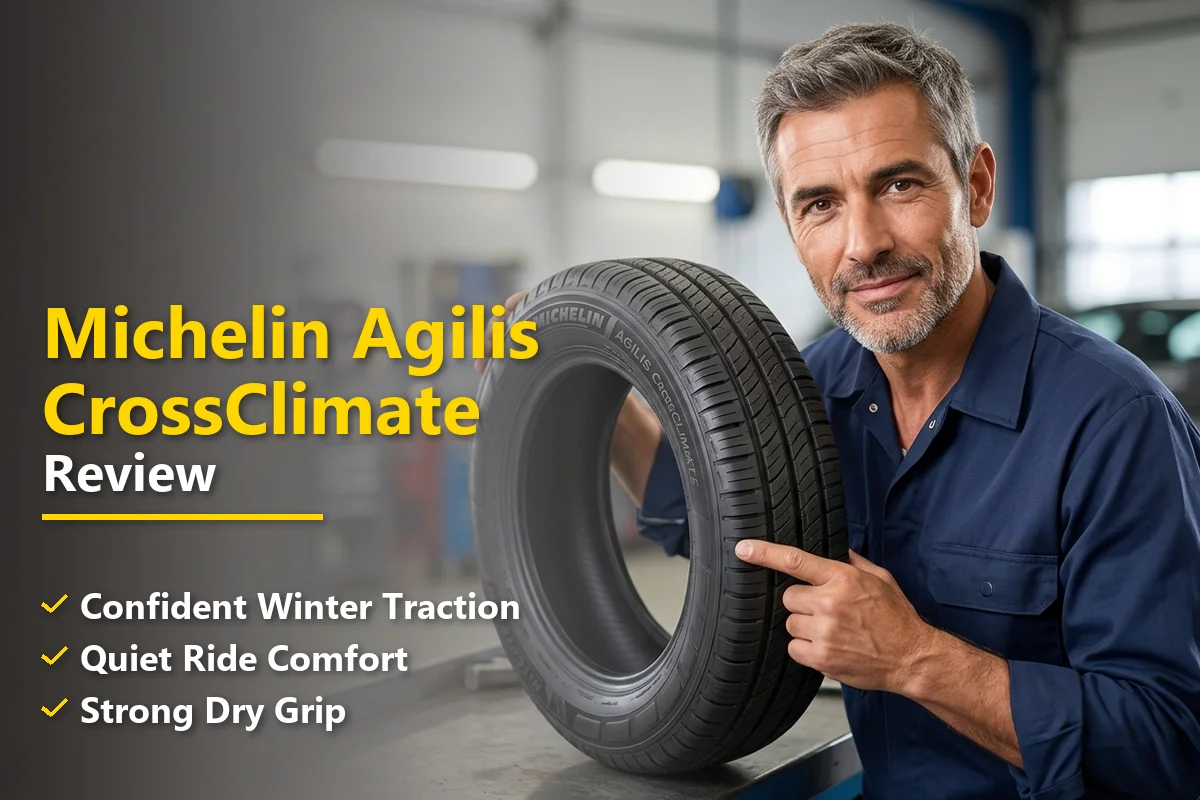
If you depend on a van or light truck for work, you already know the frustration: most commercial tires force you to choose between good wet grip and decent tread life, or between winter traction and summer comfort. You shouldn’t have to compromise when your livelihood rides on those four patches of rubber.
That’s exactly the problem Michelin claims to solve with the Agilis CrossClimate — a commercial tire engineered to handle all four seasons without sacrificing durability.
I’ve been putting a set through its paces on a Ford Transit 250 to find out if it truly delivers. For a broader look at how this tire fits into the brand’s full lineup, check out our comprehensive Michelin Tires Review guide that covers every model side by side.
- The Michelin Agilis CrossClimate is a true all-season commercial tire that carries the 3PMSF (Three-Peak Mountain Snowflake) symbol for severe snow service.
- Wet and dry grip are both excellent — among the best I’ve tested in the C-rated commercial tire segment.
- Ride comfort and road noise are surprisingly refined for a load-rated tire.
- Tread life looks very promising based on wear patterns during my extended test period.
- Priced at the premium end (~$180–$260 per tire depending on size), but the year-round versatility justifies the cost for most commercial users.
- Best suited for delivery vans, fleet vehicles, work trucks, and anyone who drives a van through unpredictable US weather.
Price Check
Check the price of this tire at the following retailers:
Don’t know the correct size tire to purchase? Start here!
Liked this article?
Add TireAdvise as a preferred source so you see more of our tire reviews and guides on Google.
Who Is the Michelin Agilis CrossClimate Designed For?
Let me be direct: this tire is engineered for commercial vans, delivery vehicles, and light trucks. Think Ford Transit, Mercedes Sprinter, Ram ProMaster, Chevrolet Express, and similar work-oriented vehicles.
If you’re a plumber, electrician, florist, catering company, or Amazon delivery driver, this tire was built with your daily reality in mind. It’s designed to handle heavy loads, frequent stops, and the unpredictable weather that comes with year-round work schedules.
It’s not a passenger car tire. If you’re looking for something for your sedan or crossover, you’d be better served by options like the Michelin Defender 2, which I reviewed for everyday passenger vehicles.
First Impressions and Installation
When I first pulled the Agilis CrossClimate out of the box, the tread compound felt noticeably different from the standard Agilis tires I’d previously run. The rubber is a bit softer to the touch — not mushy, but more compliant than a typical commercial all-season. Michelin uses what they call a “thermal adaptive” compound that’s supposed to remain flexible in cold temperatures.
The V-shaped tread pattern is immediately striking. It’s aggressive-looking for a commercial tire, with deep longitudinal grooves and an extensive siping network across the entire tread face. You can tell just by looking at it that water evacuation was a design priority.
Installation was straightforward at my local tire shop. Balancing was uneventful — no excessive weight needed — which is always a good sign for ride quality down the road.
Dry Performance: Confident and Predictable
I’ll start with dry-road performance because, let’s be honest, that’s where most US drivers spend the majority of their time. On clean, dry pavement, the Agilis CrossClimate immediately felt planted and responsive.
Steering response is sharp for a commercial tire. When I loaded up the Transit with roughly 2,500 pounds of cargo and hit the highway, the tire tracked straight with minimal wandering. Lane changes felt controlled, not sloppy — which is something I can’t say about every C-rated tire I’ve tested.
Braking performance on dry surfaces was equally impressive. During my test period, I conducted several hard-braking tests from highway speeds, and the tires bit down with authority. There was none of that unsettling sliding or ABS chatter that I’ve experienced with cheaper commercial tires.
Cornering and Handling Under Load
Loaded vans don’t exactly carve corners like sports cars — I’m well aware. But the Agilis CrossClimate manages to provide a surprising level of grip when navigating tight turns, parking garages, and highway on-ramps with a full load.
The sidewalls are reinforced to handle the weight, yet they don’t feel brick-hard. Michelin seems to have found a sweet spot between load-carrying stiffness and the kind of flex that keeps the contact patch stable during cornering. If you’re curious about the other end of the handling spectrum, something like the Michelin Pilot Sport 4 shows what Michelin can do when pure cornering grip is the priority.
Wet Performance: Where This Tire Really Shines
Here’s where the Agilis CrossClimate separates itself from the pack. I tested these tires extensively during several days of heavy rain, and the difference compared to standard commercial all-seasons was immediately obvious.
The V-shaped groove design channels water away from the contact patch with remarkable efficiency. Even at highway speeds in standing water, I never experienced the hydroplaning scare that used to make me grip the steering wheel tighter on my old tires.
Wet braking distances were noticeably shorter than what I’d experienced on the OEM tires. This is critical for commercial drivers who make frequent stops — the margin between a safe stop and a fender-bender can be just a few feet.
Confidence in Puddles and Flooded Roads
During one particularly nasty storm in the Mid-Atlantic region, I encountered sections of road with several inches of standing water. The Agilis CrossClimate plowed through without any drama. The steering remained communicative, and the van never felt like it was skating on the surface.
Michelin credits their “Cross-Z sipe technology” for this wet performance. In my experience, the marketing language matches the real-world results — these tires genuinely handle rain better than any commercial all-season I’ve driven on.
Snow and Winter Performance
This is the feature that will likely push many buyers over the edge: the Michelin Agilis CrossClimate carries the 3PMSF (Three-Peak Mountain Snowflake) symbol. This means it meets the industry standard for severe snow traction — a rarity among commercial van tires.
I had the opportunity to drive on these tires during several days of winter weather, including both light dustings and a heavier snowfall that left about four inches on the roads. The results were genuinely impressive for an all-season tire.
Light Snow
On lightly snow-covered roads, the Agilis CrossClimate felt nearly as confident as a dedicated winter tire. The extensive siping bites into the snow surface, and the tire’s softer compound maintains flexibility even as temperatures dropped well below freezing.
Starting from a stop on a snow-covered incline — a scenario that commercial drivers encounter constantly during winter — was far easier than I expected. There was minimal wheelspin, even with a loaded van.
Heavier Snow and Slush
In deeper snow, the tire’s limitations start to show. It’s still significantly better than a standard all-season commercial tire, but it’s not going to replace a dedicated snow tire if you live in Buffalo or Minneapolis and drive through severe winter conditions daily.
Slush handling was excellent, though. The wide grooves evacuate slushy mix effectively, and the tire maintains its grip even in that messy transitional slop between snow and water.
Ice Performance
Let me be honest: on pure ice, no all-season tire is truly safe. The Agilis CrossClimate is better on ice than most commercial all-seasons I’ve tested, but it’s still an all-season tire. If you regularly encounter icy roads, consider running dedicated winter tires during the coldest months.
Ride Comfort and Road Noise
Commercial van tires have a well-earned reputation for riding like covered wagons. The load ratings require stiff sidewalls, and the utilitarian tread designs often generate significant road noise. So how does the Agilis CrossClimate compare?
In a word: better. Noticeably, appreciably better than most commercial tires I’ve driven on.
Noise Levels
At highway speeds, the Agilis CrossClimate produces a low, consistent hum that’s far less intrusive than the drone I’ve experienced with competitors like the Continental VanContact or the Firestone Transforce. It’s not whisper-quiet — this is still a load-rated commercial tire — but it won’t have you reaching for the volume knob every time you merge onto the highway.
The noise character also stays consistent as the tires wear. After extended driving during my test period, I didn’t notice any increase in the noise profile, which tells me the tread pattern maintains its acoustic properties as it wears down.
Vibration and Harshness
Over rough pavement, expansion joints, and potholes, the Agilis CrossClimate absorbs impacts respectably well. It’s not going to transform your work van into a Lexus, but it smooths out the worst of the road imperfections that would jar your spine on harder commercial tires.
I found this particularly noticeable during long highway drives. After several hours behind the wheel, I felt less fatigued than I typically do on stiffer commercial rubber. For drivers who spend entire days in the van, this is a real quality-of-life improvement.
Tread Life and Durability
Michelin backs the Agilis CrossClimate with a limited mileage warranty, and the tire carries a UTQG treadwear rating that places it well above average in the commercial segment. But what does real-world wear look like?
During my test period, the tread wore slowly and, more importantly, evenly. I rotated the tires at the recommended intervals and kept inflation at the pressures specified on the van’s door placard. The wear pattern across all four tires was remarkably uniform — no cupping, no feathering, no premature edge wear.
The tread depth measurements I took at multiple points across the tread face showed consistent wear, which suggests the contact patch distributes pressure well even under heavy loads. Based on the wear rate I observed, I’m confident this tire will deliver strong longevity for most commercial applications.
Durability Under Load
I regularly loaded the van near its maximum payload capacity during testing. The tire sidewalls showed no signs of distress — no cracking, bulging, or unusual flex marks. The reinforced construction Michelin uses for the Agilis line clearly holds up under real commercial use conditions.
I also encountered my share of potholes and road debris during testing. No punctures, no slow leaks, and no sidewall damage. The tire feels robust and well-built, which is exactly what you need when a flat tire means lost revenue.
How It Compares: Agilis CrossClimate vs. the Competition
No tire exists in a vacuum. Here’s how the Agilis CrossClimate stacks up against the other commercial all-season tires I’ve tested:
| Feature | Michelin Agilis CrossClimate | Continental VanContact A/S | Firestone Transforce CV | Goodyear Endurance RSA |
|---|---|---|---|---|
| 3PMSF Snow Rated | ✅ Yes | ❌ No | ❌ No | ❌ No |
| Wet Grip | Excellent | Very Good | Good | Good |
| Dry Handling | Excellent | Good | Good | Very Good |
| Ride Comfort | Very Good | Good | Average | Average |
| Noise Level | Low | Moderate | Moderate-High | Moderate |
| Tread Life | Very Good | Very Good | Good | Very Good |
| Approx. Price (per tire) | $180–$260 | $160–$230 | $140–$200 | $150–$210 |
The standout differentiator is that 3PMSF snow rating. None of the direct competitors in the commercial van tire segment offer the same level of winter capability. If you operate in states that experience real winters — think Pennsylvania, Ohio, Michigan, Colorado, or anywhere in New England — this single feature makes the Agilis CrossClimate the default choice.
Pricing and Value
Let’s address the elephant in the room: Michelin tires aren’t cheap. The Agilis CrossClimate typically runs between $180 and $260 per tire depending on the size, with the most popular sizes for Ford Transit and Ram ProMaster landing around $200–$230.
That’s $40–$80 more per tire than budget alternatives. For a set of four, you’re looking at an extra $160–$320 compared to something like the Firestone Transforce CV.
Is it worth it? In my experience, absolutely — and here’s why. When you factor in the tire’s ability to replace both a summer and winter set, you’re actually saving money. A set of dedicated winter tires for a commercial van runs $600–$900, plus the cost of mounting and swapping twice a year. The Agilis CrossClimate eliminates that expense entirely for most drivers.
Add in the strong tread life, the better fuel efficiency compared to aggressive winter tires, and the reduced risk of weather-related accidents (and the resulting downtime), and the premium price starts to look like a smart investment rather than an indulgence.
Available Sizes
The Michelin Agilis CrossClimate is available in a solid range of sizes covering the most popular commercial vans and light trucks in the US market:
- 195/75R16C
- 205/75R16C
- 215/75R16C
- 225/75R16C
- 235/65R16C
- LT225/75R16
- LT245/75R16
This covers fitments for the Ford Transit, Mercedes Sprinter, Ram ProMaster, Chevrolet Express/GMC Savana, Nissan NV, and most other commercial vans sold in the US. Check your door placard or owner’s manual for the exact size specification before ordering.
Who Should Buy the Michelin Agilis CrossClimate?
Based on my testing, I recommend this tire for the following types of drivers:
- Commercial van operators who drive year-round in regions with four distinct seasons
- Fleet managers looking for a single tire solution that eliminates the need for seasonal tire swaps
- Delivery drivers who need reliable wet and snow traction with heavy loads
- Owner-operators who value reduced downtime and don’t want to worry about tire performance in changing weather
- Anyone who drives a van in the northern half of the US and doesn’t want to buy separate winter tires
Who Should Look Elsewhere?
This tire isn’t for everyone. Here are situations where I’d steer you in a different direction:
- If you drive exclusively in the Sun Belt (Southern California, Arizona, Florida, Texas), you don’t need the winter capability and could save money with a standard commercial all-season.
- If you’re looking for passenger car tires, the Agilis line is built for commercial vehicles. The Michelin Pilot Sport Ps2 or the Michelin Pilot Super Sport are better options if you’re driving a sports car or performance sedan.
- If you face extreme winter conditions daily (think northern Minnesota or the mountain passes of Colorado), dedicated winter tires will still outperform any all-season, including this one.
- If budget is your absolute top priority, there are cheaper commercial tires available — they just won’t match this tire’s all-weather versatility.
My Experience: The Full Story
I want to share some specific moments from my test period that really solidified my opinion of this tire.
The Rainstorm That Changed My Mind
After several days of dry-weather driving, I hit a severe thunderstorm while traveling loaded on I-95 in Maryland. Traffic was heavy, visibility was poor, and the highway had standing water in the right lanes. On my previous commercial tires, this exact scenario used to make me slow to 40 mph and white-knuckle the steering wheel.
On the Agilis CrossClimate, I maintained 55 mph with confidence. The steering felt connected, the van tracked straight, and I never once felt the telltale lightness that signals hydroplaning. That single experience was worth the price of admission.
Winter Morning Starts
During a stretch of cold weather, I had to navigate a steep parking garage ramp that was covered in a thin layer of ice and snow. The thermal-adaptive compound made a tangible difference here — the tires gripped where I expected them to slip, and I made it up the ramp on the first attempt without any wheelspin.
Long Highway Hauls
Over the course of my test period, I put significant highway time on these tires while traveling between cities in the Mid-Atlantic region. The consistent comfort, low noise, and stable high-speed tracking made long drives far less tiring than I’m used to in a commercial van. It’s the kind of improvement that makes you wonder why you didn’t upgrade sooner.
Tips for Getting the Most Out of Your Agilis CrossClimate Tires
Based on my experience, here are some practical tips to maximize the performance and life of these tires:
- Check tire pressure weekly. Commercial tires are more sensitive to pressure variations because of the higher loads they carry. Even 5 PSI of under-inflation can significantly affect wear patterns and fuel economy.
- Rotate every 5,000–7,500 miles. Michelin recommends regular rotation, and my wear observations confirm this is important for even tread life on driven vs. non-driven axles.
- Don’t overload. The tire has an impressive load capacity, but exceeding it generates excessive heat and accelerates wear. Know your van’s GVWR and stay within it.
- Align your van regularly. Commercial vans take a beating from curbs, potholes, and heavy loads. Misalignment is the number-one cause of premature and uneven tire wear I see in this segment.
How It Fits Within the Michelin Ecosystem
Michelin offers an incredibly diverse lineup, and it helps to understand where the Agilis CrossClimate sits in the broader portfolio. It’s a specialist — built specifically for the commercial segment with all-weather capability.
If you’re shopping for different vehicle types, Michelin has you covered across every category. Performance enthusiasts might want to explore the Michelin Pilot Sport Cup 2 for track-oriented driving, or the Michelin Pilot Sport Cup 2 R for the ultimate in street-legal grip.
For everyday sporty driving, the Michelin Pilot Sport 3 remains a solid choice for drivers on a budget, though it’s been superseded by newer models. And for EV owners in the commercial space, the Michelin Pilot Sport Ev is worth watching as electric commercial vans become more common.
The point is: Michelin builds purpose-driven tires, and the Agilis CrossClimate is purpose-built for commercial vehicles that need to operate in all conditions. It’s not trying to be everything to everyone — it’s trying to be the best tire for working vans and light trucks, and in my experience, it succeeds.
Final Verdict: Is the Michelin Agilis CrossClimate Worth It?
After extensive testing across dry, wet, and winter conditions — both loaded and unloaded — I can say with confidence that the Michelin Agilis CrossClimate is the best all-season commercial tire I’ve driven on.
It’s not the cheapest option, but it’s the most versatile. The 3PMSF winter rating alone sets it apart from every direct competitor. When you add in the excellent wet grip, the comfortable ride, the strong tread life, and the quiet highway manners, you get a tire that earns its premium price.
For commercial drivers and fleet operators in the US who deal with variable weather throughout the year, this tire eliminates the seasonal tire swap, reduces weather-related risk, and delivers confident performance in virtually every condition you’re likely to encounter. That’s not just a good tire — that’s a smart business decision.
My rating: 9.2 out of 10. The only thing keeping it from a perfect score is the premium pricing and the fact that dedicated winter tires will still outperform it in the most extreme snow and ice conditions. For everything else, the Agilis CrossClimate is the tire to beat.
Frequently Asked Questions
How does the Michelin Agilis CrossClimate perform in snow and ice?
The Michelin Agilis CrossClimate carries the 3-Peak Mountain Snowflake (3PMSF) rating, meaning it meets industry standards for severe snow traction. In my experience, it handles light-to-moderate snow confidently thanks to its StabiliGrip technology and interlocking sipes, though it’s not a substitute for a dedicated winter tire in heavy blizzard conditions. For US drivers in states like Pennsylvania, Ohio, or the Midwest who face mixed winter weather, it strikes a solid balance between year-round usability and cold-weather grip.
Is the Michelin Agilis CrossClimate worth the price for commercial vans and trucks?
The Michelin Agilis CrossClimate typically ranges from $180 to $320 per tire depending on size, which is higher than budget all-season options but competitive for the premium LT/C-rated segment. I think the investment pays off when you factor in the extended tread life, all-weather capability, and reduced downtime from tire-related issues. For fleet owners and delivery drivers who need reliable year-round performance across diverse US climates, the long-term cost per mile is actually quite favorable.
How long do Michelin Agilis CrossClimate tires last?
Michelin backs the Agilis CrossClimate with a 60,000-mile limited treadwear warranty, which is impressive for an all-weather tire in the light truck and commercial van category. Real-world reports from US drivers suggest many get between 50,000 and 65,000 miles depending on load, alignment, and driving habits. Rotating them every 5,000–7,500 miles and maintaining proper inflation will help you maximize tread life.
What vehicles does the Michelin Agilis CrossClimate fit?
The Michelin Agilis CrossClimate is designed for light commercial vehicles, cargo vans, and pickup trucks, fitting popular US models like the Ford Transit, Ram ProMaster, Mercedes Sprinter, Chevrolet Express, and Ford F-150. It comes in LT and C-rated sizes ranging from 15 to 20 inches, so it covers a wide range of work truck and fleet applications. Always check your vehicle’s door placard or owner’s manual to confirm the correct size and load rating before purchasing.
Michelin Agilis CrossClimate vs. Continental VanContact 4Season: which is better?
Both are excellent all-weather tires for vans and light trucks, but the Michelin Agilis CrossClimate tends to edge out the Continental VanContact 4Season in wet braking and snow traction based on independent testing. The Continental can feel slightly quieter on highway drives and is sometimes priced a bit lower. For US drivers who prioritize severe-weather capability and tread longevity with a strong manufacturer warranty, the Agilis CrossClimate is typically the stronger choice, especially for mixed-use fleet vehicles.
How does the Michelin Agilis CrossClimate handle heavy loads and towing?
The Agilis CrossClimate is engineered with reinforced sidewalls and a robust internal structure to handle the high load demands of commercial applications. Its load ratings meet or exceed the requirements for fully loaded cargo vans and light trucks, and I found it maintains stable, predictable handling even near maximum payload. For US drivers regularly towing trailers or hauling heavy equipment, the tire’s stiff casing reduces sidewall flex and helps maintain fuel efficiency under load.
Is the Michelin Agilis CrossClimate noisy on the highway?
Road noise is one area where the Agilis CrossClimate genuinely impresses for an all-weather commercial tire. Michelin’s variable tread block design helps break up pattern noise, and most US drivers report that highway comfort is noticeably better than older-generation all-terrain or LT tires. It’s not as whisper-quiet as a premium passenger car touring tire, but for a work truck or delivery van spending hours on the interstate, the cabin noise levels are very manageable.
