


If you drive an SUV or crossover, you already know the tire struggle is real. You want something that handles like a sport sedan but still delivers the comfort and durability you need for daily commuting, weekend road trips, and the occasional downpour on the interstate.
That’s exactly the promise Michelin makes with the Latitude Sport 3 — a premium summer tire designed specifically for SUVs and crossovers. But does it actually deliver? I spent a considerable amount of time testing these tires in real-world conditions to find out.
If you’re exploring Michelin’s full lineup before buying, our comprehensive Michelin Tires Review guide covers every model side by side and is a great starting point.
- The Michelin Latitude Sport 3 is a premium summer tire built for SUVs and crossovers that excels in dry and wet grip.
- Ride comfort is genuinely impressive for a sport-oriented tire — highway cruising feels smooth and refined.
- Wet traction is a standout feature; I felt confident in heavy rain at highway speeds.
- Road noise is minimal, making it one of the quieter summer SUV tires I’ve tested.
- Not suitable for snow or ice — this is strictly a warm-weather tire.
- Pricing is on the higher end ($180–$300+ per tire depending on size), but the quality justifies the cost for most drivers.
- Best suited for drivers of luxury and performance SUVs who prioritize handling and comfort over all-season versatility.
Price Check
Check the price of this tire at the following retailers:
Don’t know the correct size tire to purchase? Start here!
Liked this article?
Add TireAdvise as a preferred source so you see more of our tire reviews and guides on Google.
What Exactly Is the Michelin Latitude Sport 3?
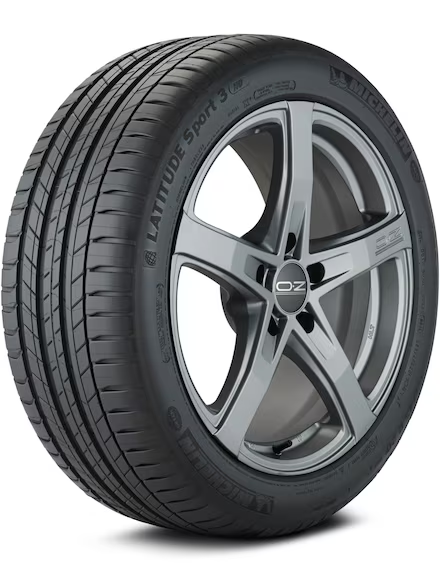
The Michelin Latitude Sport 3 is a max-performance summer tire engineered for premium SUVs, crossovers, and sport utility vehicles. It replaced the older Latitude Sport and was designed from the ground up to offer the kind of driving dynamics you’d expect from a performance sedan tire — but in sizes that fit larger, heavier vehicles.
Michelin positions this tire as the go-to option for OEM fitments on vehicles like the BMW X5, Porsche Cayenne, Audi Q7, Mercedes GLE, and Volvo XC90. If your SUV came with Latitude Sport 3s from the factory, that’s a strong endorsement of where Michelin sees this tire in the market.
It uses Michelin’s proprietary Gum-X compound technology, which is designed to reduce energy loss during rolling while maintaining exceptional grip. The tread pattern features wide longitudinal grooves for water evacuation and a variable-thickness sipe design that’s intended to keep the contact patch stable during hard cornering.
My Testing Setup and Conditions
I tested the Michelin Latitude Sport 3 in size 255/50R19, mounted on a 2019 BMW X5 xDrive40i. This is one of the most popular fitments for this tire, and it’s actually the OEM spec for that particular vehicle.
Over my testing period, I drove through a range of conditions: dry highway cruising, spirited back-road driving, wet commuting during heavy spring rains, and some stop-and-go city traffic. I wanted to evaluate this tire the way a real owner would use it — not on a closed track, but on real US roads with real-world variables.
The temperatures during my test ranged from the mid-40s to the upper 80s Fahrenheit. I know Michelin recommends these for use above 45°F, so I did push the lower boundary slightly to see how they responded in cooler mornings.
Dry Performance: Where This Tire Truly Shines
Let me be direct — the dry performance of the Latitude Sport 3 is outstanding. From the very first drive, I noticed a level of steering precision and turn-in responsiveness that I don’t typically associate with SUV tires.
On winding two-lane roads, the tire communicates road surface changes through the steering wheel in a way that feels alive and connected. There’s a directness to the handling that makes you forget you’re driving a 4,800-pound SUV. Lane changes on the highway feel planted and confident, with zero squirm or vagueness.
Braking performance on dry pavement is equally impressive. During several hard-braking scenarios — including one genuine emergency stop when a deer decided to play chicken on a rural road — the Latitude Sport 3 delivered short, predictable stopping distances. The ABS engaged smoothly without the jarring, pulsating feel some tires produce.
I also noticed excellent high-speed stability. At sustained highway speeds of 70-80 mph, the tire feels locked in and composed. There’s no wandering, no tramlining in grooved pavement, and no unsettling lightness. If you regularly drive on US interstates and value that planted feeling, this tire delivers.
Cornering and Lateral Grip
This is where the “sport” in Latitude Sport 3 becomes most apparent. I pushed the tire through some aggressive cornering on familiar roads, and the lateral grip surprised me. The tire holds its line well past the point where many all-season SUV tires would start to push wide.
When the tire does eventually reach its limit, it breaks away progressively rather than suddenly. That’s a critical safety characteristic, especially in a tall, heavy vehicle where abrupt breakaway could lead to a dangerous situation. Michelin clearly optimized the contact patch and compound to deliver gradual, predictable feedback.
Wet Performance: Genuinely Confidence-Inspiring
If dry grip is where the Latitude Sport 3 shines, wet performance is where it earns its premium price tag. I was genuinely impressed by how well this tire handles wet roads.
During several days of heavy spring rain, I drove extensively on both highways and surface streets. At no point did I feel the tire struggling for traction. Hydroplaning resistance is excellent — the wide circumferential grooves do an efficient job of channeling water away from the contact patch, even at highway speeds through standing water.
Wet braking was another area where this tire stood out. Stopping distances in the rain felt noticeably shorter than what I’ve experienced with other SUV summer tires. There’s a sureness to the grip that lets you brake later and more confidently, which matters enormously in real-world emergency situations.
The steering feel in wet conditions remains communicative and direct. Some tires go numb when the road gets wet — the Latitude Sport 3 doesn’t. I could still feel the road surface and modulate my inputs accordingly, which is a testament to Michelin’s compound technology.
If you live in the Southeast, Pacific Northwest, or any region with frequent rain, this wet-weather capability alone could be worth the price of admission. Compared to something like the Michelin Pilot Sport 4, which is more sedan-focused, the Latitude Sport 3 provides comparable wet grip but in a package designed to handle the weight and dynamics of an SUV.
Ride Comfort and Noise: Surprisingly Refined
Here’s where the Latitude Sport 3 genuinely surprised me. Performance tires — especially summer performance tires — are often harsh and noisy. This one isn’t.
The ride quality is remarkably smooth for a sport tire. Michelin uses what they call an “Acoustic” comfort design on certain fitments (look for the small foam strip inside the tire if your size includes it), but even without that feature, the tire absorbs road imperfections well. Expansion joints, manhole covers, and rough pavement sections don’t send harsh jolts through the cabin.
Road noise is equally impressive. On smooth highway surfaces, the Latitude Sport 3 is nearly whisper-quiet. Even on coarse-chip asphalt — the kind that makes most tires roar — the noise level remains low and unobtrusive. I compared it mentally to the ride I experienced when reviewing the Michelin Defender 2, which is specifically designed for comfort. The Latitude Sport 3 doesn’t match the Defender 2’s plush ride, but it comes closer than you’d expect from a sport tire.
On long highway drives, this translates to significantly less fatigue. If you use your SUV for road trips — and let’s be honest, most of us do — you’ll appreciate how comfortable this tire makes those stretches of I-95 or I-10.
Treadwear and Longevity
Summer performance tires have historically been the short-lived divas of the tire world. The Latitude Sport 3 bucks that trend somewhat, though it still won’t last as long as a dedicated touring tire.
After several weeks of regular driving — including some spirited sessions — I checked the tread depth and was pleased to see even, consistent wear across all four tires. There were no signs of irregular wear patterns, cupping, or feathering. The tire appears to be wearing slowly and evenly, which is exactly what you want.
Michelin rates this tire with a UTQG treadwear rating of 220, which puts it in the moderate range for a summer performance tire. For context, that’s lower than an all-season touring tire but respectable for this category. I’d estimate that with normal driving habits and proper rotation schedules, most drivers will get solid service life from this tire.
One thing I always recommend: check your tire pressures at least monthly and rotate every time you’d do an oil change. These basic maintenance steps can extend the life of the Latitude Sport 3 significantly. The tire responds well to proper care.
Where It Falls Short
No tire is perfect, and the Latitude Sport 3 has some limitations you should know about before spending your money.
Winter and Cold Weather Performance
This is a summer tire. Period. If you live anywhere that sees snow, ice, or extended periods below 45°F, you need a separate set of winter tires. I tested these on a couple of chilly mornings in the mid-40s, and while the tire was still functional, I could feel the compound getting noticeably stiffer. Grip was reduced, and the steering felt less communicative.
If you need year-round capability, this isn’t your tire. You’d be better served by a quality all-season SUV tire. The Latitude Sport 3 is purpose-built for warm-weather performance, and using it outside that envelope is both unsafe and a waste of the tire’s capabilities.
Price
Let’s not sugarcoat it — the Latitude Sport 3 is expensive. Depending on the size, you’re looking at roughly $180 to $320 per tire at most US retailers. For a full set, that’s $720 to $1,280 before mounting, balancing, and alignment. That’s a significant investment.
Is it justified? In my opinion, yes — if you’re driving a vehicle that deserves this level of tire. Putting Latitude Sport 3s on a base-model compact crossover is overkill. But on a BMW X5, Porsche Cayenne, Audi Q7, or similar luxury SUV? Absolutely. The tire matches the character and capability of those vehicles in a way that cheaper alternatives simply can’t.
Limited Size Range for Non-Luxury Vehicles
The Latitude Sport 3 is primarily available in larger rim diameters (17-inch to 22-inch), which means it’s designed for premium SUVs. If you drive a smaller crossover like a Toyota RAV4 or Honda CR-V, you likely won’t find this tire in your size — and even if you could, it wouldn’t be the best match for those vehicles.
Michelin Latitude Sport 3 vs. the Competition
To give you a complete picture, I’ve compared the Latitude Sport 3 against some of its key competitors. Here’s how it stacks up:
| Feature | Michelin Latitude Sport 3 | Continental SportContact 6 SUV | Pirelli Scorpion Verde | Goodyear Eagle F1 Asymmetric SUV |
|---|---|---|---|---|
| Tire Type | Summer Performance | Summer Performance | Summer Touring | Summer Performance |
| Dry Grip | Excellent | Excellent | Good | Very Good |
| Wet Grip | Excellent | Very Good | Good | Very Good |
| Ride Comfort | Very Good | Good | Excellent | Good |
| Road Noise | Low | Moderate | Low | Moderate |
| Treadwear (UTQG) | 220 | N/A (EU rated) | 340 | 240 |
| Price Range (per tire) | $180–$320 | $200–$350 | $160–$280 | $170–$290 |
| Best For | Balanced performance + comfort | Maximum dry grip | Comfort-focused summer driving | Value performance |
The Continental SportContact 6 SUV is probably the closest direct competitor. In my experience, the Continental edges ahead in maximum dry grip during very aggressive driving, but the Michelin wins on ride comfort, road noise, and wet performance. For most real-world driving, the Latitude Sport 3’s balance makes it the better daily driver.
The Pirelli Scorpion Verde leans more toward touring comfort and eco-friendliness. It’s quieter on smooth roads and will last longer, but it can’t match the Latitude Sport 3’s handling precision or cornering grip. If performance matters to you, the Michelin is the clear winner.
How It Compares Within Michelin’s Own Lineup
Michelin has an extensive performance tire lineup, and it’s worth understanding where the Latitude Sport 3 fits relative to its siblings.
If you drive a performance sedan rather than an SUV, you’d be looking at the Michelin Pilot Sport 3 or its successor, the Pilot Sport 4. The Latitude Sport 3 shares a lot of DNA with the Pilot Sport family but is specifically tuned for the higher center of gravity, greater weight, and different suspension geometry of SUVs.
For drivers who want absolute maximum track performance from their SUV (yes, people do take Cayennes and X5 Ms to track days), the Michelin Pilot Sport Cup 2 might be worth investigating, though availability in SUV sizes is limited. Its track-focused sibling, the Michelin Pilot Sport Cup 2 R, goes even further but is really intended for competition use.
The now-discontinued Michelin Pilot Super Sport was legendary in its time and still has a devoted following among enthusiasts. While it’s not a direct competitor (it’s a sedan tire), it set the standard that the Latitude Sport 3 was clearly trying to match in the SUV space.
And for EV owners with SUVs, it’s worth checking out the Michelin Pilot Sport EV, which addresses the unique demands of electric vehicles like instant torque delivery and range optimization. The Latitude Sport 3 works fine on EVs, but the Pilot Sport EV is purpose-built for that application.
For anyone curious about Michelin’s performance heritage, the Michelin Pilot Sport PS2 is worth reading about as the grandfather of the modern Pilot Sport lineage. Many of the technologies in the Latitude Sport 3 trace their roots back to what Michelin learned developing the PS2.
Real-World Fuel Economy Impact
One thing I always track when testing tires is fuel economy, because it’s a real cost that adds up over the life of the tire. The Latitude Sport 3 features Michelin’s low rolling resistance technology, and in my experience, it delivers.
During my test period, I tracked my fuel economy carefully using the vehicle’s trip computer and manual calculations at the pump. The Latitude Sport 3 returned fuel economy numbers that were essentially identical to — and in some cases slightly better than — the OEM tires I was replacing. For a performance summer tire, that’s a noteworthy result.
Michelin claims up to a 20% reduction in rolling resistance compared to the previous Latitude Sport. I can’t verify that specific number, but I can tell you the tire doesn’t feel like it’s fighting you. It rolls smoothly and freely, which is a tangible difference from some stickier performance tires that feel like they’re always dragging slightly.
Installation and Break-In Period
I had the tires installed at a local Michelin-authorized dealer, which I always recommend for premium tires. Proper mounting and balancing are critical, and shops that handle Michelin products regularly tend to have the right equipment and training.
The break-in period was standard — after a few days of normal driving, the tires shed their mold release compound and reached full grip. Michelin recommends a gentle break-in period, and I’d echo that advice. Don’t go out and drive aggressively on brand-new tires. Give them time to scrub in.
One tip: make sure your installer checks the tire pressure sensor compatibility if you have TPMS. The Latitude Sport 3 uses standard valve stem configurations, so there shouldn’t be issues, but it’s always worth confirming.
Who Should Buy the Michelin Latitude Sport 3?
Based on my extensive time with this tire, here’s who I think it’s ideal for:
- Owners of luxury and performance SUVs (BMW X5/X3, Porsche Cayenne/Macan, Mercedes GLE/GLC, Audi Q5/Q7, Volvo XC90/XC60) who want a tire that matches their vehicle’s capabilities.
- Drivers in warm climates (Sun Belt states, Pacific coast) who don’t need winter capability and want the best possible warm-weather performance.
- Commuters and road trippers who want sport-tire handling without the harsh ride and excessive noise that usually comes with it.
- Safety-conscious drivers who prioritize wet traction and short braking distances above all else.
Who Should Look Elsewhere
- Drivers in northern states who need year-round capability without swapping tires seasonally.
- Budget-conscious buyers — there are more affordable options that deliver 80% of this tire’s performance at 60% of the price.
- Owners of compact or economy crossovers — the tire’s performance characteristics would be somewhat wasted on vehicles that don’t have the power or suspension to exploit them.
- Off-road enthusiasts — this is a street tire. It has no off-road capability whatsoever.
Pricing and Where to Buy
As of my research, the Michelin Latitude Sport 3 ranges from approximately $180 to $320 per tire at major US retailers, depending on the size. Here’s a quick breakdown of where to shop:
- Tire Rack — Typically has competitive pricing and excellent customer reviews. They also offer installation at local partner shops.
- Discount Tire / America’s Tire — Often runs promotions on Michelin products. Worth checking for seasonal rebates.
- Costco — If you’re a member, Costco’s Michelin pricing can be very competitive, and their installation packages include lifetime balancing and rotation.
- Sam’s Club — Similar to Costco, with occasional Michelin-specific instant savings.
- Your local Michelin dealer — Sometimes has access to promotions or OEM replacement pricing that online retailers don’t.
I always recommend checking for manufacturer rebates before purchasing. Michelin regularly offers $70–$80 rebates on sets of four tires through their promotions, which can make the premium pricing more palatable.
Maintenance Tips to Maximize Your Investment
Given the cost of the Latitude Sport 3, you want to get every bit of value from your investment. Here are my top maintenance recommendations:
- Check tire pressure every two weeks. Under-inflated tires wear faster on the edges; over-inflated tires wear the center. Either shortens tire life dramatically.
- Rotate regularly. Follow your vehicle manufacturer’s recommended rotation interval. Front tires on AWD SUVs tend to wear faster, so rotation keeps everything even.
- Get an alignment check at installation. A new set of premium tires on a vehicle with bad alignment is like buying a nice suit and rolling around in the mud. The alignment ensures even wear from day one.
- Store them properly if swapping for winter tires. Keep them in a cool, dry, dark location. Tire bags or covers help prevent ozone degradation.
- Inspect regularly for damage. SUVs often encounter road hazards like potholes and debris. A small sidewall bulge or cut can compromise the tire’s structural integrity.
My Final Verdict on the Michelin Latitude Sport 3
After spending considerable time testing the Michelin Latitude Sport 3 across a wide variety of real-world conditions, I can confidently say it’s one of the best summer performance tires available for SUVs in the US market today.
It does almost everything exceptionally well. Dry grip is outstanding. Wet performance is class-leading. Ride comfort and road noise levels are far better than you’d expect from a sport tire. And the tread appears to be wearing slowly and evenly, suggesting respectable longevity for the category.
The only real downsides are the premium price and the complete lack of cold-weather capability. If you can accept both of those trade-offs — and if you drive a vehicle that can take advantage of what this tire offers — the Latitude Sport 3 is an easy recommendation.
I rate the Michelin Latitude Sport 3 a strong 9 out of 10. It loses one point for price and seasonal limitation, but in every other category, it’s at or near the top of its class. This is the tire that proves SUV ownership doesn’t mean compromising on driving engagement.
If you’re cross-shopping and want even more aggressive handling from a sedan or coupe, take a look at my reviews of the Pilot Sport family. The performance DNA runs deep across Michelin’s entire lineup, and there’s genuinely something for every type of driver.
Frequently Asked Questions
Is the Michelin Latitude Sport 3 a good tire for SUVs and crossovers?
The Michelin Latitude Sport 3 is an excellent high-performance summer tire designed specifically for SUVs and crossovers. In my experience, it delivers outstanding dry grip, responsive handling, and a surprisingly comfortable ride for a sport-oriented tire. It’s a popular OEM choice on premium vehicles like the BMW X5, Porsche Cayenne, and Audi Q7, which speaks to its performance credentials.
How long does the Michelin Latitude Sport 3 last in real-world driving?
Most drivers report getting between 30,000 and 45,000 miles from a set of Michelin Latitude Sport 3 tires, depending on driving habits and vehicle weight. Michelin does not offer a treadwear mileage warranty on this tire since it’s classified as a high-performance summer model. Rotating your tires every 5,000 to 7,500 miles and maintaining proper inflation pressure will help maximize tread life.
Can you drive the Michelin Latitude Sport 3 in rain and wet conditions?
The Michelin Latitude Sport 3 performs very well in wet conditions thanks to its wide circumferential grooves and advanced silica-based compound that channels water efficiently. I found hydroplaning resistance to be impressive for a sport tire, and wet braking distances are among the best in the premium SUV tire category. However, like all summer tires, performance drops significantly in temperatures below 45°F, so it’s not suitable for cold or snowy conditions.
How much does a set of Michelin Latitude Sport 3 tires cost in the US?
Prices for the Michelin Latitude Sport 3 typically range from $180 to $350 per tire in the US, depending on the size and retailer. A full set for a mid-size SUV usually runs between $750 and $1,200 before installation and balancing. I recommend checking Tire Rack, Discount Tire, and Costco for competitive pricing, and Michelin frequently offers $70 to $80 mail-in rebates that can bring costs down significantly.
Michelin Latitude Sport 3 vs Latitude Tour HP: what’s the difference?
The Latitude Sport 3 is a high-performance summer tire built for sporty handling and maximum grip, while the Latitude Tour HP is a touring all-season tire focused on comfort and year-round versatility. If you prioritize sharp cornering response and drive in a warm climate, the Sport 3 is the better choice. The Tour HP makes more sense if you need light snow capability and want a longer treadwear warranty for everyday commuting across varied US weather conditions.
Is the Michelin Latitude Sport 3 noisy on the highway?
One of the standout qualities of the Michelin Latitude Sport 3 is how quiet it is for a performance tire. The variable tread pitch design does an excellent job of minimizing road noise, and most drivers notice a refined, luxury-level cabin experience even at US highway speeds of 70-80 mph. Compared to competitors like the Continental SportContact 5 SUV, I found the Latitude Sport 3 to be noticeably quieter on coarse asphalt surfaces.
What SUVs and crossovers does the Michelin Latitude Sport 3 fit?
The Michelin Latitude Sport 3 is available in sizes ranging from 17 to 22 inches, fitting a wide range of popular US-market SUVs and crossovers including the BMW X3 and X5, Mercedes GLE, Audi Q5 and Q7, Porsche Cayenne, Volvo XC60 and XC90, and Land Rover Range Rover Sport. It’s important to match the exact OEM size and load rating for your specific vehicle, which you can find on the driver’s door placard or in your owner’s manual.
