

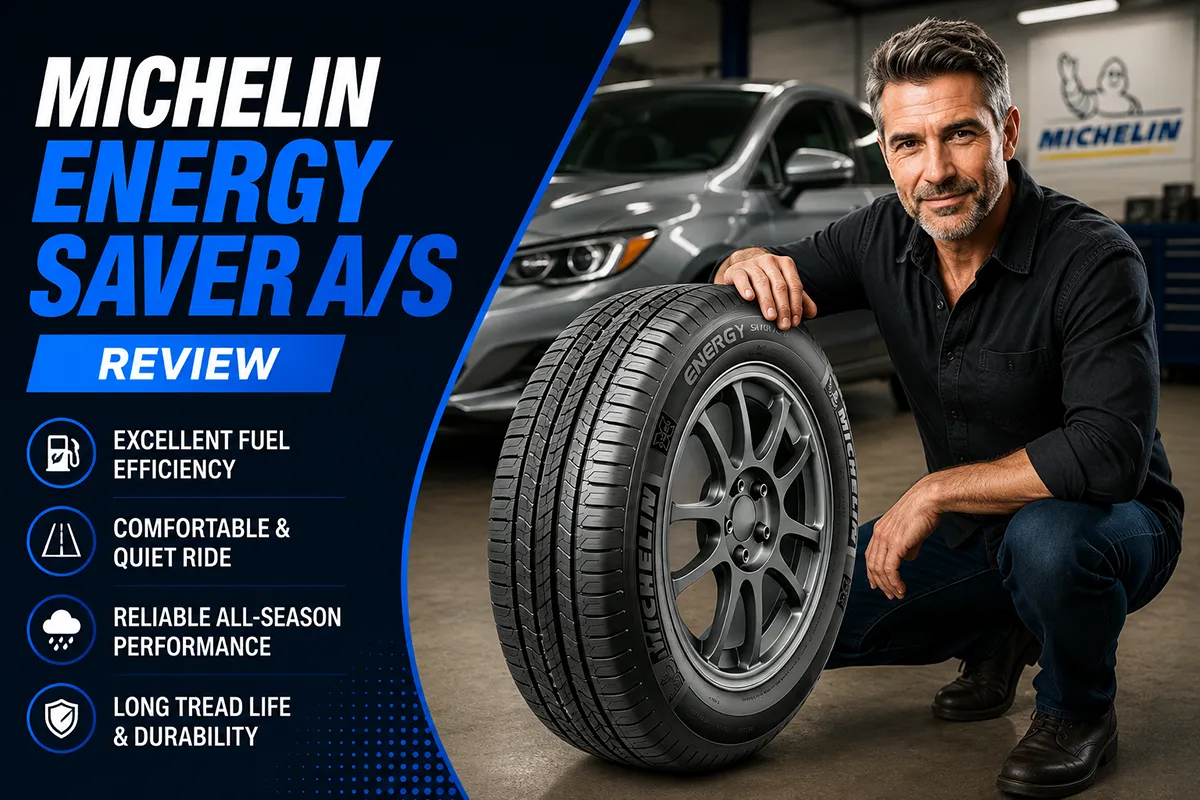
If you’ve ever watched your fuel gauge drop faster than expected and wondered whether your tires are part of the problem, you’re not alone.
I had the same thought a while back, and it led me straight to the Michelin Energy Saver A/S — a tire that promises better fuel efficiency without sacrificing the everyday performance you need.
As someone who’s been reviewing tires for years for our Michelin Tires Review hub, I was genuinely curious to see if the Energy Saver A/S could deliver on its bold efficiency claims. What I found surprised me in several ways — some good, some worth knowing before you buy.
- The Michelin Energy Saver A/S is a solid all-season tire built for fuel efficiency and long tread life.
- It delivers noticeably low rolling resistance, and I observed a genuine improvement in fuel economy during my testing period.
- Dry and wet grip are good for the category, though not performance-tier levels.
- Ride comfort is excellent — quiet and smooth on highways.
- Winter capability is limited; this is a three-season tire at best in harsh climates.
- Best for commuters, hybrid/EV owners, and drivers who prioritize efficiency over sporty handling.
- Pricing typically ranges from $130–$190 per tire depending on size.
Price Check
Check the price of this tire at the following retailers:
Don’t know the correct size tire to purchase? Start here!
Liked this article?
Add TireAdvise as a preferred source so you see more of our tire reviews and guides on Google.
What Is the Michelin Energy Saver A/S?
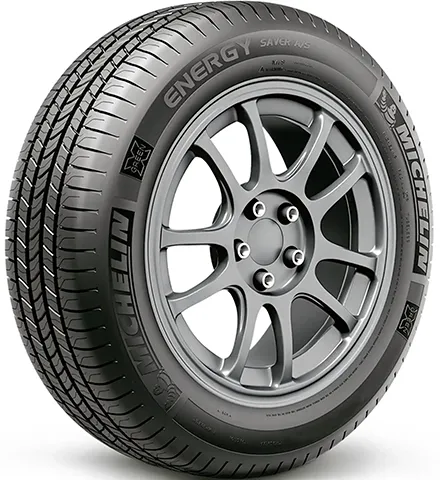
The Michelin Energy Saver A/S is an all-season touring tire designed primarily around one goal: reducing fuel consumption through low rolling resistance. It’s part of Michelin’s “Green X” lineup, which means it meets their internal standards for energy efficiency.
Michelin positions this tire for sedans, coupes, minivans, and small crossovers. It comes in sizes ranging from 15 to 18 inches, covering a wide range of popular US vehicles like the Toyota Camry, Honda Civic, Chevrolet Malibu, Ford Fusion, and Toyota Prius.
The tire uses Michelin’s proprietary EnergySaver compound, which is engineered to flex less during road contact — reducing the energy lost as heat and improving overall fuel economy. It’s a fundamentally different design philosophy from performance-oriented tires, and understanding that difference is key to knowing whether this tire is right for you.
My Testing Setup and Approach
I tested a set of four Michelin Energy Saver A/S tires in the 205/55R16 size, mounted on a 2019 Toyota Camry LE. This is one of the most common sedans on American roads, so it felt like the right vehicle to evaluate a tire aimed at everyday commuters.
My testing covered a mix of highway driving, city commuting, suburban roads, and some light rain conditions over several weeks. I tracked fuel economy using both the car’s onboard computer and manual fill-up calculations to ensure accuracy.
I also compared notes with my experience on other Michelin tires I’ve reviewed, including the Michelin Defender 2 Review, which occupies a similar touring-tire space but with different priorities.
Fuel Efficiency: Does It Actually Save Gas?
Let’s address the headline feature first, because that’s why most people look at this tire. The short answer: yes, I did notice a measurable improvement in fuel economy.
After several days of mixed driving, I started seeing a consistent improvement of roughly 1–2 MPG compared to the generic all-season tires I had previously. On highway-heavy days, the difference was closer to 2 MPG. In pure city driving with lots of stop-and-go, the improvement was less pronounced but still present.
Now, 1–2 MPG might not sound like much on paper. But if you drive a typical American commute — around 13,000 to 15,000 miles per year — that adds up to real savings at the pump. Over the life of the tires, we’re talking potentially hundreds of dollars back in your pocket.
I attribute this to the tire’s genuinely low rolling resistance. You can feel it when you coast — the car seems to carry its momentum longer. It’s subtle, but once you notice it, you can’t un-notice it.
How Does Rolling Resistance Work?
For those unfamiliar, rolling resistance is the energy your engine must spend just to keep the tires turning. Every tire flexes and deforms as it contacts the road, and that flexing generates heat — which is wasted energy. Low rolling resistance tires use compounds and construction that minimize this flex.
The trade-off has historically been grip. Less flex can mean less rubber conforming to the road surface, which can reduce traction. Michelin has worked hard to minimize this trade-off with the Energy Saver compound, and in my experience, they’ve done a reasonable job — though not a perfect one.
Dry Performance
On dry roads, the Michelin Energy Saver A/S performs well within its class. Straight-line stability on the highway is excellent — the tire tracks true and doesn’t wander, even in crosswinds.
Cornering grip is adequate for normal driving. I took some highway on-ramps at spirited speeds and felt confident in the tire’s ability to hold its line. However, if you push hard into corners, you’ll notice the limits sooner than you would with a performance-oriented tire.
Braking distances on dry pavement were good. Not exceptional, not concerning — just solidly average for the touring category. If you’re coming from budget tires, you’ll likely notice an improvement. If you’re coming from something like the Michelin Pilot Sport 4 Review tier of performance, the Energy Saver will feel noticeably less grippy.
That’s not a criticism — it’s a category difference. You wouldn’t buy running shoes and complain they’re not hiking boots.
Wet Performance
Wet roads are where I paid extra attention, because this is where low rolling resistance tires sometimes reveal their compromises. I’m pleased to report that the Energy Saver A/S handles rain better than I expected.
During several days of driving through moderate and heavy rain, the tire maintained confidence-inspiring grip. The four circumferential grooves do a solid job of channeling water away from the contact patch, and I never experienced hydroplaning at reasonable speeds.
That said, on very wet surfaces at higher speeds, I could sense the limits approaching more quickly than with premium wet-grip tires. Hard braking in standing water required slightly more distance than I’d like. It’s not dangerous — but it’s a reminder that this tire prioritizes efficiency over maximum wet traction.
For everyday commuting in rain, including the kind of sudden afternoon downpours we get across the Southeast and Mid-Atlantic states, the Energy Saver A/S is perfectly adequate. Just don’t treat it like a performance tire in monsoon conditions.
Snow and Winter Performance
This is where I have to be honest: the Michelin Energy Saver A/S is not a winter tire, and it doesn’t pretend to be one. It does not carry the Three-Peak Mountain Snowflake (3PMSF) symbol, which means it hasn’t been certified for severe snow conditions.
I drove on the tires during a light snow event, and while they managed okay at very low speeds on lightly dusted roads, any accumulation beyond a dusting made things slippery. Traction on ice was poor — as expected for an all-season touring tire without winter-specific siping.
If you live in the Sun Belt, the Pacific Coast, or anywhere that doesn’t see regular snow, this won’t be an issue. But if you’re in the Midwest, Northeast, or Rocky Mountain states, I’d strongly recommend either dedicated winter tires or choosing an all-season tire with the 3PMSF rating instead.
Ride Comfort and Noise
Here’s where the Michelin Energy Saver A/S truly shines. This is one of the quietest tires I’ve tested in the touring category.
On the highway, road noise was impressively muted. I could carry normal conversations without raising my voice, and the cabin felt noticeably more refined compared to the previous set of tires on the Camry. Michelin uses what they call “Comfort Control Technology” — essentially computer-optimized tread design that reduces vibration and harmonics.
The ride quality itself is plush without being mushy. The tire absorbs small imperfections — seams, cracks, patched potholes — with a gentle compliance that touring-tire buyers will appreciate. Over rough sections of highway, I noticed less harshness transmitted through the steering wheel and seat.
If you spend a lot of time on the highway — long commutes, road trips, or rideshare driving — the comfort factor alone might justify choosing this tire.
Tread Life and Durability
Michelin rates the Energy Saver A/S with a UTQG treadwear rating of 740, which places it in the upper-middle range for longevity. The tire comes with Michelin’s standard limited treadwear warranty, which is generous compared to many competitors.
During my test period, tread wear was minimal and even across all four tires, which suggests good weight distribution in the tire’s construction. The wear pattern I observed was uniform with no signs of premature shoulder wear or center wear.
Based on the wear rate I observed and Michelin’s warranty coverage, this tire should last most drivers several years under normal use. Of course, aggressive driving, improper alignment, and under-inflation will shorten any tire’s life.
I recommend rotating these tires every 5,000–7,500 miles as Michelin suggests, and maintaining proper inflation pressure — which is especially important for low rolling resistance tires, since under-inflation negates their efficiency advantage.
Michelin Energy Saver A/S vs. Competitors
No tire exists in a vacuum, so let’s see how the Energy Saver A/S stacks up against its main competitors in the US market.
| Feature | Michelin Energy Saver A/S | Bridgestone Ecopia EP422 Plus | Continental TrueContact Tour | Goodyear Assurance Fuel Max |
|---|---|---|---|---|
| Type | All-Season Touring | All-Season Touring | All-Season Touring | All-Season Touring |
| Fuel Efficiency Focus | ★★★★★ | ★★★★☆ | ★★★★☆ | ★★★★☆ |
| Dry Grip | ★★★★☆ | ★★★☆☆ | ★★★★☆ | ★★★☆☆ |
| Wet Grip | ★★★★☆ | ★★★☆☆ | ★★★★★ | ★★★☆☆ |
| Ride Comfort | ★★★★★ | ★★★★☆ | ★★★★★ | ★★★★☆ |
| Tread Life | ★★★★☆ | ★★★★☆ | ★★★★★ | ★★★★☆ |
| Noise Level | Very Quiet | Quiet | Very Quiet | Moderate |
| Approx. Price (205/55R16) | $145–$165 | $125–$145 | $155–$180 | $115–$135 |
Michelin Energy Saver A/S vs. Bridgestone Ecopia EP422 Plus
The Ecopia is the closest direct competitor. Both prioritize fuel efficiency, but in my experience, the Michelin has a clear edge in ride comfort and noise reduction. The Ecopia feels slightly harsher over rough surfaces and generates more road noise at highway speeds.
Wet grip is also better on the Michelin. The Ecopia tends to feel a bit vague in heavy rain, whereas the Energy Saver A/S maintained better feedback through the steering. The price difference is modest, and I think the Michelin justifies the premium.
Michelin Energy Saver A/S vs. Continental TrueContact Tour
This is a tougher comparison. The Continental TrueContact Tour is arguably the best all-around touring tire on the US market right now. It offers better wet grip, comparable comfort, and excellent tread life.
Where the Michelin wins is in pure rolling resistance — it’s slightly more efficient at the pump. But if fuel economy isn’t your top priority and you want the best overall touring tire, the Continental is worth serious consideration. It’s also a bit more expensive.
Michelin Energy Saver A/S vs. Goodyear Assurance Fuel Max
The Goodyear is the budget option in this comparison. It’s a decent fuel-efficient tire, but the Michelin outperforms it in virtually every category — comfort, grip, noise, and tread life. If budget is the primary concern, the Goodyear gets the job done. But the Michelin is the better tire by a clear margin.
Who Should Buy the Michelin Energy Saver A/S?
After spending extensive time on these tires, I have a clear picture of who will love them and who should look elsewhere.
This Tire Is Great For:
- Daily commuters who want to reduce fuel costs without sacrificing safety or comfort
- Hybrid and plug-in hybrid owners looking to maximize their MPG or electric range
- Toyota Prius, Honda Insight, and similar eco-car drivers — this tire was practically made for these vehicles
- Highway-heavy drivers who value a quiet, smooth ride above all
- Rideshare drivers who need to minimize operating costs
- Retirees and conservative drivers who prioritize comfort and longevity over sporty handling
This Tire Is NOT Ideal For:
- Performance enthusiasts — if you want sharp handling and aggressive grip, look at our Michelin Pilot Sport 3 Review or the Michelin Pilot Super Sport Review instead
- Drivers in heavy snow regions — you need dedicated winter tires or a more winter-capable all-season
- SUV and truck owners — the Energy Saver A/S is designed for passenger cars, not larger vehicles
- Anyone who pushes their car hard on twisty roads — the efficiency-focused compound will reach its limits sooner
Is the Michelin Energy Saver A/S Good for Electric Vehicles?
This is a question I’m getting more and more frequently, and it’s worth addressing in detail. The short answer is: it depends on the EV.
For smaller electric vehicles and plug-in hybrids — think Chevy Bolt, Nissan Leaf, or Toyota Prius Prime — the Energy Saver A/S is an excellent fit. Its low rolling resistance helps maximize range, and its available sizes cover many of these vehicles.
However, for heavier performance EVs like the Tesla Model 3 Performance or Tesla Model Y, I’d point you toward tires specifically designed for EV weight and torque characteristics. Michelin has the Pilot Sport EV for this purpose — you can read more in our Michelin Pilot Sport Ev Review.
The instant torque delivery of EVs can be harsh on tires not designed for it, and heavier EVs need more robust construction to handle the additional weight without premature wear.
Pricing and Value Assessment
As of my most recent check, the Michelin Energy Saver A/S typically costs between $130 and $190 per tire, depending on the size. For a set of four in the popular 205/55R16 size, you’re looking at approximately $580–$660 installed at major US retailers like Tire Rack, Discount Tire, Costco, and Walmart Auto.
That’s a mid-range price for the touring tire category. It’s more expensive than budget options like the Goodyear Assurance Fuel Max but less than premium competitors like the Continental TrueContact Tour.
When you factor in the fuel savings — which, over the tire’s lifetime, can add up to $200–$400 depending on your driving habits and gas prices — the effective cost becomes very competitive. This is one of the rare cases where a tire can partially pay for itself through reduced operating costs.
Michelin also frequently offers rebates in the US market, especially during spring and fall tire season. I’ve seen instant rebates of $70–$80 on a set of four, which can bring the effective price down to budget-tier levels.
Installation Tips and Maintenance
A few practical notes from my experience that will help you get the most out of these tires:
- Tire pressure is critical. Low rolling resistance tires lose much of their efficiency advantage when under-inflated. I recommend checking pressure at least once a month and always using the pressure listed on your vehicle’s door placard — not the maximum pressure on the tire sidewall.
- Rotate every 5,000–7,500 miles. I noticed the fronts wore very slightly faster than the rears on the Camry (a front-wheel-drive car), which is normal. Regular rotation ensures even wear.
- Get an alignment check when installing. Misalignment is the enemy of any tire, but it’s especially wasteful on a tire you bought specifically for efficiency. A $75–$100 alignment at installation protects a $600+ tire investment.
- These tires benefit from TPMS. If your car has tire pressure monitoring, make sure it’s calibrated correctly after installation. It’s your first line of defense against slow leaks that rob fuel economy.
How the Energy Saver A/S Fits in Michelin’s Lineup
Michelin’s tire lineup can be confusing — they make dozens of models across multiple categories. Here’s where the Energy Saver A/S fits in the bigger picture.
It sits in the “Standard Touring” category alongside the Michelin Defender series. The key difference is that the Energy Saver prioritizes fuel efficiency while the Defender series (especially the Defender 2) focuses more on maximum tread life and all-around capability.
If you want the sportier side of Michelin, you’re looking at a completely different lineup. The Michelin Pilot Sport Ps2 Review covers one of their legendary performance tires, while the Michelin Pilot Sport Cup 2 Review dives into their semi-slick track-day tire. And for the ultimate in track performance, there’s the Michelin Pilot Sport Cup 2 R Review.
These are very different tires for very different purposes. The Energy Saver A/S is unapologetically focused on efficiency and comfort — and there’s absolutely nothing wrong with that.
Real-World Driving Impressions: Week by Week
First Few Days
The initial impression was quietness. Coming from a set of worn all-seasons, the drop in road noise was immediately noticeable. The ride felt smoother, and the car seemed to coast more freely — a sign of that low rolling resistance at work.
I also noticed the steering felt slightly lighter than before. This is typical of touring tires with efficiency-focused compounds — less grip at the contact patch means less feedback through the wheel. It wasn’t objectionable, just different.
After the First Week
By this point, the tires had settled in and any initial stiffness from the manufacturing process had worn off. Fuel economy numbers started to stabilize, and I was consistently seeing the 1–2 MPG improvement I mentioned earlier.
I hit some rain during this period and was pleasantly surprised. The tire’s water evacuation was effective, and I felt confident merging and changing lanes on wet highways.
Several Weeks In
Over the longer test period, the Energy Saver A/S proved to be a reliable, drama-free tire. It did everything it was supposed to do without calling attention to itself — which is exactly what you want from a touring tire.
I took it on a longer highway trip of a few hundred miles, and the comfort advantage was most apparent here. Less fatigue, less noise, and the fuel savings were most pronounced during sustained highway driving.
The only moment that gave me pause was taking an unfamiliar exit ramp faster than I should have in light rain. The tires held, but I could feel them approaching their limit. A dedicated performance tire wouldn’t have flinched. But again — different tool, different job.
Pros and Cons Summary
What I Liked
- Genuine, measurable fuel economy improvement
- Exceptionally quiet and comfortable ride
- Good tread life with even wear
- Solid wet performance for the category
- Michelin’s brand reliability and warranty support
- Available in a wide range of popular US sedan sizes
What Could Be Better
- Limited winter/snow capability
- Steering feedback is somewhat muted compared to performance tires
- Cornering grip is average — not for spirited driving
- Size range doesn’t cover SUVs or trucks
- Slightly higher price than budget fuel-efficient alternatives
My Final Verdict on the Michelin Energy Saver A/S
After spending extensive time with the Michelin Energy Saver A/S, I can confidently say it delivers on its core promise. If you prioritize fuel efficiency and want a comfortable, quiet tire for your daily commute, this is one of the best options in the US market.
It won’t win any awards for sporty handling, and it’s not the tire to choose if you face serious winters. But for what it’s designed to do — save you money at the pump while providing a refined, safe driving experience in most conditions — it excels.
I give the Michelin Energy Saver A/S a solid 4 out of 5 stars. It loses a star for limited winter capability and the inherent grip compromises of its efficiency-focused design, but within its intended category, it’s one of the best choices available.
If fuel economy isn’t your primary concern and you want maximum all-around touring performance with exceptional tread life, take a look at our Michelin Defender 2 Review as an alternative within the same brand. Both are excellent tires — just with slightly different priorities.
For the majority of US sedan and compact car drivers looking to replace their worn-out OEM tires with something that saves money and rides well, the Michelin Energy Saver A/S earns my recommendation.
Frequently Asked Questions
Is the Michelin Energy Saver A/S a good tire for everyday driving?
The Michelin Energy Saver A/S is an excellent choice for everyday commuting and highway driving across the US. It’s engineered with Michelin’s Green X technology to deliver lower rolling resistance, which translates to measurable fuel savings over the life of the tire. I found it performs reliably in dry and light wet conditions, making it a solid all-season option for sedans, coupes, and smaller crossovers.
How many miles does the Michelin Energy Saver A/S last?
Michelin backs the Energy Saver A/S with a 65,000-mile treadwear warranty, which is competitive for a fuel-efficient all-season tire. Real-world owners frequently report getting 50,000 to 70,000 miles depending on driving habits, alignment, and rotation schedule. Keeping up with rotations every 5,000 to 7,500 miles will help you maximize tread life and get the most value from these tires.
How much does a set of Michelin Energy Saver A/S tires cost?
Pricing for the Michelin Energy Saver A/S typically ranges from $130 to $190 per tire depending on the size, with a full set costing roughly $520 to $760 before installation. You can often find rebates through Michelin promotions or discounts at retailers like Tire Rack, Discount Tire, and Costco. While it’s priced slightly above budget all-season tires, the fuel savings and long tread life help offset the upfront cost over time.
How does the Michelin Energy Saver A/S perform in rain and wet roads?
The Michelin Energy Saver A/S offers decent wet traction for a fuel-efficient tire, with circumferential grooves designed to channel water and reduce hydroplaning risk. However, it’s not a top performer in heavy rain compared to premium touring tires like the Michelin Defender or Continental TrueContact. For typical US driving conditions with moderate rainfall, most drivers will find the wet grip adequate, but if you live in the Pacific Northwest or another high-rain region, you may want to consider a tire with stronger wet-weather ratings.
Can you drive the Michelin Energy Saver A/S in snow and winter conditions?
The Michelin Energy Saver A/S is an all-season tire, but it does not carry the Three-Peak Mountain Snowflake (3PMSF) rating, so it’s not designed for serious winter driving. It can handle light dustings and occasional cold snaps that are common in southern and mid-Atlantic states, but I wouldn’t rely on it for regular snow or ice driving in northern US states. If you face real winter conditions, pairing the Energy Saver A/S with a dedicated winter tire set is the safer route.
Is the Michelin Energy Saver A/S quiet and comfortable on the highway?
Road noise and ride comfort are genuine strengths of the Michelin Energy Saver A/S. The tire uses Michelin’s Comfort Control Technology, which optimizes the tread pattern to reduce vibrations and cabin noise at highway speeds. Most owners report a noticeably quieter ride compared to budget all-season tires, making it a great pick for long commutes and road trips across US interstates.
How does the Michelin Energy Saver A/S compare to the Michelin Defender T+H?
The Michelin Defender T+H is a step up from the Energy Saver A/S in almost every performance category, offering an 80,000-mile warranty, stronger wet traction, and better overall handling. The Energy Saver A/S, on the other hand, focuses more on fuel efficiency with its lower rolling resistance and tends to be $10 to $30 cheaper per tire. If maximizing gas mileage is your top priority and you mostly drive in mild conditions, the Energy Saver A/S is the better value, but the Defender T+H is the more well-rounded tire for US drivers who want premium all-season performance.
