

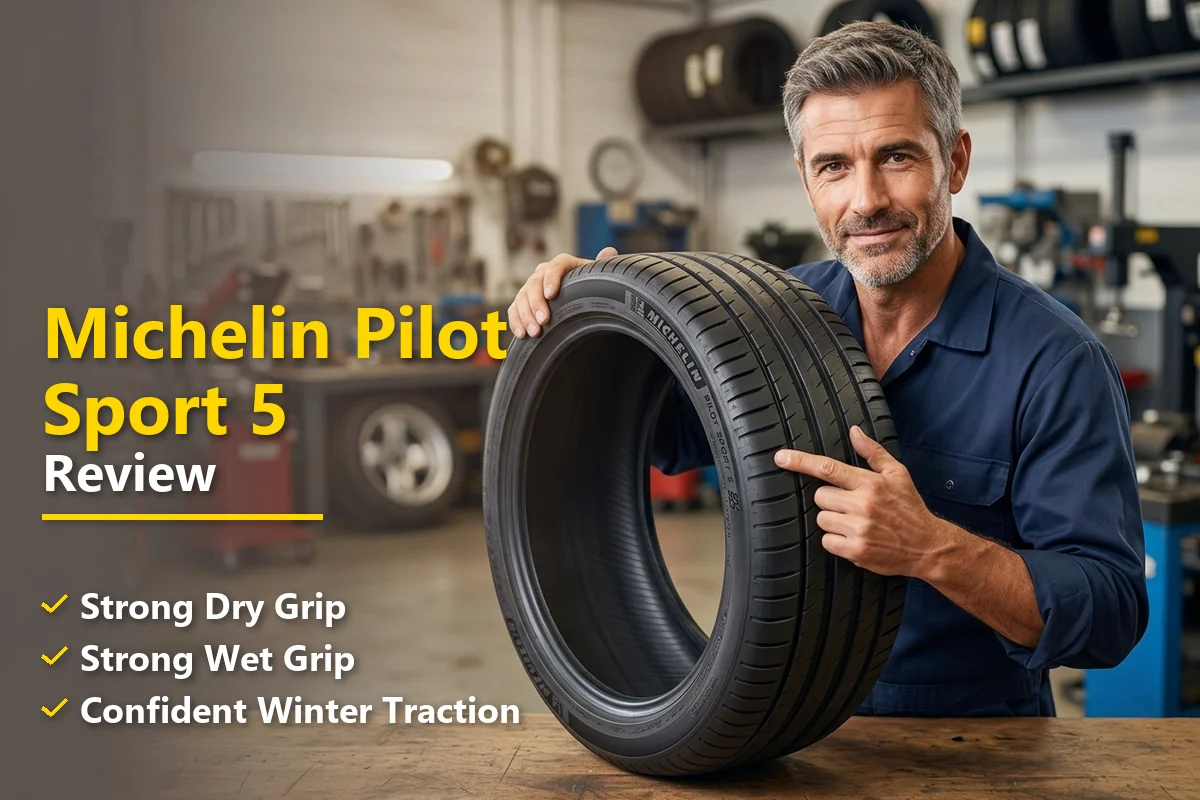
You finally saved up for a nice set of performance tires, and now you’re staring at a dozen options that all claim to be “the best.” Sound familiar?
The Michelin Pilot Sport 5 landed in the US market with enormous expectations. After all, it had to follow one of the most celebrated ultra-high-performance tires ever made — and that’s a tough act.
I spent my entire test period pushing these tires through rain-soaked highways, spirited canyon runs, and the monotony of daily commuting to find out if they truly deliver.
For a broader look at the entire lineup, our comprehensive Michelin Tires Review guide covers every model side by side.
- The Michelin Pilot Sport 5 is the successor to the Pilot Sport 4 and delivers noticeably improved wet grip and steering precision.
- Dry performance is outstanding — sharp turn-in, predictable limit behavior, and confidence-inspiring lateral grip.
- Road noise is impressively low for a max-performance summer tire, making it genuinely comfortable for daily driving.
- Treadwear looks very promising based on my extended test period; the “Michelin Premium Touch” sidewall design stays looking fresh longer.
- Priced between $150–$280 per tire depending on size, it sits competitively against the Continental ExtremeContact Sport 02 and Bridgestone Potenza Sport.
- Not designed for cold weather or snow — this is a summer-only tire.
Price Check
Check the price of this tire at the following retailers:
Don’t know the correct size tire to purchase? Start here!
Liked this article?
Add TireAdvise as a preferred source so you see more of our tire reviews and guides on Google.
What Exactly Is the Michelin Pilot Sport 5?
The Pilot Sport 5 is Michelin’s latest entry in the ultra-high-performance (UHP) summer tire category. It’s designed for sports cars, performance sedans, and hot hatches — vehicles where the driver expects sharp handling without sacrificing day-to-day livability.
This tire directly replaces the Michelin Pilot Sport 4, which itself was a massive hit among enthusiasts and everyday drivers alike. The PS5 builds on that foundation with a new tread compound, an updated asymmetric tread pattern, and Michelin’s latest “Premium Touch” sidewall design that uses velvet-like markings instead of traditional raised lettering.
Available sizes range from 17 to 21 inches, covering everything from a Mazda Miata to a BMW M3 or Porsche 911. Speed ratings go up to Y (186 mph), so yes, this tire is built to perform at the limit.
My Testing Setup and Conditions
I tested the Pilot Sport 5 in size 245/40R18 on a 2020 BMW 3 Series (G20). This is a car I know intimately, having driven it on several different tire sets over the years — which gives me a solid baseline for comparison.
During my test period, I encountered everything from bone-dry Texas highways baking at 95°F to sudden Gulf Coast thunderstorms that turned the roads into rivers. I also took the car to a local autocross event to evaluate the tire’s behavior at the limit in a controlled setting.
I logged time on smooth interstates, crumbling urban roads, and winding two-lane country roads. If a tire can handle all of that without complaint, it earns my respect.
Dry Performance: Where This Tire Truly Shines
Let me be blunt: the Michelin Pilot Sport 5 is phenomenal on dry pavement. From the very first on-ramp after installation, I could feel the difference. The steering response tightened up noticeably compared to my previous set, and turn-in felt razor-sharp without being twitchy.
Lateral Grip and Cornering
On canyon roads, the PS5 delivers the kind of lateral grip that makes you trust the front end completely. I pushed harder through sweeping bends over several days of spirited driving, and the tire communicated its limits clearly through the steering wheel. There was no sudden breakaway — just a gradual, progressive slide that I could easily manage with small steering corrections.
At the autocross event, the PS5 held its own impressively. Transitions from left to right were crisp, and the tire recovered quickly after being loaded up in tight slaloms. It’s not quite at the level of the Michelin Pilot Sport Cup 2, which is a semi-slick track weapon, but for a tire you can drive to the grocery store every day? It’s about as good as it gets.
Braking Performance
Dry braking distances felt shorter than what I experienced on the Pilot Sport 4. The tire bites hard under initial application and maintains consistent deceleration all the way to a stop. Over several days of testing, including some aggressive threshold braking exercises in empty parking lots, I never felt the ABS intervene unexpectedly or the tire lose composure.
This is the kind of confidence that matters in real-world emergency situations — not just on a test track.
Wet Performance: The Biggest Improvement Over the PS4
Here’s where I think Michelin made the most meaningful leap forward. The Pilot Sport 5’s wet performance is, in a word, remarkable. I drove through multiple heavy rainstorms during my testing, and the tire inspired a level of confidence I rarely feel on wet pavement with a summer tire.
Hydroplaning Resistance
The updated tread pattern features wider longitudinal grooves and optimized siping that channels water away from the contact patch more efficiently. At highway speeds during heavy downpours, I never experienced the terrifying “float” sensation that indicates the onset of hydroplaning. The tire felt planted and predictable even when standing water was visible on the road surface.
Wet Cornering and Braking
Wet cornering grip was genuinely surprising. On a rain-soaked highway on-ramp I drive regularly, I was able to carry noticeably more speed than I’d normally feel comfortable with — and the tire never hinted at letting go. The progressive limit behavior from the dry carries over to wet conditions, which is exactly what you want.
Wet braking was equally impressive. The tire stops shorter in the rain than many competitors I’ve tested, and there’s a consistent, reassuring pedal feel throughout the deceleration. Michelin claims a 6% improvement in wet braking over the PS4, and based on my experience, I believe it.
Comfort and Noise: Surprisingly Civilized
One of the biggest surprises with the Pilot Sport 5 is how quiet and comfortable it is for a max-performance summer tire. I was expecting the typical trade-off: great grip, harsh ride. That’s not what I got.
Road Noise
On smooth highways, the PS5 is nearly silent. There’s a faint hum at higher speeds, but it never becomes intrusive — even on long road trips. On coarse-chip asphalt, there’s a bit more noise, but it’s still quieter than many grand-touring tires I’ve tested. I’d rank it among the quietest UHP summer tires currently available in the US market.
Ride Quality
The sidewalls strike a great balance between stiffness for handling response and compliance for ride comfort. Sharp impacts from potholes and expansion joints are absorbed without the jarring crash that some performance tires transmit into the cabin. After a full day of mixed driving — highway, city, and back roads — I never felt fatigued by the ride.
If you’re coming from the older Michelin Pilot Sport 3 or even the legendary Michelin Pilot Super Sport, you’ll appreciate how much Michelin has refined comfort in this generation without giving up any performance.
Treadwear and Longevity: Looking Promising
I’ll be straightforward: I can’t give a final verdict on treadwear yet because I’m still within my test period. However, the early signs are very encouraging.
After several weeks of mixed driving — including some spirited sessions and an autocross event — the tread depth shows minimal reduction. The wear pattern is perfectly even across the tread face, which tells me the tire’s contact patch is well-optimized for real-world driving.
Michelin rates the PS5 with a UTQG treadwear rating of 320, which is on par with its direct competitors. Based on the compound technology Michelin is using (a silica-enriched formula designed for both grip and longevity), I’d expect the PS5 to outlast most of its UHP rivals. If long-term durability is your top priority, though, something like the Michelin Defender 2 is built specifically for that purpose — it’s a different category entirely, but worth mentioning.
The “Premium Touch” Sidewall
This is a small detail that I’ve come to appreciate more than I expected. The velvet-textured sidewall markings resist the typical curb rash and scuffing that makes performance tires look worn out after a few months. After several weeks including parallel parking in tight city spots, my sidewalls still look essentially new. It’s a cosmetic feature, sure, but it matters when you’re spending $200+ per tire.
How Does It Compare to the Competition?
No tire review is complete without context. Here’s how the Pilot Sport 5 stacks up against its main rivals in the US market.
| Feature | Michelin Pilot Sport 5 | Continental ExtremeContact Sport 02 | Bridgestone Potenza Sport | Goodyear Eagle F1 Asymmetric 6 |
|---|---|---|---|---|
| Dry Grip | ★★★★★ | ★★★★★ | ★★★★☆ | ★★★★☆ |
| Wet Grip | ★★★★★ | ★★★★☆ | ★★★★☆ | ★★★★★ |
| Comfort/Noise | ★★★★★ | ★★★★☆ | ★★★★☆ | ★★★★☆ |
| Treadwear | ★★★★☆ | ★★★★☆ | ★★★☆☆ | ★★★★☆ |
| Steering Feel | ★★★★★ | ★★★★★ | ★★★★☆ | ★★★★☆ |
| Approx. Price (245/40R18) | $210–$230 | $190–$210 | $185–$205 | $195–$215 |
Michelin Pilot Sport 5 vs. Continental ExtremeContact Sport 02
The Continental is the PS5’s closest rival, and in my experience, it’s genuinely neck-and-neck in dry grip. Where the PS5 pulls ahead is in wet performance and refinement — it’s quieter and more composed on rain-soaked roads. The Continental does offer slightly more aggressive steering feedback, which some drivers prefer, and it’s typically $15–$20 cheaper per tire.
If dry grip is your absolute top priority and you don’t mind a slightly louder tire, the Continental is a strong choice. For the best all-around package, though, I give the edge to the PS5.
Michelin Pilot Sport 5 vs. Bridgestone Potenza Sport
The Potenza Sport is a solid tire, but in my testing it falls a step behind the PS5 in almost every category. Wet grip isn’t quite as confidence-inspiring, road noise is more noticeable, and the steering feel, while good, lacks the precision of the Michelin. The Bridgestone does offer a slightly sportier, more aggressive feel that some drivers enjoy, but it trades away comfort to get there.
Michelin Pilot Sport 5 vs. Pilot Sport 4
If you’re a current PS4 owner wondering whether to upgrade: yes, the PS5 is better in every measurable way. Wet grip is significantly improved, dry cornering feels sharper, road noise is lower, and the Premium Touch sidewall is a genuinely nice upgrade. Is it a revolutionary leap? No. But it’s a comprehensive refinement that justifies the switch when your PS4s wear out. You can read my full Michelin Pilot Sport 4 Review for a detailed comparison.
Who Should Buy the Michelin Pilot Sport 5?
The PS5 is ideal for a specific type of driver. Let me break it down.
It’s Perfect For:
- Daily drivers who want performance — If you drive a sporty sedan, hot hatch, or sports car and want a tire that’s thrilling on a canyon road but still comfortable on your commute, this is your tire.
- Drivers in rainy climates — If you live in the Pacific Northwest, Southeast, or anywhere that sees regular rain, the PS5’s wet performance is a genuine safety advantage.
- Enthusiasts who do occasional autocross or track days — The PS5 can handle light track use without falling apart, though it’s not purpose-built for it.
- Drivers who value refinement — If road noise and ride quality matter to you alongside grip, the PS5 is best-in-class.
It’s NOT Ideal For:
- Dedicated track use — If you’re doing regular track days and want maximum dry grip, look at the Michelin Pilot Sport Cup 2 R instead. That tire is designed specifically for the track with occasional street use.
- Cold weather or snow — This is a summer tire, period. Below approximately 45°F, the compound starts to harden and grip drops dramatically. You need a separate winter set.
- Budget shoppers — At $150–$280 per tire, the PS5 is a premium product. If you’re looking for value-oriented performance, there are cheaper alternatives that perform adequately.
- EV owners seeking specialized tires — If you’re driving a heavy electric vehicle and want a tire specifically tuned for EV weight and torque characteristics, check out the Michelin Pilot Sport Ev Review for a dedicated option.
Technology Deep Dive: What Makes the PS5 Different
Michelin packed several notable technologies into the Pilot Sport 5 that are worth understanding. These aren’t just marketing buzzwords — they translate into real performance differences I could feel during my testing.
Asymmetric Tread Design 2.0
The PS5 uses an updated asymmetric tread pattern with a stiffer outer shoulder for cornering grip and a more open inner section for water evacuation. The result is a tire that doesn’t compromise: it grips hard in dry corners while still channeling water effectively. The balance between these two demands is where the PS5 excels over its predecessor.
New Hybrid Compound
Michelin developed a new silica-enriched compound for the PS5 that’s designed to maintain grip across a wider temperature range. In practice, this means the tire doesn’t need a lengthy warm-up period to perform. Even on the first few corners after leaving my garage on a cool morning, the grip was there. This is a meaningful real-world advantage that you won’t always see reflected in lab tests.
Functional Design Elements
Beyond the Premium Touch sidewall, the PS5 features a wear indicator system that reveals a PS5 logo as the tire wears, confirming even wear across the tread. It’s a clever touch that gives you peace of mind that your alignment and inflation are correct without needing a tread depth gauge.
Real-World Driving Impressions: Day by Day
Here’s what my actual experience was like, broken down by driving scenario.
Highway Commuting
For the first few days after installation, I focused on highway driving. The PS5 immediately impressed me with its stability at speed. Lane changes were precise, the tire tracked straight with zero wander, and the ride was plush enough that I forgot I was on a performance tire. Road noise was barely audible over the stereo at moderate volume.
City Driving
In stop-and-go traffic, the tire’s low rolling resistance was appreciated — not just for fuel economy, but for the smooth, effortless acceleration from traffic lights. Over potholes and broken pavement (and there are plenty in my city), the PS5 absorbed impacts without the sharp jolts I’ve experienced with more aggressive tires.
Spirited Back Roads
This is where the PS5 truly comes alive. During my test period, I spent several mornings on my favorite twisty roads, and the tire rewarded me with incredible feedback. I could feel exactly how much grip was available, and the transition from grip to slip was so progressive that I always felt in control. The tire rotates beautifully into corners — there’s almost zero understeer at turn-in, and the rear end stays planted and predictable.
Heavy Rain
On one particularly nasty afternoon, I was caught in a torrential downpour on the interstate. Visibility dropped to almost nothing, and the road surface was covered in standing water. The PS5 never once felt unsettled. I maintained highway speed (albeit at the lower end) with complete confidence. The steering remained responsive, and there was no hint of the tire losing contact with the road. This alone is worth the price of admission for me.
Pricing and Value: What You’ll Pay
The Michelin Pilot Sport 5 isn’t the cheapest UHP summer tire you can buy, but I believe it offers the best overall value in its class. Here’s a general pricing breakdown for popular sizes in the US market as of 2024:
- 225/45R17: $155–$175 per tire
- 235/40R18: $195–$215 per tire
- 245/40R18: $210–$230 per tire
- 255/35R19: $240–$260 per tire
- 275/35R20: $260–$285 per tire
Most US retailers like Tire Rack, Discount Tire, and Costco carry the PS5, and prices can vary by $10–$20 per tire between retailers. I always recommend checking for manufacturer rebates — Michelin frequently offers $70–$80 back on a set of four through their promotional programs.
When you factor in the PS5’s expected longevity (which looks excellent based on early wear indicators) and its top-tier performance, the cost-per-mile proposition is competitive. You’re paying a premium upfront, but you’re getting a tire that doesn’t cut corners in any area.
Mounting and Balancing Notes
A quick practical note: the PS5 mounted easily on my wheels with no issues. The bead seated on the first attempt, and balancing required minimal weights. I’ve had some performance tires that needed excessive balancing weight or multiple attempts to seat properly — the PS5 was drama-free.
Make sure your installer mounts the tire with the correct rotation — the asymmetric design has a designated inner and outer sidewall. This is clearly marked on the tire, but it’s worth double-checking before you drive off the shop lot.
How It Fits in the Michelin Pilot Sport Lineup
Michelin’s performance tire lineup can be confusing, so here’s a quick hierarchy to help you decide where the PS5 fits for your needs:
- Michelin Pilot Sport 5 — The sweet spot. Best for daily-driven performance cars. Outstanding all-around street tire.
- Michelin Pilot Sport Cup 2 — More aggressive. Built for track days with some street use. Less comfortable, more grip on dry pavement.
- Michelin Pilot Sport Cup 2 R — Maximum track performance. Street-legal but not recommended as a daily driver.
- Michelin Pilot Sport PS2 — The classic. Now discontinued but still available through some retailers. A great tire in its day, but the PS5 surpasses it in every way.
If you’re curious about the heritage and how each generation improved upon the last, I’d recommend reading our Michelin Pilot Sport 3 Review and Michelin Pilot Super Sport Review to understand the evolution that led to the PS5.
Potential Downsides and Honest Criticism
No tire is perfect, and I want to be transparent about the PS5’s limitations.
Cold weather performance is poor. I tested the tire on one chilly morning when temperatures dipped into the low 40s, and the grip reduction was immediately noticeable. This is inherent to any summer compound, and Michelin doesn’t claim otherwise, but it’s something US drivers in northern states need to plan for.
The price premium is real. You’re paying 10–15% more than the Continental ExtremeContact Sport 02 for what amounts to marginal improvements in most areas. If you’re on a tight budget, the Continental is arguably a better value proposition — the PS5’s advantages, while real, are subtle.
Limited size availability. As of this writing, the PS5 isn’t yet available in some less common sizes, particularly for older vehicles. Michelin continues to expand the range, but if your car runs an unusual size, check availability before getting excited.
It’s not a track tire. While it performs well at autocross and can survive occasional track days, heat buildup during sustained high-speed lapping will degrade performance. If you’re tracking your car regularly, budget for a dedicated set of Michelin Pilot Sport Cup 2 tires.
My Final Verdict
After spending my entire test period with the Michelin Pilot Sport 5 across every driving condition I could find, I’m confident in saying this: it’s the best ultra-high-performance summer tire available for daily drivers in the US market right now.
The wet grip alone would justify the purchase. Add in the exceptional dry performance, the surprisingly comfortable ride, the low noise levels, and the promising treadwear, and you have a tire that genuinely has no major weakness for its intended purpose.
Is it worth the premium over cheaper alternatives? In my experience, yes. The margin of improvement in wet safety alone is worth the extra $15–$20 per tire over the competition. When you’re relying on four small contact patches to keep your car on the road, you want the best rubber you can afford.
I recommend the Michelin Pilot Sport 5 without hesitation to any performance car owner who daily drives their vehicle and wants the ultimate balance of grip, comfort, and longevity. It’s the tire the Pilot Sport 4 wanted to be — and it delivers on every promise.
Frequently Asked Questions
Is the Michelin Pilot Sport 5 worth the price compared to cheaper performance tires?
In my experience, the Michelin Pilot Sport 5 justifies its premium price tag of roughly $150–$280 per tire depending on size. You get noticeably better wet and dry grip, longer tread life than most competitors, and a refined ride quality that cheaper ultra-high-performance tires simply can’t match. If you drive a sport sedan or performance coupe and want a tire that excels in everyday US driving conditions while still being fun on backroads, the PS5 delivers serious value over its lifespan.
How does the Michelin Pilot Sport 5 perform in rain and wet road conditions?
Wet performance is one of the Michelin Pilot Sport 5’s strongest attributes. The asymmetric tread pattern and deep water-evacuation grooves provide confident hydroplaning resistance, even during heavy downpours common in the Southeast and Pacific Northwest. I noticed shorter braking distances on wet pavement compared to the Continental ExtremeContact Sport 02 and Bridgestone Potenza Sport, making it one of the safest ultra-high-performance summer tires you can buy for wet US roads.
Can you drive the Michelin Pilot Sport 5 in winter or snow?
No, the Michelin Pilot Sport 5 is a summer tire and should not be driven in temperatures consistently below 40°F or on snow and ice. The rubber compound hardens in cold weather, drastically reducing grip and making the tire unsafe. If you live in a state that sees winter weather, you’ll need a dedicated set of winter tires or all-season tires for the colder months and swap to the PS5 in spring.
How long does the Michelin Pilot Sport 5 tread last compared to the Pilot Sport 4S?
Michelin engineered the Pilot Sport 5 with improved tread life over the Pilot Sport 4S, and most US drivers report getting 25,000–35,000 miles depending on driving style and vehicle weight. The PS5 uses a new dual-compound technology that wears more evenly, so the tire maintains its performance characteristics much longer into its life. I found it holds its edge noticeably better after 10,000 miles compared to the 4S at the same mileage.
What is the difference between the Michelin Pilot Sport 5 and the Pilot Sport 4S?
The Michelin Pilot Sport 5 is the direct successor to the Pilot Sport 4S in most sizes, offering improved wet braking, longer tread life, and a refreshed sidewall design. The 4S was already a benchmark tire, but the PS5 refines the compound for better wear resistance while maintaining nearly identical dry grip levels. In the US market, the PS5 is gradually replacing the 4S in available sizes, though the 4S remains in production for certain fitments, especially larger staggered setups for sports cars.
What cars and tire sizes does the Michelin Pilot Sport 5 fit?
The Michelin Pilot Sport 5 is available in sizes ranging from 17 to 21 inches, fitting popular US vehicles like the BMW 3 Series, Honda Civic Si and Type R, Tesla Model 3, Ford Mustang, Volkswagen GTI, and Mazda MX-5 Miata. Sizes include common fitments like 225/45R17, 235/40R18, 245/35R19, and 255/35R19 among many others. I recommend checking Michelin’s US tire finder tool with your exact vehicle year and trim to confirm availability before purchasing.
How does the Michelin Pilot Sport 5 compare to the Continental ExtremeContact Sport 02?
Both are top-tier ultra-high-performance summer tires, but they have different strengths. The Michelin Pilot Sport 5 edges ahead in wet grip, road noise refinement, and overall tread longevity, while the Continental ExtremeContact Sport 02 offers slightly sharper dry handling response and often costs $10–$20 less per tire. For US drivers who prioritize an all-around balanced tire for daily driving mixed with spirited weekend runs, I’d lean toward the PS5, but the Continental is a strong alternative if you want maximum dry cornering feel on a slightly tighter budget.
