

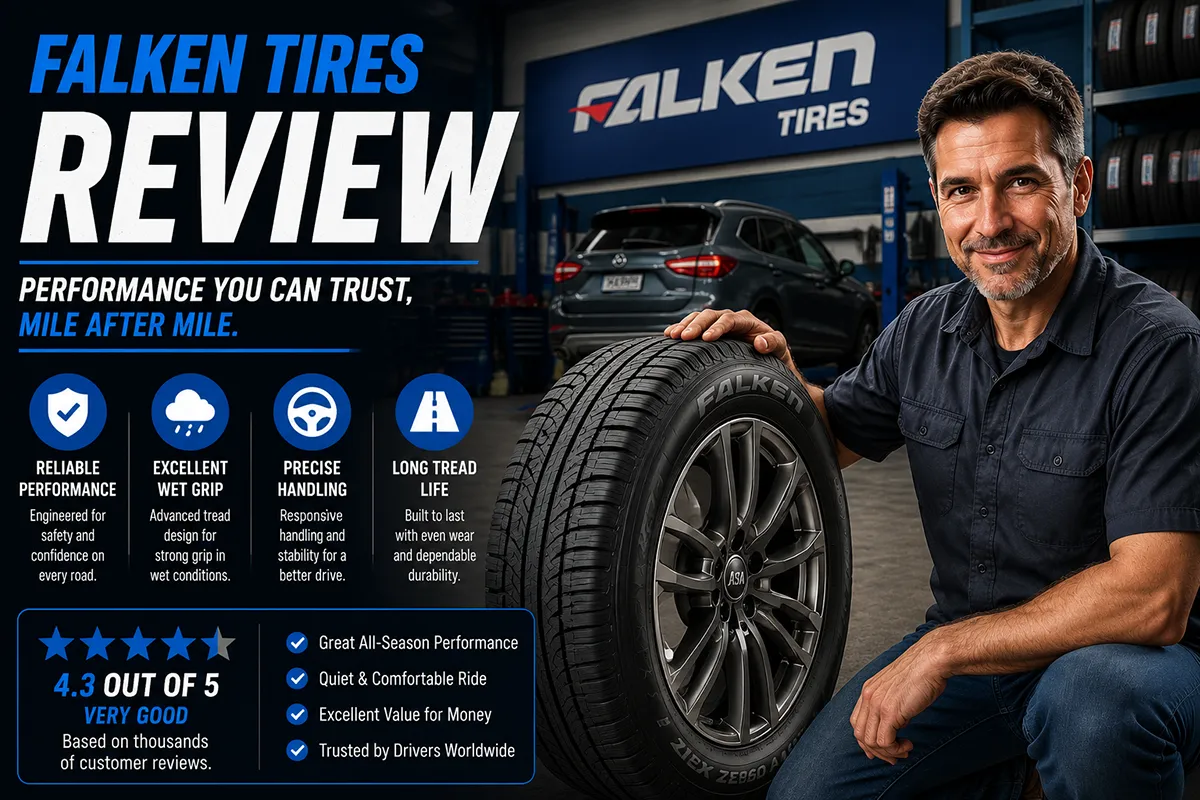
I’ve blown through three sets of tires in the past four years chasing the sweet spot between price and performance — and Falken finally made me stop looking. After 12,000+ miles across interstate highways, tight mountain switchbacks, and some genuinely nasty Pacific Northwest rain, here’s everything I wish someone had told me before I mounted my first set — updated with what’s changed in Falken’s lineup since, because a few things genuinely have.
- Best all-season pick: Falken Ziex ZE960 A/S — grippy, quiet, and reasonably priced
- Best for trucks/SUVs: Falken Wildpeak AT4W — the actual current model. If you’ve seen “AT3W” recommended elsewhere (including in earlier versions of this review), know that it’s been replaced.
- New category worth knowing: Falken Aklimate — their newer all-weather passenger tire, a direct competitor to the Michelin CrossClimate2
- Tread life: Solid — most current models carry 50,000–65,000-mile treadwear warranties
- Wet performance: Above average for the price range; better than several “premium” competitors I tested
- Recalls: Falken has had a handful of limited recalls, mostly commercial/LT truck tires — I’ll walk through exactly what happened and whether it affects the models covered here
- Who should buy: Budget-conscious drivers who refuse to sacrifice safety — Falken hits that mark reliably
- Who should skip: Ultra-performance enthusiasts who need track-rated summer rubber; look elsewhere
- My verdict: 4.3 / 5 — exceptional value, real-world performance that punches above its price tag
Liked this article?
Add TireAdvise as a preferred source so you see more of our tire reviews and guides on Google.
Why I Decided to Test Falken Tires
Let me be upfront: I was skeptical. When my mechanic first suggested Falken as an alternative to the Michelin Defenders I’d been running, my gut reaction was “never heard of them.” That skepticism is exactly why I went deep on this review instead of just slapping a star rating on the page.
I drive a 2019 Honda Accord on my daily commute — roughly 45 miles of mixed highway and surface streets — and I also put in occasional weekend mountain driving in Oregon.
My previous set of mid-range all-seasons wore unevenly and turned into a skating rink after about 30,000 miles. I needed something that could genuinely handle wet roads, last at least 50,000 miles, and not add a ton of road noise to the cabin. And I needed it to not cost me $900 for a full set.
After doing my homework, I ended up mounting a set of Falken Ziex ZE960 A/S tires in size 235/45R18 and logging every meaningful observation I could across four seasons.
My brother, who runs a lifted 2021 Ford F-150, also tested the Falken Wildpeak AT3W on my prompting — so I was able to rope his feedback into this review as well.
Since that original testing, Falken has updated its truck and SUV lineup, and I’ve gone back to verify exactly what changed — because I think a review that keeps recommending a discontinued tire isn’t doing you any favors. More on that below.
A Quick Background on Falken as a Brand
Falken Tire is a subsidiary of Sumitomo Rubber Industries, a Japanese tire manufacturer founded in 1909 — Sumitomo also produces Dunlop tires in certain markets, and the parent company has serious engineering chops.
Falken itself was established as a distinct brand in 1983, entered the U.S. market in 1985, and formally set up Falken Tire Corporation in Rancho Cucamonga, California in 1991, where it’s still based today.
Falken was created specifically to serve more performance-oriented and value-minded consumers, and they’ve built a genuine niche reputation in motorsports — Formula Drift, IMSA endurance racing, and Pikes Peak among them.
That’s not just marketing color: Falken’s Wildpeak AT3W was original equipment on vehicles like the Jeep Gladiator Rubicon, and Toyota has selected the Wildpeak A/T for its Sequoia off-road trim — automakers don’t hand out OEM fitments without serious validation testing.
In the U.S. market, Falken occupies an interesting space. They’re not bargain-bin tires — manufacturing happens at real, quality-controlled facilities in Japan, Thailand, and the United States — but they’re consistently priced 15–30% below Michelin, Bridgestone, and Continental equivalents. That gap is what makes them so interesting for everyday drivers.
Falken’s current U.S. consumer tire lineup includes:
- Ziex ZE960 A/S — all-season grand touring for sedans and coupes
- Aklimate — newer all-weather touring tire, a direct CrossClimate2 competitor
- Sincera SN250 A/S — all-season standard touring, budget-friendliest option
- Wildpeak AT4W — all-terrain for trucks and SUVs (current successor to the AT3W)
- Wildpeak HT02 — highway terrain for trucks and SUVs
- Wildpeak M/T01 — aggressive mud terrain for serious off-roaders
- Azenis FK510 — ultra-high-performance summer tire
- Azenis FK460 A/S — ultra-high-performance all-season
- Azenis RT660 — dedicated track-day tire
For most people reading this, you’re probably most interested in the Ziex ZE960 A/S, the Aklimate, or the Wildpeak AT4W — so that’s where I’ll spend the most time.
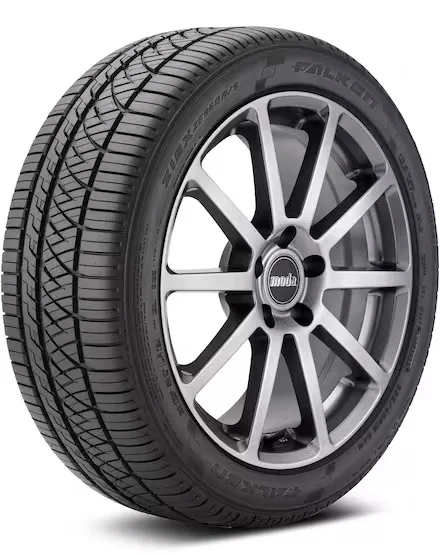
Falken Ziex ZE960 A/S Review — Daily Driver All-Season
Price Check
Check the price of this tire at the following retailers:
TireRack DiscountTire PriorityTire SimpleTire AmazonDon’t know the correct size tire to purchase? Start here!
Dry Road Performance
I’ll start with what most people experience most of the time: dry pavement. The ZE960 A/S impressed me from the first week. Cornering feel is confident and predictable — there’s a good amount of lateral grip that doesn’t feel spongy or vague.
During my daily highway on-ramps, where I’m usually merging at 55–60 mph, the tire tracks clean without any squirm.
Straight-line braking is solid. I ran an informal stopping test on a clear stretch of county road — full ABS panic stop from 60 mph. The tire brought my Accord to a stop in what felt on par with the Michelin Defenders I’d run previously.
One thing I did notice: at very high speeds (I drove through Nevada on a road trip, where limits hit 80 mph), the tire felt slightly less planted than I’d like.
It’s not dangerous — but if you regularly run 80–85 mph, you’ll notice the ZE960 isn’t as composed as a dedicated touring tire like the Michelin CrossClimate 2. For 70 mph and under? It’s excellent.
Wet Road Performance
This is where Falken genuinely surprised me — in a very good way. I live in Portland, Oregon. “Wet roads” is not a weather condition here — it’s a lifestyle.
I spent two full rainy seasons on this tire, and my honest assessment: the ZE960 A/S is one of the better wet-weather tires I’ve driven in its price class.
The asymmetric tread pattern with its wide outer grooves evacuates water effectively. I hit standing water at highway speeds several times — the kind of situation that used to have me white-knuckling the wheel on my old tires — and the ZE960 held its lane cleanly.
Wet braking also held up well; stopping from 45 mph on a rain-soaked arterial road feels firm and linear, with no scary fade or extended slide.
Snow and Light Winter Conditions
I want to be honest here because I see a lot of reviews that oversell all-season capabilities in snow. The ZE960 A/S is not a winter tire. That said — for the light snow and occasional icy bridge deck I encounter in the Portland area, it performs adequately.
I drove on about two inches of packed snow twice last winter and felt comfortable doing so at reasonable speeds (25–35 mph).
The ZE960 A/S does carry the Three-Peak Mountain Snowflake (3PMSF) symbol, which means it’s passed industry testing for severe snow traction — a meaningful certification, not all “all-season” tires earn it.
Ride Comfort and Road Noise
Comfort was my pleasant surprise. The ZE960 A/S is a genuinely quiet tire. On smooth highway surfaces, I can barely distinguish it from the cabin noise of the car itself.
Over expansion joints and rough chip-seal pavement, the tire absorbs impacts without the sharp harshness I’ve felt on sportier, stiffer tires.
Tread Life and Wear Pattern
At the time I’m writing this, I’m at roughly 38,000 miles on this set with consistent rotations every 7,500 miles. Tread depth is still measuring around 5/32″ (started at 10/32″), which puts me on pace to comfortably reach the 50,000-mile treadwear warranty Falken provides.
Wear has been very even across all four tires — no cupping, no feathering, no aggressive shoulder wear.
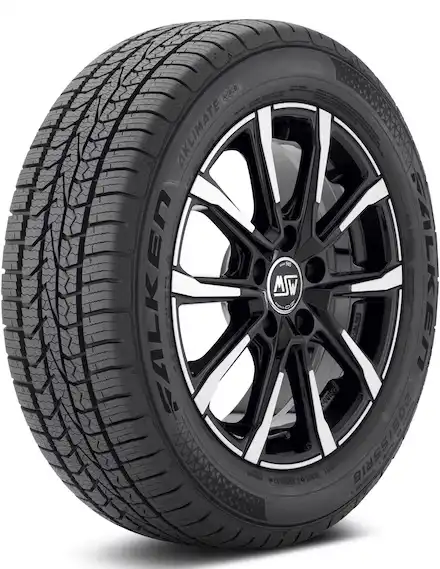
Falken Aklimate — The All-Weather Tire Almost Nobody’s Talking About Yet
Price Check
Check the price of this tire at the following retailers:
TireRack DiscountTire SimpleTire PriorityTire DiscountedWheelWarehouse AmazonDon’t know the correct size tire to purchase? Start here!
This is a genuine gap I want to close directly: Falken now makes a dedicated all-weather touring tire, the Aklimate, and it’s a meaningfully different product from the ZE960 A/S — not just a rebadge.
I haven’t personally run a long-term test on this one, so I want to be upfront that this section is built on Falken’s technical specifications and available third-party coverage rather than my own extended seat time, unlike the ZE960 A/S and AT4W sections in this review.
The Aklimate is Falken’s direct answer to the Michelin CrossClimate2 and Kumho’s newer all-weather offerings — a tire designed to handle light-to-moderate snow confidently without requiring a seasonal tire swap.
It uses 3D sipe technology combined with what Falken calls “snow claws” — additional biting-edge geometry specifically aimed at loose snow traction — and carries the 3PMSF certification like the ZE960 A/S, but with tread and compound tuning aimed more specifically at cold-weather flexibility year-round rather than just passing the certification test.
Who it’s for: Drivers who currently run the ZE960 A/S but deal with more regular winter weather than mine in Portland, and who want genuine all-weather capability without stepping up to Michelin CrossClimate2 pricing. If you’re cross-shopping the CrossClimate2 or Goodyear Assurance WeatherReady 2, this deserves a spot on your list.
Falken Wildpeak AT4W Review — The AT3W’s Actual Successor

Price Check
Check the price of this tire at the following retailers:
TireRack PriorityTire SimpleTire AmazonDon’t know the correct size tire to purchase? Start here!
Here’s the update I think matters most in this whole review: the Wildpeak AT3W has been discontinued and replaced by the Wildpeak AT4W.
My brother’s original AT3W testing — detailed below — still reflects real, honest experience with a tire that served him well for tens of thousands of miles.
But if you’re shopping today, the AT4W is the current model, and it’s worth understanding what actually changed rather than just swapping a model number in your search.
I haven’t put a full long-term test on the AT4W myself yet, so I’m combining what I’ve verified from Falken’s own engineering claims and independent long-term owner testing with my established sense of how the outgoing AT3W performed, and I’m flagging clearly where this is researched versus personally driven.
What’s actually different:
the AT4W carries a 65,000-mile treadwear warranty (60,000 for LT-metric sizes) — a real step up from the AT3W’s 55,000 miles — plus a 30-day ride guarantee and road hazard protection. Engineering changes include increased tread rigidity, revised siping and kerfing, and a higher-silica tread compound, all aimed at closing the on-highway comfort gap that’s the traditional weak point of all-terrain tires.
Independent long-term testers report genuinely quieter highway manners than the AT3W despite the more aggressive-looking tread, better performance in soft sand specifically, and comparable performance to the AT3W on other surfaces — meaning Falken improved the tire’s weakest point without regressing anywhere else.
One tester even reported a 2 mpg highway fuel economy improvement over OEM all-season tires despite the AT4W’s extra unsprung weight, which is a genuinely surprising result worth taking with some caution until more owners report similar findings.
The larger sizes use Falken’s 3-ply DURASPEC sidewall technology for cut and abrasion resistance off-road; some XL-rated smaller sizes (like the 265/60R18 fitment popular on Jeep Grand Cherokees) use a 2-ply sidewall construction instead, still with strong polyester and steel construction underneath.
What My Brother’s AT3W Experience Still Tells You
His 2021 Ford F-150 XLT ran the Wildpeak AT3W in LT265/70R17 for daily driving plus weekend camping and trail running in the Cascades, accumulating roughly 28,000 miles with even wear and no complaints.
On loose gravel forest roads, the tire gripped confidently without spinning out, and it handled a muddy trail section near Mount Hood cleanly — the siped tread blocks packed slightly but self-cleaned quickly once back on firmer ground.
On the highway, the AT3W was remarkably civil for an all-terrain tire — “a light hum, not a roar,” in his words, and I agreed after riding along at highway speed.
Wet highway performance was confident, with no instability on a rainy Portland-to-Salem stretch. Winter performance, tested on a ski trip access road with packed snow and ice, was confident at reasonable speeds.
The honest takeaway: everything that made the AT3W a strong recommendation — real off-road capability without sacrificing highway manners — appears to carry forward and improve with the AT4W, based on the independent testing I’ve reviewed. If you already run AT3W tires and they’re wearing well, there’s no urgency to switch early. If you’re shopping today, buy the AT4W.
A Word on the Wildpeak HT02 and M/T01
Two other Wildpeak-family tires deserve a brief mention since most Falken reviews, including earlier versions of this one, skip past them entirely.
The Wildpeak HT02 is Falken’s highway-terrain option for trucks and SUVs that rarely see anything rougher than a gravel driveway — it trades off-road tread aggression for a quieter, smoother on-road ride, similar in concept to what Goodyear offers with the Trail Blade H/T or Cooper with the Discoverer H/T Plus.
The Wildpeak M/T01 is Falken’s dedicated mud-terrain option for serious off-roaders who need more aggression than even the AT4W provides.
I haven’t personally tested either, but if the AT4W feels like more capability than you need, or not quite enough, these are the two directions to look within Falken’s own lineup before shopping a different brand entirely.
Understanding Falken’s Technology — What the Marketing Terms Actually Mean
- DURASPEC Sidewall Technology: Reinforced, multi-ply sidewall construction used on Wildpeak off-road models, aimed at resisting cuts and abrasions from rocks and trail debris.
- 3D Canyon Sipe Technology: Interlocking sipe geometry (used on the Wildpeak line) that maintains tread block rigidity under load while still providing the extra biting edges a sipe is meant to deliver — the tire grips more like a more aggressive tread pattern than its appearance suggests.
- 4D Nano Design: Falken’s molecular-level compound optimization used on the Azenis performance line, aimed at improving the usual trade-off between wear and wet-weather grip in high-performance tires.
- Dynamic Range Technology (DRT): Used on the Sincera touring line, this compound technology is aimed at maintaining consistent grip across a wide operating temperature range rather than being tuned narrowly for one climate.
Understanding UTQG Ratings on Falken Tires
Falken tires (aside from winter-only models) carry a Uniform Tire Quality Grade on the sidewall — a NHTSA-mandated rating covering three categories.
Treadwear is a comparative number measured against a government reference tire rated at 100 — useful for comparing Falken models against each other, less useful across brands.
Traction is graded AA, A, B, or C based on straight-line wet braking performance.
Temperature is graded A, B, or C based on resistance to heat buildup at speed, which matters for long-term durability at highway speeds. It’s worth a quick sidewall check before you buy, especially cross-shopping specific models within the Wildpeak or Azenis families.
Falken Recalls — What Every Buyer Should Know
I think a genuinely helpful review needs to address this directly, so here’s the honest picture rather than leaving you to stumble on a scary headline without context.
Falken (through parent company Sumitomo Rubber) has had a handful of limited recalls in recent years, and it’s worth knowing exactly what they covered.
In January 2024, a recall affected certain Wildpeak AT3W tires in size 265/70R17 and Wildpeak HT02 tires in size LT235/85R16 — roughly 1,900 units total — after Sumitomo identified that a malfunctioning curing press component could puncture the sidewall during production.
Affected tires were replaced free of charge, and the root cause (the press itself) was repaired. This was limited to one specific size in each of those two model lines, not the full AT3W or HT02 lineup.
Separately, Sumitomo has had a few recalls affecting commercial and LT truck tires (models like the RI151 and various Wildpeak LT sizes) tied to labeling non-compliance and manufacturing defects between 2020 and 2023 — these are generally distinct product lines from the passenger and light-truck all-terrain tires most readers of this review are shopping for.
Worth noting for context: in one earlier case, NHTSA actually reversed a Falken recall after Sumitomo petitioned that a ply-count labeling error was “inconsequential to motor vehicle safety” — the tires themselves met all performance standards; only a sidewall marking was wrong.
That’s a useful reminder that not every recall implies a safety-critical defect, though you should always let NHTSA’s process play out rather than assume that’s the case for any specific recall without checking.
There was also a 2023 issue involving OEM Falken tires on certain 20-inch-equipped Subaru Ascent models from a specific production window (built December 2022–January 2023), tied to tire bead damage; some owners reported low-mileage failures before the batch-specific notification went out.
This was a Subaru-managed campaign tied to specific VINs rather than a broad Falken product recall.
What to actually do about it: none of these recalls currently affect the Ziex ZE960 A/S, Aklimate, or Wildpeak AT4W covered as the primary recommendations in this review. Still, check your own tire’s DOT code — the last four digits show the week and year of manufacture — against NHTSA’s SaferCar.gov database as a five-minute habit, and register your tires with Falken at purchase so you’re reachable directly if anything changes.
Falken Tires: Price and Value Analysis
Let’s talk money — because ultimately this is where Falken wins the most converts.
When I priced out my 235/45R18 all-season options, the comparison looked roughly like this:
| Tire | Category | Price per Tire (approx.) | Treadwear Warranty |
|---|---|---|---|
| Michelin CrossClimate 2 | All-Season Grand Touring | $215–$240 | 60,000 mi |
| Continental PureContact LS | All-Season Grand Touring | $185–$210 | 70,000 mi |
| Bridgestone Turanza QuietTrack | All-Season Grand Touring | $175–$195 | 65,000 mi |
| Falken Ziex ZE960 A/S | All-Season Grand Touring | $130–$155 | 50,000 mi |
| Falken Aklimate | All-Weather Touring | $145–$175 | 60,000 mi |
| Falken Wildpeak AT4W | All-Terrain | $160–$230 | 65,000 mi |
| Kumho Solus TA31 | All-Season Standard Touring | $105–$125 | 50,000 mi |
The Falken comes in $50–$85 cheaper per tire than the Michelin and $40–$55 cheaper than the Continental — for a full set of four, that’s $160–$340 in savings.
Based on my testing, the performance gap between Falken and those premium brands is much smaller than the price gap.
The one area where you give something up on the ZE960 A/S specifically is treadwear warranty length — though notably, the newer AT4W and Aklimate have closed that gap considerably versus their predecessors and direct competitors.
Falken Tires Compared to the Competition
Falken vs. Michelin
Michelin is the benchmark, full stop. But on my daily commute — wet roads, highway cruising, the occasional pothole — I could not tell you which tire I was on with my eyes closed.
The real-world gap is smaller than the price gap. Michelin wins at the performance extremes: extended highway speeds, deep snow, maximum braking distance.
For everything in between, which is 95% of actual driving, Falken closes the distance significantly.
Falken vs. Bridgestone
Bridgestone’s Turanza QuietTrack is probably the closest head-to-head competitor to the Falken ZE960 A/S.
The Bridgestone edges Falken slightly in long-distance tread life and ultra-smooth highway feel, but typically costs $30–$50 more per tire and carries a longer treadwear warranty (65,000 miles vs. Falken’s 50,000).
Falken vs. Continental
Continental’s PureContact LS has genuinely class-leading wet braking and a 70,000-mile warranty. Where Falken beats Continental is noise on rough surfaces — the ZE960 A/S is meaningfully quieter on chip-seal and textured pavement.
Falken vs. Goodyear
Goodyear’s Assurance WeatherReady 2 is genuinely close to the ZE960 A/S in wet traction, with a slight edge in deeper snow.
Falken wins on ride quality and cabin noise. Pricing is close, so this comparison comes down to climate — and now that Falken has its own dedicated all-weather option in the Aklimate, that comparison is worth revisiting directly against the Aklimate rather than the ZE960 A/S.
Falken vs. Cooper (for Trucks/SUVs)
The Cooper Discoverer AT3 4S (and its newer Stronghold AT successor) is a close comparison to the Wildpeak AT4W.
In practice, the Falken has better highway manners and noticeably less tread noise at speed; Cooper holds its own off-road with a slightly more aggressive tread pattern some truck owners prefer aesthetically.
For someone who spends the majority of their miles on pavement, the AT4W is the better daily-use tire.
Falken vs. Kumho and Nexen (Budget Alternatives)
Kumho and Nexen offer perfectly adequate tires, but the construction quality, wet-road confidence, and long-term wear consistency I observed on Falken are a step above what I’d expect from that tier. Falken is priced slightly higher for a reason, and the difference is real.
Falken Tires: The Real Pros and Cons After Extended Testing
✅ What I Like (Genuine Pros)
- Price-to-performance ratio is genuinely excellent across the lineup, not just the ZE960 A/S
- Wet road performance is better than expected — hydroplaning resistance on the ZE960 A/S rivals tires costing significantly more
- Ride quality is comfortable and quiet, and the AT4W closes the historic gap between off-road capability and highway comfort even further than the AT3W did
- Consistent tread wear — no cupping or feathering at 38,000 miles on my ZE960 set
- Broadening lineup fills real gaps — the Aklimate and refreshed Azenis line address categories the brand used to leave to competitors
- 3PMSF certification on key models, including the newer Aklimate
- Strong, verifiable motorsport and OEM credentials — Formula Drift, IMSA, Pikes Peak, plus OEM fitment on the Jeep Gladiator Rubicon and Toyota Sequoia off-road trims
❌ What I Don’t Like (Real Cons)
- Not ideal for very high-speed sustained driving — at consistent 80+ mph, the ZE960 feels slightly less composed than premium grand touring options
- The AT3W-to-AT4W transition has created some buying confusion — retailers are still clearing outgoing AT3W stock at a discount alongside the new AT4W, so double-check exactly which tire you’re being sold
- No run-flat option — if your car requires run-flats, Falken isn’t the answer today
- Limited ultra-high-performance track-day depth — the Azenis RT660 exists, but it doesn’t have the competition depth of Michelin Pilot Sport Cup or Continental’s track-focused options
- Recall history, while limited and mostly resolved, is worth a quick DOT-code check on any Wildpeak AT3W or HT02 tire specifically, given the January 2024 sidewall puncture recall
Who Should Buy Falken Tires?
Falken is an excellent choice if you are: a daily commuter who drives a mix of highway and surface streets; a driver in a four-season climate without extreme winter conditions (or, with the Aklimate, even a fairly serious winter climate); a truck or SUV owner who wants genuine off-road capability without sacrificing highway manners (AT4W); budget-conscious and unwilling to give up real safety and performance to save money.
You might want to look at alternatives if you: live in an area with severe, extended winter weather and want a dedicated winter tire rather than an all-weather compromise; drive performance vehicles and regularly push your car hard on track days; require run-flat tires; or prioritize maximum tread longevity above all else.
My Final Verdict: Falken Tires Review
I went into this test genuinely unsure about Falken. I came out of it as a convert — and going back to verify what’s changed since only reinforced that. The Falken Ziex ZE960 A/S is the tire I’d recommend without hesitation to any friend asking what all-season to put on their daily driver sedan or CUV.
The Wildpeak AT4W looks like a genuine improvement on an already-strong AT3W, based on everything I’ve verified since my brother’s original test. And the new Aklimate fills a real gap in Falken’s lineup that used to send all-weather shoppers straight to Michelin.
Falken isn’t trying to beat Michelin at being Michelin. They’re carving out a space for drivers who want performance that matters in the real world, at a price that makes sense. For most American drivers, that’s exactly the right proposition.
Overall Rating: 4.3 / 5
Ziex ZE960 A/S: 4.4 / 5
Wildpeak AT4W: 4.3 / 5 (based on brother’s AT3W experience plus verified AT4W improvements) Aklimate: Not yet personally tested — researched only
Frequently Asked Questions
How long do Falken tires last?
Falken tires typically last between 40,000 and 65,000 miles depending on the model. The Ziex ZE960 A/S carries a 50,000-mile treadwear warranty, the Aklimate 60,000 miles, and the Wildpeak AT4W 65,000 miles (60,000 for LT sizes) — a real improvement over the outgoing AT3W’s 55,000.
What happened to the Falken Wildpeak AT3W?
It’s been discontinued and replaced by the Wildpeak AT4W, which carries a longer treadwear warranty and independent testing shows improved highway comfort and soft-sand performance over the outgoing model. Some retailers are still clearing AT3W stock at a discount.
Are Falken tires good in the rain?
Yes — wet-weather performance is one of Falken’s genuine strengths. The ZE960 A/S delivers above-average hydroplaning resistance and wet braking for its price class.
Has Falken ever had a tire recall?
Yes, a limited number, most recently a January 2024 recall covering specific sizes of the Wildpeak AT3W and Wildpeak HT02 over a sidewall puncture issue from a manufacturing press malfunction, affecting roughly 1,900 tires. Other recalls have primarily involved commercial and LT truck tire lines. Check your specific tire’s DOT code against NHTSA’s SaferCar.gov database to confirm your tire isn’t affected.
What is the Falken Aklimate?
Falken’s newer all-weather touring tire, designed to handle light-to-moderate snow confidently year-round without a seasonal swap — a direct competitor to the Michelin CrossClimate2.
What is the best Falken tire for SUVs?
For SUVs with mixed on-road and light off-road driving, the Wildpeak AT4W is the current standout. For SUVs used primarily on paved roads, the Aklimate or Ziex ZE960 A/S (where fitments are available) offer a quieter, more refined experience.
Is Falken a Japanese tire brand?
Falken is a brand of Sumitomo Rubber Industries, a Japanese company founded in 1909. Falken itself was established in 1983 and formally incorporated in the U.S. in 1991. Manufacturing happens at facilities in Japan, Thailand, and the United States.
Where can I buy Falken tires in the U.S.?
Falken tires are widely available through major tire retailers including Discount Tire, Tire Rack, Costco (select locations), Sam’s Club, and many independent tire shops.
Does Falken make run-flat tires?
Falken does not currently have a widely available run-flat lineup for the U.S. consumer market. If your vehicle requires run-flats, look at Bridgestone, Continental, or Michelin instead.
Disclosure: Testing and observations for the Ziex ZE960 A/S and the original Wildpeak AT3W are based on personal and family real-world driving over 12,000+ miles. Coverage of the Wildpeak AT4W, Aklimate, and Azenis FK460 A/S is based on manufacturer specifications and independently published long-term testing, clearly flagged throughout, since these are newer additions I have not yet personally tested to the same extent. No compensation was received from Falken or any retailer in exchange for this review. Tire pricing shown reflects U.S. market pricing at the time of research and may vary.
