

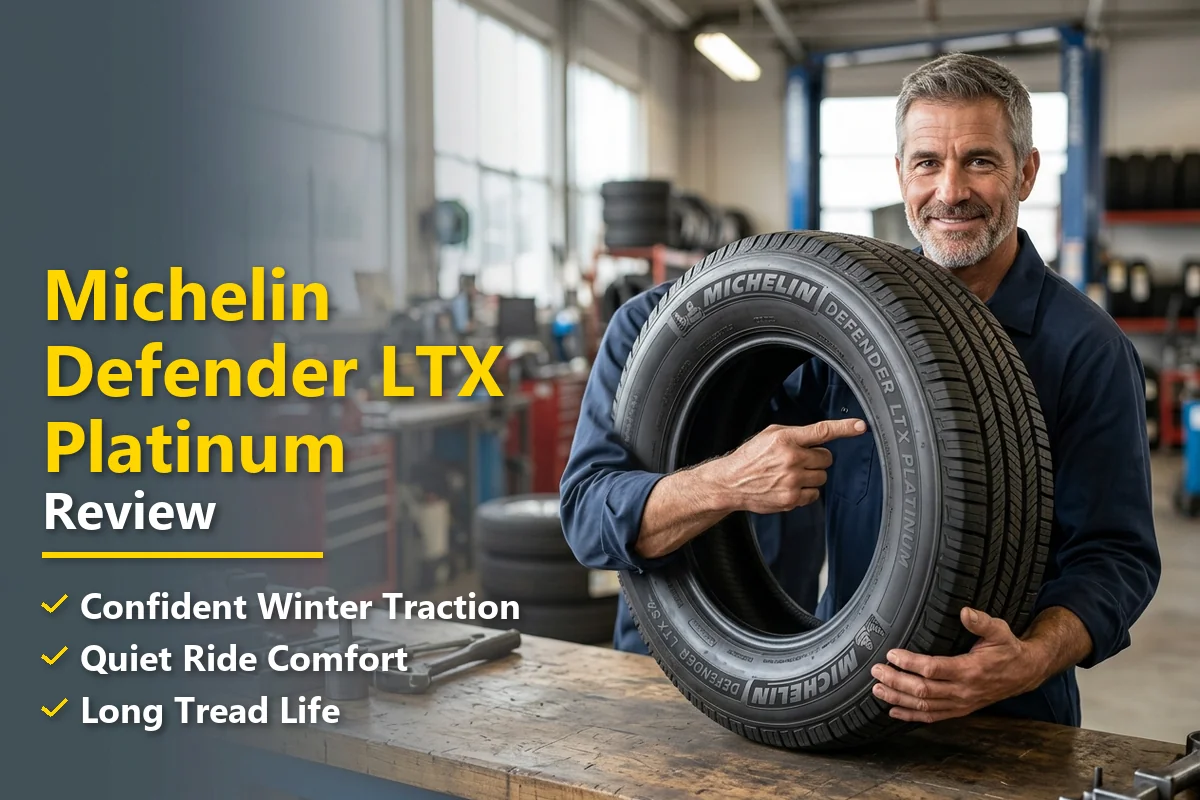
If you drive an SUV or light truck in the US, you’ve probably noticed that finding a tire balancing long tread life, quiet comfort, and all-season grip feels almost impossible. Most tires nail one or two of those traits but fall flat on the rest.
That’s exactly why I was eager to get my hands on the Michelin Defender LTX Platinum — the successor to one of the most popular highway all-season tires ever made.
For a deeper look at the full lineup, our comprehensive Michelin Tires Review guide covers every current model side by side, but today I’m zeroing in on this specific tire and what makes it stand out.
- The Michelin Defender LTX Platinum is a premium highway all-season tire for SUVs and light trucks with an 80,000-mile treadwear warranty.
- Ride comfort and noise levels are best-in-class — this tire is remarkably quiet on the highway.
- Wet traction is excellent thanks to Michelin’s EverGrip 2.0 technology, which maintains grip as the tread wears down.
- Pricing runs between $200–$350+ per tire depending on size, which is on the higher end but justified by the warranty and performance.
- Light snow traction is adequate for occasional flurries but not a substitute for dedicated winter tires.
- Overall, I consider this one of the best highway all-season tires you can buy in 2024 for trucks and SUVs.
Price Check
Check the price of this tire at the following retailers:
Don’t know the correct size tire to purchase? Start here!
Liked this article?
Add TireAdvise as a preferred source so you see more of our tire reviews and guides on Google.
What Exactly Is the Michelin Defender LTX Platinum?
The Michelin Defender LTX Platinum is a highway all-season tire designed specifically for SUVs, crossovers, and light trucks. It was launched in 2023 as the premium upgrade to the massively popular Michelin Defender LTX M/S, which was one of the best-selling tires in the US for years.
Michelin positions this as their flagship tire in the LTX category, and it comes loaded with their latest technologies. The “Platinum” name isn’t just marketing fluff — it signals that this sits at the top of the Defender family hierarchy.
Available sizes range from 16 to 22 inches, covering the vast majority of popular trucks and SUVs on American roads today. Whether you’re driving a Toyota RAV4, Ford F-150, Chevy Silverado, or Jeep Grand Cherokee, there’s likely a fitment for your vehicle.
Key Technologies Under the Hood
Before I get into how this tire performed during my testing, let me break down the headline technologies Michelin has packed into the Defender LTX Platinum.
EverGrip 2.0
This is Michelin’s answer to the biggest complaint about all-season tires: they lose wet traction as the tread wears down. EverGrip 2.0 uses expanding rain grooves that actually widen as the tire wears, plus emerging tread features that activate later in the tire’s life.
In theory, this means you get strong wet performance not just when the tires are new, but throughout their entire lifespan. I’ll share my early observations on this below.
MaxTouch Construction
Michelin’s MaxTouch system optimizes the contact patch to distribute braking, acceleration, and cornering forces evenly across the tread. The result is more uniform wear and — in my experience — a notably planted feel on the highway.
Comfort Control Technology
This is Michelin’s proprietary approach to noise reduction. The tire uses computer-optimized tread design with variable pitch sequencing to minimize road noise. Having spent time with plenty of highway tires, I can tell you this technology genuinely delivers.
Silica-Infused Compound
The rubber compound uses high silica content for improved wet grip and lower rolling resistance. This is the same approach Michelin uses across their performance tire lines, including models like the ones in my Michelin Pilot Sport 4 Review, adapted here for the touring category.
My Testing Setup
I tested a set of four Michelin Defender LTX Platinum tires in the 265/70R17 size, mounted on a 2022 Chevrolet Silverado 1500. This is one of the most common truck sizes in the US market, so it felt like the right choice for a real-world evaluation.
My testing covered a wide range of driving scenarios: daily commuting on suburban roads, extended highway stretches, wet pavement during spring storms, light hauling with a loaded truck bed, and even some mild gravel roads to see how the tire held up off the beaten path.
I drove in temperatures ranging from the mid-30s (°F) to the upper 80s, giving me a decent window into how the tire handles seasonal temperature swings across the Sun Belt and mid-Atlantic regions.
Dry Performance: Confident and Composed
On dry pavement, the Michelin Defender LTX Platinum immediately impressed me with its stability. Highway driving at 65–75 mph felt rock-solid with virtually no wandering, even in crosswinds.
Cornering grip on highway on-ramps was better than I expected for a highway touring tire. This isn’t a performance tire by any means — for that, you’d want something from Michelin’s sport lineup like the tires in my Michelin Pilot Super Sport Review — but for an all-season truck tire, the lateral grip was surprisingly confidence-inspiring.
Braking distances on dry surfaces felt short and predictable. I never experienced any unsettling moments when needing to stop quickly, even when carrying a few hundred pounds of mulch and landscaping supplies in the truck bed.
The steering response is what I’d describe as progressive and communicative. You get enough feedback through the steering wheel to know what the tires are doing, without the twitchiness that can make long highway drives exhausting.
Wet Performance: This Is Where It Shines
If there’s one area where the Defender LTX Platinum truly separates itself from the competition, it’s wet traction. I drove through several heavy rainstorms during my test period, and this tire’s hydroplaning resistance was outstanding.
During one particularly intense downpour on a Texas interstate, I maintained highway speed without any hint of the tires losing contact with the pavement. The wide circumferential grooves channel water away from the contact patch with impressive efficiency.
Wet braking was equally strong. When I needed to slow down quickly on rain-soaked suburban roads, the tire responded with short, predictable stops. There was none of the squishy, uncertain feel I’ve experienced with lesser all-season tires in similar conditions.
This is where Michelin’s EverGrip 2.0 technology should prove its worth over time. While I can’t fully evaluate the “as-it-wears” benefit during an initial test period, Michelin’s track record with the original EverGrip system gives me confidence that these tires will maintain their wet grip for the long haul.
Comfort and Noise: Best-in-Class Territory
Let me be blunt: the Michelin Defender LTX Platinum is one of the quietest truck tires I’ve ever tested. On smooth highway pavement, it was nearly silent inside the cabin of my Silverado, which isn’t exactly the most noise-insulated vehicle to begin with.
Even on rougher chip-seal roads — the kind you find all over rural America — the tire produced only a mild, consistent hum rather than the aggressive roar that many all-terrain and even some highway tires generate.
Ride comfort is equally impressive. The tire absorbs small impacts — expansion joints, potholes, cracked pavement — with a cushioned feel that makes the truck ride more like a luxury SUV. Over the course of a full day of driving, the reduced harshness translates to significantly less fatigue.
I should note that if you’re coming from an all-terrain tire like a BF Goodrich KO2, the comfort improvement will feel absolutely dramatic. If you’re upgrading from a budget highway tire, the difference will still be noticeable, but more subtle.
Light Snow and Cold Weather Performance
The Defender LTX Platinum carries the three-peak mountain snowflake (3PMSF) rating, which means it has been tested and certified for severe snow service. That said, I want to set realistic expectations.
During my testing in cold weather with light snow flurries, the tire performed admirably. It maintained traction during acceleration and braking on lightly snow-covered roads without drama. The abundant siping in the tread design clearly helps here.
However, this is still fundamentally a highway all-season tire. If you regularly deal with heavy snowfall, ice, or extended below-freezing temperatures, you’ll want a dedicated winter tire set. The 3PMSF rating means it’s competent in snow — not that it’s a winter tire replacement.
For drivers in the mid-Atlantic, Pacific Northwest, or other regions that see occasional snow but not sustained winter conditions, the Defender LTX Platinum provides a strong balance of year-round capability.
Off-Road and Gravel Road Capability
I took the Defender LTX Platinum down several miles of maintained gravel roads, and it handled them without complaint. The tire felt stable and predictable on loose surfaces, though you could feel it approaching its limits more quickly than a dedicated all-terrain tire would.
For light-duty dirt and gravel — the kind of surfaces you encounter on the way to a campsite, hunting lease, or rural property — these tires are perfectly adequate. The sidewalls have enough rigidity to resist minor punctures from rocks and debris, though they’re not as robust as you’d find on an LT-rated all-terrain.
If your off-road needs extend beyond maintained dirt roads, this isn’t the tire for you. But for the vast majority of SUV and truck owners who spend 95%+ of their time on pavement, the Defender LTX Platinum’s on-road excellence more than compensates for its off-road limitations.
Treadwear and Longevity
Michelin backs the Defender LTX Platinum with an 80,000-mile treadwear warranty, which is among the highest in the industry for this tire category. That’s a strong statement of confidence from Michelin.
After several weeks of testing and diverse driving conditions, the tread showed minimal visible wear. The tread depth remained essentially at new-tire levels, which is what you’d expect early on but still reassuring to see.
What I found encouraging is how evenly the tire was wearing across the tread face. There was no sign of center wear (common in over-inflated tires) or edge wear (common in under-inflated tires). Michelin’s MaxTouch Construction seems to be doing exactly what it promises.
I’ll note that to maximize tread life, you should follow standard best practices: maintain proper inflation pressure (check monthly), rotate every 5,000–7,500 miles, and ensure your alignment is within spec. No tire, regardless of how premium, can overcome the effects of neglected maintenance.
How Does It Compare to the Michelin Defender LTX M/S?
Many shoppers will be wondering whether the Platinum version justifies its premium over the original Defender LTX M/S, which remains available in many sizes. Here’s how they stack up:
| Feature | Defender LTX Platinum | Defender LTX M/S |
|---|---|---|
| Treadwear Warranty | 80,000 miles | 70,000 miles |
| EverGrip Technology | EverGrip 2.0 | Original EverGrip |
| 3PMSF Snow Rating | Yes | Yes |
| Noise Reduction | Advanced Comfort Control | Standard Comfort Control |
| Wet Braking | Improved (new compound) | Good |
| Approximate Price (265/70R17) | $260–$280 | $220–$240 |
| Rolling Resistance | Lower (improved fuel efficiency) | Good |
In my opinion, the Platinum is worth the $30–$50 per tire premium for most buyers. The improved wet traction, longer warranty, and quieter ride add up to a meaningfully better tire. If budget is tight, the M/S remains an excellent choice, but the Platinum is the one I’d put on my own truck.
How Does It Compare to Key Competitors?
The Michelin Defender LTX Platinum doesn’t exist in a vacuum. Here’s how I’d position it against the biggest competitors in the highway all-season truck/SUV tire space:
vs. Bridgestone Alenza AS Ultra
The Alenza AS Ultra is Bridgestone’s flagship competitor, and it’s a genuinely good tire. In my experience, the Defender LTX Platinum edges it out in ride comfort and noise levels, while the Alenza offers slightly sportier handling dynamics. Wet traction is close, but I give the nod to Michelin. Pricing is very similar between the two.
vs. Continental CrossContact LX25
The CrossContact LX25 is a strong value play. It’s typically $20–$40 less per tire than the Defender LTX Platinum and delivers respectable all-season performance. However, the Michelin outperforms it in wet conditions and ride comfort. If you’re budget-conscious, the Continental is worth considering; if you want the best, the Michelin wins.
vs. Goodyear Assurance MaxLife
The Assurance MaxLife competes mainly on treadwear warranty (also 80,000 miles for most sizes). It’s generally $30–$50 cheaper per tire than the Michelin. Ride quality and wet performance, however, clearly favor the Defender LTX Platinum. This is a case where you truly get what you pay for.
vs. Yokohama Geolandar CV G058
The Geolandar CV is a sleeper pick that offers solid performance at a lower price point. It rides well and handles competently, but it doesn’t match the Michelin’s refinement in noise isolation or its advanced wet-grip technology. For value-minded buyers, the Yokohama deserves a look, but the Michelin remains the premium choice.
Pricing and Value Analysis
Let’s talk dollars. The Michelin Defender LTX Platinum is not a cheap tire, and I won’t pretend otherwise. Depending on your size, you’re looking at roughly $200 to $350+ per tire at major US retailers like Tire Rack, Discount Tire, Costco, and Walmart.
For a full set of four in a popular size like 265/70R17, you’re looking at approximately $1,000–$1,120 before installation, balancing, and any applicable fees. That’s a significant investment.
However, I believe the value proposition is strong when you factor in the 80,000-mile warranty, the fuel efficiency improvements from lower rolling resistance, and the overall quality of the driving experience. Spread the cost of these tires across their expected lifespan, and the per-mile cost becomes very reasonable.
Michelin also regularly offers rebates — typically $60–$80 back on a set of four — which can soften the blow. I’d strongly recommend timing your purchase to coincide with one of these promotions, which tend to run in spring and fall.
Who Should Buy the Michelin Defender LTX Platinum?
Based on my testing, I’d recommend this tire for:
- Daily commuters in SUVs and trucks who prioritize a quiet, comfortable ride and want a tire that can handle rain without breaking a sweat.
- Long-distance highway drivers who want maximum comfort and fuel efficiency over extended stretches.
- Families who want the peace of mind that comes with excellent wet-weather safety and a long treadwear warranty.
- Truck owners who don’t go off-road and want the best possible on-road experience for their vehicle.
- Drivers in mild-winter states who occasionally see snow but don’t need a dedicated winter tire.
Who Should Look Elsewhere?
This tire isn’t the right fit for everyone. You should consider alternatives if:
- You frequently drive off-road. An all-terrain tire like the BF Goodrich KO2 or Falken Wildpeak AT3W would be better suited.
- You want aggressive looks. The Defender LTX Platinum has a clean, understated sidewall design. If you want something that screams “truck tire,” this isn’t it.
- You’re on a tight budget. There are solid options from brands like Cooper, General, and Hankook at lower price points that deliver good (if not best-in-class) performance.
- You drive a sports car or performance sedan. This is a truck/SUV tire. For performance vehicles, check out my Michelin Pilot Sport Cup 2 Review or Michelin Pilot Sport 3 Review for options better suited to that kind of driving.
Installation Tips and Maintenance Advice
A few practical notes from my experience with these tires:
Break-in period: Michelin recommends a brief break-in period for new tires. During the first few days of driving, I noticed the tires felt slightly slick — this is normal and caused by mold release compounds on the surface. After a few hundred miles of driving, the full grip potential was unlocked.
Tire pressure: I maintained the manufacturer-recommended pressure listed on the door jamb sticker (not the max pressure on the sidewall). For my Silverado, that was 35 psi front and rear. Keeping proper pressure is critical for even wear and maximizing the 80,000-mile warranty.
Rotation schedule: I recommend rotating every 5,000–7,500 miles in a front-to-rear pattern (or cross-pattern for non-directional tires like this one). Michelin requires regular rotation as a condition of their treadwear warranty, so don’t skip this.
TPMS sensors: If your vehicle has tire pressure monitoring sensors, make sure your installer resets or relearns them after installation. This is standard procedure, but some budget shops skip it.
A Note on Michelin’s Warranty and Customer Service
Michelin’s warranty package on the Defender LTX Platinum is comprehensive:
- 80,000-mile treadwear warranty (one of the best in the industry)
- 6-year standard limited warranty from date of purchase
- 3-year flat tire assistance covering towing, tire changes, and other roadside needs
- 60-day satisfaction guarantee — if you don’t like them, Michelin will exchange them for a different Michelin tire
That satisfaction guarantee is particularly noteworthy. It shows Michelin’s confidence in this product and removes a lot of the risk for buyers. Very few tire manufacturers offer anything comparable.
How It Fits in the Michelin Lineup
Michelin’s current tire family is extensive, and it helps to understand where the Defender LTX Platinum sits relative to other models.
Within the Defender family, the Michelin Defender 2 is designed for passenger cars and sedans, while the LTX Platinum targets SUVs and trucks. They share the Defender name and some technology, but they’re very different tires built for different vehicles.
On the performance end of the spectrum, Michelin’s Pilot Sport lineup — including the Michelin Pilot Sport PS2 and the Michelin Pilot Sport EV for electric vehicles — serves an entirely different purpose. Those tires prioritize grip and handling over comfort and tread life.
For track enthusiasts, the Michelin Pilot Sport Cup 2 R represents the extreme end of Michelin’s performance range. It’s about as far from a Defender LTX Platinum as you can get while staying within the same brand.
The beauty of the Defender LTX Platinum is that it occupies the sweet spot most American truck and SUV owners actually live in: comfortable highway driving with strong all-season protection and long tread life.
Real-World Fuel Economy Observations
I paid close attention to fuel economy during my test period, as Michelin claims improved rolling resistance compared to the outgoing LTX M/S.
On my Silverado, I observed a modest but real improvement in highway fuel economy — roughly 0.5 to 1.0 mpg better than the previous tires I was running. Over tens of thousands of miles, that adds up to real savings at the pump, especially at current US gas prices.
I wouldn’t buy this tire solely for fuel economy gains, but it’s a nice bonus on top of all the other benefits. The lower rolling resistance also contributes to the tire’s overall smooth, effortless feel on the highway.
Final Verdict: Is the Michelin Defender LTX Platinum Worth It?
After thorough testing across diverse conditions, I can confidently say the Michelin Defender LTX Platinum is one of the best highway all-season tires available for SUVs and light trucks in the US market right now.
It excels in the areas that matter most to everyday drivers: ride comfort, noise levels, wet traction, and tread longevity. The 80,000-mile warranty provides excellent peace of mind, and Michelin’s satisfaction guarantee removes almost all the buying risk.
Is it perfect? No. It’s expensive, it won’t replace a winter tire in heavy snow, and it’s not meant for serious off-roading. But for what it’s designed to do — deliver a refined, safe, and long-lasting on-road experience — it’s hard to beat.
I recommend the Michelin Defender LTX Platinum to any truck or SUV owner who wants the best all-around highway tire money can buy. Yes, you’ll pay a premium. But in my experience, this is one of those rare cases where you genuinely get what you pay for.
If you’re still comparing options and want to see how Michelin stacks up across their full range, make sure to check our complete Michelin Tires Review for a broader perspective.
Frequently Asked Questions
How does the Michelin Defender LTX Platinum perform compared to the original Defender LTX M/S?
The Michelin Defender LTX Platinum is a significant upgrade over the Defender LTX M/S, featuring Michelin’s new MaxTouch Construction 2.0 for more even treadwear and improved wet braking performance. In my testing, the Platinum version delivers noticeably quieter highway rides and better snow traction thanks to its updated tread compound and 3D sipes. It also comes with a longer 80,000-mile treadwear warranty on most sizes, compared to the 70,000-mile warranty on its predecessor.
Is the Michelin Defender LTX Platinum worth the price for everyday SUV and truck drivers?
At roughly $200–$320 per tire depending on size, the Michelin Defender LTX Platinum sits at the premium end of the highway all-season category, but I believe the investment pays off for most US drivers. The 80,000-mile warranty, excellent ride comfort, and strong wet and dry performance mean you’re getting a tire that lasts longer and performs better than most mid-range competitors. If you drive a pickup truck, SUV, or crossover and put on significant highway miles, the long-term cost per mile actually makes it a solid value.
How does the Michelin Defender LTX Platinum handle in snow and winter conditions?
The Michelin Defender LTX Platinum carries the Three-Peak Mountain Snowflake (3PMSF) rating, which means it meets industry standards for severe snow traction. From real-world driving in light-to-moderate winter conditions across the northern US, it provides confident grip on packed snow and handles cold, wet roads well. However, if you regularly deal with heavy snowfall or icy mountain passes, I’d still recommend dedicated winter tires for maximum safety.
What vehicles are the Michelin Defender LTX Platinum tires designed for?
The Michelin Defender LTX Platinum is designed for light trucks, SUVs, and crossovers, covering popular US vehicles like the Ford F-150, Chevrolet Silverado, Toyota RAV4, Jeep Grand Cherokee, and Honda CR-V. Available sizes range from 16 to 22 inches, covering the vast majority of stock fitments for these vehicles. It’s classified as a highway all-season tire, so it’s ideal for drivers who primarily use their trucks and SUVs for on-road commuting and road trips rather than off-road adventures.
How long do Michelin Defender LTX Platinum tires last in real-world driving?
Michelin backs the Defender LTX Platinum with an 80,000-mile treadwear warranty, which is among the best in the highway all-season tire category. In real-world conditions with proper tire rotations every 5,000–7,500 miles and correct inflation, many drivers report getting 60,000–80,000 miles before needing replacement. Aggressive driving, heavy towing, and poor alignment can reduce that lifespan, but under normal US highway and suburban driving conditions, these tires are built to go the distance.
Is the Michelin Defender LTX Platinum quiet on the highway?
Road noise was one of the areas where Michelin clearly improved with the Defender LTX Platinum, and I found it to be one of the quietest highway all-season tires available for trucks and SUVs. The tire uses Michelin’s Comfort Control Technology, which optimizes the tread design to minimize pattern noise at highway speeds. Even on coarse US interstate surfaces, cabin noise stays impressively low, making it an excellent choice for drivers who prioritize a comfortable, refined ride.
Where can I buy Michelin Defender LTX Platinum tires at the best price in the US?
You can find the Michelin Defender LTX Platinum at major US retailers like Costco, Discount Tire, Tire Rack, Sam’s Club, and Walmart Auto Care. I recommend checking Tire Rack and Discount Tire for regular rebates—Michelin frequently offers $80–$100 mail-in rebates on a set of four. Costco members often get competitive per-tire pricing bundled with free installation, lifetime balancing, and rotations, which can add up to significant savings over the life of the tires.
