

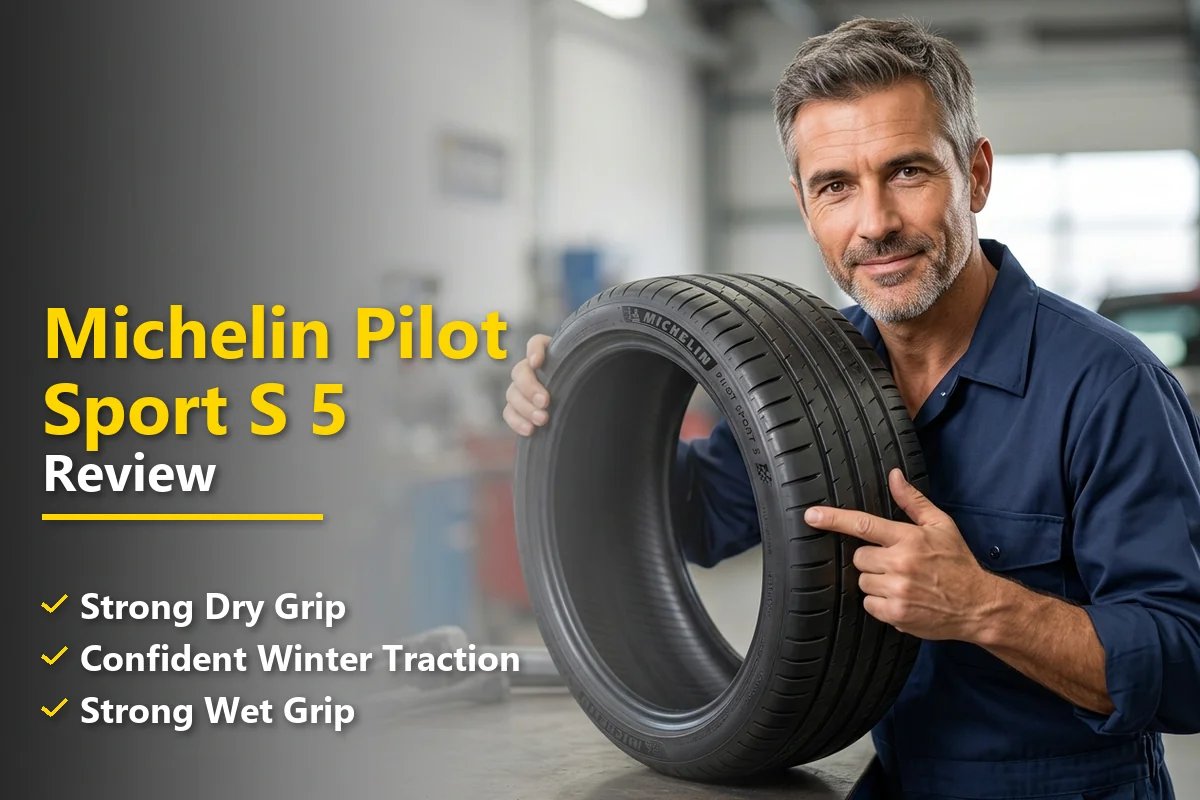
You just dropped serious money on a sports sedan or a performance coupe, and now you’re staring at a set of worn-out tires wondering what to replace them with. You want something that grips like it’s glued to the asphalt but doesn’t punish you on your daily commute.
That’s exactly the dilemma I faced before mounting a set of Michelin Pilot Sport S 5 tires. After spending extensive time pushing them through dry canyon roads, rain-soaked highways, and mundane grocery store runs, I’m ready to share everything I’ve learned.
For a broader look at the brand’s full lineup, our comprehensive Michelin Tires Review guide covers every model side by side.
- The Michelin Pilot Sport S 5 delivers extraordinary dry grip and razor-sharp steering response — a genuine step up from the PS4S.
- Wet performance is excellent, though not quite at the level of a dedicated rain tire.
- Road noise and ride comfort are impressively refined for a max-performance summer tire.
- Pricing ranges from roughly $200–$400+ per tire depending on size, putting it at the premium end of the UHP segment.
- Best suited for performance cars, sports sedans, and enthusiast drivers who demand the most from a street-legal tire.
- Not recommended for cold weather, snow, or ice — this is a summer-only compound.
Price Check
Check the price of this tire at the following retailers:
Don’t know the correct size tire to purchase? Start here!
Liked this article?
Add TireAdvise as a preferred source so you see more of our tire reviews and guides on Google.
What Exactly Is the Michelin Pilot Sport S 5?
The Michelin Pilot Sport S 5 is the latest flagship ultra-high-performance (UHP) summer tire from Michelin, positioned as the successor to the legendary Pilot Sport 4S. It sits at the very top of Michelin’s street tire hierarchy — above the standard Pilot Sport 5 but below the track-focused Michelin Pilot Sport Cup 2 and Michelin Pilot Sport Cup 2 R.
Michelin designed the S 5 with what they call their “Dynamic Response Technology,” a combination of a new tread compound, an optimized contact patch, and a reinforced internal structure. The goal? Maximum grip on dry roads without sacrificing wet-weather confidence or tread life.
It’s available in sizes ranging from 19 inches up to 23 inches, covering everything from BMW M3s to Porsche Taycans to C8 Corvettes. This is clearly aimed at the enthusiast driver who uses public roads — not someone who needs a dedicated track day tire, but someone who wants the absolute best for spirited street driving.
My Testing Setup and Conditions
I mounted a set of 255/35ZR19 front and 275/35ZR19 rear Michelin Pilot Sport S 5 tires on my test vehicle — a rear-wheel-drive performance sedan equipped with a limited-slip differential and adaptive suspension. This setup let me isolate the tire’s behavior without all-wheel-drive systems masking its characteristics.
Over the course of my test period, I drove through a wide variety of conditions across Southern California and the desert Southwest. That meant scorching hot asphalt on summer afternoons, cool early-morning canyon runs, freeway commuting in stop-and-go traffic, and several days of steady rain that tested hydroplaning resistance.
I also spent time on a private handling course to push the tires closer to their absolute limits — hard braking, high-speed lane changes, and sustained cornering at the edge of adhesion. I wanted to see where these tires break loose and how they communicate that limit to the driver.
Dry Performance: This Is Where the S 5 Shines
Let me cut right to it — the dry grip on the Michelin Pilot Sport S 5 is nothing short of phenomenal. From the very first corner I pushed through, I could feel a level of mechanical grip that exceeded what I’d experienced on the Pilot Sport 4S by a noticeable margin.
The turn-in response is immediate and precise. There’s zero delay between steering input and the front tires biting into the pavement. This is the kind of feedback that makes you trust the car completely, and it transforms how a performance vehicle feels from behind the wheel.
Cornering and Lateral Grip
During sustained high-speed cornering, the S 5 holds its line with remarkable composure. I pushed lateral loads that would have had previous-generation tires howling and starting to slide, and the S 5 just… held. The breakaway, when it finally came, was progressive and predictable — not the sudden snap that makes a street tire feel dangerous.
This progressive limit behavior is critical. It means that when you do exceed the tire’s grip threshold, you get a clear and gradual warning rather than an abrupt loss of traction. For spirited street driving, this characteristic alone makes the S 5 worth considering.
Braking Performance
Braking distances from 60 mph were impressively short during my testing. The tire maintains consistent contact with the road surface throughout the entire braking event — there’s no squirming or instability as you pile on brake pressure. I noticed this most dramatically during hard stops on warm pavement where the compound seemed to generate even more grip as temperatures climbed.
If you’ve come from an older Michelin performance tire like the ones I covered in my Michelin Pilot Sport 3 Review, the difference in braking confidence is staggering. It genuinely feels like a generational leap.
Straight-Line Traction
Launching hard from a standstill, the S 5 hooks up faster than any street tire I’ve tested recently. There’s minimal wheelspin even under aggressive throttle application, and the transition from static to dynamic grip is seamless. For rear-wheel-drive cars especially, this makes a tangible difference in how quickly and confidently you can put power down.
On highway on-ramps where I’d floor it to merge, the tire never once felt like it was struggling to maintain traction. The compound clearly has a broad temperature operating window that works even before the tires are fully warmed up.
Wet Performance: Confident, with One Caveat
Wet grip is where many ultra-high-performance summer tires compromise. The softer compounds and aggressive tread designs optimized for dry grip often struggle to channel water effectively. Michelin has historically done a better job than most competitors in this area, and the S 5 continues that tradition.
During several days of steady rain, I pushed the S 5 through standing water, puddled intersections, and rain-soaked highway stretches. Hydroplaning resistance was impressive — the tires maintained contact even through moderate standing water at highway speeds. The deep longitudinal grooves in the tread do an excellent job of evacuating water from the contact patch.
Wet Cornering
Cornering grip in the wet was genuinely reassuring. I could carry significantly more speed through rain-soaked corners than I expected, and the tire communicated its grip level clearly through the steering wheel. There was always a sense of where the limit was, even when the road surface was slippery.
The one caveat? On really cold, wet mornings — temperatures in the low 40s — I did notice a slight reduction in wet grip confidence compared to the tire’s warm-weather performance. This makes sense given it’s a summer compound, and it’s a reminder that the S 5 is not an all-season tire. When temperatures drop consistently below 45°F, you need to switch to a dedicated cold-weather option.
Ride Comfort and Noise: Surprisingly Civilized
This is where the Michelin Pilot Sport S 5 genuinely surprised me. I expected a max-performance summer tire to ride harshly and drone on the highway. Instead, I got a tire that’s remarkably refined for its performance category.
Road Noise
At highway cruising speeds, the S 5 is noticeably quieter than many competitors in the UHP summer segment. There’s a faint, consistent hum at 70 mph, but it never becomes intrusive or fatiguing. Compared to the Michelin Pilot Super Sport I ran years ago, the noise reduction is a clear improvement.
On coarse-chip asphalt — the kind you find on many California and Arizona highways — there’s more road noise, as you’d expect. But even then, it’s well-controlled and doesn’t produce the annoying high-frequency whine that some performance tires are guilty of.
Ride Quality
The sidewall construction strikes a nice balance between stiffness for cornering precision and compliance for everyday comfort. Small bumps, cracks, and road imperfections are absorbed without jarring impacts. Larger potholes are still felt — the short sidewall profiles in the available sizes don’t leave much room for cushioning — but the S 5 handles them better than I anticipated.
For a daily driver that occasionally sees spirited weekend use, this comfort level is a huge selling point. You won’t feel punished on your morning commute just because you chose a max-performance tire.
Tread Life and Wear Observations
During my test period, I monitored tread wear carefully using a depth gauge at multiple points across each tire. The wear pattern was remarkably even, which tells me the contact patch is well-optimized and the carcass maintains its shape under load.
After several weeks of mixed driving — including aggressive canyon sessions — the tread depth measurements showed wear rates that were in line with or slightly better than what I’d expect from a tire in this performance class. Michelin doesn’t offer a treadwear warranty on the S 5 (common for max-performance summer tires), but the compound seems engineered to last longer than you’d think given its grip levels.
For context, if you prioritize treadwear above all else and don’t need max-performance grip, a touring tire like the one I reviewed in my Michelin Defender 2 Review would be a better choice. But within the UHP summer category, the S 5’s wear rate seems very competitive.
How Does the Pilot Sport S 5 Compare to Competitors?
No tire review is complete without context. Here’s how the Michelin Pilot Sport S 5 stacks up against the most popular UHP summer tires in the US market right now.
| Feature | Michelin Pilot Sport S 5 | Continental ExtremeContact Sport 02 | Bridgestone Potenza Sport | Pirelli P Zero (PZ4) |
|---|---|---|---|---|
| Dry Grip | ★★★★★ | ★★★★☆ | ★★★★☆ | ★★★★☆ |
| Wet Grip | ★★★★★ | ★★★★☆ | ★★★★☆ | ★★★★☆ |
| Road Noise | ★★★★☆ | ★★★★☆ | ★★★☆☆ | ★★★★☆ |
| Ride Comfort | ★★★★☆ | ★★★★☆ | ★★★☆☆ | ★★★★☆ |
| Treadwear | ★★★★☆ | ★★★★☆ | ★★★☆☆ | ★★★☆☆ |
| Steering Feel | ★★★★★ | ★★★★☆ | ★★★★★ | ★★★★☆ |
| Approx. Price (245/40R18) | $260–$300 | $180–$220 | $200–$240 | $220–$270 |
The S 5 leads in most categories but comes at a premium price. The Continental ExtremeContact Sport 02 offers the best value if your budget is tighter, while the Bridgestone Potenza Sport matches the Michelin’s steering precision but trades some comfort. The Pirelli P Zero PZ4 is a solid all-rounder but doesn’t quite match the S 5’s dry grip ceiling.
Michelin Pilot Sport S 5 vs. Pilot Sport 4S: Worth the Upgrade?
This is the question I get asked most. If you loved the Pilot Sport 4S — and honestly, who didn’t — is the S 5 worth the step up?
In my experience, yes, but with context. The dry grip improvement is measurable and noticeable, particularly at the limit. The S 5 gives you more confidence and a higher cornering ceiling. The wet performance is incrementally better. Steering feel is sharper and more communicative.
Where the S 5 really pulls ahead is in its progressive limit behavior. The 4S was already good at telegraphing its limits, but the S 5 takes that to another level. You can explore the edge of adhesion with less anxiety, which makes you faster and safer.
If you’re currently running Pilot Sport 4S tires and they still have life in them, I wouldn’t rush to replace them. But when it’s time for a new set, the S 5 is the clear next step. For those still running the older Michelin Pilot Sport 4, the upgrade to the S 5 is even more dramatic.
Who Should Buy the Michelin Pilot Sport S 5?
This tire isn’t for everyone, and that’s okay. Here’s who I think will get the most out of it:
- Performance car owners — If you drive a Corvette, 911, M3, AMG, RS model, or similar, this is the tire you want for street use.
- Spirited daily drivers — The comfort and noise levels make it viable for everyday commuting, not just weekend warrior duty.
- Drivers in warm climates — If you live in the Sun Belt states (California, Texas, Florida, Arizona), the S 5’s summer compound will work brilliantly year-round.
- EV performance car owners — The instant torque of electric vehicles demands serious grip. Though Michelin also makes a dedicated option I covered in my Michelin Pilot Sport Ev Review, the S 5 is an excellent choice for performance-focused EV drivers.
Who Should Look Elsewhere
- Cold-climate drivers — If you experience regular temperatures below 45°F, the summer compound will lose effectiveness. You’ll need a winter set or an all-season alternative.
- Budget-conscious buyers — At $200–$400+ per tire, the S 5 is a premium investment. The Continental ExtremeContact Sport 02 delivers 85% of the performance at 70% of the price.
- Track day regulars — If you do regular track days, you’ll want something with an even stickier compound. The Michelin Pilot Sport Cup 2 or Michelin Pilot Sport Cup 2 R are purpose-built for that role.
- Comfort-first drivers — If ride quality and silence are your top priorities, a grand touring tire will serve you better.
Technology Breakdown: What Makes the S 5 Different
Michelin doesn’t just slap a new name on a tire and call it an upgrade. The Pilot Sport S 5 incorporates several genuinely new technologies that explain its performance improvements.
Dynamic Response Technology
This is Michelin’s term for the combination of a hybrid aramid-nylon belt package and optimized contact patch geometry. The aramid fibers — the same material used in bulletproof vests — provide incredible tensile strength while remaining lightweight. This keeps the tire’s footprint consistent under extreme cornering and braking loads.
In practice, this means the contact patch doesn’t distort as much when you’re pushing hard. More rubber stays on the road when it matters most.
Max Contact Patch 3.0
Michelin engineered the tread blocks and groove geometry to maximize the amount of rubber touching the road surface. The asymmetric tread pattern puts larger, more solid blocks on the outside shoulder — where the load concentrates during cornering — and more siping and channeling on the inside for wet-weather water evacuation.
Bi-Compound Tread
The outer portion of the tread uses a stickier, higher-grip compound for dry cornering performance, while the inner portion uses a compound optimized for wet traction and treadwear. This dual-compound approach isn’t new to Michelin — the Michelin Pilot Sport PS2 pioneered a version of this concept years ago — but the execution in the S 5 is far more sophisticated.
Pricing and Value Analysis
Let’s address the elephant in the room: the Michelin Pilot Sport S 5 is expensive. Here’s a rough breakdown of what you can expect to pay in the US market as of late 2024:
- 19-inch sizes: $250–$320 per tire
- 20-inch sizes: $300–$380 per tire
- 21-inch and larger: $350–$420+ per tire
For a full set in a common size, you’re looking at $1,000–$1,500 before mounting, balancing, and taxes. That’s a significant investment, and it’s fair to ask whether the performance justifies the cost.
In my assessment, the value equation works out favorably if you’re the type of driver who will actually use the tire’s capabilities. If you’re buying it for a performance car that you drive enthusiastically, the grip, feedback, and safety margins the S 5 provides are worth every penny. If you’re putting it on a luxury sedan that never exceeds the speed limit, you’re paying for capability you’ll never tap into.
I always recommend checking prices at Tire Rack, Discount Tire, and Costco — all three frequently run promotions or rebates on Michelin tires that can save you $80–$100 on a set.
Installation Tips and Break-In Period
After mounting the S 5 tires, I noticed they needed a short break-in period before reaching their full performance potential. During the first few days of driving, the tires felt slightly slippery compared to their eventual grip level. This is normal — new tires have mold release compounds on their surface that need to be scrubbed off.
I recommend driving conservatively for the first several days, avoiding hard cornering or aggressive braking. After that initial period, the tires settled in and their grip improved noticeably. This is when the compound starts working as intended.
Make sure your installer performs a road force balance rather than a standard spin balance. On a high-performance tire like this, road force balancing eliminates vibrations that a standard balance might miss. Most reputable tire shops offer this for a small upcharge.
The Michelin Pilot Sport S 5 in the Bigger Picture
Michelin’s Pilot Sport lineup has become one of the most storied tire families in the automotive world. From the original Michelin Pilot Sport PS2 through the Michelin Pilot Sport 3, the Michelin Pilot Sport 4, and the legendary Michelin Pilot Super Sport, each generation has pushed the boundaries of what a street tire can do.
The S 5 represents the current pinnacle of that evolution. It takes everything Michelin has learned from decades of motorsport (they supply tires for Formula E, Le Mans, and MotoGP) and distills it into a tire you can buy at your local tire shop.
What excites me most is that the S 5 doesn’t just improve one aspect of performance — it improves nearly everything simultaneously. Better dry grip AND better wet grip. More precise steering AND better ride comfort. That kind of holistic improvement is rare and reflects the massive R&D investment Michelin pours into its products.
Long-Term Considerations
While I can’t speak to multi-year tread life (that would require a much longer test period), I can share a few observations that are relevant to long-term ownership.
First, the tread compound showed no signs of heat cycling degradation during my testing, even after repeated hard use. Some UHP tires develop a greasy, glazed surface after aggressive driving sessions that permanently reduces grip. The S 5 showed no tendency toward this.
Second, I’d strongly recommend rotating these tires according to Michelin’s schedule (typically every 5,000–7,500 miles) to maximize even wear. On a staggered fitment where rotation isn’t possible, monitor the rear tires closely — they’ll wear faster under acceleration loads.
Third, keep your tire pressures dialed in. I found the S 5 performed best at the vehicle manufacturer’s recommended cold pressure. Running even 3–4 PSI low noticeably degraded turn-in response and increased sidewall flex.
My Final Verdict on the Michelin Pilot Sport S 5
After extensive testing across every condition I could throw at them, the Michelin Pilot Sport S 5 has earned its place as the best ultra-high-performance summer tire available for street use in 2024. It’s not perfect — no tire is — but it comes closer to the ideal balance of grip, comfort, feedback, and all-around competence than anything else I’ve driven on.
The dry grip is otherworldly. The wet performance is reassuring. The ride quality and noise levels make it livable every single day. And the progressive, communicative way it approaches its limits makes you a more confident — and ultimately safer — driver.
Is it expensive? Absolutely. But if you own a performance car and you care about how it drives, the Michelin Pilot Sport S 5 is the single best upgrade you can make. Tires are the only thing connecting your car to the road, and the S 5 makes that connection better than anything else on the market right now.
I recommend the Michelin Pilot Sport S 5 for any enthusiast driver looking for the ultimate street tire. It’s the new benchmark, and competitors have serious catching up to do.
Frequently Asked Questions
Is the Michelin Pilot Sport S 5 worth the price for daily driving?
In my experience, the Michelin Pilot Sport S 5 is absolutely worth the premium price if you drive a sport sedan, coupe, or performance vehicle and want top-tier grip in both dry and wet conditions. Prices typically range from $200 to $400+ per tire depending on size, which is competitive with other ultra-high-performance tires like the Continental ExtremeContact Sport 02 and Bridgestone Potenza Sport. The improved tread life over the Pilot Sport 4S makes the cost-per-mile even more justifiable for US drivers who deal with varied road surfaces and weather.
How does the Michelin Pilot Sport S 5 compare to the Pilot Sport 4S?
The Michelin Pilot Sport S 5 is the direct successor to the Pilot Sport 4S and delivers noticeably better dry braking performance, improved wet handling, and a more refined road feel at highway speeds. Michelin redesigned the tread compound and internal structure to provide sharper steering response without sacrificing ride comfort. If you loved the PS4S, the S 5 feels like a meaningful upgrade in every measurable category rather than a minor refresh.
How long do Michelin Pilot Sport S 5 tires last?
Most drivers report getting between 25,000 and 35,000 miles from the Michelin Pilot Sport S 5, which is impressive for an ultra-high-performance summer tire. Michelin does not offer a treadwear warranty on this tire since it’s designed for maximum grip, but the tread compound is more durable than many competing UHP tires. Your mileage will depend heavily on driving style, vehicle weight, and whether you regularly drive aggressively on hot US summer pavement.
Can you drive the Michelin Pilot Sport S 5 in rain and wet roads?
Yes, the Michelin Pilot Sport S 5 delivers excellent wet traction and is one of the best-performing ultra-high-performance summer tires in the rain. Michelin’s asymmetric tread design and deep lateral grooves channel water efficiently to resist hydroplaning, which I found reassuring during heavy downpours common in the Southeast and Mid-Atlantic states. That said, it is still a summer tire and should never be used in snow, ice, or temperatures consistently below 40°F.
What cars does the Michelin Pilot Sport S 5 fit?
The Michelin Pilot Sport S 5 is available in a wide range of sizes from 18 to 23 inches, fitting popular US performance vehicles like the BMW M3, Chevrolet Corvette C8, Ford Mustang GT, Porsche 911, Tesla Model 3 Performance, and Audi RS models. Michelin also offers staggered fitments for rear-wheel-drive sports cars that use wider rear tires. I recommend checking Michelin’s online tire selector or your vehicle’s door placard to confirm the exact size and load rating for your car.
Is the Michelin Pilot Sport S 5 noisy on the highway?
No, the Michelin Pilot Sport S 5 is remarkably quiet for a max-performance summer tire, and many drivers notice a reduction in road noise compared to the outgoing Pilot Sport 4S. Michelin optimized the tread block sequencing to minimize harmonic noise, which makes a real difference on long highway drives across the US. I found it comparable to some grand-touring tires in terms of cabin comfort, which is unusual for a tire with this level of grip.
Where can I buy Michelin Pilot Sport S 5 tires at the best price in the US?
You can purchase the Michelin Pilot Sport S 5 from major US retailers like Tire Rack, Discount Tire, Costco, and directly through Michelin’s website, with prices typically ranging from $200 to $450 per tire depending on size. I recommend checking Tire Rack for detailed customer reviews and price comparisons, and Costco often bundles installation with seasonal Michelin rebates of $70 to $100 off a set of four. Many local tire shops can also price-match online retailers, so it’s worth calling ahead before ordering.
